Classical and molecular taxonomic parameters, species
concept, systematic gradation of animals, nomenclature,
modern scheme of animal classification into sub-Kingdom,
division, section, phyla and minor phyla
Dr. Manoj K. Bangadkar
Asst. Professor
Sevadal Mahila Mahavidyalaya,
Nagpur
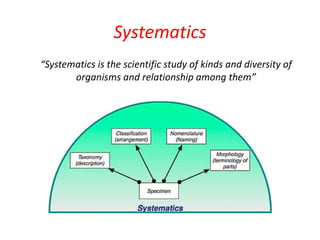
Systematics
“Systematics is the scientific study of kinds and diversity of
organisms and relationship among them”
• Classical systematics examines the phylogenetic relationships of
organisms using morphological and anatomical methods as well as
applying state of the art techniques like ultrastructural research.
• Molecular systematics reads the information provided by the
genetic material of the organisms and analyses it with the aid of
electronic data processing. By constructing phylogenetic trees
hypotheses can be established that describe the relationship and
the lineage of organisms as well as character changes in the
course of evolution. Molecular systematic methods allow the
detection of relationships even if they are concealed by the
adaptation to differing environmental conditions.
Taxonomic characters
• Morphological characters
• Physiological characters
• Ecological characters
• Ethological characters
• Geographical characters
Morphological characters
• General morphological characters Ex. Plumage pattern in bird and
mammal, Scales in fish and reptiles
• Genital structures
• Internal morphology Ex. Internal skeleton (Skull)
• Embryology Ex. Cleavage pattern
• Karyology Ex. Chromosome number/morphology
Physiological characters
• Metabolic factors Ex. Anabolic and catabolic rections, Gram +ve & -
ve bacteria
• Serological, protein and other biochemical differences Ex. Ag & Ab
• Body secretion Ex. Waxy secretion of insect and mealy bug
Ecological characters
• Habitat
• Food
• Seasonal variation Ex. Insects, Polar bear
• Parasitic descrimination Ex. Ascaris in man (A. lumbricoides) and pig
(A. suum) is different
Ethological characters
• Courtship mechanism Ex. Mating habit in slug
• Nature of webbing by spiders
• Nest building
• Drinking habit of pigeon and sand grooves
Geographical characters
• General geographical pattern
• Sympatric, allopatric relationship
Species concept
1. Allopatric species: The species inhabiting different geographical
area
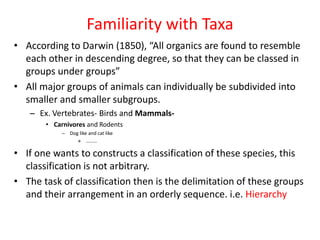
2. Sympatric species: The species normally occupying same
geographical area, Ex. Resident and transient orcas inhabit the
same waters, but avoid each other and do not interbreed
3. Morphospecies: Only morphological similarity regardless of other
similarity.
4. Biospecies: Groups of actually or potentially interbreeding natural
population, which are reproductively isolated from other such
groups.
5. Sibling species: Any of two or more related species that are
morphologically nearly identical but are incapable of producing
fertile hybrids. Sibling species can only be identified by genetic,
biochemical, behavioral, or ecological factors, and are thought to
have become divergent very recently.
6. Evolutionary species: These are lineages evolving separately from
each other.
7. Polytypic species: Consist of two or more subspecies.
8. Monotypic species: Consist of a single subspecies.
alder and willow flycatcher
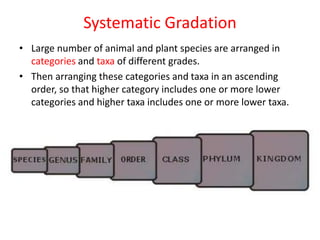
Familiarity with Taxa
• According to Darwin (1850), “All organics are found to resemble
each other in descending degree, so that they can be classed in
groups under groups”
• All major groups of animals can individually be subdivided into
smaller and smaller subgroups.
– Ex. Vertebrates- Birds and Mammals-
• Carnivores and Rodents
– Dog like and cat like
» ………
• If one wants to constructs a classification of these species, this
classification is not arbitrary.
• The task of classification then is the delimitation of these groups
and their arrangement in an orderly sequence. i.e. Hierarchy
Systematic Gradation
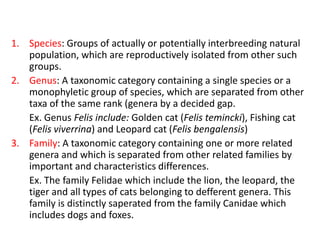
• Large number of animal and plant species are arranged in
categories and taxa of different grades.
• Then arranging these categories and taxa in an ascending
order, so that higher category includes one or more lower
categories and higher taxa includes one or more lower taxa.
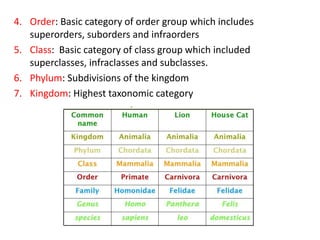
1. Species: Groups of actually or potentially interbreeding natural
population, which are reproductively isolated from other such
groups.
2. Genus: A taxonomic category containing a single species or a
monophyletic group of species, which are separated from other
taxa of the same rank (genera by a decided gap.
Ex. Genus Felis include: Golden cat (Felis temincki), Fishing cat
(Felis viverrina) and Leopard cat (Felis bengalensis)
3. Family: A taxonomic category containing one or more related
genera and which is separated from other related families by
important and characteristics differences.
Ex. The family Felidae which include the lion, the leopard, the
tiger and all types of cats belonging to defferent genera. This
family is distinctly saperated from the family Canidae which
includes dogs and foxes.
4. Order: Basic category of order group which includes
superorders, suborders and infraorders
5. Class: Basic category of class group which included
superclasses, infraclasses and subclasses.
6. Phylum: Subdivisions of the kingdom
7. Kingdom: Highest taxonomic category
Nomenclature
Rules of Nomenclature by International congress of Zoology (1898)
• The system of nomenclature adopted is the bionomial system to
indicate the specific name and trinomical for subspecific name
• The name of the genus is a single word and must begin with
capital letter. Name of the species is single or compound word
and must begin with small letter.
• Name must be in Latin form and usually printed in Italic type.
• Within a animal or plant kingdom no two genera can have the
same name.
• If the generic name is changed the original authors name is
written in parentheses.
• A name may be based on any part of an animal or a plant, or on
any stage of an organisms life history.
Levels of Organisation
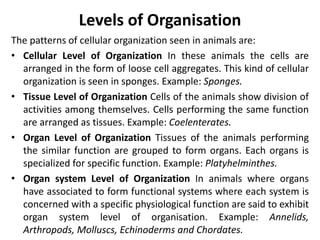
The patterns of cellular organization seen in animals are:
• Cellular Level of Organization In these animals the cells are
arranged in the form of loose cell aggregates. This kind of cellular
organization is seen in sponges. Example: Sponges.
• Tissue Level of Organization Cells of the animals show division of
activities among themselves. Cells performing the same function
are arranged as tissues. Example: Coelenterates.
• Organ Level of Organization Tissues of the animals performing
the similar function are grouped to form organs. Each organs is
specialized for specific function. Example: Platyhelminthes.
• Organ system Level of Organization In animals where organs
have associated to form functional systems where each system is
concerned with a specific physiological function are said to exhibit
organ system level of organisation. Example: Annelids,
Arthropods, Molluscs, Echinoderms and Chordates.
Patterns of Organ Systems
Organs systems in different groups of animals exhibit various patterns of
complexities.
• Digestive System There are two patterns of digestive system incomplete
and complete digestive system.
Incomplete digestive system This pattern of digestive has only one
opening to the outside of the body, i.e., a single opening serves as both
mouth and anus. Example: Platyhelminthes.
Complete digestive system In this pattern there are two opening to the
outside of the body, the mouth and the anus. Example: Arthropods,
Chordates, etc.
• Circulatory System Circulatory system may be of two types open type
and closed type.
Open type In open type circulatory system the blood is pumped out of
the heart and the cells and tissues are directly bathed in it.
Closed type In this type of circulatory system the blood is circulated
through a series of vessels of varying diameters the arteries, veins and
capillaries.
Body Symmetry
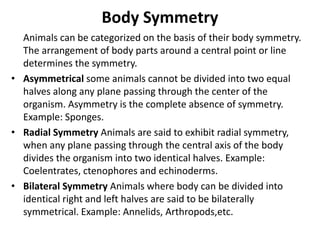
Animals can be categorized on the basis of their body symmetry.
The arrangement of body parts around a central point or line
determines the symmetry.
• Asymmetrical some animals cannot be divided into two equal
halves along any plane passing through the center of the
organism. Asymmetry is the complete absence of symmetry.
Example: Sponges.
• Radial Symmetry Animals are said to exhibit radial symmetry,
when any plane passing through the central axis of the body
divides the organism into two identical halves. Example:
Coelentrates, ctenophores and echinoderms.
• Bilateral Symmetry Animals where body can be divided into
identical right and left halves are said to be bilaterally
symmetrical. Example: Annelids, Arthropods,etc.
Body Wall
Body wall of animals are arranged in two or three embryonic
layers. Accordingly animals are diplobalstic or triploblastic.
• Diploblastic Animals Animals in which the cells are arranged in
two embryonic layers are known as diploblastic animals.
Diploblastic animals have an external ectoderm and an internal
endoderm. Example: Coelentrates.
• Triploblastic Animals Triploblastic animals are those, whose cells
are arranged in three germinal layers, the outer ectoderm, inner
endoderm and the third germinal layer mesoderm which is in
between outer ectoderm and the endoderm.
Example: Platyhelminthes to Chordates.
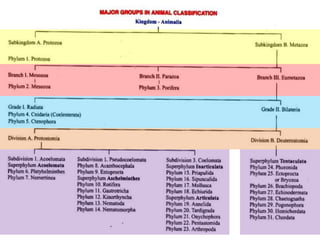
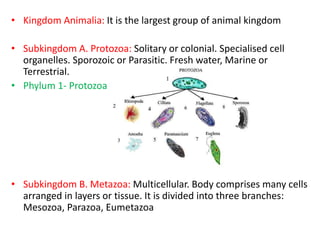
• Kingdom Animalia: It is the largest group of animal kingdom
• Subkingdom A. Protozoa: Solitary or colonial. Specialised cell
organelles. Sporozoic or Parasitic. Fresh water, Marine or
Terrestrial.
• Phylum 1- Protozoa
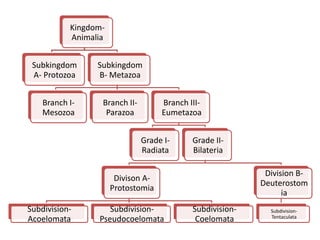
• Subkingdom B. Metazoa: Multicellular. Body comprises many cells
arranged in layers or tissue. It is divided into three branches:
Mesozoa, Parazoa, Eumetazoa
• Branch I- Mesozoa:
• Phylum 2: Mesozoa
• Branch II- Parazoa:
• Phylum 3: Porifera
• Branch III- Eumetazoa: It is devided into Grade I Radiata and
Grade ii Bilateria
Phylogenetic tree
• This tree was so close to the already established
phylogenetic trees.
• The taxonomists realized significance of molecular data
and this made them understand that other traditional
methods are although important but molecular
evidences could be final or confirmatory evidences.
• Phylogenetic studies assess the historical processes
which affect relationships and phylogeographic studies
assess the geographical distributions.
• Phylogenetic and phylogeographic studies started with
the introduction of mtDNA markers in population
genetic analyses.
Kingdom-
Animalia
Subkingdom
A- Protozoa
Subkingdom
B- Metazoa
Branch I-
Mesozoa
Branch II-
Parazoa
Branch III-
Eumetazoa
Grade I-
Radiata
Grade II-
Bilateria
Divison A-
Protostomia
Subdivision-
Acoelomata
Subdivision-
Pseudocoelomata
Subdivision-
Coelomata
Division B-
Deuterostom
ia
Subdivision-
Tentaculata

Systematics

  • 1.
    Classical and moleculartaxonomic parameters, species concept, systematic gradation of animals, nomenclature, modern scheme of animal classification into sub-Kingdom, division, section, phyla and minor phyla Dr. Manoj K. Bangadkar Asst. Professor Sevadal Mahila Mahavidyalaya, Nagpur
  • 2.
    Systematics “Systematics is thescientific study of kinds and diversity of organisms and relationship among them”
  • 3.
    • Classical systematicsexamines the phylogenetic relationships of organisms using morphological and anatomical methods as well as applying state of the art techniques like ultrastructural research. • Molecular systematics reads the information provided by the genetic material of the organisms and analyses it with the aid of electronic data processing. By constructing phylogenetic trees hypotheses can be established that describe the relationship and the lineage of organisms as well as character changes in the course of evolution. Molecular systematic methods allow the detection of relationships even if they are concealed by the adaptation to differing environmental conditions.
  • 4.
    Taxonomic characters • Morphologicalcharacters • Physiological characters • Ecological characters • Ethological characters • Geographical characters
  • 5.
    Morphological characters • Generalmorphological characters Ex. Plumage pattern in bird and mammal, Scales in fish and reptiles • Genital structures • Internal morphology Ex. Internal skeleton (Skull) • Embryology Ex. Cleavage pattern • Karyology Ex. Chromosome number/morphology Physiological characters • Metabolic factors Ex. Anabolic and catabolic rections, Gram +ve & - ve bacteria • Serological, protein and other biochemical differences Ex. Ag & Ab • Body secretion Ex. Waxy secretion of insect and mealy bug
  • 6.
    Ecological characters • Habitat •Food • Seasonal variation Ex. Insects, Polar bear • Parasitic descrimination Ex. Ascaris in man (A. lumbricoides) and pig (A. suum) is different Ethological characters • Courtship mechanism Ex. Mating habit in slug • Nature of webbing by spiders • Nest building • Drinking habit of pigeon and sand grooves Geographical characters • General geographical pattern • Sympatric, allopatric relationship
  • 7.
    Species concept 1. Allopatricspecies: The species inhabiting different geographical area 2. Sympatric species: The species normally occupying same geographical area, Ex. Resident and transient orcas inhabit the same waters, but avoid each other and do not interbreed 3. Morphospecies: Only morphological similarity regardless of other similarity. 4. Biospecies: Groups of actually or potentially interbreeding natural population, which are reproductively isolated from other such groups.
  • 8.
    5. Sibling species:Any of two or more related species that are morphologically nearly identical but are incapable of producing fertile hybrids. Sibling species can only be identified by genetic, biochemical, behavioral, or ecological factors, and are thought to have become divergent very recently. 6. Evolutionary species: These are lineages evolving separately from each other. 7. Polytypic species: Consist of two or more subspecies. 8. Monotypic species: Consist of a single subspecies. alder and willow flycatcher
  • 9.
    Familiarity with Taxa •According to Darwin (1850), “All organics are found to resemble each other in descending degree, so that they can be classed in groups under groups” • All major groups of animals can individually be subdivided into smaller and smaller subgroups. – Ex. Vertebrates- Birds and Mammals- • Carnivores and Rodents – Dog like and cat like » ……… • If one wants to constructs a classification of these species, this classification is not arbitrary. • The task of classification then is the delimitation of these groups and their arrangement in an orderly sequence. i.e. Hierarchy
  • 10.
    Systematic Gradation • Largenumber of animal and plant species are arranged in categories and taxa of different grades. • Then arranging these categories and taxa in an ascending order, so that higher category includes one or more lower categories and higher taxa includes one or more lower taxa.
  • 11.
    1. Species: Groupsof actually or potentially interbreeding natural population, which are reproductively isolated from other such groups. 2. Genus: A taxonomic category containing a single species or a monophyletic group of species, which are separated from other taxa of the same rank (genera by a decided gap. Ex. Genus Felis include: Golden cat (Felis temincki), Fishing cat (Felis viverrina) and Leopard cat (Felis bengalensis) 3. Family: A taxonomic category containing one or more related genera and which is separated from other related families by important and characteristics differences. Ex. The family Felidae which include the lion, the leopard, the tiger and all types of cats belonging to defferent genera. This family is distinctly saperated from the family Canidae which includes dogs and foxes.
  • 12.
    4. Order: Basiccategory of order group which includes superorders, suborders and infraorders 5. Class: Basic category of class group which included superclasses, infraclasses and subclasses. 6. Phylum: Subdivisions of the kingdom 7. Kingdom: Highest taxonomic category
  • 13.
    Nomenclature Rules of Nomenclatureby International congress of Zoology (1898) • The system of nomenclature adopted is the bionomial system to indicate the specific name and trinomical for subspecific name • The name of the genus is a single word and must begin with capital letter. Name of the species is single or compound word and must begin with small letter. • Name must be in Latin form and usually printed in Italic type. • Within a animal or plant kingdom no two genera can have the same name. • If the generic name is changed the original authors name is written in parentheses. • A name may be based on any part of an animal or a plant, or on any stage of an organisms life history.
  • 14.
    Levels of Organisation Thepatterns of cellular organization seen in animals are: • Cellular Level of Organization In these animals the cells are arranged in the form of loose cell aggregates. This kind of cellular organization is seen in sponges. Example: Sponges. • Tissue Level of Organization Cells of the animals show division of activities among themselves. Cells performing the same function are arranged as tissues. Example: Coelenterates. • Organ Level of Organization Tissues of the animals performing the similar function are grouped to form organs. Each organs is specialized for specific function. Example: Platyhelminthes. • Organ system Level of Organization In animals where organs have associated to form functional systems where each system is concerned with a specific physiological function are said to exhibit organ system level of organisation. Example: Annelids, Arthropods, Molluscs, Echinoderms and Chordates.
  • 15.
    Patterns of OrganSystems Organs systems in different groups of animals exhibit various patterns of complexities. • Digestive System There are two patterns of digestive system incomplete and complete digestive system. Incomplete digestive system This pattern of digestive has only one opening to the outside of the body, i.e., a single opening serves as both mouth and anus. Example: Platyhelminthes. Complete digestive system In this pattern there are two opening to the outside of the body, the mouth and the anus. Example: Arthropods, Chordates, etc. • Circulatory System Circulatory system may be of two types open type and closed type. Open type In open type circulatory system the blood is pumped out of the heart and the cells and tissues are directly bathed in it. Closed type In this type of circulatory system the blood is circulated through a series of vessels of varying diameters the arteries, veins and capillaries.
  • 16.
    Body Symmetry Animals canbe categorized on the basis of their body symmetry. The arrangement of body parts around a central point or line determines the symmetry. • Asymmetrical some animals cannot be divided into two equal halves along any plane passing through the center of the organism. Asymmetry is the complete absence of symmetry. Example: Sponges. • Radial Symmetry Animals are said to exhibit radial symmetry, when any plane passing through the central axis of the body divides the organism into two identical halves. Example: Coelentrates, ctenophores and echinoderms. • Bilateral Symmetry Animals where body can be divided into identical right and left halves are said to be bilaterally symmetrical. Example: Annelids, Arthropods,etc.
  • 18.
    Body Wall Body wallof animals are arranged in two or three embryonic layers. Accordingly animals are diplobalstic or triploblastic. • Diploblastic Animals Animals in which the cells are arranged in two embryonic layers are known as diploblastic animals. Diploblastic animals have an external ectoderm and an internal endoderm. Example: Coelentrates. • Triploblastic Animals Triploblastic animals are those, whose cells are arranged in three germinal layers, the outer ectoderm, inner endoderm and the third germinal layer mesoderm which is in between outer ectoderm and the endoderm. Example: Platyhelminthes to Chordates.
  • 20.
    • Kingdom Animalia:It is the largest group of animal kingdom • Subkingdom A. Protozoa: Solitary or colonial. Specialised cell organelles. Sporozoic or Parasitic. Fresh water, Marine or Terrestrial. • Phylum 1- Protozoa • Subkingdom B. Metazoa: Multicellular. Body comprises many cells arranged in layers or tissue. It is divided into three branches: Mesozoa, Parazoa, Eumetazoa
  • 21.
    • Branch I-Mesozoa: • Phylum 2: Mesozoa • Branch II- Parazoa: • Phylum 3: Porifera • Branch III- Eumetazoa: It is devided into Grade I Radiata and Grade ii Bilateria
  • 22.
    Phylogenetic tree • Thistree was so close to the already established phylogenetic trees. • The taxonomists realized significance of molecular data and this made them understand that other traditional methods are although important but molecular evidences could be final or confirmatory evidences. • Phylogenetic studies assess the historical processes which affect relationships and phylogeographic studies assess the geographical distributions. • Phylogenetic and phylogeographic studies started with the introduction of mtDNA markers in population genetic analyses.
  • 23.
    Kingdom- Animalia Subkingdom A- Protozoa Subkingdom B- Metazoa BranchI- Mesozoa Branch II- Parazoa Branch III- Eumetazoa Grade I- Radiata Grade II- Bilateria Divison A- Protostomia Subdivision- Acoelomata Subdivision- Pseudocoelomata Subdivision- Coelomata Division B- Deuterostom ia Subdivision- Tentaculata