Jitendra Kumar
College of Fisheries Mangalore
Principles of taxonomy is an
interesting tool, need to
understand concept and
meaning between Taxonomy,
Systematic and International
code of nomenclature.
Taxonomy or Systematic, two
terms that more or less
synonymously used.
 It is the science of grouping biodiversity into species,
describing the species, and classifying this diversity into
higher-level taxa that reflect evolutionary history.
 (1) It introduces the main concepts and goals of
taxonomy and systematics.
 (2) It teaches the qualitative and quantitative
techniques that are today used to describe/identify
species and higher-level taxa based on the analysis of
morphological and DNA sequence evidence.
 The aim is to equip environmental as well as other
biologists with a thorough understanding of
taxonomic/systematic units and the tools needed for
evaluating and quantifying diversity in samples of plant
and animal specimens.
Hawksworth and Bisby (1988) suggest that…….
 Taxonomy is only a part of systematic.
 Taxonomy in this sense includes a range of different
areas from description and naming of new taxa
(nomenclature), classification and construction of
identification system for particular groups of organisms.
 Systematic includes traditional taxonomy with the
addition of theoretical and practical aspects of
evolution, genetics and speciation.
 The study of the evolutionary relationship between
organisms is usually referred to as phylogenetics.
 -science of the diversity of organisms
 -broad field concerned with biodiversity,
naming, classification according to
evolutionary relationships, and identification
of animals
 -sometimes used interchangeably with
taxonomy
 - theory and practice of classifying organisms
 - study of classification, identification, nomenclature, &
faunistics
 Classification- arrangement of animals into groups having
common characteristics that express evolutionary relationships
 Identification or Determination- identifying animals by the
recognition of certain characters
 Nomenclature- naming of organisms according to the
International Code of Zoological Nomenclature (ICZN)
 Faunistics- inventory of the native or naturalized animals of an
area; called a fauna
 a. Organize species into
groups and discuss them.
 b. Identify new organisms.
 c. Show relationships
between organisms.
☻ Making and maintaining
collection
☻ Differentiating species
☻ Identification (Keys) and
diagnosis of species and genera
☻ Naming and describing species
and genera
☻ Develops the classification of organisms
☻ Species comparison and grouping into
higher categories
☻ Organisms are arranged in definite,
hierarchical order
☻ The order of the system is based on
hypotheses of common descent
 ( “ Study of the kinds and diversity of
organisms and the relationships between
them”)
1. Identify and describe all animals of world
@55,000 species of vertebrates known. Many more
undiscovered. Undiscovered species are much more in
case of invertebrates.
2. Develop a uniform, practical, and stable system of
naming animals that can be used by both animal
taxonomists and others needing to communicate
about animals
International Code of Zoological Nomenclature (ICZN)
provides rules for naming and classification that is
uniform and stable
3. Form groups that reflect their evolutionary
relationships
 Biodiversity: In last two and a half century only
one million animals and 0.5 million plants
identified. This forms 10% of worlds organisms.
Many may extinct before discovered. Status to be
studied to conserve.
 Base of research & studies:
 Use in Medicine:
 Agriculture and pest management-
 Identification of pests-
 Identification of natural enemies-
 Fisheries-
 Conservation
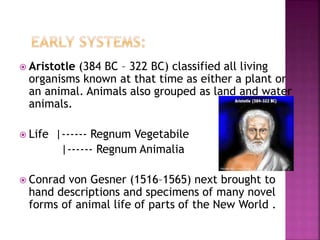
 Aristotle (384 BC – 322 BC) classified all living
organisms known at that time as either a plant or
an animal. Animals also grouped as land and water
animals.
 Life |------ Regnum Vegetabile
|------ Regnum Animalia
 Conrad von Gesner (1516–1565) next brought to
hand descriptions and specimens of many novel
forms of animal life of parts of the New World .
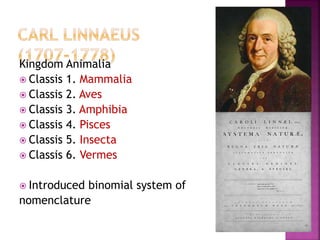
Kingdom Animalia
 Classis 1. Mammalia
 Classis 2. Aves
 Classis 3. Amphibia
 Classis 4. Pisces
 Classis 5. Insecta
 Classis 6. Vermes
 Introduced binomial system of
nomenclature
The Binomial system, also called binomial nomenclature,
involves each organism being given a two part name using
Latin as a standard language.
i. Developed by Carolus Linnaeus (1707-1778).
ii. Provides a uniform means of communication for
all people. This avoids the confusion caused by organisms
with different common names in different areas.
iii. The format is Genus species or G. species
e.g., Sardinella fimbriata
(1) The genus name is capitalized and may be
abbreviated by the first initial. The species name is not
capitalized and cannot be used alone. e.g., S. fimbriata.
iv. The 2 part name gives clues about
relationships between organisms.
(1) For instance, Lutjanus johnii, L.
fulvus, L. fulviflamma, and L. bohar are all
related.
v. Names were based largely on physical
appearances but modern taxonomists use
genetic information, molecular biology, and
phylogeny (evolutionary relationships) as other
criteria for classifying.
(1) The work of Charles Darwin
introduced the idea of considering evolutionary
history.
The binomial classification system is
hierarchical
i. The levels of organization are
kingdom, phylum, class, order, family,
genus, and species. Each of these levels
is called a taxon (plural, taxa).
ii. Note that the genus and species
name are italicized because they are
Latin. When handwriting, underline the
words. Other levels are capitalized but
no special print features are used.
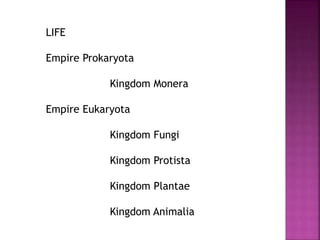
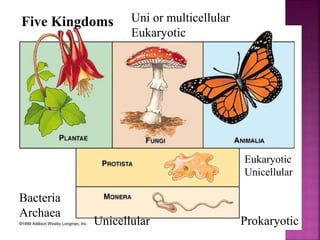
LIFE
Empire Prokaryota
Kingdom Monera
Empire Eukaryota
Kingdom Fungi
Kingdom Protista
Kingdom Plantae
Kingdom Animalia
Uni or multicellular
Eukaryotic
Bacteria
Archaea
Eukaryotic
Unicellular
Unicellular Prokaryotic
Five Kingdoms
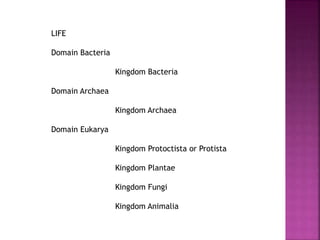
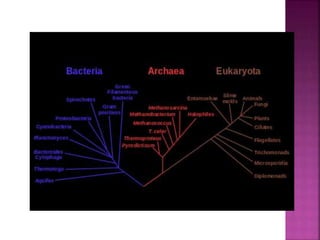
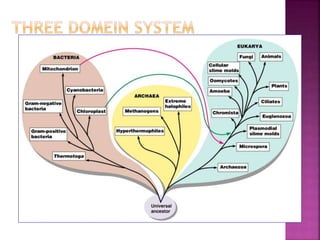
LIFE
Domain Bacteria
Kingdom Bacteria
Domain Archaea
Kingdom Archaea
Domain Eukarya
Kingdom Protoctista or Protista
Kingdom Plantae
Kingdom Fungi
Kingdom Animalia
Linnaeus
1735
Haeckel
1866
Chatton
1925
Copeland
1938
Whittaker
1969
Woese et al.
1977
Woese et al.
1990
Cavalier-Smith
1993]
Cavalier-Smith
1998]
2 kingdoms 3 kingdoms 2 empires 4 kingdoms 5 kingdoms 6 kingdoms 3 domains 8 kingdoms 6 kingdoms
(not treated) Protista
Prokaryota Monera Monera
Eubacteria Bacteria Eubacteria
Bacteria
Archaebacteria Archaea Archaebacteria
Eukaryota
Protoctista Protista Protista
Eukarya
Archezoa
Protozoa
Protozoa
Chromista Chromista
Vegetabilia Plantae Plantae
Plantae Plantae Plantae Plantae
Fungi Fungi Fungi Fungi
Animalia Animalia Animalia Animalia Animalia Animalia Animalia
 Taxa are grouped according to two main schools of
taxonomists:
1. Traditional taxonomists
-use Linnaean system of binomial nomenclature and
hierarchical ranks to reflect evolutionary history
-look at overall similarity or phonetics which may
recognize
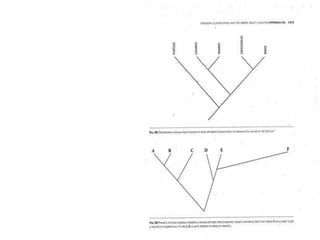
paraphyletic groups like Asclepiadaceae and Reptiles
-Cronquist System is a widely used traditional
classification and uses monophyletic and
paraphyletic groups
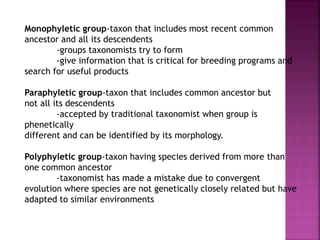
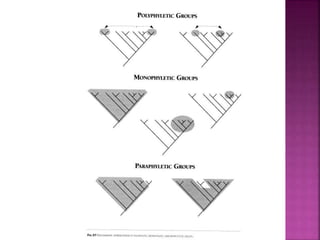
Monophyletic group-taxon that includes most recent common
ancestor and all its descendents
-groups taxonomists try to form
-give information that is critical for breeding programs and
search for useful products
Paraphyletic group-taxon that includes common ancestor but
not all its descendents
-accepted by traditional taxonomist when group is
phenetically
different and can be identified by its morphology.
Polyphyletic group-taxon having species derived from more than
one common ancestor
-taxonomist has made a mistake due to convergent
evolution where species are not genetically closely related but have
adapted to similar environments
2. Cladists or phylogenetic classification
-does not use binomial nomenclature or
ranks
-only examines the branching patterns of
evolution using phylogenetic trees that
reflect monophyletic groups
-only recognizes monophyletic groups, so
birds part of Reptilia
-only recognizes cladogram using DNA
sequence data
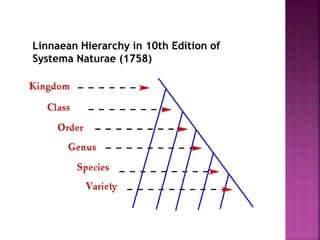
Linnaean Hierarchy in 10th Edition of
Systema Naturae (1758)
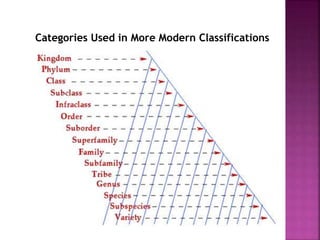
Categories Used in More Modern Classifications
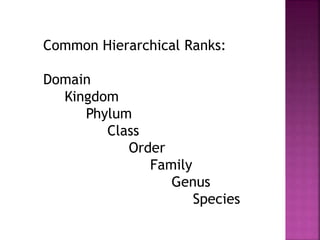
Common Hierarchical Ranks:
Domain
Kingdom
Phylum
Class
Order
Family
Genus
Species
Methods of collection-
Labeling- Locality: Collector:
Date of Collection
Curation of collection &
preservation-
Cataloging-
 Study of available literature of the group
 Learn the terms and relevant data used to describe
a taxa of the group
 Collection of relevant literature
 Identification using taxonomic keys
 Comparing of identified specimen with previous
description available
 Comparing with authenticated identified specimen
 Requesting help of specialists
 Use of internet information
Dichotomous keys-
Bracket key
Serial key
Indented key
Branching key
Circular key
Box key
Multi-entry key
 Linnaeus' system of classification made a major impact
on the world in terms of naming diversity and organizing
the information.
 There are four different codes of nomenclature today.
 = International Code of Zoological
Nomenclature. 1999. Fourth Edition. International Trust
for Zoological Nomenclature. London. 306 pp.
 = International Code of Botanical
Nomenclature. 1994. Koeltz Scientific Publishers,
Koenigstein, Germany (International Association for
Plant Taxonomy)
 = International Code of Nomenclature of
Bacteria. 1976. American Society of Microbiology,
Washington, D. C. 180 pp.
 = International Code of Nomenclature for Cultivated
Plants. 1980. American Horticultural Society. 32 pp.
General Objectives
Uniqueness - Gives one immediate access to all
of the known information. If several names
used, valid name should be ascertained.
Universality -Vernacular names for taxa in
innumerable languages. A single language
(Latin) and a single set of names for biological
diversity to be used on a worldwide.
Stability – Not to be changed frequently and
arbitrarily
Various Codes for nomenclature consider
Latin to be an essential language.
Taxa at the level of species are named
with binomials, consisting of generic
and specific epithets or names that
together equal the species name.
Taxa above the level of species are
Supraspecific Taxa and are
Uninominals.
Taxa below the level of species are
Subspecies and are Trinominals.
 Each species is placed into a genus. Generic names are
Latin nouns. Names of species are Latin adjectives in
agreement with the nouns (Generic epithet) (or are
nouns in apposition).
 Generic names (epithets) always begin with a capital
letter; species names (epithets) always begin with
lower-case letter. Homo sapiens
 Both names are set apart from the accompaning text:
The species is Homo sapiens.
The species is Homo sapiens
 Scientific names do not include diacritial marks but may
be hyphenated Erimystax x-punctata
 Author's names All generic and specific epithets have authors, the
name(s) of the person(s) who first officially described them in a
publication.
Psallopsis femoralis Reuter
This is often confusing to non-taxonomists but is really important
because it is very useful in tracing the history of applications of
names through time. Scientific names with very similar spellings
can usually be distinguished from one another when an author's
names is included.
Rhinacloa pallipes Reuter
Rhinacloa pallidipes Maldonado
 Dates of authorship Dates of official descriptions can also be
included with scientific names to further clarify situations and
locate relevant literature.
Macrocoleus femoralis Reuter, 1879
Cyrtocapsus femoralis Reuter, 1892
 Author's names in parentheses - typographical errors? No.
If the species in question in a particular classification is in
the genus in which it was described the author's name(s) do
not appear in parentheses
Notropis cardinalis Mayden
 If the species in a classification is in a genus other than the
one in which it was described the author's name(s) appear in
parentheses
Luxilus cardinalis (Mayden)
Different usages of the same name?
 In some instances in zoology authors may use a scientific
name differently than the person (author) who originally
described the species. In such a case the scientific name, as
listed in catalogs and other writings, is separated from users
name by a colon.
Phytocoris marmoratus Blanchard
Phytocoris marmoratus: Stonedahl.
 Priority: The first name applied to a taxon is the
name that will be used. Priority relates to date of
publication. The oldest valid name of a taxon
(senior name) takes precedence over all other
names of a taxon.
 Priority is not intended to upset stability. In
instances where a name change would cause much
confusion the codes provide provisions that permit
the conservation of a younger and well-established
name.
 Any works published in 1758 or after are considered
published.
Whereas priority is a comparatively objective
criterion, availability is more nebulous. With
reference to the different codes most names would
be considered "available" if they meet the following
four criteria.
 Appear in a work published after 1753 for plants
and 1758 for most animals.
 Meet the criteria for publication designated by the
codes.
 Are written in the Latin alphabet (today in English
except for plants)
 Are binominal (if referring to species)
Okay publications –
 Must be issued publically for the purpose of providing a
permanent scientific record.
 Must be obtainable, when first issued, free of charge or
by purchase.
 Must have been produced in an edition containing
simultaneously obtainable copies by a method that
assures numerous identical copies.
 Before 1986, must be via ink on paper, i.e. conventional
printing or mimeographing (latter okay in zoology but not
botany)
 After 1985 can be via photocopying or any other
"unconventional" method but must include a statement that
nomenclatural content is for permanent, public, and scientific
record therein.
Forbidden publications -
 Distribution on microfilm, computer printouts, or pre-
1986 photocopies
 A mention of a name at a scientific meeting
 Labeling specimens deposited in a museum
 The distribution of proof sheets (zoology)
 Deposition of document (e.g., thesis) in a collection of
documents, a library, or other archive
 Distribution only to colleagues or students of a note,
even if printed, in explanation of an accompanying
illustration.
= Criteria for "publication" are being evaluated seriously
now with the many more options for reproducing
multiple copies available to the public for permanent
record (dissertations through University Microfilms and
WWW).
 Species-group types represent a single specimen to
which a name is attached. This provides an objective
criterion for establishment of usage of that name.
Species-group types are recognized in the codes as
primary types and include the following possibilities.
 Type locality: All types of species and subspecies are
tied to a spatial location called the type locality.
 Holotype: Single specimen designated by the author(s) of
the name at the time of publication of the original
description.
 Paratype: Commonly designated in descriptions of new
species as specimens being studied by the author in the
description of the new species or subspecies and
designated by that person at the time of publication of
the original description. These specimens are valuable as
reference materials that are deposited at multiple,
dedicated museums or institutions.
 Syntypes: A group of specimens thought to represent a
species, as designated or indicated by the author(s) of the
original description. These specimens may sometimes be
referred to as the "type series". Cotypes are sometimes used
in the same way. If syntypes exist for a species only from this
series can a lectotype be designated. [Many early
descriptions of species were based on syntypes because the
requirement for a holotype designation or indication did not
exist].
 Lectotype: One of the syntypes chosen by the original or
subsequent author(s) to function as the name bearer.
 Primary types are customarily deposited in recognized
institutions dedicated to the long-term maintenance of
collections.
 Topotypes: specimen(s) collected from the same location as
the holotype (perhaps at the same time). These specimens
are useful at the time of designating a Neotype.
 Neotype: A specimen later designated to replace a holotype
(or other primary type) if the latter can be documented as
lost or destroyed.
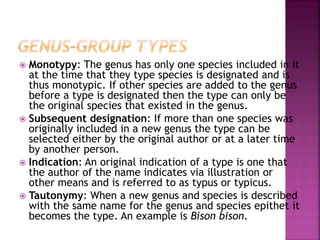
 Monotypy: The genus has only one species included in it
at the time that they type species is designated and is
thus monotypic. If other species are added to the genus
before a type is designated then the type can only be
the original species that existed in the genus.
 Subsequent designation: If more than one species was
originally included in a new genus the type can be
selected either by the original author or at a later time
by another person.
 Indication: An original indication of a type is one that
the author of the name indicates via illustration or
other means and is referred to as typus or typicus.
 Tautonymy: When a new genus and species is described
with the same name for the genus and species epithet it
becomes the type. An example is Bison bison.
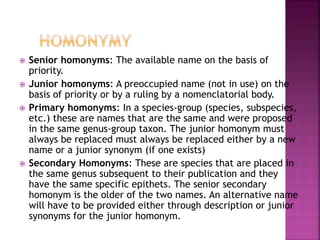
 Senior homonyms: The available name on the basis of
priority.
 Junior homonyms: A preoccupied name (not in use) on the
basis of priority or by a ruling by a nomenclatorial body.
 Primary homonyms: In a species-group (species, subspecies,
etc.) these are names that are the same and were proposed
in the same genus-group taxon. The junior homonym must
always be replaced must always be replaced either by a new
name or a junior synonym (if one exists)
 Secondary Homonyms: These are species that are placed in
the same genus subsequent to their publication and they
have the same specific epithets. The senior secondary
homonym is the older of the two names. An alternative name
will have to be provided either through description or junior
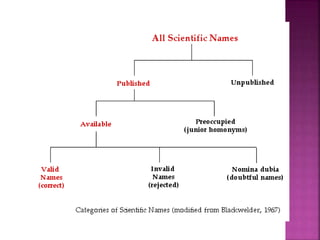
synonyms for the junior homonym.
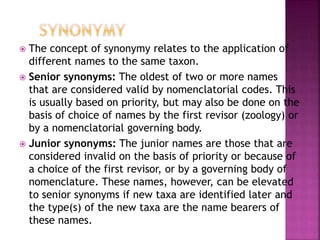
 The concept of synonymy relates to the application of
different names to the same taxon.
 Senior synonyms: The oldest of two or more names
that are considered valid by nomenclatorial codes. This
is usually based on priority, but may also be done on the
basis of choice of names by the first revisor (zoology) or
by a nomenclatorial governing body.
 Junior synonyms: The junior names are those that are
considered invalid on the basis of priority or because of
a choice of the first revisor, or by a governing body of
nomenclature. These names, however, can be elevated
to senior synonyms if new taxa are identified later and
the type(s) of the new taxa are the name bearers of
these names.
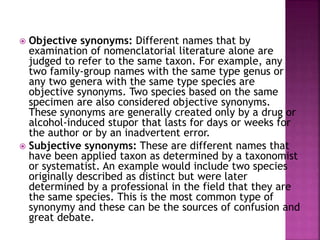
 Objective synonyms: Different names that by
examination of nomenclatorial literature alone are
judged to refer to the same taxon. For example, any
two family-group names with the same type genus or
any two genera with the same type species are
objective synonyms. Two species based on the same
specimen are also considered objective synonyms.
These synonyms are generally created only by a drug or
alcohol-induced stupor that lasts for days or weeks for
the author or by an inadvertent error.
 Subjective synonyms: These are different names that
have been applied taxon as determined by a taxonomist
or systematist. An example would include two species
originally described as distinct but were later
determined by a professional in the field that they are
the same species. This is the most common type of
synonymy and these can be the sources of confusion and
great debate.
 Forgotten name = nomen oblitum (after 1960 if not used for 50
years) [ Law of proscription]
 Superfluous name = nomen superfluum. A name is superfluous if it
includes the type of another name wich should have been used
(i.e., a description error; should never have been described)
 Ambiguous name = nomen ambiguum. A name that has been used
for a long time in different contexts and is thus confused (seriously)
 Dubious name = nomen dubium. Available name but cannot be
assigned to a definite taxon due to the shortcomings in the original
description/diagnosis or because of type material problems. These
names are in taxonomic limbo and are never allocated until such
time that a type fixation is devised. Usually in these cases no type
was designated or only an illustration may exist.
 Improper publication of a new name without a description = nomen
nudum. These are names that may be nomenclaturally published
but lack any description or indication; they have no nomenclatural
status (i.e., not occupied)
 Supressed names = nomina conservanda. These are names that have
been suppressed by a nomenclatural governing body.
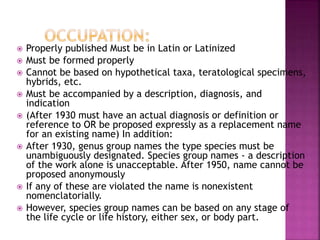
 Properly published Must be in Latin or Latinized
 Must be formed properly
 Cannot be based on hypothetical taxa, teratological specimens,
hybrids, etc.
 Must be accompanied by a description, diagnosis, and
indication
 (After 1930 must have an actual diagnosis or definition or
reference to OR be proposed expressly as a replacement name
for an existing name) In addition:
 After 1930, genus group names the type species must be
unambiguously designated. Species group names - a description
of the work alone is unacceptable. After 1950, name cannot be
proposed anonymously
 If any of these are violated the name is nonexistent
nomenclatorially.
 However, species group names can be based on any stage of
the life cycle or life history, either sex, or body part.
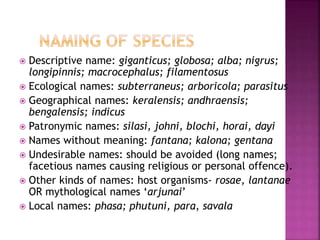
 Descriptive name: giganticus; globosa; alba; nigrus;
longipinnis; macrocephalus; filamentosus
 Ecological names: subterraneus; arboricola; parasitus
 Geographical names: keralensis; andhraensis;
bengalensis; indicus
 Patronymic names: silasi, johni, blochi, horai, dayi
 Names without meaning: fantana; kalona; gentana
 Undesirable names: should be avoided (long names;
facetious names causing religious or personal offence).
 Other kinds of names: host organisms- rosae, lantanae
OR mythological names ‘arjunai’
 Local names: phasa; phutuni, para, savala
Thank you

Principles of taxonomy

  • 1.
    Jitendra Kumar College ofFisheries Mangalore
  • 2.
    Principles of taxonomyis an interesting tool, need to understand concept and meaning between Taxonomy, Systematic and International code of nomenclature. Taxonomy or Systematic, two terms that more or less synonymously used.
  • 3.
     It isthe science of grouping biodiversity into species, describing the species, and classifying this diversity into higher-level taxa that reflect evolutionary history.  (1) It introduces the main concepts and goals of taxonomy and systematics.  (2) It teaches the qualitative and quantitative techniques that are today used to describe/identify species and higher-level taxa based on the analysis of morphological and DNA sequence evidence.  The aim is to equip environmental as well as other biologists with a thorough understanding of taxonomic/systematic units and the tools needed for evaluating and quantifying diversity in samples of plant and animal specimens.
  • 4.
    Hawksworth and Bisby(1988) suggest that…….  Taxonomy is only a part of systematic.  Taxonomy in this sense includes a range of different areas from description and naming of new taxa (nomenclature), classification and construction of identification system for particular groups of organisms.  Systematic includes traditional taxonomy with the addition of theoretical and practical aspects of evolution, genetics and speciation.  The study of the evolutionary relationship between organisms is usually referred to as phylogenetics.
  • 5.
     -science ofthe diversity of organisms  -broad field concerned with biodiversity, naming, classification according to evolutionary relationships, and identification of animals  -sometimes used interchangeably with taxonomy
  • 6.
     - theoryand practice of classifying organisms  - study of classification, identification, nomenclature, & faunistics  Classification- arrangement of animals into groups having common characteristics that express evolutionary relationships  Identification or Determination- identifying animals by the recognition of certain characters  Nomenclature- naming of organisms according to the International Code of Zoological Nomenclature (ICZN)  Faunistics- inventory of the native or naturalized animals of an area; called a fauna
  • 7.
     a. Organizespecies into groups and discuss them.  b. Identify new organisms.  c. Show relationships between organisms.
  • 8.
    ☻ Making andmaintaining collection ☻ Differentiating species ☻ Identification (Keys) and diagnosis of species and genera ☻ Naming and describing species and genera
  • 9.
    ☻ Develops theclassification of organisms ☻ Species comparison and grouping into higher categories ☻ Organisms are arranged in definite, hierarchical order ☻ The order of the system is based on hypotheses of common descent  ( “ Study of the kinds and diversity of organisms and the relationships between them”)
  • 10.
    1. Identify anddescribe all animals of world @55,000 species of vertebrates known. Many more undiscovered. Undiscovered species are much more in case of invertebrates. 2. Develop a uniform, practical, and stable system of naming animals that can be used by both animal taxonomists and others needing to communicate about animals International Code of Zoological Nomenclature (ICZN) provides rules for naming and classification that is uniform and stable 3. Form groups that reflect their evolutionary relationships
  • 11.
     Biodiversity: Inlast two and a half century only one million animals and 0.5 million plants identified. This forms 10% of worlds organisms. Many may extinct before discovered. Status to be studied to conserve.  Base of research & studies:  Use in Medicine:  Agriculture and pest management-  Identification of pests-  Identification of natural enemies-  Fisheries-  Conservation
  • 12.
     Aristotle (384BC – 322 BC) classified all living organisms known at that time as either a plant or an animal. Animals also grouped as land and water animals.  Life |------ Regnum Vegetabile |------ Regnum Animalia  Conrad von Gesner (1516–1565) next brought to hand descriptions and specimens of many novel forms of animal life of parts of the New World .
  • 13.
    Kingdom Animalia  Classis1. Mammalia  Classis 2. Aves  Classis 3. Amphibia  Classis 4. Pisces  Classis 5. Insecta  Classis 6. Vermes  Introduced binomial system of nomenclature
  • 14.
    The Binomial system,also called binomial nomenclature, involves each organism being given a two part name using Latin as a standard language. i. Developed by Carolus Linnaeus (1707-1778). ii. Provides a uniform means of communication for all people. This avoids the confusion caused by organisms with different common names in different areas. iii. The format is Genus species or G. species e.g., Sardinella fimbriata (1) The genus name is capitalized and may be abbreviated by the first initial. The species name is not capitalized and cannot be used alone. e.g., S. fimbriata.
  • 15.
    iv. The 2part name gives clues about relationships between organisms. (1) For instance, Lutjanus johnii, L. fulvus, L. fulviflamma, and L. bohar are all related. v. Names were based largely on physical appearances but modern taxonomists use genetic information, molecular biology, and phylogeny (evolutionary relationships) as other criteria for classifying. (1) The work of Charles Darwin introduced the idea of considering evolutionary history.
  • 16.
    The binomial classificationsystem is hierarchical i. The levels of organization are kingdom, phylum, class, order, family, genus, and species. Each of these levels is called a taxon (plural, taxa). ii. Note that the genus and species name are italicized because they are Latin. When handwriting, underline the words. Other levels are capitalized but no special print features are used.
  • 17.
    LIFE Empire Prokaryota Kingdom Monera EmpireEukaryota Kingdom Fungi Kingdom Protista Kingdom Plantae Kingdom Animalia
  • 18.
  • 19.
    LIFE Domain Bacteria Kingdom Bacteria DomainArchaea Kingdom Archaea Domain Eukarya Kingdom Protoctista or Protista Kingdom Plantae Kingdom Fungi Kingdom Animalia
  • 22.
    Linnaeus 1735 Haeckel 1866 Chatton 1925 Copeland 1938 Whittaker 1969 Woese et al. 1977 Woeseet al. 1990 Cavalier-Smith 1993] Cavalier-Smith 1998] 2 kingdoms 3 kingdoms 2 empires 4 kingdoms 5 kingdoms 6 kingdoms 3 domains 8 kingdoms 6 kingdoms (not treated) Protista Prokaryota Monera Monera Eubacteria Bacteria Eubacteria Bacteria Archaebacteria Archaea Archaebacteria Eukaryota Protoctista Protista Protista Eukarya Archezoa Protozoa Protozoa Chromista Chromista Vegetabilia Plantae Plantae Plantae Plantae Plantae Plantae Fungi Fungi Fungi Fungi Animalia Animalia Animalia Animalia Animalia Animalia Animalia
  • 23.
     Taxa aregrouped according to two main schools of taxonomists: 1. Traditional taxonomists -use Linnaean system of binomial nomenclature and hierarchical ranks to reflect evolutionary history -look at overall similarity or phonetics which may recognize paraphyletic groups like Asclepiadaceae and Reptiles -Cronquist System is a widely used traditional classification and uses monophyletic and paraphyletic groups
  • 24.
    Monophyletic group-taxon thatincludes most recent common ancestor and all its descendents -groups taxonomists try to form -give information that is critical for breeding programs and search for useful products Paraphyletic group-taxon that includes common ancestor but not all its descendents -accepted by traditional taxonomist when group is phenetically different and can be identified by its morphology. Polyphyletic group-taxon having species derived from more than one common ancestor -taxonomist has made a mistake due to convergent evolution where species are not genetically closely related but have adapted to similar environments
  • 26.
    2. Cladists orphylogenetic classification -does not use binomial nomenclature or ranks -only examines the branching patterns of evolution using phylogenetic trees that reflect monophyletic groups -only recognizes monophyletic groups, so birds part of Reptilia -only recognizes cladogram using DNA sequence data
  • 28.
    Linnaean Hierarchy in10th Edition of Systema Naturae (1758)
  • 29.
    Categories Used inMore Modern Classifications
  • 30.
  • 31.
    Methods of collection- Labeling-Locality: Collector: Date of Collection Curation of collection & preservation- Cataloging-
  • 32.
     Study ofavailable literature of the group  Learn the terms and relevant data used to describe a taxa of the group  Collection of relevant literature  Identification using taxonomic keys  Comparing of identified specimen with previous description available  Comparing with authenticated identified specimen  Requesting help of specialists  Use of internet information
  • 33.
    Dichotomous keys- Bracket key Serialkey Indented key Branching key Circular key Box key Multi-entry key
  • 34.
     Linnaeus' systemof classification made a major impact on the world in terms of naming diversity and organizing the information.  There are four different codes of nomenclature today.  = International Code of Zoological Nomenclature. 1999. Fourth Edition. International Trust for Zoological Nomenclature. London. 306 pp.  = International Code of Botanical Nomenclature. 1994. Koeltz Scientific Publishers, Koenigstein, Germany (International Association for Plant Taxonomy)  = International Code of Nomenclature of Bacteria. 1976. American Society of Microbiology, Washington, D. C. 180 pp.  = International Code of Nomenclature for Cultivated Plants. 1980. American Horticultural Society. 32 pp.
  • 35.
    General Objectives Uniqueness -Gives one immediate access to all of the known information. If several names used, valid name should be ascertained. Universality -Vernacular names for taxa in innumerable languages. A single language (Latin) and a single set of names for biological diversity to be used on a worldwide. Stability – Not to be changed frequently and arbitrarily
  • 36.
    Various Codes fornomenclature consider Latin to be an essential language. Taxa at the level of species are named with binomials, consisting of generic and specific epithets or names that together equal the species name. Taxa above the level of species are Supraspecific Taxa and are Uninominals. Taxa below the level of species are Subspecies and are Trinominals.
  • 37.
     Each speciesis placed into a genus. Generic names are Latin nouns. Names of species are Latin adjectives in agreement with the nouns (Generic epithet) (or are nouns in apposition).  Generic names (epithets) always begin with a capital letter; species names (epithets) always begin with lower-case letter. Homo sapiens  Both names are set apart from the accompaning text: The species is Homo sapiens. The species is Homo sapiens. The species is Homo sapiens  Scientific names do not include diacritial marks but may be hyphenated Erimystax x-punctata
  • 38.
     Author's namesAll generic and specific epithets have authors, the name(s) of the person(s) who first officially described them in a publication. Psallopsis femoralis Reuter This is often confusing to non-taxonomists but is really important because it is very useful in tracing the history of applications of names through time. Scientific names with very similar spellings can usually be distinguished from one another when an author's names is included. Rhinacloa pallipes Reuter Rhinacloa pallidipes Maldonado  Dates of authorship Dates of official descriptions can also be included with scientific names to further clarify situations and locate relevant literature. Macrocoleus femoralis Reuter, 1879 Cyrtocapsus femoralis Reuter, 1892
  • 39.
     Author's namesin parentheses - typographical errors? No. If the species in question in a particular classification is in the genus in which it was described the author's name(s) do not appear in parentheses Notropis cardinalis Mayden  If the species in a classification is in a genus other than the one in which it was described the author's name(s) appear in parentheses Luxilus cardinalis (Mayden) Different usages of the same name?  In some instances in zoology authors may use a scientific name differently than the person (author) who originally described the species. In such a case the scientific name, as listed in catalogs and other writings, is separated from users name by a colon. Phytocoris marmoratus Blanchard Phytocoris marmoratus: Stonedahl.
  • 40.
     Priority: Thefirst name applied to a taxon is the name that will be used. Priority relates to date of publication. The oldest valid name of a taxon (senior name) takes precedence over all other names of a taxon.  Priority is not intended to upset stability. In instances where a name change would cause much confusion the codes provide provisions that permit the conservation of a younger and well-established name.  Any works published in 1758 or after are considered published.
  • 41.
    Whereas priority isa comparatively objective criterion, availability is more nebulous. With reference to the different codes most names would be considered "available" if they meet the following four criteria.  Appear in a work published after 1753 for plants and 1758 for most animals.  Meet the criteria for publication designated by the codes.  Are written in the Latin alphabet (today in English except for plants)  Are binominal (if referring to species)
  • 42.
    Okay publications – Must be issued publically for the purpose of providing a permanent scientific record.  Must be obtainable, when first issued, free of charge or by purchase.  Must have been produced in an edition containing simultaneously obtainable copies by a method that assures numerous identical copies.  Before 1986, must be via ink on paper, i.e. conventional printing or mimeographing (latter okay in zoology but not botany)  After 1985 can be via photocopying or any other "unconventional" method but must include a statement that nomenclatural content is for permanent, public, and scientific record therein.
  • 43.
    Forbidden publications - Distribution on microfilm, computer printouts, or pre- 1986 photocopies  A mention of a name at a scientific meeting  Labeling specimens deposited in a museum  The distribution of proof sheets (zoology)  Deposition of document (e.g., thesis) in a collection of documents, a library, or other archive  Distribution only to colleagues or students of a note, even if printed, in explanation of an accompanying illustration. = Criteria for "publication" are being evaluated seriously now with the many more options for reproducing multiple copies available to the public for permanent record (dissertations through University Microfilms and WWW).
  • 45.
     Species-group typesrepresent a single specimen to which a name is attached. This provides an objective criterion for establishment of usage of that name. Species-group types are recognized in the codes as primary types and include the following possibilities.  Type locality: All types of species and subspecies are tied to a spatial location called the type locality.  Holotype: Single specimen designated by the author(s) of the name at the time of publication of the original description.  Paratype: Commonly designated in descriptions of new species as specimens being studied by the author in the description of the new species or subspecies and designated by that person at the time of publication of the original description. These specimens are valuable as reference materials that are deposited at multiple, dedicated museums or institutions.
  • 46.
     Syntypes: Agroup of specimens thought to represent a species, as designated or indicated by the author(s) of the original description. These specimens may sometimes be referred to as the "type series". Cotypes are sometimes used in the same way. If syntypes exist for a species only from this series can a lectotype be designated. [Many early descriptions of species were based on syntypes because the requirement for a holotype designation or indication did not exist].  Lectotype: One of the syntypes chosen by the original or subsequent author(s) to function as the name bearer.  Primary types are customarily deposited in recognized institutions dedicated to the long-term maintenance of collections.  Topotypes: specimen(s) collected from the same location as the holotype (perhaps at the same time). These specimens are useful at the time of designating a Neotype.  Neotype: A specimen later designated to replace a holotype (or other primary type) if the latter can be documented as lost or destroyed.
  • 47.
     Monotypy: Thegenus has only one species included in it at the time that they type species is designated and is thus monotypic. If other species are added to the genus before a type is designated then the type can only be the original species that existed in the genus.  Subsequent designation: If more than one species was originally included in a new genus the type can be selected either by the original author or at a later time by another person.  Indication: An original indication of a type is one that the author of the name indicates via illustration or other means and is referred to as typus or typicus.  Tautonymy: When a new genus and species is described with the same name for the genus and species epithet it becomes the type. An example is Bison bison.
  • 48.
     Senior homonyms:The available name on the basis of priority.  Junior homonyms: A preoccupied name (not in use) on the basis of priority or by a ruling by a nomenclatorial body.  Primary homonyms: In a species-group (species, subspecies, etc.) these are names that are the same and were proposed in the same genus-group taxon. The junior homonym must always be replaced must always be replaced either by a new name or a junior synonym (if one exists)  Secondary Homonyms: These are species that are placed in the same genus subsequent to their publication and they have the same specific epithets. The senior secondary homonym is the older of the two names. An alternative name will have to be provided either through description or junior synonyms for the junior homonym.
  • 49.
     The conceptof synonymy relates to the application of different names to the same taxon.  Senior synonyms: The oldest of two or more names that are considered valid by nomenclatorial codes. This is usually based on priority, but may also be done on the basis of choice of names by the first revisor (zoology) or by a nomenclatorial governing body.  Junior synonyms: The junior names are those that are considered invalid on the basis of priority or because of a choice of the first revisor, or by a governing body of nomenclature. These names, however, can be elevated to senior synonyms if new taxa are identified later and the type(s) of the new taxa are the name bearers of these names.
  • 50.
     Objective synonyms:Different names that by examination of nomenclatorial literature alone are judged to refer to the same taxon. For example, any two family-group names with the same type genus or any two genera with the same type species are objective synonyms. Two species based on the same specimen are also considered objective synonyms. These synonyms are generally created only by a drug or alcohol-induced stupor that lasts for days or weeks for the author or by an inadvertent error.  Subjective synonyms: These are different names that have been applied taxon as determined by a taxonomist or systematist. An example would include two species originally described as distinct but were later determined by a professional in the field that they are the same species. This is the most common type of synonymy and these can be the sources of confusion and great debate.
  • 51.
     Forgotten name= nomen oblitum (after 1960 if not used for 50 years) [ Law of proscription]  Superfluous name = nomen superfluum. A name is superfluous if it includes the type of another name wich should have been used (i.e., a description error; should never have been described)  Ambiguous name = nomen ambiguum. A name that has been used for a long time in different contexts and is thus confused (seriously)  Dubious name = nomen dubium. Available name but cannot be assigned to a definite taxon due to the shortcomings in the original description/diagnosis or because of type material problems. These names are in taxonomic limbo and are never allocated until such time that a type fixation is devised. Usually in these cases no type was designated or only an illustration may exist.  Improper publication of a new name without a description = nomen nudum. These are names that may be nomenclaturally published but lack any description or indication; they have no nomenclatural status (i.e., not occupied)  Supressed names = nomina conservanda. These are names that have been suppressed by a nomenclatural governing body.
  • 52.
     Properly publishedMust be in Latin or Latinized  Must be formed properly  Cannot be based on hypothetical taxa, teratological specimens, hybrids, etc.  Must be accompanied by a description, diagnosis, and indication  (After 1930 must have an actual diagnosis or definition or reference to OR be proposed expressly as a replacement name for an existing name) In addition:  After 1930, genus group names the type species must be unambiguously designated. Species group names - a description of the work alone is unacceptable. After 1950, name cannot be proposed anonymously  If any of these are violated the name is nonexistent nomenclatorially.  However, species group names can be based on any stage of the life cycle or life history, either sex, or body part.
  • 53.
     Descriptive name:giganticus; globosa; alba; nigrus; longipinnis; macrocephalus; filamentosus  Ecological names: subterraneus; arboricola; parasitus  Geographical names: keralensis; andhraensis; bengalensis; indicus  Patronymic names: silasi, johni, blochi, horai, dayi  Names without meaning: fantana; kalona; gentana  Undesirable names: should be avoided (long names; facetious names causing religious or personal offence).  Other kinds of names: host organisms- rosae, lantanae OR mythological names ‘arjunai’  Local names: phasa; phutuni, para, savala
  • 54.