CLASSIFICATION OF LIVING THINGS By JGHT Repetition is the mother of learning. Latin Proverb
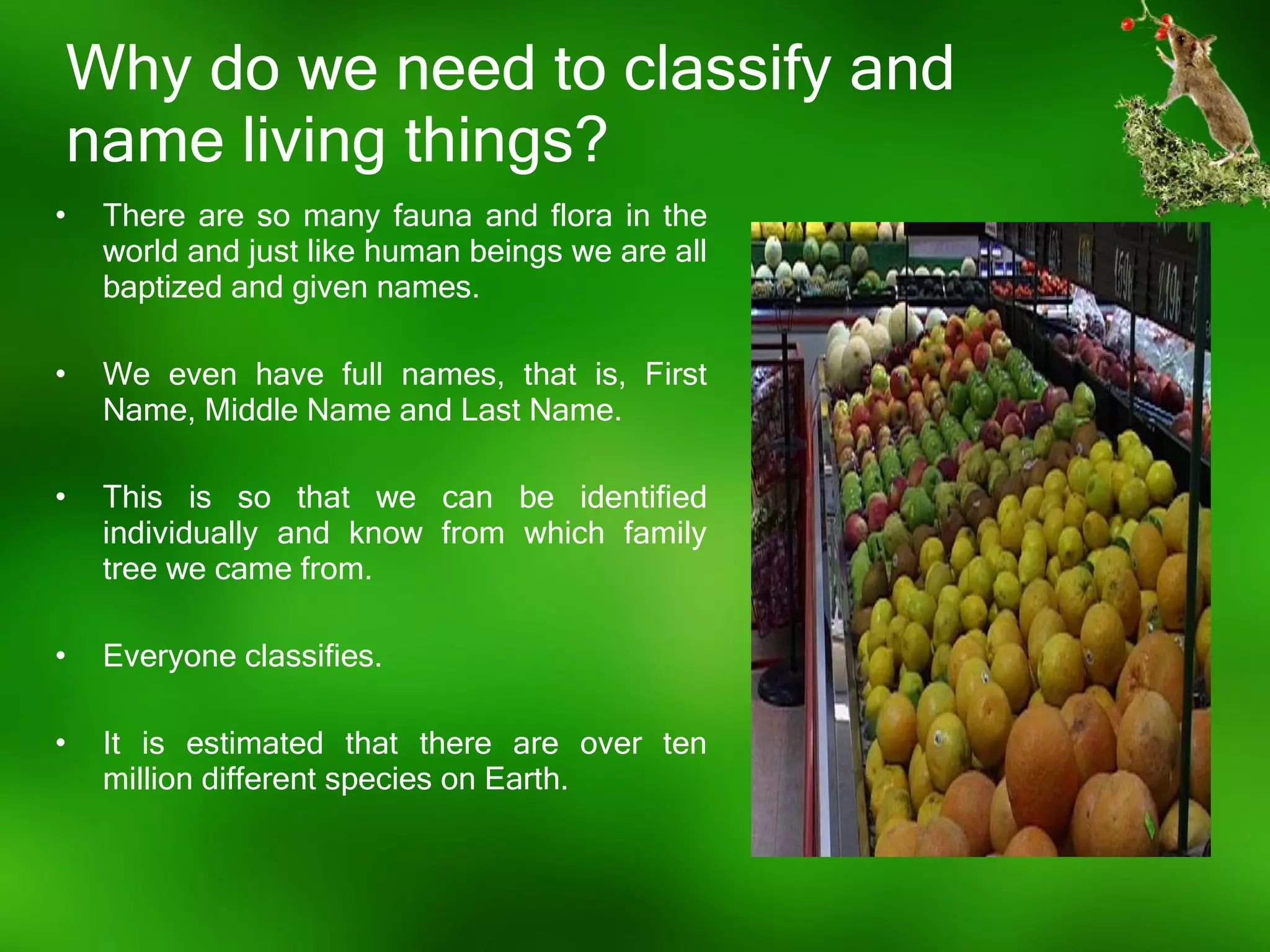
Why do we need to classify and name living things? There are so many fauna and flora in the world and just like human beings we are all baptized and given names.  We even have full names, that is, First Name, Middle Name and Last Name.  This is so that we can be identified individually and know from which family tree we came from.  Everyone classifies.  It is estimated that there are over ten million different species on Earth.
Methods of classification Numerical (1,2,3……….) Alphabetical Order (A-Z) Alphabetical and Numerical Order is not applicable in Biology Likeness of Object (Method used in Biological Classification)
Biological classification is: The process of grouping organisms based on similar characteristics and shared ancestry.  Purpose Comparison (similarities and differences) Easier to find things Easier to study and identify
What then is Taxonomy? The practice of classifying organisms is called  taxonomy  (Taxis means arrangement and nomos means law) Taxonomist Biologist dealing with problems in classification Not all taxonomists agree (Texts Disagree) b.1 Great numbers and kinds of living things b.2 NOT FACT ( Opinion  based on Facts ) All agree  that organisms with similar traits should be grouped together
Aristotle (384 BC–322 BC) classified animal species in his work the History of Animals And his pupil Theophrastus' (c. 371–c. 287 BC) wrote a parallel work on plants  Historia de Plantis  (Enquiry into Plants) HISTORY OF CLASSIFICATION
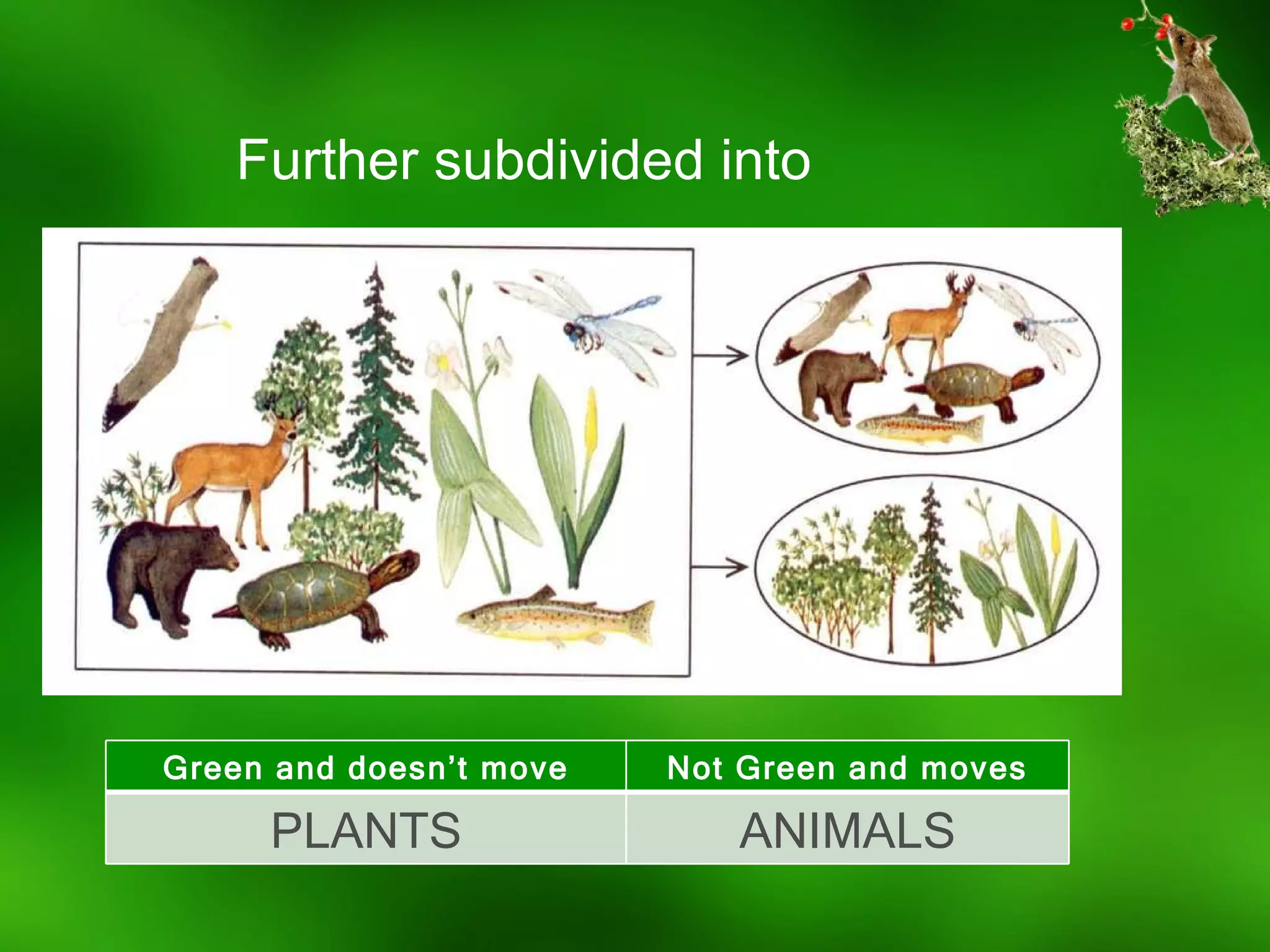
Further subdivided into Green and doesn’t move Not Green and moves PLANTS ANIMALS
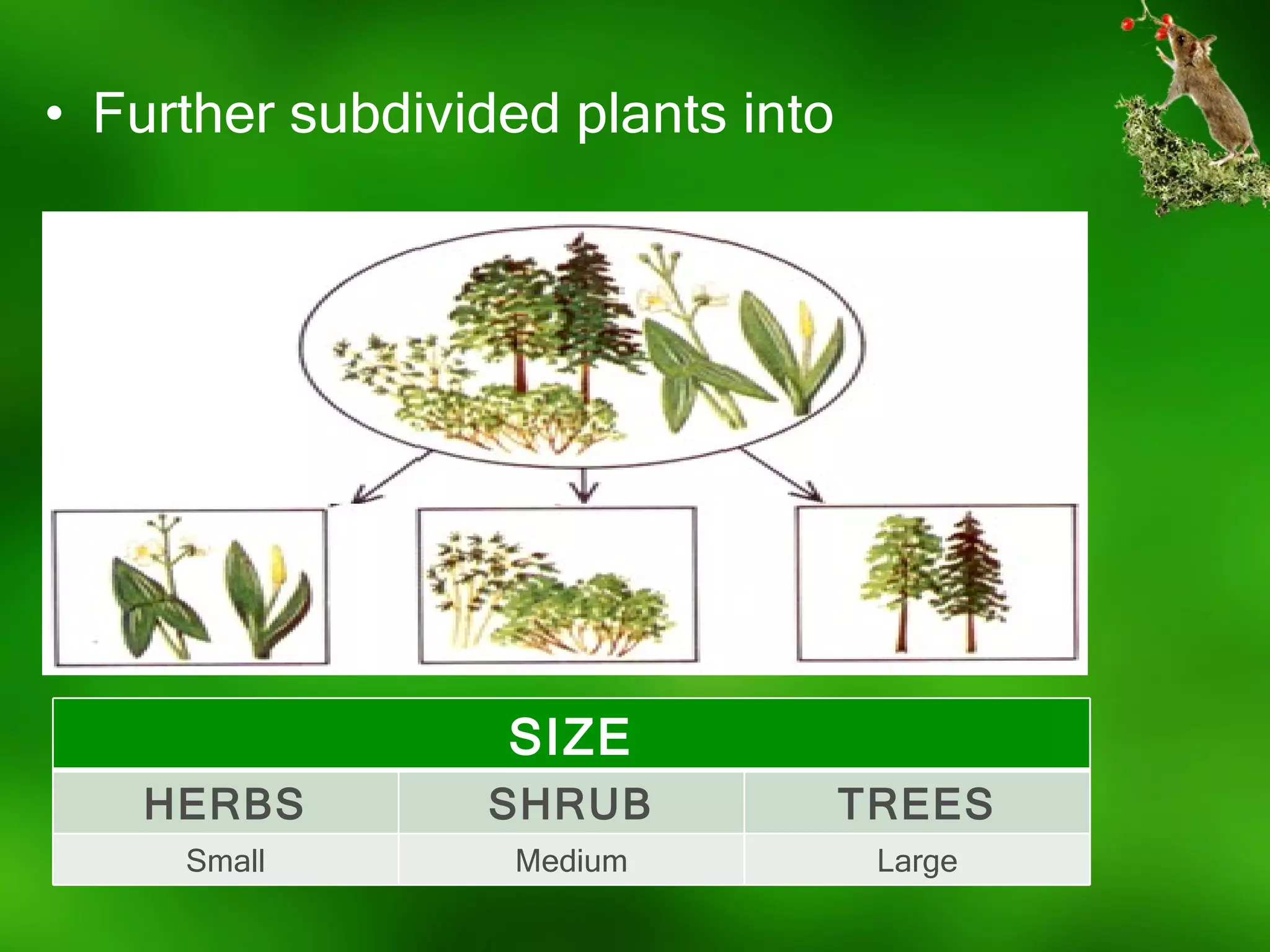
Further subdivided plants into SIZE HERBS SHRUB TREES Small Medium Large
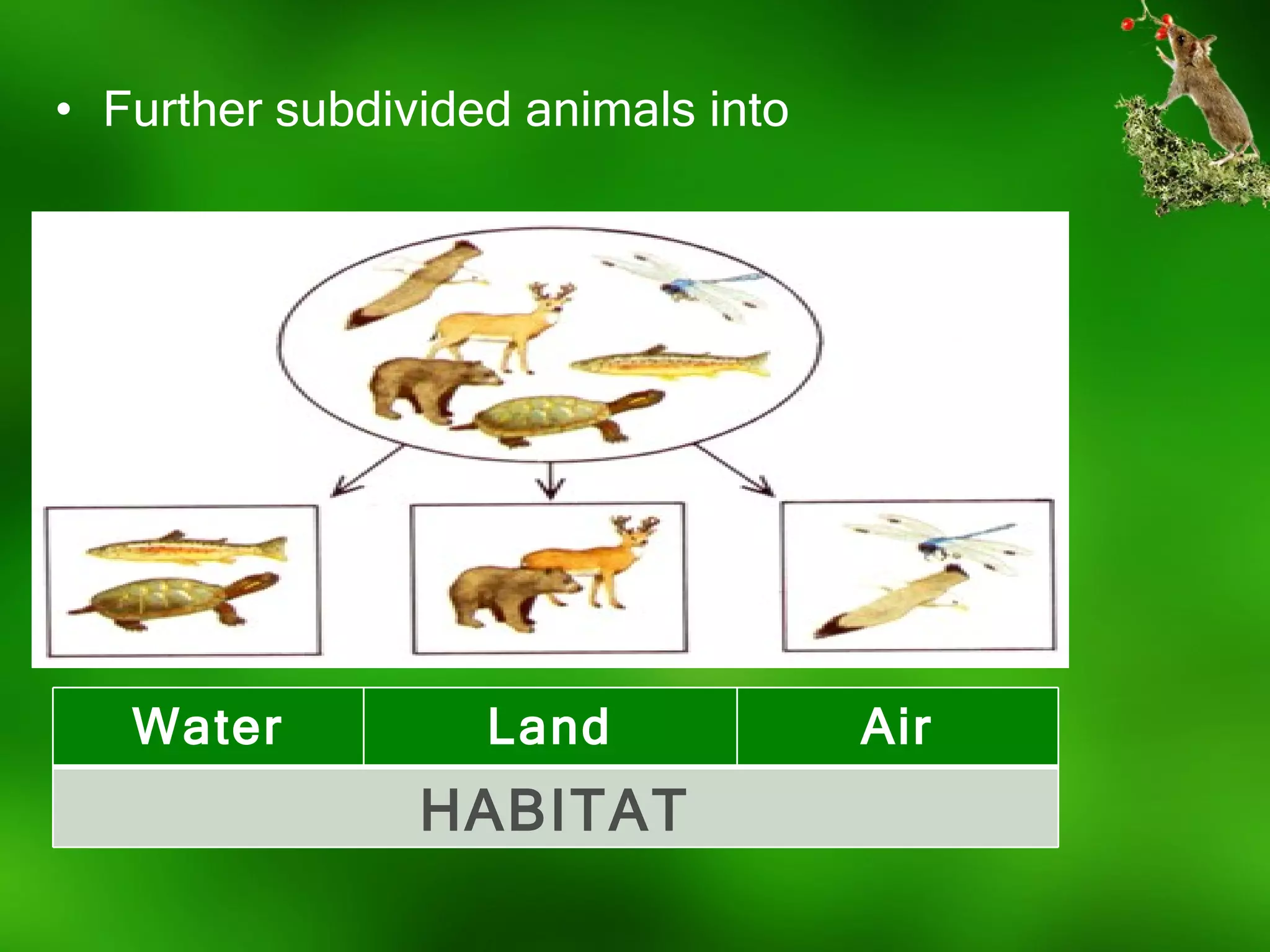
Further subdivided animals into Water Land Air HABITAT
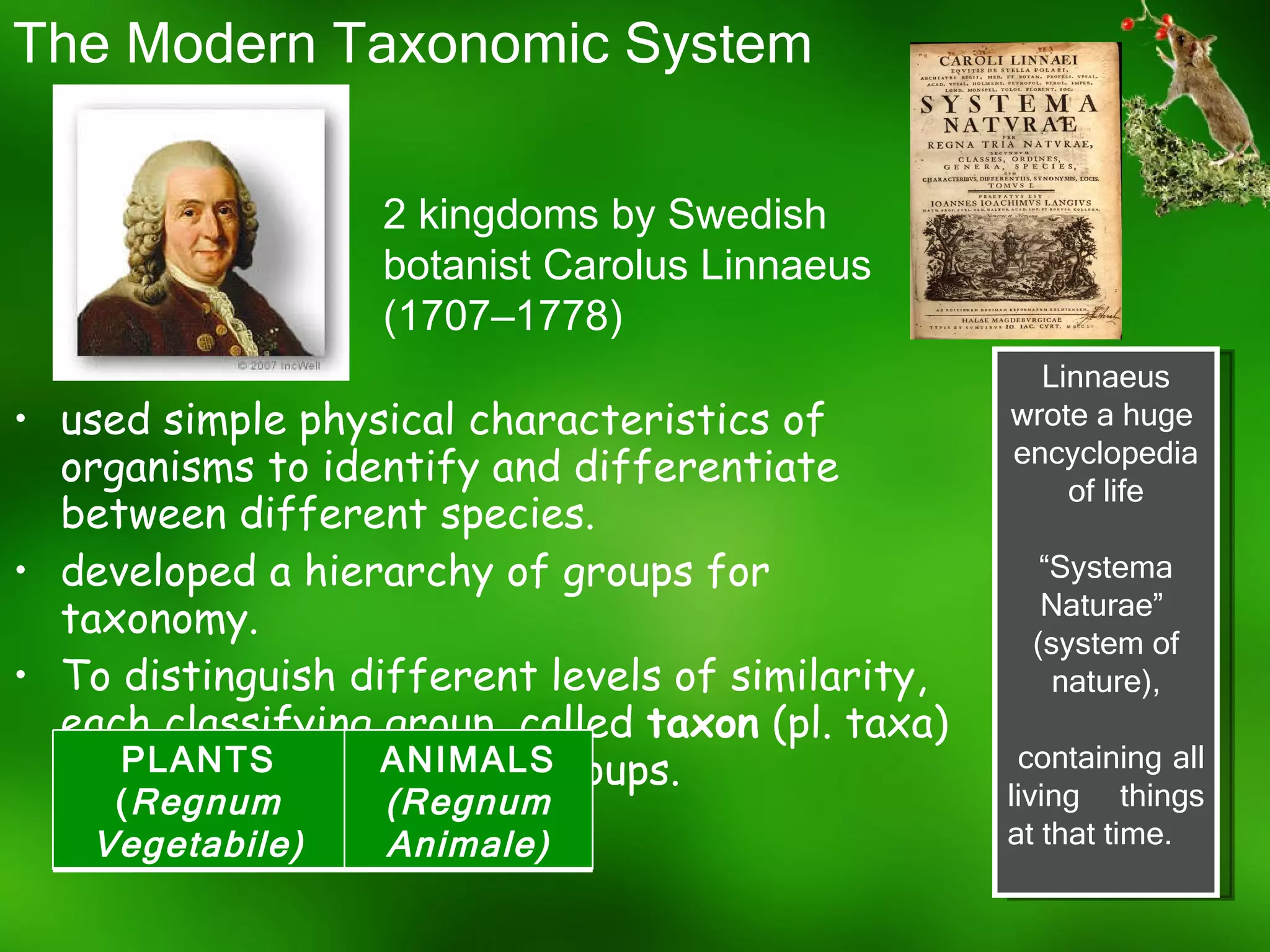
The Modern Taxonomic System  used simple physical characteristics of organisms to identify and differentiate between different species. developed a hierarchy of groups for taxonomy.  To distinguish different levels of similarity, each classifying group, called  taxon  (pl. taxa) is subdivided into other groups. 2 kingdoms by Swedish botanist Carolus Linnaeus (1707–1778) Linnaeus wrote a huge  encyclopedia of life “ Systema Naturae”  (system of nature), containing all living things at that time.  PLANTS ( Regnum Vegetabile) ANIMALS (Regnum Animale)
At present, the Domain is the broadest category, while species is the most specific category available.  The taxon Domain was only introduced in 1990 by Carl Woese, as scientists reorganise things based on new discoveries and information. Currently, textbooks from the United States use a system of six kingdoms  (Animalia, Plantae, Fungi, Protista, Archae, Bacteria)  while British, Australian and Latin American textbooks may describe five kingdoms   (Animalia, Plantae, Fungi, Protista, and Prokayota or  Monera).
Historically, the number of kingdoms in widely accepted classifications has grown from two to six. However, phylogenetic research from about 2000 onwards does not support any of the traditional systems.
Modern Classification 7 Major Groups in the levels of classification Their basis is on: Homologus Structures Common Ancestory (Evolutionary Relationships) DNA and RNA Embryology Many others
Most General (Largest Group) Most Specific (Smallest Group)
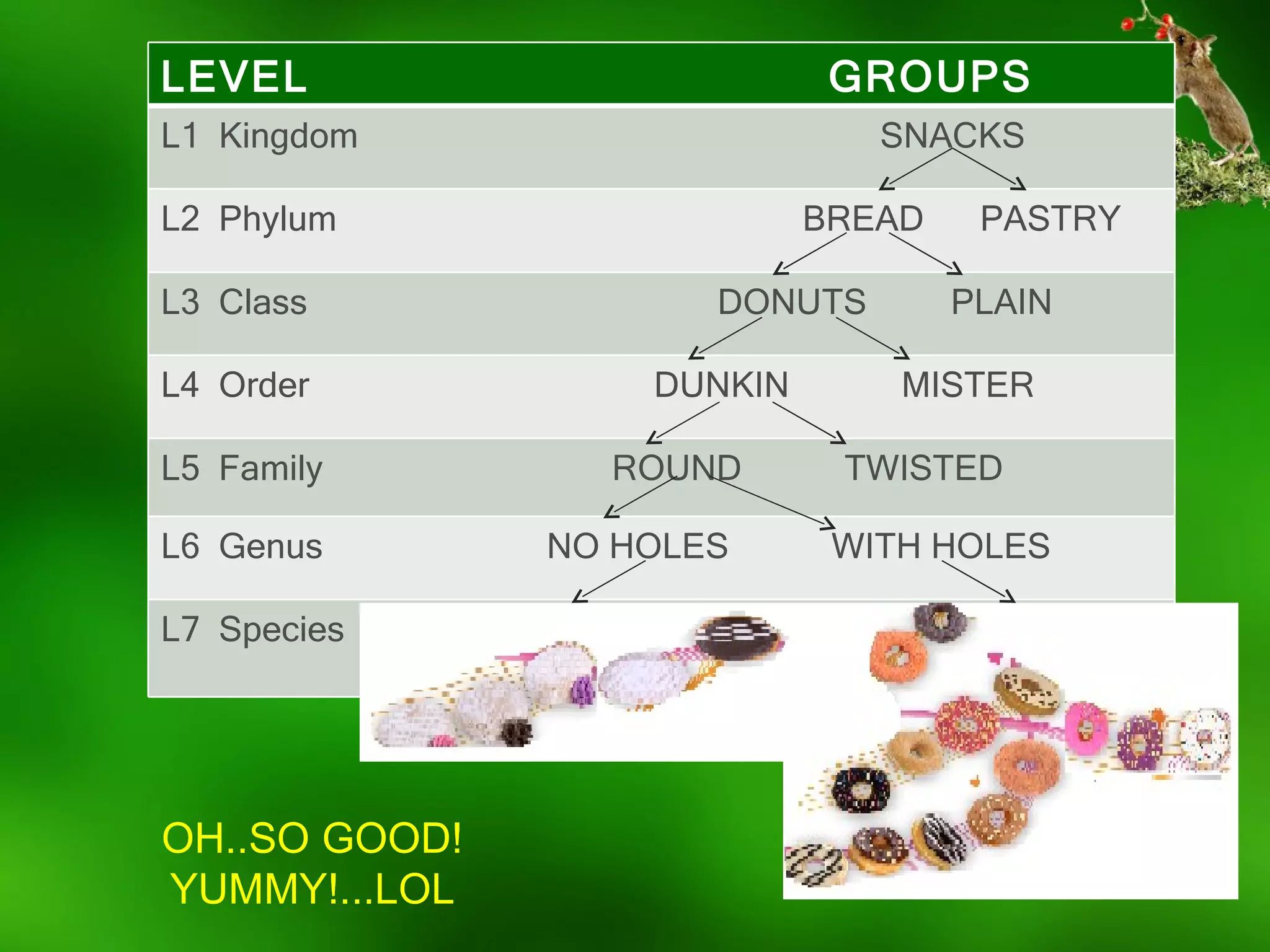
OH..SO GOOD! YUMMY!...LOL LEVEL  GROUPS L1  Kingdom  SNACKS L2  Phylum  BREAD  PASTRY L3  Class  DONUTS  PLAIN L4  Order  DUNKIN  MISTER L5  Family  ROUND  TWISTED L6  Genus  NO HOLES  WITH HOLES L7  Species
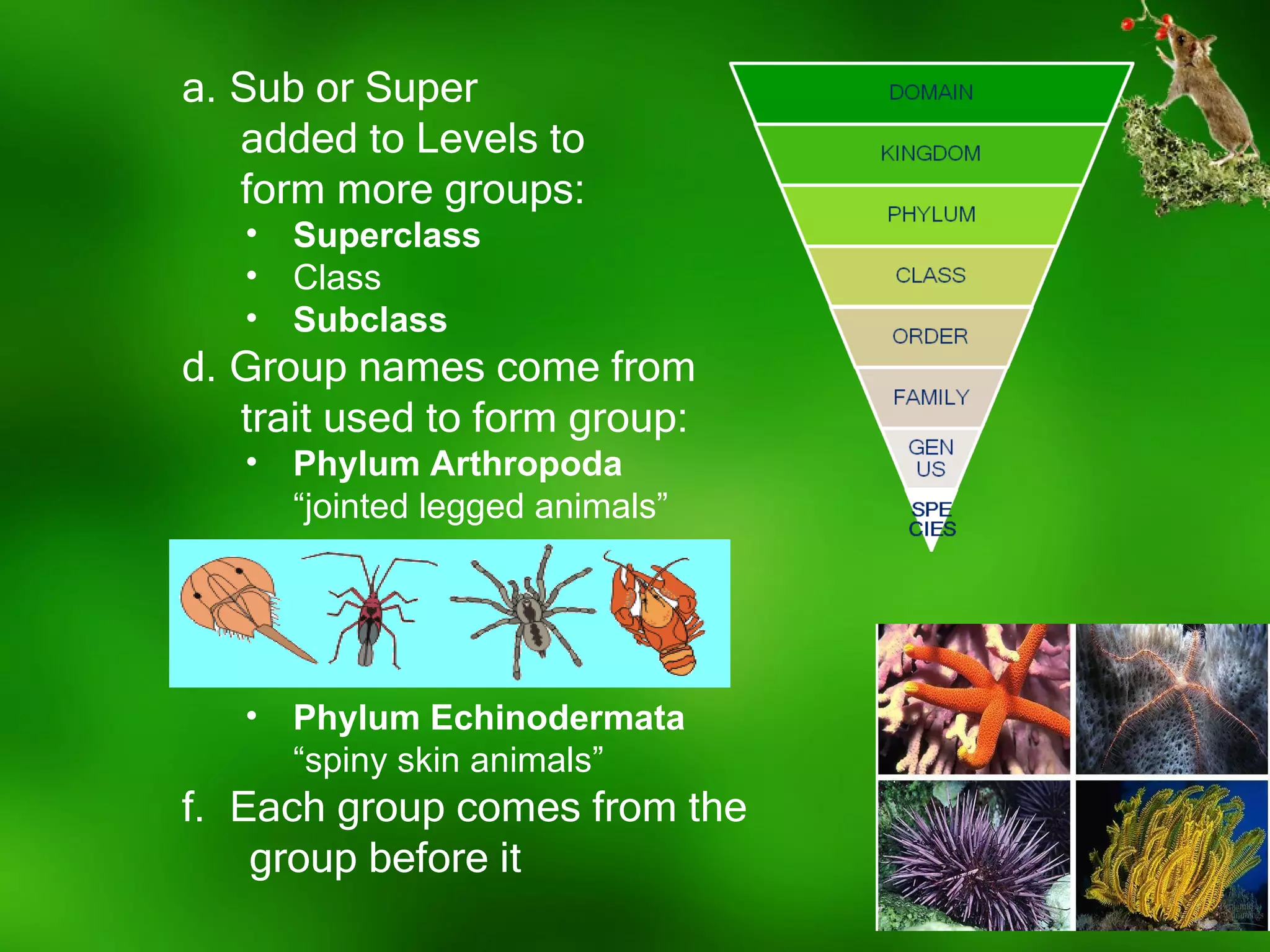
Sub or Super   added to Levels to   form more groups: Superclass Class Subclass Group names come from   trait used to form group : Phylum Arthropoda “ jointed legged animals” Phylum Echinodermata “ spiny skin animals” Each group comes from the group before it
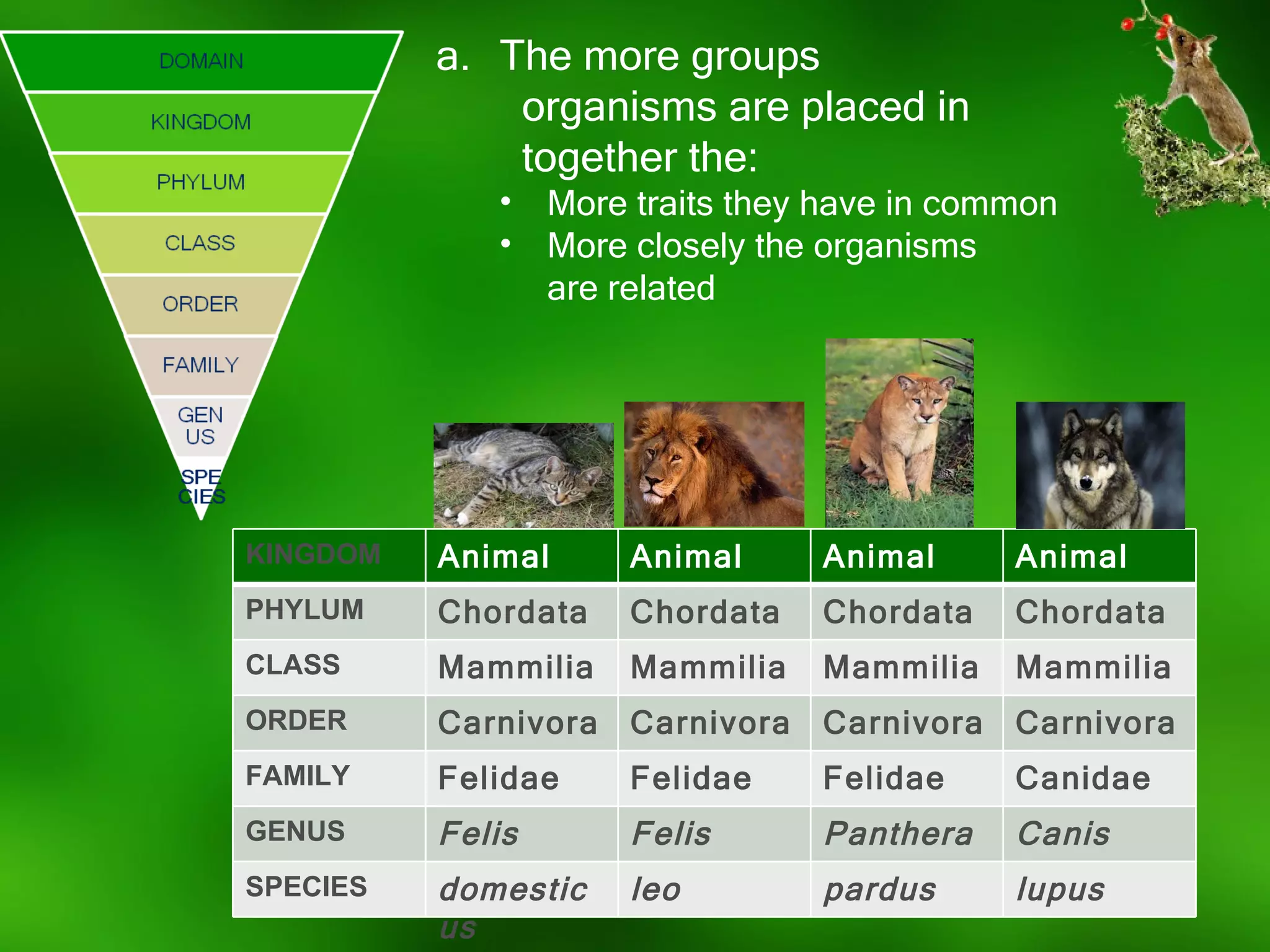
The more groups   organisms are placed in    together the: More traits they have in common More closely the organisms are related KINGDOM Animal Animal Animal Animal PHYLUM Chordata Chordata Chordata Chordata CLASS Mammilia Mammilia Mammilia Mammilia ORDER Carnivora Carnivora Carnivora Carnivora FAMILY Felidae Felidae Felidae Canidae GENUS Felis Felis Panthera Canis SPECIES domesticus leo pardus lupus
Which two organisms are most closely related? KINGDOM Animal Animal Animal Plant PHYLUM Chordata Chordata Arthropoda Tracheophyta CLASS Mammilia Reptilia Insecta Angiospermae ORDER Primates Chelonia Diptera Fagales FAMILY Hominidae Emydidae Culicdae Fagaceae GENUS Homo Terrapene Theobaldia Quercus SPECIES sapiens carolina anulata alba
 
 
Keeping a species Unique Elephants and Blue Crabs cannot mate Leopard Frog eggs fertilized by a Bullfrog do not make it past youth
Donkey and Horse yield  a Mule?  (NOT SAME SPECIES) Polar Bear and Alaskan Brown    can mate and produce fertile  offspring?  (NOT SAME SPECIES )
 
Confusion in using different names in all languages
 
 
Roadrunner Speedea blazi Coyote Hungrais maximus
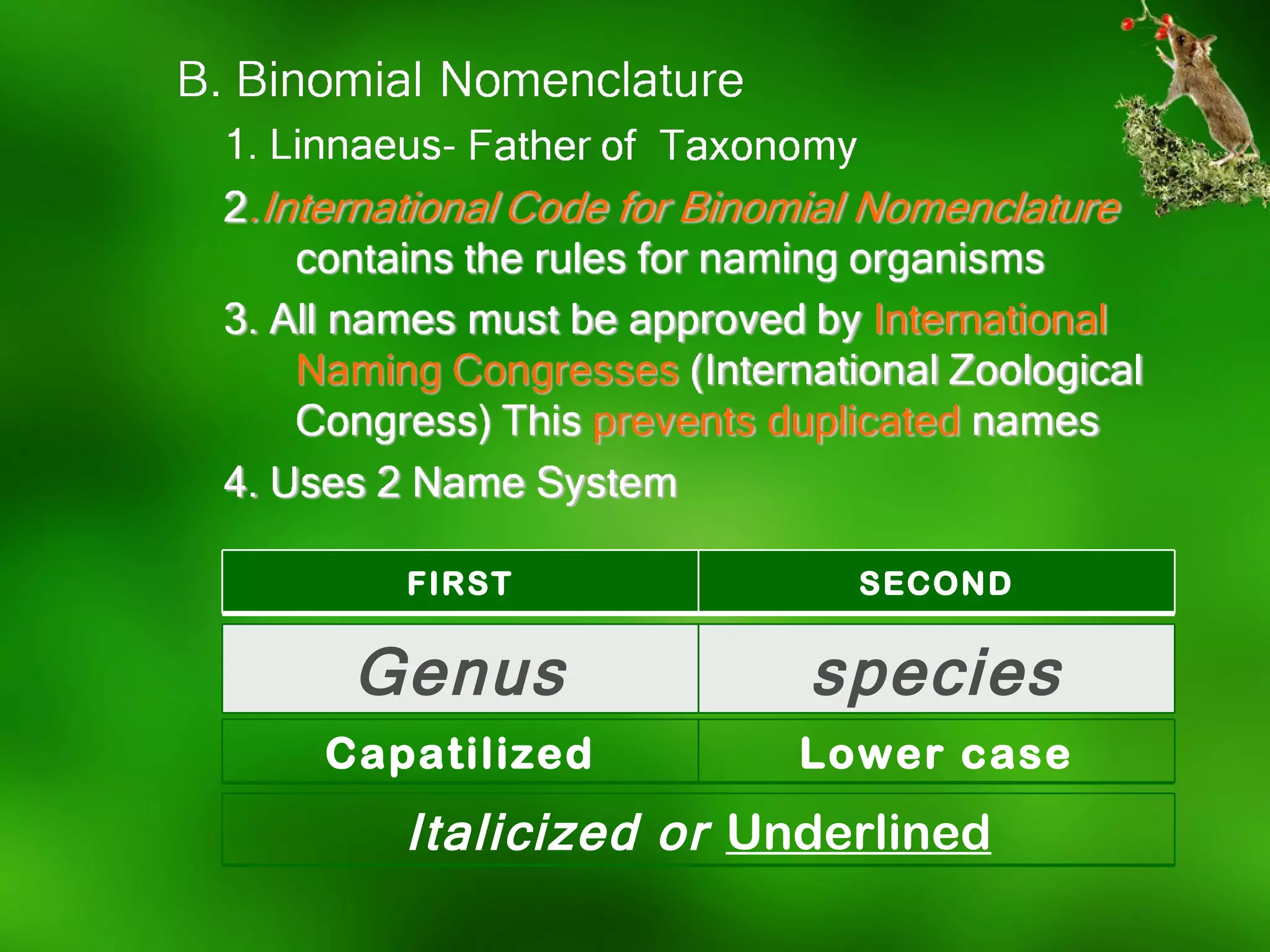
FIRST SECOND Genus species Capatilized Lower case Italicized or  Underlined
Example:  Felis domesticus   F. domesticus
Latin or Greek names are understood by all taxonomists
 
 
Definitions Cell Type Prokaryote – NO Nucleus Eukaryotes - Nucleus Cells Unicellular – ONE Cell Multicellular – MANY Cells Nutrition Autotroph – MAKES Food Heterotroph – USES others for Food
Broadest , most inclusive taxon Three  domains Archaea and Eubacteria  are unicellular prokaryotes (no nucleus or membrane-bound organelles) Eukarya  are more complex and have a nucleus and membrane-bound organelles Domains
Archaea  live in  harsh environments  and may represent the first cells to have evolved. Sewage treatment plants, thermal vents, etc.
Eubacteria,  some of which cause human diseases, are present in almost  all habitats  on earth. Many bacteria are important  environmentally and commercially. Live in the intestines of animals
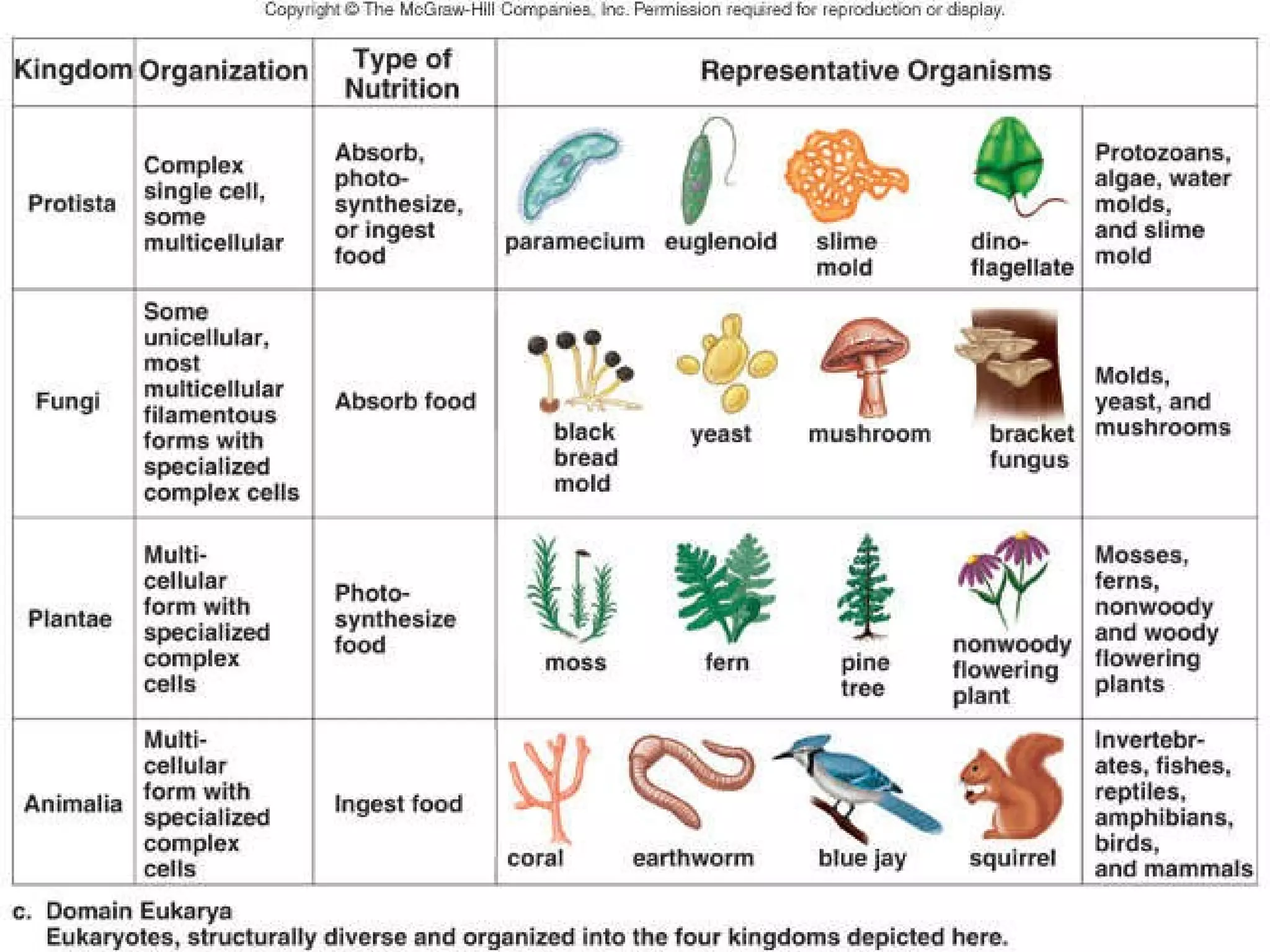
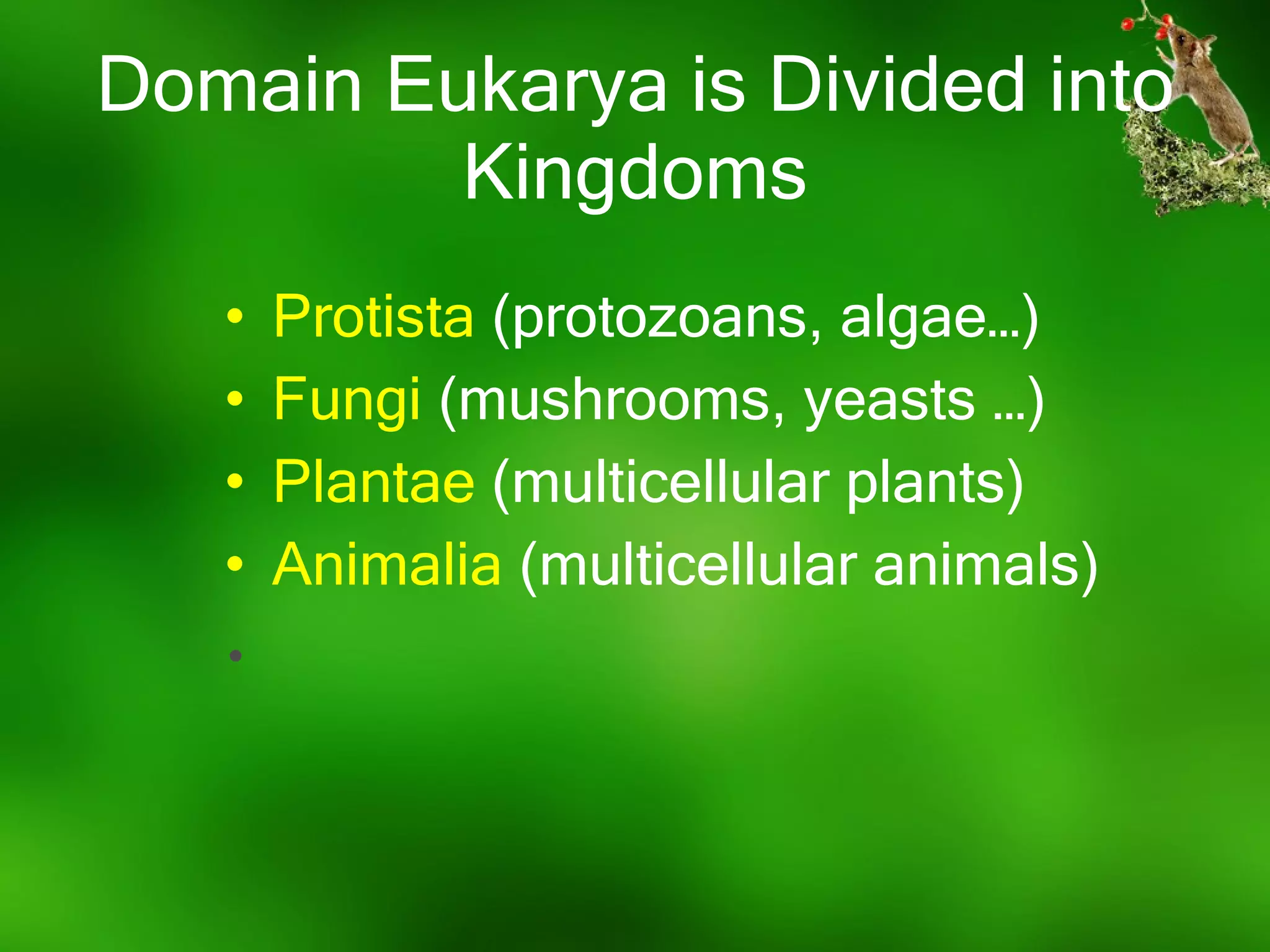
Domain Eukarya is Divided into Kingdoms Protista  (protozoans, algae…) Fungi  (mushrooms, yeasts …) Plantae  (multicellular plants) Animalia  (multicellular animals)
Protista Most are unicellular Some are multicellular Some are  autotrophic , while others are  heterotrophic
Fungi Multicellular,  except yeast Absorptive heterotrophs  (digest food outside their body & then absorb it) Cell walls made of  chitin
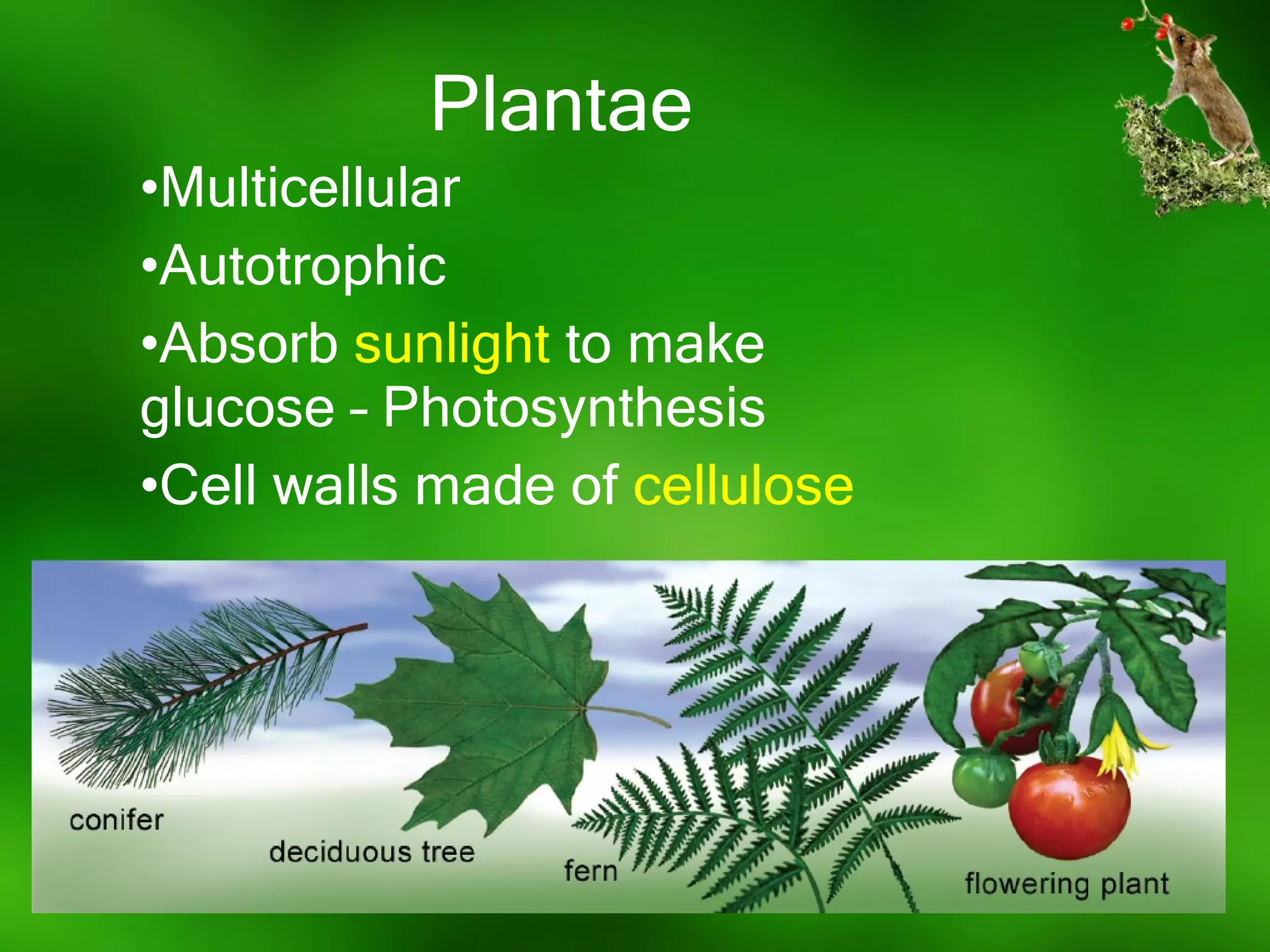
Plantae Multicellular Autotrophic Absorb  sunlight   to make glucose – Photosynthesis Cell walls made of  cellulose
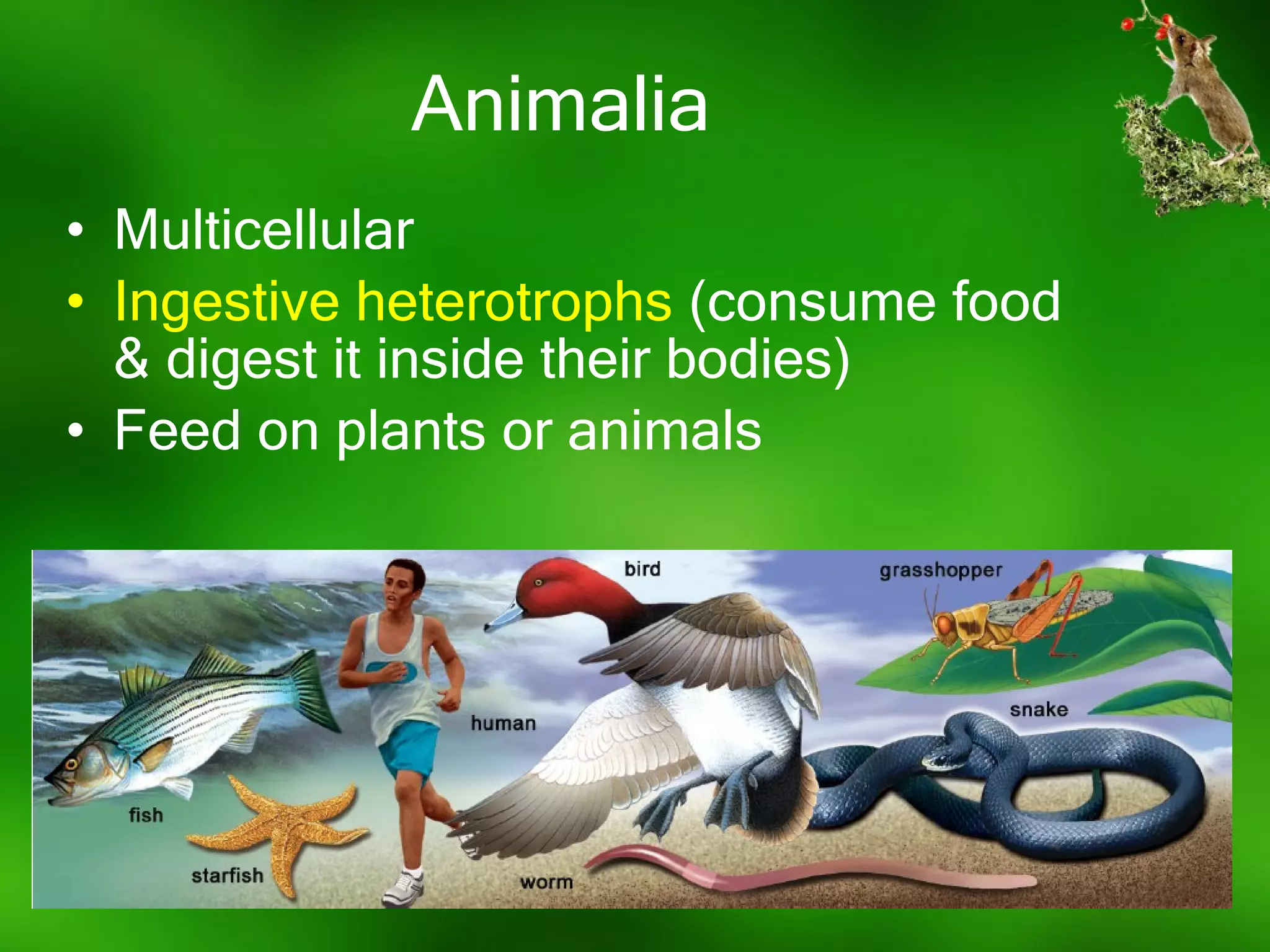
Animalia Multicellular Ingestive heterotrophs  (consume food & digest it inside their bodies) Feed on plants or animals
 
 
Taxons Most   genera   contain a number of similar species, with the exception of  Homo   that only contains modern humans Classification is based on  evolutionary relationships
 
Basis for Modern Taxonomy Homologous structures  (same structure, different function) Similar  embryo  development Similarity in  DNA, RNA , or  amino acid  sequence of Proteins
Homologous Structures  show Similarities in mammals.
Similarities in Vertebrate Embryos
Cladogram Diagram showing how organisms are related based on  shared, derived characteristics  such as feathers, hair, or scales
Primate Cladogram
 
Dichotomous Keying Used to identify organisms Characteristics given in  pairs Read both characteristics  and either go to another set of characteristics  OR  identify the organism
Example of Dichotomous Key 1a Tentacles present – Go to 2 1b Tentacles absent – Go to 3 2a Eight Tentacles – Octopus 2b More than 8 tentacles – 3 3a Tentacles hang down – go to 4 3b Tentacles upright–Sea Anemone 4a Balloon-shaped body–Jellyfish 4b Body NOT balloon-shaped - 5
Weblinks Animal Classification Jeopardy http://www.quia.com/cb/15245.html Animal classification game http://www.teachersdomain.org/asset/lsps07_int_animalclass/ A Touch of Class an interactive online Game http://www.sciencenetlinks.com/interactives/class.html Animal Classification Millionaire http://www.quia.com/rr/11806.html Aliens in your neighborhood http://www.nps.gov/invspcurr/alienXIDactivities.htm Introduction to the principles of taxonomy http://anthro.palomar.edu/animal/ Tigons and Ligers – Interbreeding http://www.pbs.org/wgbh/evolution/library/05/2/l_052_02.html
THANK YOU. You can download or print  this for your lesson.

Classification of living things

  • 1.
    CLASSIFICATION OF LIVINGTHINGS By JGHT Repetition is the mother of learning. Latin Proverb
  • 2.
    Why do weneed to classify and name living things? There are so many fauna and flora in the world and just like human beings we are all baptized and given names. We even have full names, that is, First Name, Middle Name and Last Name. This is so that we can be identified individually and know from which family tree we came from. Everyone classifies. It is estimated that there are over ten million different species on Earth.
  • 3.
    Methods of classificationNumerical (1,2,3……….) Alphabetical Order (A-Z) Alphabetical and Numerical Order is not applicable in Biology Likeness of Object (Method used in Biological Classification)
  • 4.
    Biological classification is:The process of grouping organisms based on similar characteristics and shared ancestry. Purpose Comparison (similarities and differences) Easier to find things Easier to study and identify
  • 5.
    What then isTaxonomy? The practice of classifying organisms is called taxonomy (Taxis means arrangement and nomos means law) Taxonomist Biologist dealing with problems in classification Not all taxonomists agree (Texts Disagree) b.1 Great numbers and kinds of living things b.2 NOT FACT ( Opinion based on Facts ) All agree that organisms with similar traits should be grouped together
  • 6.
    Aristotle (384 BC–322BC) classified animal species in his work the History of Animals And his pupil Theophrastus' (c. 371–c. 287 BC) wrote a parallel work on plants Historia de Plantis (Enquiry into Plants) HISTORY OF CLASSIFICATION
  • 7.
    Further subdivided intoGreen and doesn’t move Not Green and moves PLANTS ANIMALS
  • 8.
    Further subdivided plantsinto SIZE HERBS SHRUB TREES Small Medium Large
  • 9.
    Further subdivided animalsinto Water Land Air HABITAT
  • 10.
    The Modern TaxonomicSystem used simple physical characteristics of organisms to identify and differentiate between different species. developed a hierarchy of groups for taxonomy. To distinguish different levels of similarity, each classifying group, called taxon (pl. taxa) is subdivided into other groups. 2 kingdoms by Swedish botanist Carolus Linnaeus (1707–1778) Linnaeus wrote a huge encyclopedia of life “ Systema Naturae” (system of nature), containing all living things at that time. PLANTS ( Regnum Vegetabile) ANIMALS (Regnum Animale)
  • 11.
    At present, theDomain is the broadest category, while species is the most specific category available. The taxon Domain was only introduced in 1990 by Carl Woese, as scientists reorganise things based on new discoveries and information. Currently, textbooks from the United States use a system of six kingdoms (Animalia, Plantae, Fungi, Protista, Archae, Bacteria) while British, Australian and Latin American textbooks may describe five kingdoms (Animalia, Plantae, Fungi, Protista, and Prokayota or Monera).
  • 12.
    Historically, the numberof kingdoms in widely accepted classifications has grown from two to six. However, phylogenetic research from about 2000 onwards does not support any of the traditional systems.
  • 13.
    Modern Classification 7Major Groups in the levels of classification Their basis is on: Homologus Structures Common Ancestory (Evolutionary Relationships) DNA and RNA Embryology Many others
  • 14.
    Most General (LargestGroup) Most Specific (Smallest Group)
  • 15.
    OH..SO GOOD! YUMMY!...LOLLEVEL GROUPS L1 Kingdom SNACKS L2 Phylum BREAD PASTRY L3 Class DONUTS PLAIN L4 Order DUNKIN MISTER L5 Family ROUND TWISTED L6 Genus NO HOLES WITH HOLES L7 Species
  • 16.
    Sub or Super added to Levels to form more groups: Superclass Class Subclass Group names come from trait used to form group : Phylum Arthropoda “ jointed legged animals” Phylum Echinodermata “ spiny skin animals” Each group comes from the group before it
  • 17.
    The more groups organisms are placed in together the: More traits they have in common More closely the organisms are related KINGDOM Animal Animal Animal Animal PHYLUM Chordata Chordata Chordata Chordata CLASS Mammilia Mammilia Mammilia Mammilia ORDER Carnivora Carnivora Carnivora Carnivora FAMILY Felidae Felidae Felidae Canidae GENUS Felis Felis Panthera Canis SPECIES domesticus leo pardus lupus
  • 18.
    Which two organismsare most closely related? KINGDOM Animal Animal Animal Plant PHYLUM Chordata Chordata Arthropoda Tracheophyta CLASS Mammilia Reptilia Insecta Angiospermae ORDER Primates Chelonia Diptera Fagales FAMILY Hominidae Emydidae Culicdae Fagaceae GENUS Homo Terrapene Theobaldia Quercus SPECIES sapiens carolina anulata alba
  • 19.
  • 20.
  • 21.
    Keeping a speciesUnique Elephants and Blue Crabs cannot mate Leopard Frog eggs fertilized by a Bullfrog do not make it past youth
  • 22.
    Donkey and Horseyield a Mule? (NOT SAME SPECIES) Polar Bear and Alaskan Brown can mate and produce fertile offspring? (NOT SAME SPECIES )
  • 23.
  • 24.
    Confusion in usingdifferent names in all languages
  • 25.
  • 26.
  • 27.
    Roadrunner Speedea blaziCoyote Hungrais maximus
  • 28.
    FIRST SECOND Genusspecies Capatilized Lower case Italicized or Underlined
  • 29.
    Example: Felisdomesticus F. domesticus
  • 30.
    Latin or Greeknames are understood by all taxonomists
  • 31.
  • 32.
  • 33.
    Definitions Cell TypeProkaryote – NO Nucleus Eukaryotes - Nucleus Cells Unicellular – ONE Cell Multicellular – MANY Cells Nutrition Autotroph – MAKES Food Heterotroph – USES others for Food
  • 34.
    Broadest , mostinclusive taxon Three domains Archaea and Eubacteria are unicellular prokaryotes (no nucleus or membrane-bound organelles) Eukarya are more complex and have a nucleus and membrane-bound organelles Domains
  • 35.
    Archaea livein harsh environments and may represent the first cells to have evolved. Sewage treatment plants, thermal vents, etc.
  • 36.
    Eubacteria, someof which cause human diseases, are present in almost all habitats on earth. Many bacteria are important environmentally and commercially. Live in the intestines of animals
  • 37.
    Domain Eukarya isDivided into Kingdoms Protista (protozoans, algae…) Fungi (mushrooms, yeasts …) Plantae (multicellular plants) Animalia (multicellular animals)
  • 38.
    Protista Most areunicellular Some are multicellular Some are autotrophic , while others are heterotrophic
  • 39.
    Fungi Multicellular, except yeast Absorptive heterotrophs (digest food outside their body & then absorb it) Cell walls made of chitin
  • 40.
    Plantae Multicellular AutotrophicAbsorb sunlight to make glucose – Photosynthesis Cell walls made of cellulose
  • 41.
    Animalia Multicellular Ingestiveheterotrophs (consume food & digest it inside their bodies) Feed on plants or animals
  • 42.
  • 43.
  • 44.
    Taxons Most genera contain a number of similar species, with the exception of Homo that only contains modern humans Classification is based on evolutionary relationships
  • 45.
  • 46.
    Basis for ModernTaxonomy Homologous structures (same structure, different function) Similar embryo development Similarity in DNA, RNA , or amino acid sequence of Proteins
  • 47.
    Homologous Structures show Similarities in mammals.
  • 48.
  • 49.
    Cladogram Diagram showinghow organisms are related based on shared, derived characteristics such as feathers, hair, or scales
  • 50.
  • 51.
  • 52.
    Dichotomous Keying Usedto identify organisms Characteristics given in pairs Read both characteristics and either go to another set of characteristics OR identify the organism
  • 53.
    Example of DichotomousKey 1a Tentacles present – Go to 2 1b Tentacles absent – Go to 3 2a Eight Tentacles – Octopus 2b More than 8 tentacles – 3 3a Tentacles hang down – go to 4 3b Tentacles upright–Sea Anemone 4a Balloon-shaped body–Jellyfish 4b Body NOT balloon-shaped - 5
  • 54.
    Weblinks Animal ClassificationJeopardy http://www.quia.com/cb/15245.html Animal classification game http://www.teachersdomain.org/asset/lsps07_int_animalclass/ A Touch of Class an interactive online Game http://www.sciencenetlinks.com/interactives/class.html Animal Classification Millionaire http://www.quia.com/rr/11806.html Aliens in your neighborhood http://www.nps.gov/invspcurr/alienXIDactivities.htm Introduction to the principles of taxonomy http://anthro.palomar.edu/animal/ Tigons and Ligers – Interbreeding http://www.pbs.org/wgbh/evolution/library/05/2/l_052_02.html
  • 55.
    THANK YOU. Youcan download or print this for your lesson.

Editor's Notes

  • #41 Growth, with increases in size and number of cells, is part of development. Development involves many stages from conception until death.