1
Cladistics And Systematics
2
Definition of Terms
•Systematics – study of the diversification of
living forms, both past and present, and
the relationships among living things through
time.
•Cladistics – (from ancient Greek, klados,
"branch"; originally called phylogenetic
systematics) is a taxonomical technique for
arranging organisms according to how they
branch in the evolutionary tree of life.
Introduction
All organisms:
Are composed of one or more cells
Carry out metabolism
Transfer energy with ATP
Encode hereditary information in DNA
Tremendous diversity of life
Bacteria-----whales----sequoia trees
Biologists group organisms based on shared
characteristics and newer molecular sequence
data
3
SYSTEMATICS
Since fossil records are not complete,
scientists rely on other types of
evidence to establish the best
hypothesis of evolutionary
relationships
Systematics: the study of evolutionary
relationships
Phylogeny: a hypothesis about
patterns of relationship among species
4
SYSTEMATICS
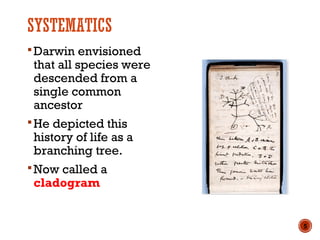
Darwin envisioned
that all species were
descended from a
single common
ancestor
He depicted this
history of life as a
branching tree.
Now called a
cladogram
5
SYSTEMATICS
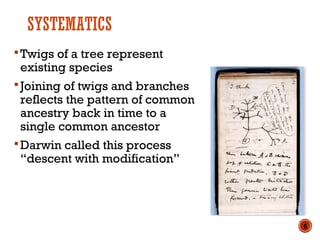
Twigs of a tree represent
existing species
Joining of twigs and branches
reflects the pattern of common
ancestry back in time to a
single common ancestor
Darwin called this process
“descent with modification”
6
SYSTEMATICS
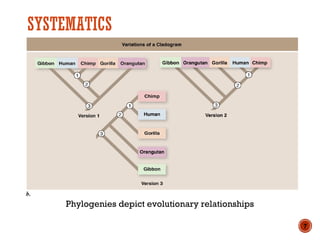
Phylogenies depict evolutionary relationships
7
SYSTEMATICS
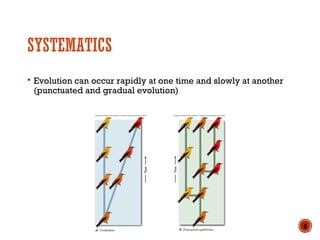
 Evolution can occur rapidly at one time and slowly at another
(punctuated and gradual evolution)
8
SYSTEMATICS
Oscillating selection: Traits can evolve in
one direction, then back the other way
Evolution is not always divergent:
convergent evolution
Use similar habitats
Similar environmental pressures
Evolutionary reversal: process in which a
species re-evolves the characteristics of an
ancestral species
9
CLADISTICS
Derived characteristic: similarity that is
inherited from the most recent common ancestor
of an entire group
Ancestral: similarity that arose prior to the
common ancestor of the group
In cladistics, only shared derived characters are
considered informative about evolutionary
relationships
To use the cladistic method character variation
must be identified as ancestral or derived
10
CLADISTICS
Characters can be any aspect of the phenotype
Morphology - Physiology
Behavior - DNA
Characters should exist in recognizable
character states
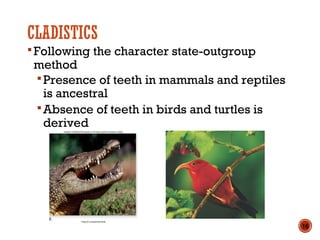
Example: Teeth in amniote vertebrates has
two states, present in most mammals and
reptiles and absence in birds and turtles
11
CLADISTICS
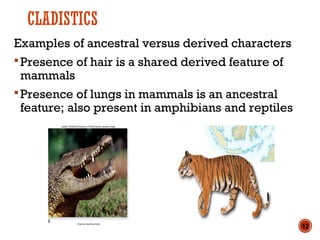
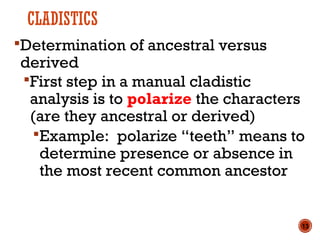
Examples of ancestral versus derived characters
Presence of hair is a shared derived feature of
mammals
Presence of lungs in mammals is an ancestral
feature; also present in amphibians and reptiles
12
CLADISTICS
Determination of ancestral versus
derived
First step in a manual cladistic
analysis is to polarize the characters
(are they ancestral or derived)
Example: polarize “teeth” means to
determine presence or absence in
the most recent common ancestor
13
CLADISTICS
Outgroup comparison is used to assign
character polarity
A species or group of species not a
member of the group under study is
designated as the outgroup
Outgroup species do not always exhibit the
ancestral condition
14
CLADISTICS
When the group under study exhibits
multiple character states, and one of those
states is exhibited by the outgroup, then that
state is ancestral and other states are derived
Most reliable if character state is exhibited
by several different outgroups
15
CLADISTICS
Following the character state-outgroup
method
Presence of teeth in mammals and reptiles
is ancestral
Absence of teeth in birds and turtles is
derived
16
CLADISTICS
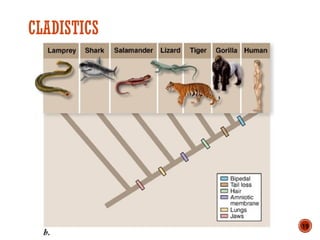
Construction of a cladogram
Polarize characteristics
Clade: species that share a common ancestor as
indicated by the possession of shared derived
characters
Clades are evolutionary units and refer to a
common ancestor and all descendants
Synapomorphy: a derived character shared by
clade members
17
CLADISTICS
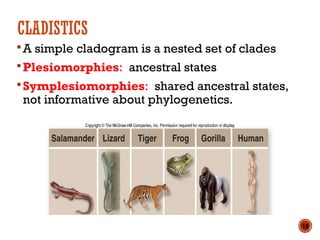
A simple cladogram is a nested set of clades
Plesiomorphies: ancestral states
Symplesiomorphies: shared ancestral states,
not informative about phylogenetics.
18
CLADISTICS
19
CLADISTICS
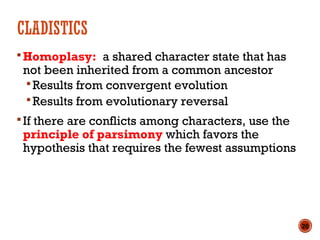
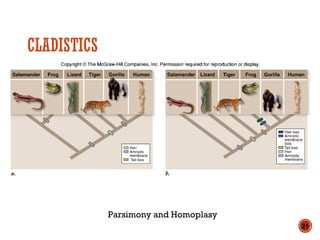
Homoplasy: a shared character state that has
not been inherited from a common ancestor
Results from convergent evolution
Results from evolutionary reversal
If there are conflicts among characters, use the
principle of parsimony which favors the
hypothesis that requires the fewest assumptions
20
CLADISTICS
Parsimony and Homoplasy
21
CLADISTICS
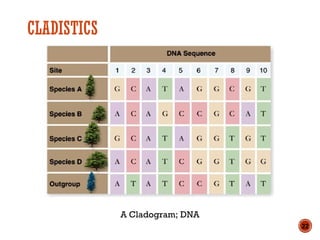
A Cladogram; DNA
22
CLADISTICS
23
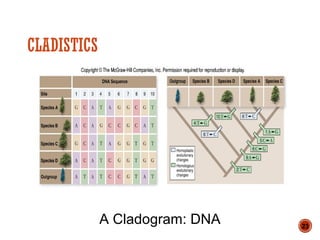
A Cladogram: DNA
OTHER PHYLOGENETIC METHODS
 Some characters evolve rapidly and principle of
parsimony may be misleading
 Rate at which some parts of the DNA genome evolve
 Mutations in repetition sequences, not deleted by
natural selection
 Statistical approaches
 Molecular clock: rate of evolution of a molecule is
constant through time
24
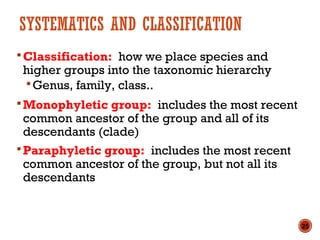
SYSTEMATICS AND CLASSIFICATION
Classification: how we place species and
higher groups into the taxonomic hierarchy
Genus, family, class..
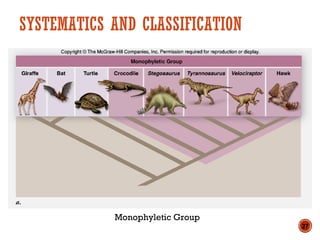
Monophyletic group: includes the most recent
common ancestor of the group and all of its
descendants (clade)
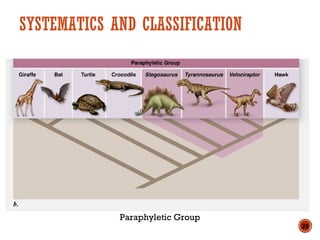
Paraphyletic group: includes the most recent
common ancestor of the group, but not all its
descendants
25
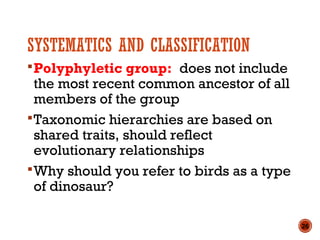
SYSTEMATICS AND CLASSIFICATION
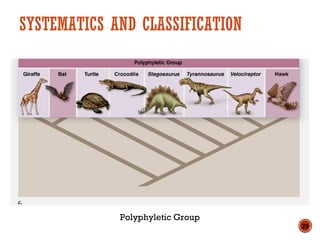
Polyphyletic group: does not include
the most recent common ancestor of all
members of the group
Taxonomic hierarchies are based on
shared traits, should reflect
evolutionary relationships
Why should you refer to birds as a type
of dinosaur?
26
SYSTEMATICS AND CLASSIFICATION
Monophyletic Group
27
SYSTEMATICS AND CLASSIFICATION
Paraphyletic Group
28
SYSTEMATICS AND CLASSIFICATION
Polyphyletic Group
29
SYSTEMATICS AND CLASSIFICATION
Phylogenetic species concept (PSC)
Focuses on shared derived characters
Biological species concept (BSC)
Defines species as groups of interbreeding
population that are reproductively isolated
Typological species concept (TSC)
concept of a species as a group whose members
share certain characteristics that distinguish
them from other species
30
31
32

Cladistic systematics

  • 1.
  • 2.
    2 Definition of Terms •Systematics– study of the diversification of living forms, both past and present, and the relationships among living things through time. •Cladistics – (from ancient Greek, klados, "branch"; originally called phylogenetic systematics) is a taxonomical technique for arranging organisms according to how they branch in the evolutionary tree of life.
  • 3.
    Introduction All organisms: Are composedof one or more cells Carry out metabolism Transfer energy with ATP Encode hereditary information in DNA Tremendous diversity of life Bacteria-----whales----sequoia trees Biologists group organisms based on shared characteristics and newer molecular sequence data 3
  • 4.
    SYSTEMATICS Since fossil recordsare not complete, scientists rely on other types of evidence to establish the best hypothesis of evolutionary relationships Systematics: the study of evolutionary relationships Phylogeny: a hypothesis about patterns of relationship among species 4
  • 5.
    SYSTEMATICS Darwin envisioned that allspecies were descended from a single common ancestor He depicted this history of life as a branching tree. Now called a cladogram 5
  • 6.
    SYSTEMATICS Twigs of atree represent existing species Joining of twigs and branches reflects the pattern of common ancestry back in time to a single common ancestor Darwin called this process “descent with modification” 6
  • 7.
  • 8.
    SYSTEMATICS  Evolution canoccur rapidly at one time and slowly at another (punctuated and gradual evolution) 8
  • 9.
    SYSTEMATICS Oscillating selection: Traitscan evolve in one direction, then back the other way Evolution is not always divergent: convergent evolution Use similar habitats Similar environmental pressures Evolutionary reversal: process in which a species re-evolves the characteristics of an ancestral species 9
  • 10.
    CLADISTICS Derived characteristic: similaritythat is inherited from the most recent common ancestor of an entire group Ancestral: similarity that arose prior to the common ancestor of the group In cladistics, only shared derived characters are considered informative about evolutionary relationships To use the cladistic method character variation must be identified as ancestral or derived 10
  • 11.
    CLADISTICS Characters can beany aspect of the phenotype Morphology - Physiology Behavior - DNA Characters should exist in recognizable character states Example: Teeth in amniote vertebrates has two states, present in most mammals and reptiles and absence in birds and turtles 11
  • 12.
    CLADISTICS Examples of ancestralversus derived characters Presence of hair is a shared derived feature of mammals Presence of lungs in mammals is an ancestral feature; also present in amphibians and reptiles 12
  • 13.
    CLADISTICS Determination of ancestralversus derived First step in a manual cladistic analysis is to polarize the characters (are they ancestral or derived) Example: polarize “teeth” means to determine presence or absence in the most recent common ancestor 13
  • 14.
    CLADISTICS Outgroup comparison isused to assign character polarity A species or group of species not a member of the group under study is designated as the outgroup Outgroup species do not always exhibit the ancestral condition 14
  • 15.
    CLADISTICS When the groupunder study exhibits multiple character states, and one of those states is exhibited by the outgroup, then that state is ancestral and other states are derived Most reliable if character state is exhibited by several different outgroups 15
  • 16.
    CLADISTICS Following the characterstate-outgroup method Presence of teeth in mammals and reptiles is ancestral Absence of teeth in birds and turtles is derived 16
  • 17.
    CLADISTICS Construction of acladogram Polarize characteristics Clade: species that share a common ancestor as indicated by the possession of shared derived characters Clades are evolutionary units and refer to a common ancestor and all descendants Synapomorphy: a derived character shared by clade members 17
  • 18.
    CLADISTICS A simple cladogramis a nested set of clades Plesiomorphies: ancestral states Symplesiomorphies: shared ancestral states, not informative about phylogenetics. 18
  • 19.
  • 20.
    CLADISTICS Homoplasy: a sharedcharacter state that has not been inherited from a common ancestor Results from convergent evolution Results from evolutionary reversal If there are conflicts among characters, use the principle of parsimony which favors the hypothesis that requires the fewest assumptions 20
  • 21.
  • 22.
  • 23.
  • 24.
    OTHER PHYLOGENETIC METHODS Some characters evolve rapidly and principle of parsimony may be misleading  Rate at which some parts of the DNA genome evolve  Mutations in repetition sequences, not deleted by natural selection  Statistical approaches  Molecular clock: rate of evolution of a molecule is constant through time 24
  • 25.
    SYSTEMATICS AND CLASSIFICATION Classification:how we place species and higher groups into the taxonomic hierarchy Genus, family, class.. Monophyletic group: includes the most recent common ancestor of the group and all of its descendants (clade) Paraphyletic group: includes the most recent common ancestor of the group, but not all its descendants 25
  • 26.
    SYSTEMATICS AND CLASSIFICATION Polyphyleticgroup: does not include the most recent common ancestor of all members of the group Taxonomic hierarchies are based on shared traits, should reflect evolutionary relationships Why should you refer to birds as a type of dinosaur? 26
  • 27.
  • 28.
  • 29.
  • 30.
    SYSTEMATICS AND CLASSIFICATION Phylogeneticspecies concept (PSC) Focuses on shared derived characters Biological species concept (BSC) Defines species as groups of interbreeding population that are reproductively isolated Typological species concept (TSC) concept of a species as a group whose members share certain characteristics that distinguish them from other species 30
  • 31.
  • 32.

Editor's Notes

  • #3 Systematics - Relationships are visualized as evolutionary trees (synonyms: cladograms,phylogenetic trees, phylogenies). Phylogenies have two components, branching order (showing group relationships) and branch length (showing amount of evolution). Phylogenetic trees of species and higher taxa are used to study the evolution of traits. Systematics, in other words, is used to understand the evolutionary history of life on Earth. Cladistics - is an approach to biological classification in which organisms are categorized based on shared derived characteristics that can be traced to a group's most recent common ancestor and are not present in more distant ancestors.Therefore, members of a group are assumed to share a common history and are considered to be closely related.