CHAPTER 1:
ALCOHOLS
NORFAZRIN MOHD HANIF
FACULTY OF APPLIED SCIENCE
UITM NEGERI SEMBILAN
SUBTOPICS
Nomenclature
– common and IUPAC names for alcohols & phenols
Classification of alcohol as 1°, 2°, and 3°.
Physical properties of alcohol.

Preparation of alcohol
–Grignard synthesis
–Hydrolysis of alkyl halides
–Industrial and laboratory preparations of ethyl alcohol
Reactions of alcohol
–Oxidation
–Esterification
–Dehydration
–Halogenation
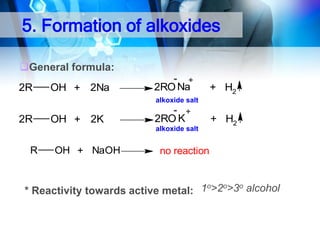
–Formation of alkoxides
INTRODUCTION
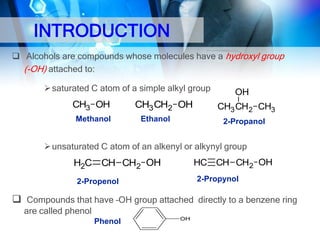
 Alcohols are compounds whose molecules have a hydroxyl group
(-OH) attached to:
 saturated C atom of a simple alkyl group

CH3 OH
Methanol

CH3 CH2 OH
Ethanol

OH
CH3 CH2 CH3
2-Propanol

 unsaturated C atom of an alkenyl or alkynyl group

HC CH CH2 OH

H2C CH CH2 OH

2-Propynol

2-Propenol

 Compounds that have –OH group attached directly to a benzene ring
are called phenol
Phenol

OH
CLASSIFICATION
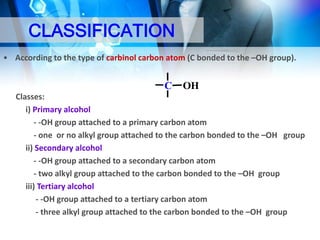
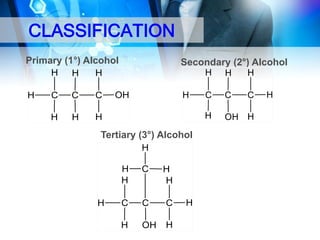
• According to the type of carbinol carbon atom (C bonded to the –OH group).

C

OH

Classes:
i) Primary alcohol
- -OH group attached to a primary carbon atom
- one or no alkyl group attached to the carbon bonded to the –OH group
ii) Secondary alcohol
- -OH group attached to a secondary carbon atom
- two alkyl group attached to the carbon bonded to the –OH group
iii) Tertiary alcohol
- -OH group attached to a tertiary carbon atom
- three alkyl group attached to the carbon bonded to the –OH group
CLASSIFICATION
Primary (1°) Alcohol
H
H

H
C

C

H

H

H

H

OH

H

Tertiary (3°) Alcohol
H
H
H
H

C

H
H

C

C

C

H

OH

H

H

H

H

C

C

C

H

H

C

Secondary (2°) Alcohol

OH

H

H
CLASSIFICATION
Polyhydroxy Alcohols
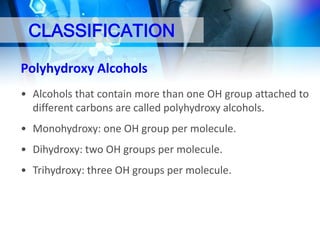
• Alcohols that contain more than one OH group attached to
different carbons are called polyhydroxy alcohols.

• Monohydroxy: one OH group per molecule.
• Dihydroxy: two OH groups per molecule.
• Trihydroxy: three OH groups per molecule.
NOMENCLATURE
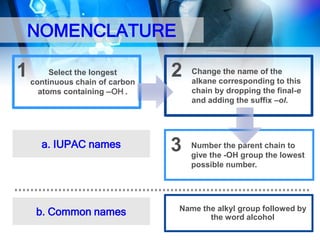
Select
1 continuous the longest
chain of carbon

2

atoms containing –-OH .

a. IUPAC names

b. Common names

3

Change the name of the
alkane corresponding to this
chain by dropping the final-e
and adding the suffix –ol.

Number the parent chain to
give the -OH group the lowest
possible number.

Name the alkyl group followed by
the word alcohol
NOMENCLATURE
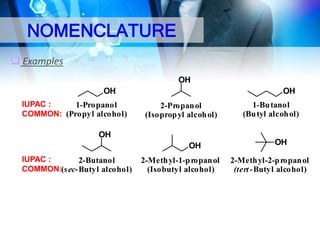
 Examples
OH
OH
IUPAC :
1-Propanol
COMMON: (Propyl alcohol)

OH
2-Propan ol
(Isoprop yl alcoh ol)

OH
OH
IUPAC :
2-Butanol
COMMON:(s ec-Butyl alcohol)

2-Meth yl-1-p ropan ol
(Isobutyl alcohol)

1-Bu tanol
(Bu tyl alcoh ol)
OH
2-Meth yl-2-p ropan ol
(tert -Butyl alcohol)
NOMENCLATURE
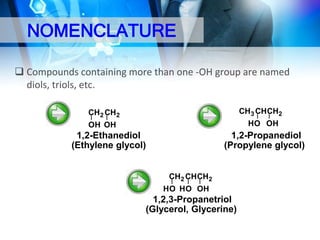
 Compounds containing more than one -OH group are named
diols, triols, etc.
CH3 CH CH2

CH2 CH2

HO OH

O H OH

1,2-Ethanediol
(Ethylene glycol)

1,2-Propanediol
(Propylene glycol)
CH2 CH CH2
H O H O OH

1,2,3-Propanetriol
(Glycerol, Glycerine)
NOMENCLATURE
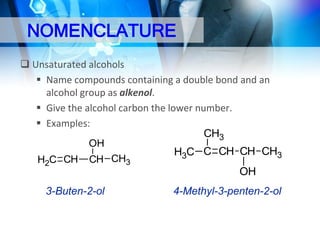
 Unsaturated alcohols
 Name compounds containing a double bond and an
alcohol group as alkenol.
 Give the alcohol carbon the lower number.
 Examples:
CH3
OH
H3C C CH CH CH3
H2C CH CH CH3
OH

3-Buten-2-ol

4-Methyl-3-penten-2-ol
NOMENCLATURE
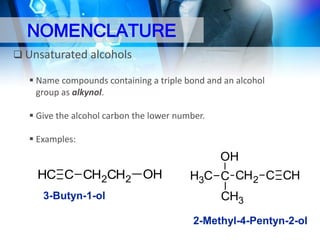
 Unsaturated alcohols
 Name compounds containing a triple bond and an alcohol
group as alkynol.
 Give the alcohol carbon the lower number.
 Examples:

OH

HC C CH2CH2 OH
3-Butyn-1-ol

H3C C CH 2 C CH
CH3
2-Methyl-4-Pentyn-2-ol
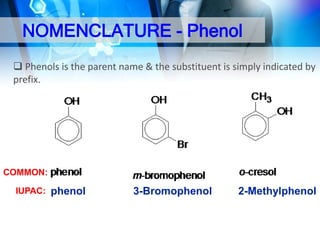
NOMENCLATURE - Phenol
 Phenols is the parent name & the substituent is simply indicated by
prefix.

COMMON:
IUPAC: phenol

3-Bromophenol

2-Methylphenol
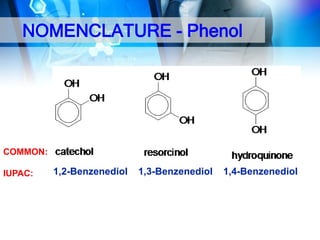
NOMENCLATURE - Phenol

COMMON:
IUPAC:

1,2-Benzenediol

1,3-Benzenediol

1,4-Benzenediol
PHYSICAL PROPERTIES
• PHYSICAL STATES OF ALCOHOLS
- simple aliphatic alcohols and lower aromatic alcohols
(such as phenylmethanol, C6H5CH2OH) → liquids at
room temperature.
- highly branched alcohols and alcohols with twelve or
more carbon atoms → solids.
PHYSICAL PROPERTIES
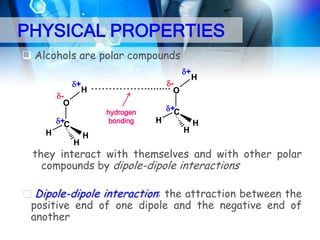
 Alcohols are polar compounds
+
+
O

H

……………......... O
hydrogen
bonding

+C

H
H

H

H

+C

H
H

H

they interact with themselves and with other polar
compounds by dipole-dipole interactions
 Dipole-dipole interaction: the attraction between the
positive end of one dipole and the negative end of
another
PHYSICAL PROPERTIES
 Hydrogen bonding: when the positive end of one
dipole is a H bonded to F, O, or N (atoms of high
electronegativity) and the other end is F, O, or N
▫ the strength of hydrogen bonding in water is
approximately 21 kJ (5 kcal)/mol
▫ hydrogen bonds are considerably weaker than
covalent bonds
▫ nonetheless, they can have a significant effect on
physical properties
Boiling point & solubility
 In relation to alkanes of comparable size and
molecular weight, alcohols
– have higher boiling points
– are more soluble in water
 The presence of additional -OH groups in a molecule
further increases solubility in water and boiling point
A. Solubility
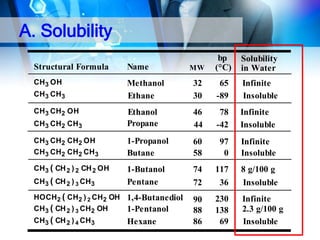
i) Alcohols with short carbon chains (such as methanol, ethanol, and
propanol) dissolve in water.
- when alcohols dissolve in water, hydrogen bonds are formed
between the –OH group of the alcohol molecule and the –OH
group of the water molecule.
ii) The solubility of alcohols in water decreases sharply with the
increasing length of the carbon chain. Higher alcohols are insoluble
in water.
- alcohol contains a polar end (-OH group) called ‘hydrophilic’
and a non-polar end (the alkyl group) called ‘hydrophobic’.
- the water solubility decreases as the alkyl group becomes
larger.
A. Solubility
iii) alcohols with more than one hydroxyl group (polyhydroxy
alcohols) are more soluble than monohydroxy alcohols with the
same number of carbon atoms. This is because they can form
more hydrogen bonds with water molecule.
iv) branched hydrocarbon increases the solubility of alcohol in
water.
- reason: branched hydrocarbon cause the hydrophobic region
becomes compact.
* Phenol is unusually soluble (9.3%) because of its compact
shape and the particularly strong hydrogen bonds formed
between phenolic –OH groups and water molecules.
A. Solubility
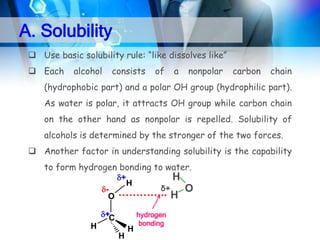
 Use basic solubility rule: “like dissolves like”
 Each

alcohol

consists

of

a

nonpolar

carbon

chain

(hydrophobic part) and a polar OH group (hydrophilic part).

As water is polar, it attracts OH group while carbon chain
on the other hand as nonpolar is repelled. Solubility of
alcohols is determined by the stronger of the two forces.

 Another factor in understanding solubility is the capability
to form hydrogen bonding to water.
+

O

H

H

δ+
………….. H O

+C

H
H

H

hydrogen
bonding
A. Solubility
MW

bp
(°C)

Solubility
in Water

Structural Formula

Name

CH3 OH

Methanol
Ethane

32
30

65
-89

Infinite
Insoluble

CH3 CH2 CH3

Ethanol
Propane

46
44

78
-42

Infinite
Insoluble

CH3 CH2 CH2 OH
CH3 CH2 CH2 CH3

1-Propanol
Butane

60
58

97
0

Infinite
Insoluble

CH3 ( CH 2 ) 2 CH 2 OH

1-Butanol
Pentane

74
72

117
36

8 g/100 g
Insoluble

90
88
86

230
138
69

Infinite
2.3 g/100 g
Insoluble

CH3 CH3
CH3 CH2 OH

CH3 ( CH 2 ) 3 CH 3

HOCH2 ( CH2 ) 2 CH2 OH 1,4-Butanediol
CH3 ( CH 2 ) 3 CH 2 OH
1-Pentanol
CH3 ( CH 2 ) 4 CH 3

Hexane
B. Boiling point
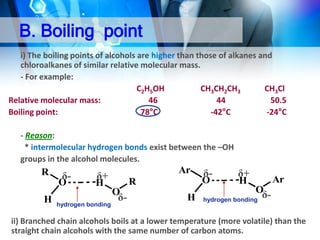
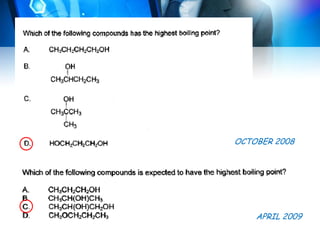
i) The boiling points of alcohols are higher than those of alkanes and
chloroalkanes of similar relative molecular mass.
- For example:
C2H5OH
CH3CH2CH3
CH3Cl
Relative molecular mass:
46
44
50.5
Boiling point:
78°C
-42°C
-24°C
- Reason:
* intermolecular hydrogen bonds exist between the –OH
groups in the alcohol molecules.

R

δ-

O
H

Ar

δ+

H

hydrogen bonding

O

R
O

δ-

δ-

H

δ+
H

Ar
O

hydrogen bonding

δ-

ii) Branched chain alcohols boils at a lower temperature (more volatile) than the
straight chain alcohols with the same number of carbon atoms.
B. Boiling point
CH3CH2 OH
Ethanol
bp 78° C

CH3OCH3
Dimethyl ether
bp -24°C

CH3CH3
Ethane
bp -89°C

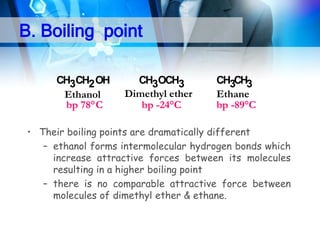
• Their boiling points are dramatically different
– ethanol forms intermolecular hydrogen bonds which
increase attractive forces between its molecules
resulting in a higher boiling point
– there is no comparable attractive force between
molecules of dimethyl ether & ethane.
OCTOBER 2008

APRIL 2009
C. Acidity
• Alcohol is weakly acidic.
• In aqueous solution, alcohol will donated its proton to water
molecule to give an alkoxide ion (R-O-).
R-OH + H2O

R-O- + H3O+

Ka = ~ 10-16 to 10-18

alkoxide ion
Example
CH3CH2-OH + H2O


CH3CH2-O- + H3O+

The acid-dissociation constant, Ka, of an alcohol is defined by the
equilibrium

K
a
Ka = [H3O+] [RO-]

R-OH + H2O

[ROH]

R-O- + H3O+
pKa = - log (Ka)

* More smaller the pKa
value, the alcohol is
more acidic
C. Acidity
 Alcohol is weakly acidic.
 In aqueous solution, alcohol will donated its proton to water
molecule to give an alkoxide ion (R-O-).
CH3 O H + :O H
H
Ka =

+
CH3 O: + H O H
alkoxide ion
H

[ CH3 O-] [H3 O+ ]
[ CH3 OH]

–

= 1 0 - 15 .5

pKa = 1 5 .5

pKa decrease, acidity increase
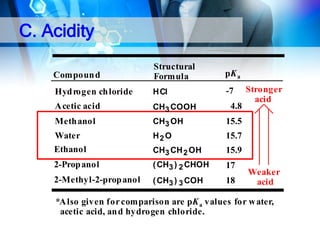
C. Acidity
Compoun d

Structural
Formula

pK a

Hyd rogen ch loride

HCl

-7

A cetic acid

CH3 COOH

Meth anol

CH3 OH

15.5

Water
Ethanol

H2 O

15.7

CH3 CH 2 OH

15.9

2-Prop anol

( CH3 ) 2 CHOH

17

2-Methyl-2-prop anol

( CH3 ) 3 COH

18

4.8

Stronger
acid

Weaker
acid

*A lso given for comparison are pK a values for w ater,
acetic acid, an d hydrogen chloride.
C. Acidity
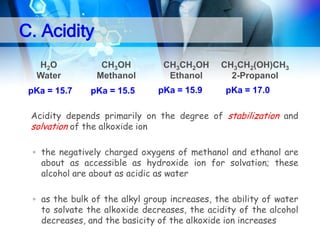
H 2O
Water

pKa = 15.7

CH3OH
Methanol

pKa = 15.5

CH3CH2OH
Ethanol
pKa = 15.9

CH3CH2(OH)CH3
2-Propanol
pKa = 17.0

 Acidity depends primarily on the degree of stabilization and
solvation of the alkoxide ion
▫ the negatively charged oxygens of methanol and ethanol are
about as accessible as hydroxide ion for solvation; these
alcohol are about as acidic as water
▫ as the bulk of the alkyl group increases, the ability of water
to solvate the alkoxide decreases, the acidity of the alcohol
decreases, and the basicity of the alkoxide ion increases
C. Acidity of phenols
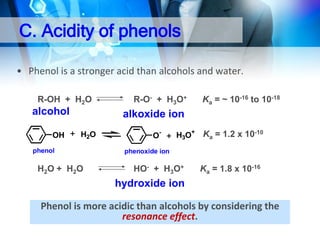
• Phenol is a stronger acid than alcohols and water.
R-OH + H2O

alcohol
OH

R-O- + H3O+

Ka = ~ 10-16 to 10-18

alkoxide ion
H2O

phenol

H 2 O + H2 O

O-

H3O+

Ka = 1.2 x 10⁻¹⁰

phenoxide ion

HO- + H3O+

Ka = 1.8 x 10⁻¹⁶

hydroxide ion

Phenol is more acidic than alcohols by considering the
resonance effect.
C. Acidity of phenols
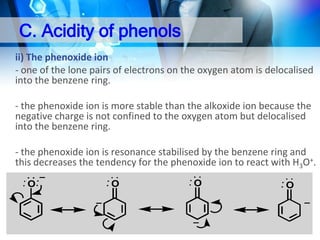
ii) The phenoxide ion
- one of the lone pairs of electrons on the oxygen atom is delocalised
into the benzene ring.
- the phenoxide ion is more stable than the alkoxide ion because the
negative charge is not confined to the oxygen atom but delocalised
into the benzene ring.
- the phenoxide ion is resonance stabilised by the benzene ring and
this decreases the tendency for the phenoxide ion to react with H3O+.
O

O

O

O
C. Acidity
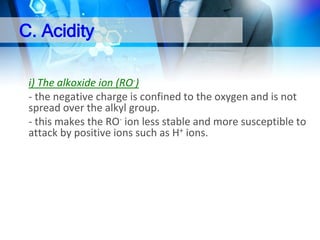
i) The alkoxide ion (RO-)
- the negative charge is confined to the oxygen and is not
spread over the alkyl group.
- this makes the RO- ion less stable and more susceptible to
attack by positive ions such as H+ ions.
PREPARATION
 Grignard Synthesis
 Hydrolysis of alkyl halides
 Acid-catalyzed Hydration of
alkenes
1.Grignard Synthesis
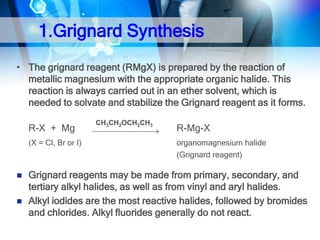
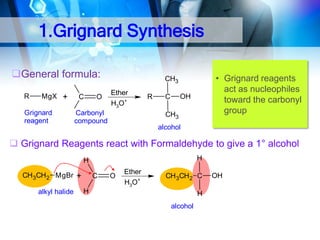
• The grignard reagent (RMgX) is prepared by the reaction of
metallic magnesium with the appropriate organic halide. This
reaction is always carried out in an ether solvent, which is
needed to solvate and stabilize the Grignard reagent as it forms.
R-X + Mg
(X = Cl, Br or I)




CH3CH2OCH2CH3

R-Mg-X
organomagnesium halide
(Grignard reagent)

Grignard reagents may be made from primary, secondary, and
tertiary alkyl halides, as well as from vinyl and aryl halides.
Alkyl iodides are the most reactive halides, followed by bromides
and chlorides. Alkyl fluorides generally do not react.
1.Grignard Synthesis
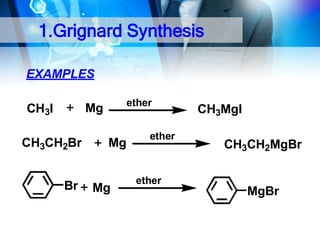
EXAMPLES
ether

Mg

CH3I
CH3CH2Br
Br

Mg

Mg

ether

CH3MgI
CH3CH2MgBr

ether

MgBr
1.Grignard Synthesis
General formula:
R

MgX +

Grignard
reagent

C

O

• Grignard reagents
act as nucleophiles
toward the carbonyl
group

CH3

H3C

Ether
H3O+

H3C Carbonyl
compound

R

OH

C
CH3

alcohol

 Grignard Reagents react with Formaldehyde to give a 1° alcohol
H

H
CH 3CH 2 MgBr +
alkyl halide

C

O

Ether
H3O+

CH 3CH 2 C

H

H
alcohol

OH
1.Grignard Synthesis
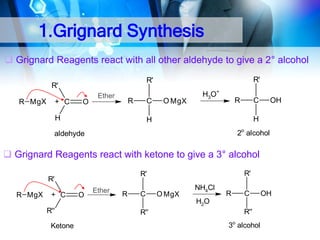
 Grignard Reagents react with all other aldehyde to give a 2° alcohol

+ C

R MgX

R'

R'

R'
O

Ether

R

C

H

O MgX

H3O+

R

C

OH

H

H

2o alcohol

aldehyde

 Grignard Reagents react with ketone to give a 3° alcohol
R'
R MgX

+ C
R''
Ketone

R'

R'
O

Ether

R

C

O MgX

NH4Cl

R

C

H2O
R''

R''
3o alcohol

OH
2. Hydrolysis of alkyl halide
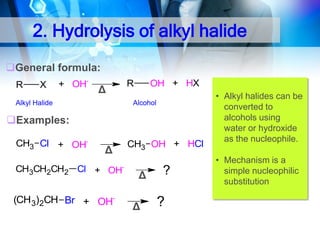
General formula:
R

X

+ OH-

Δ

Alkyl Halide

OH + HX

R

Alcohol

Examples:
CH3 Cl + OH-

Δ

CH3CH2CH2 Cl + OH-

(CH 3)2CH Br + OH-

CH3 OH + HCl

Δ
Δ

?

?

• Alkyl halides can be
converted to
alcohols using
water or hydroxide
as the nucleophile.
• Mechanism is a
simple nucleophilic
substitution
3. Acid catalyzed hydration of alkene
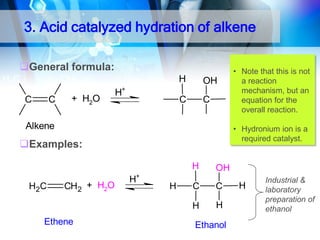
General formula:
H3C

CH3
C

H3C

C

Alkene

H

+ H2O

H+

C

H3C

OH
C
CH3

H3C

CH3

• Note that this is not
a reaction
mechanism, but an
CH3
equation for the
overall reaction.

Examples:
H
H2 C

CH 2

+ H2O

H+

OH

C

C

H
Ethene

H

• Hydronium ion is a
required catalyst.

H

Ethanol

H

Industrial &
laboratory
preparation of
ethanol
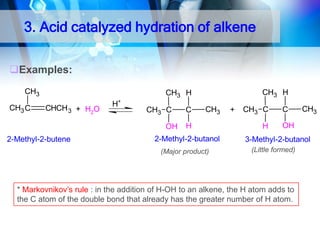
3. Acid catalyzed hydration of alkene
Examples:
CH3
CH3 C

CH3 H

CH3 H
CHCH 3 + H2O

H+

CH3 C
OH

2-Methyl-2-butene

C

CH3

H

2-Methyl-2-butanol
(Major product)

+

CH3 C
H

C

CH3

OH

3-Methyl-2-butanol
(Little formed)

* Markovnikov’s rule : in the addition of H-OH to an alkene, the H atom adds to
the C atom of the double bond that already has the greater number of H atom.
REACTION






Oxidation
Dehydration
Halogenation
Esterification
Formation of alkoxides
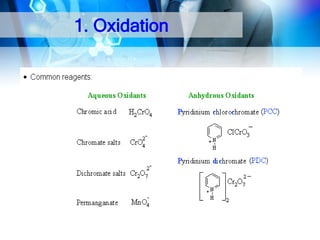
1. Oxidation
1. Oxidation
 Oxidation of 1°Alcohol to Aldehyde : RCH2-OH

[O]

RCHO

O
CH3CH 2OH + PCC
Ethanol

CH2CI2
o

25 C

CH3 C H
Ethanal
PCC: Pyridinium chlorochromate

 Oxidation of 1°Alcohol to Carboxylic Acid : RCH2-OH
O
CH3CH 2 OH
Ethanol

H2CrO4
acetone
35oC

CH3 C OH
Ethanoic Acid
O

CH3CH 2 OH
Ethanol

KMnO4/ H+

CH3 C OH
Ethanoic Acid

[O]

RCOOH
1. Oxidation
O

OH

 Oxidation of 2°Alcohol to Ketone :

R CHR'

[O]

O

OH
CH3CHCH2 CH3

H2CrO4
acetone
35oC

CH3CCH2CH3
2-Butanone

2-Butanol

O

OH
KMnO4/H+

cyclohexanol

cyclohexanone

R C R'
1. Oxidation
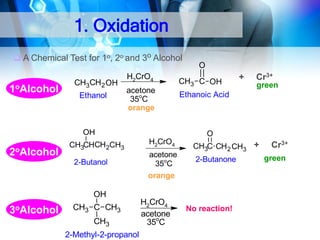
 A Chemical Test for 1o, 2o and 3o Alcohol

1oAlcohol

CH3CH 2 OH
Ethanol

H2CrO4
acetone
35oC
orange

OH

2oAlcohol

CH3CHCH 2CH3
2-Butanol

O

CH3 C OH

3oAlcohol

CH3 C CH3
CH3
2-Methyl-2-propanol

Cr3+
green

Ethanoic Acid

O
H2CrO4
acetone
35oC

CH3C CH 2 CH3 +
2-Butanone

orange

OH

+

H2CrO4
acetone
35oC

No reaction!

Cr3+
green
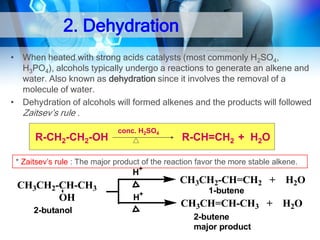
2. Dehydration
• When heated with strong acids catalysts (most commonly H2SO4,
H3PO4), alcohols typically undergo a reactions to generate an alkene and
water. Also known as dehydration since it involves the removal of a
molecule of water.
• Dehydration of alcohols will formed alkenes and the products will followed
Zaitsev’s rule .

R-CH2-CH2-OH

conc. H2SO4

R-CH=CH2 + H2O

* Zaitsev’s rule : The major product of the reaction favor the more stable alkene.
+

H

CH3CH2-CH-CH3
OH
2-butanol

CH3CH2-CH=CH2 + H2O
+

H

1-butene

CH3CH=CH-CH3 + H2O
2-butene
major product
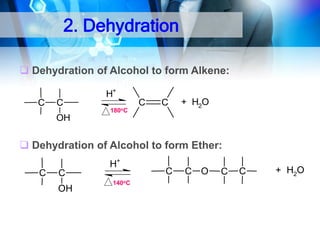
2. Dehydration
 Dehydration of Alcohol to form Alkene:
H3C
H3C

C
H3C

CH3
C

H+
CH3

OH

H3C

CH3
C

C

180oC

H3C

+ H2O
CH3

 Dehydration of Alcohol to form Ether:
H3C

H3C

C
H3C

CH3
C

OH

H+
CH3

140oC

H3C

H3C

C
H3C

CH3

CH3 CH3

C O

C

OH

CH3CH3

C

CH3+ H2O
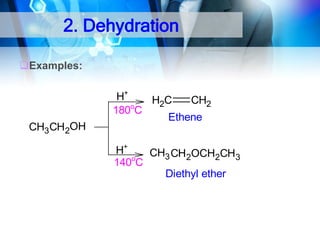
2. Dehydration
Examples:

CH3 CH2OH

H+
H2C
CH2
o
180 C
Ethene
H+
CH3 CH2OCH2CH3
o
140 C
Diethyl ether
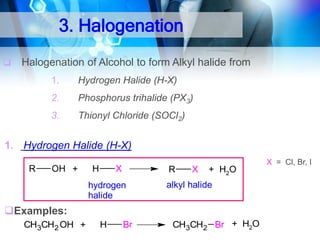
3. Halogenation


Halogenation of Alcohol to form Alkyl halide from
1.

Hydrogen Halide (H-X)

2.

Phosphorus trihalide (PX3)

3.

Thionyl Chloride (SOCl2)

1. Hydrogen Halide (H-X)
R

OH +

H

X

R

hydrogen
halide

X

+ H2O

alkyl halide

Examples:
CH3CH2 OH +

H

Br

CH3CH2 Br + H2O

X = Cl, Br, I
3. Halogenation
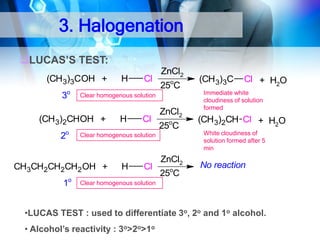
LUCAS’S TEST:
(CH 3)3COH +
3o

2

1

25oC

H

Cl

ZnCl2
o

25 C

H

Cl

(CH 3)3C

Cl + H2O

Immediate white
cloudiness of solution
formed

(CH 3)2CH Cl + H2O
White cloudiness of
solution formed after 5
min

Clear homogenous solution

CH3CH2CH2CH2 OH +
o

Cl

Clear homogenous solution

(CH 3)2CHOH +
o

H

ZnCl2

ZnCl2
o

25 C

No reaction

Clear homogenous solution

•LUCAS TEST : used to differentiate 3o, 2o and 1o alcohol.
• Alcohol’s reactivity : 3o>2o>1o
3. Halogenation
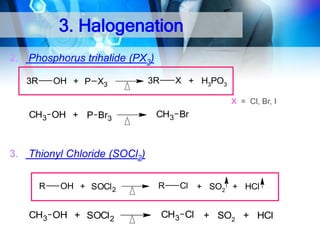
2. Phosphorus trihalide (PX3)
3R

OH + P X3

3R

X + H3PO3
X = Cl, Br, I

CH3 OH + P Br3

CH3 Br

3. Thionyl Chloride (SOCl2)
R

OH + SOCl 2

CH3 OH + SOCl 2

R

Cl + SO2 + HCl

CH3 Cl + SO2 + HCl
4. Esterification
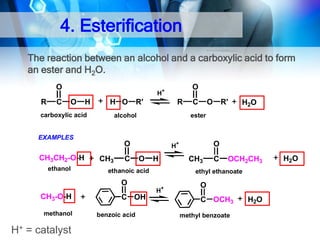
The reaction between an alcohol and a carboxylic acid to form
an ester and H2O.
O
R

C

O

H+

O

H

H O

carboxylic acid

ethanol

O
CH3

C

methanol

H+ = catalyst

O

R'

H2O

O

H+

O

H

ethanoic acid

C OH
benzoic acid

C
ester

O
CH3-O-H

R

alcohol

EXAMPLES

CH3CH2-O-H

R'

CH3

C

OCH2CH3

ethyl ethanoate
H+

O
C OCH3
methyl benzoate

H2O

H2O
4. Esterification
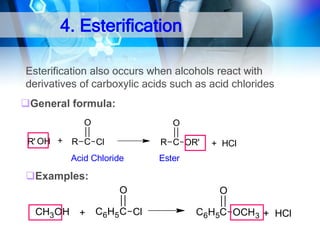
Esterification also occurs when alcohols react with
derivatives of carboxylic acids such as acid chlorides

General formula:
O
R' OH +

O

R C Cl

R C OR'

Acid Chloride

Ester

+ HCl

Examples:
O
CH3 OH

+

C6H5 C Cl

O
C6H5C OCH3 + HCl
5. Formation of alkoxides
General formula:
2R

OH + 2Na

- +
2RO Na

+ H2

alkoxide salt

2R

OH + 2K

- +
2RO K
alkoxide salt

R

OH + NaOH

+ H2

no reaction

1o>2o>3o alcohol
* Reactivity towards active metal:
End of Chapter 1…
Thank you

Chapter 1 alcohol

  • 1.
    CHAPTER 1: ALCOHOLS NORFAZRIN MOHDHANIF FACULTY OF APPLIED SCIENCE UITM NEGERI SEMBILAN
  • 2.
    SUBTOPICS Nomenclature – common andIUPAC names for alcohols & phenols Classification of alcohol as 1°, 2°, and 3°. Physical properties of alcohol. Preparation of alcohol –Grignard synthesis –Hydrolysis of alkyl halides –Industrial and laboratory preparations of ethyl alcohol Reactions of alcohol –Oxidation –Esterification –Dehydration –Halogenation –Formation of alkoxides
  • 3.
    INTRODUCTION  Alcohols arecompounds whose molecules have a hydroxyl group (-OH) attached to:  saturated C atom of a simple alkyl group CH3 OH Methanol CH3 CH2 OH Ethanol OH CH3 CH2 CH3 2-Propanol  unsaturated C atom of an alkenyl or alkynyl group HC CH CH2 OH H2C CH CH2 OH 2-Propynol 2-Propenol  Compounds that have –OH group attached directly to a benzene ring are called phenol Phenol OH
  • 4.
    CLASSIFICATION • According tothe type of carbinol carbon atom (C bonded to the –OH group). C OH Classes: i) Primary alcohol - -OH group attached to a primary carbon atom - one or no alkyl group attached to the carbon bonded to the –OH group ii) Secondary alcohol - -OH group attached to a secondary carbon atom - two alkyl group attached to the carbon bonded to the –OH group iii) Tertiary alcohol - -OH group attached to a tertiary carbon atom - three alkyl group attached to the carbon bonded to the –OH group
  • 5.
    CLASSIFICATION Primary (1°) Alcohol H H H C C H H H H OH H Tertiary(3°) Alcohol H H H H C H H C C C H OH H H H H C C C H H C Secondary (2°) Alcohol OH H H
  • 6.
    CLASSIFICATION Polyhydroxy Alcohols • Alcoholsthat contain more than one OH group attached to different carbons are called polyhydroxy alcohols. • Monohydroxy: one OH group per molecule. • Dihydroxy: two OH groups per molecule. • Trihydroxy: three OH groups per molecule.
  • 7.
    NOMENCLATURE Select 1 continuous thelongest chain of carbon 2 atoms containing –-OH . a. IUPAC names b. Common names 3 Change the name of the alkane corresponding to this chain by dropping the final-e and adding the suffix –ol. Number the parent chain to give the -OH group the lowest possible number. Name the alkyl group followed by the word alcohol
  • 8.
    NOMENCLATURE  Examples OH OH IUPAC : 1-Propanol COMMON:(Propyl alcohol) OH 2-Propan ol (Isoprop yl alcoh ol) OH OH IUPAC : 2-Butanol COMMON:(s ec-Butyl alcohol) 2-Meth yl-1-p ropan ol (Isobutyl alcohol) 1-Bu tanol (Bu tyl alcoh ol) OH 2-Meth yl-2-p ropan ol (tert -Butyl alcohol)
  • 9.
    NOMENCLATURE  Compounds containingmore than one -OH group are named diols, triols, etc. CH3 CH CH2 CH2 CH2 HO OH O H OH 1,2-Ethanediol (Ethylene glycol) 1,2-Propanediol (Propylene glycol) CH2 CH CH2 H O H O OH 1,2,3-Propanetriol (Glycerol, Glycerine)
  • 10.
    NOMENCLATURE  Unsaturated alcohols Name compounds containing a double bond and an alcohol group as alkenol.  Give the alcohol carbon the lower number.  Examples: CH3 OH H3C C CH CH CH3 H2C CH CH CH3 OH 3-Buten-2-ol 4-Methyl-3-penten-2-ol
  • 11.
    NOMENCLATURE  Unsaturated alcohols Name compounds containing a triple bond and an alcohol group as alkynol.  Give the alcohol carbon the lower number.  Examples: OH HC C CH2CH2 OH 3-Butyn-1-ol H3C C CH 2 C CH CH3 2-Methyl-4-Pentyn-2-ol
  • 12.
    NOMENCLATURE - Phenol Phenols is the parent name & the substituent is simply indicated by prefix. COMMON: IUPAC: phenol 3-Bromophenol 2-Methylphenol
  • 13.
  • 14.
    PHYSICAL PROPERTIES • PHYSICALSTATES OF ALCOHOLS - simple aliphatic alcohols and lower aromatic alcohols (such as phenylmethanol, C6H5CH2OH) → liquids at room temperature. - highly branched alcohols and alcohols with twelve or more carbon atoms → solids.
  • 15.
    PHYSICAL PROPERTIES  Alcoholsare polar compounds + + O H ……………......... O hydrogen bonding +C H H H H +C H H H they interact with themselves and with other polar compounds by dipole-dipole interactions  Dipole-dipole interaction: the attraction between the positive end of one dipole and the negative end of another
  • 16.
    PHYSICAL PROPERTIES  Hydrogenbonding: when the positive end of one dipole is a H bonded to F, O, or N (atoms of high electronegativity) and the other end is F, O, or N ▫ the strength of hydrogen bonding in water is approximately 21 kJ (5 kcal)/mol ▫ hydrogen bonds are considerably weaker than covalent bonds ▫ nonetheless, they can have a significant effect on physical properties
  • 17.
    Boiling point &solubility  In relation to alkanes of comparable size and molecular weight, alcohols – have higher boiling points – are more soluble in water  The presence of additional -OH groups in a molecule further increases solubility in water and boiling point
  • 18.
    A. Solubility i) Alcoholswith short carbon chains (such as methanol, ethanol, and propanol) dissolve in water. - when alcohols dissolve in water, hydrogen bonds are formed between the –OH group of the alcohol molecule and the –OH group of the water molecule. ii) The solubility of alcohols in water decreases sharply with the increasing length of the carbon chain. Higher alcohols are insoluble in water. - alcohol contains a polar end (-OH group) called ‘hydrophilic’ and a non-polar end (the alkyl group) called ‘hydrophobic’. - the water solubility decreases as the alkyl group becomes larger.
  • 19.
    A. Solubility iii) alcoholswith more than one hydroxyl group (polyhydroxy alcohols) are more soluble than monohydroxy alcohols with the same number of carbon atoms. This is because they can form more hydrogen bonds with water molecule. iv) branched hydrocarbon increases the solubility of alcohol in water. - reason: branched hydrocarbon cause the hydrophobic region becomes compact. * Phenol is unusually soluble (9.3%) because of its compact shape and the particularly strong hydrogen bonds formed between phenolic –OH groups and water molecules.
  • 20.
    A. Solubility  Usebasic solubility rule: “like dissolves like”  Each alcohol consists of a nonpolar carbon chain (hydrophobic part) and a polar OH group (hydrophilic part). As water is polar, it attracts OH group while carbon chain on the other hand as nonpolar is repelled. Solubility of alcohols is determined by the stronger of the two forces.  Another factor in understanding solubility is the capability to form hydrogen bonding to water. + O H H δ+ ………….. H O +C H H H hydrogen bonding
  • 21.
    A. Solubility MW bp (°C) Solubility in Water StructuralFormula Name CH3 OH Methanol Ethane 32 30 65 -89 Infinite Insoluble CH3 CH2 CH3 Ethanol Propane 46 44 78 -42 Infinite Insoluble CH3 CH2 CH2 OH CH3 CH2 CH2 CH3 1-Propanol Butane 60 58 97 0 Infinite Insoluble CH3 ( CH 2 ) 2 CH 2 OH 1-Butanol Pentane 74 72 117 36 8 g/100 g Insoluble 90 88 86 230 138 69 Infinite 2.3 g/100 g Insoluble CH3 CH3 CH3 CH2 OH CH3 ( CH 2 ) 3 CH 3 HOCH2 ( CH2 ) 2 CH2 OH 1,4-Butanediol CH3 ( CH 2 ) 3 CH 2 OH 1-Pentanol CH3 ( CH 2 ) 4 CH 3 Hexane
  • 22.
    B. Boiling point i)The boiling points of alcohols are higher than those of alkanes and chloroalkanes of similar relative molecular mass. - For example: C2H5OH CH3CH2CH3 CH3Cl Relative molecular mass: 46 44 50.5 Boiling point: 78°C -42°C -24°C - Reason: * intermolecular hydrogen bonds exist between the –OH groups in the alcohol molecules. R δ- O H Ar δ+ H hydrogen bonding O R O δ- δ- H δ+ H Ar O hydrogen bonding δ- ii) Branched chain alcohols boils at a lower temperature (more volatile) than the straight chain alcohols with the same number of carbon atoms.
  • 23.
    B. Boiling point CH3CH2OH Ethanol bp 78° C CH3OCH3 Dimethyl ether bp -24°C CH3CH3 Ethane bp -89°C • Their boiling points are dramatically different – ethanol forms intermolecular hydrogen bonds which increase attractive forces between its molecules resulting in a higher boiling point – there is no comparable attractive force between molecules of dimethyl ether & ethane.
  • 24.
  • 25.
    C. Acidity • Alcoholis weakly acidic. • In aqueous solution, alcohol will donated its proton to water molecule to give an alkoxide ion (R-O-). R-OH + H2O R-O- + H3O+ Ka = ~ 10-16 to 10-18 alkoxide ion Example CH3CH2-OH + H2O  CH3CH2-O- + H3O+ The acid-dissociation constant, Ka, of an alcohol is defined by the equilibrium K a Ka = [H3O+] [RO-] R-OH + H2O [ROH] R-O- + H3O+ pKa = - log (Ka) * More smaller the pKa value, the alcohol is more acidic
  • 26.
    C. Acidity  Alcoholis weakly acidic.  In aqueous solution, alcohol will donated its proton to water molecule to give an alkoxide ion (R-O-). CH3 O H + :O H H Ka = + CH3 O: + H O H alkoxide ion H [ CH3 O-] [H3 O+ ] [ CH3 OH] – = 1 0 - 15 .5 pKa = 1 5 .5 pKa decrease, acidity increase
  • 27.
    C. Acidity Compoun d Structural Formula pKa Hyd rogen ch loride HCl -7 A cetic acid CH3 COOH Meth anol CH3 OH 15.5 Water Ethanol H2 O 15.7 CH3 CH 2 OH 15.9 2-Prop anol ( CH3 ) 2 CHOH 17 2-Methyl-2-prop anol ( CH3 ) 3 COH 18 4.8 Stronger acid Weaker acid *A lso given for comparison are pK a values for w ater, acetic acid, an d hydrogen chloride.
  • 28.
    C. Acidity H 2O Water pKa= 15.7 CH3OH Methanol pKa = 15.5 CH3CH2OH Ethanol pKa = 15.9 CH3CH2(OH)CH3 2-Propanol pKa = 17.0  Acidity depends primarily on the degree of stabilization and solvation of the alkoxide ion ▫ the negatively charged oxygens of methanol and ethanol are about as accessible as hydroxide ion for solvation; these alcohol are about as acidic as water ▫ as the bulk of the alkyl group increases, the ability of water to solvate the alkoxide decreases, the acidity of the alcohol decreases, and the basicity of the alkoxide ion increases
  • 29.
    C. Acidity ofphenols • Phenol is a stronger acid than alcohols and water. R-OH + H2O alcohol OH R-O- + H3O+ Ka = ~ 10-16 to 10-18 alkoxide ion H2O phenol H 2 O + H2 O O- H3O+ Ka = 1.2 x 10⁻¹⁰ phenoxide ion HO- + H3O+ Ka = 1.8 x 10⁻¹⁶ hydroxide ion Phenol is more acidic than alcohols by considering the resonance effect.
  • 30.
    C. Acidity ofphenols ii) The phenoxide ion - one of the lone pairs of electrons on the oxygen atom is delocalised into the benzene ring. - the phenoxide ion is more stable than the alkoxide ion because the negative charge is not confined to the oxygen atom but delocalised into the benzene ring. - the phenoxide ion is resonance stabilised by the benzene ring and this decreases the tendency for the phenoxide ion to react with H3O+. O O O O
  • 31.
    C. Acidity i) Thealkoxide ion (RO-) - the negative charge is confined to the oxygen and is not spread over the alkyl group. - this makes the RO- ion less stable and more susceptible to attack by positive ions such as H+ ions.
  • 32.
    PREPARATION  Grignard Synthesis Hydrolysis of alkyl halides  Acid-catalyzed Hydration of alkenes
  • 33.
    1.Grignard Synthesis • Thegrignard reagent (RMgX) is prepared by the reaction of metallic magnesium with the appropriate organic halide. This reaction is always carried out in an ether solvent, which is needed to solvate and stabilize the Grignard reagent as it forms. R-X + Mg (X = Cl, Br or I)   CH3CH2OCH2CH3 R-Mg-X organomagnesium halide (Grignard reagent) Grignard reagents may be made from primary, secondary, and tertiary alkyl halides, as well as from vinyl and aryl halides. Alkyl iodides are the most reactive halides, followed by bromides and chlorides. Alkyl fluorides generally do not react.
  • 34.
  • 35.
    1.Grignard Synthesis General formula: R MgX+ Grignard reagent C O • Grignard reagents act as nucleophiles toward the carbonyl group CH3 H3C Ether H3O+ H3C Carbonyl compound R OH C CH3 alcohol  Grignard Reagents react with Formaldehyde to give a 1° alcohol H H CH 3CH 2 MgBr + alkyl halide C O Ether H3O+ CH 3CH 2 C H H alcohol OH
  • 36.
    1.Grignard Synthesis  GrignardReagents react with all other aldehyde to give a 2° alcohol + C R MgX R' R' R' O Ether R C H O MgX H3O+ R C OH H H 2o alcohol aldehyde  Grignard Reagents react with ketone to give a 3° alcohol R' R MgX + C R'' Ketone R' R' O Ether R C O MgX NH4Cl R C H2O R'' R'' 3o alcohol OH
  • 37.
    2. Hydrolysis ofalkyl halide General formula: R X + OH- Δ Alkyl Halide OH + HX R Alcohol Examples: CH3 Cl + OH- Δ CH3CH2CH2 Cl + OH- (CH 3)2CH Br + OH- CH3 OH + HCl Δ Δ ? ? • Alkyl halides can be converted to alcohols using water or hydroxide as the nucleophile. • Mechanism is a simple nucleophilic substitution
  • 38.
    3. Acid catalyzedhydration of alkene General formula: H3C CH3 C H3C C Alkene H + H2O H+ C H3C OH C CH3 H3C CH3 • Note that this is not a reaction mechanism, but an CH3 equation for the overall reaction. Examples: H H2 C CH 2 + H2O H+ OH C C H Ethene H • Hydronium ion is a required catalyst. H Ethanol H Industrial & laboratory preparation of ethanol
  • 39.
    3. Acid catalyzedhydration of alkene Examples: CH3 CH3 C CH3 H CH3 H CHCH 3 + H2O H+ CH3 C OH 2-Methyl-2-butene C CH3 H 2-Methyl-2-butanol (Major product) + CH3 C H C CH3 OH 3-Methyl-2-butanol (Little formed) * Markovnikov’s rule : in the addition of H-OH to an alkene, the H atom adds to the C atom of the double bond that already has the greater number of H atom.
  • 40.
  • 41.
  • 42.
    1. Oxidation  Oxidationof 1°Alcohol to Aldehyde : RCH2-OH [O] RCHO O CH3CH 2OH + PCC Ethanol CH2CI2 o 25 C CH3 C H Ethanal PCC: Pyridinium chlorochromate  Oxidation of 1°Alcohol to Carboxylic Acid : RCH2-OH O CH3CH 2 OH Ethanol H2CrO4 acetone 35oC CH3 C OH Ethanoic Acid O CH3CH 2 OH Ethanol KMnO4/ H+ CH3 C OH Ethanoic Acid [O] RCOOH
  • 43.
    1. Oxidation O OH  Oxidationof 2°Alcohol to Ketone : R CHR' [O] O OH CH3CHCH2 CH3 H2CrO4 acetone 35oC CH3CCH2CH3 2-Butanone 2-Butanol O OH KMnO4/H+ cyclohexanol cyclohexanone R C R'
  • 44.
    1. Oxidation  AChemical Test for 1o, 2o and 3o Alcohol 1oAlcohol CH3CH 2 OH Ethanol H2CrO4 acetone 35oC orange OH 2oAlcohol CH3CHCH 2CH3 2-Butanol O CH3 C OH 3oAlcohol CH3 C CH3 CH3 2-Methyl-2-propanol Cr3+ green Ethanoic Acid O H2CrO4 acetone 35oC CH3C CH 2 CH3 + 2-Butanone orange OH + H2CrO4 acetone 35oC No reaction! Cr3+ green
  • 45.
    2. Dehydration • Whenheated with strong acids catalysts (most commonly H2SO4, H3PO4), alcohols typically undergo a reactions to generate an alkene and water. Also known as dehydration since it involves the removal of a molecule of water. • Dehydration of alcohols will formed alkenes and the products will followed Zaitsev’s rule . R-CH2-CH2-OH conc. H2SO4 R-CH=CH2 + H2O * Zaitsev’s rule : The major product of the reaction favor the more stable alkene. + H CH3CH2-CH-CH3 OH 2-butanol CH3CH2-CH=CH2 + H2O + H 1-butene CH3CH=CH-CH3 + H2O 2-butene major product
  • 46.
    2. Dehydration  Dehydrationof Alcohol to form Alkene: H3C H3C C H3C CH3 C H+ CH3 OH H3C CH3 C C 180oC H3C + H2O CH3  Dehydration of Alcohol to form Ether: H3C H3C C H3C CH3 C OH H+ CH3 140oC H3C H3C C H3C CH3 CH3 CH3 C O C OH CH3CH3 C CH3+ H2O
  • 47.
    2. Dehydration Examples: CH3 CH2OH H+ H2C CH2 o 180C Ethene H+ CH3 CH2OCH2CH3 o 140 C Diethyl ether
  • 48.
    3. Halogenation  Halogenation ofAlcohol to form Alkyl halide from 1. Hydrogen Halide (H-X) 2. Phosphorus trihalide (PX3) 3. Thionyl Chloride (SOCl2) 1. Hydrogen Halide (H-X) R OH + H X R hydrogen halide X + H2O alkyl halide Examples: CH3CH2 OH + H Br CH3CH2 Br + H2O X = Cl, Br, I
  • 49.
    3. Halogenation LUCAS’S TEST: (CH3)3COH + 3o 2 1 25oC H Cl ZnCl2 o 25 C H Cl (CH 3)3C Cl + H2O Immediate white cloudiness of solution formed (CH 3)2CH Cl + H2O White cloudiness of solution formed after 5 min Clear homogenous solution CH3CH2CH2CH2 OH + o Cl Clear homogenous solution (CH 3)2CHOH + o H ZnCl2 ZnCl2 o 25 C No reaction Clear homogenous solution •LUCAS TEST : used to differentiate 3o, 2o and 1o alcohol. • Alcohol’s reactivity : 3o>2o>1o
  • 50.
    3. Halogenation 2. Phosphorustrihalide (PX3) 3R OH + P X3 3R X + H3PO3 X = Cl, Br, I CH3 OH + P Br3 CH3 Br 3. Thionyl Chloride (SOCl2) R OH + SOCl 2 CH3 OH + SOCl 2 R Cl + SO2 + HCl CH3 Cl + SO2 + HCl
  • 51.
    4. Esterification The reactionbetween an alcohol and a carboxylic acid to form an ester and H2O. O R C O H+ O H H O carboxylic acid ethanol O CH3 C methanol H+ = catalyst O R' H2O O H+ O H ethanoic acid C OH benzoic acid C ester O CH3-O-H R alcohol EXAMPLES CH3CH2-O-H R' CH3 C OCH2CH3 ethyl ethanoate H+ O C OCH3 methyl benzoate H2O H2O
  • 52.
    4. Esterification Esterification alsooccurs when alcohols react with derivatives of carboxylic acids such as acid chlorides General formula: O R' OH + O R C Cl R C OR' Acid Chloride Ester + HCl Examples: O CH3 OH + C6H5 C Cl O C6H5C OCH3 + HCl
  • 53.
    5. Formation ofalkoxides General formula: 2R OH + 2Na - + 2RO Na + H2 alkoxide salt 2R OH + 2K - + 2RO K alkoxide salt R OH + NaOH + H2 no reaction 1o>2o>3o alcohol * Reactivity towards active metal:
  • 54.
    End of Chapter1… Thank you