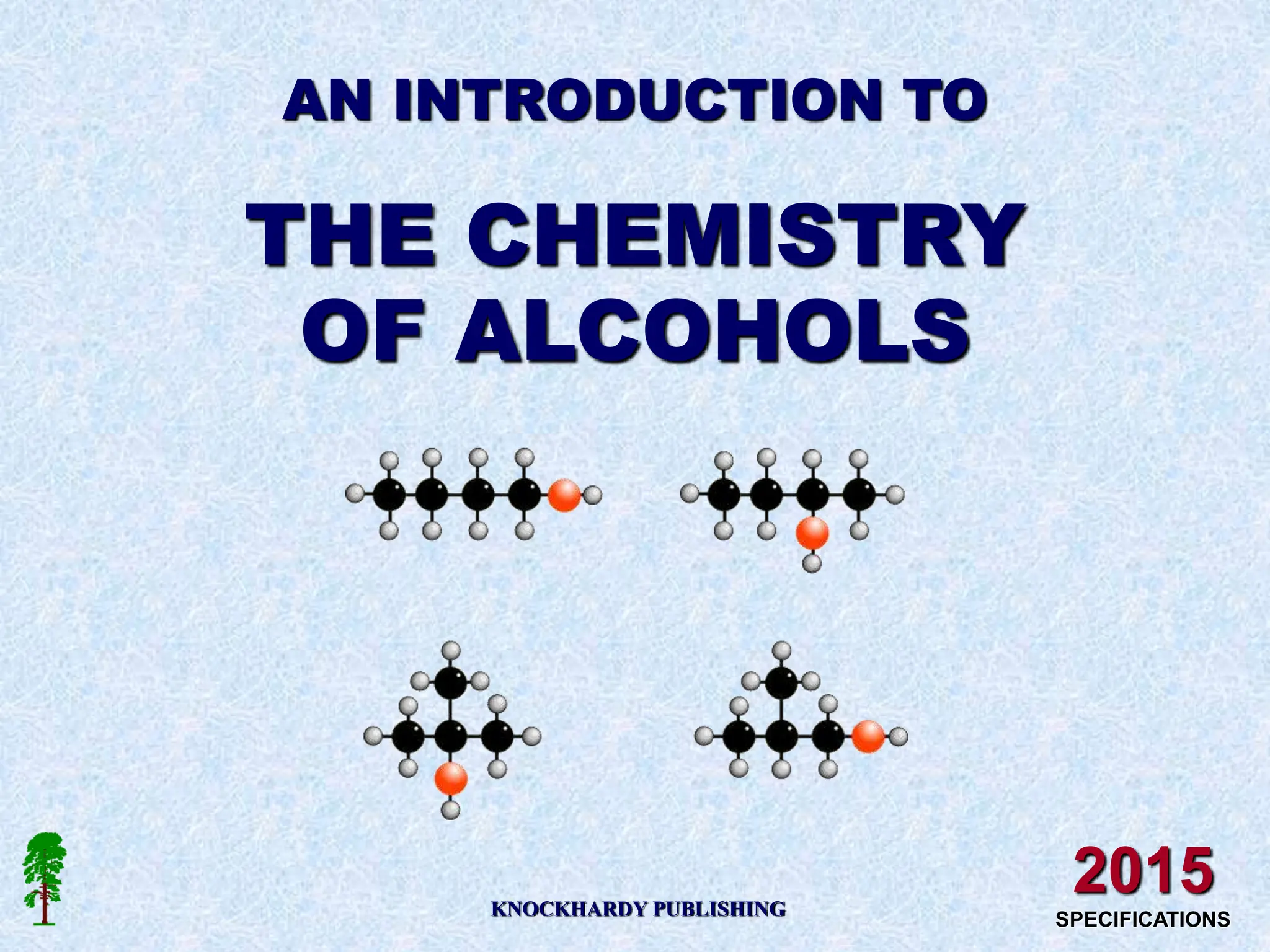
AN INTRODUCTION TO
THE CHEMISTRY
OF ALCOHOLS
KNOCKHARDY PUBLISHING
2015
SPECIFICATIONS
INTRODUCTION
This Powerpoint show is one of several produced to help students
understand selected topics at AS and A2 level Chemistry. It is based on the
requirements of the AQA and OCR specifications but is suitable for other
examination boards.
Individual students may use the material at home for revision purposes or it
may be used for classroom teaching.
Accompanying notes on this, and the full range of AS and A2 topics, are
available from the KNOCKHARDY SCIENCE WEBSITE at...
www.knockhardy.org.uk/sci.htm
Navigation is achieved by...
either clicking on the grey arrows at the foot of each page
or using the left and right arrow keys on the keyboard
KNOCKHARDY PUBLISHING
THE CHEMISTRY OF ALCOHOLS
CONTENTS
• Structure and classification of alcohols
• Nomenclature
• Isomerism
• Physical properties
• Chemical properties of alcohols
• Identification using infra-red spectroscopy
• Industrial preparation and uses of ethanol
• Revision check list
THE CHEMISTRY OF ALCOHOLS
Before you start it would be helpful to…
• Recall the definition of a covalent bond
• Recall the difference types of physical bonding
• Be able to balance simple equations
• Be able to write out structures for simple organic molecules
• Understand the IUPAC nomenclature rules for simple organic compounds
• Recall the chemical properties of alkanes and alkenes
THE CHEMISTRY OF ALCOHOLS
CLASSIFICATION OF ALCOHOLS
Aliphatic • general formula CnH2n+1OH - provided there are no rings
• the OH replaces an H in a basic hydrocarbon skeleton
CLASSIFICATION OF ALCOHOLS
Aliphatic • general formula CnH2n+1OH - provided there are no rings
• the OH replaces an H in a basic hydrocarbon skeleton
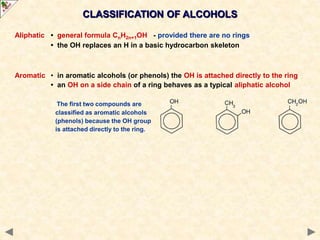
Aromatic • in aromatic alcohols (or phenols) the OH is attached directly to the ring
• an OH on a side chain of a ring behaves as a typical aliphatic alcohol
The first two compounds are
classified as aromatic alcohols
(phenols) because the OH group
is attached directly to the ring.
CLASSIFICATION OF ALCOHOLS
Aliphatic • general formula CnH2n+1OH - provided there are no rings
• the OH replaces an H in a basic hydrocarbon skeleton
Aromatic • in aromatic alcohols (or phenols) the OH is attached directly to the ring
• an OH on a side chain of a ring behaves as a typical aliphatic alcohol
The first two compounds are
classified as aromatic alcohols
(phenols) because the OH group
is attached directly to the ring.
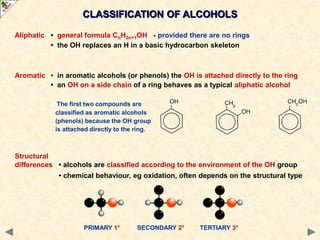
Structural
differences • alcohols are classified according to the environment of the OH group
• chemical behaviour, eg oxidation, often depends on the structural type
PRIMARY 1° SECONDARY 2° TERTIARY 3°
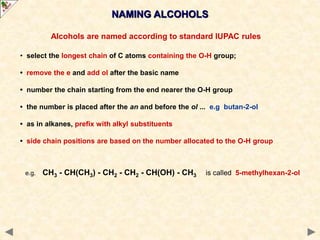
Alcohols are named according to standard IUPAC rules
• select the longest chain of C atoms containing the O-H group;
• remove the e and add ol after the basic name
• number the chain starting from the end nearer the O-H group
• the number is placed after the an and before the ol ... e.g butan-2-ol
• as in alkanes, prefix with alkyl substituents
• side chain positions are based on the number allocated to the O-H group
e.g. CH3 - CH(CH3) - CH2 - CH2 - CH(OH) - CH3 is called 5-methylhexan-2-ol
NAMING ALCOHOLS
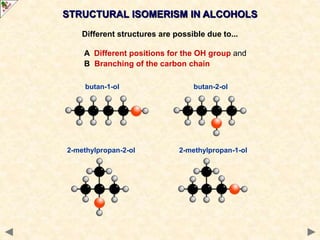
STRUCTURAL ISOMERISM IN ALCOHOLS
Different structures are possible due to...
A Different positions for the OH group and
B Branching of the carbon chain
butan-1-ol butan-2-ol
2-methylpropan-1-ol
2-methylpropan-2-ol
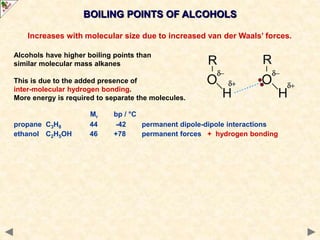
BOILING POINTS OF ALCOHOLS
Increases with molecular size due to increased van der Waals’ forces.
Alcohols have higher boiling points than
similar molecular mass alkanes
This is due to the added presence of
inter-molecular hydrogen bonding.
More energy is required to separate the molecules.
Mr bp / °C
propane C3H8 44 -42 permanent dipole-dipole interactions
ethanol C2H5OH 46 +78 permanent forces + hydrogen bonding
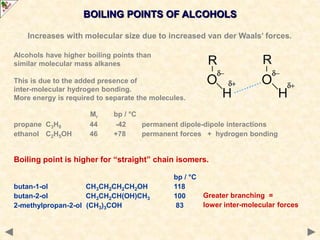
BOILING POINTS OF ALCOHOLS
Increases with molecular size due to increased van der Waals’ forces.
Alcohols have higher boiling points than
similar molecular mass alkanes
This is due to the added presence of
inter-molecular hydrogen bonding.
More energy is required to separate the molecules.
Mr bp / °C
propane C3H8 44 -42 permanent dipole-dipole interactions
ethanol C2H5OH 46 +78 permanent forces + hydrogen bonding
Boiling point is higher for “straight” chain isomers.
bp / °C
butan-1-ol CH3CH2CH2CH2OH 118
butan-2-ol CH3CH2CH(OH)CH3 100
2-methylpropan-2-ol (CH3)3COH 83
Greater branching =
lower inter-molecular forces
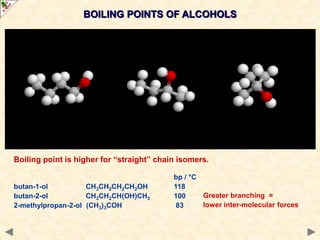
BOILING POINTS OF ALCOHOLS
Increases with molecular size due to increased van der Waals’ forces.
Alcohols have higher boiling points than
similar molecular mass alkanes
This is due to the added presence of
inter-molecular hydrogen bonding.
More energy is required to separate the molecules.
Mr bp / °C
propane C3H8 44 -42 just van der Waals’ forces
ethanol C2H5OH 46 +78 van der Waals’ forces + hydrogen bonding
Boiling point is higher for “straight” chain isomers.
bp / °C
butan-1-ol CH3CH2CH2CH2OH 118
butan-2-ol CH3CH2CH(OH)CH3 100
2-methylpropan-2-ol (CH3)3COH 83
Greater branching =
lower inter-molecular forces
SOLVENT PROPERTIES OF ALCOHOLS
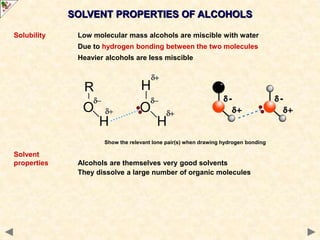
Solubility Low molecular mass alcohols are miscible with water
Due to hydrogen bonding between the two molecules
Heavier alcohols are less miscible
Solvent
properties Alcohols are themselves very good solvents
They dissolve a large number of organic molecules
Show the relevant lone pair(s) when drawing hydrogen bonding
CHEMICAL PROPERTIES OF ALCOHOLS
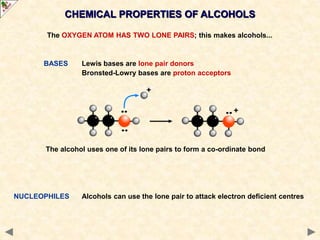
The OXYGEN ATOM HAS TWO LONE PAIRS; this makes alcohols...
BASES Lewis bases are lone pair donors
Bronsted-Lowry bases are proton acceptors
The alcohol uses one of its lone pairs to form a co-ordinate bond
NUCLEOPHILES Alcohols can use the lone pair to attack electron deficient centres
ELIMINATION OF WATER (DEHYDRATION)
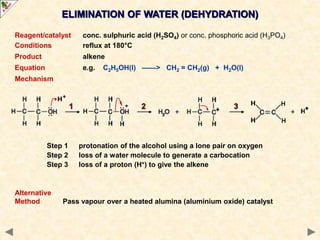
Reagent/catalyst conc. sulphuric acid (H2SO4) or conc. phosphoric acid (H3PO4)
Conditions reflux at 180°C
Product alkene
Equation e.g. C2H5OH(l) ——> CH2 = CH2(g) + H2O(l)
Mechanism
Step 1 protonation of the alcohol using a lone pair on oxygen
Step 2 loss of a water molecule to generate a carbocation
Step 3 loss of a proton (H+) to give the alkene
Alternative
Method Pass vapour over a heated alumina (aluminium oxide) catalyst
ELIMINATION OF WATER (DEHYDRATION)
MECHANISM
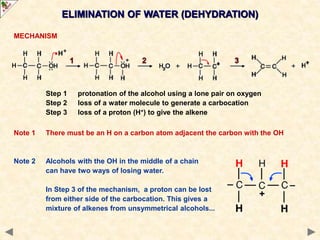
Step 1 protonation of the alcohol using a lone pair on oxygen
Step 2 loss of a water molecule to generate a carbocation
Step 3 loss of a proton (H+) to give the alkene
Note 1 There must be an H on a carbon atom adjacent the carbon with the OH
Note 2 Alcohols with the OH in the middle of a chain
can have two ways of losing water.
In Step 3 of the mechanism, a proton can be lost
from either side of the carbocation. This gives a
mixture of alkenes from unsymmetrical alcohols...
OXIDATION OF ALCOHOLS
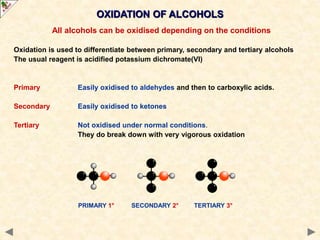
All alcohols can be oxidised depending on the conditions
Oxidation is used to differentiate between primary, secondary and tertiary alcohols
The usual reagent is acidified potassium dichromate(VI)
Primary Easily oxidised to aldehydes and then to carboxylic acids.
Secondary Easily oxidised to ketones
Tertiary Not oxidised under normal conditions.
They do break down with very vigorous oxidation
PRIMARY 1° SECONDARY 2° TERTIARY 3°
OXIDATION OF PRIMARY ALCOHOLS
Primary alcohols are easily oxidised to aldehydes
e.g. CH3CH2OH(l) + [O] ——> CH3CHO(l) + H2O(l)
ethanol ethanal
it is essential to distil off the aldehyde before it gets oxidised to the acid
CH3CHO(l) + [O] ——> CH3COOH(l)
ethanal ethanoic acid
OXIDATION OF PRIMARY ALCOHOLS
Primary alcohols are easily oxidised to aldehydes
e.g. CH3CH2OH(l) + [O] ——> CH3CHO(l) + H2O(l)
ethanol ethanal
it is essential to distil off the aldehyde before it gets oxidised to the acid
CH3CHO(l) + [O] ——> CH3COOH(l)
ethanal ethanoic acid
Practical details
• the alcohol is dripped into a warm solution of acidified K2Cr2O7
• aldehydes have low boiling points - no hydrogen bonding - they distil off immediately
• if it didn’t distil off it would be oxidised to the equivalent carboxylic acid
• to oxidise an alcohol straight to the acid, reflux the mixture
compound formula intermolecular bonding boiling point
ETHANOL C2H5OH HYDROGEN BONDING 78°C
ETHANAL CH3CHO DIPOLE-DIPOLE 23°C
ETHANOIC ACID CH3COOH HYDROGEN BONDING 118°C
OXIDATION OF PRIMARY ALCOHOLS
Controlling the products
e.g. CH3CH2OH(l) + [O] ——> CH3CHO(l) + H2O(l)
then CH3CHO(l) + [O] ——> CH3COOH(l)
Aldehyde has a lower boiling point so
distils off before being oxidised further
OXIDATION TO ALDEHYDES
DISTILLATION
OXIDATION TO CARBOXYLIC ACIDS
REFLUX
Aldehyde condenses back into the
mixture and gets oxidised to the acid
OXIDATION OF SECONDARY ALCOHOLS
Secondary alcohols are easily oxidised to ketones
e.g. CH3CHOHCH3(l) + [O] ——> CH3COCH3(l) + H2O(l)
propan-2-ol propanone
The alcohol is refluxed with acidified K2Cr2O7. However, on prolonged treatment
with a powerful oxidising agent they can be further oxidised to a mixture of acids
with fewer carbon atoms than the original alcohol.
OXIDATION OF SECONDARY ALCOHOLS
Secondary alcohols are easily oxidised to ketones
e.g. CH3CHOHCH3(l) + [O] ——> CH3COCH3(l) + H2O(l)
propan-2-ol propanone
The alcohol is refluxed with acidified K2Cr2O7. However, on prolonged treatment
with a powerful oxidising agent they can be further oxidised to a mixture of acids
with fewer carbon atoms than the original alcohol.
OXIDATION OF TERTIARY ALCOHOLS
Tertiary alcohols are resistant to normal oxidation
OXIDATION OF ALCOHOLS
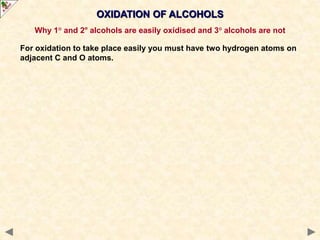
Why 1° and 2° alcohols are easily oxidised and 3° alcohols are not
For oxidation to take place easily you must have two hydrogen atoms on
adjacent C and O atoms.
OXIDATION OF ALCOHOLS
Why 1° and 2° alcohols are easily oxidised and 3° alcohols are not
For oxidation to take place easily you must have two hydrogen atoms on
adjacent C and O atoms.
H H
R C O + [O] R C O + H2O
H H
1°
OXIDATION OF ALCOHOLS
Why 1° and 2° alcohols are easily oxidised and 3° alcohols are not
For oxidation to take place easily you must have two hydrogen atoms on
adjacent C and O atoms.
H H
R C O + [O] R C O + H2O
H H
H H
R C O + [O] R C O + H2O
R R
1°
2°
OXIDATION OF ALCOHOLS
Why 1° and 2° alcohols are easily oxidised and 3° alcohols are not
For oxidation to take place easily you must have two hydrogen atoms on
adjacent C and O atoms.
H H
R C O + [O] R C O + H2O
H H
H H
R C O + [O] R C O + H2O
R R
This is possible in 1° and 2° alcohols but not in 3° alcohols.
1°
2°
OXIDATION OF ALCOHOLS
Why 1° and 2° alcohols are easily oxidised and 3° alcohols are not
For oxidation to take place easily you must have two hydrogen atoms on
adjacent C and O atoms.
H H
R C O + [O] R C O + H2O
H H
H H
R C O + [O] R C O + H2O
R R
R H
R C O + [O]
R
This is possible in 1° and 2° alcohols but not in 3° alcohols.
1°
2°
3°
ESTERIFICATION OF ALCOHOLS
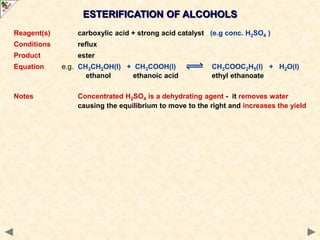
Reagent(s) carboxylic acid + strong acid catalyst (e.g conc. H2SO4 )
Conditions reflux
Product ester
Equation e.g. CH3CH2OH(l) + CH3COOH(l) CH3COOC2H5(l) + H2O(l)
ethanol ethanoic acid ethyl ethanoate
Notes Concentrated H2SO4 is a dehydrating agent - it removes water
causing the equilibrium to move to the right and increases the yield
ESTERIFICATION OF ALCOHOLS
Reagent(s) carboxylic acid + strong acid catalyst (e.g conc. H2SO4 )
Conditions reflux
Product ester
Equation e.g. CH3CH2OH(l) + CH3COOH(l) CH3COOC2H5(l) + H2O(l)
ethanol ethanoic acid ethyl ethanoate
Notes Concentrated H2SO4 is a dehydrating agent - it removes water
causing the equilibrium to move to the right and increases the yield
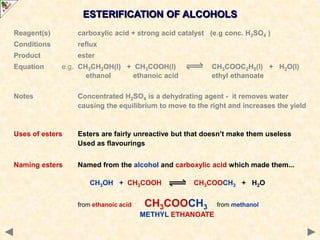
Uses of esters Esters are fairly unreactive but that doesn’t make them useless
Used as flavourings
Naming esters Named from the alcohol and carboxylic acid which made them...
CH3OH + CH3COOH CH3COOCH3 + H2O
from ethanoic acid CH3COOCH3 from methanol
METHYL ETHANOATE
OTHER REACTIONS OF ALCOHOLS
OXYGEN Alcohols make useful fuels
C2H5OH(l) + 3O2(g) ———> 2CO2(g) + 3H2O(l)
Advantages have high enthalpies of combustion
do not contain sulphur so there is less pollution
can be obtained from renewable resources
OTHER REACTIONS OF ALCOHOLS
OXYGEN Alcohols make useful fuels
C2H5OH(l) + 3O2(g) ———> 2CO2(g) + 3H2O(l)
Advantages have high enthalpies of combustion
do not contain sulphur so there is less pollution
can be obtained from renewable resources
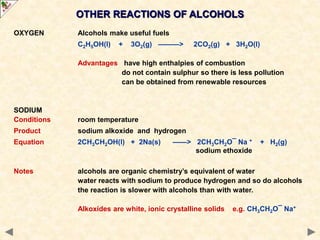
SODIUM
Conditions room temperature
Product sodium alkoxide and hydrogen
Equation 2CH3CH2OH(l) + 2Na(s) ——> 2CH3CH2O¯ Na + + H2(g)
sodium ethoxide
Notes alcohols are organic chemistry’s equivalent of water
water reacts with sodium to produce hydrogen and so do alcohols
the reaction is slower with alcohols than with water.
Alkoxides are white, ionic crystalline solids e.g. CH3CH2O¯ Na+
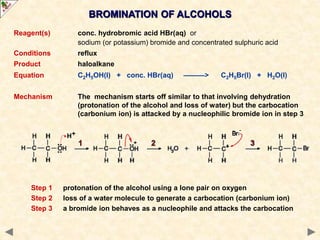
BROMINATION OF ALCOHOLS
Reagent(s) conc. hydrobromic acid HBr(aq) or
sodium (or potassium) bromide and concentrated sulphuric acid
Conditions reflux
Product haloalkane
Equation C2H5OH(l) + conc. HBr(aq) ———> C2H5Br(l) + H2O(l)
Mechanism The mechanism starts off similar to that involving dehydration
(protonation of the alcohol and loss of water) but the carbocation
(carbonium ion) is attacked by a nucleophilic bromide ion in step 3
Step 1 protonation of the alcohol using a lone pair on oxygen
Step 2 loss of a water molecule to generate a carbocation (carbonium ion)
Step 3 a bromide ion behaves as a nucleophile and attacks the carbocation
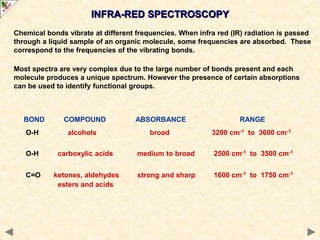
INFRA-RED SPECTROSCOPY
Chemical bonds vibrate at different frequencies. When infra red (IR) radiation is passed
through a liquid sample of an organic molecule, some frequencies are absorbed. These
correspond to the frequencies of the vibrating bonds.
Most spectra are very complex due to the large number of bonds present and each
molecule produces a unique spectrum. However the presence of certain absorptions
can be used to identify functional groups.
BOND COMPOUND ABSORBANCE RANGE
O-H alcohols broad 3200 cm-1 to 3600 cm-1
O-H carboxylic acids medium to broad 2500 cm-1 to 3500 cm-1
C=O ketones, aldehydes strong and sharp 1600 cm-1 to 1750 cm-1
esters and acids
INFRA-RED SPECTROSCOPY
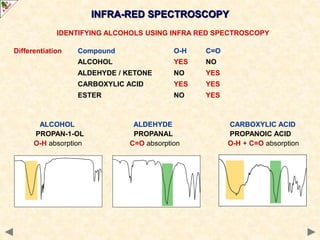
IDENTIFYING ALCOHOLS USING INFRA RED SPECTROSCOPY
Differentiation Compound O-H C=O
ALCOHOL YES NO
ALDEHYDE / KETONE NO YES
CARBOXYLIC ACID YES YES
ESTER NO YES
ALCOHOL ALDEHYDE CARBOXYLIC ACID
PROPAN-1-OL PROPANAL PROPANOIC ACID
O-H absorption C=O absorption O-H + C=O absorption
INDUSTRIAL PREPARATION OF ALCOHOLS
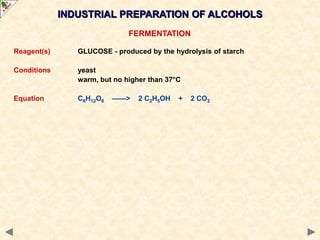
FERMENTATION
Reagent(s) GLUCOSE - produced by the hydrolysis of starch
Conditions yeast
warm, but no higher than 37°C
Equation C6H12O6 ——> 2 C2H5OH + 2 CO2
INDUSTRIAL PREPARATION OF ALCOHOLS
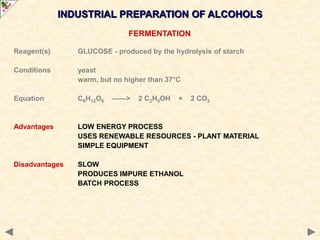
FERMENTATION
Reagent(s) GLUCOSE - produced by the hydrolysis of starch
Conditions yeast
warm, but no higher than 37°C
Equation C6H12O6 ——> 2 C2H5OH + 2 CO2
Advantages LOW ENERGY PROCESS
USES RENEWABLE RESOURCES - PLANT MATERIAL
SIMPLE EQUIPMENT
Disadvantages SLOW
PRODUCES IMPURE ETHANOL
BATCH PROCESS
INDUSTRIAL PREPARATION OF ALCOHOLS
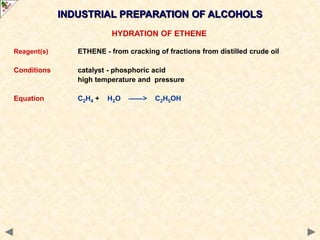
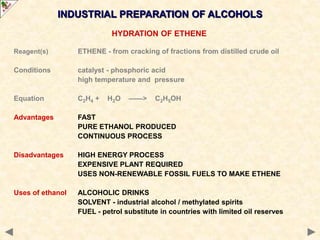
HYDRATION OF ETHENE
Reagent(s) ETHENE - from cracking of fractions from distilled crude oil
Conditions catalyst - phosphoric acid
high temperature and pressure
Equation C2H4 + H2O ——> C2H5OH
INDUSTRIAL PREPARATION OF ALCOHOLS
HYDRATION OF ETHENE
Reagent(s) ETHENE - from cracking of fractions from distilled crude oil
Conditions catalyst - phosphoric acid
high temperature and pressure
Equation C2H4 + H2O ——> C2H5OH
Advantages FAST
PURE ETHANOL PRODUCED
CONTINUOUS PROCESS
Disadvantages HIGH ENERGY PROCESS
EXPENSIVE PLANT REQUIRED
USES NON-RENEWABLE FOSSIL FUELS TO MAKE ETHENE
Uses of ethanol ALCOHOLIC DRINKS
SOLVENT - industrial alcohol / methylated spirits
FUEL - petrol substitute in countries with limited oil reserves
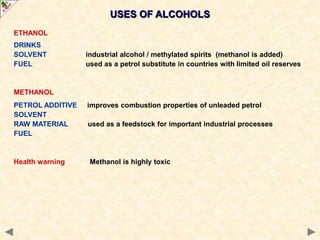
USES OF ALCOHOLS
ETHANOL
DRINKS
SOLVENT industrial alcohol / methylated spirits (methanol is added)
FUEL used as a petrol substitute in countries with limited oil reserves
METHANOL
PETROL ADDITIVE improves combustion properties of unleaded petrol
SOLVENT
RAW MATERIAL used as a feedstock for important industrial processes
FUEL
Health warning Methanol is highly toxic
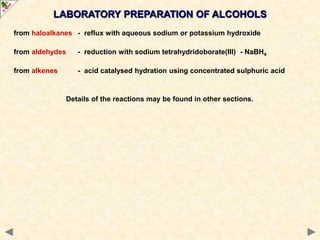
LABORATORY PREPARATION OF ALCOHOLS
from haloalkanes - reflux with aqueous sodium or potassium hydroxide
from aldehydes - reduction with sodium tetrahydridoborate(III) - NaBH4
from alkenes - acid catalysed hydration using concentrated sulphuric acid
Details of the reactions may be found in other sections.
REVISION CHECK
What should you be able to do?
Recall and explain the physical properties of alcohols
Recall the different structural types of alcohols
Recall the Lewis base properties of alcohols
Recall and explain the chemical reactions of alcohols
Write balanced equations representing any reactions in the section
Understand how oxidation is affected by structure
Recall how conditions and apparatus influence the products of oxidation
Explain how infrared spectroscopy can be used to differentiate between functional groups
CAN YOU DO ALL OF THESE? YES NO
You need to go over the
relevant topic(s) again
Click on the button to
return to the menu
WELL DONE!
Try some past paper questions
© 2015 JONATHAN HOPTON & KNOCKHARDY PUBLISHING
THE END
AN INTRODUCTION TO
THE CHEMISTRY
OF ALCOHOLS
BIOFUELS
What are they?
Liquid fuels made from plant material and recycled elements of the food chain
Biodiesel
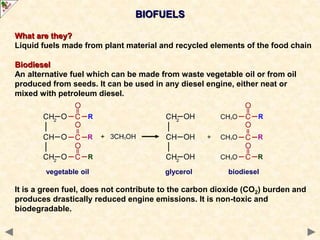
An alternative fuel which can be made from waste vegetable oil or from oil
produced from seeds. It can be used in any diesel engine, either neat or
mixed with petroleum diesel.
It is a green fuel, does not contribute to the carbon dioxide (CO2) burden and
produces drastically reduced engine emissions. It is non-toxic and
biodegradable.
vegetable oil glycerol biodiesel
BIOFUELS
Advantages • renewable - derived from sugar beet, rape seed
• dramatically reduces emissions
• carbon neutral
• biodegradable
• non-toxic
• fuel & exhaust emissions are less unpleasant
• can be used directly in unmodified diesel engine
• high flashpoint - safer to store & transport
• simple to make
• used neat or blended in any ratio with petroleum diesel
BIOFUELS
Advantages • renewable - derived from sugar beet, rape seed
• dramatically reduces emissions
• carbon neutral
• biodegradable
• non-toxic
• fuel & exhaust emissions are less unpleasant
• can be used directly in unmodified diesel engine
• high flashpoint - safer to store & transport
• simple to make
• used neat or blended in any ratio with petroleum diesel
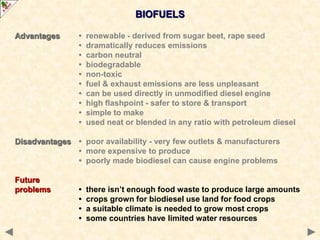
Disadvantages • poor availability - very few outlets & manufacturers
• more expensive to produce
• poorly made biodiesel can cause engine problems
BIOFUELS
Advantages • renewable - derived from sugar beet, rape seed
• dramatically reduces emissions
• carbon neutral
• biodegradable
• non-toxic
• fuel & exhaust emissions are less unpleasant
• can be used directly in unmodified diesel engine
• high flashpoint - safer to store & transport
• simple to make
• used neat or blended in any ratio with petroleum diesel
Disadvantages • poor availability - very few outlets & manufacturers
• more expensive to produce
• poorly made biodiesel can cause engine problems
Future
problems • there isn’t enough food waste to produce large amounts
• crops grown for biodiesel use land for food crops
• a suitable climate is needed to grow most crops
• some countries have limited water resources

15alcpp (1).ppt

  • 1.
    AN INTRODUCTION TO THECHEMISTRY OF ALCOHOLS KNOCKHARDY PUBLISHING 2015 SPECIFICATIONS
  • 2.
    INTRODUCTION This Powerpoint showis one of several produced to help students understand selected topics at AS and A2 level Chemistry. It is based on the requirements of the AQA and OCR specifications but is suitable for other examination boards. Individual students may use the material at home for revision purposes or it may be used for classroom teaching. Accompanying notes on this, and the full range of AS and A2 topics, are available from the KNOCKHARDY SCIENCE WEBSITE at... www.knockhardy.org.uk/sci.htm Navigation is achieved by... either clicking on the grey arrows at the foot of each page or using the left and right arrow keys on the keyboard KNOCKHARDY PUBLISHING THE CHEMISTRY OF ALCOHOLS
  • 3.
    CONTENTS • Structure andclassification of alcohols • Nomenclature • Isomerism • Physical properties • Chemical properties of alcohols • Identification using infra-red spectroscopy • Industrial preparation and uses of ethanol • Revision check list THE CHEMISTRY OF ALCOHOLS
  • 4.
    Before you startit would be helpful to… • Recall the definition of a covalent bond • Recall the difference types of physical bonding • Be able to balance simple equations • Be able to write out structures for simple organic molecules • Understand the IUPAC nomenclature rules for simple organic compounds • Recall the chemical properties of alkanes and alkenes THE CHEMISTRY OF ALCOHOLS
  • 5.
    CLASSIFICATION OF ALCOHOLS Aliphatic• general formula CnH2n+1OH - provided there are no rings • the OH replaces an H in a basic hydrocarbon skeleton
  • 6.
    CLASSIFICATION OF ALCOHOLS Aliphatic• general formula CnH2n+1OH - provided there are no rings • the OH replaces an H in a basic hydrocarbon skeleton Aromatic • in aromatic alcohols (or phenols) the OH is attached directly to the ring • an OH on a side chain of a ring behaves as a typical aliphatic alcohol The first two compounds are classified as aromatic alcohols (phenols) because the OH group is attached directly to the ring.
  • 7.
    CLASSIFICATION OF ALCOHOLS Aliphatic• general formula CnH2n+1OH - provided there are no rings • the OH replaces an H in a basic hydrocarbon skeleton Aromatic • in aromatic alcohols (or phenols) the OH is attached directly to the ring • an OH on a side chain of a ring behaves as a typical aliphatic alcohol The first two compounds are classified as aromatic alcohols (phenols) because the OH group is attached directly to the ring. Structural differences • alcohols are classified according to the environment of the OH group • chemical behaviour, eg oxidation, often depends on the structural type PRIMARY 1° SECONDARY 2° TERTIARY 3°
  • 8.
    Alcohols are namedaccording to standard IUPAC rules • select the longest chain of C atoms containing the O-H group; • remove the e and add ol after the basic name • number the chain starting from the end nearer the O-H group • the number is placed after the an and before the ol ... e.g butan-2-ol • as in alkanes, prefix with alkyl substituents • side chain positions are based on the number allocated to the O-H group e.g. CH3 - CH(CH3) - CH2 - CH2 - CH(OH) - CH3 is called 5-methylhexan-2-ol NAMING ALCOHOLS
  • 9.
    STRUCTURAL ISOMERISM INALCOHOLS Different structures are possible due to... A Different positions for the OH group and B Branching of the carbon chain butan-1-ol butan-2-ol 2-methylpropan-1-ol 2-methylpropan-2-ol
  • 10.
    BOILING POINTS OFALCOHOLS Increases with molecular size due to increased van der Waals’ forces. Alcohols have higher boiling points than similar molecular mass alkanes This is due to the added presence of inter-molecular hydrogen bonding. More energy is required to separate the molecules. Mr bp / °C propane C3H8 44 -42 permanent dipole-dipole interactions ethanol C2H5OH 46 +78 permanent forces + hydrogen bonding
  • 11.
    BOILING POINTS OFALCOHOLS Increases with molecular size due to increased van der Waals’ forces. Alcohols have higher boiling points than similar molecular mass alkanes This is due to the added presence of inter-molecular hydrogen bonding. More energy is required to separate the molecules. Mr bp / °C propane C3H8 44 -42 permanent dipole-dipole interactions ethanol C2H5OH 46 +78 permanent forces + hydrogen bonding Boiling point is higher for “straight” chain isomers. bp / °C butan-1-ol CH3CH2CH2CH2OH 118 butan-2-ol CH3CH2CH(OH)CH3 100 2-methylpropan-2-ol (CH3)3COH 83 Greater branching = lower inter-molecular forces
  • 12.
    BOILING POINTS OFALCOHOLS Increases with molecular size due to increased van der Waals’ forces. Alcohols have higher boiling points than similar molecular mass alkanes This is due to the added presence of inter-molecular hydrogen bonding. More energy is required to separate the molecules. Mr bp / °C propane C3H8 44 -42 just van der Waals’ forces ethanol C2H5OH 46 +78 van der Waals’ forces + hydrogen bonding Boiling point is higher for “straight” chain isomers. bp / °C butan-1-ol CH3CH2CH2CH2OH 118 butan-2-ol CH3CH2CH(OH)CH3 100 2-methylpropan-2-ol (CH3)3COH 83 Greater branching = lower inter-molecular forces
  • 13.
    SOLVENT PROPERTIES OFALCOHOLS Solubility Low molecular mass alcohols are miscible with water Due to hydrogen bonding between the two molecules Heavier alcohols are less miscible Solvent properties Alcohols are themselves very good solvents They dissolve a large number of organic molecules Show the relevant lone pair(s) when drawing hydrogen bonding
  • 14.
    CHEMICAL PROPERTIES OFALCOHOLS The OXYGEN ATOM HAS TWO LONE PAIRS; this makes alcohols... BASES Lewis bases are lone pair donors Bronsted-Lowry bases are proton acceptors The alcohol uses one of its lone pairs to form a co-ordinate bond NUCLEOPHILES Alcohols can use the lone pair to attack electron deficient centres
  • 15.
    ELIMINATION OF WATER(DEHYDRATION) Reagent/catalyst conc. sulphuric acid (H2SO4) or conc. phosphoric acid (H3PO4) Conditions reflux at 180°C Product alkene Equation e.g. C2H5OH(l) ——> CH2 = CH2(g) + H2O(l) Mechanism Step 1 protonation of the alcohol using a lone pair on oxygen Step 2 loss of a water molecule to generate a carbocation Step 3 loss of a proton (H+) to give the alkene Alternative Method Pass vapour over a heated alumina (aluminium oxide) catalyst
  • 16.
    ELIMINATION OF WATER(DEHYDRATION) MECHANISM Step 1 protonation of the alcohol using a lone pair on oxygen Step 2 loss of a water molecule to generate a carbocation Step 3 loss of a proton (H+) to give the alkene Note 1 There must be an H on a carbon atom adjacent the carbon with the OH Note 2 Alcohols with the OH in the middle of a chain can have two ways of losing water. In Step 3 of the mechanism, a proton can be lost from either side of the carbocation. This gives a mixture of alkenes from unsymmetrical alcohols...
  • 17.
    OXIDATION OF ALCOHOLS Allalcohols can be oxidised depending on the conditions Oxidation is used to differentiate between primary, secondary and tertiary alcohols The usual reagent is acidified potassium dichromate(VI) Primary Easily oxidised to aldehydes and then to carboxylic acids. Secondary Easily oxidised to ketones Tertiary Not oxidised under normal conditions. They do break down with very vigorous oxidation PRIMARY 1° SECONDARY 2° TERTIARY 3°
  • 18.
    OXIDATION OF PRIMARYALCOHOLS Primary alcohols are easily oxidised to aldehydes e.g. CH3CH2OH(l) + [O] ——> CH3CHO(l) + H2O(l) ethanol ethanal it is essential to distil off the aldehyde before it gets oxidised to the acid CH3CHO(l) + [O] ——> CH3COOH(l) ethanal ethanoic acid
  • 19.
    OXIDATION OF PRIMARYALCOHOLS Primary alcohols are easily oxidised to aldehydes e.g. CH3CH2OH(l) + [O] ——> CH3CHO(l) + H2O(l) ethanol ethanal it is essential to distil off the aldehyde before it gets oxidised to the acid CH3CHO(l) + [O] ——> CH3COOH(l) ethanal ethanoic acid Practical details • the alcohol is dripped into a warm solution of acidified K2Cr2O7 • aldehydes have low boiling points - no hydrogen bonding - they distil off immediately • if it didn’t distil off it would be oxidised to the equivalent carboxylic acid • to oxidise an alcohol straight to the acid, reflux the mixture compound formula intermolecular bonding boiling point ETHANOL C2H5OH HYDROGEN BONDING 78°C ETHANAL CH3CHO DIPOLE-DIPOLE 23°C ETHANOIC ACID CH3COOH HYDROGEN BONDING 118°C
  • 20.
    OXIDATION OF PRIMARYALCOHOLS Controlling the products e.g. CH3CH2OH(l) + [O] ——> CH3CHO(l) + H2O(l) then CH3CHO(l) + [O] ——> CH3COOH(l) Aldehyde has a lower boiling point so distils off before being oxidised further OXIDATION TO ALDEHYDES DISTILLATION OXIDATION TO CARBOXYLIC ACIDS REFLUX Aldehyde condenses back into the mixture and gets oxidised to the acid
  • 21.
    OXIDATION OF SECONDARYALCOHOLS Secondary alcohols are easily oxidised to ketones e.g. CH3CHOHCH3(l) + [O] ——> CH3COCH3(l) + H2O(l) propan-2-ol propanone The alcohol is refluxed with acidified K2Cr2O7. However, on prolonged treatment with a powerful oxidising agent they can be further oxidised to a mixture of acids with fewer carbon atoms than the original alcohol.
  • 22.
    OXIDATION OF SECONDARYALCOHOLS Secondary alcohols are easily oxidised to ketones e.g. CH3CHOHCH3(l) + [O] ——> CH3COCH3(l) + H2O(l) propan-2-ol propanone The alcohol is refluxed with acidified K2Cr2O7. However, on prolonged treatment with a powerful oxidising agent they can be further oxidised to a mixture of acids with fewer carbon atoms than the original alcohol. OXIDATION OF TERTIARY ALCOHOLS Tertiary alcohols are resistant to normal oxidation
  • 23.
    OXIDATION OF ALCOHOLS Why1° and 2° alcohols are easily oxidised and 3° alcohols are not For oxidation to take place easily you must have two hydrogen atoms on adjacent C and O atoms.
  • 24.
    OXIDATION OF ALCOHOLS Why1° and 2° alcohols are easily oxidised and 3° alcohols are not For oxidation to take place easily you must have two hydrogen atoms on adjacent C and O atoms. H H R C O + [O] R C O + H2O H H 1°
  • 25.
    OXIDATION OF ALCOHOLS Why1° and 2° alcohols are easily oxidised and 3° alcohols are not For oxidation to take place easily you must have two hydrogen atoms on adjacent C and O atoms. H H R C O + [O] R C O + H2O H H H H R C O + [O] R C O + H2O R R 1° 2°
  • 26.
    OXIDATION OF ALCOHOLS Why1° and 2° alcohols are easily oxidised and 3° alcohols are not For oxidation to take place easily you must have two hydrogen atoms on adjacent C and O atoms. H H R C O + [O] R C O + H2O H H H H R C O + [O] R C O + H2O R R This is possible in 1° and 2° alcohols but not in 3° alcohols. 1° 2°
  • 27.
    OXIDATION OF ALCOHOLS Why1° and 2° alcohols are easily oxidised and 3° alcohols are not For oxidation to take place easily you must have two hydrogen atoms on adjacent C and O atoms. H H R C O + [O] R C O + H2O H H H H R C O + [O] R C O + H2O R R R H R C O + [O] R This is possible in 1° and 2° alcohols but not in 3° alcohols. 1° 2° 3°
  • 28.
    ESTERIFICATION OF ALCOHOLS Reagent(s)carboxylic acid + strong acid catalyst (e.g conc. H2SO4 ) Conditions reflux Product ester Equation e.g. CH3CH2OH(l) + CH3COOH(l) CH3COOC2H5(l) + H2O(l) ethanol ethanoic acid ethyl ethanoate Notes Concentrated H2SO4 is a dehydrating agent - it removes water causing the equilibrium to move to the right and increases the yield
  • 29.
    ESTERIFICATION OF ALCOHOLS Reagent(s)carboxylic acid + strong acid catalyst (e.g conc. H2SO4 ) Conditions reflux Product ester Equation e.g. CH3CH2OH(l) + CH3COOH(l) CH3COOC2H5(l) + H2O(l) ethanol ethanoic acid ethyl ethanoate Notes Concentrated H2SO4 is a dehydrating agent - it removes water causing the equilibrium to move to the right and increases the yield Uses of esters Esters are fairly unreactive but that doesn’t make them useless Used as flavourings Naming esters Named from the alcohol and carboxylic acid which made them... CH3OH + CH3COOH CH3COOCH3 + H2O from ethanoic acid CH3COOCH3 from methanol METHYL ETHANOATE
  • 30.
    OTHER REACTIONS OFALCOHOLS OXYGEN Alcohols make useful fuels C2H5OH(l) + 3O2(g) ———> 2CO2(g) + 3H2O(l) Advantages have high enthalpies of combustion do not contain sulphur so there is less pollution can be obtained from renewable resources
  • 31.
    OTHER REACTIONS OFALCOHOLS OXYGEN Alcohols make useful fuels C2H5OH(l) + 3O2(g) ———> 2CO2(g) + 3H2O(l) Advantages have high enthalpies of combustion do not contain sulphur so there is less pollution can be obtained from renewable resources SODIUM Conditions room temperature Product sodium alkoxide and hydrogen Equation 2CH3CH2OH(l) + 2Na(s) ——> 2CH3CH2O¯ Na + + H2(g) sodium ethoxide Notes alcohols are organic chemistry’s equivalent of water water reacts with sodium to produce hydrogen and so do alcohols the reaction is slower with alcohols than with water. Alkoxides are white, ionic crystalline solids e.g. CH3CH2O¯ Na+
  • 32.
    BROMINATION OF ALCOHOLS Reagent(s)conc. hydrobromic acid HBr(aq) or sodium (or potassium) bromide and concentrated sulphuric acid Conditions reflux Product haloalkane Equation C2H5OH(l) + conc. HBr(aq) ———> C2H5Br(l) + H2O(l) Mechanism The mechanism starts off similar to that involving dehydration (protonation of the alcohol and loss of water) but the carbocation (carbonium ion) is attacked by a nucleophilic bromide ion in step 3 Step 1 protonation of the alcohol using a lone pair on oxygen Step 2 loss of a water molecule to generate a carbocation (carbonium ion) Step 3 a bromide ion behaves as a nucleophile and attacks the carbocation
  • 33.
    INFRA-RED SPECTROSCOPY Chemical bondsvibrate at different frequencies. When infra red (IR) radiation is passed through a liquid sample of an organic molecule, some frequencies are absorbed. These correspond to the frequencies of the vibrating bonds. Most spectra are very complex due to the large number of bonds present and each molecule produces a unique spectrum. However the presence of certain absorptions can be used to identify functional groups. BOND COMPOUND ABSORBANCE RANGE O-H alcohols broad 3200 cm-1 to 3600 cm-1 O-H carboxylic acids medium to broad 2500 cm-1 to 3500 cm-1 C=O ketones, aldehydes strong and sharp 1600 cm-1 to 1750 cm-1 esters and acids
  • 34.
    INFRA-RED SPECTROSCOPY IDENTIFYING ALCOHOLSUSING INFRA RED SPECTROSCOPY Differentiation Compound O-H C=O ALCOHOL YES NO ALDEHYDE / KETONE NO YES CARBOXYLIC ACID YES YES ESTER NO YES ALCOHOL ALDEHYDE CARBOXYLIC ACID PROPAN-1-OL PROPANAL PROPANOIC ACID O-H absorption C=O absorption O-H + C=O absorption
  • 35.
    INDUSTRIAL PREPARATION OFALCOHOLS FERMENTATION Reagent(s) GLUCOSE - produced by the hydrolysis of starch Conditions yeast warm, but no higher than 37°C Equation C6H12O6 ——> 2 C2H5OH + 2 CO2
  • 36.
    INDUSTRIAL PREPARATION OFALCOHOLS FERMENTATION Reagent(s) GLUCOSE - produced by the hydrolysis of starch Conditions yeast warm, but no higher than 37°C Equation C6H12O6 ——> 2 C2H5OH + 2 CO2 Advantages LOW ENERGY PROCESS USES RENEWABLE RESOURCES - PLANT MATERIAL SIMPLE EQUIPMENT Disadvantages SLOW PRODUCES IMPURE ETHANOL BATCH PROCESS
  • 37.
    INDUSTRIAL PREPARATION OFALCOHOLS HYDRATION OF ETHENE Reagent(s) ETHENE - from cracking of fractions from distilled crude oil Conditions catalyst - phosphoric acid high temperature and pressure Equation C2H4 + H2O ——> C2H5OH
  • 38.
    INDUSTRIAL PREPARATION OFALCOHOLS HYDRATION OF ETHENE Reagent(s) ETHENE - from cracking of fractions from distilled crude oil Conditions catalyst - phosphoric acid high temperature and pressure Equation C2H4 + H2O ——> C2H5OH Advantages FAST PURE ETHANOL PRODUCED CONTINUOUS PROCESS Disadvantages HIGH ENERGY PROCESS EXPENSIVE PLANT REQUIRED USES NON-RENEWABLE FOSSIL FUELS TO MAKE ETHENE Uses of ethanol ALCOHOLIC DRINKS SOLVENT - industrial alcohol / methylated spirits FUEL - petrol substitute in countries with limited oil reserves
  • 39.
    USES OF ALCOHOLS ETHANOL DRINKS SOLVENTindustrial alcohol / methylated spirits (methanol is added) FUEL used as a petrol substitute in countries with limited oil reserves METHANOL PETROL ADDITIVE improves combustion properties of unleaded petrol SOLVENT RAW MATERIAL used as a feedstock for important industrial processes FUEL Health warning Methanol is highly toxic
  • 40.
    LABORATORY PREPARATION OFALCOHOLS from haloalkanes - reflux with aqueous sodium or potassium hydroxide from aldehydes - reduction with sodium tetrahydridoborate(III) - NaBH4 from alkenes - acid catalysed hydration using concentrated sulphuric acid Details of the reactions may be found in other sections.
  • 41.
    REVISION CHECK What shouldyou be able to do? Recall and explain the physical properties of alcohols Recall the different structural types of alcohols Recall the Lewis base properties of alcohols Recall and explain the chemical reactions of alcohols Write balanced equations representing any reactions in the section Understand how oxidation is affected by structure Recall how conditions and apparatus influence the products of oxidation Explain how infrared spectroscopy can be used to differentiate between functional groups CAN YOU DO ALL OF THESE? YES NO
  • 42.
    You need togo over the relevant topic(s) again Click on the button to return to the menu
  • 43.
    WELL DONE! Try somepast paper questions
  • 44.
    © 2015 JONATHANHOPTON & KNOCKHARDY PUBLISHING THE END AN INTRODUCTION TO THE CHEMISTRY OF ALCOHOLS
  • 45.
    BIOFUELS What are they? Liquidfuels made from plant material and recycled elements of the food chain Biodiesel An alternative fuel which can be made from waste vegetable oil or from oil produced from seeds. It can be used in any diesel engine, either neat or mixed with petroleum diesel. It is a green fuel, does not contribute to the carbon dioxide (CO2) burden and produces drastically reduced engine emissions. It is non-toxic and biodegradable. vegetable oil glycerol biodiesel
  • 46.
    BIOFUELS Advantages • renewable- derived from sugar beet, rape seed • dramatically reduces emissions • carbon neutral • biodegradable • non-toxic • fuel & exhaust emissions are less unpleasant • can be used directly in unmodified diesel engine • high flashpoint - safer to store & transport • simple to make • used neat or blended in any ratio with petroleum diesel
  • 47.
    BIOFUELS Advantages • renewable- derived from sugar beet, rape seed • dramatically reduces emissions • carbon neutral • biodegradable • non-toxic • fuel & exhaust emissions are less unpleasant • can be used directly in unmodified diesel engine • high flashpoint - safer to store & transport • simple to make • used neat or blended in any ratio with petroleum diesel Disadvantages • poor availability - very few outlets & manufacturers • more expensive to produce • poorly made biodiesel can cause engine problems
  • 48.
    BIOFUELS Advantages • renewable- derived from sugar beet, rape seed • dramatically reduces emissions • carbon neutral • biodegradable • non-toxic • fuel & exhaust emissions are less unpleasant • can be used directly in unmodified diesel engine • high flashpoint - safer to store & transport • simple to make • used neat or blended in any ratio with petroleum diesel Disadvantages • poor availability - very few outlets & manufacturers • more expensive to produce • poorly made biodiesel can cause engine problems Future problems • there isn’t enough food waste to produce large amounts • crops grown for biodiesel use land for food crops • a suitable climate is needed to grow most crops • some countries have limited water resources