Chapter 10
Structure and Synthesis
of Alcohols
Organic Chemistry
Chapter 10 2
Structure of Alcohols
• Hydroxyl (OH) functional group
• Oxygen is sp3
hybridized.
=>
Chapter 10 3
Classification
• Primary: carbon with –OH is bonded to
one other carbon.
• Secondary: carbon with –OH is bonded
to two other carbons.
• Tertiary: carbon with –OH is bonded to
three other carbons.
• Aromatic (phenol): -OH is bonded to a
benzene ring.
=>
Chapter 10 4
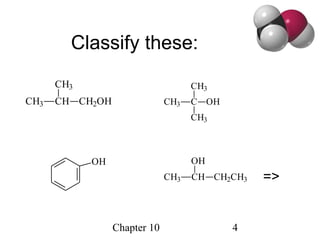
Classify these:
CH3 CH
CH3
CH2OH CH3 C
CH3
CH3
OH
OH
CH3 CH
OH
CH2CH3 =>
Chapter 10 5
IUPAC Nomenclature
• Find the longest carbon chain
containing the carbon with the -OH
group.
• Drop the -e from the alkane name, add
-ol.
• Number the chain, starting from the end
closest to the -OH group.
• Number and name all substituents. =>
Chapter 10 6
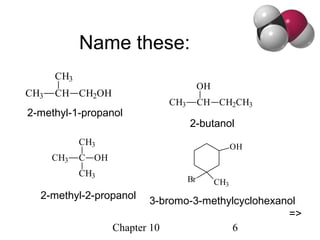
Name these:
CH3 CH
CH3
CH2OH
CH3 C
CH3
CH3
OH
CH3 CH
OH
CH2CH3
2-methyl-1-propanol
2-methyl-2-propanol
2-butanol
OH
Br CH3
3-bromo-3-methylcyclohexanol
=>
Chapter 10 7
Unsaturated Alcohols
• Hydroxyl group takes precedence. Assign
that carbon the lowest number.
• Use alkene or alkyne name.
4-penten-2-ol (old)
pent-4-ene-2-ol
(1997 revision of IUPAC rules)
=>
CH2 CHCH2CHCH3
OH
Chapter 10 8
Naming Priority
• Acids
• Esters
• Aldehydes
• Ketones
• Alcohols
• Amines
• Alkenes
• Alkynes
• Alkanes
• Ethers
• Halides
=>
Chapter 10 9
Hydroxy Substituent
• When -OH is part of a higher priority class of
compound, it is named as hydroxy.
• Example:
CH2CH2CH2COOH
OH
4-hydroxybutanoic acid
also known as GHB
=>
Chapter 10 10
Common Names
• Alcohol can be named as alkyl alcohol.
• Useful only for small alkyl groups.
• Examples:
CH3 CH
CH3
CH2OH CH3 CH
OH
CH2CH3
isobutyl alcohol sec-butyl alcohol
=>
Chapter 10 11
Naming Diols
• Two numbers are needed to locate the two
-OH groups.
• Use -diol as suffix instead of -ol.
HO OH
1,6-hexanediol
=>
Chapter 10 12
Glycols
• 1, 2 diols (vicinal diols) are called glycols.
• Common names for glycols use the name of
the alkene from which they were made.
CH2CH2
OH OH
CH2CH2CH3
OH OH
1,2-ethanediol
ethylene glycol
1,2-propanediol
propylene glycol
=>
Chapter 10 13
Naming Phenols
• -OH group is assumed to be on carbon 1.
• For common names of disubstituted phenols,
use ortho- for 1,2; meta- for 1,3; and para- for
1,4.
• Methyl phenols are cresols.
OH
Cl
3-chlorophenol
meta-chlorophenol
OH
H3C
4-methylphenol
para-cresol
=>
Chapter 10 14
Physical Properties
• Unusually high boiling points due to
hydrogen bonding between molecules.
• Small alcohols are miscible in water, but
solubility decreases as the size of the
alkyl group increases.
=>
Chapter 10 15
Boiling Points
=>
Chapter 10 16
Solubility in Water
Solubility decreases as the size
of the alkyl group increases.
=>
Chapter 10 17
Methanol
• “Wood alcohol”
• Industrial production from synthesis gas
• Common industrial solvent
• Fuel at Indianapolis 500
Fire can be extinguished with water
High octane rating
Low emissions
But, lower energy content
Invisible flame =>
Chapter 10 18
Ethanol
• Fermentation of sugar and starches in grains
• 12-15% alcohol, then yeast cells die.
• Distillation produces “hard” liquors
• Azeotrope: 95% ethanol, constant boiling
• Denatured alcohol used as solvent
• Gasahol: 10% ethanol in gasoline
• Toxic dose: 200 mL ethanol, 100 mL methanol
=>
Chapter 10 19
2-Propanol
• “Rubbing alcohol”
• Catalytic hydration of propene
=>
CH2 CH CH2 H2O
100-300 atm, 300°C
catalyst
+ CH3 CH
OH
CH3
Chapter 10 20
Acidity of Alcohols
• pKa range: 15.5-18.0 (water: 15.7)
• Acidity decreases as alkyl group
increases.
• Halogens increase the acidity.
• Phenol is 100 million times more acidic
than cyclohexanol!
=>
Chapter 10 21
Table of Ka Values
=>
CH3 OH
Chapter 10 22
Formation of Alkoxide
Ions
React methanol and ethanol with sodium
metal (redox reaction).
CH3CH2OH + Na CH3CH2O Na +
1
/2
H2
React less acidic alcohols with more
reactive potassium.
+ K (CH3)3CO K +
1
/2
H2)3C OH(CH3
=>
Chapter 10 23
Formation of Phenoxide
Ion
Phenol reacts with hydroxide ions to form
phenoxide ions - no redox is necessary.
O H
+ OH
O
+ HOH
pK a = 10
pK a = 15.7
=>
Chapter 10 24
Synthesis (Review)
• Nucleophilic substitution of OH-
on alkyl
halide
• Hydration of alkenes
water in acid solution (not very effective)
oxymercuration - demercuration
hydroboration - oxidation
=>
Chapter 10 25
Glycols (Review)
• Syn hydroxylation of alkenes
osmium tetroxide, hydrogen peroxide
cold, dilute, basic potassium
permanganate
• Anti hydroxylation of alkenes
peroxyacids, hydrolysis
=>
Chapter 10 26
Organometallic
Reagents
• Carbon is bonded to a metal (Mg or Li).
• Carbon is nucleophilic (partially
negative).
• It will attack a partially positive carbon.
C - X
C = O
• A new carbon-carbon bond forms.
=>
Chapter 10 27
Grignard Reagents
• Formula R-Mg-X (reacts like R:- +
MgX)
• Stabilized by anhydrous ether
• Iodides most reactive
• May be formed from any halide
primary
secondary
tertiary
vinyl
aryl =>
Chapter 10 28
Some Grignard
Reagents
Br
+ Mg
ether MgBr
CH3CHCH2CH3
Cl
ether
+ Mg CH3CHCH2CH3
MgCl
CH3C CH2
Br + Mg
ether
CH3C CH2
MgBr
=>
Chapter 10 29
Organolithium Reagents
• Formula R-Li (reacts like R:- +
Li)
• Can be produced from alkyl, vinyl, or
aryl halides, just like Grignard reagents.
• Ether not necessary, wide variety of
solvents can be used.
=>
Chapter 10 30
Reaction with Carbonyl
• R:-
attacks the partially positive carbon in the
carbonyl.
• The intermediate is an alkoxide ion.
• Addition of water or dilute acid protonates the
alkoxide to produce an alcohol.
R
C O R C O
HOH
R C OH
OH
=>
Chapter 10 31
Synthesis of 1° Alcohols
Grignard + formaldehyde yields a primary
alcohol with one additional carbon.
C O
H
H
C
CH3
H3C CH2 C MgBr
H
HH
CH3 CH
CH3
CH2 CH2 C
H
H
O MgBr
HOH
CH3 CH
CH3
CH2 CH2 C
H
H
O H
=>
Chapter 10 32
Synthesis of 2º Alcohols
Grignard + aldehyde yields a secondary
alcohol.
MgBrCH3 CH
CH3
CH2 CH2 C
CH3
H
OC
CH3
H3C CH2 C MgBr
H
HH
C O
H
H3C
CH3 CH
CH3
CH2 CH2 C
CH3
H
O H
HOH
=>
Chapter 10 33
Synthesis of 3º Alcohols
Grignard + ketone yields a tertiary alcohol.
MgBrCH3 CH
CH3
CH2 CH2 C
CH3
CH3
OC
CH3
H3C CH2 C MgBr
H
HH
C O
H3C
H3C
CH3 CH
CH3
CH2 CH2 C
CH3
CH3
O H
HOH
=>
Chapter 10 34
How would you
synthesize…
CH3CH2CHCH2CH2CH3
OH CH2OH
OH
CH3
C
OH
CH2CH3
CH3
=>
Chapter 10 35
Grignard Reactions
with Acid Chlorides
and Esters
• Use two moles of Grignard reagent.
• The product is a tertiary alcohol with
two identical alkyl groups.
• Reaction with one mole of Grignard
reagent produces a ketone
intermediate, which reacts with the
second mole of Grignard reagent.
=>
Chapter 10 36
Grignard + Acid
Chloride (1)
C O
Cl
H3C
MgBrR MgBr C
CH3
Cl
OR
C
CH3
Cl
OR MgBr C
CH3
R
O
+ MgBrCl
Ketone intermediate =>
• Grignard attacks the carbonyl.
• Chloride ion leaves.
Chapter 10 37
Grignard and Ester (1)
• Grignard attacks the carbonyl.
• Alkoxide ion leaves! ? !
C O
CH3O
H3C
MgBrR MgBr C
CH3
OCH3
OR
C
CH3
OCH3
OR MgBr C
CH3
R
O
+ MgBrOCH3
Ketone intermediate =>
Chapter 10 38
Second step of reaction
• Second mole of Grignard reacts with the
ketone intermediate to form an alkoxide ion.
• Alkoxide ion is protonated with dilute acid.
C
CH3
R
O
R MgBr + C
CH3
R
OR MgBr
HOH
C
CH3
R
OHR
=>
Chapter 10 39
How would you
synthesize...
CH3CH2CCH3
OH
CH3
C
OH
CH3
Using an acid chloride or ester.
CH3CH2CHCH2CH3
OH
=>
Chapter 10 40
Grignard Reagent +
Ethylene Oxide
• Epoxides are unusually reactive ethers.
• Product is a 1º alcohol with 2 additional
carbons.
MgBr + CH2 CH2
O
CH2CH2
O MgBr
HOH
CH2CH2
O H
=>
Chapter 10 41
Limitations of Grignard
• No water or other acidic protons like
O-H, N-H, S-H, or -C—C-H. Grignard
reagent is destroyed, becomes an
alkane.
• No other electrophilic multiple bonds,
like C=N, C—N, S=O, or N=O.
=>
Chapter 10 42
Reduction of Carbonyl
• Reduction of aldehyde yields 1º alcohol.
• Reduction of ketone yields 2º alcohol.
• Reagents:
Sodium borohydride, NaBH4
Lithium aluminum hydride, LiAlH4
Raney nickel
=>
Chapter 10 43
Sodium Borohydride
• Hydride ion, H-
, attacks the carbonyl
carbon, forming an alkoxide ion.
• Then the alkoxide ion is protonated by
dilute acid.
• Only reacts with carbonyl of aldehyde or
ketone, not with carbonyls of esters or
carboxylic acids.
H
C
O
H
C
H
OH
C
H
OH H
H3O+
=>
Chapter 10 44
Lithium Aluminum
Hydride
• Stronger reducing agent than sodium
borohydride, but dangerous to work with.
• Converts esters and acids to 1º alcohols.
C
O
OCH3
C
OH H
H
H3O
+
LAH
=>
Chapter 10 45
Comparison of
Reducing Agents
• LiAlH4 is stronger.
• LiAlH4 reduces more
stable compounds
which are resistant
to reduction.
=>
Chapter 10 46
Catalytic Hydrogenation
• Add H2 with Raney nickel catalyst.
• Also reduces any C=C bonds.
O
H2, Raney Ni
OH
NaBH4
OH
=>
Chapter 10 47
Thiols (Mercaptans)
• Sulfur analogues of alcohols, -SH.
• Named by adding -thiol to alkane name.
• The -SH group is called mercapto.
• Complex with heavy metals: Hg, As, Au.
• More acidic than alcohols, react with
NaOH to form thiolate ion.
• Stinks! =>
Chapter 10 48
Thiol Synthesis
Use a large excess of sodium
hydrosulfide with unhindered alkyl
halide to prevent dialkylation to R-S-R.
H S
_
R X R SH +
_
X
=>
Chapter 10 49
Thiol Oxidation
• Easily oxidized to disulfides, an
important feature of protein structure.
R SH + RHS
Br2
Zn, HCl
R S S R + 2 HBr
• Vigorous oxidation with KMnO4,
HNO3, or NaOCl, produces sulfonic acids.
SH
HNO3
boil
S
O
O
OH
=>
Chapter 10 50
End of Chapter 10

Alcohol

  • 1.
    Chapter 10 Structure andSynthesis of Alcohols Organic Chemistry
  • 2.
    Chapter 10 2 Structureof Alcohols • Hydroxyl (OH) functional group • Oxygen is sp3 hybridized. =>
  • 3.
    Chapter 10 3 Classification •Primary: carbon with –OH is bonded to one other carbon. • Secondary: carbon with –OH is bonded to two other carbons. • Tertiary: carbon with –OH is bonded to three other carbons. • Aromatic (phenol): -OH is bonded to a benzene ring. =>
  • 4.
    Chapter 10 4 Classifythese: CH3 CH CH3 CH2OH CH3 C CH3 CH3 OH OH CH3 CH OH CH2CH3 =>
  • 5.
    Chapter 10 5 IUPACNomenclature • Find the longest carbon chain containing the carbon with the -OH group. • Drop the -e from the alkane name, add -ol. • Number the chain, starting from the end closest to the -OH group. • Number and name all substituents. =>
  • 6.
    Chapter 10 6 Namethese: CH3 CH CH3 CH2OH CH3 C CH3 CH3 OH CH3 CH OH CH2CH3 2-methyl-1-propanol 2-methyl-2-propanol 2-butanol OH Br CH3 3-bromo-3-methylcyclohexanol =>
  • 7.
    Chapter 10 7 UnsaturatedAlcohols • Hydroxyl group takes precedence. Assign that carbon the lowest number. • Use alkene or alkyne name. 4-penten-2-ol (old) pent-4-ene-2-ol (1997 revision of IUPAC rules) => CH2 CHCH2CHCH3 OH
  • 8.
    Chapter 10 8 NamingPriority • Acids • Esters • Aldehydes • Ketones • Alcohols • Amines • Alkenes • Alkynes • Alkanes • Ethers • Halides =>
  • 9.
    Chapter 10 9 HydroxySubstituent • When -OH is part of a higher priority class of compound, it is named as hydroxy. • Example: CH2CH2CH2COOH OH 4-hydroxybutanoic acid also known as GHB =>
  • 10.
    Chapter 10 10 CommonNames • Alcohol can be named as alkyl alcohol. • Useful only for small alkyl groups. • Examples: CH3 CH CH3 CH2OH CH3 CH OH CH2CH3 isobutyl alcohol sec-butyl alcohol =>
  • 11.
    Chapter 10 11 NamingDiols • Two numbers are needed to locate the two -OH groups. • Use -diol as suffix instead of -ol. HO OH 1,6-hexanediol =>
  • 12.
    Chapter 10 12 Glycols •1, 2 diols (vicinal diols) are called glycols. • Common names for glycols use the name of the alkene from which they were made. CH2CH2 OH OH CH2CH2CH3 OH OH 1,2-ethanediol ethylene glycol 1,2-propanediol propylene glycol =>
  • 13.
    Chapter 10 13 NamingPhenols • -OH group is assumed to be on carbon 1. • For common names of disubstituted phenols, use ortho- for 1,2; meta- for 1,3; and para- for 1,4. • Methyl phenols are cresols. OH Cl 3-chlorophenol meta-chlorophenol OH H3C 4-methylphenol para-cresol =>
  • 14.
    Chapter 10 14 PhysicalProperties • Unusually high boiling points due to hydrogen bonding between molecules. • Small alcohols are miscible in water, but solubility decreases as the size of the alkyl group increases. =>
  • 15.
  • 16.
    Chapter 10 16 Solubilityin Water Solubility decreases as the size of the alkyl group increases. =>
  • 17.
    Chapter 10 17 Methanol •“Wood alcohol” • Industrial production from synthesis gas • Common industrial solvent • Fuel at Indianapolis 500 Fire can be extinguished with water High octane rating Low emissions But, lower energy content Invisible flame =>
  • 18.
    Chapter 10 18 Ethanol •Fermentation of sugar and starches in grains • 12-15% alcohol, then yeast cells die. • Distillation produces “hard” liquors • Azeotrope: 95% ethanol, constant boiling • Denatured alcohol used as solvent • Gasahol: 10% ethanol in gasoline • Toxic dose: 200 mL ethanol, 100 mL methanol =>
  • 19.
    Chapter 10 19 2-Propanol •“Rubbing alcohol” • Catalytic hydration of propene => CH2 CH CH2 H2O 100-300 atm, 300°C catalyst + CH3 CH OH CH3
  • 20.
    Chapter 10 20 Acidityof Alcohols • pKa range: 15.5-18.0 (water: 15.7) • Acidity decreases as alkyl group increases. • Halogens increase the acidity. • Phenol is 100 million times more acidic than cyclohexanol! =>
  • 21.
    Chapter 10 21 Tableof Ka Values => CH3 OH
  • 22.
    Chapter 10 22 Formationof Alkoxide Ions React methanol and ethanol with sodium metal (redox reaction). CH3CH2OH + Na CH3CH2O Na + 1 /2 H2 React less acidic alcohols with more reactive potassium. + K (CH3)3CO K + 1 /2 H2)3C OH(CH3 =>
  • 23.
    Chapter 10 23 Formationof Phenoxide Ion Phenol reacts with hydroxide ions to form phenoxide ions - no redox is necessary. O H + OH O + HOH pK a = 10 pK a = 15.7 =>
  • 24.
    Chapter 10 24 Synthesis(Review) • Nucleophilic substitution of OH- on alkyl halide • Hydration of alkenes water in acid solution (not very effective) oxymercuration - demercuration hydroboration - oxidation =>
  • 25.
    Chapter 10 25 Glycols(Review) • Syn hydroxylation of alkenes osmium tetroxide, hydrogen peroxide cold, dilute, basic potassium permanganate • Anti hydroxylation of alkenes peroxyacids, hydrolysis =>
  • 26.
    Chapter 10 26 Organometallic Reagents •Carbon is bonded to a metal (Mg or Li). • Carbon is nucleophilic (partially negative). • It will attack a partially positive carbon. C - X C = O • A new carbon-carbon bond forms. =>
  • 27.
    Chapter 10 27 GrignardReagents • Formula R-Mg-X (reacts like R:- + MgX) • Stabilized by anhydrous ether • Iodides most reactive • May be formed from any halide primary secondary tertiary vinyl aryl =>
  • 28.
    Chapter 10 28 SomeGrignard Reagents Br + Mg ether MgBr CH3CHCH2CH3 Cl ether + Mg CH3CHCH2CH3 MgCl CH3C CH2 Br + Mg ether CH3C CH2 MgBr =>
  • 29.
    Chapter 10 29 OrganolithiumReagents • Formula R-Li (reacts like R:- + Li) • Can be produced from alkyl, vinyl, or aryl halides, just like Grignard reagents. • Ether not necessary, wide variety of solvents can be used. =>
  • 30.
    Chapter 10 30 Reactionwith Carbonyl • R:- attacks the partially positive carbon in the carbonyl. • The intermediate is an alkoxide ion. • Addition of water or dilute acid protonates the alkoxide to produce an alcohol. R C O R C O HOH R C OH OH =>
  • 31.
    Chapter 10 31 Synthesisof 1° Alcohols Grignard + formaldehyde yields a primary alcohol with one additional carbon. C O H H C CH3 H3C CH2 C MgBr H HH CH3 CH CH3 CH2 CH2 C H H O MgBr HOH CH3 CH CH3 CH2 CH2 C H H O H =>
  • 32.
    Chapter 10 32 Synthesisof 2º Alcohols Grignard + aldehyde yields a secondary alcohol. MgBrCH3 CH CH3 CH2 CH2 C CH3 H OC CH3 H3C CH2 C MgBr H HH C O H H3C CH3 CH CH3 CH2 CH2 C CH3 H O H HOH =>
  • 33.
    Chapter 10 33 Synthesisof 3º Alcohols Grignard + ketone yields a tertiary alcohol. MgBrCH3 CH CH3 CH2 CH2 C CH3 CH3 OC CH3 H3C CH2 C MgBr H HH C O H3C H3C CH3 CH CH3 CH2 CH2 C CH3 CH3 O H HOH =>
  • 34.
    Chapter 10 34 Howwould you synthesize… CH3CH2CHCH2CH2CH3 OH CH2OH OH CH3 C OH CH2CH3 CH3 =>
  • 35.
    Chapter 10 35 GrignardReactions with Acid Chlorides and Esters • Use two moles of Grignard reagent. • The product is a tertiary alcohol with two identical alkyl groups. • Reaction with one mole of Grignard reagent produces a ketone intermediate, which reacts with the second mole of Grignard reagent. =>
  • 36.
    Chapter 10 36 Grignard+ Acid Chloride (1) C O Cl H3C MgBrR MgBr C CH3 Cl OR C CH3 Cl OR MgBr C CH3 R O + MgBrCl Ketone intermediate => • Grignard attacks the carbonyl. • Chloride ion leaves.
  • 37.
    Chapter 10 37 Grignardand Ester (1) • Grignard attacks the carbonyl. • Alkoxide ion leaves! ? ! C O CH3O H3C MgBrR MgBr C CH3 OCH3 OR C CH3 OCH3 OR MgBr C CH3 R O + MgBrOCH3 Ketone intermediate =>
  • 38.
    Chapter 10 38 Secondstep of reaction • Second mole of Grignard reacts with the ketone intermediate to form an alkoxide ion. • Alkoxide ion is protonated with dilute acid. C CH3 R O R MgBr + C CH3 R OR MgBr HOH C CH3 R OHR =>
  • 39.
    Chapter 10 39 Howwould you synthesize... CH3CH2CCH3 OH CH3 C OH CH3 Using an acid chloride or ester. CH3CH2CHCH2CH3 OH =>
  • 40.
    Chapter 10 40 GrignardReagent + Ethylene Oxide • Epoxides are unusually reactive ethers. • Product is a 1º alcohol with 2 additional carbons. MgBr + CH2 CH2 O CH2CH2 O MgBr HOH CH2CH2 O H =>
  • 41.
    Chapter 10 41 Limitationsof Grignard • No water or other acidic protons like O-H, N-H, S-H, or -C—C-H. Grignard reagent is destroyed, becomes an alkane. • No other electrophilic multiple bonds, like C=N, C—N, S=O, or N=O. =>
  • 42.
    Chapter 10 42 Reductionof Carbonyl • Reduction of aldehyde yields 1º alcohol. • Reduction of ketone yields 2º alcohol. • Reagents: Sodium borohydride, NaBH4 Lithium aluminum hydride, LiAlH4 Raney nickel =>
  • 43.
    Chapter 10 43 SodiumBorohydride • Hydride ion, H- , attacks the carbonyl carbon, forming an alkoxide ion. • Then the alkoxide ion is protonated by dilute acid. • Only reacts with carbonyl of aldehyde or ketone, not with carbonyls of esters or carboxylic acids. H C O H C H OH C H OH H H3O+ =>
  • 44.
    Chapter 10 44 LithiumAluminum Hydride • Stronger reducing agent than sodium borohydride, but dangerous to work with. • Converts esters and acids to 1º alcohols. C O OCH3 C OH H H H3O + LAH =>
  • 45.
    Chapter 10 45 Comparisonof Reducing Agents • LiAlH4 is stronger. • LiAlH4 reduces more stable compounds which are resistant to reduction. =>
  • 46.
    Chapter 10 46 CatalyticHydrogenation • Add H2 with Raney nickel catalyst. • Also reduces any C=C bonds. O H2, Raney Ni OH NaBH4 OH =>
  • 47.
    Chapter 10 47 Thiols(Mercaptans) • Sulfur analogues of alcohols, -SH. • Named by adding -thiol to alkane name. • The -SH group is called mercapto. • Complex with heavy metals: Hg, As, Au. • More acidic than alcohols, react with NaOH to form thiolate ion. • Stinks! =>
  • 48.
    Chapter 10 48 ThiolSynthesis Use a large excess of sodium hydrosulfide with unhindered alkyl halide to prevent dialkylation to R-S-R. H S _ R X R SH + _ X =>
  • 49.
    Chapter 10 49 ThiolOxidation • Easily oxidized to disulfides, an important feature of protein structure. R SH + RHS Br2 Zn, HCl R S S R + 2 HBr • Vigorous oxidation with KMnO4, HNO3, or NaOCl, produces sulfonic acids. SH HNO3 boil S O O OH =>
  • 50.
    Chapter 10 50 Endof Chapter 10