
BY
VANA JAGAN MOHAN RAO M.S.Pharm, MED.CHEM
NIPER-KOLKATA
Asst.Professor, MIPER-KURNOOL
Email: jaganvana6@gmail.com
ALCOHOLS
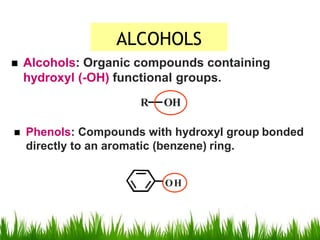
 Alcohols: Organic compounds containing
hydroxyl (-OH) functional groups.
R OH
 Phenols: Compounds with hydroxyl group bonded
directly to an aromatic (benzene) ring.
OH
IUPAC RULES
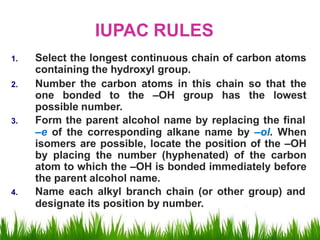
1. Select the longest continuous chain of carbon atoms
containing the hydroxyl group.
2. Number the carbon atoms in this chain so that the
one bonded to the –OH group has the lowest
possible number.
3. Form the parent alcohol name by replacing the final
–e of the corresponding alkane name by –ol. When
isomers are possible, locate the position of the –OH
by placing the number (hyphenated) of the carbon
atom to which the –OH is bonded immediately before
the parent alcohol name.
4. Name each alkyl branch chain (or other group) and
designate its position by number.
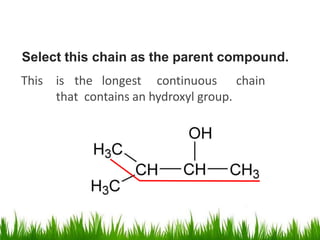
Select this chain as the parent compound.
This is the longest continuous chain
that contains an hydroxyl group.
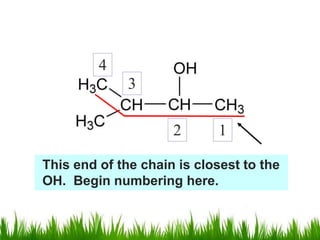
4
3
2 1
This end of the chain is closest to the
OH. Begin numbering here.
4
3
2 1
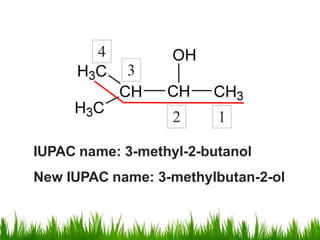
IUPAC name: 3-methyl-2-butanol
New IUPAC name: 3-methylbutan-2-ol
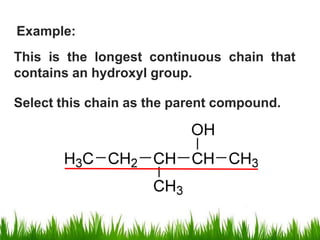
Example:
This is the longest continuous chain that
contains an hydroxyl group.
Select this chain as the parent compound.
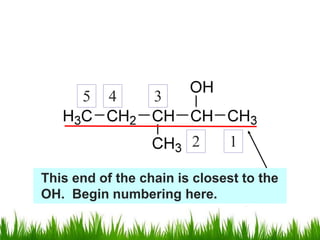
4 3
2 1
5
This end of the chain is closest to the
OH. Begin numbering here.
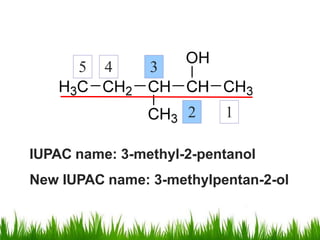
IUPAC name: 3-methyl-2-pentanol
New IUPAC name: 3-methylpentan-2-ol
4 3
2 1
5 3
2
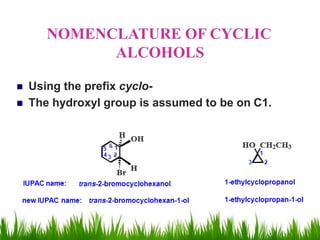
NOMENCLATURE OF CYCLIC
ALCOHOLS
 Using the prefix cyclo-
 The hydroxyl group is assumed to be on C1.
NOMENCLATURE OFALCOHOLS
CONTAINING TWO DIFFERENT
FUNCTIONAL GROUPS
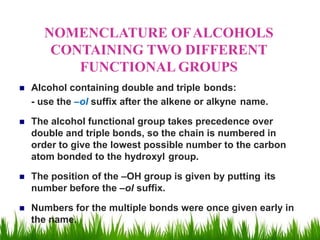
 Alcohol containing double and triple bonds:
- use the –ol suffix after the alkene or alkyne name.
 The alcohol functional group takes precedence over
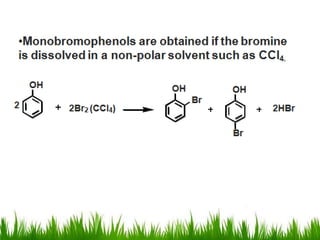
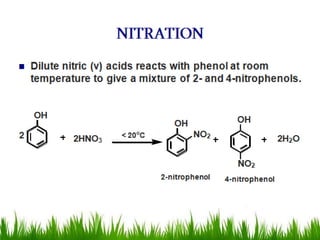
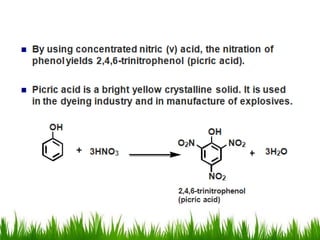
double and triple bonds, so the chain is numbered in
order to give the lowest possible number to the carbon
atom bonded to the hydroxyl group.
 The position of the –OH group is given by putting its
number before the –ol suffix.
 Numbers for the multiple bonds were once given early in
the name.
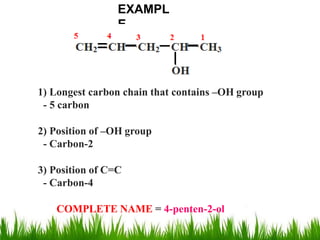
1) Longest carbon chain that contains –OH group
- 5 carbon
2) Position of –OH group
- Carbon-2
3) Position of C=C
- Carbon-4
COMPLETE NAME = 4-penten-2-ol
EXAMPL
E
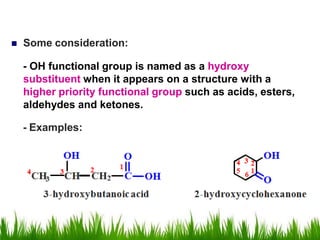
 Some consideration:
- OH functional group is named as a hydroxy
substituent when it appears on a structure with a
higher priority functional group such as acids, esters,
aldehydes and ketones.
- Examples:
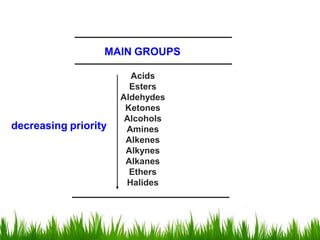
MAIN GROUPS
Acids
Esters
Aldehydes
Ketones
Alcohols
Amines
Alkenes
Alkynes
Alkanes
Ethers
Halides
decreasing priority
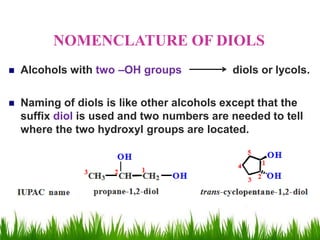
 Alcohols with two –OH groups diols or lycols.
 Naming of diols is like other alcohols except that the
suffix diol is used and two numbers are needed to tell
where the two hydroxyl groups are located.
NOMENCLATURE OF DIOLS
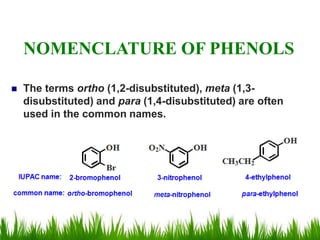
NOMENCLATURE OF PHENOLS
 The terms ortho (1,2-disubstituted), meta (1,3-
disubstituted) and para (1,4-disubstituted) are often
used in the common names.
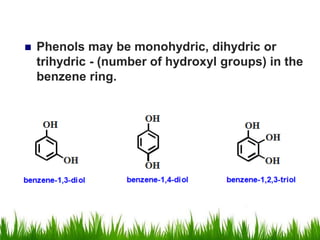
 Phenols may be monohydric, dihydric or
trihydric - (number of hydroxyl groups) in the
benzene ring.
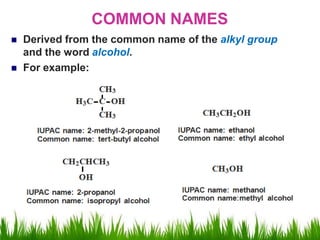
COMMON NAMES
 Derived from the common name of the alkyl group
and the word alcohol.
 For example:
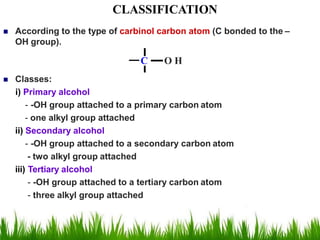
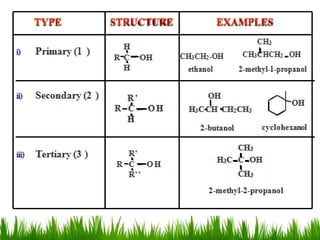
 According to the type of carbinol carbon atom (C bonded to the –
OH group).
C O H
 Classes:
i) Primary alcohol
- -OH group attached to a primary carbon atom
- one alkyl group attached
ii) Secondary alcohol
- -OH group attached to a secondary carbon atom
- two alkyl group attached
iii) Tertiary alcohol
- -OH group attached to a tertiary carbon atom
- three alkyl group attached
CLASSIFICATION
• Alcohols that contain more than one OH group -
polyhydroxy alcohols.
• Monohydroxy: one OH group.
• Dihydroxy: two OH groups.
• Trihydroxy: three OH groups.
Polyhydroxy Alcohols
PHYSICAL PROPERTIES
 PHYSICAL STATES OF ALCOHOLS
- aliphatic alcohols and lower aromatic alcohols
liquids at room temperature.
-highly branched alcohols and alcohols with twelve
or more carbon atoms solids.
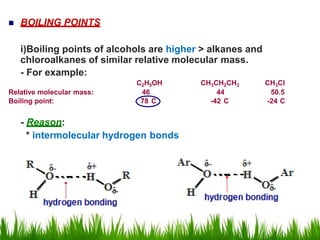
 BOILING POINTS
i)Boiling points of alcohols are higher > alkanes and
chloroalkanes of similar relative molecular mass.
- For example:
C2H5OH CH3CH2CH3 CH3Cl
Relative molecular mass: 46 44 50.5
Boiling point: 78 C -42 C -24 C
- Reason:
* intermolecular hydrogen bonds
 SOLUBILITY OF ALCOHOLS IN WATER
i)Alcohols with short carbon chains (i.e. methanol, ethanol) -
dissolve in water.
- dissolve in water (hydrogen bonds are formed).
ii)Solubility decreases sharply with the increasing length of
the carbon chain.
iii) Higher alcohols are insoluble in water.
- alcohol contains a polar end (-OH group) called ‘hydrophilic’
and a non-polar end (the alkyl group) called ‘hydrophobic’.
iii) Polyhydroxy alcohols are more soluble than monohydroxy
form more hydrogen bonds with water
molecule.
iv)Branched hydrocarbon increases the solubility of alcohol
in water branched hydrocarbon cause the
hydrophobic region becomes compact.
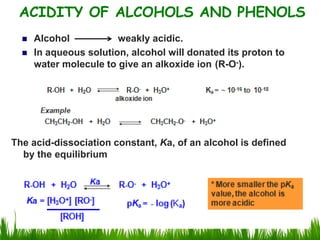
 Alcohol weakly acidic.
 In aqueous solution, alcohol will donated its proton to
water molecule to give an alkoxide ion (R-O-).
ACIDITY OF ALCOHOLS AND PHENOLS
The acid-dissociation constant, Ka, of an alcohol is defined
by the equilibrium
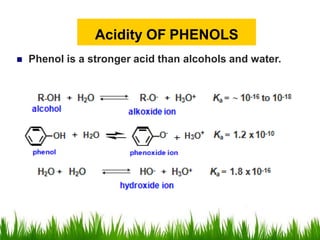
Acidity OF PHENOLS
 Phenol is a stronger acid than alcohols and water.
 Phenol is more acidic than alcohols by considering
the resonance effect.
i) The alkoxide ion (RO-)
-the negative charge is confined to the oxygen and
is not spread over the alkyl group.
-this makes the RO- ion less stable and more
susceptible to attack by positive ions such as H+
ions.
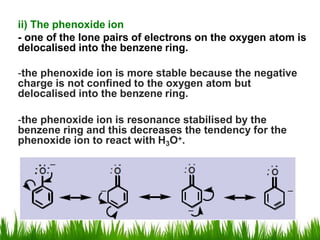
ii) The phenoxide ion
- one of the lone pairs of electrons on the oxygen atom is
delocalised into the benzene ring.
-the phenoxide ion is more stable because the negative
charge is not confined to the oxygen atom but
delocalised into the benzene ring.
-the phenoxide ion is resonance stabilised by the
benzene ring and this decreases the tendency for the
phenoxide ion to react with H3O+.
 The acidity decreases as the substitution on the alkyl group increase.
- Ethyl group is an electron-donating group strengthens the –O-H
bond harder to release a proton.
- i.e: methanol is more acidic than t-butyl alcohol.
 The present of electron-withdrawing atoms enhances the acidity of
alcohols.
- The electron withdrawing atom helps to stabilize the alkoxide ion.
-i.e: 2-chloroethanol is more acidic than ethanol because the
electron-withdrawing chlorine atom helps to stabilize the 2-
chloroethoxide ion.
-Alcohol with more than one electron withdrawing atoms are more
acidic. i.e. 2,2,-dichloroethanol is more acidic than 2-chloroethanol.
- Example of electron-withdrawing atom/groups:
Halogen atoms and NO2.
EFFECTS OF Acidity
IMPORTANT OF ALCOHOL
 Ethanol - solvent for varnishes, perfumes and
flavorings, medium for chemical reactions and in
recrystallization. Also is an important raw material
for synthesis.
 Medically, ethanol is classified as a hypnotic (sleep
producer), it is less toxic than other alcohol.
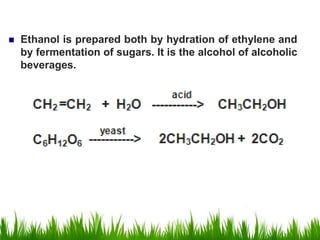
 Ethanol is prepared both by hydration of ethylene and
by fermentation of sugars. It is the alcohol of alcoholic
beverages.
 Grignard synthesis
 Hydrolysis of alkyl halides
 Industrial and laboratory preparations of
ethanol
PREPARATION OF ALCOHOLS
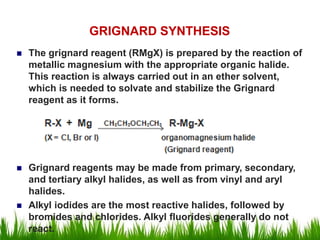
GRIGNARD SYNTHESIS
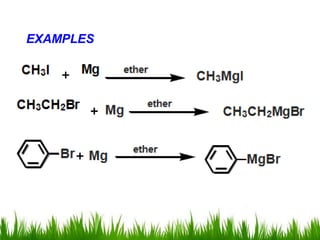
 The grignard reagent (RMgX) is prepared by the reaction of
metallic magnesium with the appropriate organic halide.
This reaction is always carried out in an ether solvent,
which is needed to solvate and stabilize the Grignard
reagent as it forms.
 Grignard reagents may be made from primary, secondary,
and tertiary alkyl halides, as well as from vinyl and aryl
halides.
 Alkyl iodides are the most reactive halides, followed by
bromides and chlorides. Alkyl fluorides generally do not
react.
EXAMPLES
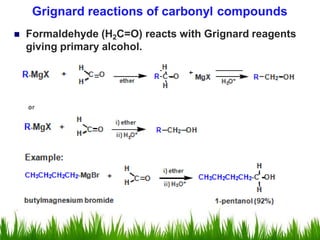
Grignard reactions of carbonyl compounds
 Formaldehyde (H2C=O) reacts with Grignard reagents
giving primary alcohol.
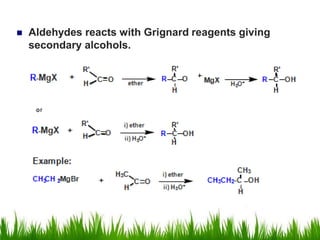
 Aldehydes reacts with Grignard reagents giving
secondary alcohols.
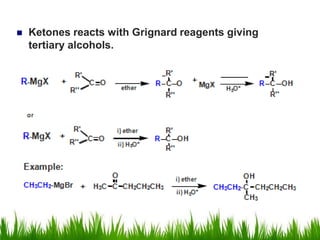
 Ketones reacts with Grignard reagents giving
tertiary alcohols.
 Hydrolysis of alkyl halides is severely limited as a
method of synthesizing alcohol, since alcohol are
usually more available than the corresponding
halides;indeed, the best general preparation of halides
is from alcohols.
 For those halides that can undergo elimination, the
formation of alkene must always be considered a
possible side reaction.
HYDROLYSIS OF ALKYL HALIDES
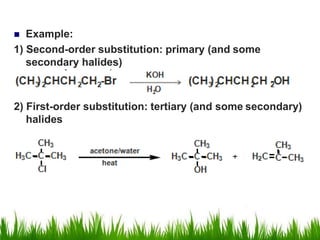
2) First-order substitution: tertiary (and some secondary)
halides
 Example:
1) Second-order substitution: primary (and some
secondary halides)
 There are three principle ways to get the simple alcohols that
are the backbone of aliphatic organic synthesis. These
methods are:
a)hydration of alkenes obtained from the cracking of
petroleum
b)the oxo process from alkenes, carbon monoxide and
hydrogen
c) fermentation of carbohydrate
INDUSTRIAL AND LABORATORY
PREPARATION OF ETHANOL
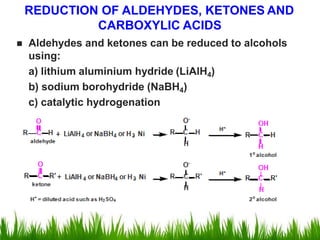
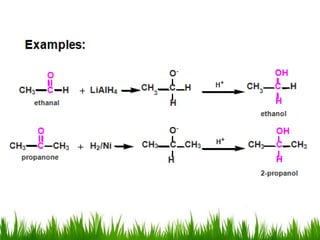
 Aldehydes and ketones can be reduced to alcohols
using:
a) lithium aluminium hydride (LiAlH4)
b) sodium borohydride (NaBH4)
c) catalytic hydrogenation
REDUCTION OF ALDEHYDES, KETONES AND
CARBOXYLIC ACIDS
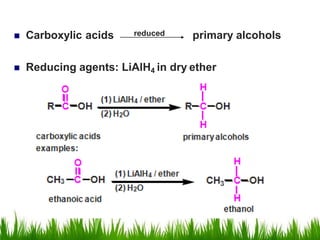
 Carboxylic acids primary alcohols
 Reducing agents: LiAlH4 in dry ether
reduced
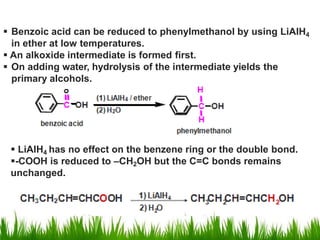
 Benzoic acid can be reduced to phenylmethanol by using LiAlH4
in ether at low temperatures.
 An alkoxide intermediate is formed first.
 On adding water, hydrolysis of the intermediate yields the
primary alcohols.
 LiAlH4 has no effect on the benzene ring or the double bond.
-COOH is reduced to –CH2OH but the C=C bonds remains
unchanged.
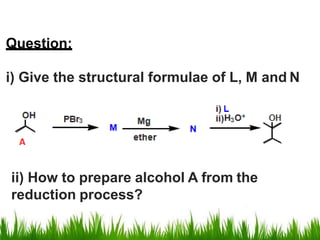
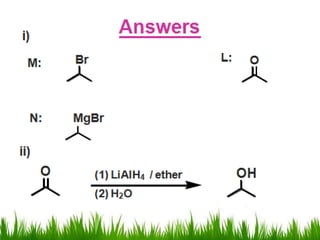
Question:
i) Give the structural formulae of L, M and N
ii) How to prepare alcohol A from the
reduction process?
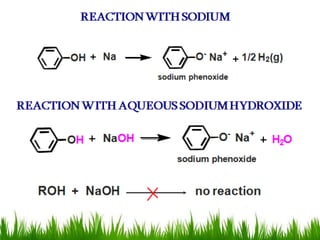
 Reaction with sodium
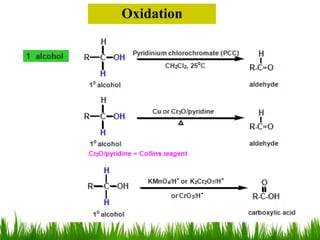
 Oxidation
 Esterification
 Halogenation and haloform reactions
 Dehydration
 Formation of ether (Williamson ether
synthesis)
REACTIONS OF ALCOHOLS
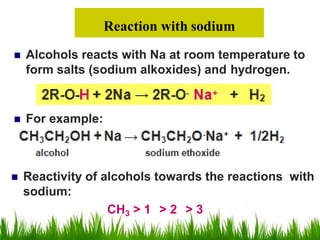
Reaction with sodium
 Alcohols reacts with Na at room temperature to
form salts (sodium alkoxides) and hydrogen.
 For example:
 Reactivity of alcohols towards the reactions with
sodium:
CH3 > 1 > 2 > 3
Oxidation
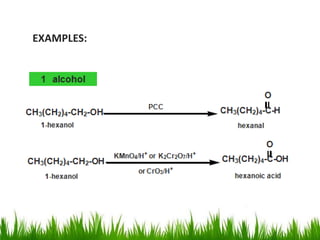
EXAMPLES:
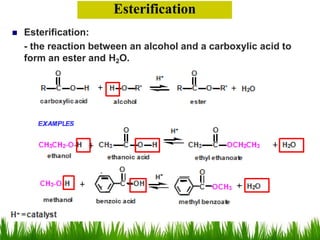
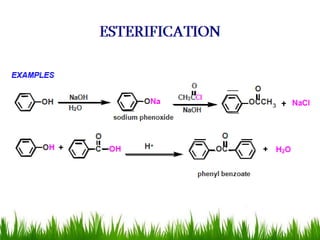
 Esterification:
- the reaction between an alcohol and a carboxylic acid to
form an ester and H2O.
Esterification
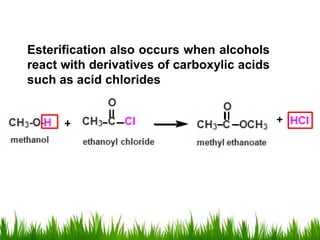
Esterification also occurs when alcohols
react with derivatives of carboxylic acids
such as acid chlorides
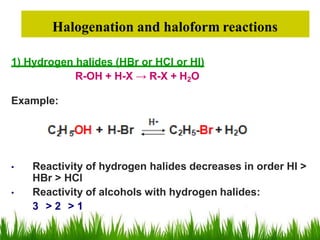
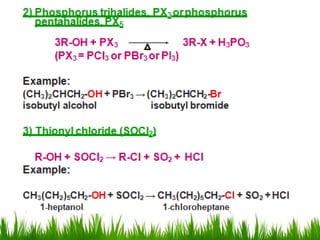
Halogenation and haloform reactions
1) Hydrogen halides (HBr or HCl or HI)
R-OH + H-X → R-X + H2O
Example:
• Reactivity of hydrogen halides decreases in order HI >
HBr > HCl
• Reactivity of alcohols with hydrogen halides:
3 > 2 > 1
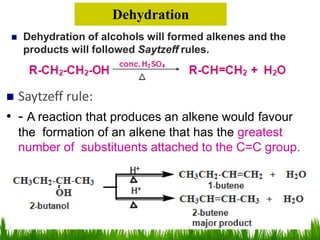
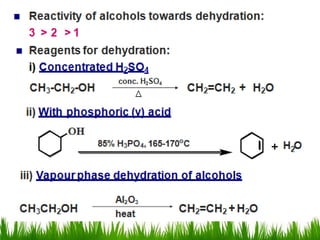
 Dehydration of alcohols will formed alkenes and the
products will followed Saytzeff rules.
Dehydration
 Saytzeff rule:
• - A reaction that produces an alkene would favour
the formation of an alkene that has the greatest
number of substituents attached to the C=C group.
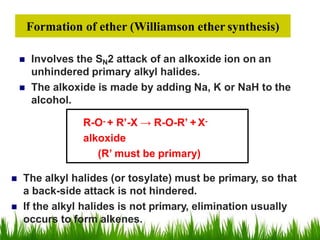
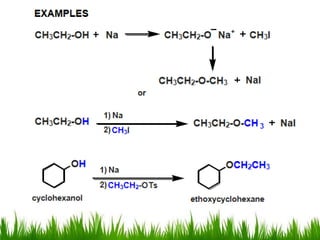
 Involves the SN2 attack of an alkoxide ion on an
unhindered primary alkyl halides.
 The alkoxide is made by adding Na, K or NaH to the
alcohol.
R-O- + R’-X → R-O-R’ + X-
alkoxide
(R’ must be primary)
Formation of ether (Williamson ether synthesis)
 The alkyl halides (or tosylate) must be primary, so that
a back-side attack is not hindered.
 If the alkyl halides is not primary, elimination usually
occurs to form alkenes.
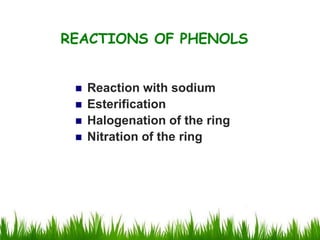
 Reaction with sodium
 Esterification
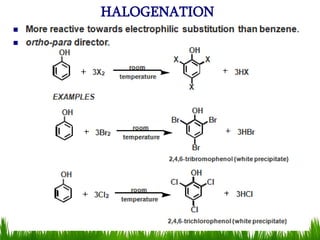
 Halogenation of the ring
 Nitration of the ring
REACTIONS OF PHENOLS
HALOGENATION
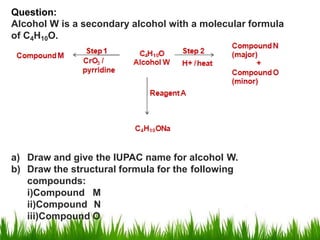
Question:
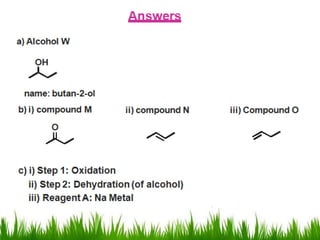
Alcohol W is a secondary alcohol with a molecular formula
of C4H10O.
a) Draw and give the IUPAC name for alcohol W.
b) Draw the structural formula for the following
compounds:
i)Compound M
ii)Compound N
iii)Compound O
c) Give the correct name for the following:
i) Step 1
ii) Step 2
iii)Reagent A
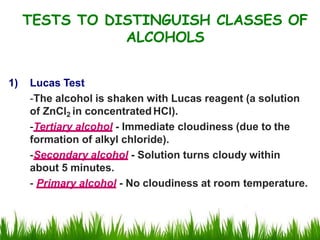
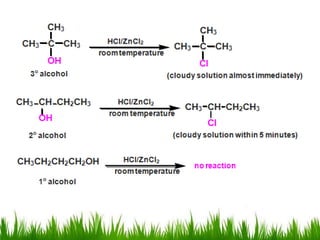
1) Lucas Test
-The alcohol is shaken with Lucas reagent (a solution
of ZnCl2 in concentratedHCl).
-Tertiary alcohol - Immediate cloudiness (due to the
formation of alkyl chloride).
-Secondary alcohol - Solution turns cloudy within
about 5 minutes.
- Primary alcohol - No cloudiness at room temperature.
TESTS TO DISTINGUISH CLASSES OF
ALCOHOLS
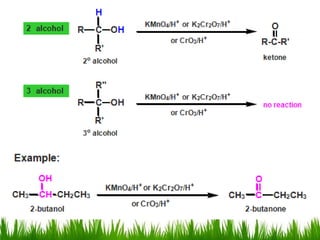
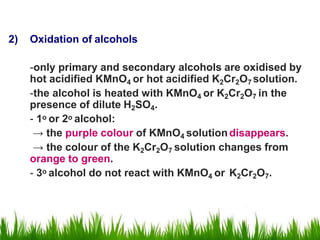
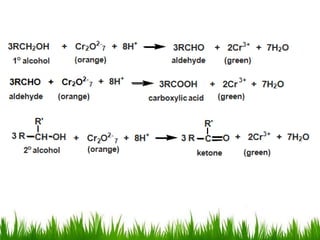
2) Oxidation of alcohols
-only primary and secondary alcohols are oxidised by
hot acidified KMnO4 or hot acidified K2Cr2O7 solution.
-the alcohol is heated with KMnO4 or K2Cr2O7 in the
presence of dilute H2SO4.
- 1o or 2o alcohol:
→ the purple colour of KMnO4 solutiondisappears.
→ the colour of the K2Cr2O7 solution changes from
orange to green.
- 3o alcohol do not react with KMnO4 or K2Cr2O7.
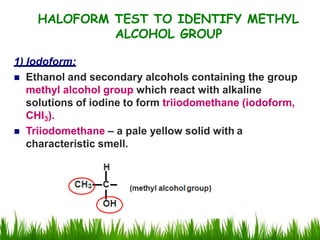
HALOFORM TEST TO IDENTIFY METHYL
ALCOHOL GROUP
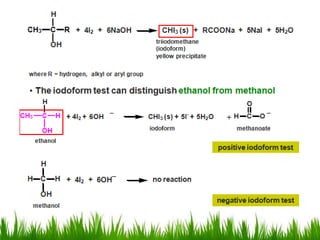
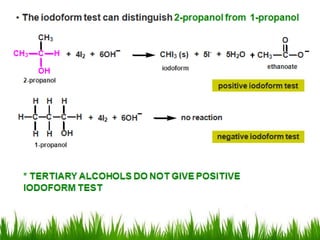
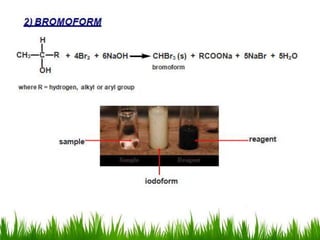
1) Iodoform:
 Ethanol and secondary alcohols containing the group
methyl alcohol group which react with alkaline
solutions of iodine to form triiodomethane (iodoform,
CHI3).
 Triiodomethane – a pale yellow solid with a
characteristic smell.
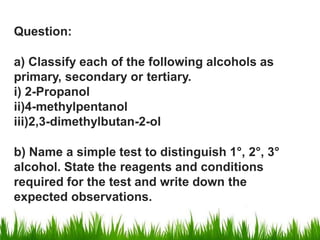
Question:
a) Classify each of the following alcohols as
primary, secondary or tertiary.
i) 2-Propanol
ii)4-methylpentanol
iii)2,3-dimethylbutan-2-ol
b) Name a simple test to distinguish 1°, 2°, 3°
alcohol. State the reagents and conditions
required for the test and write down the
expected observations.
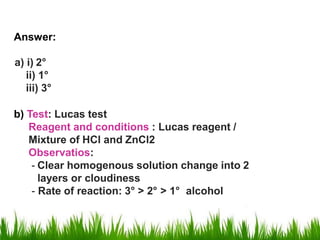
Answer:
a) i) 2°
ii) 1°
iii) 3°
b) Test: Lucas test
Reagent and conditions : Lucas reagent /
Mixture of HCl and ZnCl2
Observatios:
- Clear homogenous solution change into 2
layers or cloudiness
- Rate of reaction: 3° > 2° > 1° alcohol
STRUCTURES AND USES OF
SOME IMPORTANT
ALCOHOLS
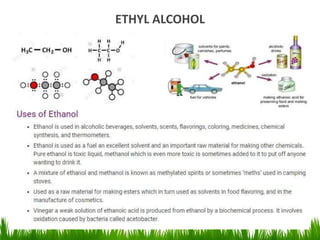
ETHYL ALCOHOL
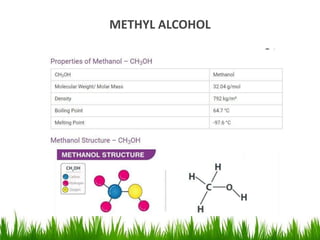
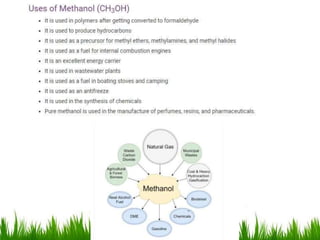
METHYL ALCOHOL
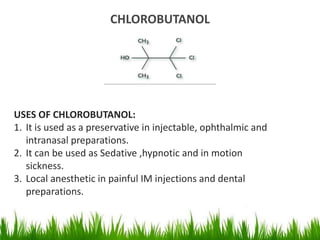
CHLOROBUTANOL
USES OF CHLOROBUTANOL:
1. It is used as a preservative in injectable, ophthalmic and
intranasal preparations.
2. It can be used as Sedative ,hypnotic and in motion
sickness.
3. Local anesthetic in painful IM injections and dental
preparations.
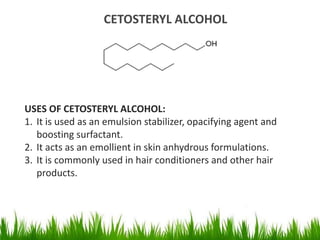
CETOSTERYL ALCOHOL
USES OF CETOSTERYL ALCOHOL:
1. It is used as an emulsion stabilizer, opacifying agent and
boosting surfactant.
2. It acts as an emollient in skin anhydrous formulations.
3. It is commonly used in hair conditioners and other hair
products.
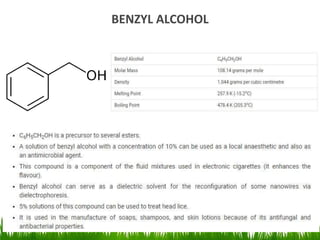
BENZYL ALCOHOL
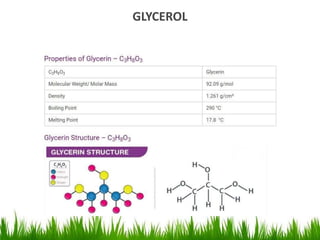
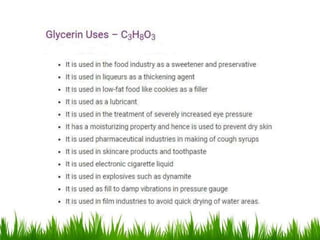
GLYCEROL
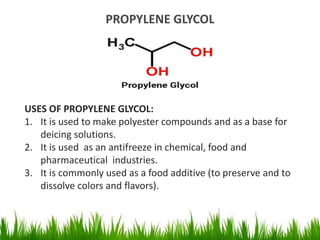
PROPYLENE GLYCOL
USES OF PROPYLENE GLYCOL:
1. It is used to make polyester compounds and as a base for
deicing solutions.
2. It is used as an antifreeze in chemical, food and
pharmaceutical industries.
3. It is commonly used as a food additive (to preserve and to
dissolve colors and flavors).
Alcohols

Alcohols

  • 1.
    BY VANA JAGAN MOHANRAO M.S.Pharm, MED.CHEM NIPER-KOLKATA Asst.Professor, MIPER-KURNOOL Email: jaganvana6@gmail.com
  • 2.
    ALCOHOLS  Alcohols: Organiccompounds containing hydroxyl (-OH) functional groups. R OH  Phenols: Compounds with hydroxyl group bonded directly to an aromatic (benzene) ring. OH
  • 4.
    IUPAC RULES 1. Selectthe longest continuous chain of carbon atoms containing the hydroxyl group. 2. Number the carbon atoms in this chain so that the one bonded to the –OH group has the lowest possible number. 3. Form the parent alcohol name by replacing the final –e of the corresponding alkane name by –ol. When isomers are possible, locate the position of the –OH by placing the number (hyphenated) of the carbon atom to which the –OH is bonded immediately before the parent alcohol name. 4. Name each alkyl branch chain (or other group) and designate its position by number.
  • 5.
    Select this chainas the parent compound. This is the longest continuous chain that contains an hydroxyl group.
  • 6.
    4 3 2 1 This endof the chain is closest to the OH. Begin numbering here.
  • 7.
    4 3 2 1 IUPAC name:3-methyl-2-butanol New IUPAC name: 3-methylbutan-2-ol
  • 8.
    Example: This is thelongest continuous chain that contains an hydroxyl group. Select this chain as the parent compound.
  • 9.
    4 3 2 1 5 Thisend of the chain is closest to the OH. Begin numbering here.
  • 10.
    IUPAC name: 3-methyl-2-pentanol NewIUPAC name: 3-methylpentan-2-ol 4 3 2 1 5 3 2
  • 11.
    NOMENCLATURE OF CYCLIC ALCOHOLS Using the prefix cyclo-  The hydroxyl group is assumed to be on C1.
  • 12.
    NOMENCLATURE OFALCOHOLS CONTAINING TWODIFFERENT FUNCTIONAL GROUPS  Alcohol containing double and triple bonds: - use the –ol suffix after the alkene or alkyne name.  The alcohol functional group takes precedence over double and triple bonds, so the chain is numbered in order to give the lowest possible number to the carbon atom bonded to the hydroxyl group.  The position of the –OH group is given by putting its number before the –ol suffix.  Numbers for the multiple bonds were once given early in the name.
  • 13.
    1) Longest carbonchain that contains –OH group - 5 carbon 2) Position of –OH group - Carbon-2 3) Position of C=C - Carbon-4 COMPLETE NAME = 4-penten-2-ol EXAMPL E
  • 14.
     Some consideration: -OH functional group is named as a hydroxy substituent when it appears on a structure with a higher priority functional group such as acids, esters, aldehydes and ketones. - Examples:
  • 15.
  • 16.
     Alcohols withtwo –OH groups diols or lycols.  Naming of diols is like other alcohols except that the suffix diol is used and two numbers are needed to tell where the two hydroxyl groups are located. NOMENCLATURE OF DIOLS
  • 17.
    NOMENCLATURE OF PHENOLS The terms ortho (1,2-disubstituted), meta (1,3- disubstituted) and para (1,4-disubstituted) are often used in the common names.
  • 18.
     Phenols maybe monohydric, dihydric or trihydric - (number of hydroxyl groups) in the benzene ring.
  • 19.
    COMMON NAMES  Derivedfrom the common name of the alkyl group and the word alcohol.  For example:
  • 21.
     According tothe type of carbinol carbon atom (C bonded to the – OH group). C O H  Classes: i) Primary alcohol - -OH group attached to a primary carbon atom - one alkyl group attached ii) Secondary alcohol - -OH group attached to a secondary carbon atom - two alkyl group attached iii) Tertiary alcohol - -OH group attached to a tertiary carbon atom - three alkyl group attached CLASSIFICATION
  • 23.
    • Alcohols thatcontain more than one OH group - polyhydroxy alcohols. • Monohydroxy: one OH group. • Dihydroxy: two OH groups. • Trihydroxy: three OH groups. Polyhydroxy Alcohols
  • 25.
    PHYSICAL PROPERTIES  PHYSICALSTATES OF ALCOHOLS - aliphatic alcohols and lower aromatic alcohols liquids at room temperature. -highly branched alcohols and alcohols with twelve or more carbon atoms solids.
  • 26.
     BOILING POINTS i)Boilingpoints of alcohols are higher > alkanes and chloroalkanes of similar relative molecular mass. - For example: C2H5OH CH3CH2CH3 CH3Cl Relative molecular mass: 46 44 50.5 Boiling point: 78 C -42 C -24 C - Reason: * intermolecular hydrogen bonds
  • 27.
     SOLUBILITY OFALCOHOLS IN WATER i)Alcohols with short carbon chains (i.e. methanol, ethanol) - dissolve in water. - dissolve in water (hydrogen bonds are formed). ii)Solubility decreases sharply with the increasing length of the carbon chain. iii) Higher alcohols are insoluble in water. - alcohol contains a polar end (-OH group) called ‘hydrophilic’ and a non-polar end (the alkyl group) called ‘hydrophobic’.
  • 28.
    iii) Polyhydroxy alcoholsare more soluble than monohydroxy form more hydrogen bonds with water molecule. iv)Branched hydrocarbon increases the solubility of alcohol in water branched hydrocarbon cause the hydrophobic region becomes compact.
  • 29.
     Alcohol weaklyacidic.  In aqueous solution, alcohol will donated its proton to water molecule to give an alkoxide ion (R-O-). ACIDITY OF ALCOHOLS AND PHENOLS The acid-dissociation constant, Ka, of an alcohol is defined by the equilibrium
  • 30.
    Acidity OF PHENOLS Phenol is a stronger acid than alcohols and water.
  • 31.
     Phenol ismore acidic than alcohols by considering the resonance effect. i) The alkoxide ion (RO-) -the negative charge is confined to the oxygen and is not spread over the alkyl group. -this makes the RO- ion less stable and more susceptible to attack by positive ions such as H+ ions.
  • 32.
    ii) The phenoxideion - one of the lone pairs of electrons on the oxygen atom is delocalised into the benzene ring. -the phenoxide ion is more stable because the negative charge is not confined to the oxygen atom but delocalised into the benzene ring. -the phenoxide ion is resonance stabilised by the benzene ring and this decreases the tendency for the phenoxide ion to react with H3O+.
  • 33.
     The aciditydecreases as the substitution on the alkyl group increase. - Ethyl group is an electron-donating group strengthens the –O-H bond harder to release a proton. - i.e: methanol is more acidic than t-butyl alcohol.  The present of electron-withdrawing atoms enhances the acidity of alcohols. - The electron withdrawing atom helps to stabilize the alkoxide ion. -i.e: 2-chloroethanol is more acidic than ethanol because the electron-withdrawing chlorine atom helps to stabilize the 2- chloroethoxide ion. -Alcohol with more than one electron withdrawing atoms are more acidic. i.e. 2,2,-dichloroethanol is more acidic than 2-chloroethanol. - Example of electron-withdrawing atom/groups: Halogen atoms and NO2. EFFECTS OF Acidity
  • 34.
    IMPORTANT OF ALCOHOL Ethanol - solvent for varnishes, perfumes and flavorings, medium for chemical reactions and in recrystallization. Also is an important raw material for synthesis.  Medically, ethanol is classified as a hypnotic (sleep producer), it is less toxic than other alcohol.
  • 35.
     Ethanol isprepared both by hydration of ethylene and by fermentation of sugars. It is the alcohol of alcoholic beverages.
  • 36.
     Grignard synthesis Hydrolysis of alkyl halides  Industrial and laboratory preparations of ethanol PREPARATION OF ALCOHOLS
  • 37.
    GRIGNARD SYNTHESIS  Thegrignard reagent (RMgX) is prepared by the reaction of metallic magnesium with the appropriate organic halide. This reaction is always carried out in an ether solvent, which is needed to solvate and stabilize the Grignard reagent as it forms.  Grignard reagents may be made from primary, secondary, and tertiary alkyl halides, as well as from vinyl and aryl halides.  Alkyl iodides are the most reactive halides, followed by bromides and chlorides. Alkyl fluorides generally do not react.
  • 38.
  • 39.
    Grignard reactions ofcarbonyl compounds  Formaldehyde (H2C=O) reacts with Grignard reagents giving primary alcohol.
  • 40.
     Aldehydes reactswith Grignard reagents giving secondary alcohols.
  • 41.
     Ketones reactswith Grignard reagents giving tertiary alcohols.
  • 42.
     Hydrolysis ofalkyl halides is severely limited as a method of synthesizing alcohol, since alcohol are usually more available than the corresponding halides;indeed, the best general preparation of halides is from alcohols.  For those halides that can undergo elimination, the formation of alkene must always be considered a possible side reaction. HYDROLYSIS OF ALKYL HALIDES
  • 43.
    2) First-order substitution:tertiary (and some secondary) halides  Example: 1) Second-order substitution: primary (and some secondary halides)
  • 44.
     There arethree principle ways to get the simple alcohols that are the backbone of aliphatic organic synthesis. These methods are: a)hydration of alkenes obtained from the cracking of petroleum b)the oxo process from alkenes, carbon monoxide and hydrogen c) fermentation of carbohydrate INDUSTRIAL AND LABORATORY PREPARATION OF ETHANOL
  • 45.
     Aldehydes andketones can be reduced to alcohols using: a) lithium aluminium hydride (LiAlH4) b) sodium borohydride (NaBH4) c) catalytic hydrogenation REDUCTION OF ALDEHYDES, KETONES AND CARBOXYLIC ACIDS
  • 47.
     Carboxylic acidsprimary alcohols  Reducing agents: LiAlH4 in dry ether reduced
  • 48.
     Benzoic acidcan be reduced to phenylmethanol by using LiAlH4 in ether at low temperatures.  An alkoxide intermediate is formed first.  On adding water, hydrolysis of the intermediate yields the primary alcohols.  LiAlH4 has no effect on the benzene ring or the double bond. -COOH is reduced to –CH2OH but the C=C bonds remains unchanged.
  • 49.
    Question: i) Give thestructural formulae of L, M and N ii) How to prepare alcohol A from the reduction process?
  • 51.
     Reaction withsodium  Oxidation  Esterification  Halogenation and haloform reactions  Dehydration  Formation of ether (Williamson ether synthesis) REACTIONS OF ALCOHOLS
  • 52.
    Reaction with sodium Alcohols reacts with Na at room temperature to form salts (sodium alkoxides) and hydrogen.  For example:  Reactivity of alcohols towards the reactions with sodium: CH3 > 1 > 2 > 3
  • 53.
  • 54.
  • 56.
     Esterification: - thereaction between an alcohol and a carboxylic acid to form an ester and H2O. Esterification
  • 57.
    Esterification also occurswhen alcohols react with derivatives of carboxylic acids such as acid chlorides
  • 58.
    Halogenation and haloformreactions 1) Hydrogen halides (HBr or HCl or HI) R-OH + H-X → R-X + H2O Example: • Reactivity of hydrogen halides decreases in order HI > HBr > HCl • Reactivity of alcohols with hydrogen halides: 3 > 2 > 1
  • 60.
     Dehydration ofalcohols will formed alkenes and the products will followed Saytzeff rules. Dehydration  Saytzeff rule: • - A reaction that produces an alkene would favour the formation of an alkene that has the greatest number of substituents attached to the C=C group.
  • 62.
     Involves theSN2 attack of an alkoxide ion on an unhindered primary alkyl halides.  The alkoxide is made by adding Na, K or NaH to the alcohol. R-O- + R’-X → R-O-R’ + X- alkoxide (R’ must be primary) Formation of ether (Williamson ether synthesis)  The alkyl halides (or tosylate) must be primary, so that a back-side attack is not hindered.  If the alkyl halides is not primary, elimination usually occurs to form alkenes.
  • 64.
     Reaction withsodium  Esterification  Halogenation of the ring  Nitration of the ring REACTIONS OF PHENOLS
  • 67.
  • 71.
    Question: Alcohol W isa secondary alcohol with a molecular formula of C4H10O. a) Draw and give the IUPAC name for alcohol W. b) Draw the structural formula for the following compounds: i)Compound M ii)Compound N iii)Compound O
  • 72.
    c) Give thecorrect name for the following: i) Step 1 ii) Step 2 iii)Reagent A
  • 74.
    1) Lucas Test -Thealcohol is shaken with Lucas reagent (a solution of ZnCl2 in concentratedHCl). -Tertiary alcohol - Immediate cloudiness (due to the formation of alkyl chloride). -Secondary alcohol - Solution turns cloudy within about 5 minutes. - Primary alcohol - No cloudiness at room temperature. TESTS TO DISTINGUISH CLASSES OF ALCOHOLS
  • 76.
    2) Oxidation ofalcohols -only primary and secondary alcohols are oxidised by hot acidified KMnO4 or hot acidified K2Cr2O7 solution. -the alcohol is heated with KMnO4 or K2Cr2O7 in the presence of dilute H2SO4. - 1o or 2o alcohol: → the purple colour of KMnO4 solutiondisappears. → the colour of the K2Cr2O7 solution changes from orange to green. - 3o alcohol do not react with KMnO4 or K2Cr2O7.
  • 78.
    HALOFORM TEST TOIDENTIFY METHYL ALCOHOL GROUP 1) Iodoform:  Ethanol and secondary alcohols containing the group methyl alcohol group which react with alkaline solutions of iodine to form triiodomethane (iodoform, CHI3).  Triiodomethane – a pale yellow solid with a characteristic smell.
  • 82.
    Question: a) Classify eachof the following alcohols as primary, secondary or tertiary. i) 2-Propanol ii)4-methylpentanol iii)2,3-dimethylbutan-2-ol b) Name a simple test to distinguish 1°, 2°, 3° alcohol. State the reagents and conditions required for the test and write down the expected observations.
  • 83.
    Answer: a) i) 2° ii)1° iii) 3° b) Test: Lucas test Reagent and conditions : Lucas reagent / Mixture of HCl and ZnCl2 Observatios: - Clear homogenous solution change into 2 layers or cloudiness - Rate of reaction: 3° > 2° > 1° alcohol
  • 84.
    STRUCTURES AND USESOF SOME IMPORTANT ALCOHOLS
  • 85.
  • 86.
  • 88.
    CHLOROBUTANOL USES OF CHLOROBUTANOL: 1.It is used as a preservative in injectable, ophthalmic and intranasal preparations. 2. It can be used as Sedative ,hypnotic and in motion sickness. 3. Local anesthetic in painful IM injections and dental preparations.
  • 89.
    CETOSTERYL ALCOHOL USES OFCETOSTERYL ALCOHOL: 1. It is used as an emulsion stabilizer, opacifying agent and boosting surfactant. 2. It acts as an emollient in skin anhydrous formulations. 3. It is commonly used in hair conditioners and other hair products.
  • 90.
  • 91.
  • 93.
    PROPYLENE GLYCOL USES OFPROPYLENE GLYCOL: 1. It is used to make polyester compounds and as a base for deicing solutions. 2. It is used as an antifreeze in chemical, food and pharmaceutical industries. 3. It is commonly used as a food additive (to preserve and to dissolve colors and flavors).