 In organic chemistry, Functional groups are specific groups
(moieties) of atoms or bonds within molecules that are
responsible for the characteristic chemical reactions of those
molecules. The same functional group will undergo the same or
similar chemical reaction(s) regardless of the size of the
molecule it is a part of. However, its relative reactivity can be
modified by other functional groups nearby. The atoms of
functional groups are linked to each other and to the rest of the
molecule by covalent bonds. When the group of covalently
bound atoms bears a net charge, the group is referred to more
properly as a polyatomic ion or a complex ion. Any subgroup
of atoms of a compound also may be called a radical, and if a
covalent bond is broken homolytically, the resulting fragment
radicals are referred as free radicals.
 Hydrocarbons
 Groups containing halogens
 Groups containing oxygen
 Groups containing nitrogen
 Groups containing sulphur
 Groups containing phosphorus
 Groups containing boron
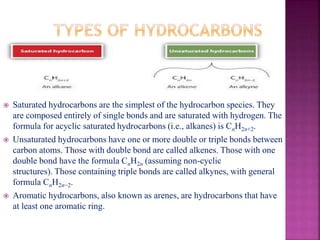
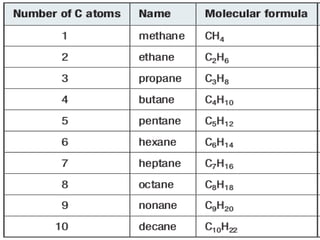
 Saturated hydrocarbons are the simplest of the hydrocarbon species. They
are composed entirely of single bonds and are saturated with hydrogen. The
formula for acyclic saturated hydrocarbons (i.e., alkanes) is CnH2n+2.
 Unsaturated hydrocarbons have one or more double or triple bonds between
carbon atoms. Those with double bond are called alkenes. Those with one
double bond have the formula CnH2n (assuming non-cyclic
structures). Those containing triple bonds are called alkynes, with general
formula CnH2n−2.
 Aromatic hydrocarbons, also known as arenes, are hydrocarbons that have
at least one aromatic ring.
 An organic chemistry, an alkane, is
an acyclic saturated hydrocarbon. In other
words, an alkane consists
of hydrogen and carbon atoms arranged in
a tree structure in which all the carbon-
carbon bonds are single. Alkanes have the
general chemical formula CnH2n+2. The
alkanes range in complexity from the
simplest case of methane, CH4where n = 1
(sometimes called the parent molecule), to
arbitrarily large molecules.
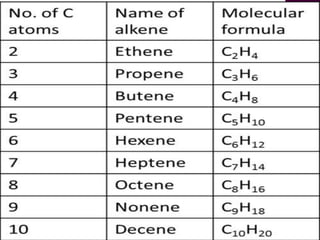
 In organic chemistry, an alkene is an unsaturated hydrocarbon
that contains at least one carbon–carbon double bond. The
words alkene, olefin, and olefin are used often interchangeably
(see nomenclature section below). Acyclic alkenes, with only
one double bond and no other functional groups, known as
mono-enes form a homologous series of hydrocarbons with the
general formula CnH2n.Alkenes have two hydrogen atoms less
than the corresponding alkane.
 In organic chemistry, an alkyne is
an unsaturated hydrocarbon containing at
least one carbon—carbon triple bond. The
simplest acyclic alkynes with only one triple
bond and no other functional groups form
a homologous series with the general
chemical formula CnH2n−2. Alkynes are
traditionally known as acetylenes, although
the name acetylene also refers specifically to
C2H2, known formally as ethyne using IUPAC
nomenclature. Like other hydrocarbons,
alkynes are generally hydrophobic but tend
to be more reactive.
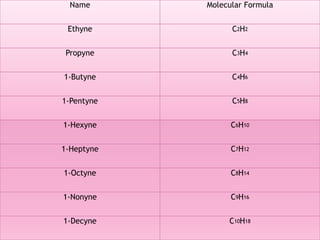
Name Molecular Formula
Ethyne C2H2
Propyne C3H4
1-Butyne C4H6
1-Pentyne C5H8
1-Hexyne C6H10
1-Heptyne C7H12
1-Octyne C8H14
1-Nonyne C9H16
1-Decyne C10H18
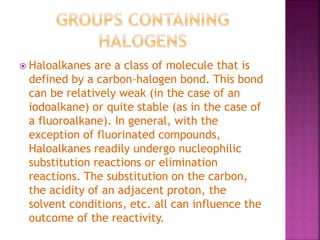
 Haloalkanes are a class of molecule that is
defined by a carbon–halogen bond. This bond
can be relatively weak (in the case of an
iodoalkane) or quite stable (as in the case of
a fluoroalkane). In general, with the
exception of fluorinated compounds,
Haloalkanes readily undergo nucleophilic
substitution reactions or elimination
reactions. The substitution on the carbon,
the acidity of an adjacent proton, the
solvent conditions, etc. all can influence the
outcome of the reactivity.
Chemical
class
Group Formula Structural
formula
Prefix
Haloalkanes Halo Rx R-x Halo-
Fluoroalkane Fluoro Rf R-f Fluoro-
Chloroalkane Chloro Rcl R-cl Chloro-
Bromoalkane Bromo Rbr R-br Bromo-
Iodoalkane Iodo Ri R-i Iodo-
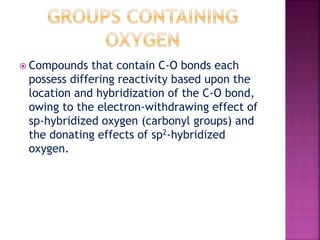
 Compounds that contain C-O bonds each
possess differing reactivity based upon the
location and hybridization of the C-O bond,
owing to the electron-withdrawing effect of
sp-hybridized oxygen (carbonyl groups) and
the donating effects of sp2-hybridized
oxygen.
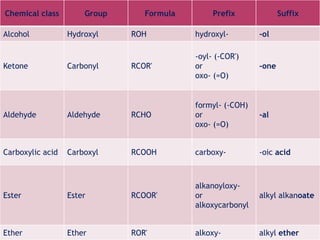
Chemical class Group Formula Prefix Suffix
Alcohol Hydroxyl ROH hydroxyl- -ol
Ketone Carbonyl RCOR'
-oyl- (-COR')
or
oxo- (=O)
-one
Aldehyde Aldehyde RCHO
formyl- (-COH)
or
oxo- (=O)
-al
Carboxylic acid Carboxyl RCOOH carboxy- -oic acid
Ester Ester RCOOR'
alkanoyloxy-
or
alkoxycarbonyl
alkyl alkanoate
Ether Ether ROR' alkoxy- alkyl ether
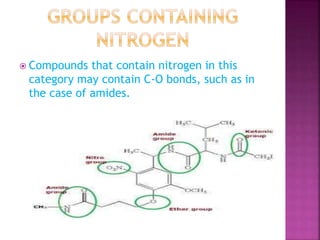
 Compounds that contain nitrogen in this
category may contain C-O bonds, such as in
the case of amides.
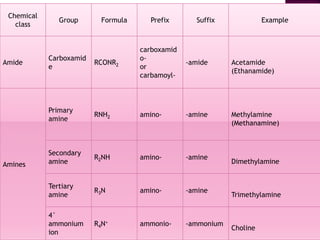
Chemical
class
Group Formula Prefix Suffix Example
Amide
Carboxamid
e
RCONR2
carboxamid
o-
or
carbamoyl-
-amide Acetamide
(Ethanamide)
Amines
Primary
amine
RNH2 amino- -amine Methylamine
(Methanamine)
Secondary
amine
R2NH amino- -amine
Dimethylamine
Tertiary
amine
R3N amino- -amine
Trimethylamine
4°
ammonium
ion
R4N+ ammonio- -ammonium
Choline
Functional groups

Functional groups

  • 3.
     In organicchemistry, Functional groups are specific groups (moieties) of atoms or bonds within molecules that are responsible for the characteristic chemical reactions of those molecules. The same functional group will undergo the same or similar chemical reaction(s) regardless of the size of the molecule it is a part of. However, its relative reactivity can be modified by other functional groups nearby. The atoms of functional groups are linked to each other and to the rest of the molecule by covalent bonds. When the group of covalently bound atoms bears a net charge, the group is referred to more properly as a polyatomic ion or a complex ion. Any subgroup of atoms of a compound also may be called a radical, and if a covalent bond is broken homolytically, the resulting fragment radicals are referred as free radicals.
  • 4.
     Hydrocarbons  Groupscontaining halogens  Groups containing oxygen  Groups containing nitrogen  Groups containing sulphur  Groups containing phosphorus  Groups containing boron
  • 5.
     Saturated hydrocarbonsare the simplest of the hydrocarbon species. They are composed entirely of single bonds and are saturated with hydrogen. The formula for acyclic saturated hydrocarbons (i.e., alkanes) is CnH2n+2.  Unsaturated hydrocarbons have one or more double or triple bonds between carbon atoms. Those with double bond are called alkenes. Those with one double bond have the formula CnH2n (assuming non-cyclic structures). Those containing triple bonds are called alkynes, with general formula CnH2n−2.  Aromatic hydrocarbons, also known as arenes, are hydrocarbons that have at least one aromatic ring.
  • 6.
     An organicchemistry, an alkane, is an acyclic saturated hydrocarbon. In other words, an alkane consists of hydrogen and carbon atoms arranged in a tree structure in which all the carbon- carbon bonds are single. Alkanes have the general chemical formula CnH2n+2. The alkanes range in complexity from the simplest case of methane, CH4where n = 1 (sometimes called the parent molecule), to arbitrarily large molecules.
  • 8.
     In organicchemistry, an alkene is an unsaturated hydrocarbon that contains at least one carbon–carbon double bond. The words alkene, olefin, and olefin are used often interchangeably (see nomenclature section below). Acyclic alkenes, with only one double bond and no other functional groups, known as mono-enes form a homologous series of hydrocarbons with the general formula CnH2n.Alkenes have two hydrogen atoms less than the corresponding alkane.
  • 10.
     In organicchemistry, an alkyne is an unsaturated hydrocarbon containing at least one carbon—carbon triple bond. The simplest acyclic alkynes with only one triple bond and no other functional groups form a homologous series with the general chemical formula CnH2n−2. Alkynes are traditionally known as acetylenes, although the name acetylene also refers specifically to C2H2, known formally as ethyne using IUPAC nomenclature. Like other hydrocarbons, alkynes are generally hydrophobic but tend to be more reactive.
  • 11.
    Name Molecular Formula EthyneC2H2 Propyne C3H4 1-Butyne C4H6 1-Pentyne C5H8 1-Hexyne C6H10 1-Heptyne C7H12 1-Octyne C8H14 1-Nonyne C9H16 1-Decyne C10H18
  • 12.
     Haloalkanes area class of molecule that is defined by a carbon–halogen bond. This bond can be relatively weak (in the case of an iodoalkane) or quite stable (as in the case of a fluoroalkane). In general, with the exception of fluorinated compounds, Haloalkanes readily undergo nucleophilic substitution reactions or elimination reactions. The substitution on the carbon, the acidity of an adjacent proton, the solvent conditions, etc. all can influence the outcome of the reactivity.
  • 13.
    Chemical class Group Formula Structural formula Prefix HaloalkanesHalo Rx R-x Halo- Fluoroalkane Fluoro Rf R-f Fluoro- Chloroalkane Chloro Rcl R-cl Chloro- Bromoalkane Bromo Rbr R-br Bromo- Iodoalkane Iodo Ri R-i Iodo-
  • 14.
     Compounds thatcontain C-O bonds each possess differing reactivity based upon the location and hybridization of the C-O bond, owing to the electron-withdrawing effect of sp-hybridized oxygen (carbonyl groups) and the donating effects of sp2-hybridized oxygen.
  • 15.
    Chemical class GroupFormula Prefix Suffix Alcohol Hydroxyl ROH hydroxyl- -ol Ketone Carbonyl RCOR' -oyl- (-COR') or oxo- (=O) -one Aldehyde Aldehyde RCHO formyl- (-COH) or oxo- (=O) -al Carboxylic acid Carboxyl RCOOH carboxy- -oic acid Ester Ester RCOOR' alkanoyloxy- or alkoxycarbonyl alkyl alkanoate Ether Ether ROR' alkoxy- alkyl ether
  • 16.
     Compounds thatcontain nitrogen in this category may contain C-O bonds, such as in the case of amides.
  • 17.
    Chemical class Group Formula PrefixSuffix Example Amide Carboxamid e RCONR2 carboxamid o- or carbamoyl- -amide Acetamide (Ethanamide) Amines Primary amine RNH2 amino- -amine Methylamine (Methanamine) Secondary amine R2NH amino- -amine Dimethylamine Tertiary amine R3N amino- -amine Trimethylamine 4° ammonium ion R4N+ ammonio- -ammonium Choline