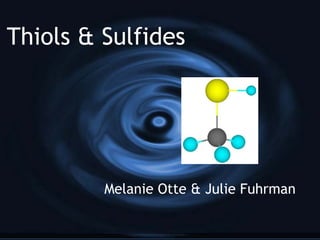
Thiols & Sulfides Melanie Otte & Julie Fuhrman
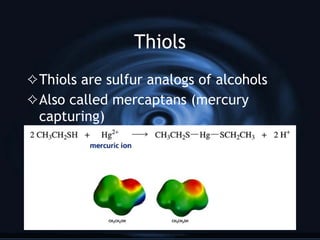
Thiols Thiols are sulfur analogs of alcohols Also called mercaptans (mercury capturing)
Sulfides  Sulfur analogs are called sulfides or thioethers Most sulfides react readily to form sulfonium salts
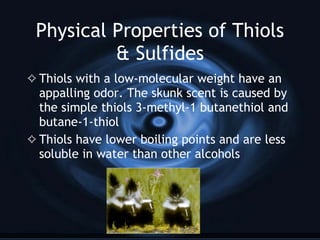
Physical Properties of Thiols & Sulfides Thiols with a low-molecular weight have an appalling odor. The skunk scent is caused by the simple thiols 3-methyl-1 butanethiol and butane-1-thiol Thiols have lower boiling points and are less soluble in water than other alcohols
Physical Properties of Thiols & Sulfides The difference in electronegativity between S (2.5) and H (2.1) is 0.4. This creates a bond with low polarity Show little association by hydrogen bonding
Chemical Properties Sulfides are easily oxidized
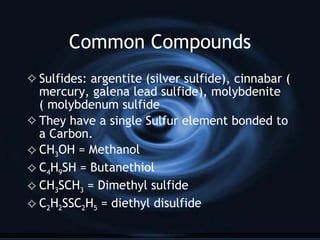
Common Compounds Sulfides: argentite (silver sulfide), cinnabar ( mercury, galena lead sulfide), molybdenite ( molybdenum sulfide They have a single Sulfur element bonded to a Carbon. CH 3 OH = Methanol C 4 H 9 SH = Butanethiol CH 3 SCH 3  = Dimethyl sulfide C 2 H 2 SSC 2 H 5  = diethyl disulfide
Uses & Occurrence  Thiols are added to natural gas to serve as an easily detectable warning in case of leaks The most common reaction in biological systems is between thiols and disulfides Thiols are often found in petroleum, pulp, and paper industries Thiols occur naturally such as in onions and garlic oil.
Hazards & Benefits Some thiols are flammable Some metal sulfides when exposed to a strong mineral acid, will release toxic hydrogen sulfide. Organic sulfides are highly flammable Almost all ogranic sulfides have a strong stench which rotting biomass releases also. Thiols have the ability to temporarily reduce a person’s ability to smell odors
Hazards & Benefits Thiols are strong irritants and can be toxic at high concentration, and can cause nausea, vomiting, coughing, and lung irritation. The active substance in onions, garlic, and and other members of the allium families are allyl sulfides have many health benefits including, protection against caner, lower cholesterol, reduce the risk of blood clots, and heart disease
How Thiols & Sulfides Relate  Sulfur analogs of alcohols are called thiols or mercaptans and ether analogs are calle sulfides.
How it relates to other groups Thiols are stronger acids than other alcohols
Works Cited Organic Chemistry Powerpoint by William H. Brown, Christopher S. Foote, Brent L. Iverson www.snow.edu/danb/files/organic/ch%2010.ppt employment.alberta.ca/documents/WHS/WHS-PUB_ch060.pdf  - http://www.answers.com/topic/sulfide http://findarticles.com/p/articles/mi_m0826/is_1_16/ai_59017937/ http://cem.msu.edu/~reusch/VirtualText/special2.htm#top1a

Thiols & sulfides

  • 1.
    Thiols & SulfidesMelanie Otte & Julie Fuhrman
  • 2.
    Thiols Thiols aresulfur analogs of alcohols Also called mercaptans (mercury capturing)
  • 3.
    Sulfides Sulfuranalogs are called sulfides or thioethers Most sulfides react readily to form sulfonium salts
  • 4.
    Physical Properties ofThiols & Sulfides Thiols with a low-molecular weight have an appalling odor. The skunk scent is caused by the simple thiols 3-methyl-1 butanethiol and butane-1-thiol Thiols have lower boiling points and are less soluble in water than other alcohols
  • 5.
    Physical Properties ofThiols & Sulfides The difference in electronegativity between S (2.5) and H (2.1) is 0.4. This creates a bond with low polarity Show little association by hydrogen bonding
  • 6.
    Chemical Properties Sulfidesare easily oxidized
  • 7.
    Common Compounds Sulfides:argentite (silver sulfide), cinnabar ( mercury, galena lead sulfide), molybdenite ( molybdenum sulfide They have a single Sulfur element bonded to a Carbon. CH 3 OH = Methanol C 4 H 9 SH = Butanethiol CH 3 SCH 3 = Dimethyl sulfide C 2 H 2 SSC 2 H 5 = diethyl disulfide
  • 8.
    Uses & Occurrence Thiols are added to natural gas to serve as an easily detectable warning in case of leaks The most common reaction in biological systems is between thiols and disulfides Thiols are often found in petroleum, pulp, and paper industries Thiols occur naturally such as in onions and garlic oil.
  • 9.
    Hazards & BenefitsSome thiols are flammable Some metal sulfides when exposed to a strong mineral acid, will release toxic hydrogen sulfide. Organic sulfides are highly flammable Almost all ogranic sulfides have a strong stench which rotting biomass releases also. Thiols have the ability to temporarily reduce a person’s ability to smell odors
  • 10.
    Hazards & BenefitsThiols are strong irritants and can be toxic at high concentration, and can cause nausea, vomiting, coughing, and lung irritation. The active substance in onions, garlic, and and other members of the allium families are allyl sulfides have many health benefits including, protection against caner, lower cholesterol, reduce the risk of blood clots, and heart disease
  • 11.
    How Thiols &Sulfides Relate Sulfur analogs of alcohols are called thiols or mercaptans and ether analogs are calle sulfides.
  • 12.
    How it relatesto other groups Thiols are stronger acids than other alcohols
  • 13.
    Works Cited OrganicChemistry Powerpoint by William H. Brown, Christopher S. Foote, Brent L. Iverson www.snow.edu/danb/files/organic/ch%2010.ppt employment.alberta.ca/documents/WHS/WHS-PUB_ch060.pdf - http://www.answers.com/topic/sulfide http://findarticles.com/p/articles/mi_m0826/is_1_16/ai_59017937/ http://cem.msu.edu/~reusch/VirtualText/special2.htm#top1a