PHENOLPHENOL
BASICBASIC
Phenols arePhenols are chemical compoundschemical compounds consist of aconsist of a
hydroxylhydroxyl groupgroup (-(-OO HH) attached to an) attached to an
aromatic hydrocarbonaromatic hydrocarbon group.group.
The simplest ofThe simplest of phenolphenol (C(C66HH55OH).OH).
Phenols are hydroxyl derivatives ofPhenols are hydroxyl derivatives of
hydrocarbons formed byhydrocarbons formed by replacing areplacing a hydrogenhydrogen
on the benzene ringon the benzene ring of an aromatic hydrocarbonof an aromatic hydrocarbon
with the hydroxyl group.with the hydroxyl group.
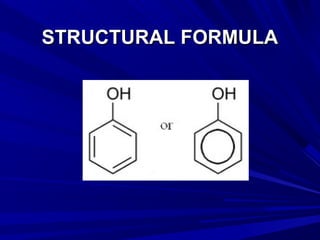
STRUCTURAL FORMULASTRUCTURAL FORMULA
PROPERTIES OF PHENOLSPROPERTIES OF PHENOLS
All phenols are white solids.All phenols are white solids.
Moderately high melting points.Moderately high melting points.
Soluble in water.Soluble in water.
Relatively higher acidities due to the aromatic ring tightlyRelatively higher acidities due to the aromatic ring tightly
coupling with the oxygen and a relatively loose bondcoupling with the oxygen and a relatively loose bond
between the oxygen and hydrogen.between the oxygen and hydrogen.
The acidity of the hydroxyl group in phenols is commonlyThe acidity of the hydroxyl group in phenols is commonly
intermediate between that of aliphatic alcohols andintermediate between that of aliphatic alcohols and
carboxylic acids.carboxylic acids.
REACTIONS OF PHENOLSREACTIONS OF PHENOLS
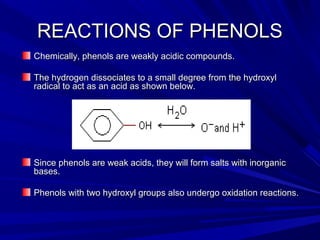
Chemically, phenols are weakly acidic compounds.Chemically, phenols are weakly acidic compounds.
The hydrogen dissociates to a small degree from the hydroxylThe hydrogen dissociates to a small degree from the hydroxyl
radical to act as an acid as shown below.radical to act as an acid as shown below.
Since phenols are weak acids, they will form salts with inorganicSince phenols are weak acids, they will form salts with inorganic
bases.bases.
Phenols with two hydroxyl groups also undergo oxidation reactions.Phenols with two hydroxyl groups also undergo oxidation reactions.
REACTIONS OF PHENOLSREACTIONS OF PHENOLS
Phenols react in a wide variety of ways.Phenols react in a wide variety of ways.
i. Reactions with bromine water.i. Reactions with bromine water.
ii. Nitrationii. Nitration
iii. Reactions with aqueous iron (III)iii. Reactions with aqueous iron (III)
chloride.chloride.
iv. Esterification.iv. Esterification.
v. Formation ofv. Formation of
i. With bromine wateri. With bromine water
Phenols forms a white precipitate of 2,4,6-Phenols forms a white precipitate of 2,4,6-
tribromophenol immediately when it istribromophenol immediately when it is
treated with bromine water at roomtreated with bromine water at room
temperature.temperature.
The reddish brown colour of bromineThe reddish brown colour of bromine
disappears and white fumes of hydrogendisappears and white fumes of hydrogen
bromine are released.bromine are released.
ii. Nitrationii. Nitration
Nitration of phenol can be carried out atNitration of phenol can be carried out at
room temperature by using dilute nitricroom temperature by using dilute nitric
acid.acid.
The product is a mixture of 2-nitrophenolThe product is a mixture of 2-nitrophenol
and 4-nitrophenol.and 4-nitrophenol.
iii. With natural aqueous iron (III)iii. With natural aqueous iron (III)
chloridechloride
Phenol produces a purple coloration whenPhenol produces a purple coloration when
treated with natural aqueous solution oftreated with natural aqueous solution of
iron(III) chloride at room temperature.iron(III) chloride at room temperature.
iv. Esterificationiv. Esterification
Phenol does not form ester with carboxylicPhenol does not form ester with carboxylic
acids, but in the presence of an alkali such asacids, but in the presence of an alkali such as
NaOH, the phenoxide ion which can act as aNaOH, the phenoxide ion which can act as a
nucleophile attacts the electrophilic acyl group,nucleophile attacts the electrophilic acyl group,
RCO-, from acyl chloride.RCO-, from acyl chloride.
The fisrt step is the dissoluton of phenol inThe fisrt step is the dissoluton of phenol in
aqueous sodium hydroxide to form a solution ofaqueous sodium hydroxide to form a solution of
sodium phenoxide.sodium phenoxide.
Addition of a little liquid benzoyl chloride gives aAddition of a little liquid benzoyl chloride gives a
whit precipitate of insoluble ester immediately.whit precipitate of insoluble ester immediately.
v. Formation of Etherv. Formation of Ether
When a hloalkane is added to a solution ofWhen a hloalkane is added to a solution of
phenl in an alkali, the halogen atom isphenl in an alkali, the halogen atom is
replaced by a phenoxide ion in areplaced by a phenoxide ion in a
nucleophilic substitution reaction.nucleophilic substitution reaction.
The product is an aromatic ether.The product is an aromatic ether.
USES OF PHENOLSUSES OF PHENOLS
Medicinally, phenolic compounds have three uses: asMedicinally, phenolic compounds have three uses: as
keratolytics (compounds that remove hornified or scalingkeratolytics (compounds that remove hornified or scaling
outer layers of skin), antipruritics (relieve itching), andouter layers of skin), antipruritics (relieve itching), and
disinfectants. These uses arise from the fact thatdisinfectants. These uses arise from the fact that
phenols are very caustic to animal tissues.phenols are very caustic to animal tissues.
Precautions must therefore be taken when you are usingPrecautions must therefore be taken when you are using
phenols in preparations. These properties, possessed tophenols in preparations. These properties, possessed to
different degrees by various phenols, depend on whichdifferent degrees by various phenols, depend on which
other functional groups are present and the number ofother functional groups are present and the number of
hydroxyl groups.hydroxyl groups.

Phenol

  • 1.
  • 2.
    BASICBASIC Phenols arePhenols arechemical compoundschemical compounds consist of aconsist of a hydroxylhydroxyl groupgroup (-(-OO HH) attached to an) attached to an aromatic hydrocarbonaromatic hydrocarbon group.group. The simplest ofThe simplest of phenolphenol (C(C66HH55OH).OH). Phenols are hydroxyl derivatives ofPhenols are hydroxyl derivatives of hydrocarbons formed byhydrocarbons formed by replacing areplacing a hydrogenhydrogen on the benzene ringon the benzene ring of an aromatic hydrocarbonof an aromatic hydrocarbon with the hydroxyl group.with the hydroxyl group.
  • 3.
  • 4.
    PROPERTIES OF PHENOLSPROPERTIESOF PHENOLS All phenols are white solids.All phenols are white solids. Moderately high melting points.Moderately high melting points. Soluble in water.Soluble in water. Relatively higher acidities due to the aromatic ring tightlyRelatively higher acidities due to the aromatic ring tightly coupling with the oxygen and a relatively loose bondcoupling with the oxygen and a relatively loose bond between the oxygen and hydrogen.between the oxygen and hydrogen. The acidity of the hydroxyl group in phenols is commonlyThe acidity of the hydroxyl group in phenols is commonly intermediate between that of aliphatic alcohols andintermediate between that of aliphatic alcohols and carboxylic acids.carboxylic acids.
  • 5.
    REACTIONS OF PHENOLSREACTIONSOF PHENOLS Chemically, phenols are weakly acidic compounds.Chemically, phenols are weakly acidic compounds. The hydrogen dissociates to a small degree from the hydroxylThe hydrogen dissociates to a small degree from the hydroxyl radical to act as an acid as shown below.radical to act as an acid as shown below. Since phenols are weak acids, they will form salts with inorganicSince phenols are weak acids, they will form salts with inorganic bases.bases. Phenols with two hydroxyl groups also undergo oxidation reactions.Phenols with two hydroxyl groups also undergo oxidation reactions.
  • 6.
    REACTIONS OF PHENOLSREACTIONSOF PHENOLS Phenols react in a wide variety of ways.Phenols react in a wide variety of ways. i. Reactions with bromine water.i. Reactions with bromine water. ii. Nitrationii. Nitration iii. Reactions with aqueous iron (III)iii. Reactions with aqueous iron (III) chloride.chloride. iv. Esterification.iv. Esterification. v. Formation ofv. Formation of
  • 7.
    i. With brominewateri. With bromine water Phenols forms a white precipitate of 2,4,6-Phenols forms a white precipitate of 2,4,6- tribromophenol immediately when it istribromophenol immediately when it is treated with bromine water at roomtreated with bromine water at room temperature.temperature. The reddish brown colour of bromineThe reddish brown colour of bromine disappears and white fumes of hydrogendisappears and white fumes of hydrogen bromine are released.bromine are released.
  • 8.
    ii. Nitrationii. Nitration Nitrationof phenol can be carried out atNitration of phenol can be carried out at room temperature by using dilute nitricroom temperature by using dilute nitric acid.acid. The product is a mixture of 2-nitrophenolThe product is a mixture of 2-nitrophenol and 4-nitrophenol.and 4-nitrophenol.
  • 9.
    iii. With naturalaqueous iron (III)iii. With natural aqueous iron (III) chloridechloride Phenol produces a purple coloration whenPhenol produces a purple coloration when treated with natural aqueous solution oftreated with natural aqueous solution of iron(III) chloride at room temperature.iron(III) chloride at room temperature.
  • 10.
    iv. Esterificationiv. Esterification Phenoldoes not form ester with carboxylicPhenol does not form ester with carboxylic acids, but in the presence of an alkali such asacids, but in the presence of an alkali such as NaOH, the phenoxide ion which can act as aNaOH, the phenoxide ion which can act as a nucleophile attacts the electrophilic acyl group,nucleophile attacts the electrophilic acyl group, RCO-, from acyl chloride.RCO-, from acyl chloride. The fisrt step is the dissoluton of phenol inThe fisrt step is the dissoluton of phenol in aqueous sodium hydroxide to form a solution ofaqueous sodium hydroxide to form a solution of sodium phenoxide.sodium phenoxide. Addition of a little liquid benzoyl chloride gives aAddition of a little liquid benzoyl chloride gives a whit precipitate of insoluble ester immediately.whit precipitate of insoluble ester immediately.
  • 11.
    v. Formation ofEtherv. Formation of Ether When a hloalkane is added to a solution ofWhen a hloalkane is added to a solution of phenl in an alkali, the halogen atom isphenl in an alkali, the halogen atom is replaced by a phenoxide ion in areplaced by a phenoxide ion in a nucleophilic substitution reaction.nucleophilic substitution reaction. The product is an aromatic ether.The product is an aromatic ether.
  • 12.
    USES OF PHENOLSUSESOF PHENOLS Medicinally, phenolic compounds have three uses: asMedicinally, phenolic compounds have three uses: as keratolytics (compounds that remove hornified or scalingkeratolytics (compounds that remove hornified or scaling outer layers of skin), antipruritics (relieve itching), andouter layers of skin), antipruritics (relieve itching), and disinfectants. These uses arise from the fact thatdisinfectants. These uses arise from the fact that phenols are very caustic to animal tissues.phenols are very caustic to animal tissues. Precautions must therefore be taken when you are usingPrecautions must therefore be taken when you are using phenols in preparations. These properties, possessed tophenols in preparations. These properties, possessed to different degrees by various phenols, depend on whichdifferent degrees by various phenols, depend on which other functional groups are present and the number ofother functional groups are present and the number of hydroxyl groups.hydroxyl groups.