Alcohol, Phenol,
And Ethers:
“Their Structures, Physical
Properties and Nomenclature”
Mr. Blithe
Topic:
Structure and Physical
Properties
ALCOHOL
An organic compound containing a
hydroxyl group attached to an alkyl group.
a non-polar (alkane-like) chain.
a polar hydroxyl group.
Alcohols have the general formula: R-OH, where “R” involves a
saturated C-atom (bound to hydrogen's and/or other carbons).
For example:
Classification of alcohols
• Alcohols may be classified as 1o (Primary), 2o (Secondary), or 3o
(Tertiary), by considering the number of carbons bound to the
hydroxyl-bearing carbon.
•Ethanol is a primary alcohol because there is only one alkyl
group attached to the carbon that carries the OH substituent.
•The isopropyl alcohol found in rubbing alcohol is a
secondary alcohol,
•An example of a tertiary alcohol is tert-butyl (or t-butyl)
alcohol or 2-methyl-2-propanol.
RCH2OH R3COHR2CHOH
R-O-H has a structure similar to that of water
Higher boiling points.
Hydrogen
Bond in
Water
Hydrogen
Bond in
Alcohol
Classification of alcohols
Solubility
The Lower the molecular weight of alcohols, the higher the
solubility in water.
The water-solubility of alcohols depends on the length of
the alkyl chain in the alcohol.
alcohols having chains longer than four carbons are not
very water-soluble.
3-4 carbons or less— ARE soluble in water
Alcohols with more than one hydroxyl group (polyhydroxyl alcohols)
have higher boiling points than monohydroxyl alcohols.
We already saw that the boiling points of alkanes increase with
increasing chain length. The same is true for alcohols.
O
CH3 H
O
CH3 H
Alcohols having chains SHORTER than four carbons are very
water-soluble…
 Methanol is Soluble and Miscible in water…
Methanol
Butanol
Alcohols having chains LONGER
than Three carbons are not very
water-soluble…
 Butanol is Soluble but not Miscible
in water…
Formula Name
Solubility in
Water (g/100 g)
CH3OH methanol infinitely soluble
CH3CH2OH ethanol infinitely soluble
CH3(CH2)2OH propanol infinitely soluble
CH3(CH2)3OH butanol 9
CH3(CH2)4OH pentanol 2.7
CH3(CH2)5OH hexanol 0.6
CH3(CH2)6OH heptanol 0.18
CH3(CH2)7OH octanol 0.054
CH3(CH2)9OH decanol insoluble in water
Solubilities of ALCOHOL in water
CH3CH2 CH2OH
CH3CH2 CH2CH3
CH3OH
CH3CH3
CH3CH2 OH
CH3CH2 CH3
CH3CH2 CH2CH2OH
CH3CH2 CH2CH2CH3
Structural Formula Name
Molecular
Weight
bp
(°C)
Solubility
in Water
methanol 32 65 infinite
ethane 30 -89 insoluble
ethanol 46 78 infinite
propane 44 -42 insoluble
1-propanol 60 97 infinite
butane 58 0 insoluble
8 g/100 g117741-butanol
pentane 72 36 insoluble
Comparison between the Boiling points and
Solubility of ALKANES and ALCOHOLs
PHENOL
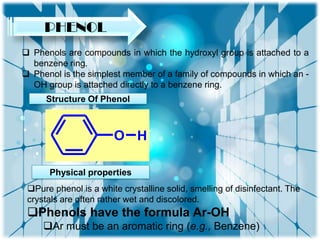
 Phenols are compounds in which the hydroxyl group is attached
to a benzene ring.
 Phenol is the simplest member of a family of compounds in which
an -OH group is attached directly to a benzene ring.
Structure Of Phenol
O H
Physical properties
Pure phenol is a white crystalline solid, smelling of disinfectant.
The crystals are often rather wet and discolored.
Phenols have the formula Ar-OH
Ar must be an aromatic ring (e.g., Benzene)
Widely used in healthcare as:
Germicides
Antiseptics
Disinfectants
Melting and boiling points
high melting and boiling points ...DocumentsMr. BLITHEDocumentsmy
filesmy academic files (2013-2014)MY chem reports (organic Chem)ACTUAL REPORTattachment.pptx
Hydrogen bonds can form between a lone pair
on an oxygen on one molecule and the hydrogen
on the -OH group of one of its neighbors.
Solubility in water
Phenol is moderately soluble in water - about 8 g
of phenol will dissolve in 100 g of water.
Phenol is somewhat soluble in water because of its
ability to form hydrogen bonds with the water.
ETHERS
Ethers are a class of organic compounds characterized by an
oxygen atom connected to two hydrocarbon groups.
Ethers do not H-bond with themselves, so have boiling points
similar to hydrocarbons
Ethers are only slightly soluble in water and are highly
flammable
Structure of ETHERS
 An ether is a characterized by an oxygen bonded to two alkyl
or aryl groups, represented here by R and R'.
The substituent's can be, but do not need to be, the same.
Ethers can act as a hydrogen-bond acceptor,
as shown in the figure on the right. But, they
can't act as hydrogen-bond donors.
Solubility
Less likely to be soluble in water than the alcohol with the same
molecular weight.
The absence of an -OH group in an ether also has important
consequences for its chemical properties.
Ethers are essentially inert to chemical reactions. They don't react
with most oxidizing or reducing agents, and they are stable to
most acids and bases, except at high temperatures.
However, extremely FLAMMABLE explode if exposed to air for
longer periods of time, to form EXPLOSIVE PEROXIDES.
Melting and Boiling points
Boiling points and melting points are dictated by intermolecular
forces.
Compared with alkane of similar molar mass, an ether will have a
similar boiling point.
Compared to an alcohol of the same molar mass, the ether will
have a much lower boiling point.
Medical use of Ethers
Ethers are often used as anesthetics
Accumulate in the lipid material of nerve
cells interfering with nerve impulse
transmission.
Today halogenated ethers are used
routinely as general anesthetics
Less flammable
Safer to store and to work with
Nomenclature
ALCOHOL
Name the C-atoms of a single alkyl group as for alkanes.
Add the word “alcohol” following a space after the alkyl
name.
1) CH3--OH methyl alcohol
For example:
2) CH3 CH2--OH ethyl alcohol
COMMON NAME
IUPAC NAME
CH3CHCHCH3
OH
CH3
For example:
Butane
Butanol
1234
3-methyl-2-butanol
Try this one:
1. CH3-CH-CH2OH
CH3
2-methyl-1-propanol
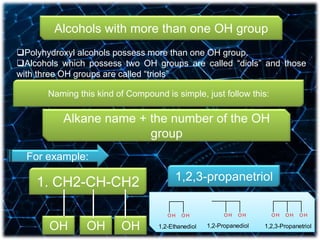
Alcohols with more than one OH group
Polyhydroxyl alcohols possess more than one OH group.
Alcohols which possess two OH groups are called “diols” and
those with three OH groups are called “triols”
Naming this kind of Compound is simple, just follow this:
Alkane name + the number of the OH
group
For example:
1. CH2-CH-CH2
OHOH OH
1,2,3-propanetriol
1,2-Ethanediol 1,2-Propanediol 1,2,3-Propanetriol
Naming Alcohols…continuation
1. Name the parent compound.
2. Replace the –e with –ol.
3. Number the ring to minimize number of carbon with the –OH
group
4. Identify, name, and number all substituent/s.
OH
CH3
For example:
Six Carbon ring= Cyclohexane
Cyclohexanol
number counterclockwise
 methyl on C-3
Note: OH must be at C-1
3-methylcyclohexanol
PHENOL
Compounds with additional substituent's are named as
substituted phenols
when there is only one other substituent, Ortho, Meta or Para
are used.
Mono-substituted phenols are characterized using the prefix
ortho (o-), meta (m-) or para (p-) depending on the placement of
the substituent from the hydroxyl group.
ortho: (1,2-) meta :(1,3-) para : (1,4-)
Cl
Cl
Cl
o-chlorophenol m-chlorophenol p-chlorophenol
If there are two or more additional substituent's, each must be
numbered, beginning at the OH and going in direction that gives
substituent's lowest numbers (or alphabetical if same in both
directions).
The simplest member of phenol is called phenol itself or
hydroxybenzene and the rest are named as its derivatives.
Phenol or
Hydroxybenzene
 Functional group suffix = -common - phenol, systematic -
benzenol
 Functional group prefix = hydroxy
 di , tri and so forth are used to denote the number of
substituent.
For example:
OH
1,2-dihydroxybenzene
OH
1,3-dihydroxybenzene
CH3
3-methylphenol
NO2
NO2
NO2
2,4,6- trinitrophenol
NOTE: Many have common or trivial names that do not at all
suggest the structure…
ETHERS
Common Name
For common names: name each alkyl group
attached to the oxygen followed by ether.
For example:
1. CH3-CH2-O-CH2-CH3 Diethyl Ether
2. CH3-CH2-O-CH3 Ethyl methyl Ether
Methyl phenyl Ether
IUPAC NAME
For complex ethers IUPAC names are used
Step1: Name as an alkane, with larger alkyl group being the
parent chain.
Step 2: Find the smaller alkyl group and the O are named
together as an alkoxy group (replace -yl with -oxy)
e.g., CH3CH2O = ethoxy
Step 3: Number chain starting at end nearest alkoxy group
Step 4: Use a number to give location of alkoxy group
For example:
CH3CH2CH2CH2CH2-O-CH3
1-methoxypentane
Pentane
Methyl=Methoxy1
Try this one:
1. CH3-CH2-CH2---C---CH2-CH3
CH3
CH3
O
3-methoxy-3methylhexane
Naming Cyclic Ethers
Cyclic ethers are generally named by their common
names.
A cyclic ether containing two carbons is called
ethylene oxide (generally known as epoxides)
A cyclic ether containing 4 carbons (with 2 double
bonds) is called a furan
A cyclic ether containing 5 carbons (with 2 double
bonds) is called a pyran
A cyclic ether containing 4 carbons and 2 oxygens is
called a dioxane
TRIVIA…
PHENOLS are next-generation anti-oxidant found
throughout nature in some of the healthiest foods.
PHENOLS are the common health-giving link that ties
together foods, such as Red Wine, Green Tea, Dark Chocolate,
and Super-Berries.
In human health these compounds are thought to be instrumental
in combating oxidative stress, a process associated with some
neurodegenerative diseases and some cardiovascular diseases.
Approximately 600,000 students per year are assaulted
by a drinking student.
Research suggests that women are more vulnerable
than men to many alcohol- induced problems. Some of
these include, Organ Damage, Trauma, Legal and
interpersonal difficulties.
Alcohol affects men and women differently. Women
become more impaired than men from drinking the same
amount of alcohol. This is because women:
• Are generally smaller in size
• Have less body water
• Have less dehydrogenase.
• Have more estrogen
Alcohol is a central nervous system depressant. In small
amounts it can have a relaxing effect.
Thank You
for
LISTENING!!!
Alcohol, phenol ,and ethers

Alcohol, phenol ,and ethers

  • 1.
    Alcohol, Phenol, And Ethers: “TheirStructures, Physical Properties and Nomenclature” Mr. Blithe Topic:
  • 2.
    Structure and Physical Properties ALCOHOL Anorganic compound containing a hydroxyl group attached to an alkyl group. a non-polar (alkane-like) chain. a polar hydroxyl group. Alcohols have the general formula: R-OH, where “R” involves a saturated C-atom (bound to hydrogen's and/or other carbons). For example:
  • 3.
    Classification of alcohols •Alcohols may be classified as 1o (Primary), 2o (Secondary), or 3o (Tertiary), by considering the number of carbons bound to the hydroxyl-bearing carbon. •Ethanol is a primary alcohol because there is only one alkyl group attached to the carbon that carries the OH substituent. •The isopropyl alcohol found in rubbing alcohol is a secondary alcohol, •An example of a tertiary alcohol is tert-butyl (or t-butyl) alcohol or 2-methyl-2-propanol. RCH2OH R3COHR2CHOH
  • 4.
    R-O-H has astructure similar to that of water Higher boiling points. Hydrogen Bond in Water Hydrogen Bond in Alcohol
  • 5.
    Classification of alcohols Solubility TheLower the molecular weight of alcohols, the higher the solubility in water. The water-solubility of alcohols depends on the length of the alkyl chain in the alcohol. alcohols having chains longer than four carbons are not very water-soluble. 3-4 carbons or less— ARE soluble in water Alcohols with more than one hydroxyl group (polyhydroxyl alcohols) have higher boiling points than monohydroxyl alcohols. We already saw that the boiling points of alkanes increase with increasing chain length. The same is true for alcohols.
  • 6.
    O CH3 H O CH3 H Alcoholshaving chains SHORTER than four carbons are very water-soluble…  Methanol is Soluble and Miscible in water… Methanol
  • 7.
    Butanol Alcohols having chainsLONGER than Three carbons are not very water-soluble…  Butanol is Soluble but not Miscible in water…
  • 8.
    Formula Name Solubility in Water(g/100 g) CH3OH methanol infinitely soluble CH3CH2OH ethanol infinitely soluble CH3(CH2)2OH propanol infinitely soluble CH3(CH2)3OH butanol 9 CH3(CH2)4OH pentanol 2.7 CH3(CH2)5OH hexanol 0.6 CH3(CH2)6OH heptanol 0.18 CH3(CH2)7OH octanol 0.054 CH3(CH2)9OH decanol insoluble in water Solubilities of ALCOHOL in water
  • 9.
    CH3CH2 CH2OH CH3CH2 CH2CH3 CH3OH CH3CH3 CH3CH2OH CH3CH2 CH3 CH3CH2 CH2CH2OH CH3CH2 CH2CH2CH3 Structural Formula Name Molecular Weight bp (°C) Solubility in Water methanol 32 65 infinite ethane 30 -89 insoluble ethanol 46 78 infinite propane 44 -42 insoluble 1-propanol 60 97 infinite butane 58 0 insoluble 8 g/100 g117741-butanol pentane 72 36 insoluble Comparison between the Boiling points and Solubility of ALKANES and ALCOHOLs
  • 10.
    PHENOL  Phenols arecompounds in which the hydroxyl group is attached to a benzene ring.  Phenol is the simplest member of a family of compounds in which an -OH group is attached directly to a benzene ring. Structure Of Phenol O H Physical properties Pure phenol is a white crystalline solid, smelling of disinfectant. The crystals are often rather wet and discolored. Phenols have the formula Ar-OH Ar must be an aromatic ring (e.g., Benzene)
  • 11.
    Widely used inhealthcare as: Germicides Antiseptics Disinfectants Melting and boiling points high melting and boiling points ...DocumentsMr. BLITHEDocumentsmy filesmy academic files (2013-2014)MY chem reports (organic Chem)ACTUAL REPORTattachment.pptx Hydrogen bonds can form between a lone pair on an oxygen on one molecule and the hydrogen on the -OH group of one of its neighbors. Solubility in water Phenol is moderately soluble in water - about 8 g of phenol will dissolve in 100 g of water. Phenol is somewhat soluble in water because of its ability to form hydrogen bonds with the water.
  • 12.
    ETHERS Ethers are aclass of organic compounds characterized by an oxygen atom connected to two hydrocarbon groups. Ethers do not H-bond with themselves, so have boiling points similar to hydrocarbons Ethers are only slightly soluble in water and are highly flammable Structure of ETHERS  An ether is a characterized by an oxygen bonded to two alkyl or aryl groups, represented here by R and R'. The substituent's can be, but do not need to be, the same.
  • 13.
    Ethers can actas a hydrogen-bond acceptor, as shown in the figure on the right. But, they can't act as hydrogen-bond donors. Solubility Less likely to be soluble in water than the alcohol with the same molecular weight. The absence of an -OH group in an ether also has important consequences for its chemical properties. Ethers are essentially inert to chemical reactions. They don't react with most oxidizing or reducing agents, and they are stable to most acids and bases, except at high temperatures. However, extremely FLAMMABLE explode if exposed to air for longer periods of time, to form EXPLOSIVE PEROXIDES.
  • 14.
    Melting and Boilingpoints Boiling points and melting points are dictated by intermolecular forces. Compared with alkane of similar molar mass, an ether will have a similar boiling point. Compared to an alcohol of the same molar mass, the ether will have a much lower boiling point.
  • 15.
    Medical use ofEthers Ethers are often used as anesthetics Accumulate in the lipid material of nerve cells interfering with nerve impulse transmission. Today halogenated ethers are used routinely as general anesthetics Less flammable Safer to store and to work with
  • 16.
  • 17.
    ALCOHOL Name the C-atomsof a single alkyl group as for alkanes. Add the word “alcohol” following a space after the alkyl name. 1) CH3--OH methyl alcohol For example: 2) CH3 CH2--OH ethyl alcohol COMMON NAME
  • 18.
  • 19.
  • 20.
    Alcohols with morethan one OH group Polyhydroxyl alcohols possess more than one OH group. Alcohols which possess two OH groups are called “diols” and those with three OH groups are called “triols” Naming this kind of Compound is simple, just follow this: Alkane name + the number of the OH group For example: 1. CH2-CH-CH2 OHOH OH 1,2,3-propanetriol 1,2-Ethanediol 1,2-Propanediol 1,2,3-Propanetriol
  • 22.
    Naming Alcohols…continuation 1. Namethe parent compound. 2. Replace the –e with –ol. 3. Number the ring to minimize number of carbon with the –OH group 4. Identify, name, and number all substituent/s. OH CH3 For example: Six Carbon ring= Cyclohexane Cyclohexanol number counterclockwise  methyl on C-3 Note: OH must be at C-1 3-methylcyclohexanol
  • 23.
    PHENOL Compounds with additionalsubstituent's are named as substituted phenols when there is only one other substituent, Ortho, Meta or Para are used. Mono-substituted phenols are characterized using the prefix ortho (o-), meta (m-) or para (p-) depending on the placement of the substituent from the hydroxyl group. ortho: (1,2-) meta :(1,3-) para : (1,4-) Cl Cl Cl o-chlorophenol m-chlorophenol p-chlorophenol
  • 24.
    If there aretwo or more additional substituent's, each must be numbered, beginning at the OH and going in direction that gives substituent's lowest numbers (or alphabetical if same in both directions). The simplest member of phenol is called phenol itself or hydroxybenzene and the rest are named as its derivatives. Phenol or Hydroxybenzene  Functional group suffix = -common - phenol, systematic - benzenol  Functional group prefix = hydroxy  di , tri and so forth are used to denote the number of substituent.
  • 25.
  • 26.
    ETHERS Common Name For commonnames: name each alkyl group attached to the oxygen followed by ether. For example: 1. CH3-CH2-O-CH2-CH3 Diethyl Ether 2. CH3-CH2-O-CH3 Ethyl methyl Ether Methyl phenyl Ether
  • 27.
    IUPAC NAME For complexethers IUPAC names are used Step1: Name as an alkane, with larger alkyl group being the parent chain. Step 2: Find the smaller alkyl group and the O are named together as an alkoxy group (replace -yl with -oxy) e.g., CH3CH2O = ethoxy Step 3: Number chain starting at end nearest alkoxy group Step 4: Use a number to give location of alkoxy group For example: CH3CH2CH2CH2CH2-O-CH3 1-methoxypentane Pentane Methyl=Methoxy1
  • 28.
    Try this one: 1.CH3-CH2-CH2---C---CH2-CH3 CH3 CH3 O 3-methoxy-3methylhexane
  • 29.
    Naming Cyclic Ethers Cyclicethers are generally named by their common names. A cyclic ether containing two carbons is called ethylene oxide (generally known as epoxides) A cyclic ether containing 4 carbons (with 2 double bonds) is called a furan A cyclic ether containing 5 carbons (with 2 double bonds) is called a pyran A cyclic ether containing 4 carbons and 2 oxygens is called a dioxane
  • 30.
    TRIVIA… PHENOLS are next-generationanti-oxidant found throughout nature in some of the healthiest foods. PHENOLS are the common health-giving link that ties together foods, such as Red Wine, Green Tea, Dark Chocolate, and Super-Berries. In human health these compounds are thought to be instrumental in combating oxidative stress, a process associated with some neurodegenerative diseases and some cardiovascular diseases.
  • 31.
    Approximately 600,000 studentsper year are assaulted by a drinking student. Research suggests that women are more vulnerable than men to many alcohol- induced problems. Some of these include, Organ Damage, Trauma, Legal and interpersonal difficulties. Alcohol affects men and women differently. Women become more impaired than men from drinking the same amount of alcohol. This is because women: • Are generally smaller in size • Have less body water • Have less dehydrogenase. • Have more estrogen Alcohol is a central nervous system depressant. In small amounts it can have a relaxing effect.
  • 32.