ALCOHOLS
ALCOHOLS
• An alcohol is any organic compound in which a
hudroxyl functional group (-OH) is bounded to a
carbon atom usually connected to other carbon or
hydrogen atom
• The word alcohol appeared in English in the 16th
century originating from the Arabic word
Classification of alcohols
Alcohols
[Based on no. of
OH group]
Monohydric alcohol-
Contains one OH
group
Eg- CH3CH2OH
Dihydric alcohol-
Contains 2 OH
group
Eg- CH2 OH
CH2 OH
Trihydric alcohol-
Contains 3 OH group
Eg- CH2 OH
CH2 OH
CH2 OH
ALCOHOL
[No.ofalkylgroup]
PRIMARY
SECONDARY
TERTIARY
PREPARATION OF ALCOHOLS
• Hydrolysis of haloalkanes/ alkyl halides-
* In this haloalkanes are converted to corresponding alcohols using
aqueous NaOH; KOH or Ca(OH)2.
*This method is used for the preparation of primary and secondary
alcohols
* This is a type of nucleophilic substitution reaction
Example- H2O
RX +Na-OH R- OH + NaX
Alkyl
halide
• Note-
* This reaction is useful only with reaction that do not
undergo E2 elimination readily
* This method of preparing alcohols is not satisfactory
because the alkyl halides may simultaneously undergo
dehydrogenation to produce alkenes. In order to remove
this difficulty, mild alkalis like silver oxide or potassium
carbonate is used to obtain good yield of alcohol
R-X +AgOH R-OH +AgX
Questions
1-Complete this reaction-
AgOH
CH3CH2CH2Cl+NaOH+H2O ?
2- Why AgOH is used in this type of
reaction?
Reduction of Carbonyl compounds-
• Aldehydes, ketones, carboxylic acids and esters when
reduced with appropriate agents give alcohols.
• Sodium in alcohol can be used for reducing
aldehydes, ketones and esters ( Bouvealt Blanc
Reaction). Such reduction are now replaced by
reductions using metal hydrides.
• Hydrogen and metal catalysts- These reduction are
used to make alcohols in large scale from aldehyde
and ketones. These are carried out in inert solvents by
Ni, Pd or Pt catalysts.
• Complex metal hydrides- These are the best reducing
agents for the preparation of alcohol from aldehyde
and ketones in laboratory. Lithium aluminium
hydroxide [LiAlH4] and sodium borohydride
[NaBH4].
• Examples-
Reduction of Aldehydes-
O
R C H + 2[H] RCH2OH
Aldehyde Primary alcohol
Reducing agents- H2/Pt, NaBH4 or LiAlH4
• Reduction of Ketones-
O H
R C R + 2[H] R C R
Ketone OH
Secondary alcohol
Reducing agents- H2/Pt, NaBH4 or LiAlH4
• Reduction of Carboxylic acids-
O
R C OH + 4[H] RCH4OH + H2O
Carboxylic acid
Reducing agents- B2H6; LiAlH4
• Reduction of Carboxylic esters-
O
R C OR’ + 4[H] RCH2OH + R’OH
Carboxylic ester Mixtures
Note-
LiAlH4, does not reduce C=C so it is used for the
preparation of unsaturated alcohols from unsaturated
aldehyde and ketones.
Question- Which reducing agent is used to make unsaturated
alcohols and why?
• Name the reaction in which sodium is used as a
reducing agent.
• Which type of solvent is used when hydrogen and
metal catalyst is used as a reducing agent.
• Name the catalyst used as hydrogen and metal
catalyst
• Name any two complex metal hydride reducing agent
with their molecular formula.
Hydration of Alkenes
• Hydration means addition of H+ and OH- across a C=C
double bond to give alcohol.
• It is a electrophilic addition of water to the alkene.
Example- R-CH=CH2 + H2SO4 CH3-CH2-O-SO2-OH
H2O
RCHOHCH3+H2SO4
Applications of alcohols
• Alcoholic beverages
• Antifreezes
• Medical
• Alcohol fuels
• Preservatives
• Solvents
QUALITATIVE TESTS FOR ALCOHOLS
▫ Sodium metal test- Alcohols react with active metals like
sodium and liberates hydrogen gas in the form of
effervescence.
2R-OH + 2Na 2R-ONa + H2
Alcohol Sodium
alkoxide
Eg- 2CH3OH + 2Na 2CH3-ONa + H2
Methanol Sodium
methoxide
• Ester test- Alcohols react with carboxylic acids to
form fruity smelling compounds called esters. The
reaction between alcohol and carboxylic acid is called
esterification and is catalysed by an acid such as
concentrated sulphuric acid.
O O
2R-OH + 2R’-C-OH R’-C-O-R + H2O
Alcohol Carboxylic acid Ester
O O
CH3OH + CH3-C-OH CH3-C-O-CH3 + H2O
Methanol Acetic acid Methyl acetate
• Ceric ammonium nitrate test- Alcohol react with cerric
ammonium nitrate to form a red coloured alkoxy
cerium(IV) compound.
2R-OH+ [NH4]2Ce(NO3)6 ( ROH)2Ce(NO3)4 +2NH4NO3
Alcohol Ceric ammonium Alkoxy cerium(IV)
nitrate compound
[Pink or Red colour]
Example-
2CH3-OH+ [NH4]2Ce(NO3)6 (CH3OH)2Ce(NO3)4+2NH4NO3
Methanol Ceric ammonium Methoxy cerium(IV)
nitrate compound
[Pink or Red colour]
• Acetyl chloride test- Alcohols react with acetyl chloride to
form esters and gives out hydrogen chloride gas. The
hydrogen chloride gives white fumes of ammonium
chloride with ammonium hydroxide.
O O
R-OH+ CH3-C-Cl CH3-C-O-R +HCl
Alcohol Acetyl Ester
Chloride
HCl+ NH4OH NH4Cl + H2O
White
fumes
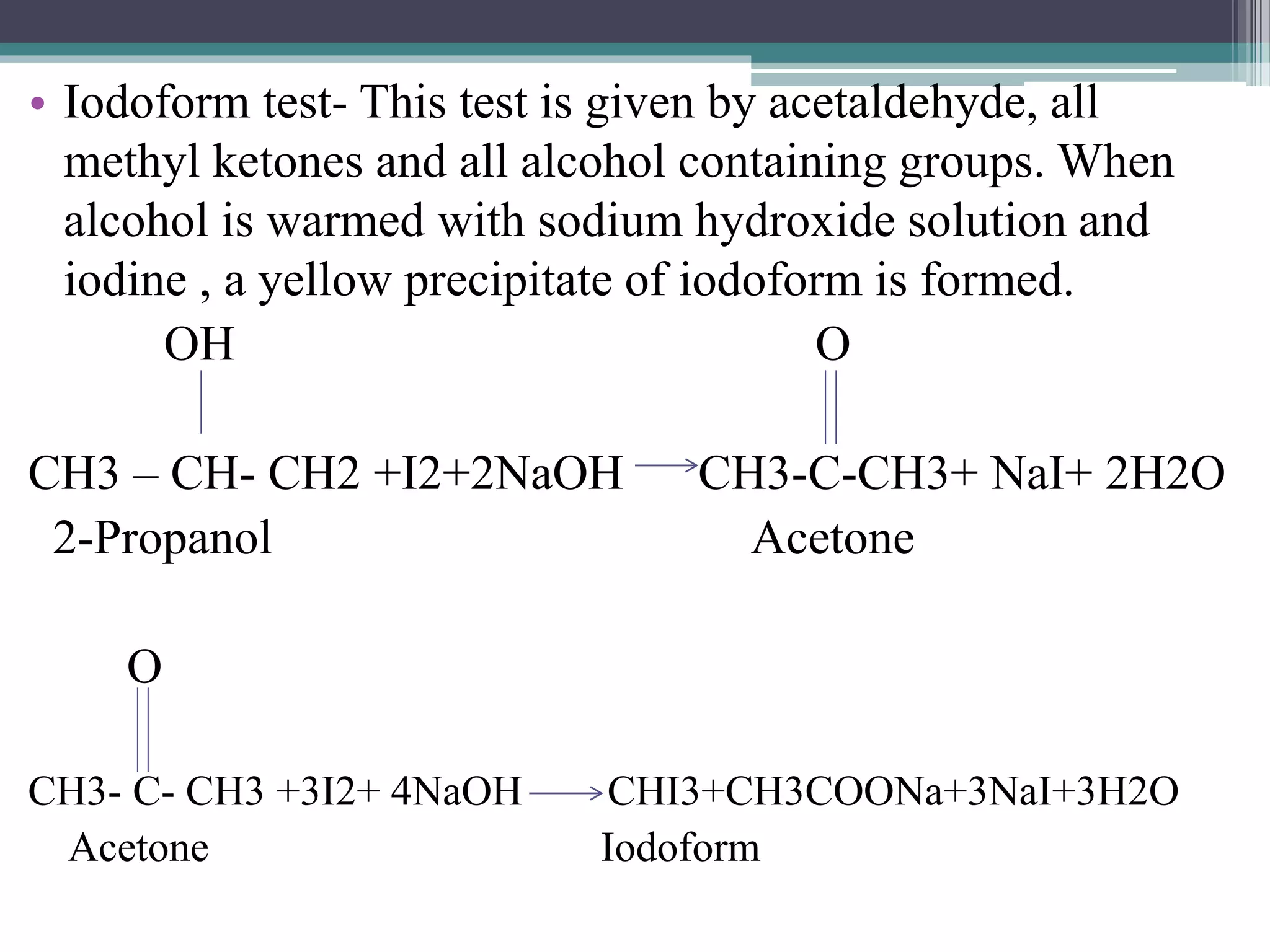
• Iodoform test- This test is given by acetaldehyde, all
methyl ketones and all alcohol containing groups. When
alcohol is warmed with sodium hydroxide solution and
iodine , a yellow precipitate of iodoform is formed.
OH O
CH3 – CH- CH2 +I2+2NaOH CH3-C-CH3+ NaI+ 2H2O
2-Propanol Acetone
O
CH3- C- CH3 +3I2+ 4NaOH CHI3+CH3COONa+3NaI+3H2O
Acetone Iodoform
Distinction between Primary, Secondary and Tertiary alcohols
1
• Lucas Test
2
• TCICA Test [ Trichloroisocyanuric acid]
3
• Victor Meyer Test
Lucas Test
• Principle-
• Lucas reagent is basically an anhydrous solution of Zinc
Chloride ( Lewis acid) in concentrated HCl. This reagent is
used to test alcohol and classify them according to their
reactivity. It is a substitution reaction as OH group of
alcohol is replaced by Chloride group of ZnCl.
• The reactivity of alcohol with Lucas reagent is measured
by degree of turbidity which may vary from colourless to
turbid.The formation of turbid solution happens due to the
formation of chloroalkane.
• Test is used to differentiate different types of alcohol
based on the time taken by the alcohol solution to
become turbid.
• Primary alcohol- Remains colourless as there is no
visible reaction occur.Eg- Pentanol
• Secondary alcohol- Solution become turbid or cloudy
in 5-20 minutes with slight heating. Eg- 2-Pentanol
• Tertiary alcohol- Solution turns turbid rapidly at
room temperature. Eg-2-Methyl-2-Butanol
• Lucas reagent formula-
• Lucas reagent basically is a solution which is formed
by the combination of HCl and ZnCl2.
• Lucas reagent mechanism-
• The reaction which normally occurs is a SN-1
nucleophilic substitution which is a two step
reaction.
• Alcohols which have the capability to form
carbocation intermediate exhibit this reaction.
• Only secondary and tertiary alcohols exhibit SN-1
nucleophilic substitution reaction.
• Steps involved in this reaction-
Step-1= The proton [H+] form Hydrochloric acid [HCl] will
protonate the OH- group of the alcohol. Water [H2O] attached
to the carbon is a weaker is a weaker nucleophile than Cl- (
Chloride). Thus, nucleophile Cl- replaces the H2O group
forming a carbocation as its present in excess.
Step-2= Cl- attacks the carbocations and the forms alkyl
chloride. +.H
: OH HCl : OH Slow + Cl- Cl
Alkyl Chloride
• Tertiary alcohol and alcohol that forms resonance-
stabilized carbocation react to form a cloudy mixture in less
than 30 seconds at room temperature.
• Secondary alcohols can react in 3-10 min, but may need to
be warmed.
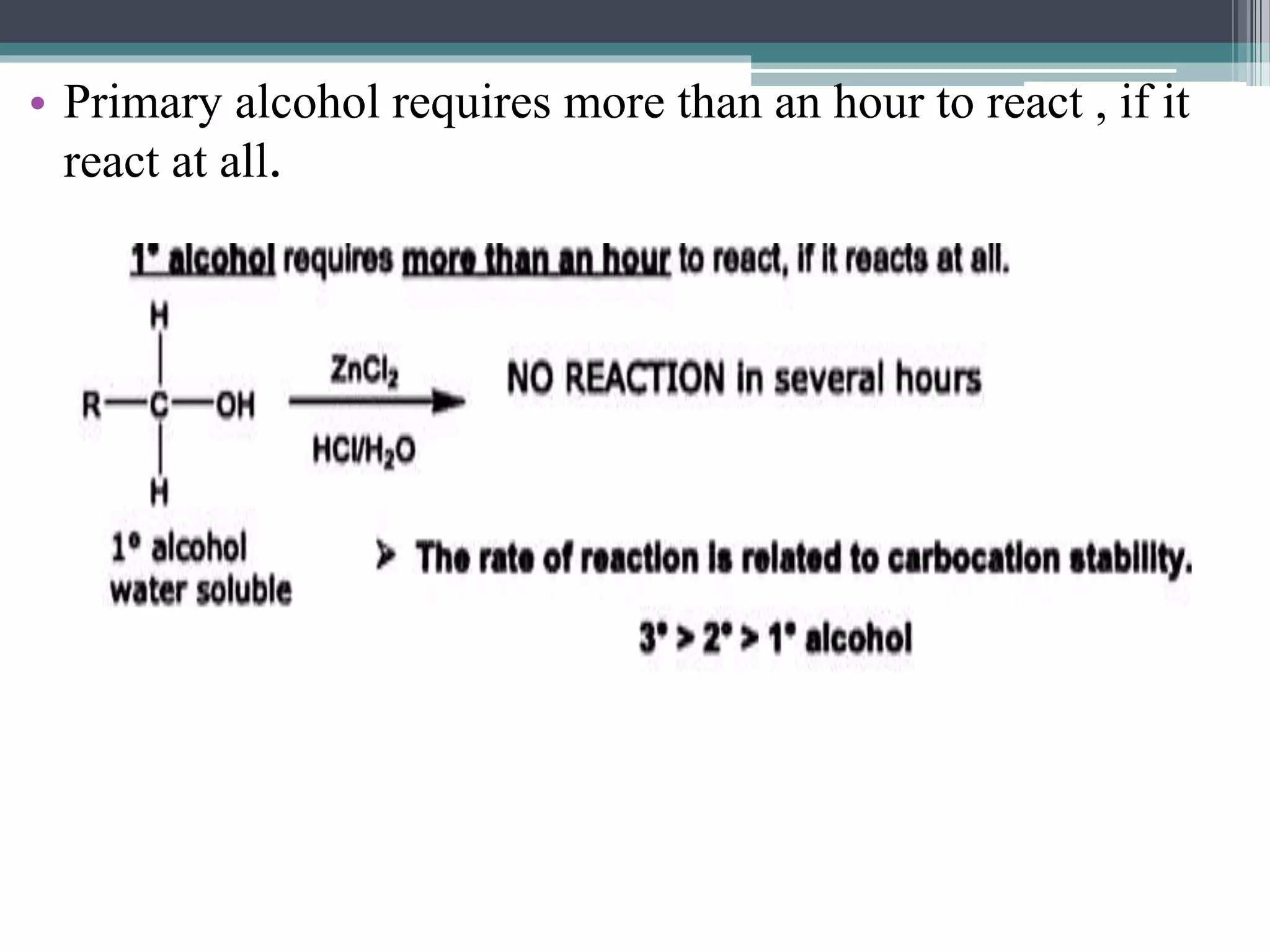
• Primary alcohol requires more than an hour to react , if it
react at all.
TCICA[ Trichloroisocyanuric Acid] TEST
• This test is used to differentiate between primary and
secondary alcohol by their rate of oxidation.
• This test is conducted by adding unknown solution of
TCICA in acetonitrile 3 containing hydrochloric acid 4 and
than measuring the time for a precipitate to form.
• Primary alcohols react slowly and secondary alcohols react
rapidly.
VICTOR MEYER TEST
• It is the most important method for the identification of
alcohol.
• This method is used for the identification of primary,
secondary and tertiary alcohol on the basis of series of
chemical analysis and colour resulting from the solution is
observed.
• The different steps involved in this test are as follows-
1) Alcohol is treated with iodine in presence of red
phosphorus to obtain iodol alkane.
• Iodoalkane so formed is allowedto react with alcoholic
silver nitrate in order to obtain nitroalkane.
• The nitroalkane is treated with nitrous acid ( Mixture of
NaNO2+HCl) and the resulting solution is made alkaline.
• The colour of resulting solution if observed-
• Primary alcohols gives blood red colour
• Secondary alcohol gives blue colour
• Tertiary alcohol does not produce any colour.
STRUCTURE AND USES
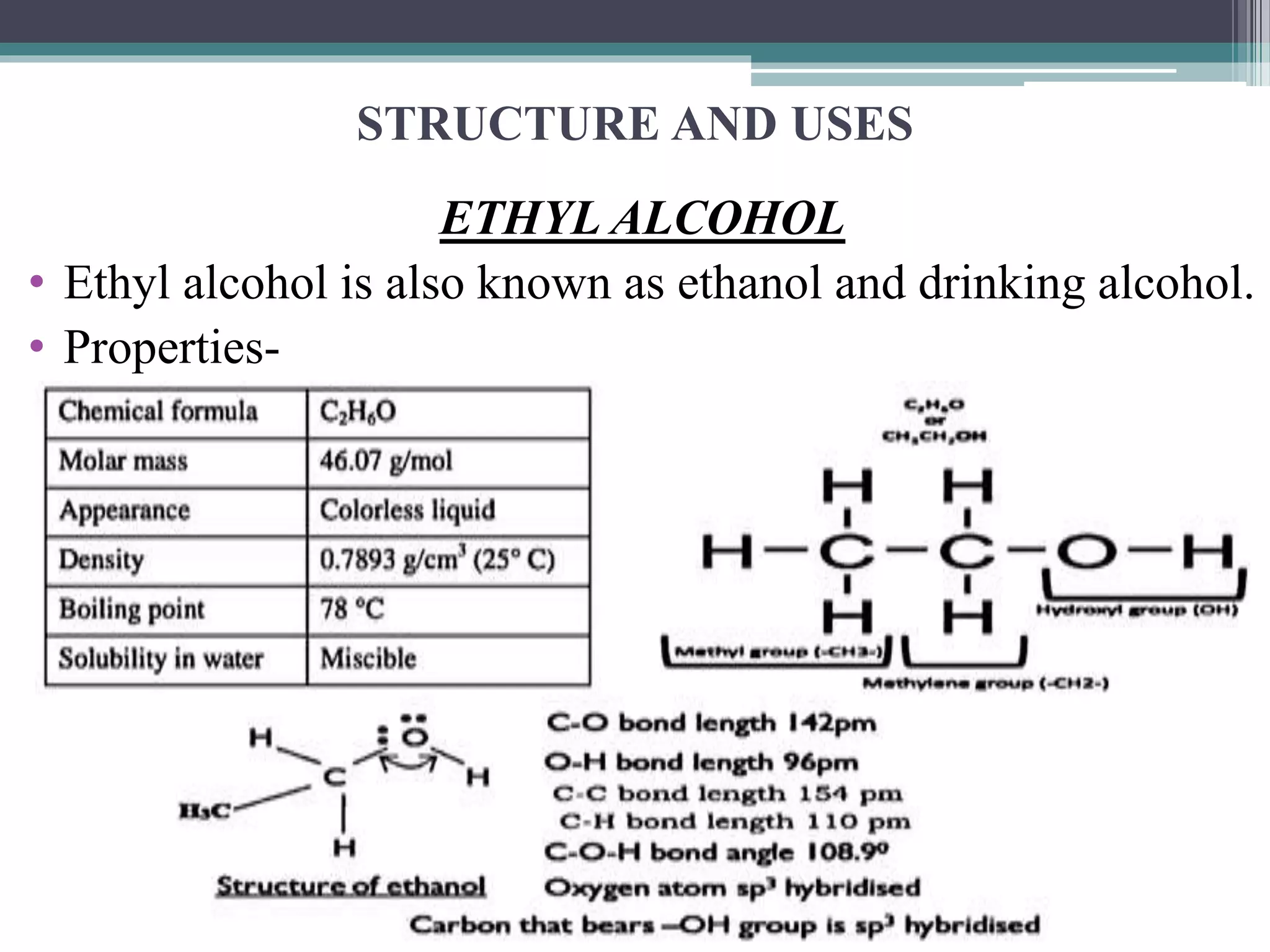
ETHYL ALCOHOL
• Ethyl alcohol is also known as ethanol and drinking alcohol.
• Properties-
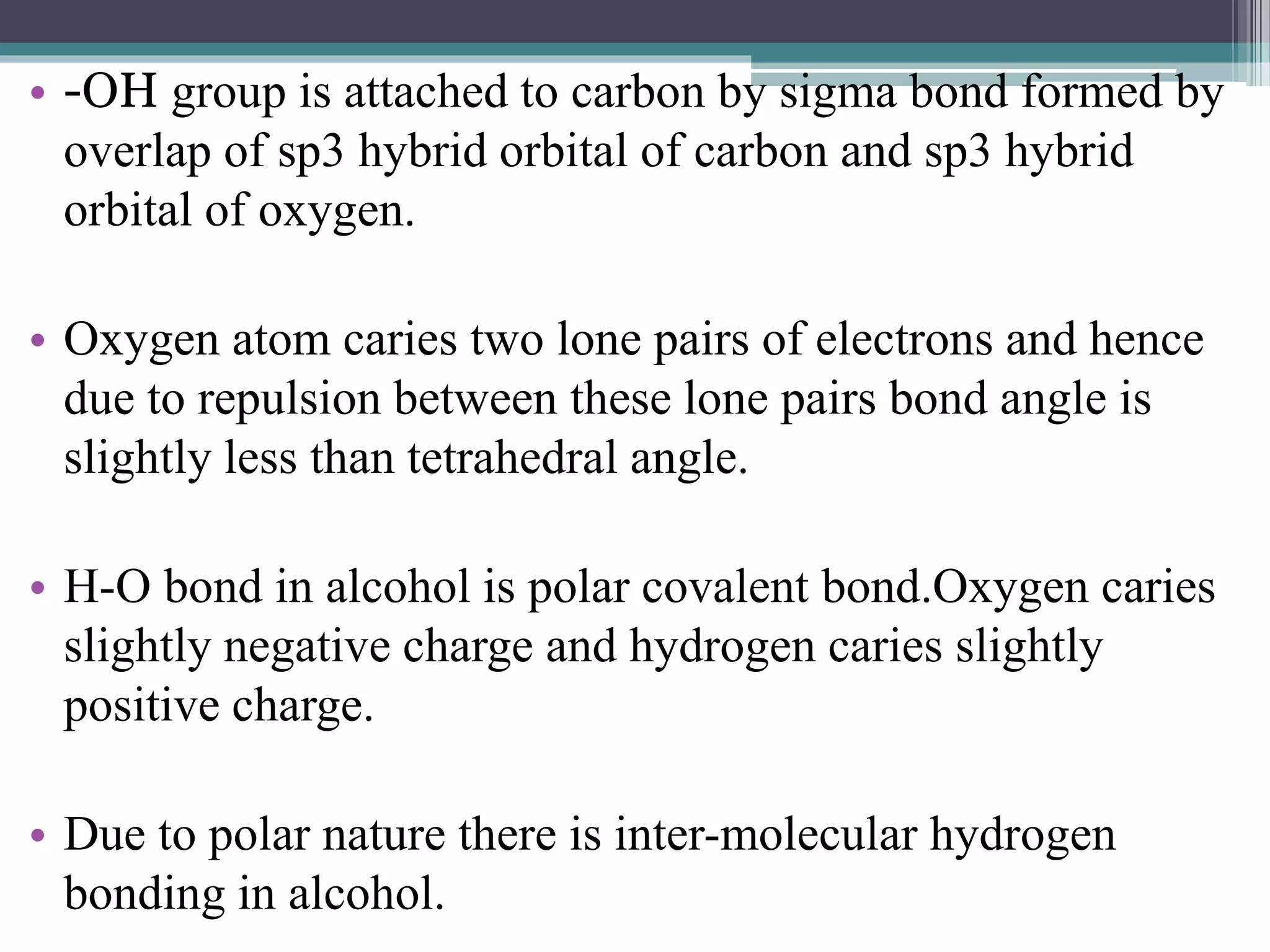
• -OH group is attached to carbon by sigma bond formed by
overlap of sp3 hybrid orbital of carbon and sp3 hybrid
orbital of oxygen.
• Oxygen atom caries two lone pairs of electrons and hence
due to repulsion between these lone pairs bond angle is
slightly less than tetrahedral angle.
• H-O bond in alcohol is polar covalent bond.Oxygen caries
slightly negative charge and hydrogen caries slightly
positive charge.
• Due to polar nature there is inter-molecular hydrogen
bonding in alcohol.
Uses-
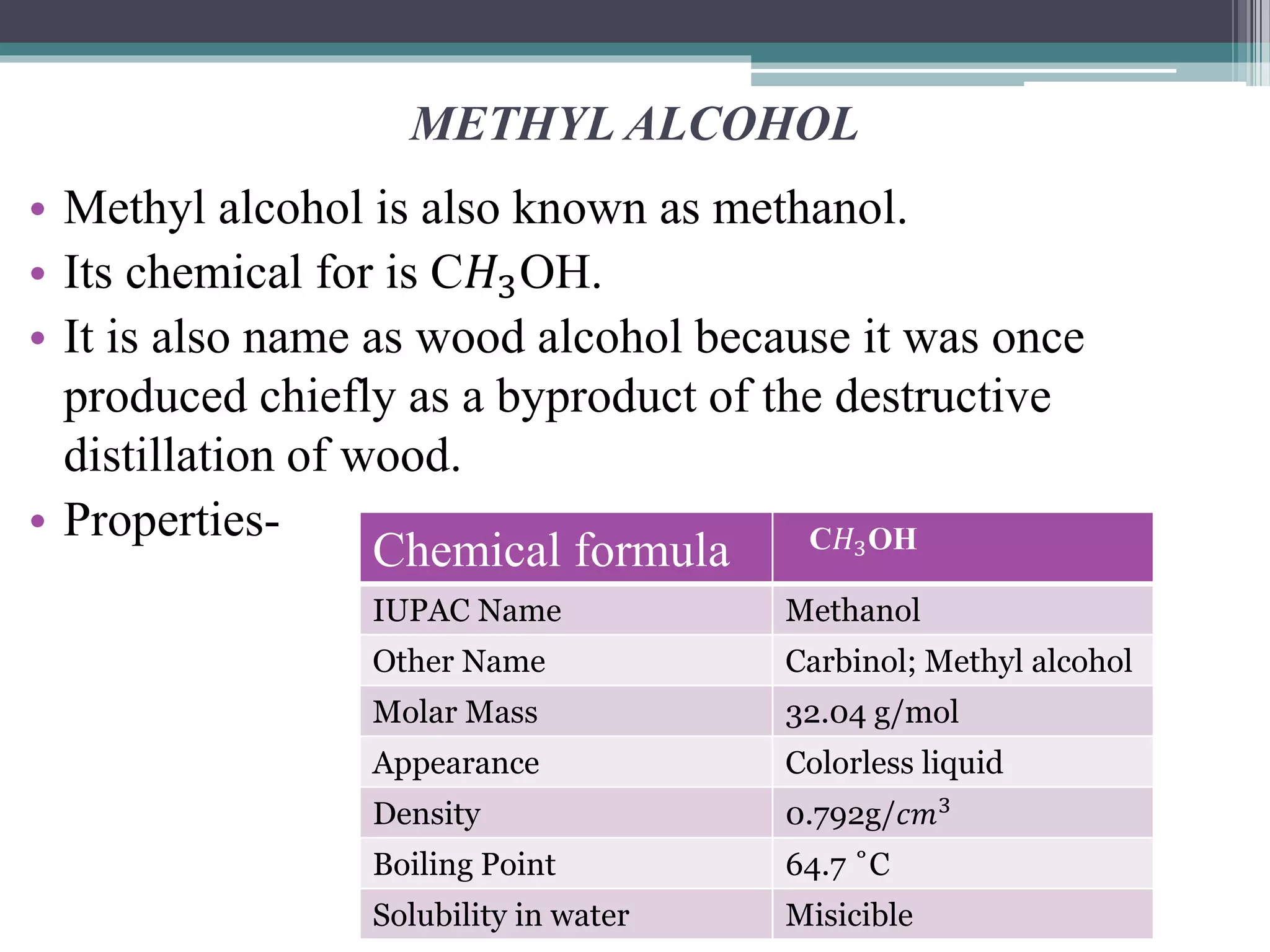
METHYL ALCOHOL
• Methyl alcohol is also known as methanol.
• Its chemical for is C𝐻3OH.
• It is also name as wood alcohol because it was once
produced chiefly as a byproduct of the destructive
distillation of wood.
• Properties-
Chemical formula C𝐻3OH
IUPAC Name Methanol
Other Name Carbinol; Methyl alcohol
Molar Mass 32.04 g/mol
Appearance Colorless liquid
Density 0.792g/𝑐𝑚3
Boiling Point 64.7 ˚C
Solubility in water Misicible
Structure of methyl alcohol
• Preparation-
Carbon monoxide and hydrogen react over a catalyst to
produce methanol.
CO + 2𝐻2 C𝐻3OH.
• Uses-
• Chemical industry- It is primarily used in making other chemicals.
About 40% of methanol is converted to formaldehyde and from
there into products as diverse as plastic, plywood, paints, explosives
etc.
• Fuel for vehicles- Methanol is occasionally used to fuel internal
combustion engines.
• Laboratory use- Methanol is used as a solvent. It is especially used
in HPLC and UV/VIS Spectroscopy.
CHLOROBUTANOL
• It is also known as Trichloro-2-methyl-2-propanol
• It is chemical preservative which is widely used in
cosmetic and pharmaceutical products.
• The anti-bacterial and anti-fungal properties of the
substance inhibit microbial growth for extended
period of time.
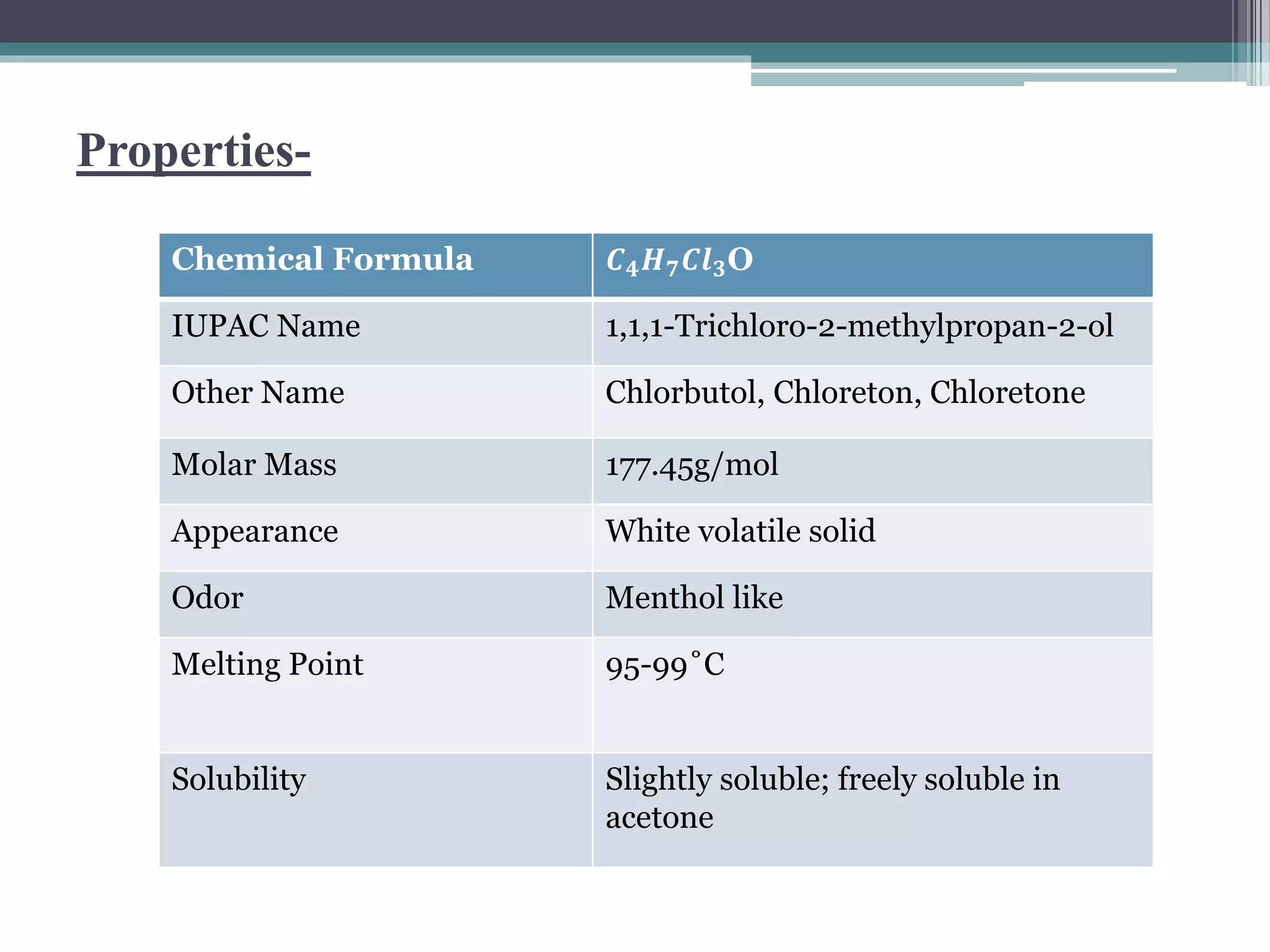
Properties-
Chemical Formula 𝑪 𝟒 𝑯 𝟕 𝑪𝒍 𝟑O
IUPAC Name 1,1,1-Trichloro-2-methylpropan-2-ol
Other Name Chlorbutol, Chloreton, Chloretone
Molar Mass 177.45g/mol
Appearance White volatile solid
Odor Menthol like
Melting Point 95-99˚C
Solubility Slightly soluble; freely soluble in
acetone
• Preparation-
Chlorobutanol is formed by the simple nucleophilic
addition of chloroform and acetone. The reaction is
base driven by potassium or sodium hydroxide.
O KOH CCl3 OH
CH3 CH3 + CHCl3 CH3 CH3
Structure-
Uses-
1
• Topically along with clove oil it is used as dental
analgesic.
• It is used as sedative and hypnotic
2
• It is used as a pharmaceutical aid
• It is used in antiseptic
3
• It is used in the break down of trichloroethanol
which carries the risk of possible neurotoxic
effects.
CETOSTEARYL ALCOHOL
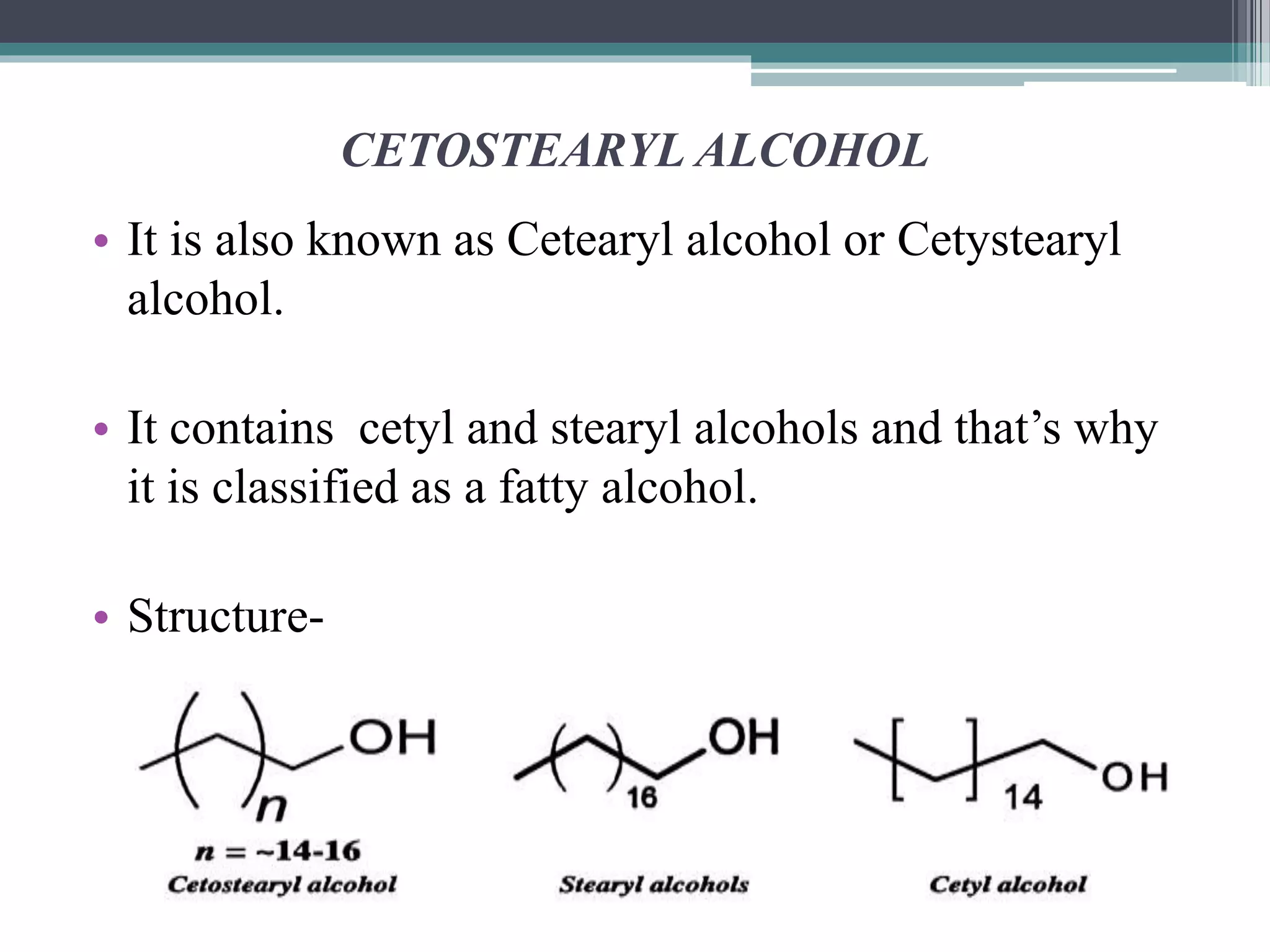
• It is also known as Cetearyl alcohol or Cetystearyl
alcohol.
• It contains cetyl and stearyl alcohols and that’s why
it is classified as a fatty alcohol.
• Structure-
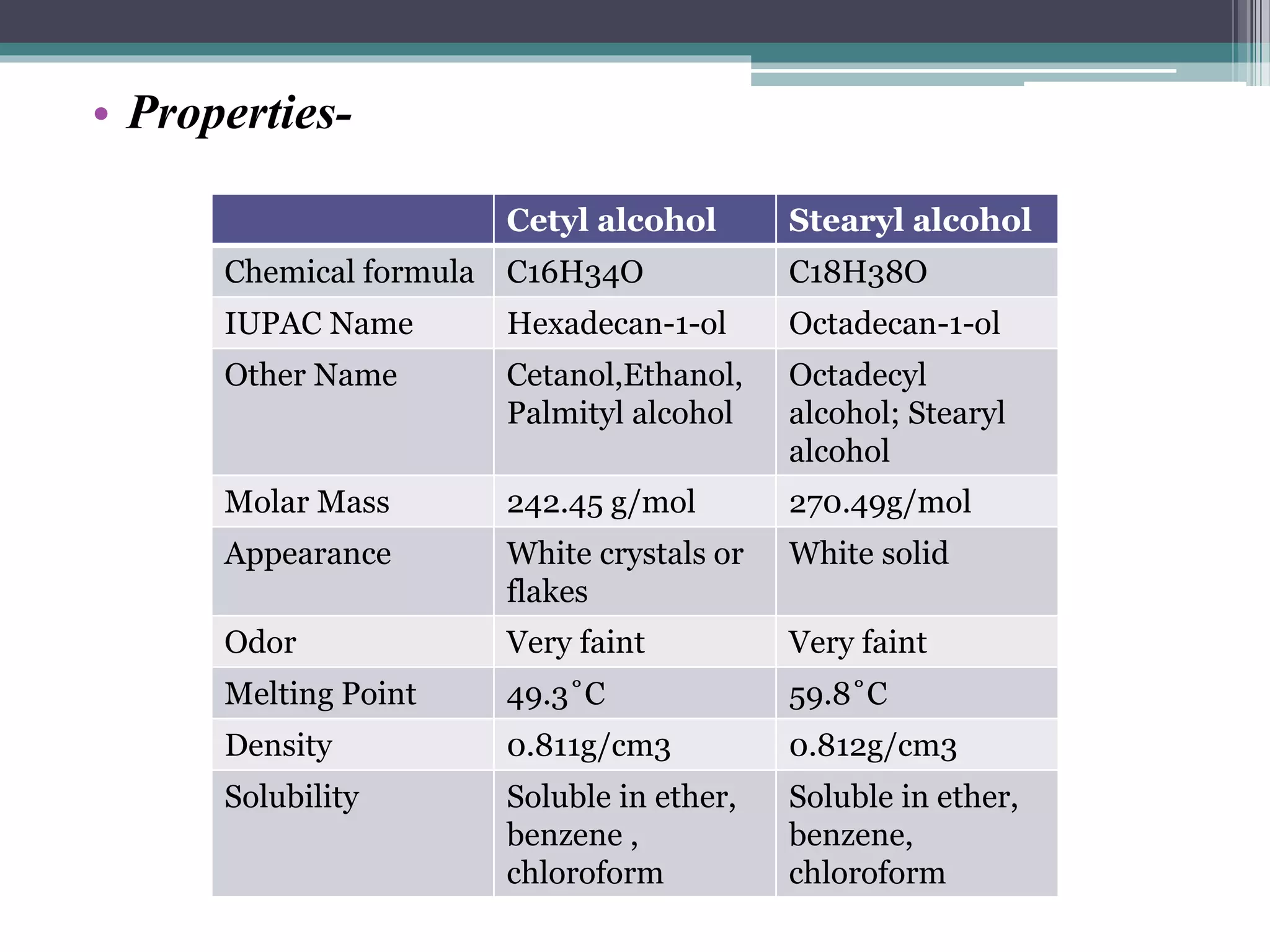
• Properties-
Cetyl alcohol Stearyl alcohol
Chemical formula C16H34O C18H38O
IUPAC Name Hexadecan-1-ol Octadecan-1-ol
Other Name Cetanol,Ethanol,
Palmityl alcohol
Octadecyl
alcohol; Stearyl
alcohol
Molar Mass 242.45 g/mol 270.49g/mol
Appearance White crystals or
flakes
White solid
Odor Very faint Very faint
Melting Point 49.3˚C 59.8˚C
Density 0.811g/cm3 0.812g/cm3
Solubility Soluble in ether,
benzene ,
chloroform
Soluble in ether,
benzene,
chloroform
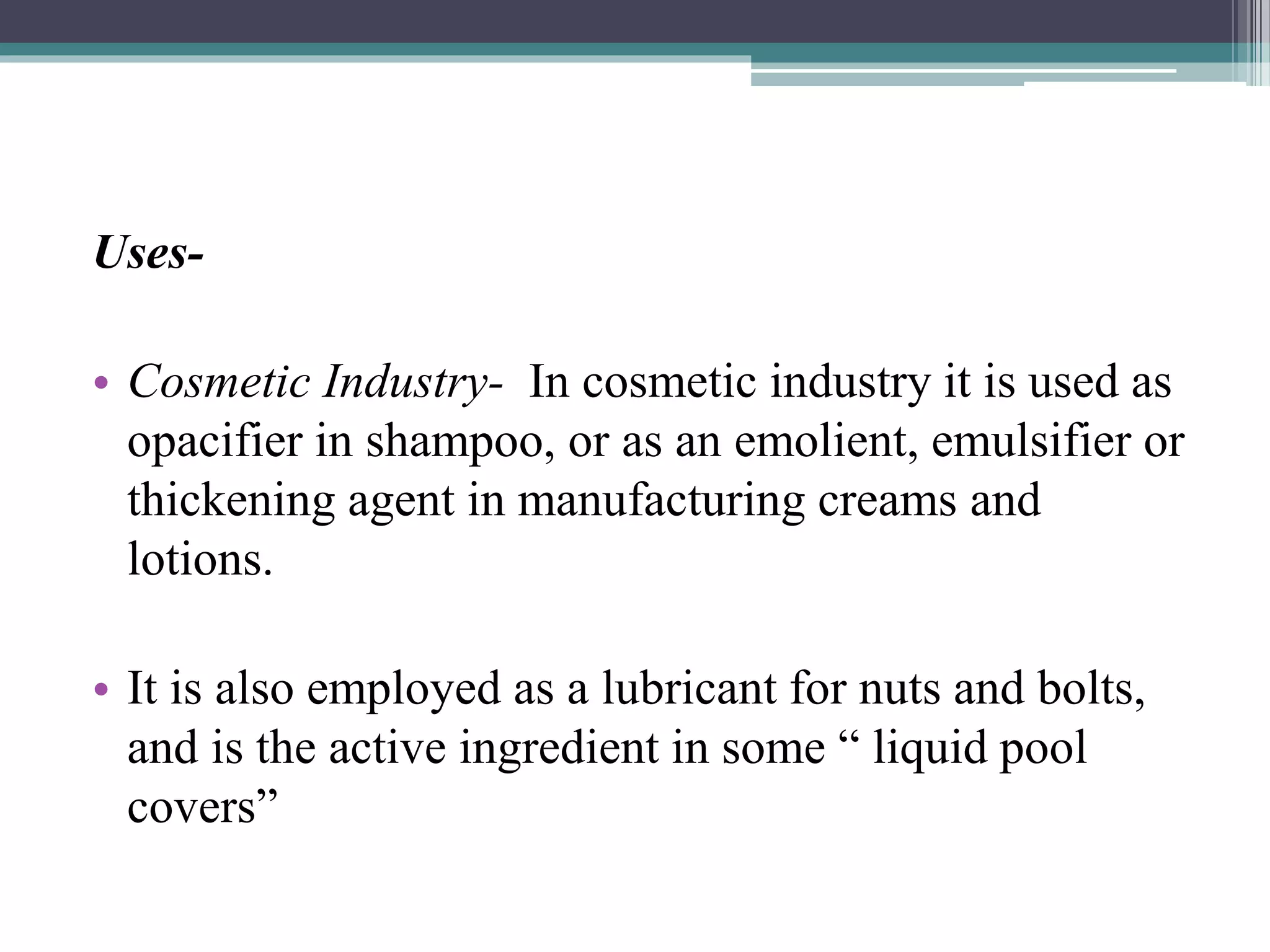
Uses-
• Cosmetic Industry- In cosmetic industry it is used as
opacifier in shampoo, or as an emolient, emulsifier or
thickening agent in manufacturing creams and
lotions.
• It is also employed as a lubricant for nuts and bolts,
and is the active ingredient in some “ liquid pool
covers”
BENZYL ALCOHOL
• Structure-
Properties-
Chemical formula C7H8O
IUPAC Name Phenylmethanol
Other Name Phenylcarbinol
Molar Mass 108.14g/mol
Appearance Colourless liquid
Odour Slightly aromatic
Density 1.044g/cm3
Boiling Point 205.3
Solubility in water 3.50g/100ml
Solubility in other solvents Soluble in
benzene,ethanol,methanol,chloroform
.,ether,acetone
Uses-
• It is used as a solvent for inks, waxes,paints etc
• Used in cigarettes to enhance flavour
• 10% solution used as antimicrobial

Alcohols

  • 1.
  • 2.
    ALCOHOLS • An alcoholis any organic compound in which a hudroxyl functional group (-OH) is bounded to a carbon atom usually connected to other carbon or hydrogen atom • The word alcohol appeared in English in the 16th century originating from the Arabic word
  • 3.
    Classification of alcohols Alcohols [Basedon no. of OH group] Monohydric alcohol- Contains one OH group Eg- CH3CH2OH Dihydric alcohol- Contains 2 OH group Eg- CH2 OH CH2 OH Trihydric alcohol- Contains 3 OH group Eg- CH2 OH CH2 OH CH2 OH
  • 4.
  • 5.
    PREPARATION OF ALCOHOLS •Hydrolysis of haloalkanes/ alkyl halides- * In this haloalkanes are converted to corresponding alcohols using aqueous NaOH; KOH or Ca(OH)2. *This method is used for the preparation of primary and secondary alcohols * This is a type of nucleophilic substitution reaction Example- H2O RX +Na-OH R- OH + NaX Alkyl halide
  • 6.
    • Note- * Thisreaction is useful only with reaction that do not undergo E2 elimination readily * This method of preparing alcohols is not satisfactory because the alkyl halides may simultaneously undergo dehydrogenation to produce alkenes. In order to remove this difficulty, mild alkalis like silver oxide or potassium carbonate is used to obtain good yield of alcohol R-X +AgOH R-OH +AgX
  • 7.
    Questions 1-Complete this reaction- AgOH CH3CH2CH2Cl+NaOH+H2O? 2- Why AgOH is used in this type of reaction?
  • 8.
    Reduction of Carbonylcompounds- • Aldehydes, ketones, carboxylic acids and esters when reduced with appropriate agents give alcohols. • Sodium in alcohol can be used for reducing aldehydes, ketones and esters ( Bouvealt Blanc Reaction). Such reduction are now replaced by reductions using metal hydrides. • Hydrogen and metal catalysts- These reduction are used to make alcohols in large scale from aldehyde and ketones. These are carried out in inert solvents by Ni, Pd or Pt catalysts.
  • 9.
    • Complex metalhydrides- These are the best reducing agents for the preparation of alcohol from aldehyde and ketones in laboratory. Lithium aluminium hydroxide [LiAlH4] and sodium borohydride [NaBH4]. • Examples- Reduction of Aldehydes- O R C H + 2[H] RCH2OH Aldehyde Primary alcohol Reducing agents- H2/Pt, NaBH4 or LiAlH4
  • 10.
    • Reduction ofKetones- O H R C R + 2[H] R C R Ketone OH Secondary alcohol Reducing agents- H2/Pt, NaBH4 or LiAlH4 • Reduction of Carboxylic acids- O R C OH + 4[H] RCH4OH + H2O Carboxylic acid Reducing agents- B2H6; LiAlH4
  • 11.
    • Reduction ofCarboxylic esters- O R C OR’ + 4[H] RCH2OH + R’OH Carboxylic ester Mixtures Note- LiAlH4, does not reduce C=C so it is used for the preparation of unsaturated alcohols from unsaturated aldehyde and ketones. Question- Which reducing agent is used to make unsaturated alcohols and why?
  • 12.
    • Name thereaction in which sodium is used as a reducing agent. • Which type of solvent is used when hydrogen and metal catalyst is used as a reducing agent. • Name the catalyst used as hydrogen and metal catalyst • Name any two complex metal hydride reducing agent with their molecular formula.
  • 13.
    Hydration of Alkenes •Hydration means addition of H+ and OH- across a C=C double bond to give alcohol. • It is a electrophilic addition of water to the alkene. Example- R-CH=CH2 + H2SO4 CH3-CH2-O-SO2-OH H2O RCHOHCH3+H2SO4
  • 14.
    Applications of alcohols •Alcoholic beverages • Antifreezes • Medical • Alcohol fuels • Preservatives • Solvents
  • 15.
    QUALITATIVE TESTS FORALCOHOLS ▫ Sodium metal test- Alcohols react with active metals like sodium and liberates hydrogen gas in the form of effervescence. 2R-OH + 2Na 2R-ONa + H2 Alcohol Sodium alkoxide Eg- 2CH3OH + 2Na 2CH3-ONa + H2 Methanol Sodium methoxide
  • 16.
    • Ester test-Alcohols react with carboxylic acids to form fruity smelling compounds called esters. The reaction between alcohol and carboxylic acid is called esterification and is catalysed by an acid such as concentrated sulphuric acid. O O 2R-OH + 2R’-C-OH R’-C-O-R + H2O Alcohol Carboxylic acid Ester O O CH3OH + CH3-C-OH CH3-C-O-CH3 + H2O Methanol Acetic acid Methyl acetate
  • 17.
    • Ceric ammoniumnitrate test- Alcohol react with cerric ammonium nitrate to form a red coloured alkoxy cerium(IV) compound. 2R-OH+ [NH4]2Ce(NO3)6 ( ROH)2Ce(NO3)4 +2NH4NO3 Alcohol Ceric ammonium Alkoxy cerium(IV) nitrate compound [Pink or Red colour] Example- 2CH3-OH+ [NH4]2Ce(NO3)6 (CH3OH)2Ce(NO3)4+2NH4NO3 Methanol Ceric ammonium Methoxy cerium(IV) nitrate compound [Pink or Red colour]
  • 18.
    • Acetyl chloridetest- Alcohols react with acetyl chloride to form esters and gives out hydrogen chloride gas. The hydrogen chloride gives white fumes of ammonium chloride with ammonium hydroxide. O O R-OH+ CH3-C-Cl CH3-C-O-R +HCl Alcohol Acetyl Ester Chloride HCl+ NH4OH NH4Cl + H2O White fumes
  • 19.
    • Iodoform test-This test is given by acetaldehyde, all methyl ketones and all alcohol containing groups. When alcohol is warmed with sodium hydroxide solution and iodine , a yellow precipitate of iodoform is formed. OH O CH3 – CH- CH2 +I2+2NaOH CH3-C-CH3+ NaI+ 2H2O 2-Propanol Acetone O CH3- C- CH3 +3I2+ 4NaOH CHI3+CH3COONa+3NaI+3H2O Acetone Iodoform
  • 20.
    Distinction between Primary,Secondary and Tertiary alcohols 1 • Lucas Test 2 • TCICA Test [ Trichloroisocyanuric acid] 3 • Victor Meyer Test
  • 21.
    Lucas Test • Principle- •Lucas reagent is basically an anhydrous solution of Zinc Chloride ( Lewis acid) in concentrated HCl. This reagent is used to test alcohol and classify them according to their reactivity. It is a substitution reaction as OH group of alcohol is replaced by Chloride group of ZnCl. • The reactivity of alcohol with Lucas reagent is measured by degree of turbidity which may vary from colourless to turbid.The formation of turbid solution happens due to the formation of chloroalkane.
  • 22.
    • Test isused to differentiate different types of alcohol based on the time taken by the alcohol solution to become turbid. • Primary alcohol- Remains colourless as there is no visible reaction occur.Eg- Pentanol • Secondary alcohol- Solution become turbid or cloudy in 5-20 minutes with slight heating. Eg- 2-Pentanol • Tertiary alcohol- Solution turns turbid rapidly at room temperature. Eg-2-Methyl-2-Butanol
  • 23.
    • Lucas reagentformula- • Lucas reagent basically is a solution which is formed by the combination of HCl and ZnCl2. • Lucas reagent mechanism- • The reaction which normally occurs is a SN-1 nucleophilic substitution which is a two step reaction. • Alcohols which have the capability to form carbocation intermediate exhibit this reaction. • Only secondary and tertiary alcohols exhibit SN-1 nucleophilic substitution reaction.
  • 24.
    • Steps involvedin this reaction- Step-1= The proton [H+] form Hydrochloric acid [HCl] will protonate the OH- group of the alcohol. Water [H2O] attached to the carbon is a weaker is a weaker nucleophile than Cl- ( Chloride). Thus, nucleophile Cl- replaces the H2O group forming a carbocation as its present in excess. Step-2= Cl- attacks the carbocations and the forms alkyl chloride. +.H : OH HCl : OH Slow + Cl- Cl Alkyl Chloride
  • 25.
    • Tertiary alcoholand alcohol that forms resonance- stabilized carbocation react to form a cloudy mixture in less than 30 seconds at room temperature. • Secondary alcohols can react in 3-10 min, but may need to be warmed.
  • 26.
    • Primary alcoholrequires more than an hour to react , if it react at all.
  • 27.
    TCICA[ Trichloroisocyanuric Acid]TEST • This test is used to differentiate between primary and secondary alcohol by their rate of oxidation. • This test is conducted by adding unknown solution of TCICA in acetonitrile 3 containing hydrochloric acid 4 and than measuring the time for a precipitate to form. • Primary alcohols react slowly and secondary alcohols react rapidly.
  • 29.
    VICTOR MEYER TEST •It is the most important method for the identification of alcohol. • This method is used for the identification of primary, secondary and tertiary alcohol on the basis of series of chemical analysis and colour resulting from the solution is observed. • The different steps involved in this test are as follows- 1) Alcohol is treated with iodine in presence of red phosphorus to obtain iodol alkane.
  • 30.
    • Iodoalkane soformed is allowedto react with alcoholic silver nitrate in order to obtain nitroalkane. • The nitroalkane is treated with nitrous acid ( Mixture of NaNO2+HCl) and the resulting solution is made alkaline. • The colour of resulting solution if observed- • Primary alcohols gives blood red colour • Secondary alcohol gives blue colour • Tertiary alcohol does not produce any colour.
  • 32.
    STRUCTURE AND USES ETHYLALCOHOL • Ethyl alcohol is also known as ethanol and drinking alcohol. • Properties-
  • 33.
    • -OH groupis attached to carbon by sigma bond formed by overlap of sp3 hybrid orbital of carbon and sp3 hybrid orbital of oxygen. • Oxygen atom caries two lone pairs of electrons and hence due to repulsion between these lone pairs bond angle is slightly less than tetrahedral angle. • H-O bond in alcohol is polar covalent bond.Oxygen caries slightly negative charge and hydrogen caries slightly positive charge. • Due to polar nature there is inter-molecular hydrogen bonding in alcohol.
  • 34.
  • 35.
    METHYL ALCOHOL • Methylalcohol is also known as methanol. • Its chemical for is C𝐻3OH. • It is also name as wood alcohol because it was once produced chiefly as a byproduct of the destructive distillation of wood. • Properties- Chemical formula C𝐻3OH IUPAC Name Methanol Other Name Carbinol; Methyl alcohol Molar Mass 32.04 g/mol Appearance Colorless liquid Density 0.792g/𝑐𝑚3 Boiling Point 64.7 ˚C Solubility in water Misicible
  • 36.
  • 37.
    • Preparation- Carbon monoxideand hydrogen react over a catalyst to produce methanol. CO + 2𝐻2 C𝐻3OH. • Uses- • Chemical industry- It is primarily used in making other chemicals. About 40% of methanol is converted to formaldehyde and from there into products as diverse as plastic, plywood, paints, explosives etc. • Fuel for vehicles- Methanol is occasionally used to fuel internal combustion engines. • Laboratory use- Methanol is used as a solvent. It is especially used in HPLC and UV/VIS Spectroscopy.
  • 38.
    CHLOROBUTANOL • It isalso known as Trichloro-2-methyl-2-propanol • It is chemical preservative which is widely used in cosmetic and pharmaceutical products. • The anti-bacterial and anti-fungal properties of the substance inhibit microbial growth for extended period of time.
  • 39.
    Properties- Chemical Formula 𝑪𝟒 𝑯 𝟕 𝑪𝒍 𝟑O IUPAC Name 1,1,1-Trichloro-2-methylpropan-2-ol Other Name Chlorbutol, Chloreton, Chloretone Molar Mass 177.45g/mol Appearance White volatile solid Odor Menthol like Melting Point 95-99˚C Solubility Slightly soluble; freely soluble in acetone
  • 40.
    • Preparation- Chlorobutanol isformed by the simple nucleophilic addition of chloroform and acetone. The reaction is base driven by potassium or sodium hydroxide. O KOH CCl3 OH CH3 CH3 + CHCl3 CH3 CH3
  • 41.
  • 42.
    Uses- 1 • Topically alongwith clove oil it is used as dental analgesic. • It is used as sedative and hypnotic 2 • It is used as a pharmaceutical aid • It is used in antiseptic 3 • It is used in the break down of trichloroethanol which carries the risk of possible neurotoxic effects.
  • 43.
    CETOSTEARYL ALCOHOL • Itis also known as Cetearyl alcohol or Cetystearyl alcohol. • It contains cetyl and stearyl alcohols and that’s why it is classified as a fatty alcohol. • Structure-
  • 44.
    • Properties- Cetyl alcoholStearyl alcohol Chemical formula C16H34O C18H38O IUPAC Name Hexadecan-1-ol Octadecan-1-ol Other Name Cetanol,Ethanol, Palmityl alcohol Octadecyl alcohol; Stearyl alcohol Molar Mass 242.45 g/mol 270.49g/mol Appearance White crystals or flakes White solid Odor Very faint Very faint Melting Point 49.3˚C 59.8˚C Density 0.811g/cm3 0.812g/cm3 Solubility Soluble in ether, benzene , chloroform Soluble in ether, benzene, chloroform
  • 45.
    Uses- • Cosmetic Industry-In cosmetic industry it is used as opacifier in shampoo, or as an emolient, emulsifier or thickening agent in manufacturing creams and lotions. • It is also employed as a lubricant for nuts and bolts, and is the active ingredient in some “ liquid pool covers”
  • 46.
  • 47.
    Properties- Chemical formula C7H8O IUPACName Phenylmethanol Other Name Phenylcarbinol Molar Mass 108.14g/mol Appearance Colourless liquid Odour Slightly aromatic Density 1.044g/cm3 Boiling Point 205.3 Solubility in water 3.50g/100ml Solubility in other solvents Soluble in benzene,ethanol,methanol,chloroform .,ether,acetone
  • 48.
    Uses- • It isused as a solvent for inks, waxes,paints etc • Used in cigarettes to enhance flavour • 10% solution used as antimicrobial