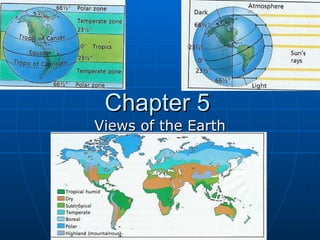
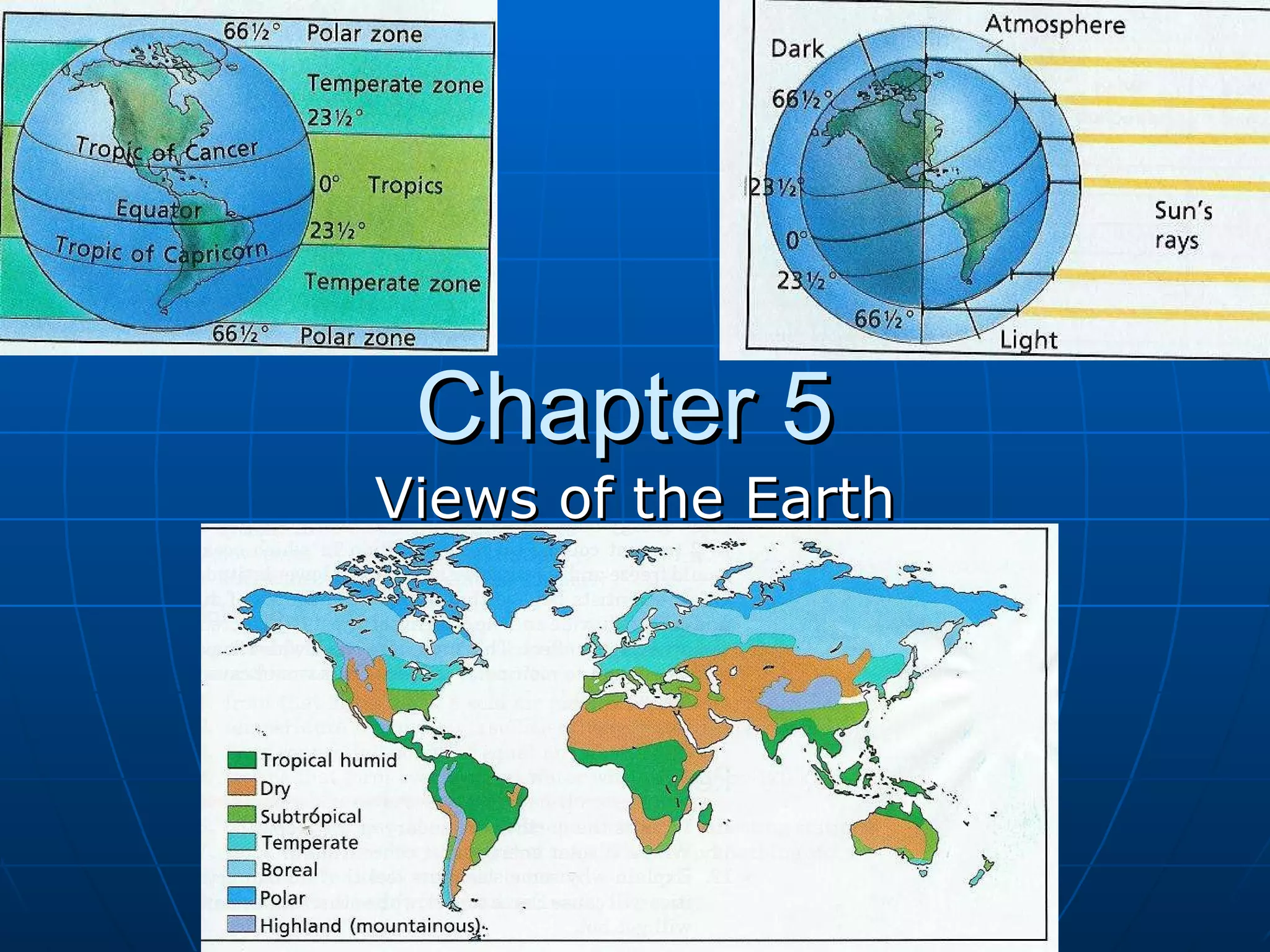
Chapter 5 Views of the Earth
 
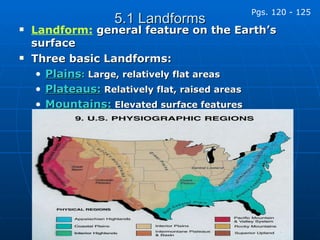
5.1 Landforms Landform:   general feature on the Earth’s surface Three basic Landforms: Plains :  Large, relatively flat areas Plateaus:  Relatively flat, raised areas Mountains:  Elevated surface features Pgs. 120 - 125
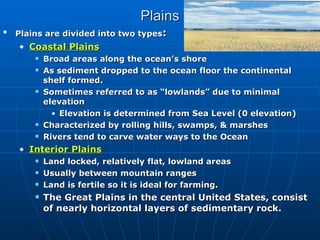
Plains Plains are divided into two types : Coastal Plains Broad areas along the ocean’s shore As sediment dropped to the ocean floor the continental shelf formed.  Sometimes referred to as “lowlands” due to minimal elevation Elevation is determined from Sea Level (0 elevation) Characterized by rolling hills, swamps, & marshes Rivers tend to carve water ways to the Ocean Interior Plains Land locked, relatively flat, lowland areas  Usually between mountain ranges Land is fertile so it is ideal for farming.  The Great Plains in the central United States, consist of nearly horizontal layers of sedimentary rock.
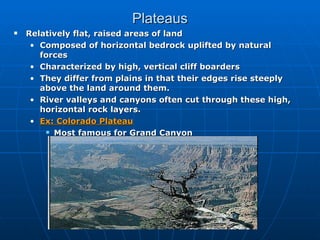
Plateaus Relatively flat, raised areas of land Composed of horizontal bedrock uplifted by natural forces Characterized by high, vertical cliff boarders They differ from plains in that their edges rise steeply above the land around them. River valleys and canyons often cut through these high, horizontal rock layers.  Ex: Colorado Plateau Most famous for Grand Canyon
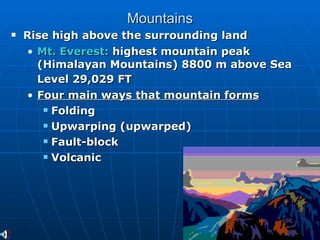
Mountains Rise high above the surrounding land Mt. Everest:  highest mountain peak (Himalayan Mountains) 8800 m above Sea Level 29,029 FT   Four main ways that mountain forms Folding Upwarping (upwarped) Fault-block Volcanic
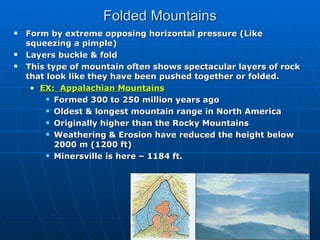
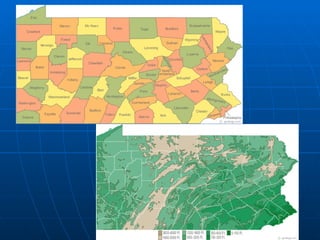
Folded Mountains Form by extreme opposing horizontal pressure (Like squeezing a pimple) Layers buckle & fold This type of mountain often shows spectacular layers of rock that look like they have been pushed together or folded. EX:  Appalachian Mountains Formed 300 to 250 million years ago Oldest & longest mountain range in North America Originally higher than the Rocky Mountains Weathering & Erosion have reduced the height below 2000 m (1200 ft) Minersville is here – 1184 ft.
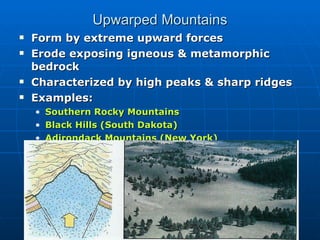
Upwarped Mountains Form by extreme upward forces Erode exposing igneous & metamorphic bedrock Characterized by high peaks & sharp ridges Examples: Southern Rocky Mountains Black Hills (South Dakota) Adirondack Mountains (New York)
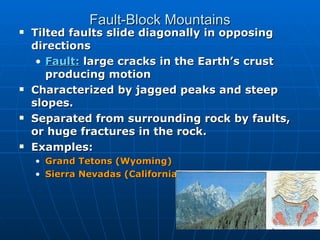
Fault-Block Mountains Tilted faults slide diagonally in opposing directions Fault:  large cracks in the Earth’s crust producing motion Characterized by jagged peaks and steep slopes.  Separated from surrounding rock by faults, or huge fractures in the rock.  Examples: Grand Tetons (Wyoming) Sierra Nevadas (California)
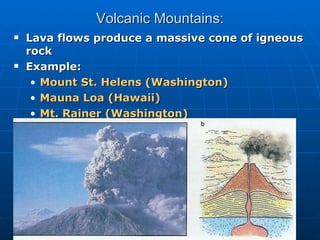
Volcanic Mountains: Lava flows produce a massive cone of igneous rock Example:  Mount St. Helens (Washington) Mauna Loa (Hawaii) Mt. Rainer (Washington)
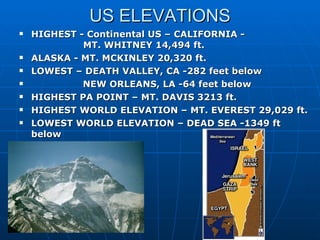
US ELEVATIONS HIGHEST - Continental US – CALIFORNIA -  MT. WHITNEY 14,494 ft.  ALASKA - MT. MCKINLEY 20,320 ft. LOWEST – DEATH VALLEY, CA -282 feet below NEW ORLEANS, LA -64 feet below  HIGHEST PA POINT – MT. DAVIS 3213 ft. HIGHEST WORLD ELEVATION – MT. EVEREST 29,029 ft. LOWEST WORLD ELEVATION – DEAD SEA -1349 ft below
 
 
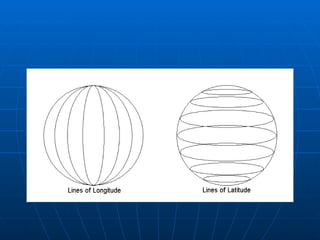
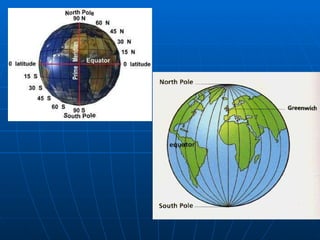
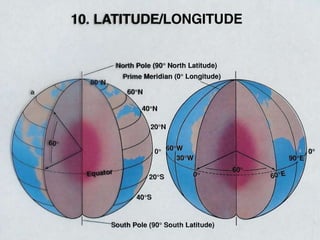
5.2 Viewpoints Latitude & Longitude Precise way of determining location System of imaginary gridlines Latitude: Horizontal lines paralleling the Equator (0 0  Latitude) Equator divides Earth into 2 halves Above the Equator =  Northern Hemisphere Below the Equator =  Southern Hemisphere Measure position North & South Poles = 90 0  North & South Longitude: Vertical lines (called meridians) intersecting at the poles  Measure position East & West Begin with the Prime Meridian (0 0  Longitude) Pgs. 126 -129
 
 
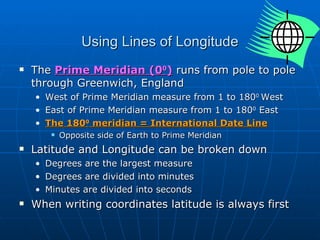
Using Lines of Longitude The  Prime Meridian (0 0 )  runs from pole to pole through Greenwich, England West of Prime Meridian measure from 1 to 180 0  West East of Prime Meridian measure from 1 to 180 0  East The 180 0  meridian = International Date Line Opposite side of Earth to Prime Meridian Latitude and Longitude can be broken down Degrees are the largest measure Degrees are divided into minutes Minutes are divided into seconds When writing coordinates latitude is always first
 
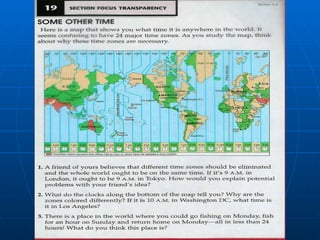
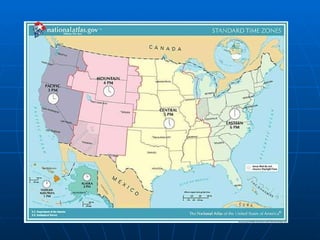
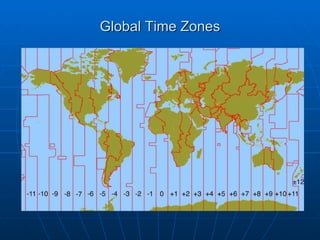
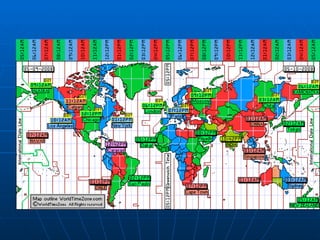
Earth Time What time is it?   The answer actually depends on where you are The Earth is divided into 24 Time Zones Each time zone is one hour different to the ones beside it Every time zone is 15 0  longitude wide 6 time zones cover the US Every time you cross a time zone going west you lose an hour Every time you cross a time zone going east you gain an hour. (Lose part of that day) Going East is like moving the clock ahead.  Going West is like going back in time, not really but it should help you remember.
 
Global Time Zones
6 Us Time Zones Eastern – The time zone we are in. Central  Mountain  Pacific Alaskan Hawaiian Let’s say you are going to London on business.  If you leave @ 3:00 PM what time is it in London?
 
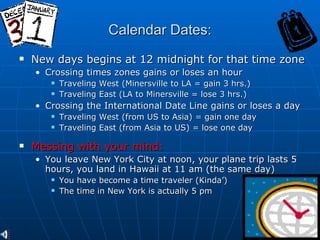
Calendar Dates: New days begins at 12 midnight for that time zone Crossing times zones gains or loses an hour Traveling West (Minersville to LA = gain 3 hrs.) Traveling East (LA to Minersville = lose 3 hrs.) Crossing the International Date Line gains or loses a day Traveling West (from US to Asia) = gain one day Traveling East (from Asia to US) = lose one day Messing with your mind: You leave New York City at noon, your plane trip lasts 5 hours, you land in Hawaii at 11 am (the same day) You have become a time traveler (Kinda’) The time in New York is actually 5 pm
 
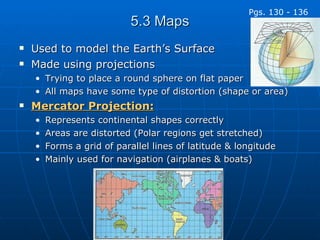
5.3 Maps Used to model the Earth’s Surface Made using projections Trying to place a round sphere on flat paper All maps have some type of distortion (shape or area) Mercator Projection: Represents continental shapes correctly Areas are distorted (Polar regions get stretched) Forms a grid of parallel lines of latitude & longitude Mainly used for navigation (airplanes & boats) Pgs. 130 - 136
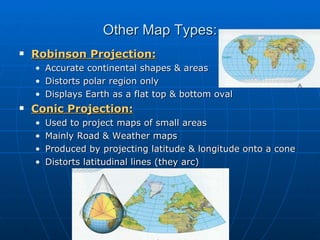
Other Map Types: Robinson Projection: Accurate continental shapes & areas Distorts polar region only Displays Earth as a flat top & bottom oval Conic Projection: Used to project maps of small areas Mainly Road & Weather maps Produced by projecting latitude & longitude onto a cone Distorts latitudinal lines (they arc)
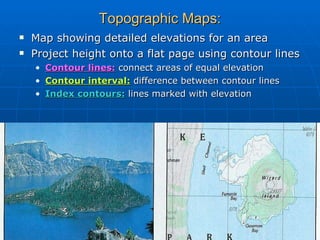
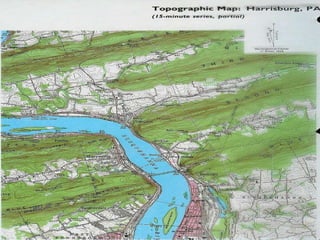
Topographic Maps: Map showing detailed elevations for an area Project height onto a flat page using contour lines Contour lines:  connect areas of equal elevation Contour interval:  difference between contour lines Index contours:  lines marked with elevation
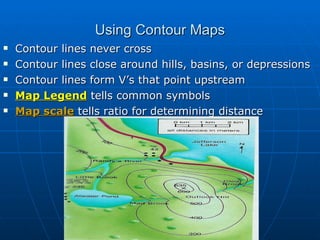
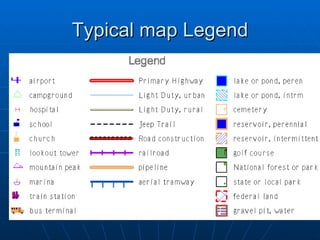
Using Contour Maps Contour lines never cross Contour lines close around hills, basins, or depressions Contour lines form V’s that point upstream Map Legend  tells common symbols Map scale  tells ratio for determining distance
Typical map Legend
 
 
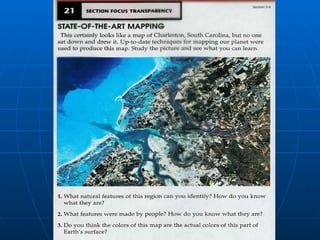
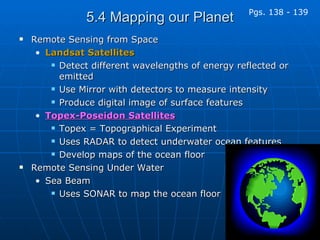
5.4 Mapping our Planet Remote Sensing from Space Landsat Satellites Detect different wavelengths of energy reflected or emitted Use Mirror with detectors to measure intensity Produce digital image of surface features Topex-Poseidon Satellites Topex = Topographical Experiment Uses RADAR to detect underwater ocean features Develop maps of the ocean floor Remote Sensing Under Water Sea Beam Uses SONAR to map the ocean floor Pgs. 138 - 139
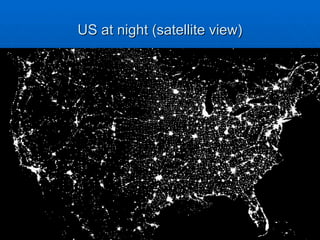
US at night (satellite view)

Ch 5 View Of Earth Notes

  • 1.
    Chapter 5 Viewsof the Earth
  • 2.
  • 3.
    5.1 Landforms Landform: general feature on the Earth’s surface Three basic Landforms: Plains : Large, relatively flat areas Plateaus: Relatively flat, raised areas Mountains: Elevated surface features Pgs. 120 - 125
  • 4.
    Plains Plains aredivided into two types : Coastal Plains Broad areas along the ocean’s shore As sediment dropped to the ocean floor the continental shelf formed. Sometimes referred to as “lowlands” due to minimal elevation Elevation is determined from Sea Level (0 elevation) Characterized by rolling hills, swamps, & marshes Rivers tend to carve water ways to the Ocean Interior Plains Land locked, relatively flat, lowland areas Usually between mountain ranges Land is fertile so it is ideal for farming. The Great Plains in the central United States, consist of nearly horizontal layers of sedimentary rock.
  • 5.
    Plateaus Relatively flat,raised areas of land Composed of horizontal bedrock uplifted by natural forces Characterized by high, vertical cliff boarders They differ from plains in that their edges rise steeply above the land around them. River valleys and canyons often cut through these high, horizontal rock layers. Ex: Colorado Plateau Most famous for Grand Canyon
  • 6.
    Mountains Rise highabove the surrounding land Mt. Everest: highest mountain peak (Himalayan Mountains) 8800 m above Sea Level 29,029 FT Four main ways that mountain forms Folding Upwarping (upwarped) Fault-block Volcanic
  • 7.
    Folded Mountains Formby extreme opposing horizontal pressure (Like squeezing a pimple) Layers buckle & fold This type of mountain often shows spectacular layers of rock that look like they have been pushed together or folded. EX: Appalachian Mountains Formed 300 to 250 million years ago Oldest & longest mountain range in North America Originally higher than the Rocky Mountains Weathering & Erosion have reduced the height below 2000 m (1200 ft) Minersville is here – 1184 ft.
  • 8.
    Upwarped Mountains Formby extreme upward forces Erode exposing igneous & metamorphic bedrock Characterized by high peaks & sharp ridges Examples: Southern Rocky Mountains Black Hills (South Dakota) Adirondack Mountains (New York)
  • 9.
    Fault-Block Mountains Tiltedfaults slide diagonally in opposing directions Fault: large cracks in the Earth’s crust producing motion Characterized by jagged peaks and steep slopes. Separated from surrounding rock by faults, or huge fractures in the rock. Examples: Grand Tetons (Wyoming) Sierra Nevadas (California)
  • 10.
    Volcanic Mountains: Lavaflows produce a massive cone of igneous rock Example: Mount St. Helens (Washington) Mauna Loa (Hawaii) Mt. Rainer (Washington)
  • 11.
    US ELEVATIONS HIGHEST- Continental US – CALIFORNIA - MT. WHITNEY 14,494 ft. ALASKA - MT. MCKINLEY 20,320 ft. LOWEST – DEATH VALLEY, CA -282 feet below NEW ORLEANS, LA -64 feet below HIGHEST PA POINT – MT. DAVIS 3213 ft. HIGHEST WORLD ELEVATION – MT. EVEREST 29,029 ft. LOWEST WORLD ELEVATION – DEAD SEA -1349 ft below
  • 12.
  • 13.
  • 14.
    5.2 Viewpoints Latitude& Longitude Precise way of determining location System of imaginary gridlines Latitude: Horizontal lines paralleling the Equator (0 0 Latitude) Equator divides Earth into 2 halves Above the Equator = Northern Hemisphere Below the Equator = Southern Hemisphere Measure position North & South Poles = 90 0 North & South Longitude: Vertical lines (called meridians) intersecting at the poles Measure position East & West Begin with the Prime Meridian (0 0 Longitude) Pgs. 126 -129
  • 15.
  • 16.
  • 17.
    Using Lines ofLongitude The Prime Meridian (0 0 ) runs from pole to pole through Greenwich, England West of Prime Meridian measure from 1 to 180 0 West East of Prime Meridian measure from 1 to 180 0 East The 180 0 meridian = International Date Line Opposite side of Earth to Prime Meridian Latitude and Longitude can be broken down Degrees are the largest measure Degrees are divided into minutes Minutes are divided into seconds When writing coordinates latitude is always first
  • 18.
  • 19.
    Earth Time Whattime is it? The answer actually depends on where you are The Earth is divided into 24 Time Zones Each time zone is one hour different to the ones beside it Every time zone is 15 0 longitude wide 6 time zones cover the US Every time you cross a time zone going west you lose an hour Every time you cross a time zone going east you gain an hour. (Lose part of that day) Going East is like moving the clock ahead. Going West is like going back in time, not really but it should help you remember.
  • 20.
  • 21.
  • 22.
    6 Us TimeZones Eastern – The time zone we are in. Central Mountain Pacific Alaskan Hawaiian Let’s say you are going to London on business. If you leave @ 3:00 PM what time is it in London?
  • 23.
  • 24.
    Calendar Dates: Newdays begins at 12 midnight for that time zone Crossing times zones gains or loses an hour Traveling West (Minersville to LA = gain 3 hrs.) Traveling East (LA to Minersville = lose 3 hrs.) Crossing the International Date Line gains or loses a day Traveling West (from US to Asia) = gain one day Traveling East (from Asia to US) = lose one day Messing with your mind: You leave New York City at noon, your plane trip lasts 5 hours, you land in Hawaii at 11 am (the same day) You have become a time traveler (Kinda’) The time in New York is actually 5 pm
  • 25.
  • 26.
    5.3 Maps Usedto model the Earth’s Surface Made using projections Trying to place a round sphere on flat paper All maps have some type of distortion (shape or area) Mercator Projection: Represents continental shapes correctly Areas are distorted (Polar regions get stretched) Forms a grid of parallel lines of latitude & longitude Mainly used for navigation (airplanes & boats) Pgs. 130 - 136
  • 27.
    Other Map Types:Robinson Projection: Accurate continental shapes & areas Distorts polar region only Displays Earth as a flat top & bottom oval Conic Projection: Used to project maps of small areas Mainly Road & Weather maps Produced by projecting latitude & longitude onto a cone Distorts latitudinal lines (they arc)
  • 28.
    Topographic Maps: Mapshowing detailed elevations for an area Project height onto a flat page using contour lines Contour lines: connect areas of equal elevation Contour interval: difference between contour lines Index contours: lines marked with elevation
  • 29.
    Using Contour MapsContour lines never cross Contour lines close around hills, basins, or depressions Contour lines form V’s that point upstream Map Legend tells common symbols Map scale tells ratio for determining distance
  • 30.
  • 31.
  • 32.
  • 33.
    5.4 Mapping ourPlanet Remote Sensing from Space Landsat Satellites Detect different wavelengths of energy reflected or emitted Use Mirror with detectors to measure intensity Produce digital image of surface features Topex-Poseidon Satellites Topex = Topographical Experiment Uses RADAR to detect underwater ocean features Develop maps of the ocean floor Remote Sensing Under Water Sea Beam Uses SONAR to map the ocean floor Pgs. 138 - 139
  • 34.
    US at night(satellite view)