Prepared By: Navya Rai
Navya Rai
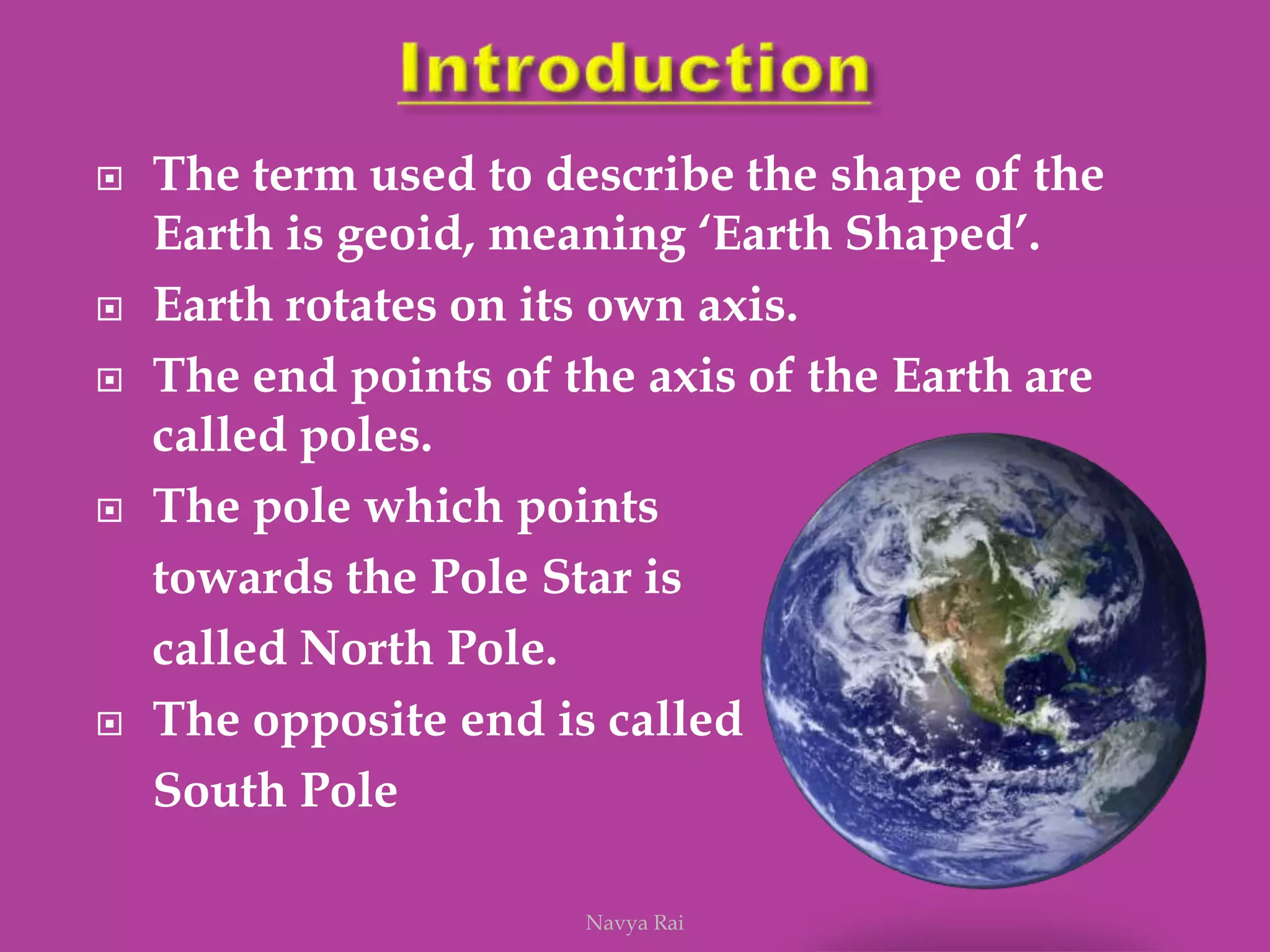
 The term used to describe the shape of the
Earth is geoid, meaning ‘Earth Shaped’.
 Earth rotates on its own axis.
 The end points of the axis of the Earth are
called poles.
 The pole which points
towards the Pole Star is
called North Pole.
 The opposite end is called
South Pole
Navya Rai
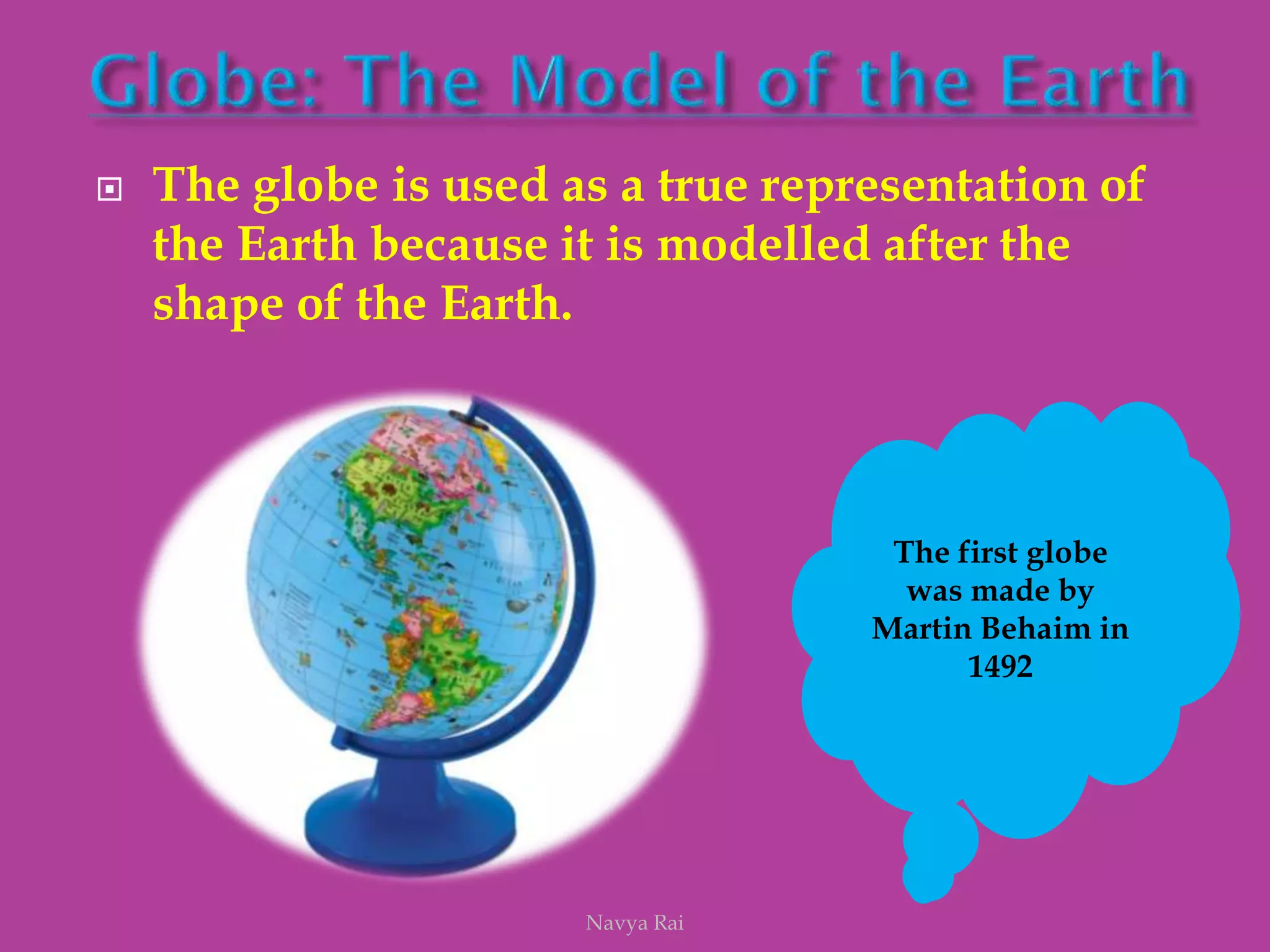
 The globe is used as a true representation of
the Earth because it is modelled after the
shape of the Earth.
The first globe
was made by
Martin Behaim in
1492
Navya Rai
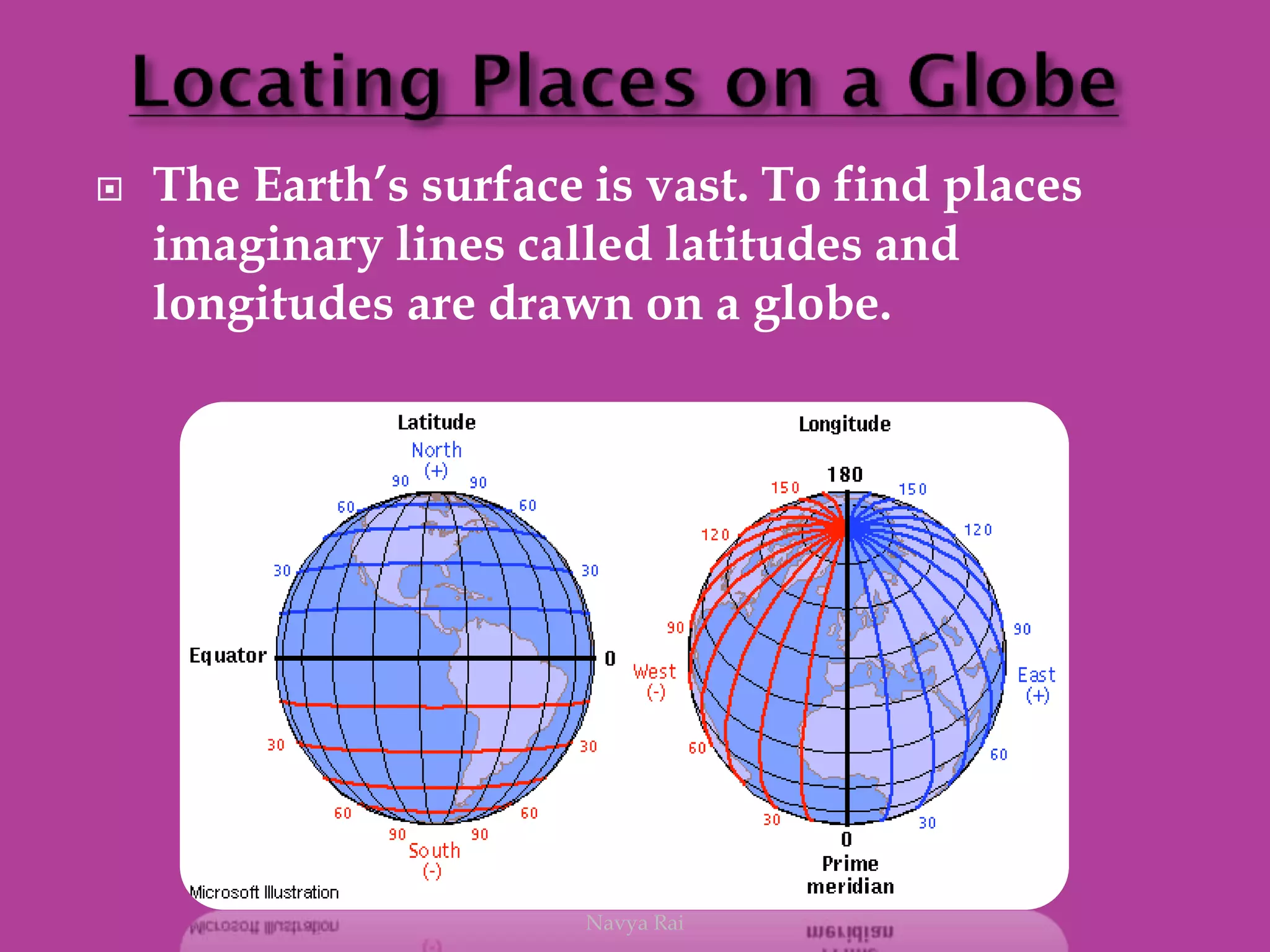
 The Earth’s surface is vast. To find places
imaginary lines called latitudes and
longitudes are drawn on a globe.
Navya Rai
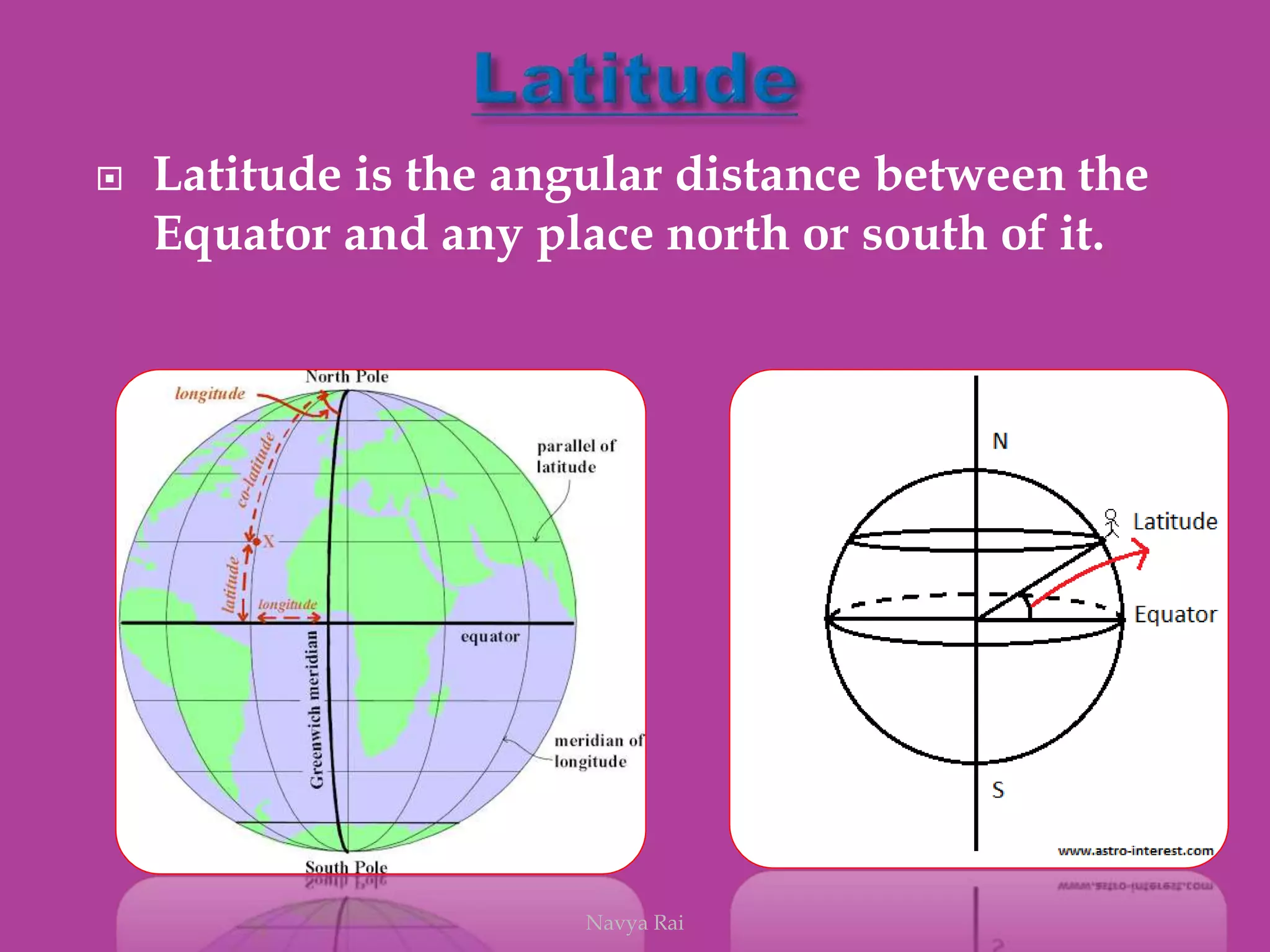
 Latitude is the angular distance between the
Equator and any place north or south of it.
Navya Rai
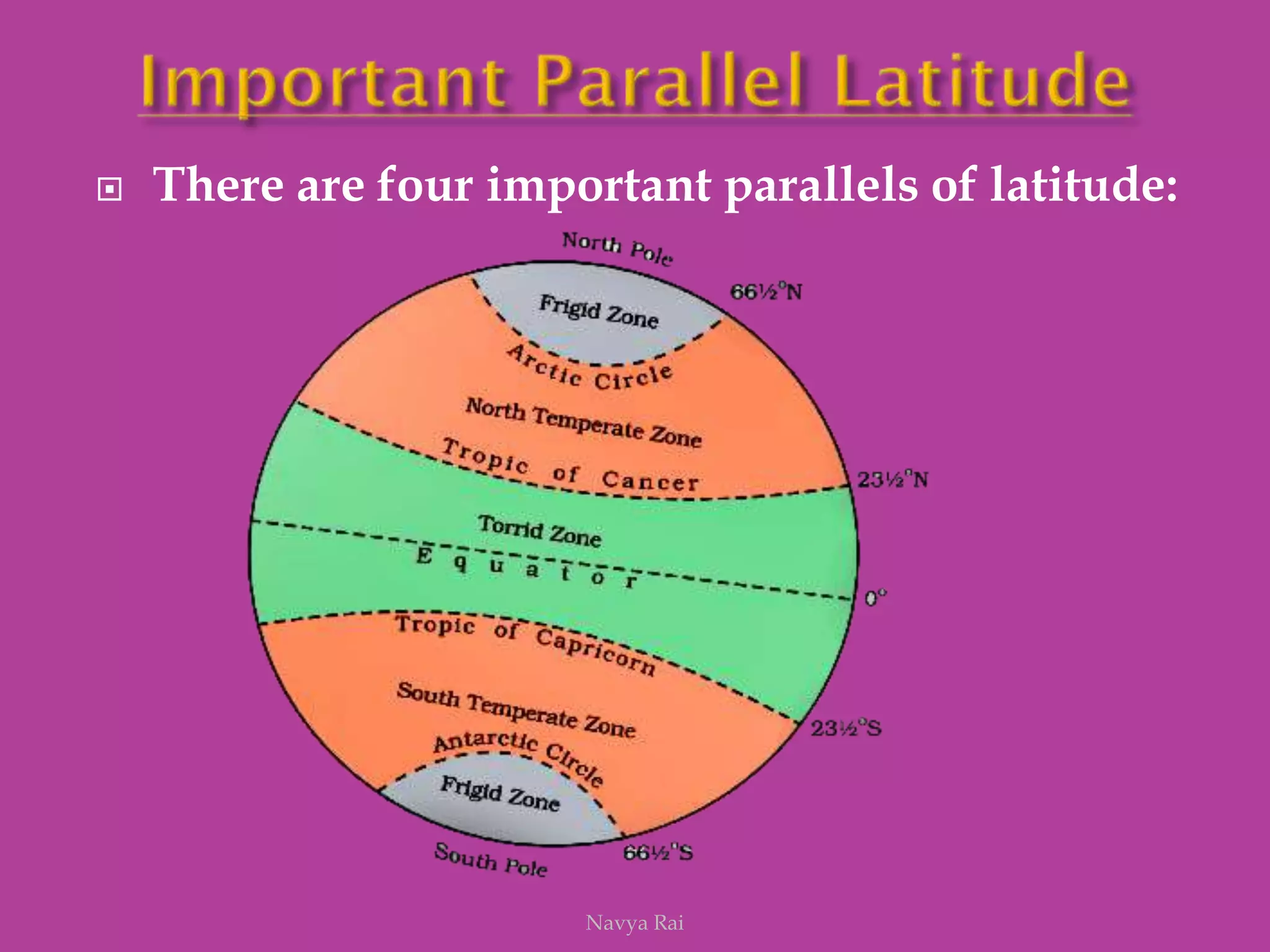
 There are four important parallels of latitude:
Navya Rai
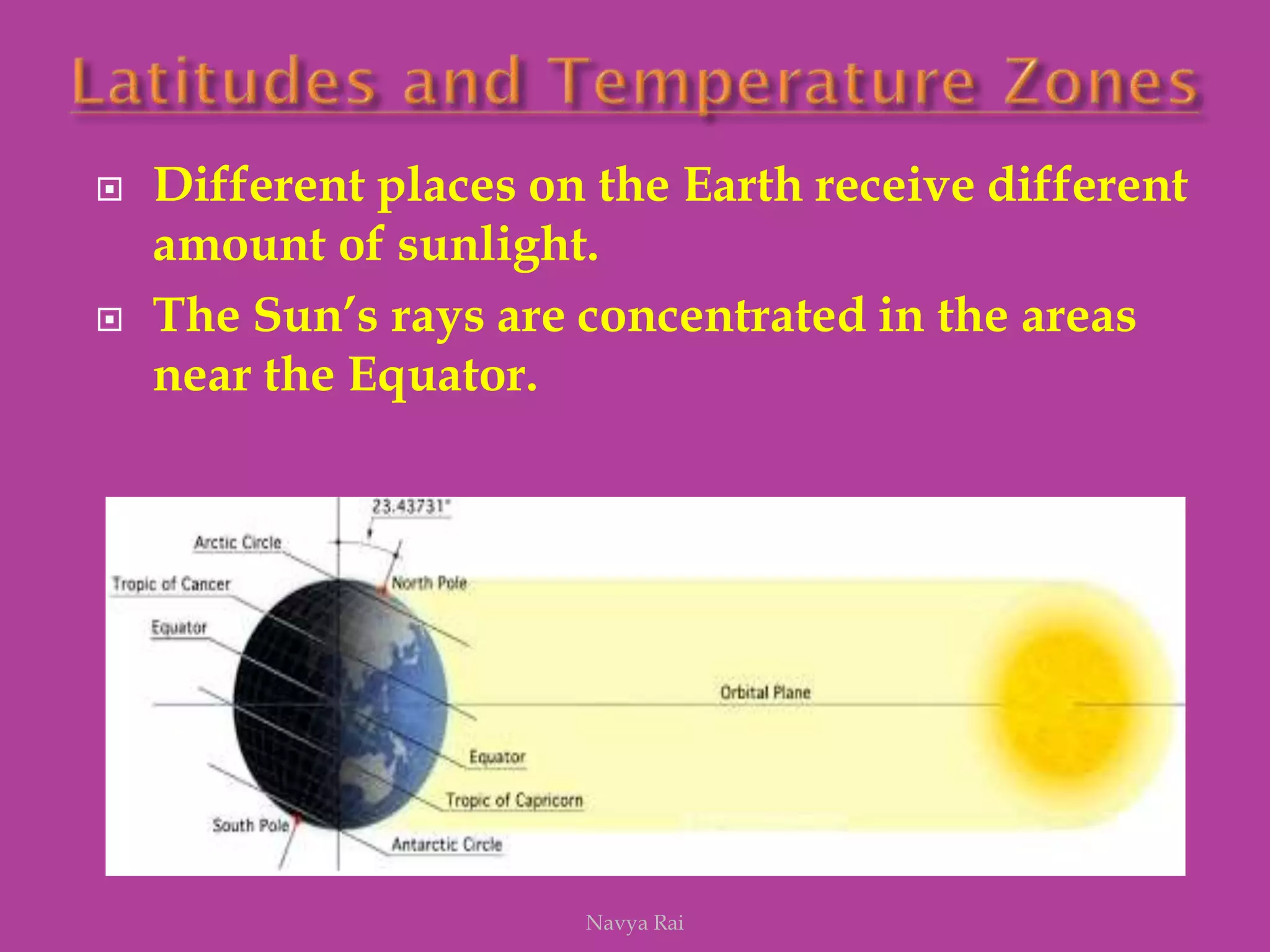
 Different places on the Earth receive different
amount of sunlight.
 The Sun’s rays are concentrated in the areas
near the Equator.
Navya Rai
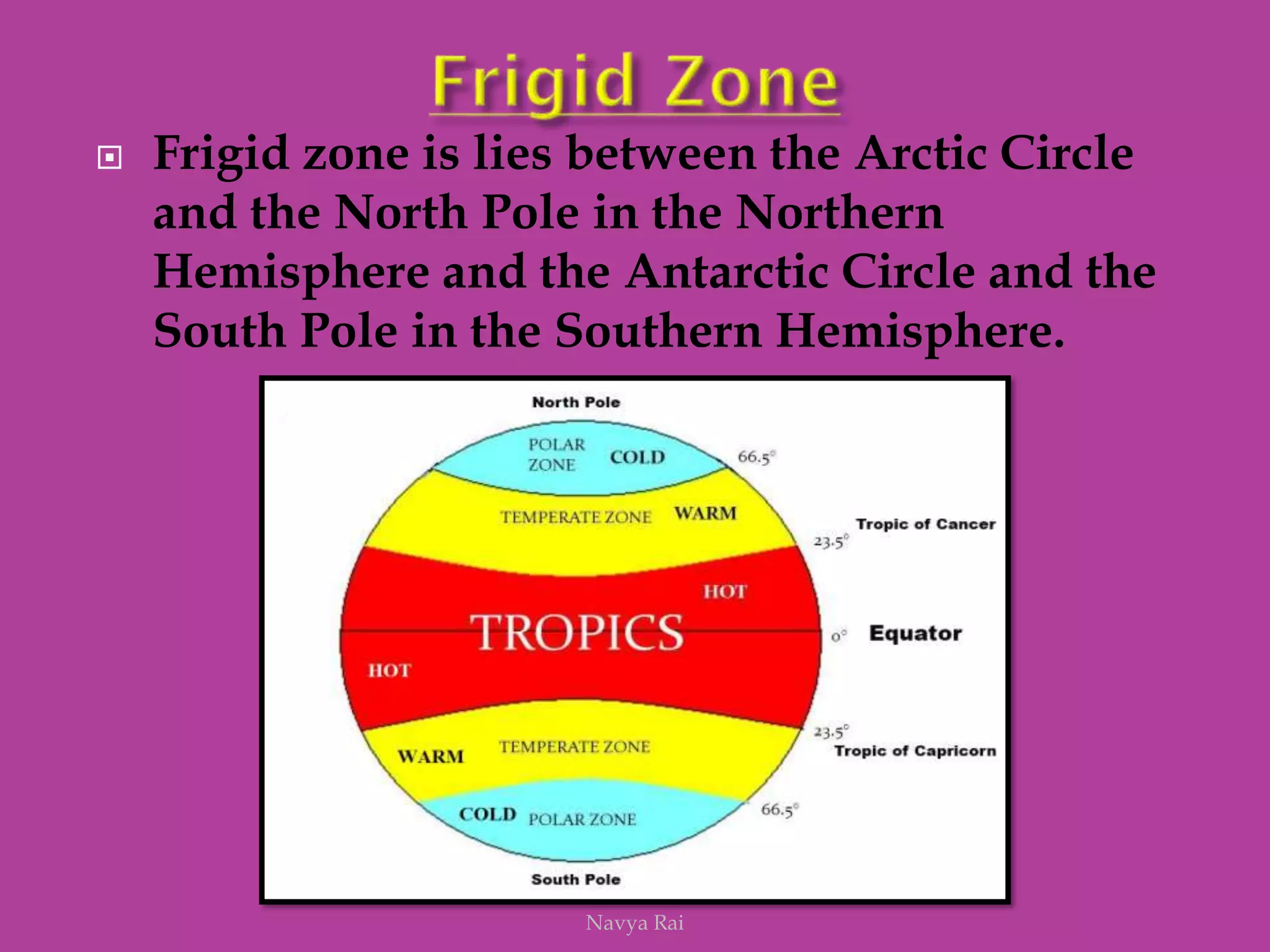
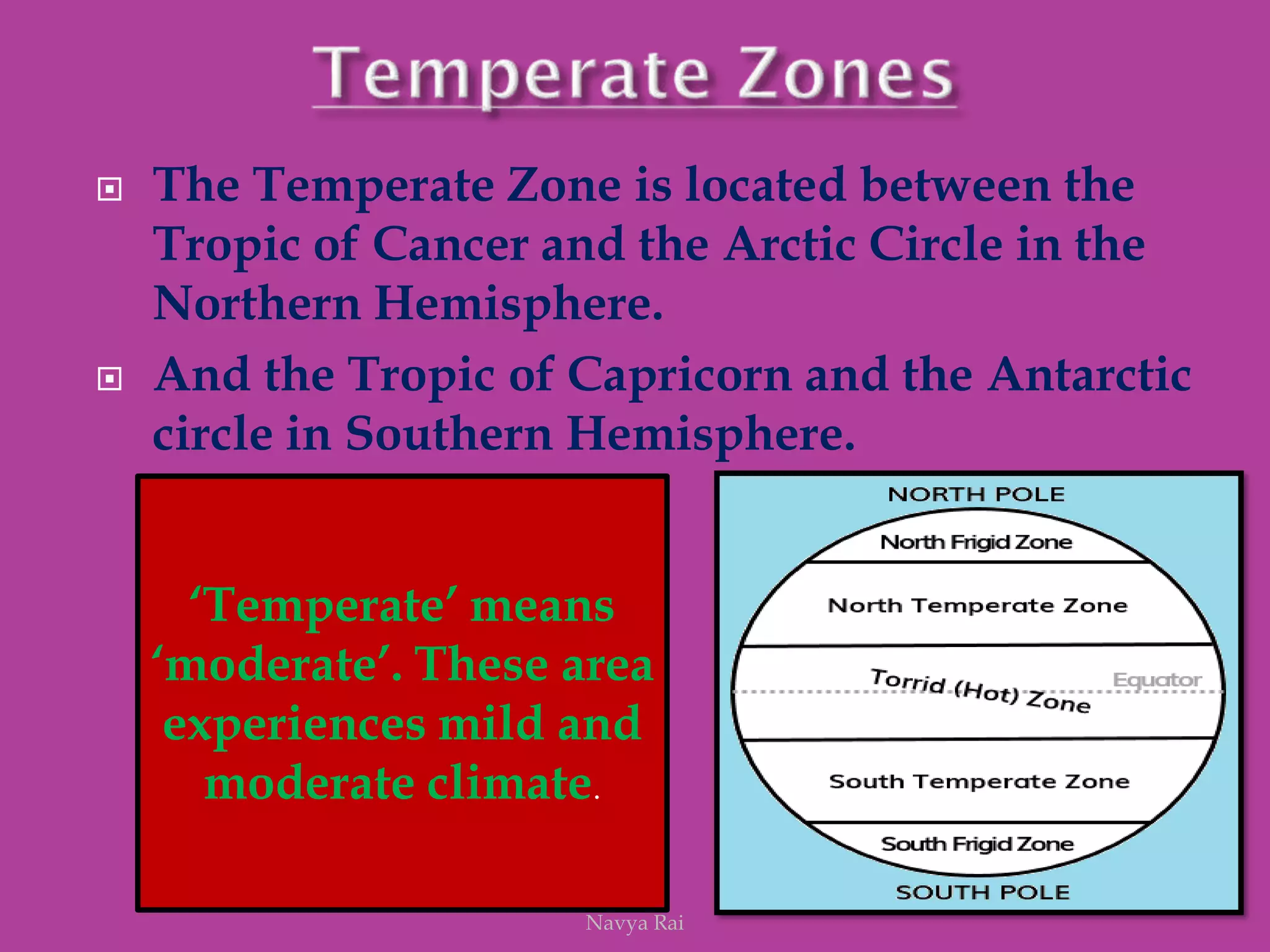
 Frigid zone is lies between the Arctic Circle
and the North Pole in the Northern
Hemisphere and the Antarctic Circle and the
South Pole in the Southern Hemisphere.
Navya Rai
 The Temperate Zone is located between the
Tropic of Cancer and the Arctic Circle in the
Northern Hemisphere.
 And the Tropic of Capricorn and the Antarctic
circle in Southern Hemisphere.
Navya Rai
‘Temperate’ means
‘moderate’. These area
experiences mild and
moderate climate.
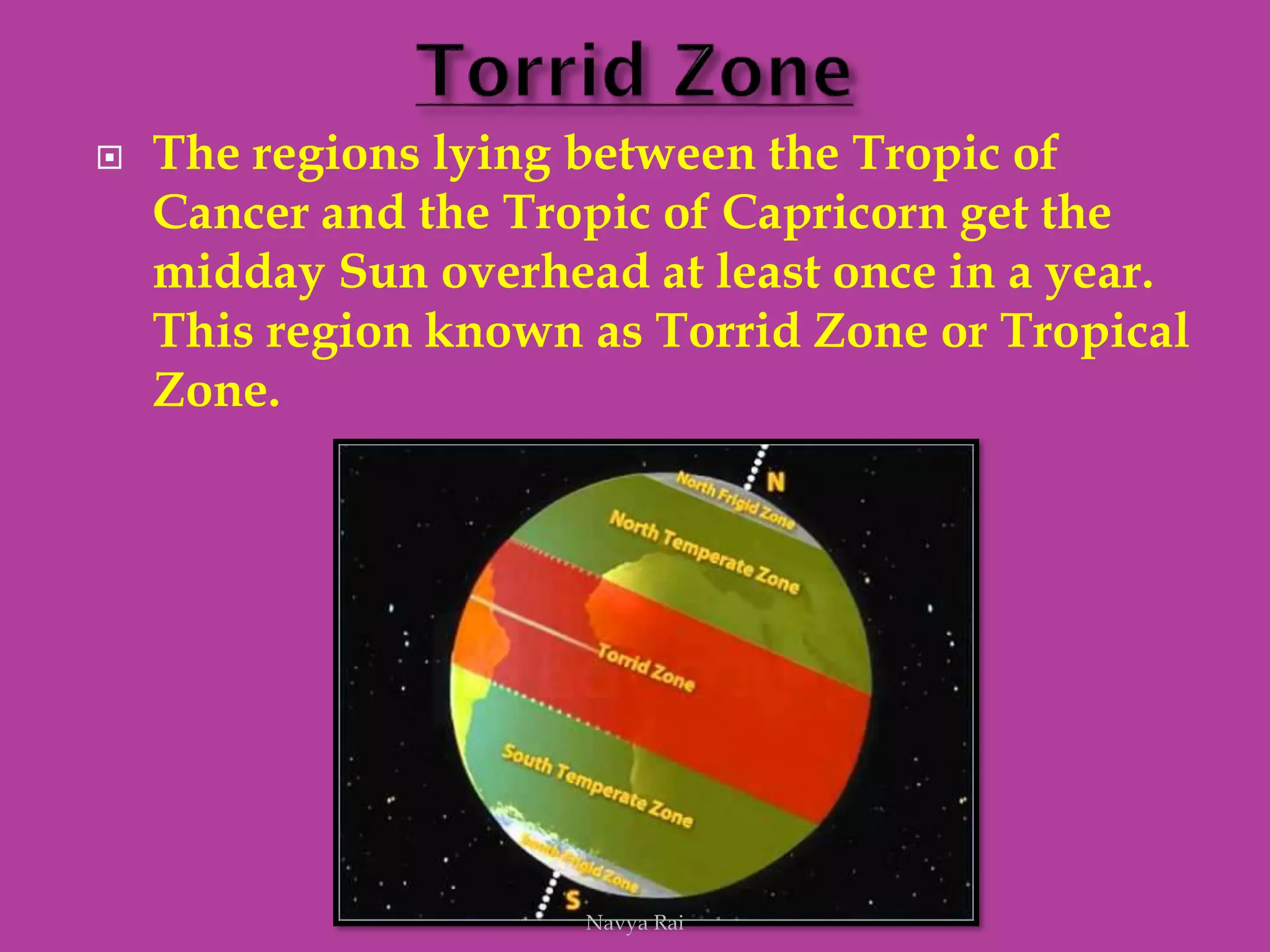
 The regions lying between the Tropic of
Cancer and the Tropic of Capricorn get the
midday Sun overhead at least once in a year.
This region known as Torrid Zone or Tropical
Zone.
Navya Rai
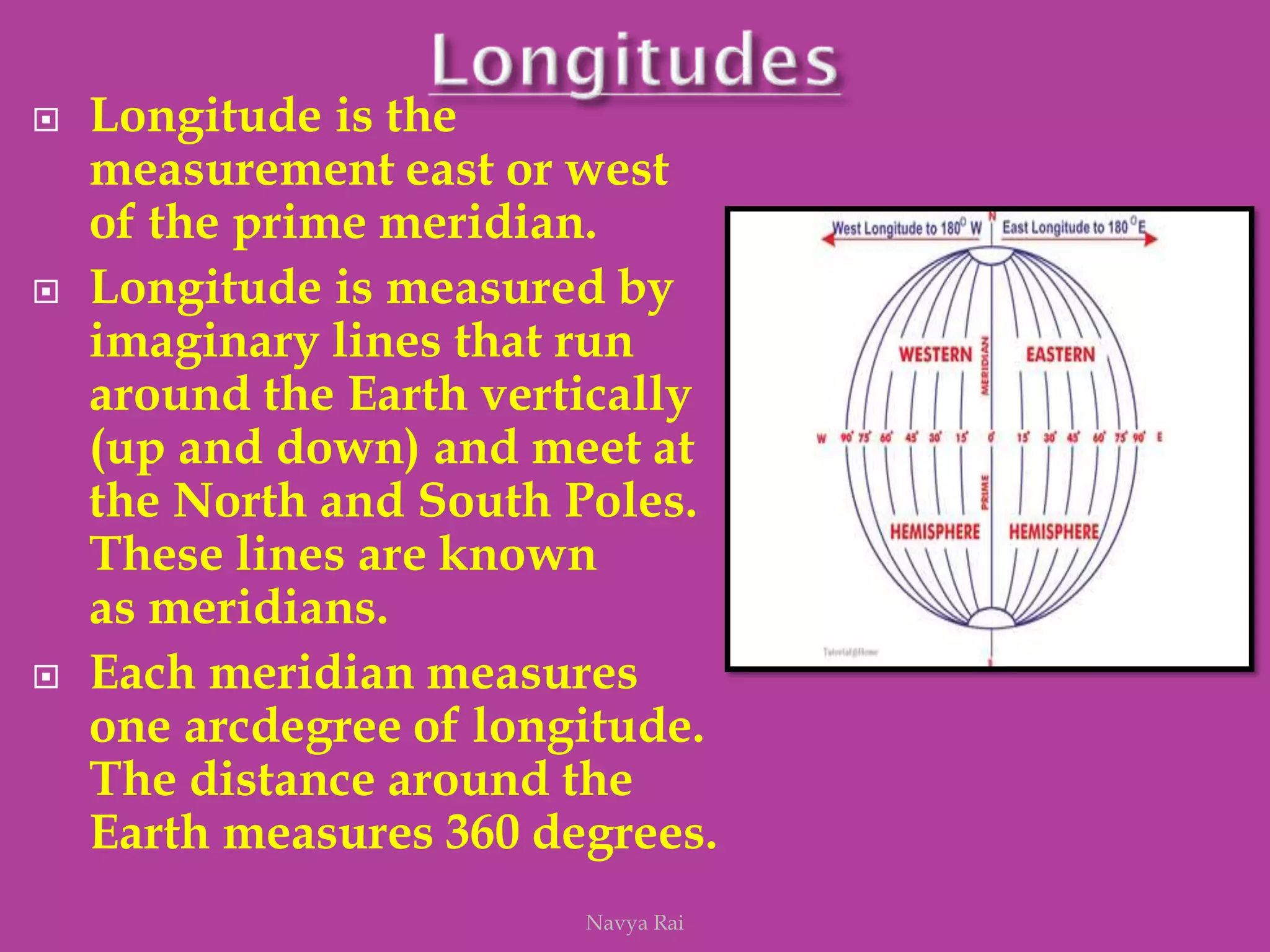
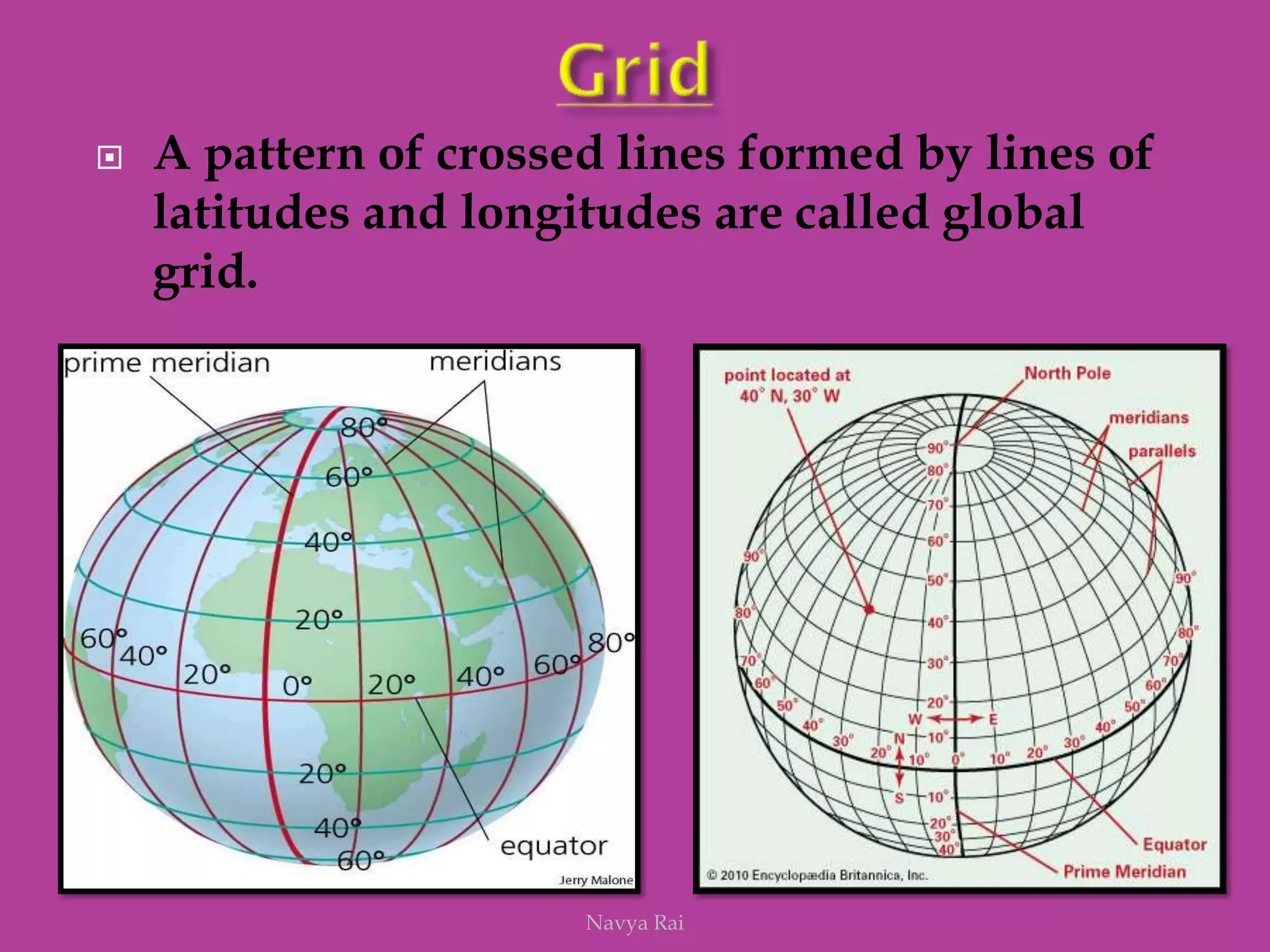
 Longitude is the
measurement east or west
of the prime meridian.
 Longitude is measured by
imaginary lines that run
around the Earth vertically
(up and down) and meet at
the North and South Poles.
These lines are known
as meridians.
 Each meridian measures
one arcdegree of longitude.
The distance around the
Earth measures 360 degrees.
Navya Rai
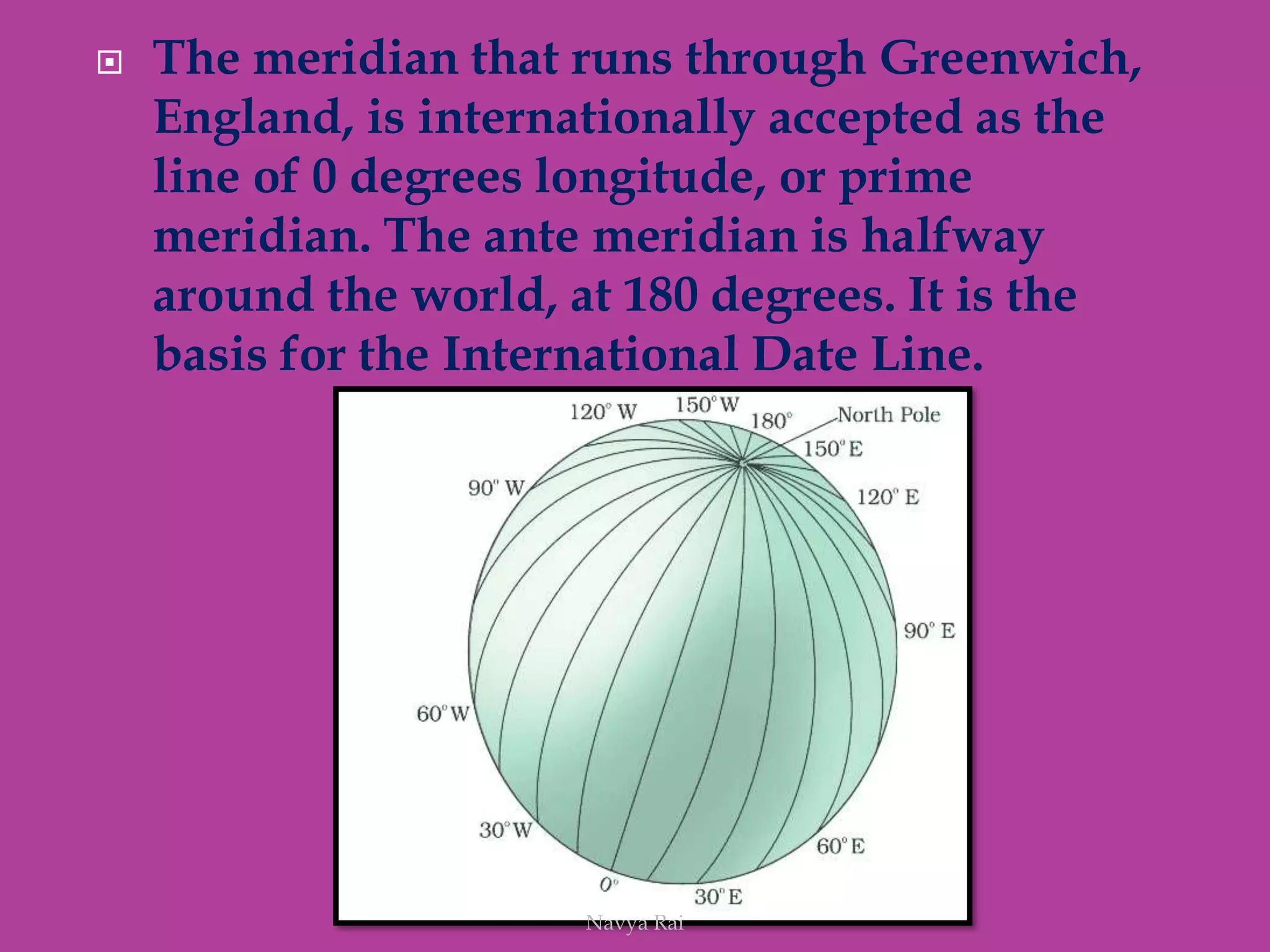
 The meridian that runs through Greenwich,
England, is internationally accepted as the
line of 0 degrees longitude, or prime
meridian. The ante meridian is halfway
around the world, at 180 degrees. It is the
basis for the International Date Line.
Navya Rai
 A pattern of crossed lines formed by lines of
latitudes and longitudes are called global
grid.
Navya Rai
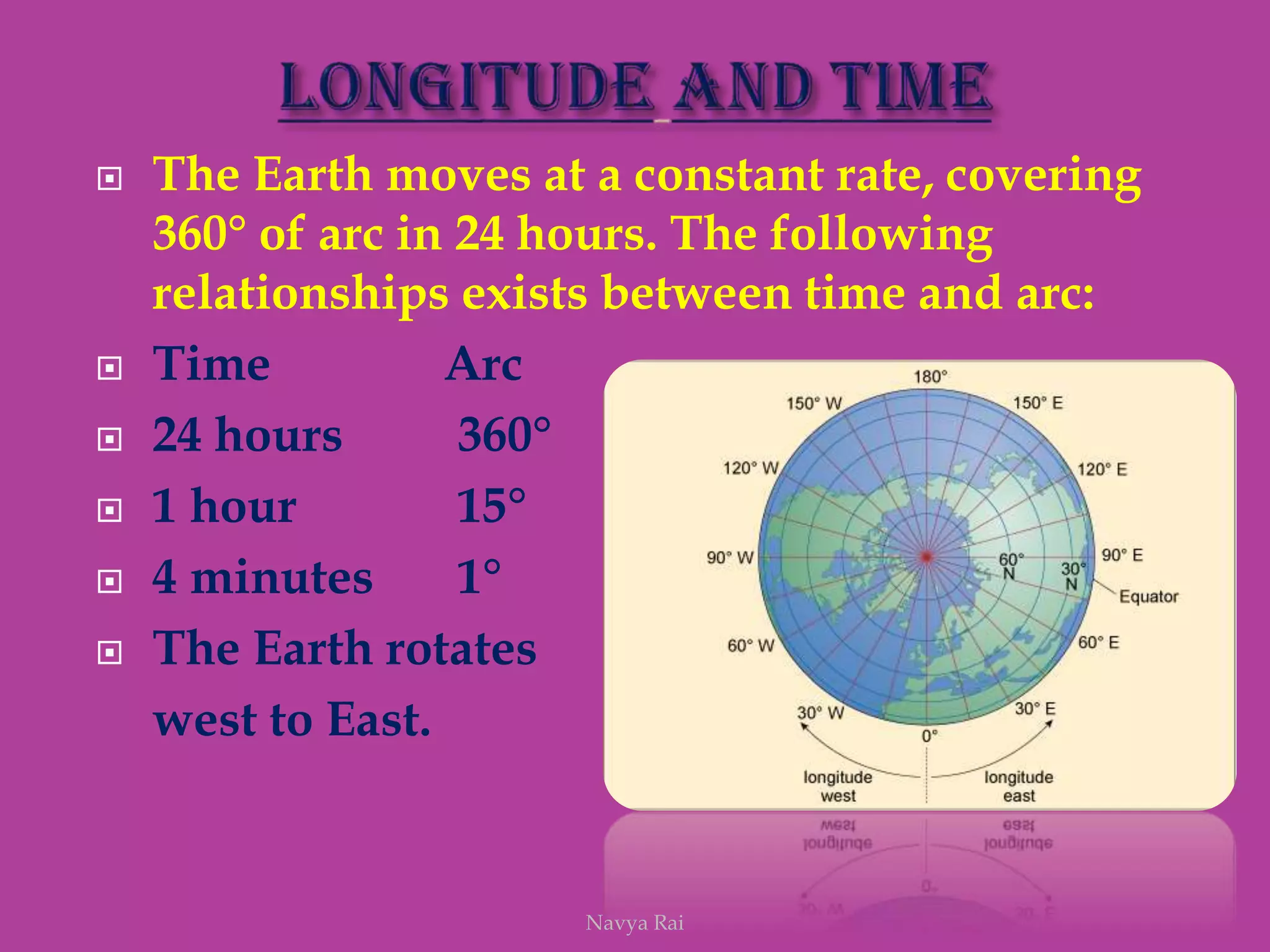
 The Earth moves at a constant rate, covering
360° of arc in 24 hours. The following
relationships exists between time and arc:
 Time Arc
 24 hours 360°
 1 hour 15°
 4 minutes 1°
 The Earth rotates
west to East.
Navya Rai
 The Earth completes the rotation of 360
degree in one day or 24 hours.
 It rotates 15 degree in one hour or 1 degree in
4 minutes.
 The Earth rotates west to east, so for every 15
degree we go eastwards, the time is advanced
by 1 hour.
 Thus, it can be concluded that places east of
Greenwich see the Sun earlier and are ahead
in time.
 The 24 hours period of a day divided into two
time periods- 12 hours before noon (a.m) and
12 hours after noon (p.m)
Navya Rai
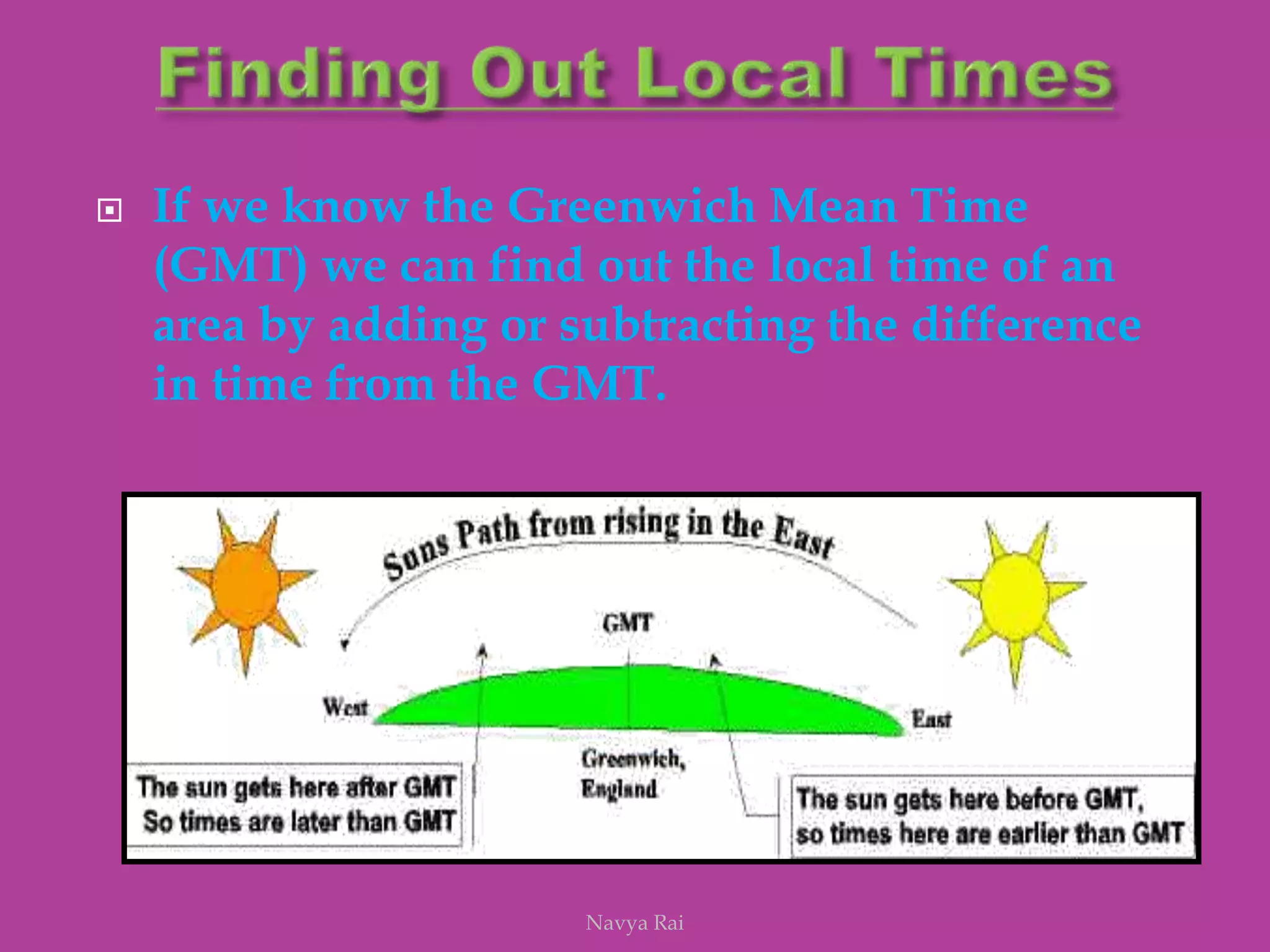
 If we know the Greenwich Mean Time
(GMT) we can find out the local time of an
area by adding or subtracting the difference
in time from the GMT.
Navya Rai
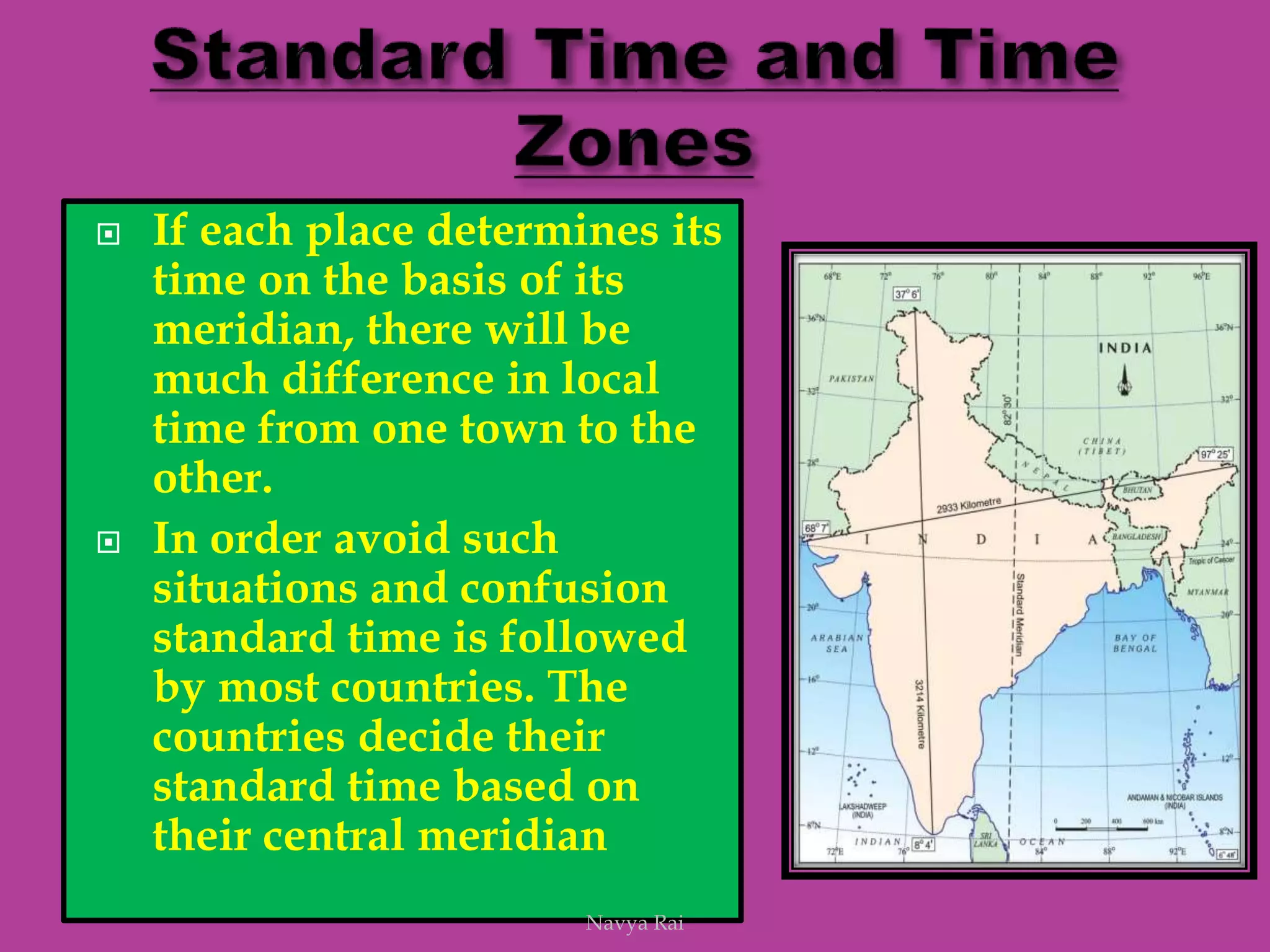
 If each place determines its
time on the basis of its
meridian, there will be
much difference in local
time from one town to the
other.
 In order avoid such
situations and confusion
standard time is followed
by most countries. The
countries decide their
standard time based on
their central meridian
Navya Rai
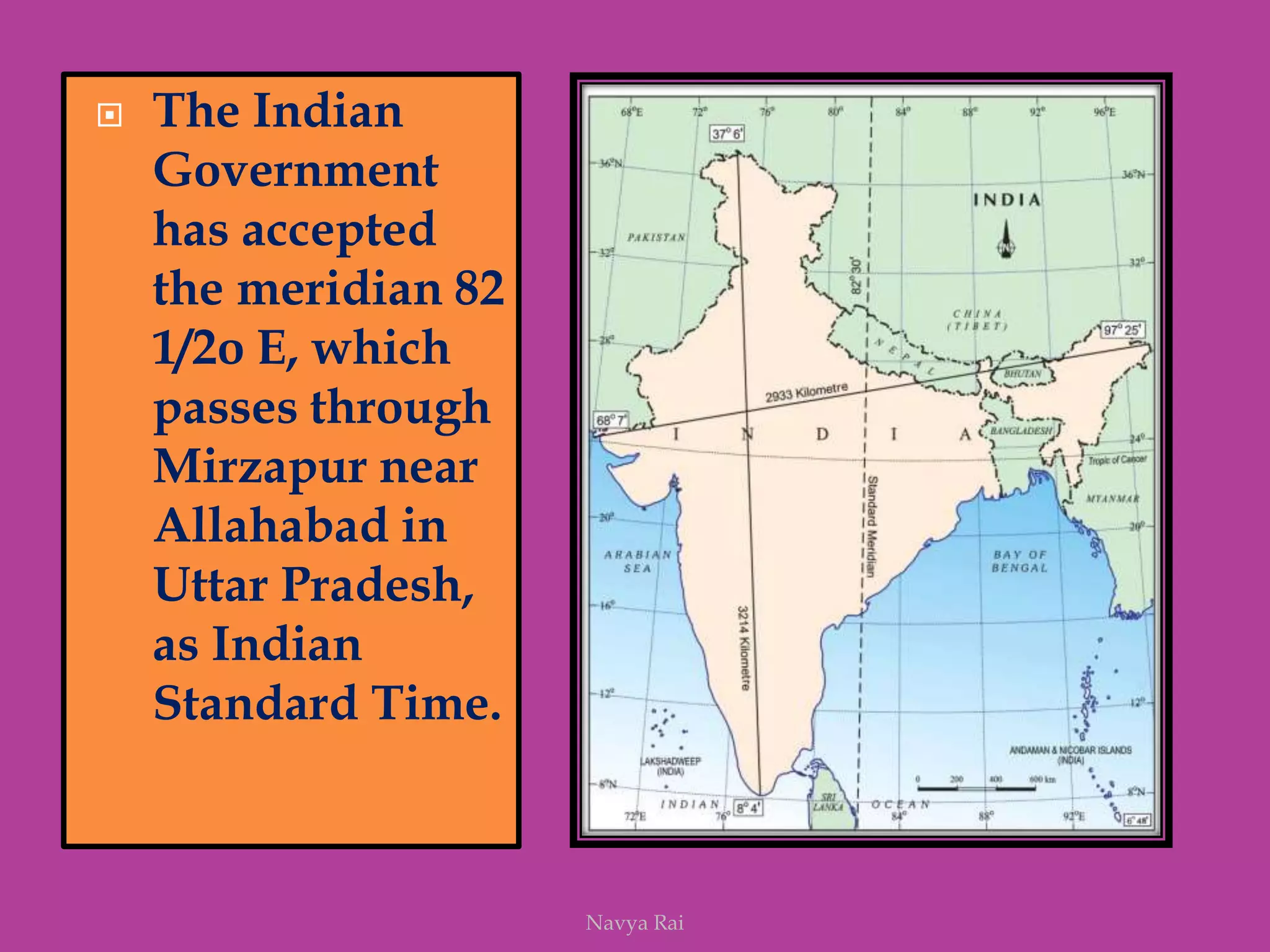
 The Indian
Government
has accepted
the meridian 82
1/2o E, which
passes through
Mirzapur near
Allahabad in
Uttar Pradesh,
as Indian
Standard Time.
Navya Rai
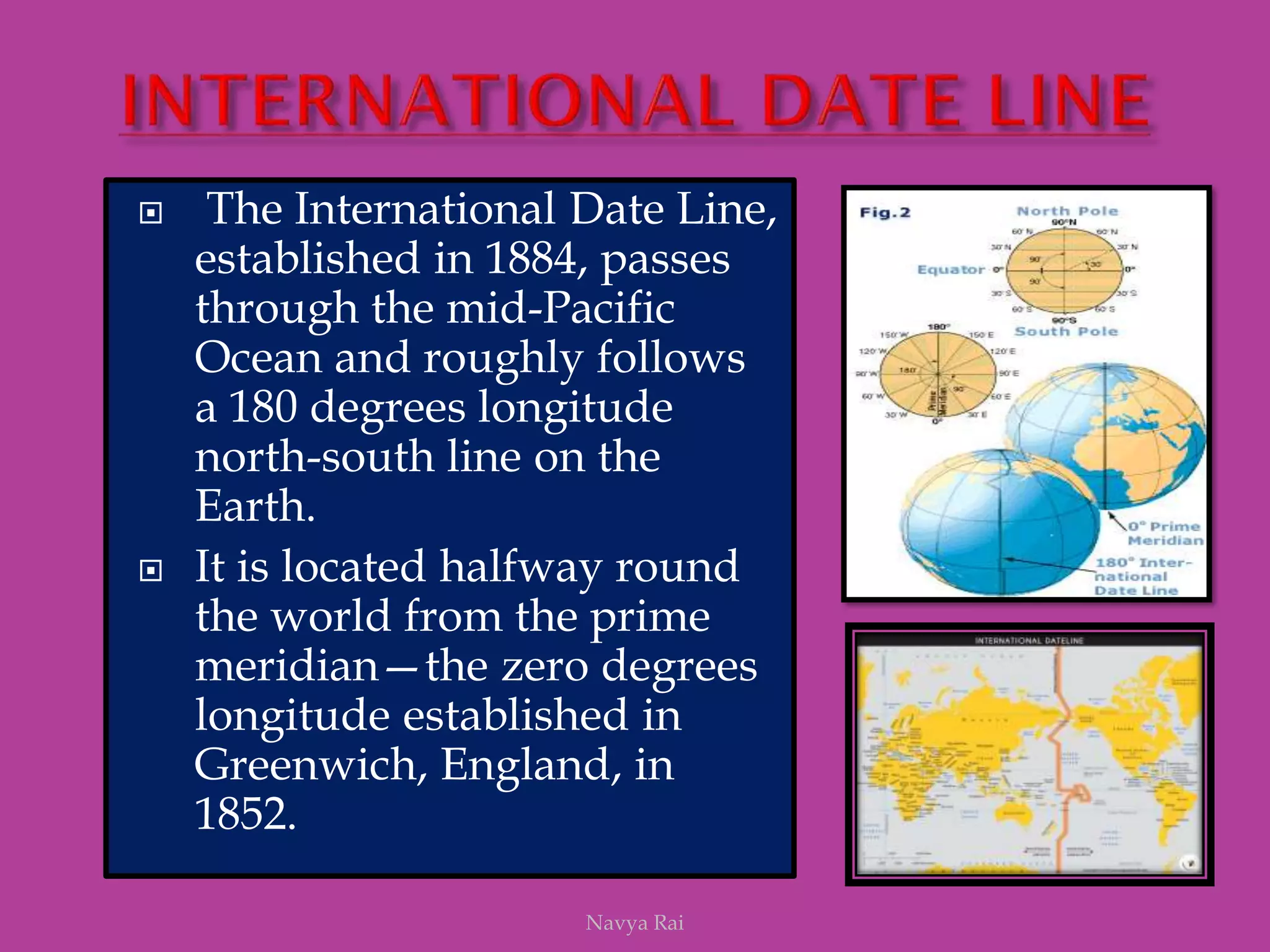
 The International Date Line,
established in 1884, passes
through the mid-Pacific
Ocean and roughly follows
a 180 degrees longitude
north-south line on the
Earth.
 It is located halfway round
the world from the prime
meridian—the zero degrees
longitude established in
Greenwich, England, in
1852.
Navya Rai
Navya Rai

6th std Social Science- Geography ch- 2 Latitudes and Longitudes

  • 1.
    Prepared By: NavyaRai Navya Rai
  • 2.
     The termused to describe the shape of the Earth is geoid, meaning ‘Earth Shaped’.  Earth rotates on its own axis.  The end points of the axis of the Earth are called poles.  The pole which points towards the Pole Star is called North Pole.  The opposite end is called South Pole Navya Rai
  • 3.
     The globeis used as a true representation of the Earth because it is modelled after the shape of the Earth. The first globe was made by Martin Behaim in 1492 Navya Rai
  • 4.
     The Earth’ssurface is vast. To find places imaginary lines called latitudes and longitudes are drawn on a globe. Navya Rai
  • 5.
     Latitude isthe angular distance between the Equator and any place north or south of it. Navya Rai
  • 6.
     There arefour important parallels of latitude: Navya Rai
  • 7.
     Different placeson the Earth receive different amount of sunlight.  The Sun’s rays are concentrated in the areas near the Equator. Navya Rai
  • 8.
     Frigid zoneis lies between the Arctic Circle and the North Pole in the Northern Hemisphere and the Antarctic Circle and the South Pole in the Southern Hemisphere. Navya Rai
  • 9.
     The TemperateZone is located between the Tropic of Cancer and the Arctic Circle in the Northern Hemisphere.  And the Tropic of Capricorn and the Antarctic circle in Southern Hemisphere. Navya Rai ‘Temperate’ means ‘moderate’. These area experiences mild and moderate climate.
  • 10.
     The regionslying between the Tropic of Cancer and the Tropic of Capricorn get the midday Sun overhead at least once in a year. This region known as Torrid Zone or Tropical Zone. Navya Rai
  • 11.
     Longitude isthe measurement east or west of the prime meridian.  Longitude is measured by imaginary lines that run around the Earth vertically (up and down) and meet at the North and South Poles. These lines are known as meridians.  Each meridian measures one arcdegree of longitude. The distance around the Earth measures 360 degrees. Navya Rai
  • 12.
     The meridianthat runs through Greenwich, England, is internationally accepted as the line of 0 degrees longitude, or prime meridian. The ante meridian is halfway around the world, at 180 degrees. It is the basis for the International Date Line. Navya Rai
  • 13.
     A patternof crossed lines formed by lines of latitudes and longitudes are called global grid. Navya Rai
  • 14.
     The Earthmoves at a constant rate, covering 360° of arc in 24 hours. The following relationships exists between time and arc:  Time Arc  24 hours 360°  1 hour 15°  4 minutes 1°  The Earth rotates west to East. Navya Rai
  • 15.
     The Earthcompletes the rotation of 360 degree in one day or 24 hours.  It rotates 15 degree in one hour or 1 degree in 4 minutes.  The Earth rotates west to east, so for every 15 degree we go eastwards, the time is advanced by 1 hour.  Thus, it can be concluded that places east of Greenwich see the Sun earlier and are ahead in time.  The 24 hours period of a day divided into two time periods- 12 hours before noon (a.m) and 12 hours after noon (p.m) Navya Rai
  • 16.
     If weknow the Greenwich Mean Time (GMT) we can find out the local time of an area by adding or subtracting the difference in time from the GMT. Navya Rai
  • 17.
     If eachplace determines its time on the basis of its meridian, there will be much difference in local time from one town to the other.  In order avoid such situations and confusion standard time is followed by most countries. The countries decide their standard time based on their central meridian Navya Rai
  • 18.
     The Indian Government hasaccepted the meridian 82 1/2o E, which passes through Mirzapur near Allahabad in Uttar Pradesh, as Indian Standard Time. Navya Rai
  • 19.
     The InternationalDate Line, established in 1884, passes through the mid-Pacific Ocean and roughly follows a 180 degrees longitude north-south line on the Earth.  It is located halfway round the world from the prime meridian—the zero degrees longitude established in Greenwich, England, in 1852. Navya Rai
  • 20.