7th Grade Science Vocabulary (Adaptations over Time) Name: ___________________
Room 124 Chapter 6 Date: ____________________
Mr. Motuk
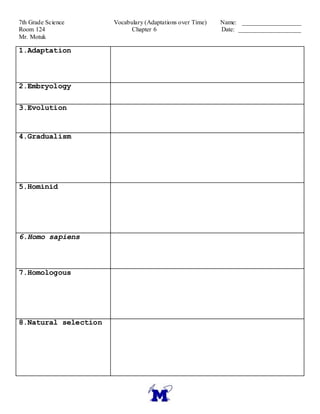
1.Adaptation Any variation that makes an organism better
suited to its environment.
2.Embryology Study of embryos and their development
3.Evolution Change in inherited characteristics over time.
4.Gradualism Model describing evolution as a slow process by
which one species changes into a new species
through a continuing series of mutations.
5.Hominid Human-like primate that appeared about 4 to 6
million years ago, ate both plants and meat, and
walked upright on two legs.
6.Homo sapiens Early humans that likely evolved from Cro-
Magnons.
7.Homologous Body parts that are similar in structure and
origin and can be similar in function.
8.Natural selection A process by which organisms with traits best
suited to their environment are more likely to
survive and reproduce; includes concepts of
variation, overproduction, and competition.
7th Grade Science Vocabulary (Adaptations over Time) Name: ___________________
Room 124 Chapter 6 Date: ____________________
Mr. Motuk
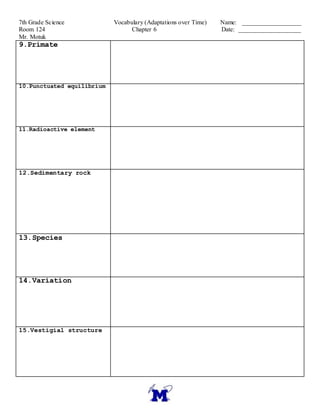
9.Primate Group of mammals including humans, monkeys, and
apes that share characteristics such as opposable
thumbs, binocular vision, and flexible shoulders.
10.Punctuated equilibrium Model describing the rapid evolution that occurs
when mutation of a few genes results in a species
suddenly changing into a new species.
11.Radioactive element Element that gives off a steady amount of
radiation as it slowly changes to a
nonradioactive element.
12.Sedimentary rock A type of rock, such as limestone, that is most
likely to contain fossils and is formed when
layers of sand, silt, clay, or mud are cemented
and compacted together or when minerals are
deposited from a solution.
13.Species Group of organisms that share similar
characteristics and can reproduce among
themselves producing fertile offspring.
14.Variation Inherited trait that makes an individual
different from other members of the same species
and results from a mutation in the organism’s
genes.
15.Vestigial structure Structure, such as the human appendix, that does
not seem to have a function and may once have
functioned in the body of an ancestor.

Chapter 6 vocabulary (Adaptations Over Time)

  • 1.
    7th Grade ScienceVocabulary (Adaptations over Time) Name: ___________________ Room 124 Chapter 6 Date: ____________________ Mr. Motuk 1.Adaptation Any variation that makes an organism better suited to its environment. 2.Embryology Study of embryos and their development 3.Evolution Change in inherited characteristics over time. 4.Gradualism Model describing evolution as a slow process by which one species changes into a new species through a continuing series of mutations. 5.Hominid Human-like primate that appeared about 4 to 6 million years ago, ate both plants and meat, and walked upright on two legs. 6.Homo sapiens Early humans that likely evolved from Cro- Magnons. 7.Homologous Body parts that are similar in structure and origin and can be similar in function. 8.Natural selection A process by which organisms with traits best suited to their environment are more likely to survive and reproduce; includes concepts of variation, overproduction, and competition.
  • 2.
    7th Grade ScienceVocabulary (Adaptations over Time) Name: ___________________ Room 124 Chapter 6 Date: ____________________ Mr. Motuk 9.Primate Group of mammals including humans, monkeys, and apes that share characteristics such as opposable thumbs, binocular vision, and flexible shoulders. 10.Punctuated equilibrium Model describing the rapid evolution that occurs when mutation of a few genes results in a species suddenly changing into a new species. 11.Radioactive element Element that gives off a steady amount of radiation as it slowly changes to a nonradioactive element. 12.Sedimentary rock A type of rock, such as limestone, that is most likely to contain fossils and is formed when layers of sand, silt, clay, or mud are cemented and compacted together or when minerals are deposited from a solution. 13.Species Group of organisms that share similar characteristics and can reproduce among themselves producing fertile offspring. 14.Variation Inherited trait that makes an individual different from other members of the same species and results from a mutation in the organism’s genes. 15.Vestigial structure Structure, such as the human appendix, that does not seem to have a function and may once have functioned in the body of an ancestor.