I. Ideas About Evolution
A. Early Models of Evolution
1. Species: A group of organisms that share
similar characteristics and can reproduce
among themselves to produce fertile offspring.
a. Many characteristics of a species are inhertited
when they pass from parent to offspring.
2. Evolution: Changes of inherited
characteristics over time.
CHAPTER 6 SECTION 1:
EVOLUTION
1
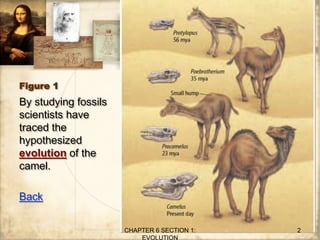
Figure 1
By studying fossils
scientists have
traced the
hypothesized
evolution of the
camel.
Back
CHAPTER 6 SECTION 1:
EVOLUTION
2
B. Hypothesis of Acquired Characteristics
1. 1809: Jean Baptiste de Lamarck proposed a
hypothesis to explain how species change over
time; called the Inheritance of Acquired
Characteristics.
a. Data showed that traits developed during a parent’s
lifetime, such as large muscles built from hard work or
exercise, are NOT passed on to offspring.
b. This evidence did NOT support his hypothesis.
CHAPTER 6 SECTION 1:
EVOLUTION
3
C. How Darwin’s Theory Started
1. Darwin sailed from England on the HMS Beagle
(ship) to explore the South American Coast.
2. During journey he recorded observations about the plants and
animals he encountered.
a. Darwin hypothesized that some plants and animals on
islands off the coast of South America originally came from
Central and South America.
b. Darwin observed that species of finches on the islands
looked similar to a mainland finch species.
c. Darwin reasoned that members of a population best able to
survive and reproduce will pass their traits to the next
generation; over time, differences can result in separate
species.
CHAPTER 6 SECTION 1:
EVOLUTION
4
D. Darwin’s Observations
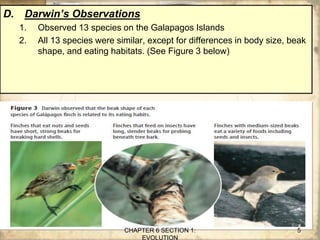
1. Observed 13 species on the Galapagos Islands
2. All 13 species were similar, except for differences in body size, beak
shape, and eating habitats. (See Figure 3 below)
CHAPTER 6 SECTION 1:
EVOLUTION
5
3. Darwin reasoned that the Galapagos finches must
have had to compete for food.
a. Finches with beak shapes that allowed each of them to
obtain food survived longer and produced more
offspring than finches without those beak shapes.
b. After many generations, these groups became
separate species.
CHAPTER 6 SECTION 1:
EVOLUTION
6
E. Darwin’s Model of Evolution
1. Darwin’s Theory of Evolution (Natural Selection)
a. Organisms produce more offspring than can survive.
b. Differences, or variations occur among individuals of a
species.
c. Some variations are passed to offspring.
d. Some variations are helpful. Individuals with helpful
variations survive and reproduce better than those
without these variations.
e. Over time, the offspring of individuals with helpful
variations make up more of a population and eventually
may become a separate species.
CHAPTER 6 SECTION 1:
EVOLUTION
7
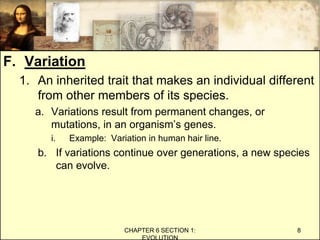
F. Variation
1. An inherited trait that makes an individual different
from other members of its species.
a. Variations result from permanent changes, or
mutations, in an organism’s genes.
i. Example: Variation in human hair line.
b. If variations continue over generations, a new species
can evolve.
CHAPTER 6 SECTION 1:
EVOLUTION
8
2. An adaptation is a variation that makes an
organism better suited to its environment
a. Variations that result in an adaptation can involve an
organism’s color, shape, behavior, or chemical make-
up.
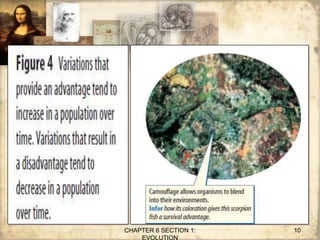
b. Camouflage is an adaptation. (See figure 4 on next
slide)
CHAPTER 6 SECTION 1:
EVOLUTION
9
CHAPTER 6 SECTION 1:
EVOLUTION
10
G. Changes in the Source of Genes
1. Over time, the genetic makeup of a species might
change its appearance.
a. Example: Finches of Galapagos Island changed.
2. Many environmental factors can bring about
changes to a species.
a. New species moving into or out of an area can affect
the environment; causing changes in variations of
genes.
b. Example: New insects could change the environment;
causing other species to change how they find food,
what food they eat, or how they live their daily life.CHAPTER 6 SECTION 1:
EVOLUTION
11
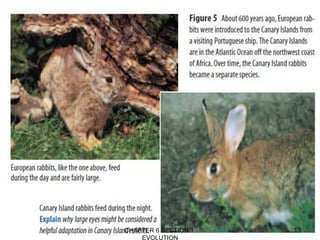
H. Geographic Issues and Variation
1. Sometimes mountains, lakes, or other geological
features isolate a small number of individuals from
the rest of a population.
a. See figure 5 on next slide
b. Some changes affect the isolated population more than
the larger population.
c. The two populations can be so different that they no
longer can breed with each other!!
CHAPTER 6 SECTION 1:
EVOLUTION
12
CHAPTER 6 SECTION 1:
EVOLUTION
13
I. The Speed of Evolution
1. Scientists do not agree on how quickly evolution
occurs.
a. Some believe it takes thousands of years.
b. Other believe that evolution can occur quickly.
2. Most scientists agree that evidence supports both
of these models.
CHAPTER 6 SECTION 1:
EVOLUTION
14
J. Gradualism
1. Darwin hypothesized that evolution takes place
slowly.
a. The model that describes evolution as a slow, ongoing
process by which one species changes to a new
species is known as GRADUALISM.
b. According to gradualism, a continuing series of
mutations and variations over time will result in a new
species. (See figure 1)
CHAPTER 6 SECTION 1:
EVOLUTION
15
K. Punctuated Equilibrium
1. Gradualism does not explain the evolution of all
species.
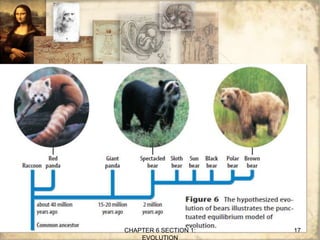
2. Punctuated equilibrium is the rapid evolution when
the mutations of a few genes results in the
appearance of a new species over a relatively
short period of time. (Figure 6 next slide)
CHAPTER 6 SECTION 1:
EVOLUTION
16
CHAPTER 6 SECTION 1:
EVOLUTION
17
L. Punctuated Equilibrium Today
1. Can occur over a few thousand or million years,
sometime faster.
2. Penicillin is produced by a fungus Penicillium.
a. Example: Some bacteria have evolved to be resistant
to penicillin.
b. Penicillin has been in use since 1943, in 1947 some
species of bacteria had already evolved into resistant
strains.
CHAPTER 6 SECTION 1:
EVOLUTION
18
3. Bacteria became resistant because people would
not take the full dose of the antibiotic.
a. The bacteria that survived the unfavorable living
conditions mutated and then reproduced.
b. Now new strains of bacteria are resistant to penicillin.
CHAPTER 6 SECTION 1:
EVOLUTION
19

Life science chapter 6 section 1 notes

  • 1.
    I. Ideas AboutEvolution A. Early Models of Evolution 1. Species: A group of organisms that share similar characteristics and can reproduce among themselves to produce fertile offspring. a. Many characteristics of a species are inhertited when they pass from parent to offspring. 2. Evolution: Changes of inherited characteristics over time. CHAPTER 6 SECTION 1: EVOLUTION 1
  • 2.
    Figure 1 By studyingfossils scientists have traced the hypothesized evolution of the camel. Back CHAPTER 6 SECTION 1: EVOLUTION 2
  • 3.
    B. Hypothesis ofAcquired Characteristics 1. 1809: Jean Baptiste de Lamarck proposed a hypothesis to explain how species change over time; called the Inheritance of Acquired Characteristics. a. Data showed that traits developed during a parent’s lifetime, such as large muscles built from hard work or exercise, are NOT passed on to offspring. b. This evidence did NOT support his hypothesis. CHAPTER 6 SECTION 1: EVOLUTION 3
  • 4.
    C. How Darwin’sTheory Started 1. Darwin sailed from England on the HMS Beagle (ship) to explore the South American Coast. 2. During journey he recorded observations about the plants and animals he encountered. a. Darwin hypothesized that some plants and animals on islands off the coast of South America originally came from Central and South America. b. Darwin observed that species of finches on the islands looked similar to a mainland finch species. c. Darwin reasoned that members of a population best able to survive and reproduce will pass their traits to the next generation; over time, differences can result in separate species. CHAPTER 6 SECTION 1: EVOLUTION 4
  • 5.
    D. Darwin’s Observations 1.Observed 13 species on the Galapagos Islands 2. All 13 species were similar, except for differences in body size, beak shape, and eating habitats. (See Figure 3 below) CHAPTER 6 SECTION 1: EVOLUTION 5
  • 6.
    3. Darwin reasonedthat the Galapagos finches must have had to compete for food. a. Finches with beak shapes that allowed each of them to obtain food survived longer and produced more offspring than finches without those beak shapes. b. After many generations, these groups became separate species. CHAPTER 6 SECTION 1: EVOLUTION 6
  • 7.
    E. Darwin’s Modelof Evolution 1. Darwin’s Theory of Evolution (Natural Selection) a. Organisms produce more offspring than can survive. b. Differences, or variations occur among individuals of a species. c. Some variations are passed to offspring. d. Some variations are helpful. Individuals with helpful variations survive and reproduce better than those without these variations. e. Over time, the offspring of individuals with helpful variations make up more of a population and eventually may become a separate species. CHAPTER 6 SECTION 1: EVOLUTION 7
  • 8.
    F. Variation 1. Aninherited trait that makes an individual different from other members of its species. a. Variations result from permanent changes, or mutations, in an organism’s genes. i. Example: Variation in human hair line. b. If variations continue over generations, a new species can evolve. CHAPTER 6 SECTION 1: EVOLUTION 8
  • 9.
    2. An adaptationis a variation that makes an organism better suited to its environment a. Variations that result in an adaptation can involve an organism’s color, shape, behavior, or chemical make- up. b. Camouflage is an adaptation. (See figure 4 on next slide) CHAPTER 6 SECTION 1: EVOLUTION 9
  • 10.
    CHAPTER 6 SECTION1: EVOLUTION 10
  • 11.
    G. Changes inthe Source of Genes 1. Over time, the genetic makeup of a species might change its appearance. a. Example: Finches of Galapagos Island changed. 2. Many environmental factors can bring about changes to a species. a. New species moving into or out of an area can affect the environment; causing changes in variations of genes. b. Example: New insects could change the environment; causing other species to change how they find food, what food they eat, or how they live their daily life.CHAPTER 6 SECTION 1: EVOLUTION 11
  • 12.
    H. Geographic Issuesand Variation 1. Sometimes mountains, lakes, or other geological features isolate a small number of individuals from the rest of a population. a. See figure 5 on next slide b. Some changes affect the isolated population more than the larger population. c. The two populations can be so different that they no longer can breed with each other!! CHAPTER 6 SECTION 1: EVOLUTION 12
  • 13.
    CHAPTER 6 SECTION1: EVOLUTION 13
  • 14.
    I. The Speedof Evolution 1. Scientists do not agree on how quickly evolution occurs. a. Some believe it takes thousands of years. b. Other believe that evolution can occur quickly. 2. Most scientists agree that evidence supports both of these models. CHAPTER 6 SECTION 1: EVOLUTION 14
  • 15.
    J. Gradualism 1. Darwinhypothesized that evolution takes place slowly. a. The model that describes evolution as a slow, ongoing process by which one species changes to a new species is known as GRADUALISM. b. According to gradualism, a continuing series of mutations and variations over time will result in a new species. (See figure 1) CHAPTER 6 SECTION 1: EVOLUTION 15
  • 16.
    K. Punctuated Equilibrium 1.Gradualism does not explain the evolution of all species. 2. Punctuated equilibrium is the rapid evolution when the mutations of a few genes results in the appearance of a new species over a relatively short period of time. (Figure 6 next slide) CHAPTER 6 SECTION 1: EVOLUTION 16
  • 17.
    CHAPTER 6 SECTION1: EVOLUTION 17
  • 18.
    L. Punctuated EquilibriumToday 1. Can occur over a few thousand or million years, sometime faster. 2. Penicillin is produced by a fungus Penicillium. a. Example: Some bacteria have evolved to be resistant to penicillin. b. Penicillin has been in use since 1943, in 1947 some species of bacteria had already evolved into resistant strains. CHAPTER 6 SECTION 1: EVOLUTION 18
  • 19.
    3. Bacteria becameresistant because people would not take the full dose of the antibiotic. a. The bacteria that survived the unfavorable living conditions mutated and then reproduced. b. Now new strains of bacteria are resistant to penicillin. CHAPTER 6 SECTION 1: EVOLUTION 19