EL RELIEVE
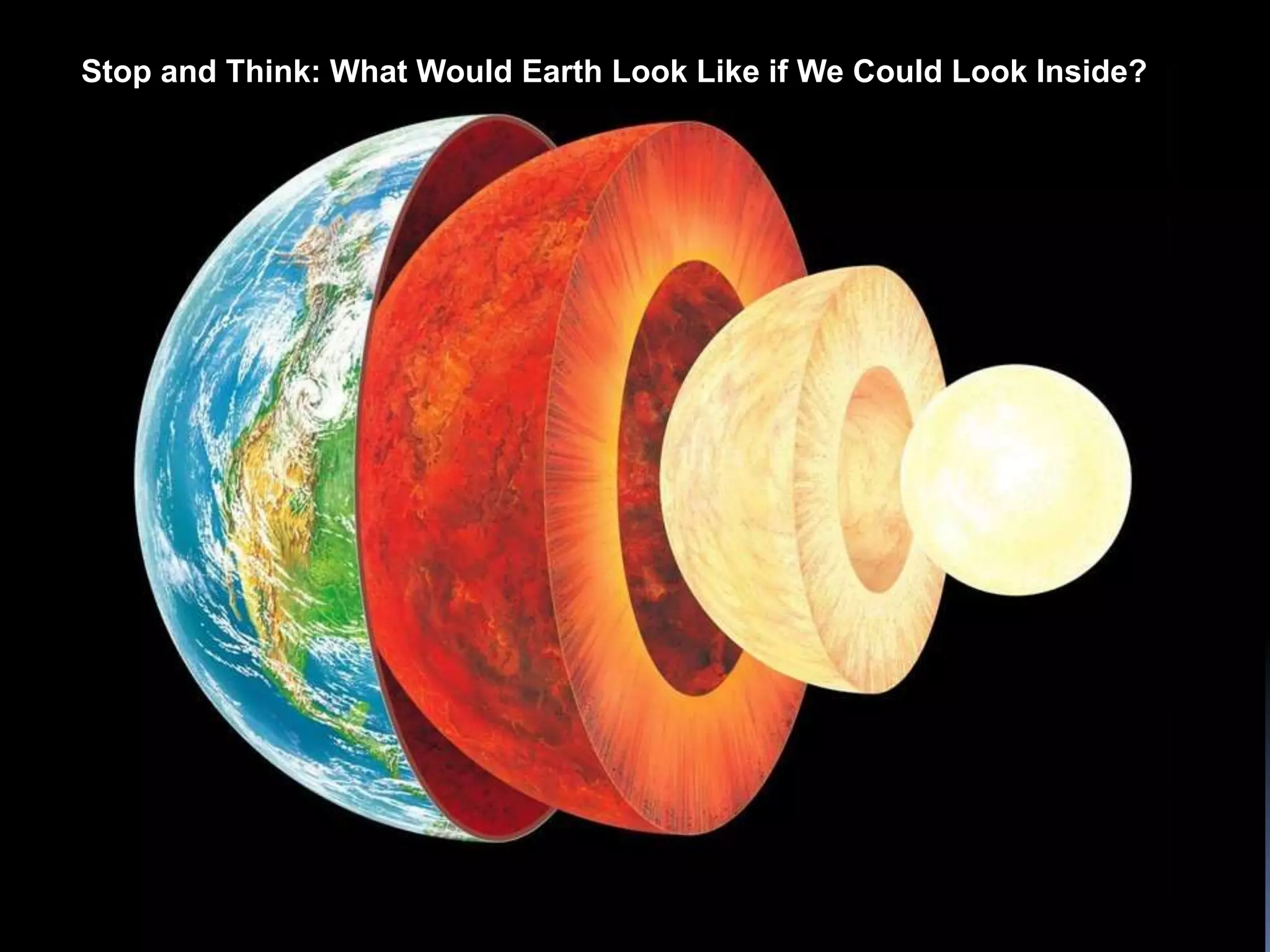
Stop and Think: What Would Earth Look Like if We Could Look Inside?
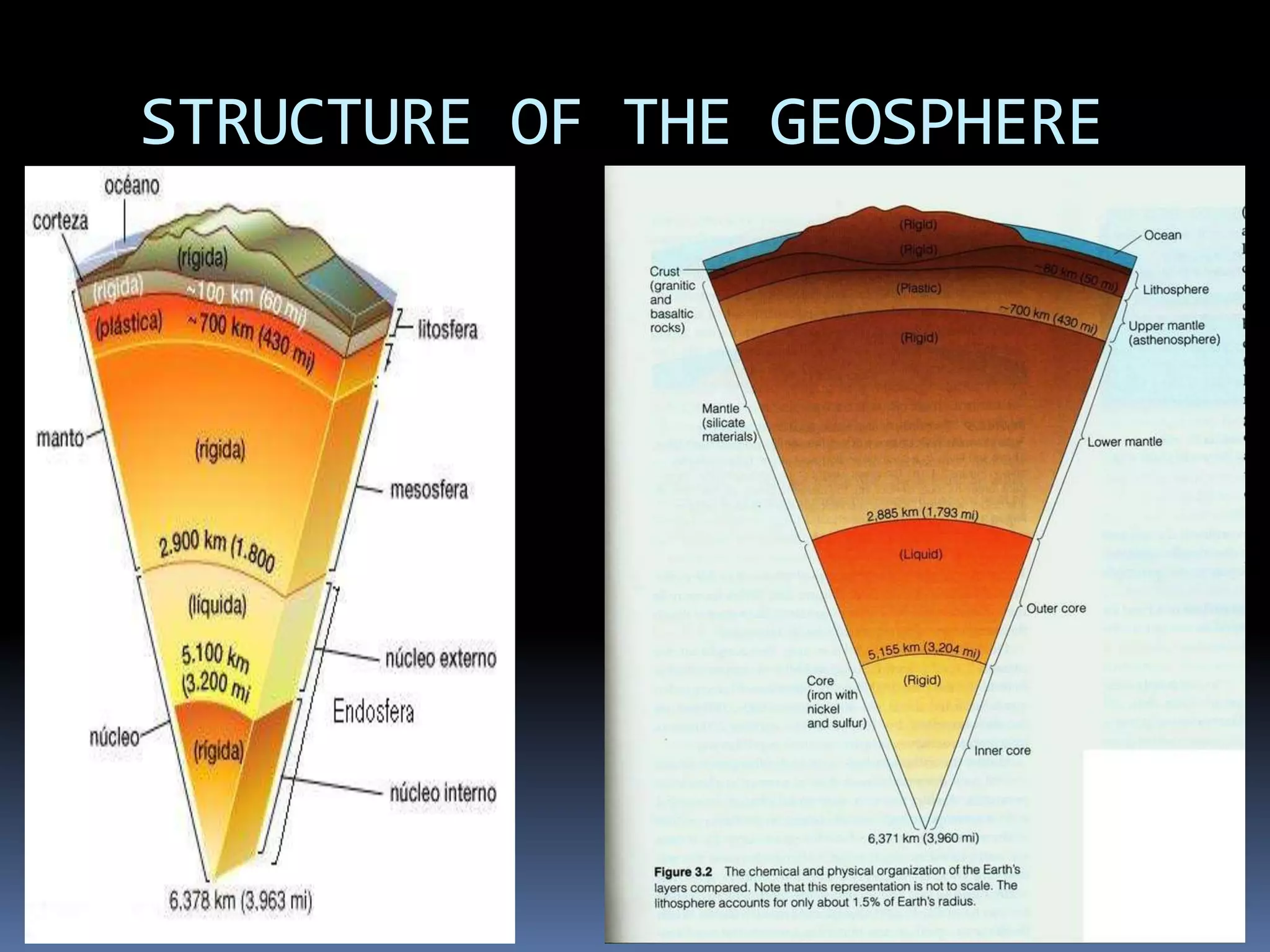
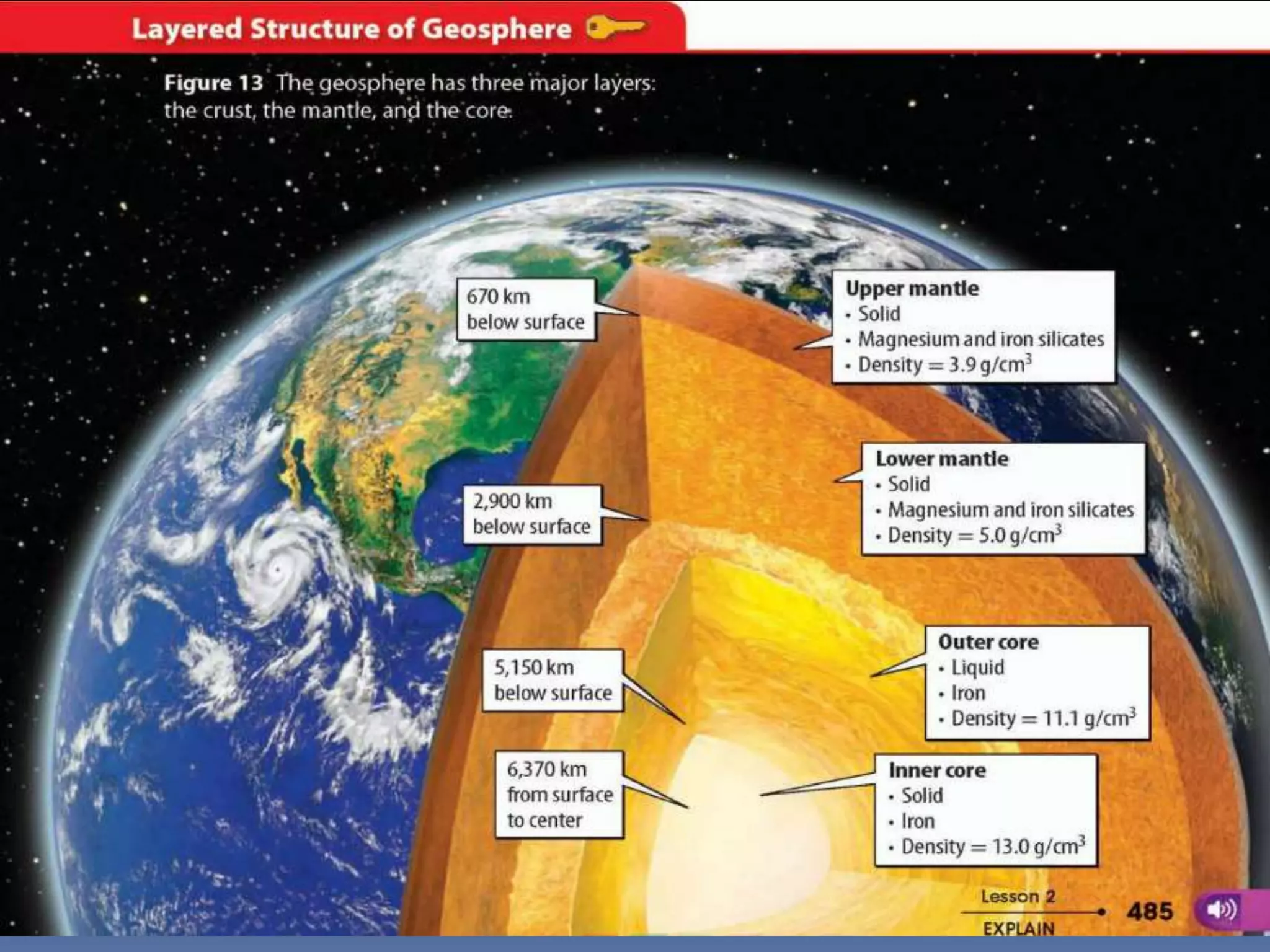
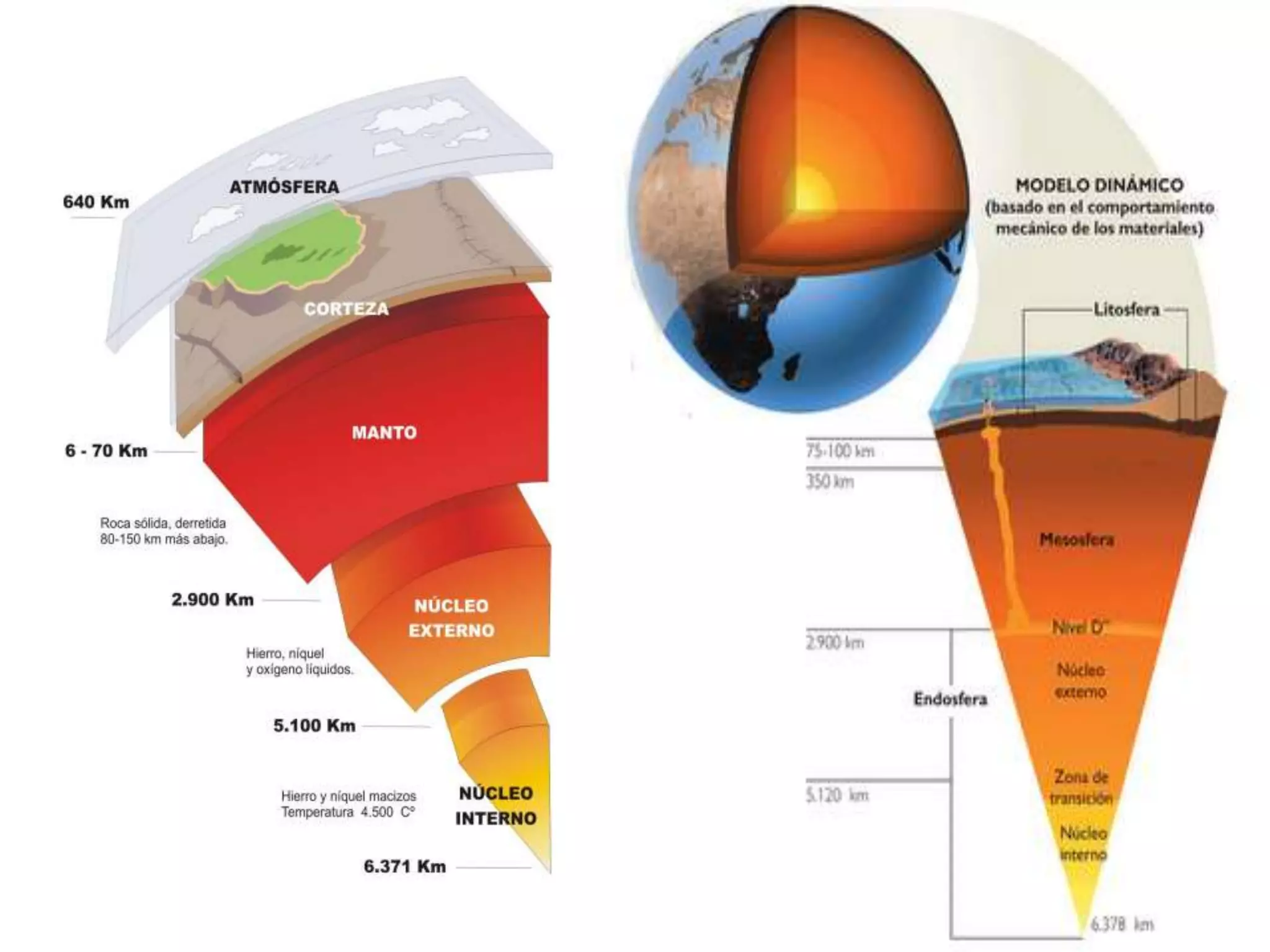
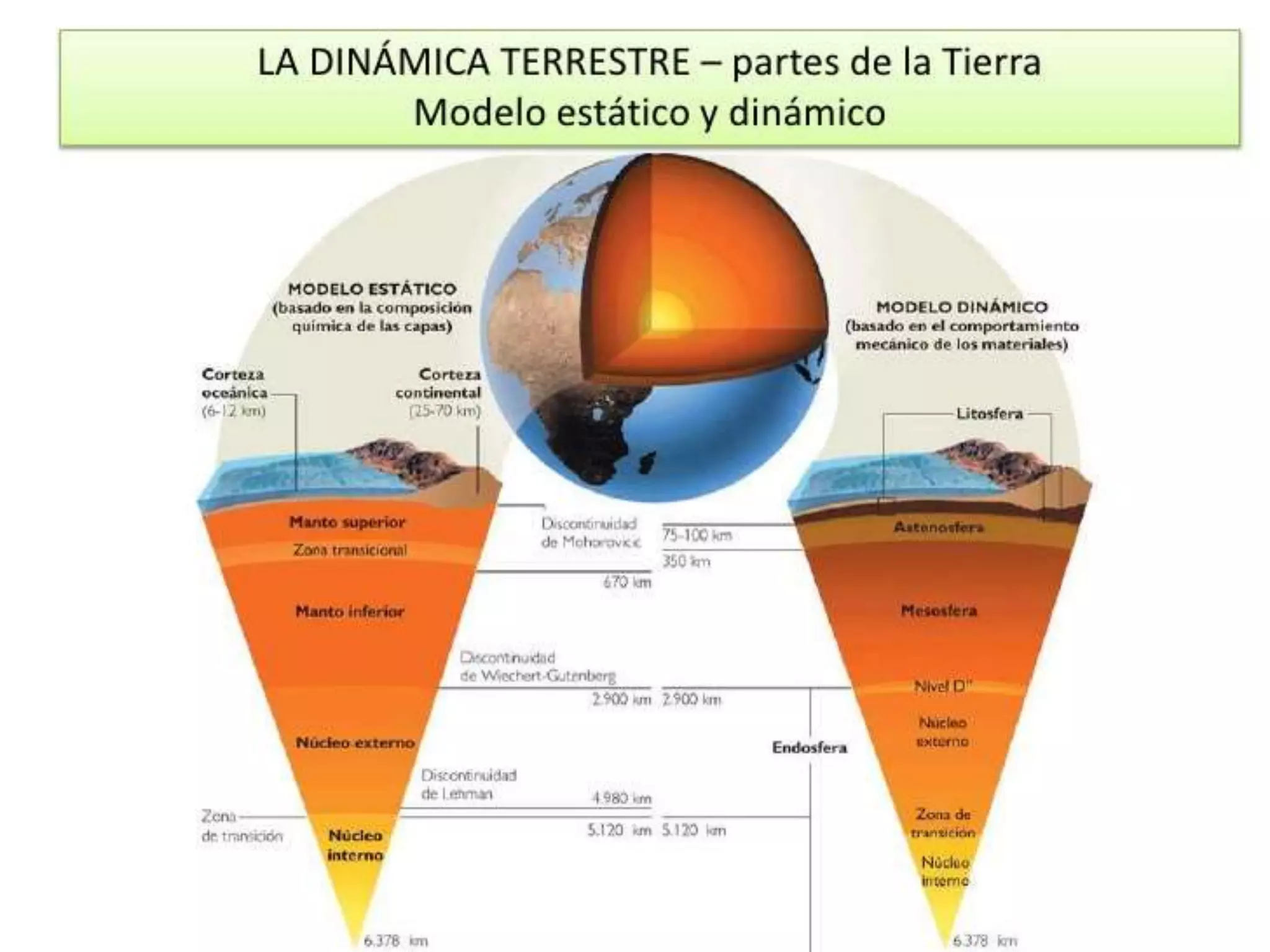
 According to its composition:
 Crust: Between 6 and 70 km.
 Mantle: It lies at a depth of 2900 km approximately.
 Core: Lies at a depth between 2900 and 6370 km. It is
divided in external and internal core.
 According to its rigidity:
 Lithosphere: Composed by the crust and the upper
mantle, thickness of around 100 km.
 Mesosphere: Inner mantle. Composed by magma.
 Endosphere: It coincides with the core.
STRUCTURE OF THE GEOSPHERE
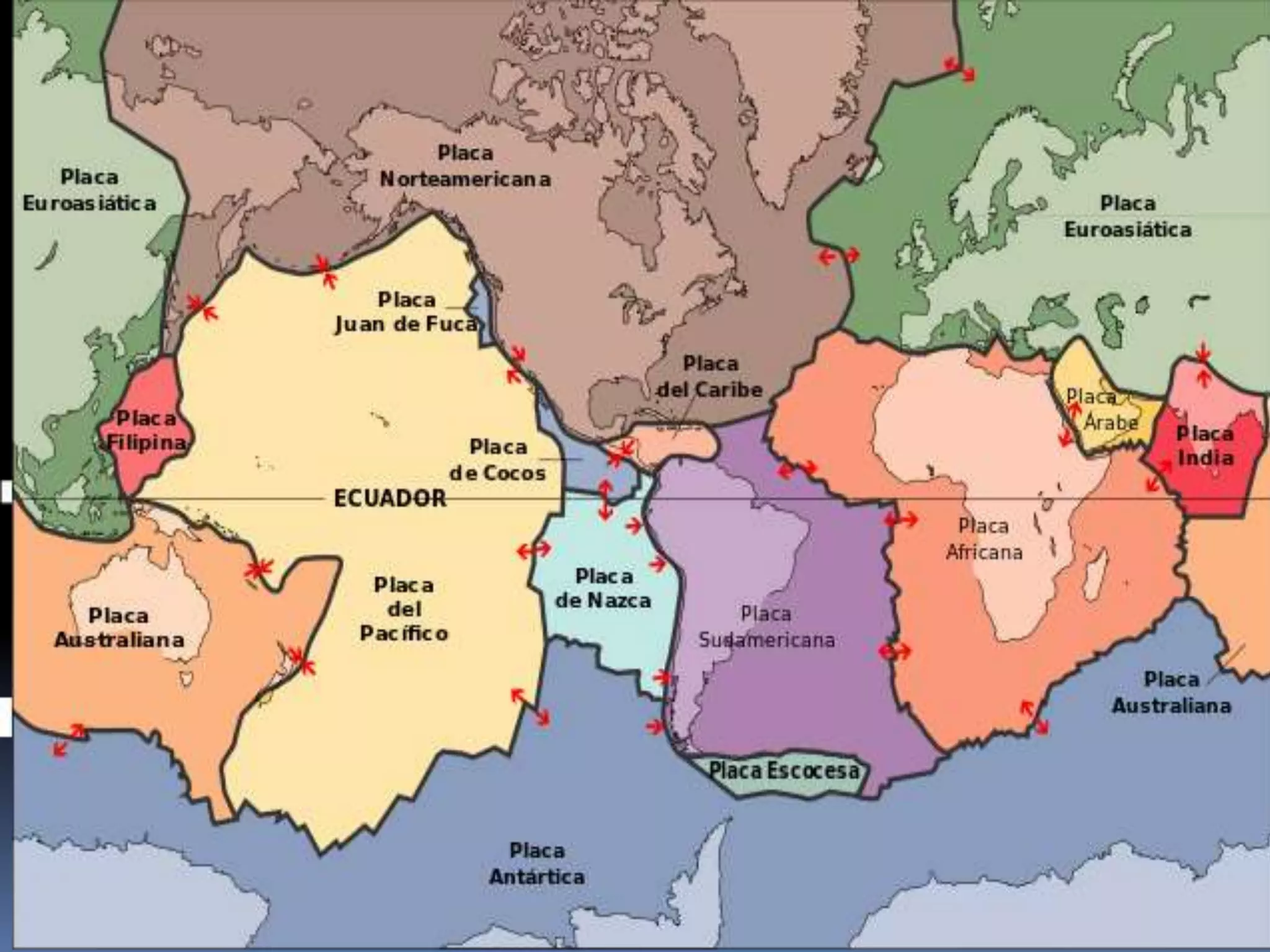
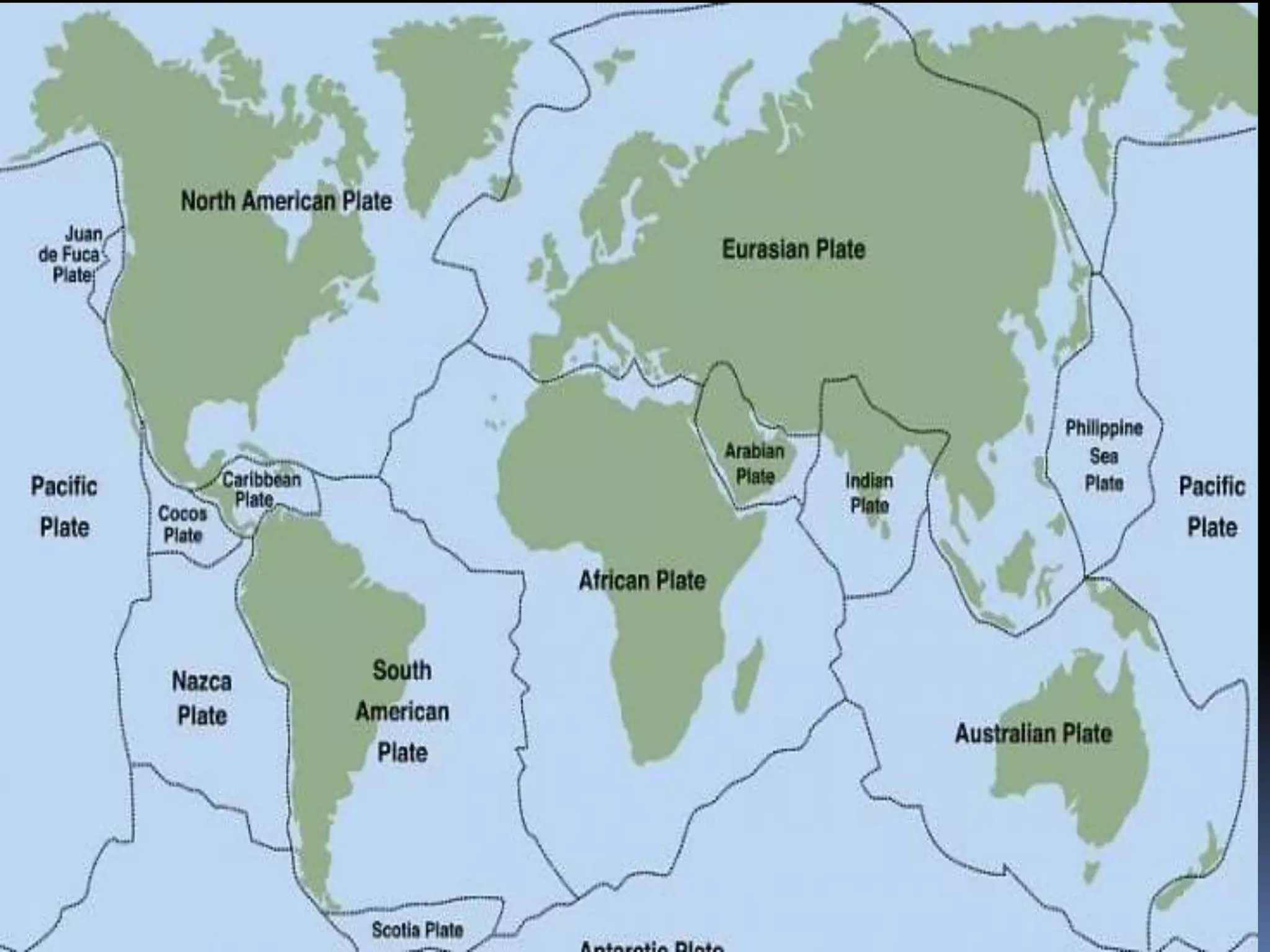
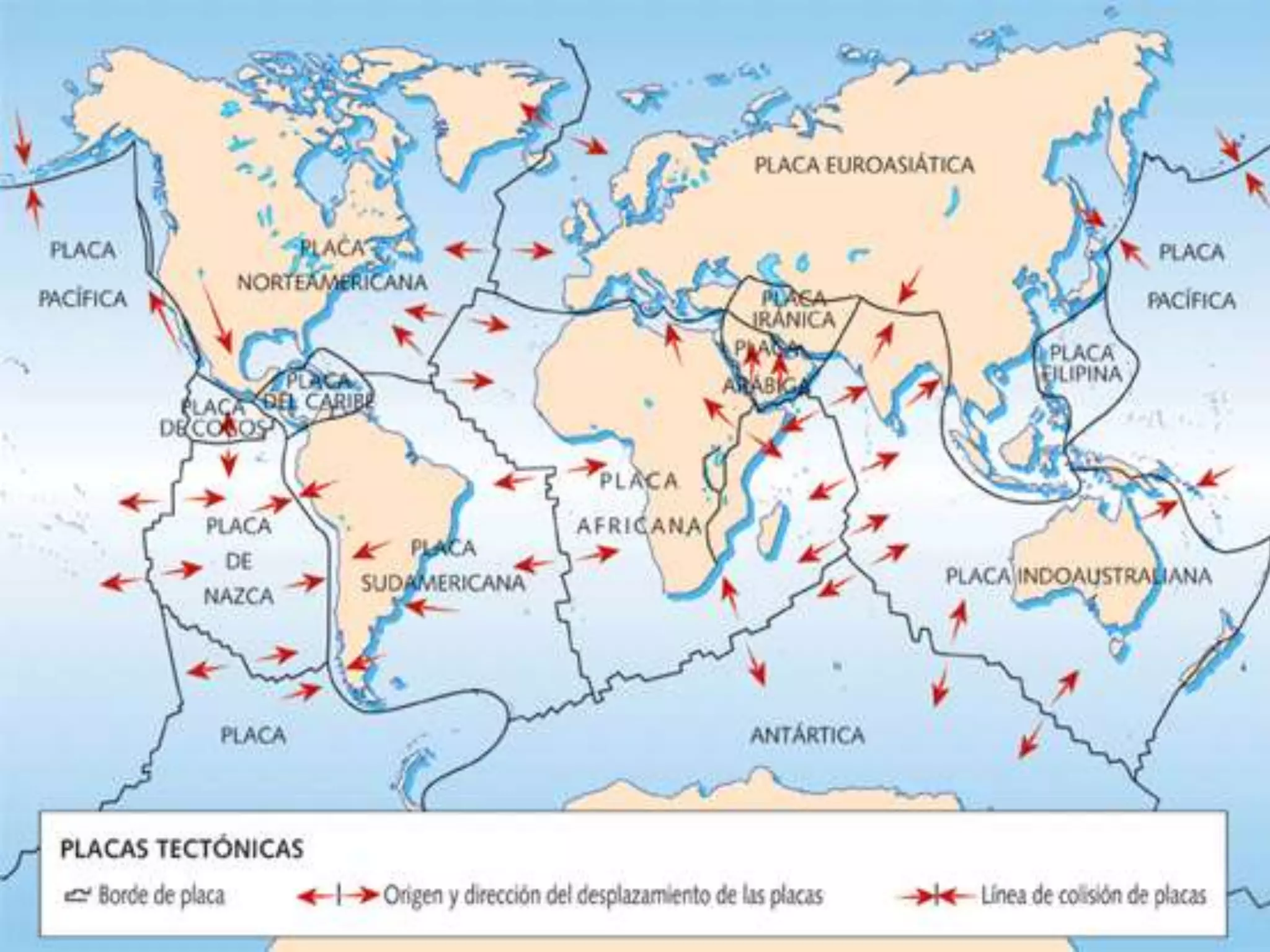
TECTONIC PLATES/ PLACAS TECTÓNICAS
 The lithosphere (crust and the upper mantle)
is divided into tectonic plates (placas
tectónicas), which are blocks that float on
top of the molten materials in the mantle.
 The scientific study of the movements and
changes of the lithosphere is called plate
tectonics (tectónica de placas).
 The tectonic plates can be:
 Continental plates (formed only by emerged lands).
 Oceanic plates (formed by the lithosphere of the
ocean floor).
 Mixed plates (formed by continental and oceanic
lithosphere).
 The edges of the plates are zones of contact and
of greater instability of the crust.
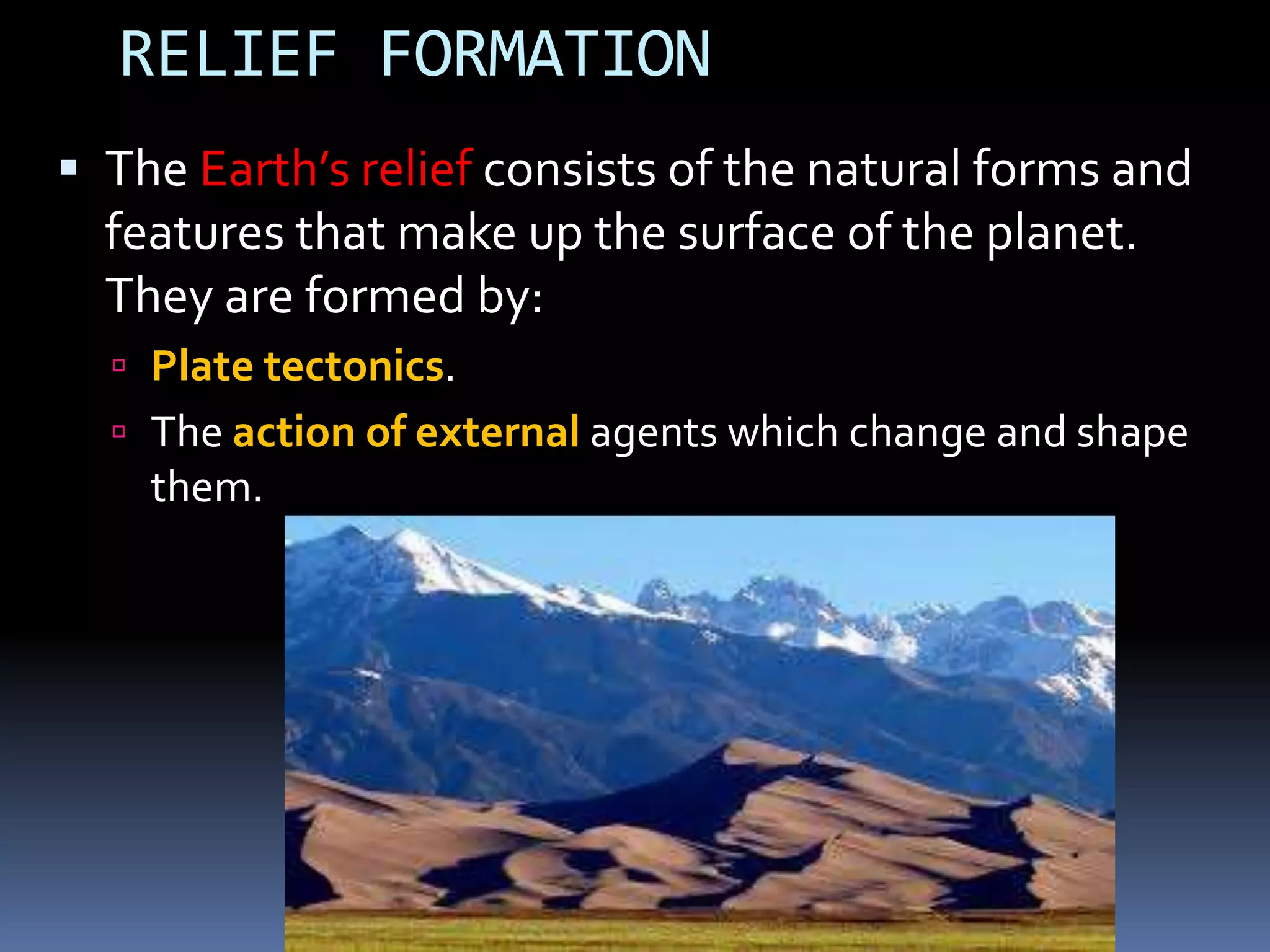
RELIEF FORMATION
 The Earth’s relief consists of the natural forms and
features that make up the surface of the planet.
They are formed by:
 Plate tectonics.
 The action of external agents which change and shape
them.
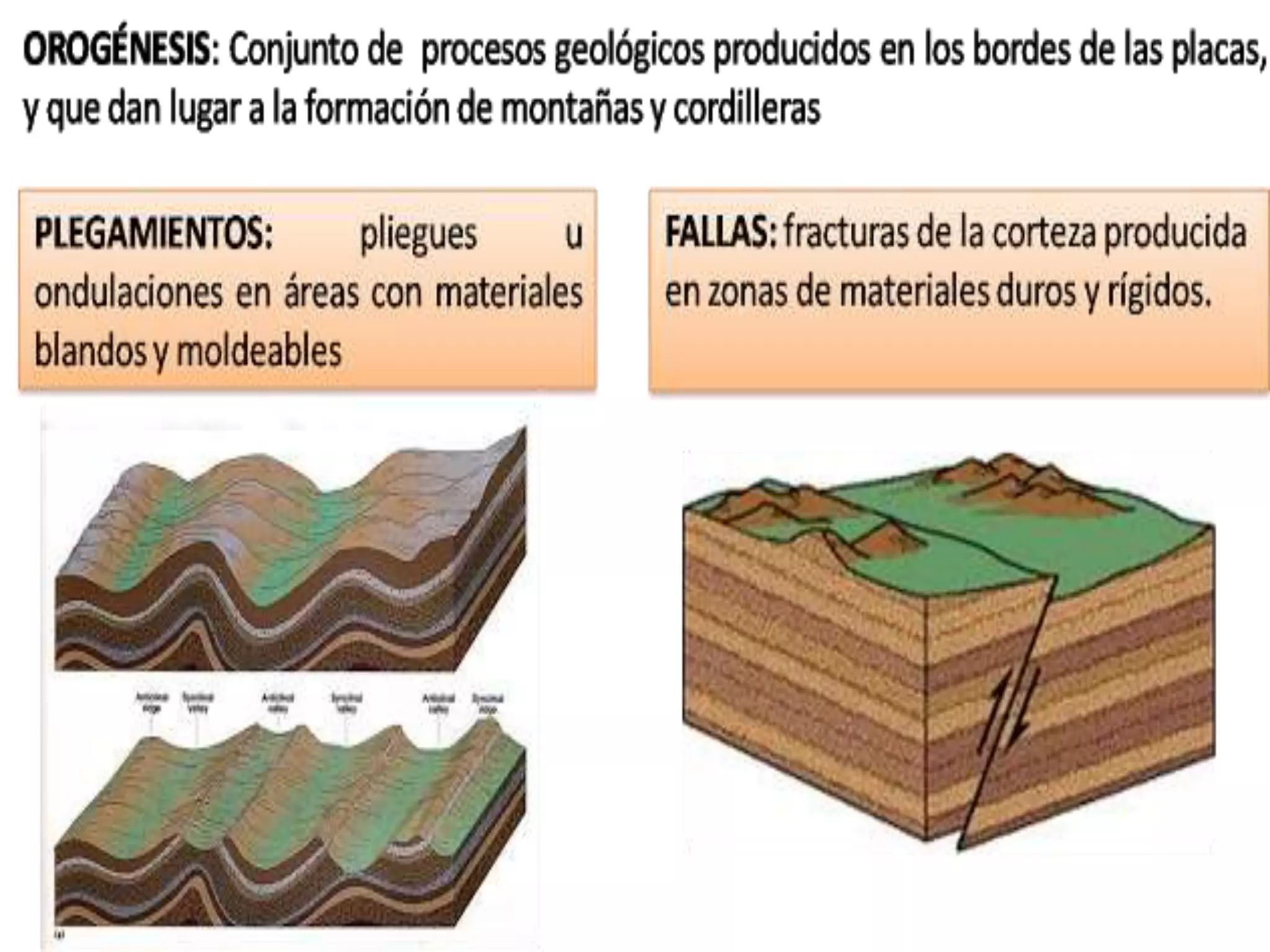
OROGENESIS
 It is the process of formation of the Earth’s
relief by the action of internal forces of the
Earth.
 Orogenesis’ processes:
Volcanic mountain formation.
Fault blocks.
Folding
VOLCANIC MOUNTAIN FORMATION
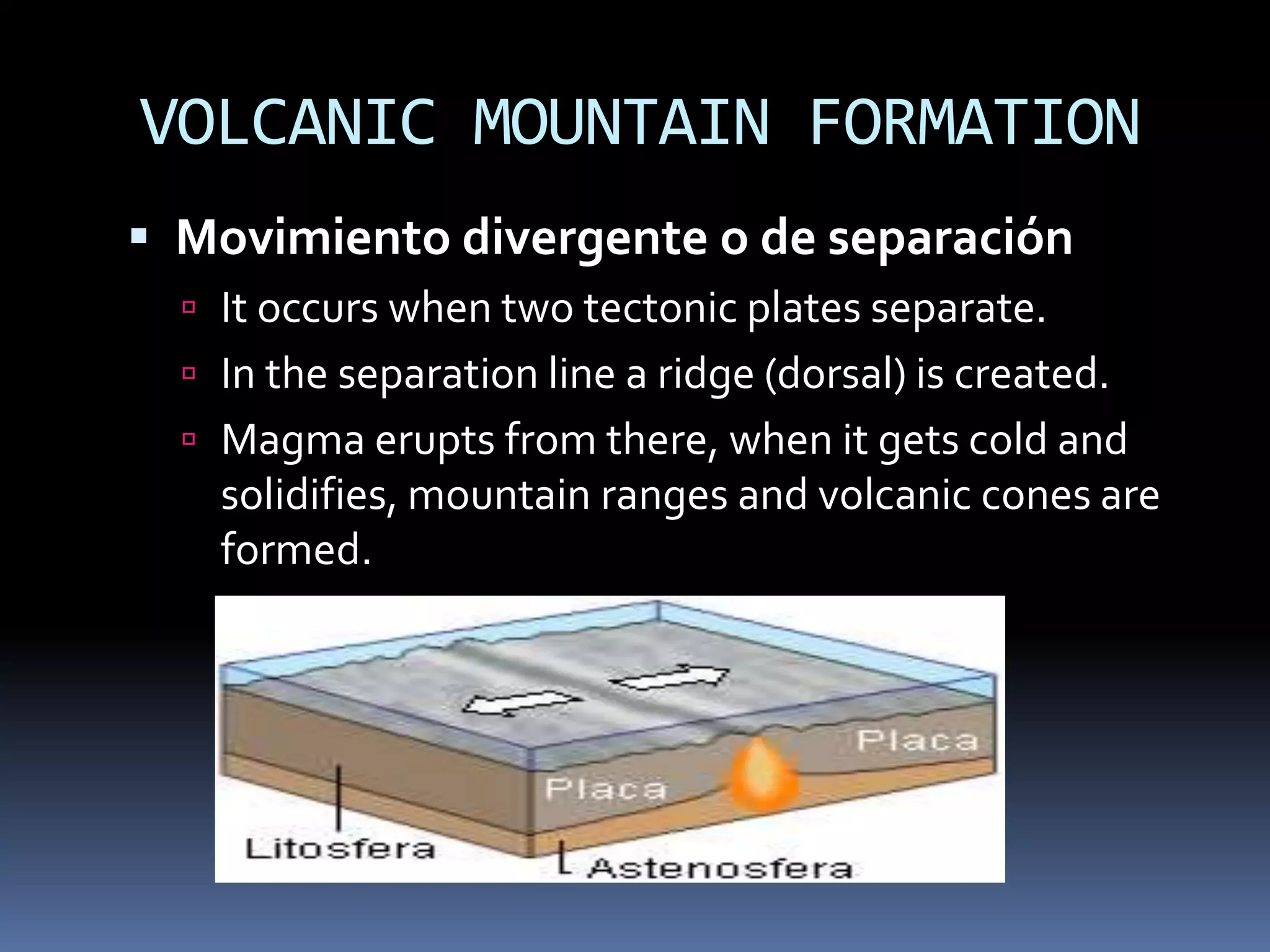
 Movimiento divergente o de separación
 It occurs when two tectonic plates separate.
 In the separation line a ridge (dorsal) is created.
 Magma erupts from there, when it gets cold and
solidifies, mountain ranges and volcanic cones are
formed.
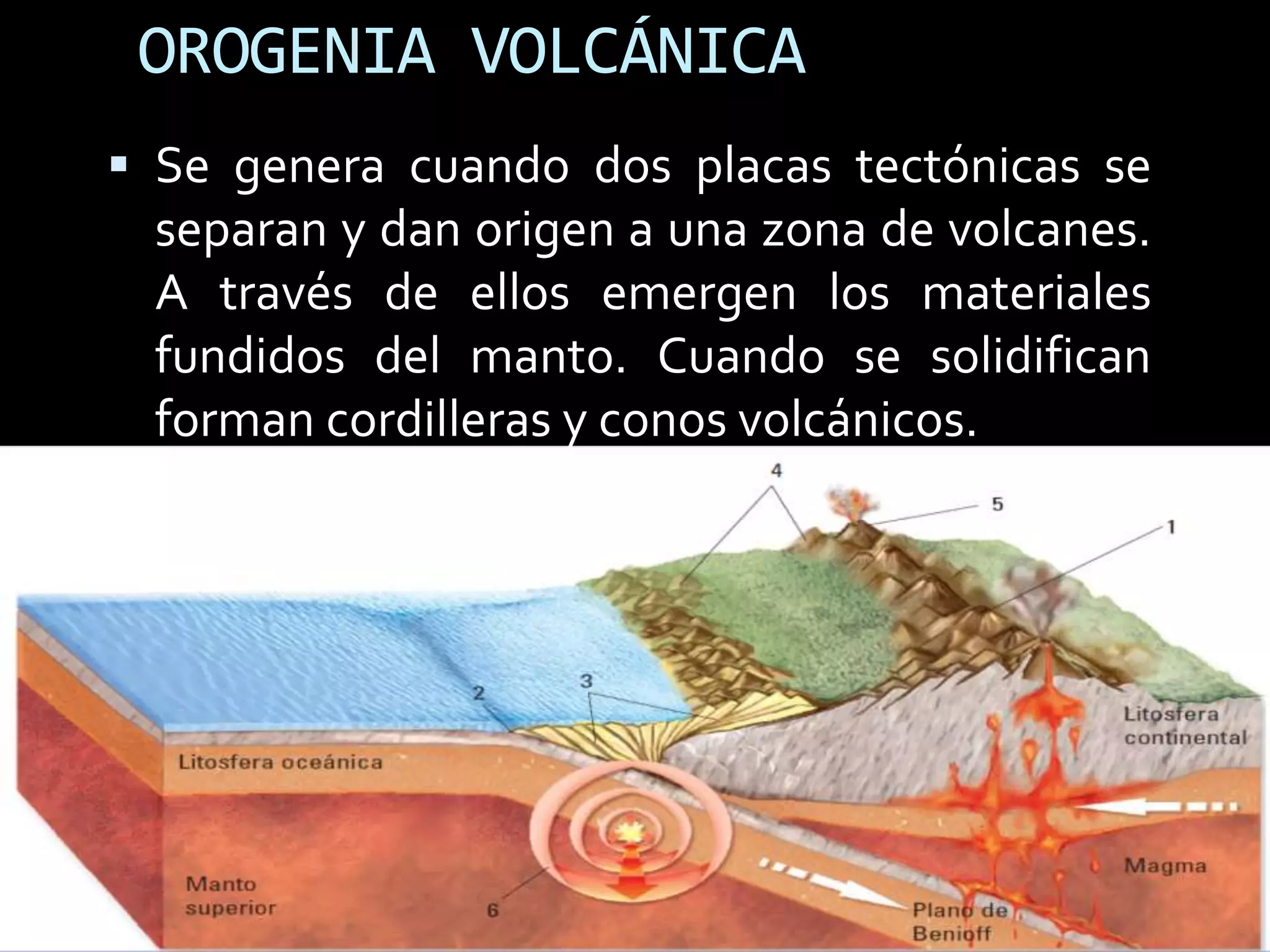
OROGENIA VOLCÁNICA
 Se genera cuando dos placas tectónicas se
separan y dan origen a una zona de volcanes.
A través de ellos emergen los materiales
fundidos del manto. Cuando se solidifican
forman cordilleras y conos volcánicos.
FAULT BLOCKS
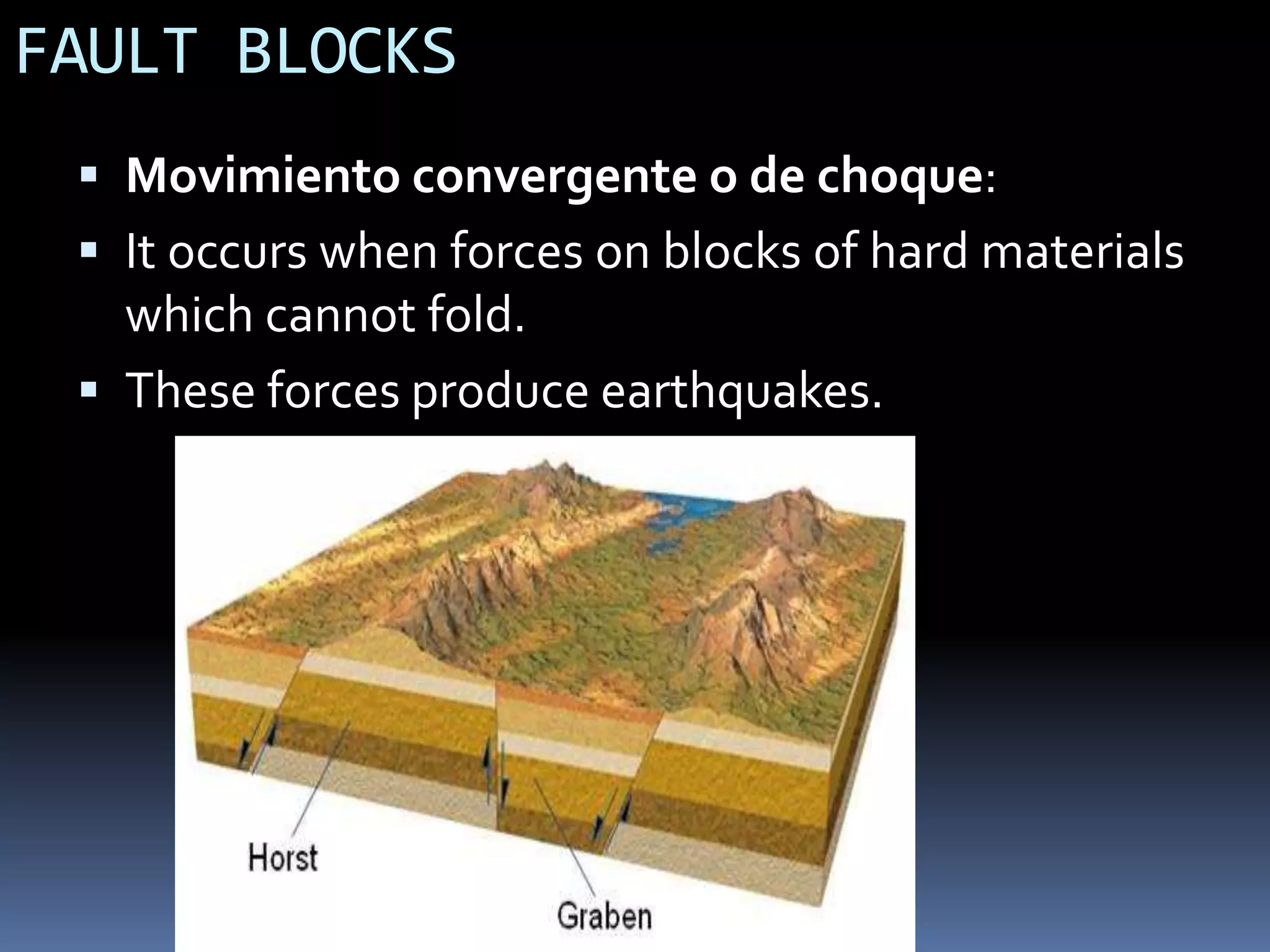
 Movimiento convergente o de choque:
 It occurs when forces on blocks of hard materials
which cannot fold.
 These forces produce earthquakes.
OROGENIA POR FALLA
 Se forman al colisionar dos placas formadas
por materiales duros, no pueden plegarse, se
fracturan y producen terremotos.
 Bloques levantados y hundidos.
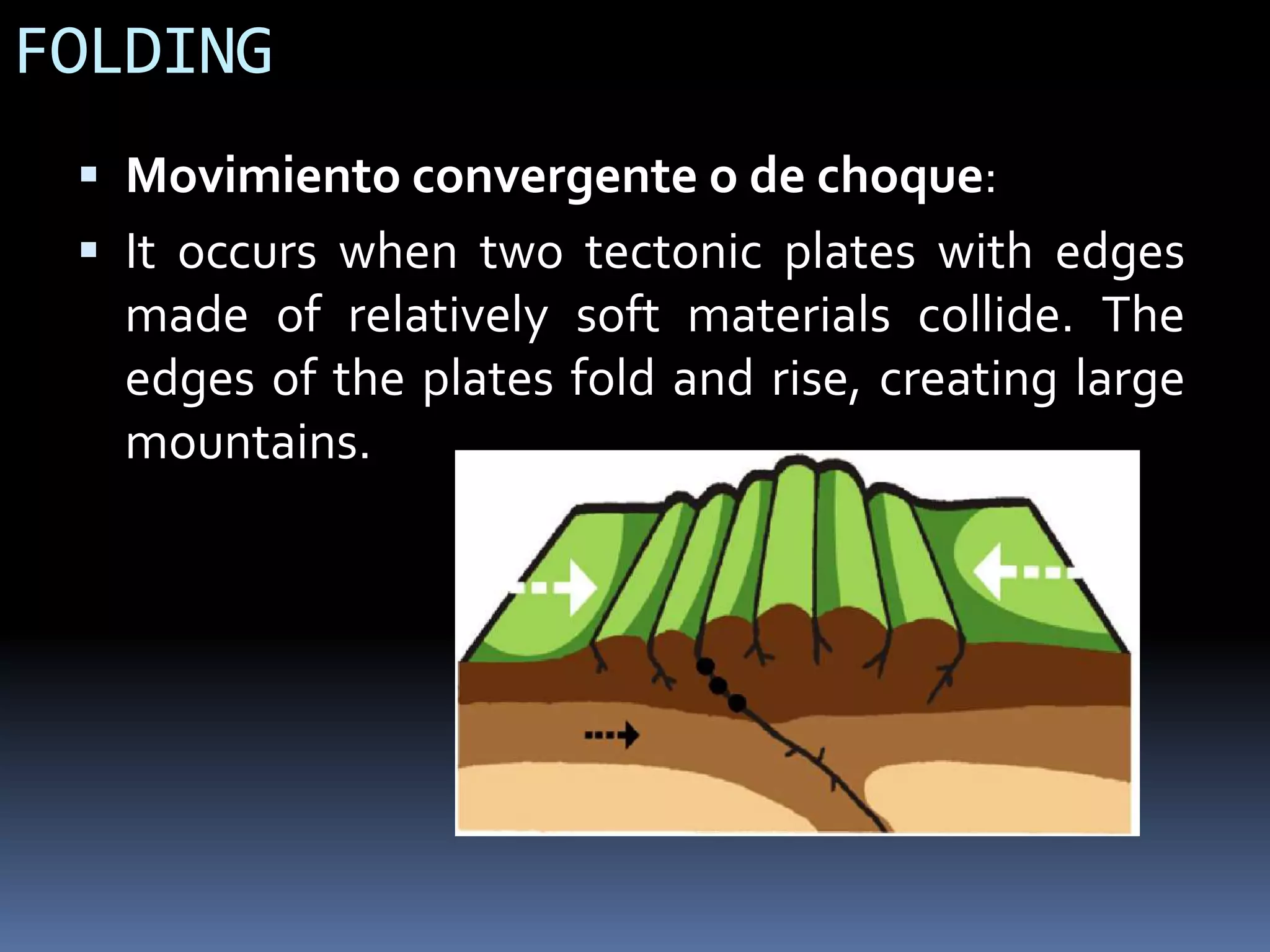
FOLDING
 Movimiento convergente o de choque:
 It occurs when two tectonic plates with edges
made of relatively soft materials collide. The
edges of the plates fold and rise, creating large
mountains.
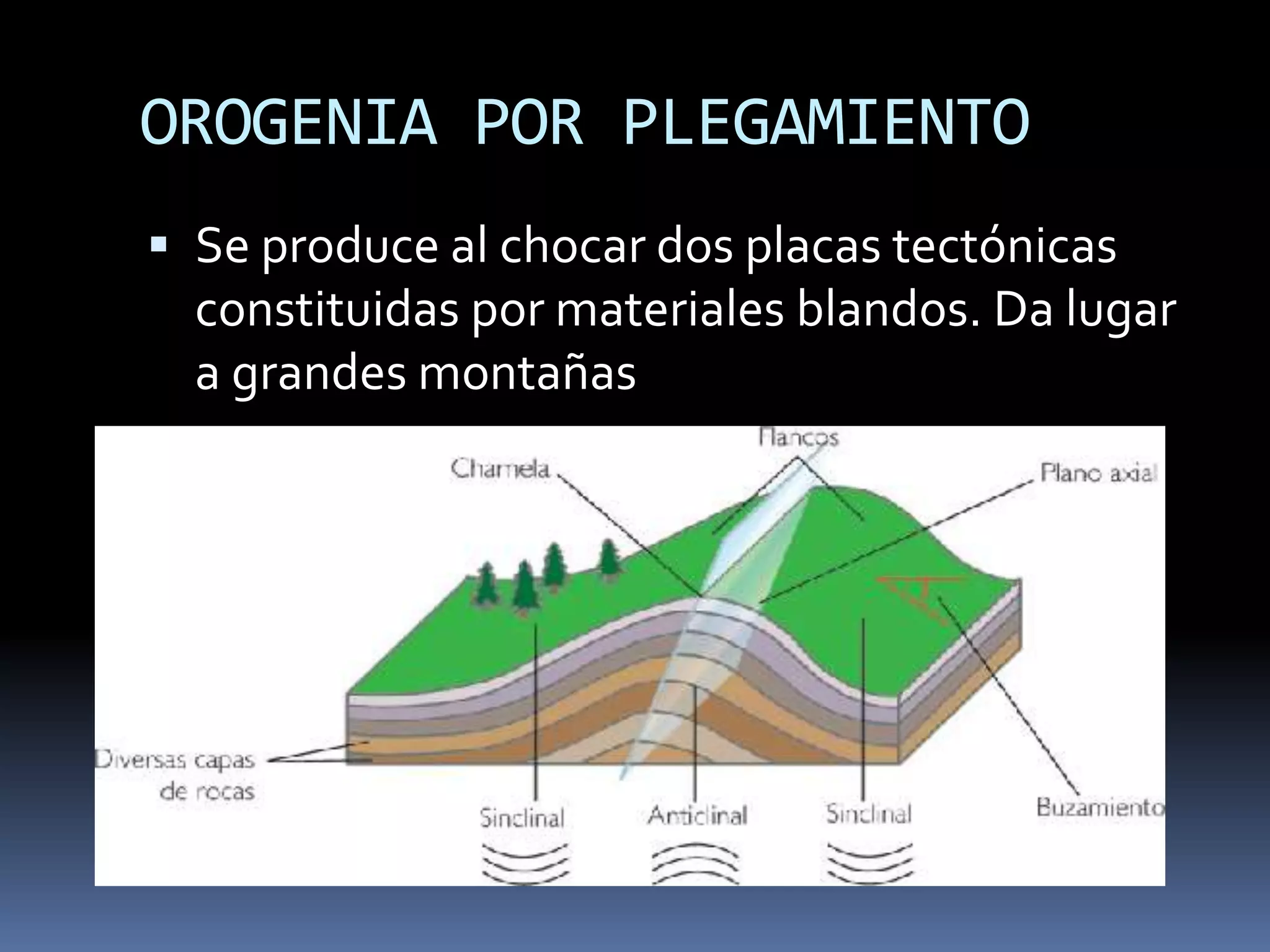
OROGENIA POR PLEGAMIENTO
 Se produce al chocar dos placas tectónicas
constituidas por materiales blandos. Da lugar
a grandes montañas
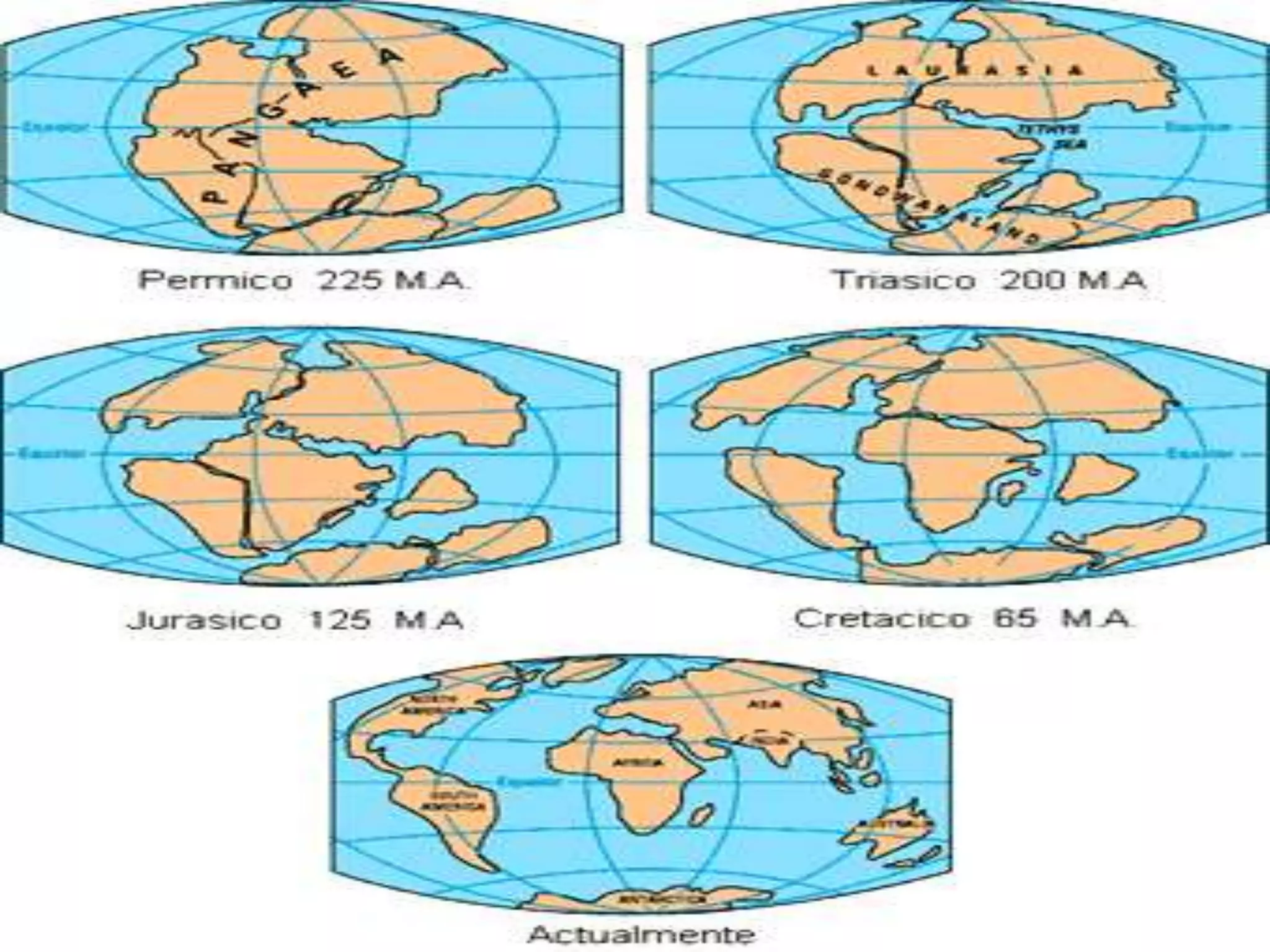
DERIVA CONTINENTAL
 Es una teoría que defiende que hace millones
de años todos los continentes se hallaban
unidos en un continente único (Pangea).
 El continente se dividió inicialmente en dos:
Laurasia y Gondwana (hace unos 150 millones
de años).
 Estas masas se fracturaron hasta que se
formaron los actuales continentes.
 Vídeo:
 https://www.youtube.com/watch?v=kwfNGat
xUJI
 https://www.youtube.com/watch?v=tcPghqn
nTVk
 https://www.youtube.com/watch?v=alkXhmp
pGMA
 http://www.profesorfrancisco.es/2013/02/la-
tectonica-de-placas-en-flash.html
EXTERNAL AGENTS
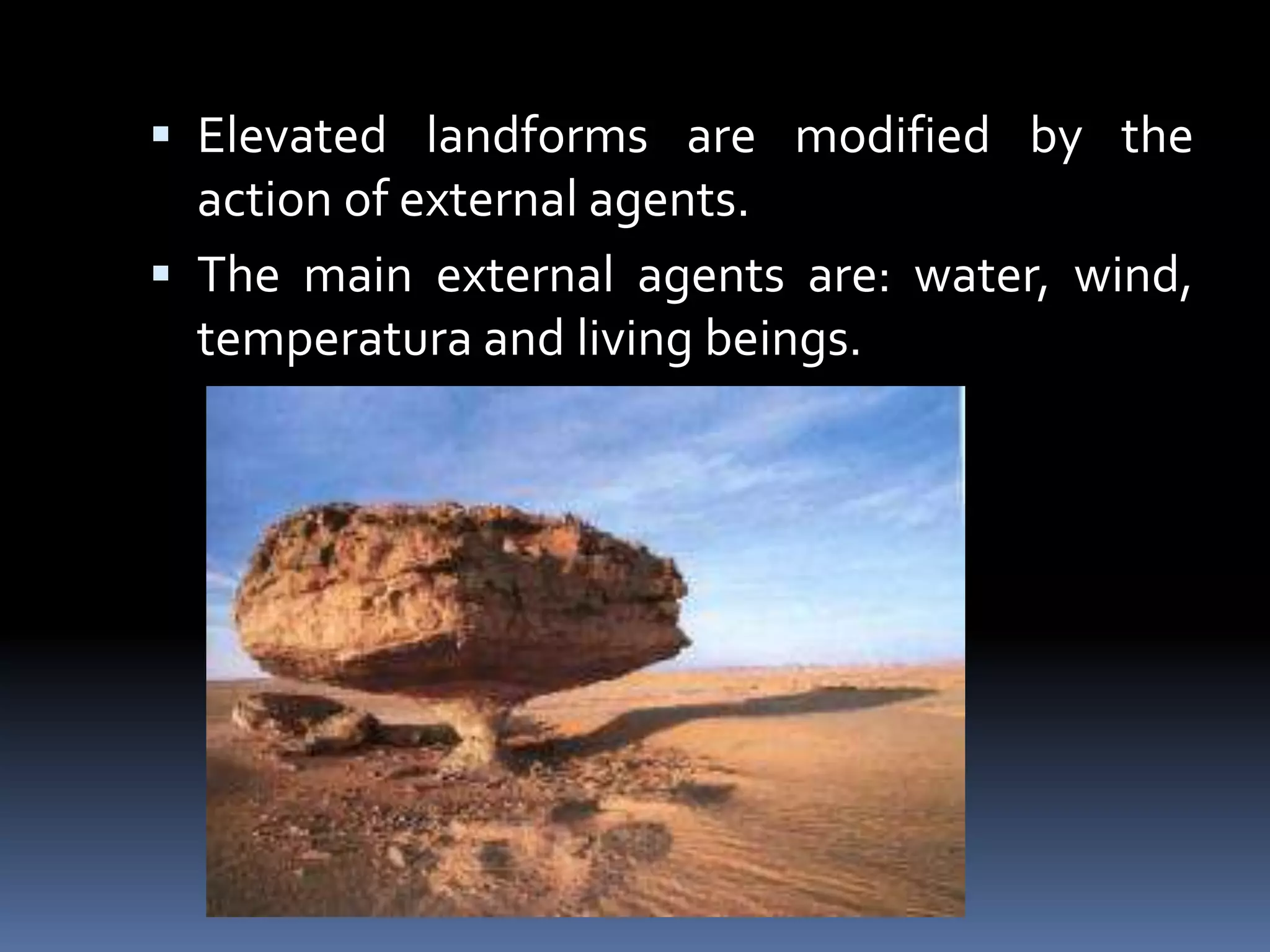
 Elevated landforms are modified by the
action of external agents.
 The main external agents are: water, wind,
temperatura and living beings.
Processes that shape the relief:
 Erosion
 Disintegration of relief shapes by the external
agents.
 Transport
 Movement of the eroded materials.
 Deposition
 Deposit of transported materials.
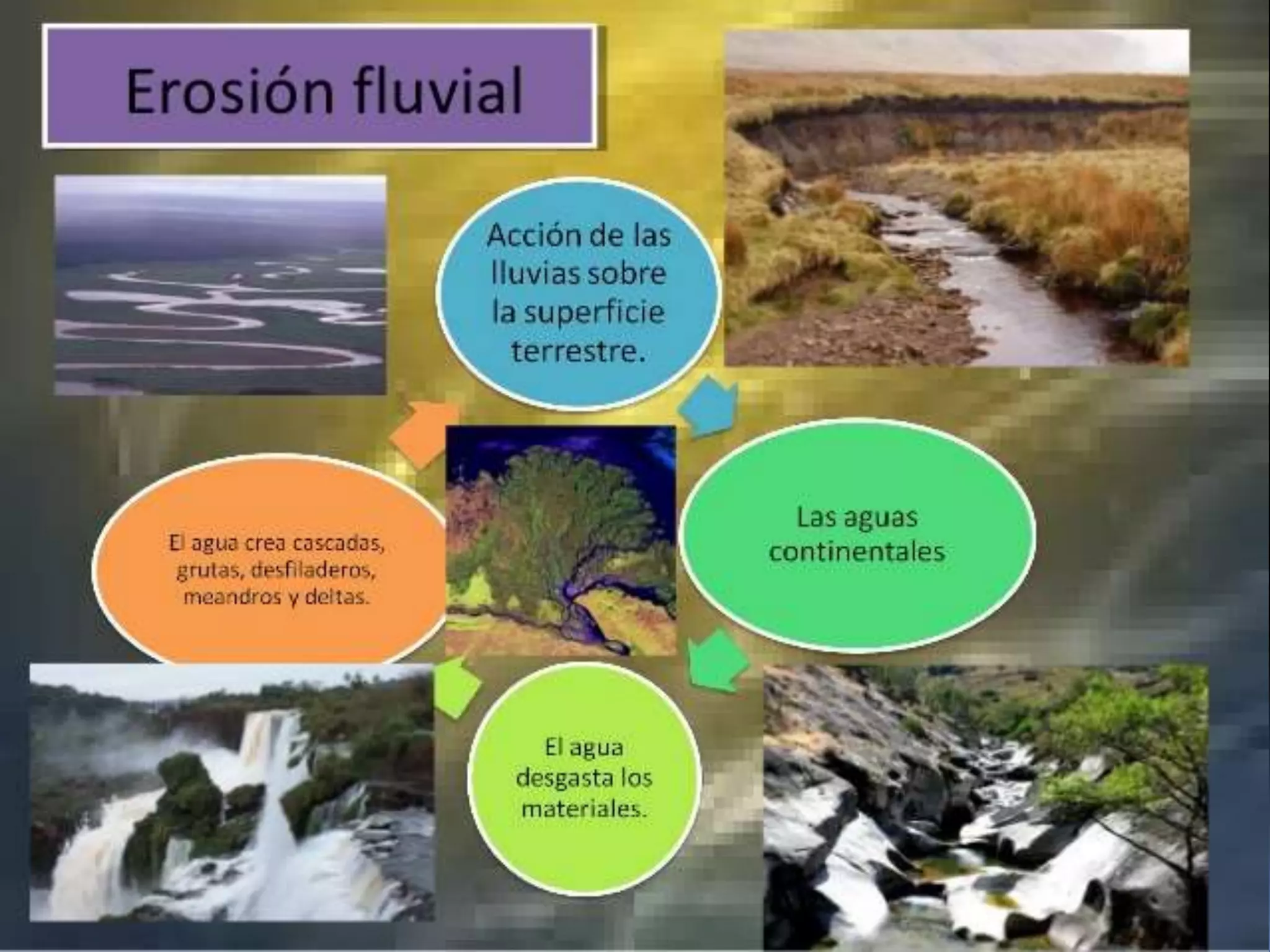
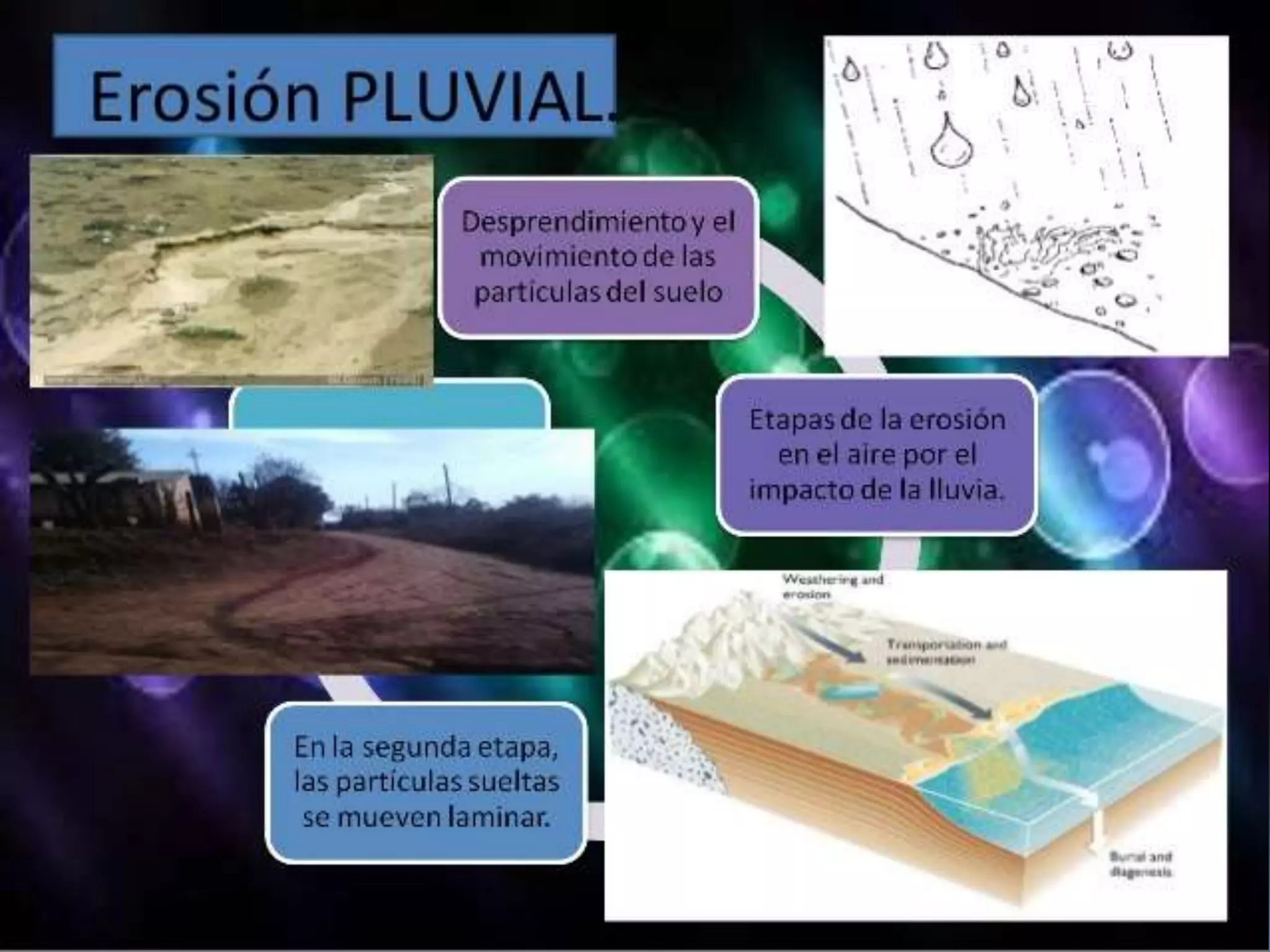
WATER EROSION
 Pluvial  It is caused by rainwater. Rainwater wears
away the materials that are dragged by rivers and
streams.
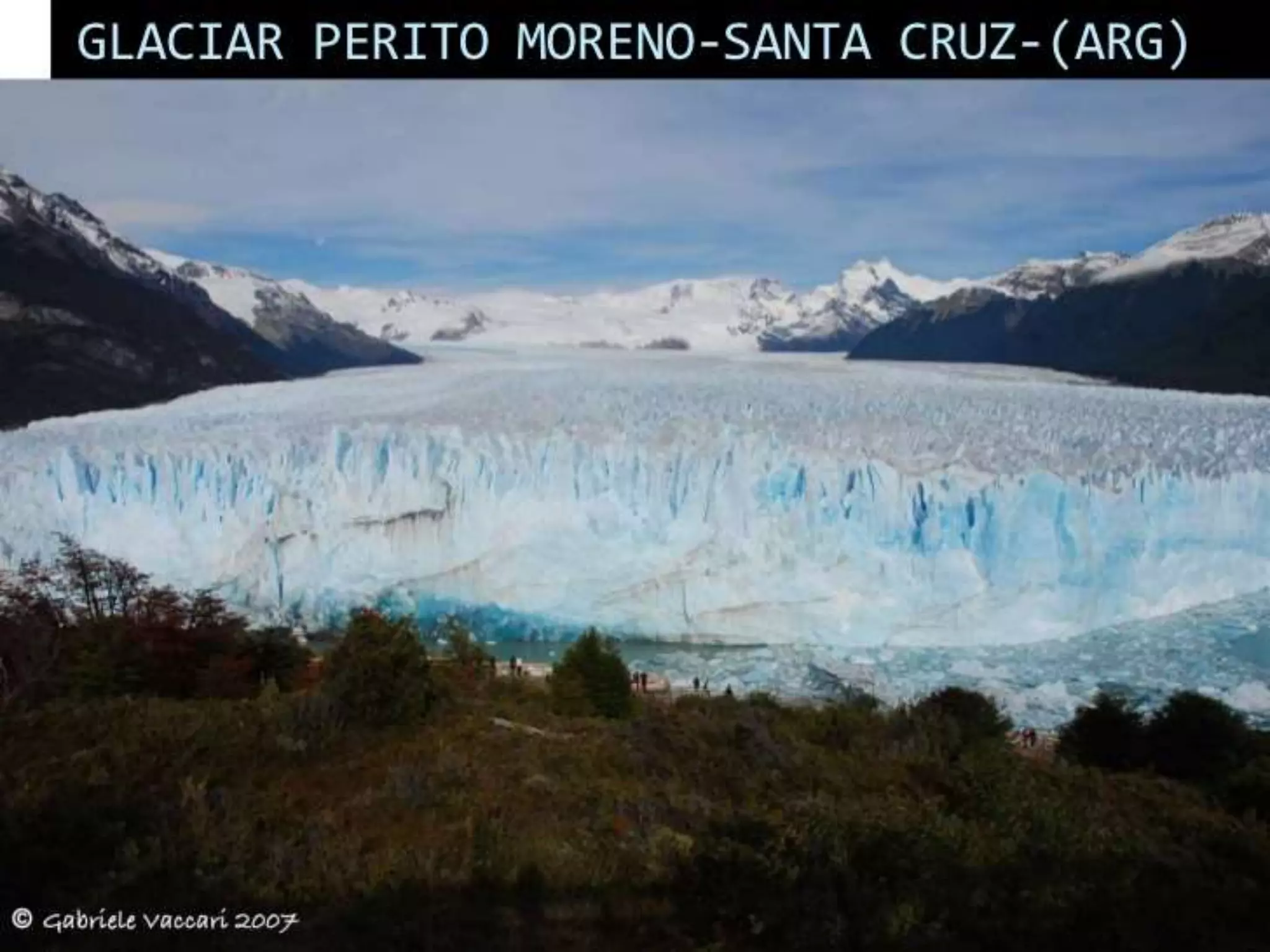
 Glacial  It is caused by glaciers. Glaciers are masses
of ice that move very slowly. They erode the surface
and deposit sediment, forming moraines.
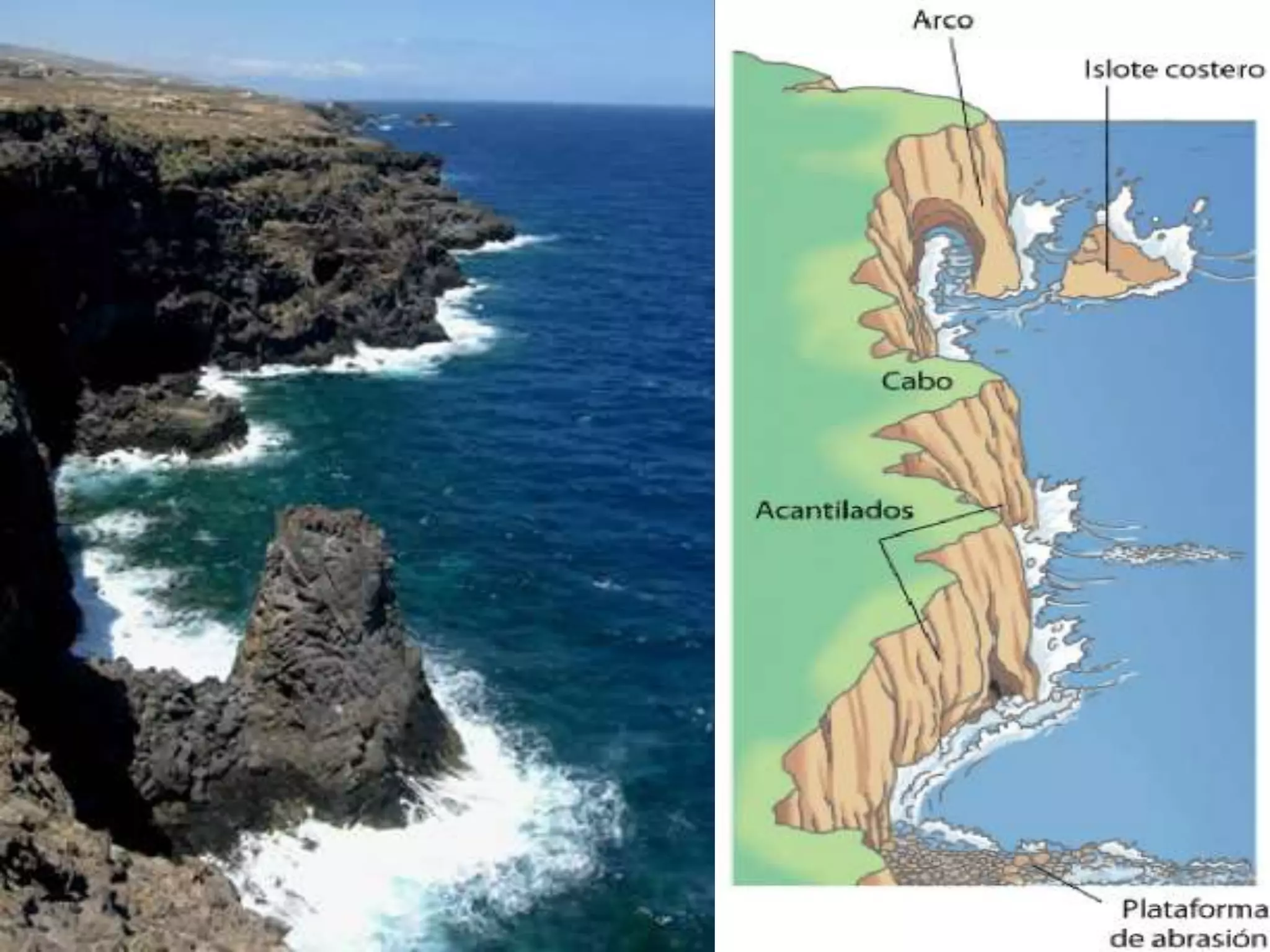
 Coastal  caused by the movement of the sea, such
as waves, tides and currents. The sea shapes the
coasts, forming cliffs or depositing materials on the
beaches.
 Fluvial  Caused by rivers. It may form valleys and
canyons.
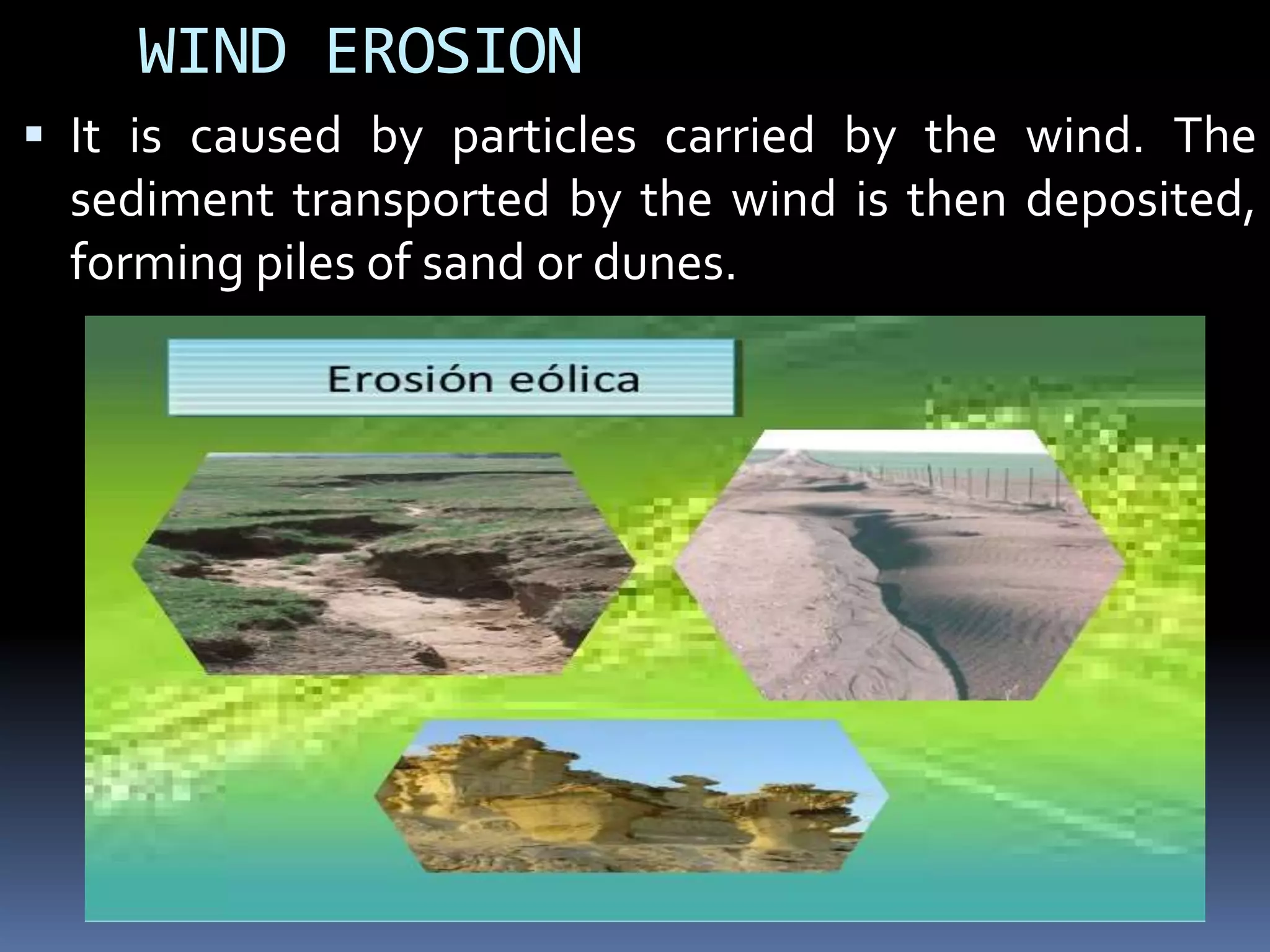
WIND EROSION
 It is caused by particles carried by the wind. The
sediment transported by the wind is then deposited,
forming piles of sand or dunes.
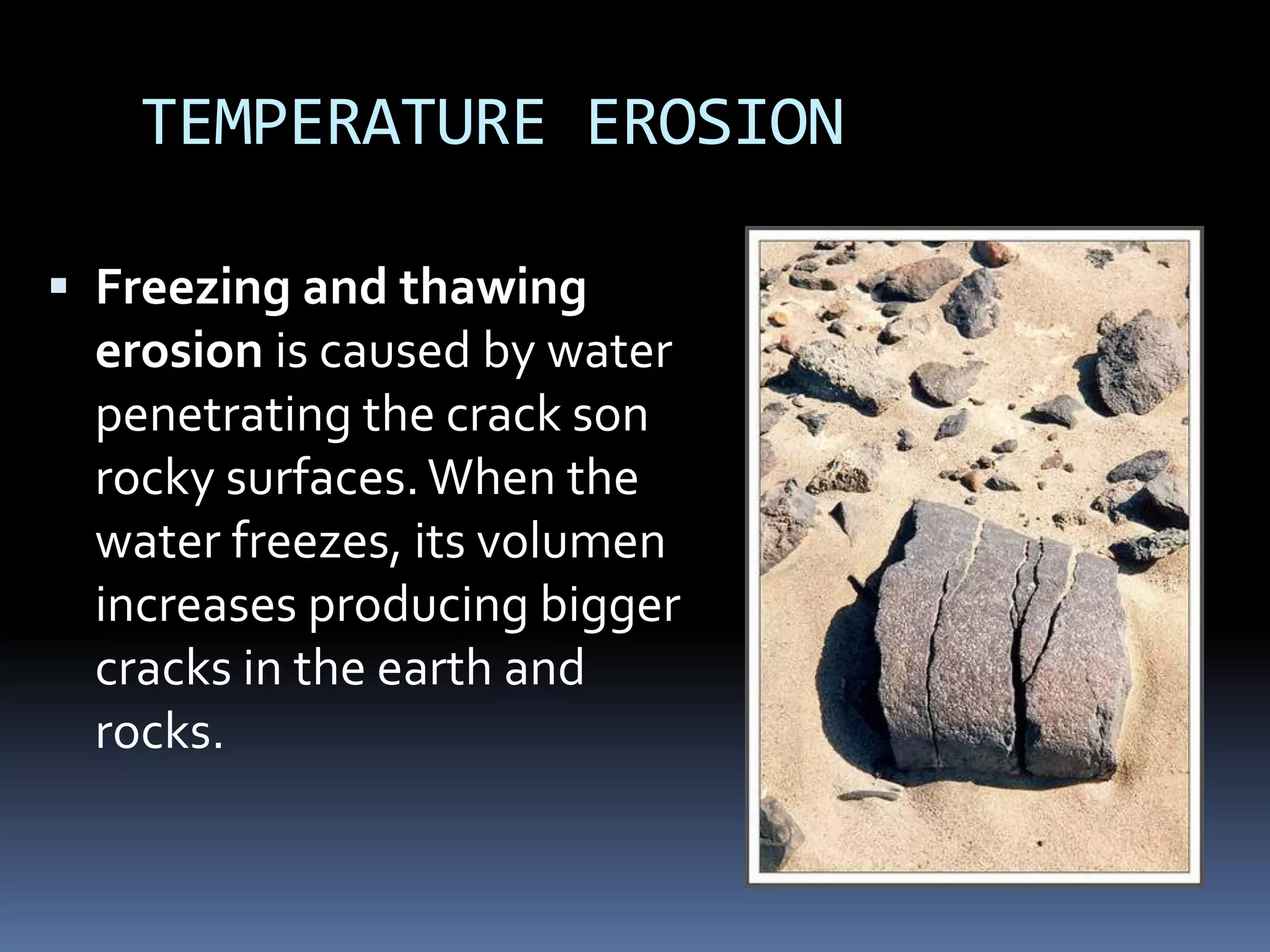
TEMPERATURE EROSION
 Freezing and thawing
erosion is caused by water
penetrating the crack son
rocky surfaces.When the
water freezes, its volumen
increases producing bigger
cracks in the earth and
rocks.
BIOLOGICAL EROSION
 It is caused by living things.
 For example, plants break the soil with their
roots.
 Animals erode the soil when they build their
dens.
 Human activity is the most significant agents
in shaping the Earth’s surface.Through the
use of technology and heavy machinery, we
shape the Earth according to our needs.
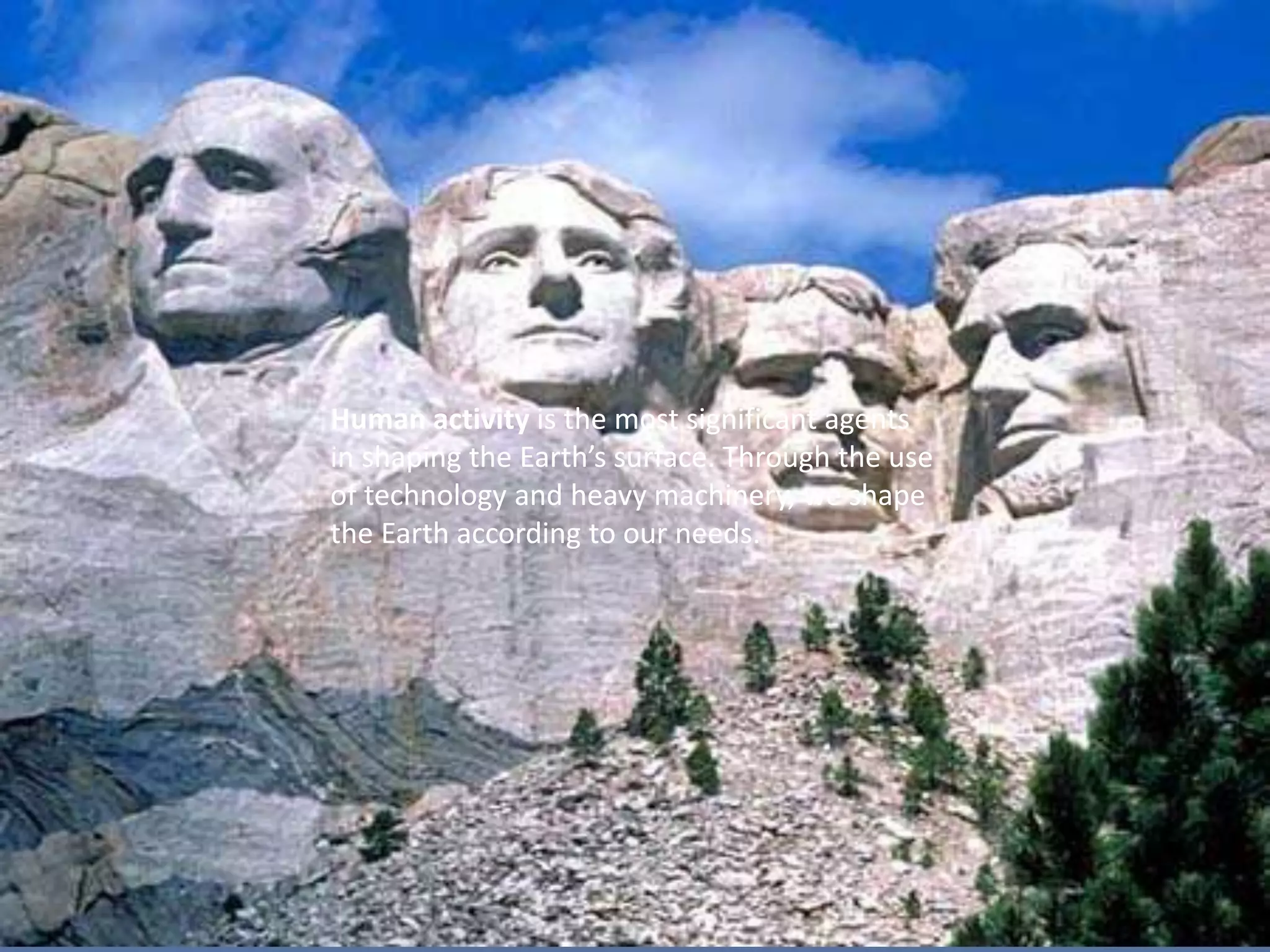
Human activity is the most significant agents
in shaping the Earth’s surface. Through the use
of technology and heavy machinery, we shape
the Earth according to our needs.
Human activity is the most significant agents
in shaping the Earth’s surface. Through the use
of technology and heavy machinery, we shape
the Earth according to our needs.
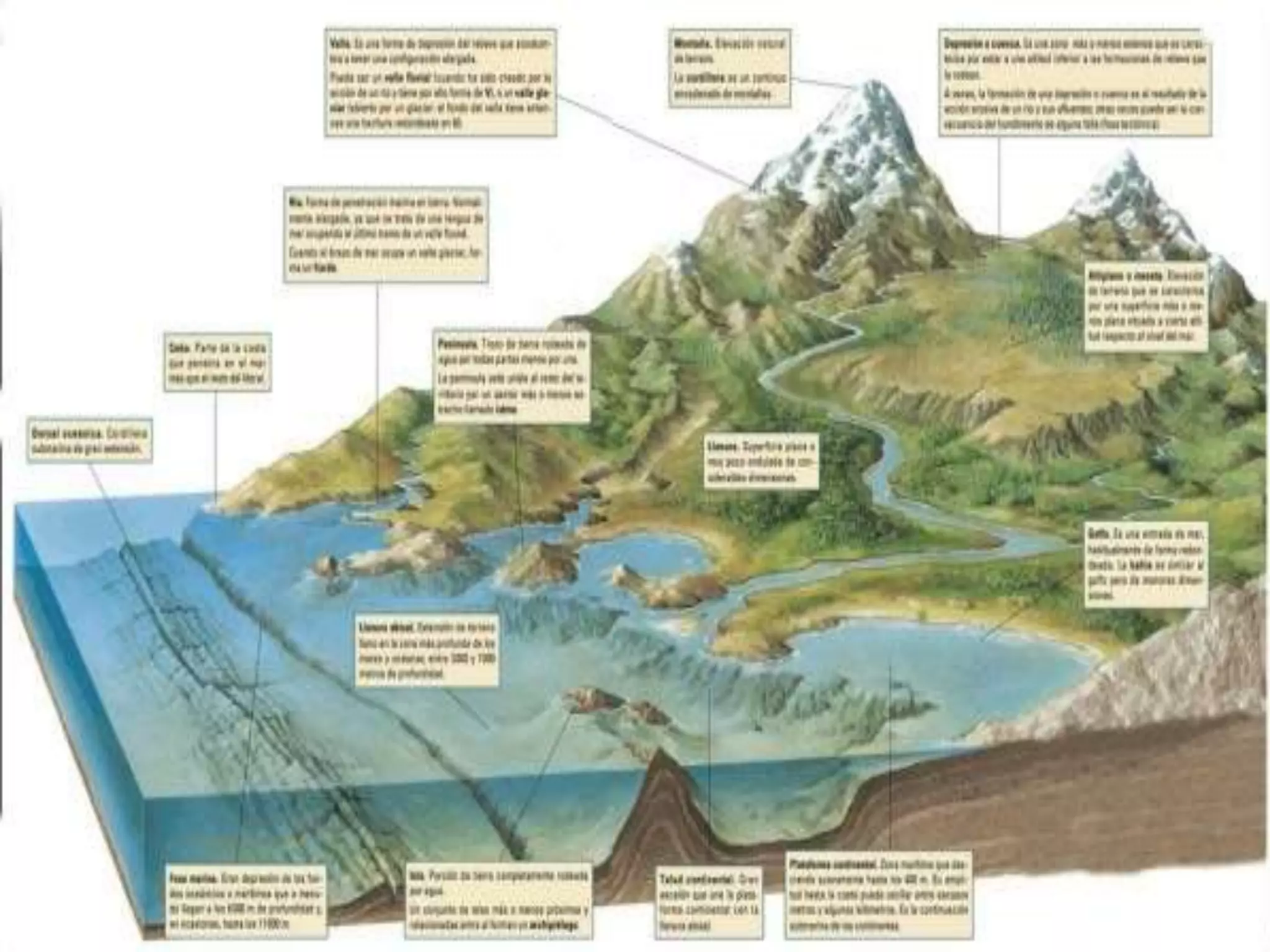
TYPES OF RELIEF
TYPES OF LANDFORMS
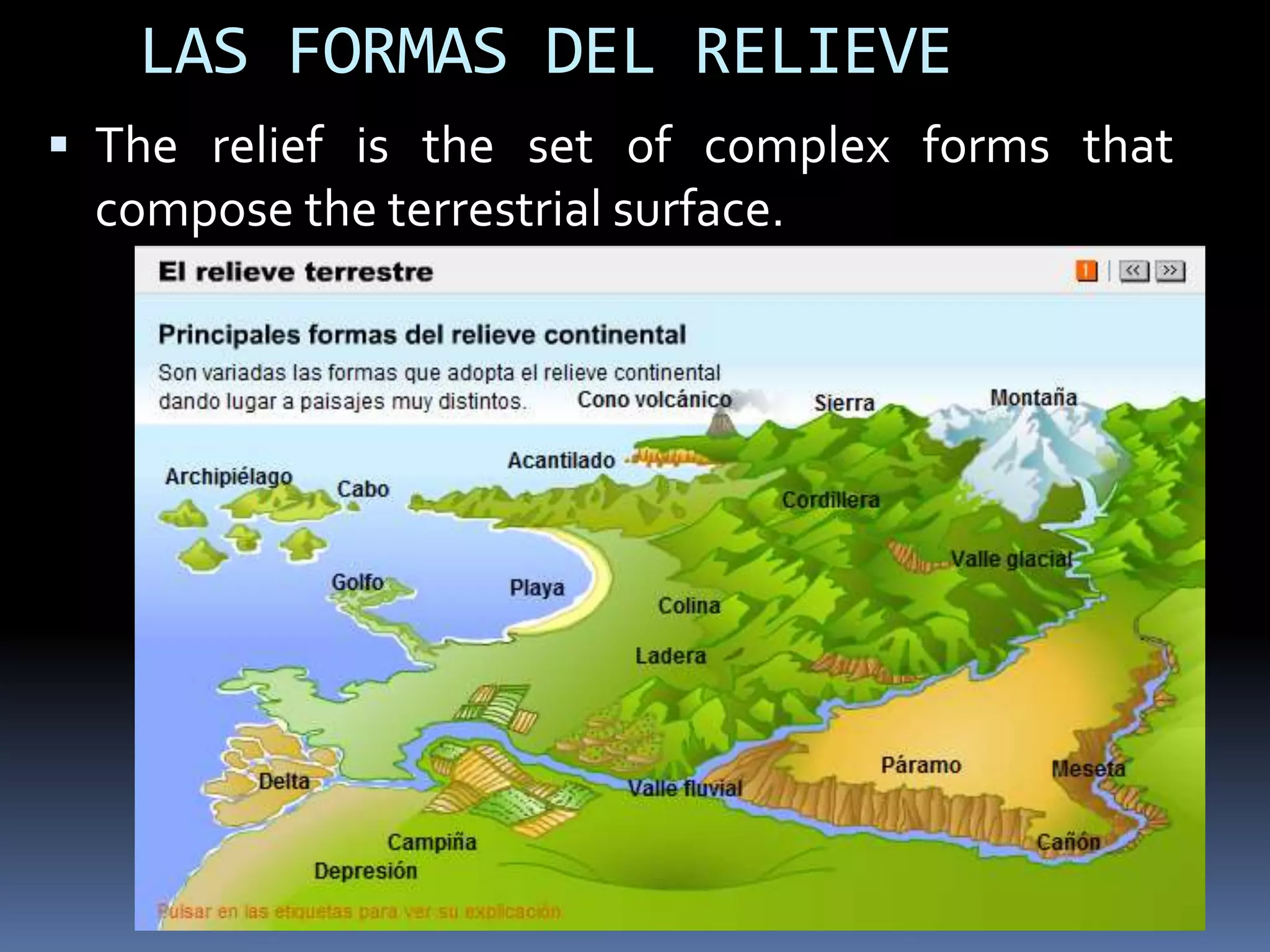
LAS FORMAS DEL RELIEVE
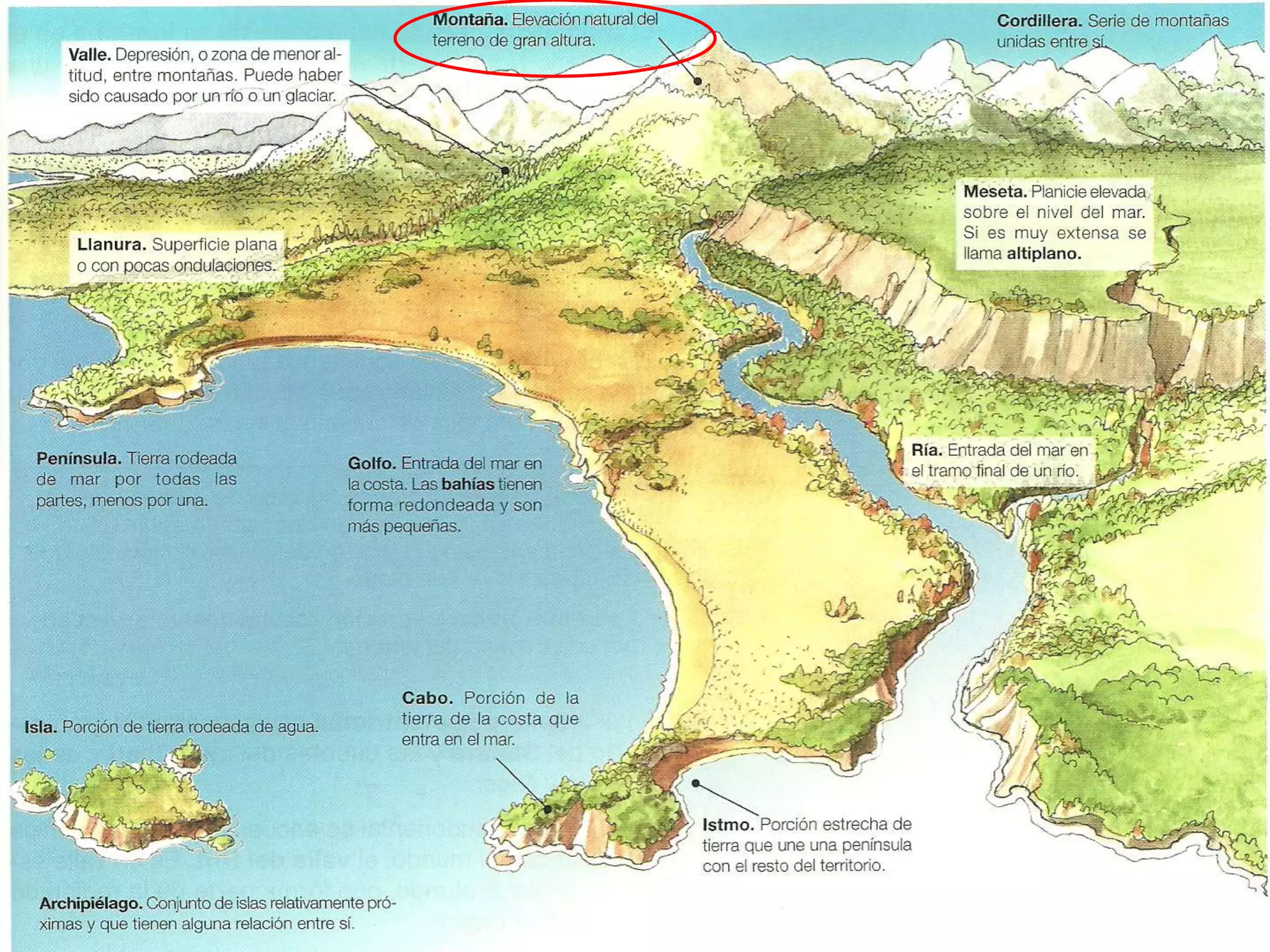
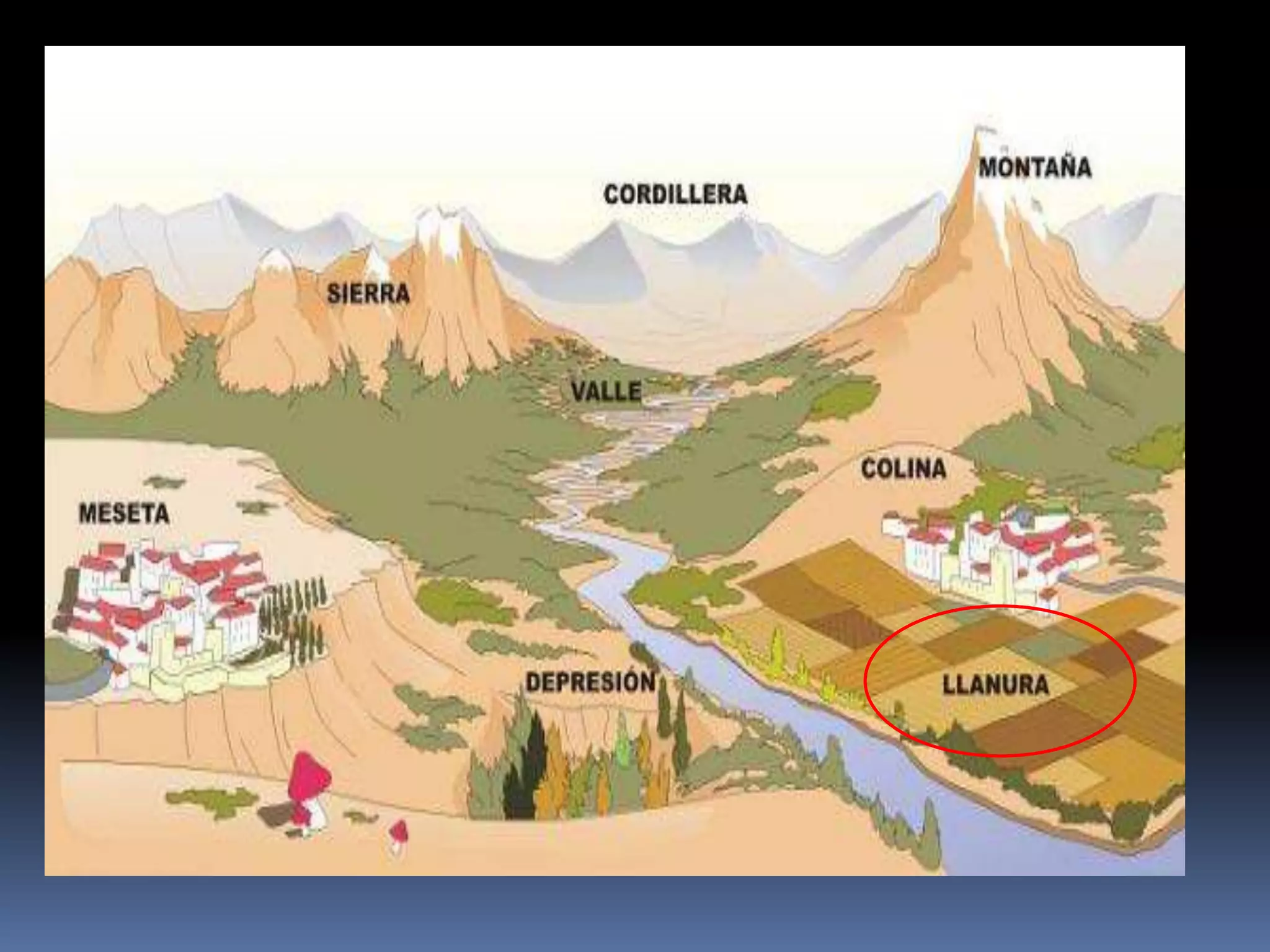
 The relief is the set of complex forms that
compose the terrestrial surface.
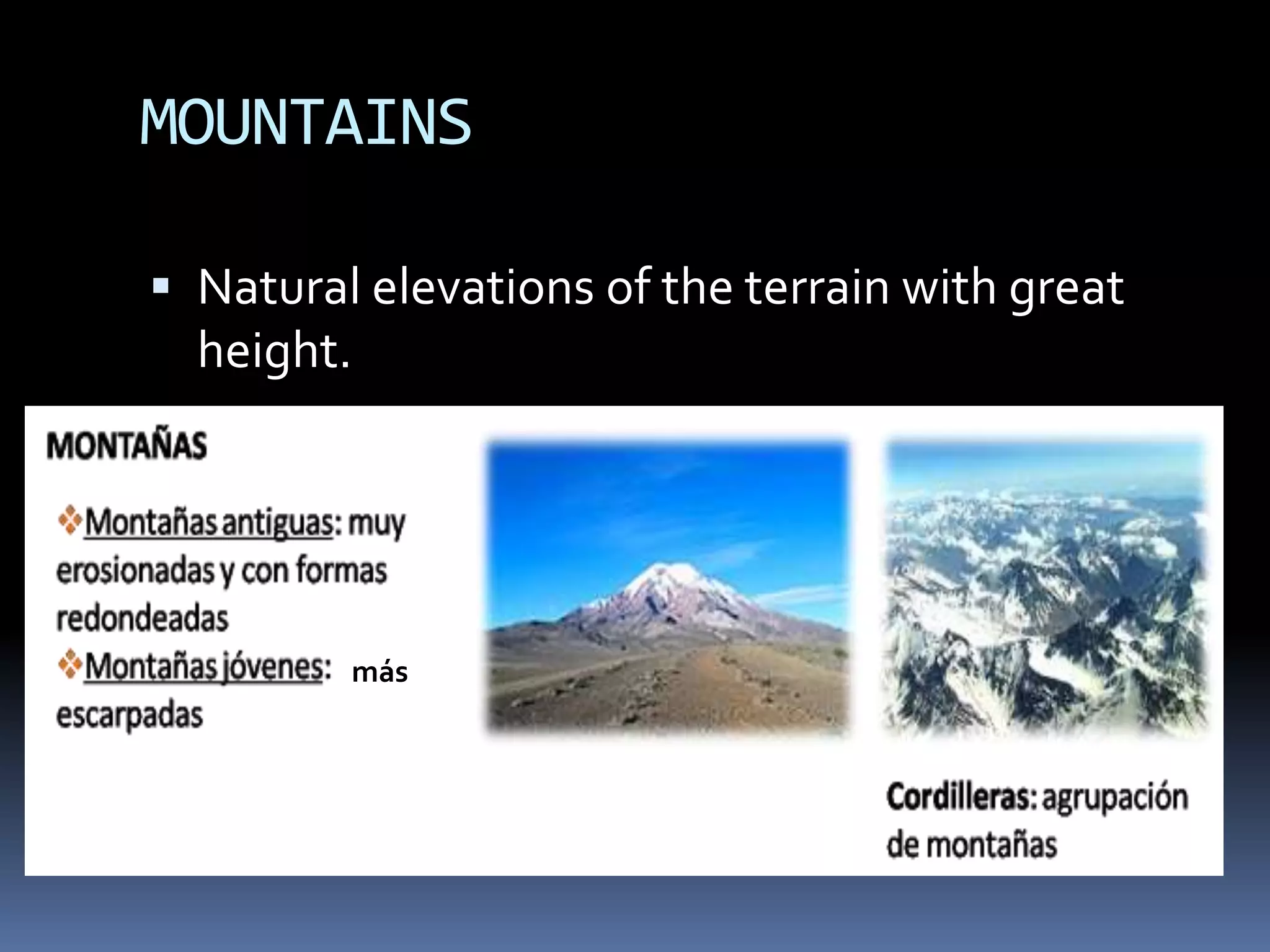
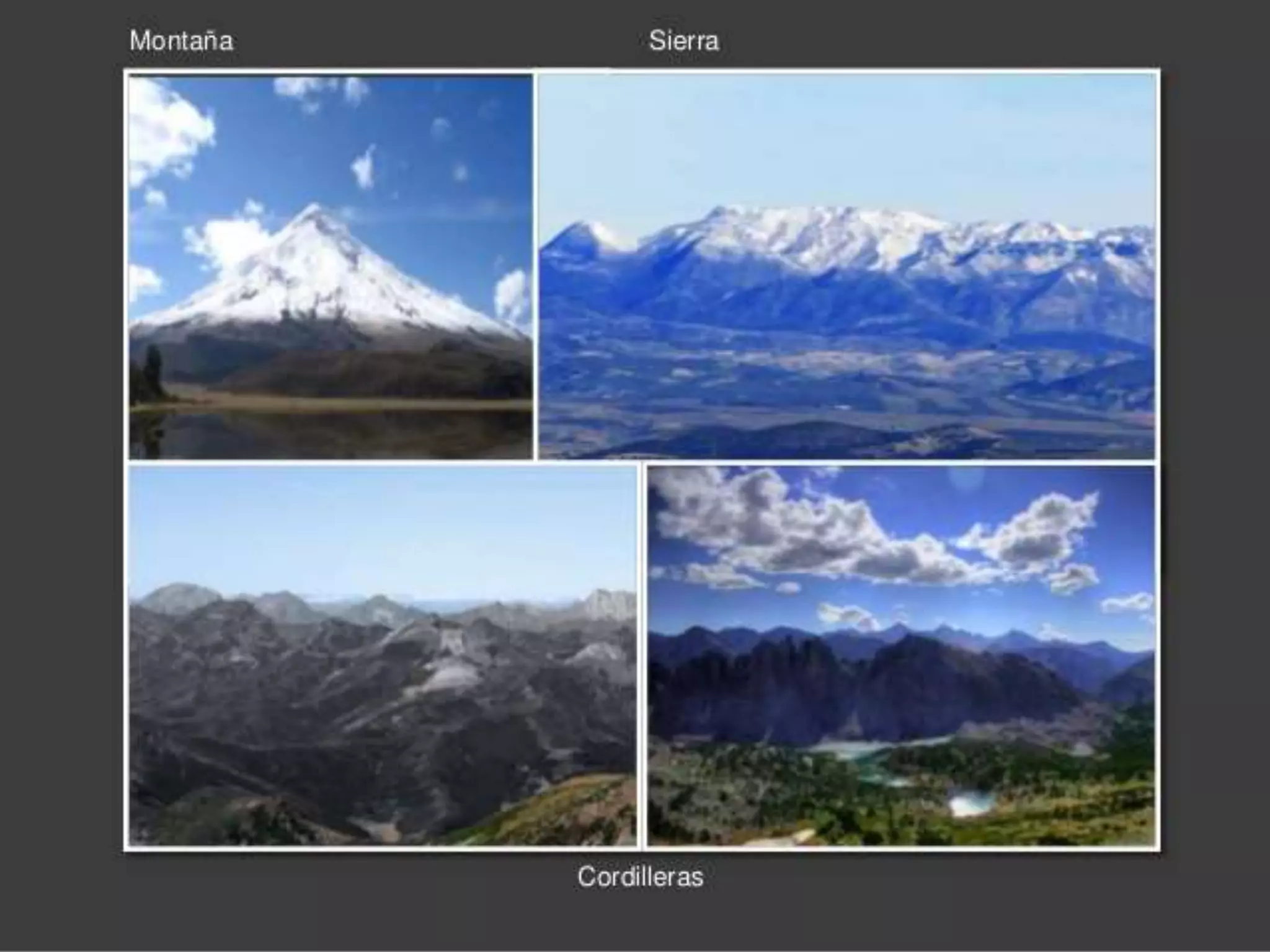
MOUNTAINS
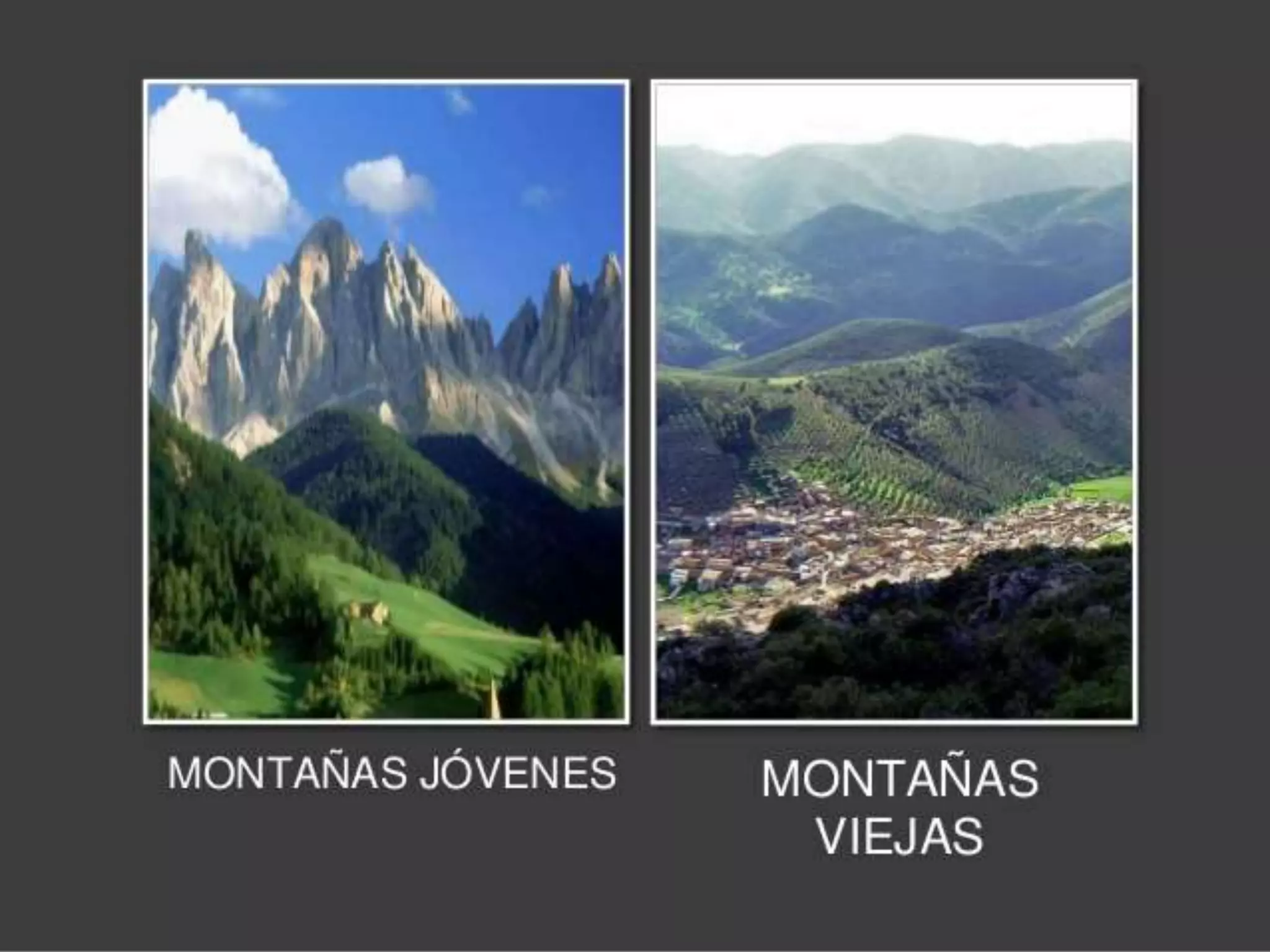
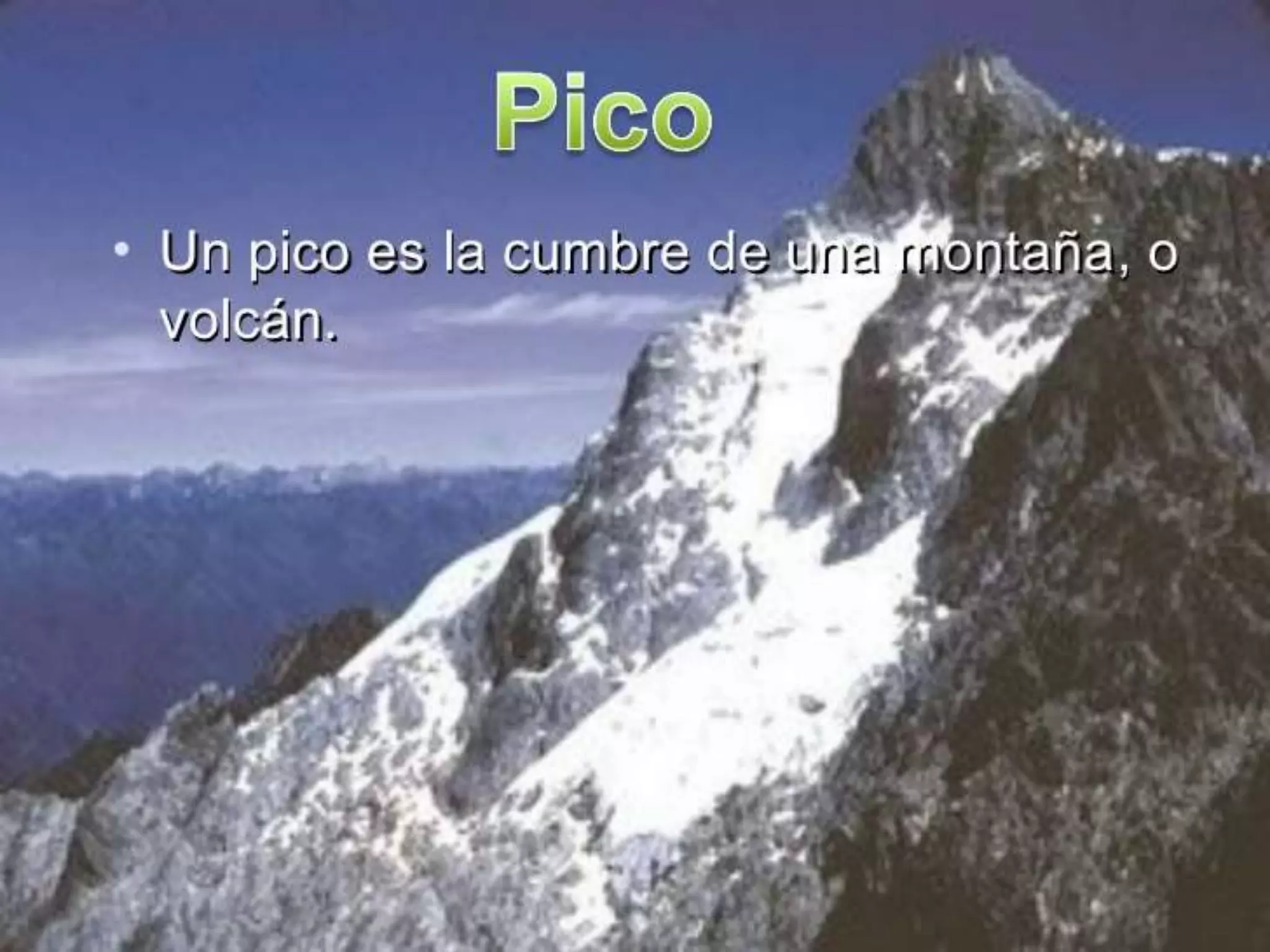
 Natural elevations of the terrain with great
height.
más
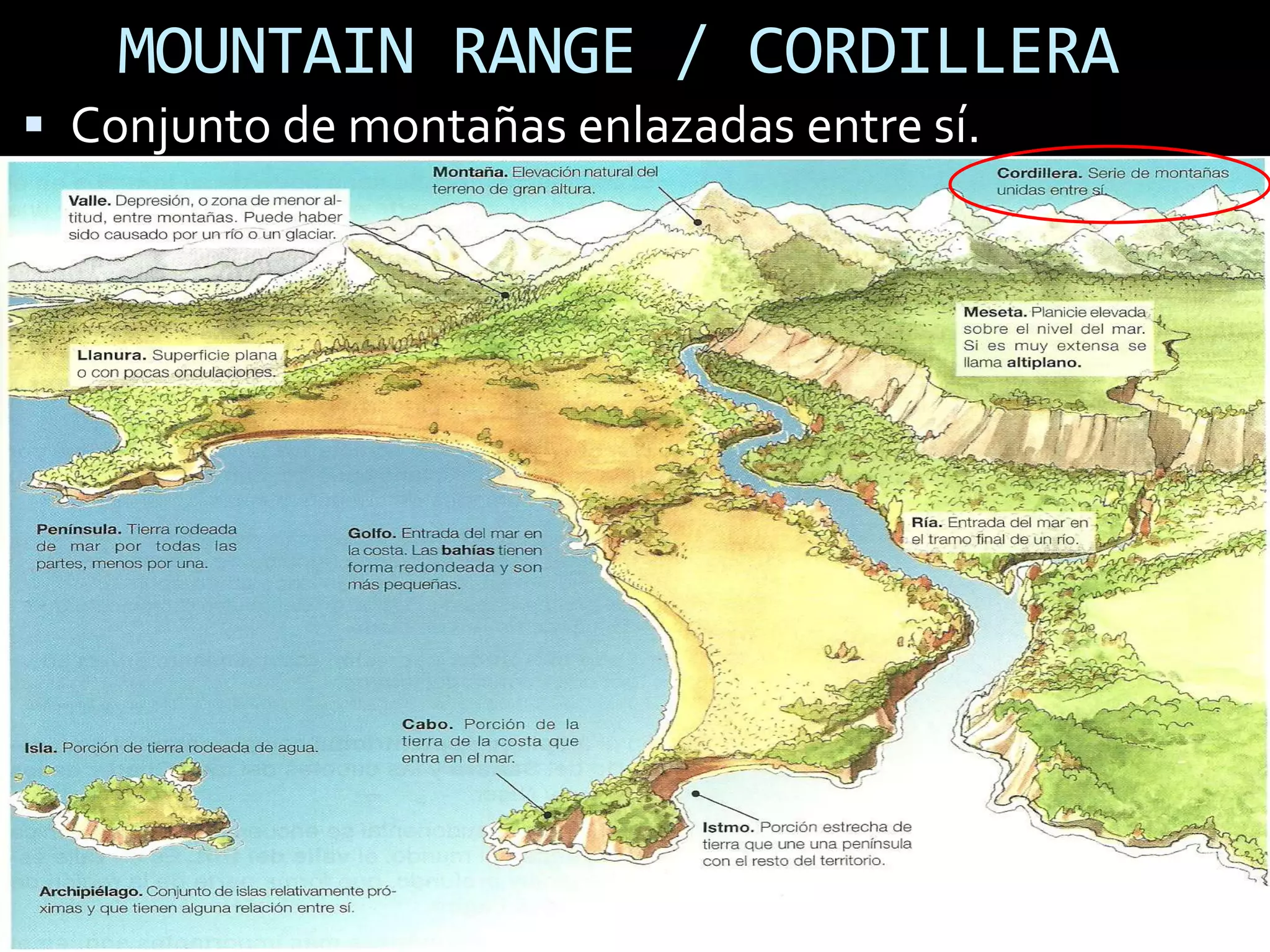
MOUNTAIN RANGE / CORDILLERA
 Conjunto de montañas enlazadas entre sí.
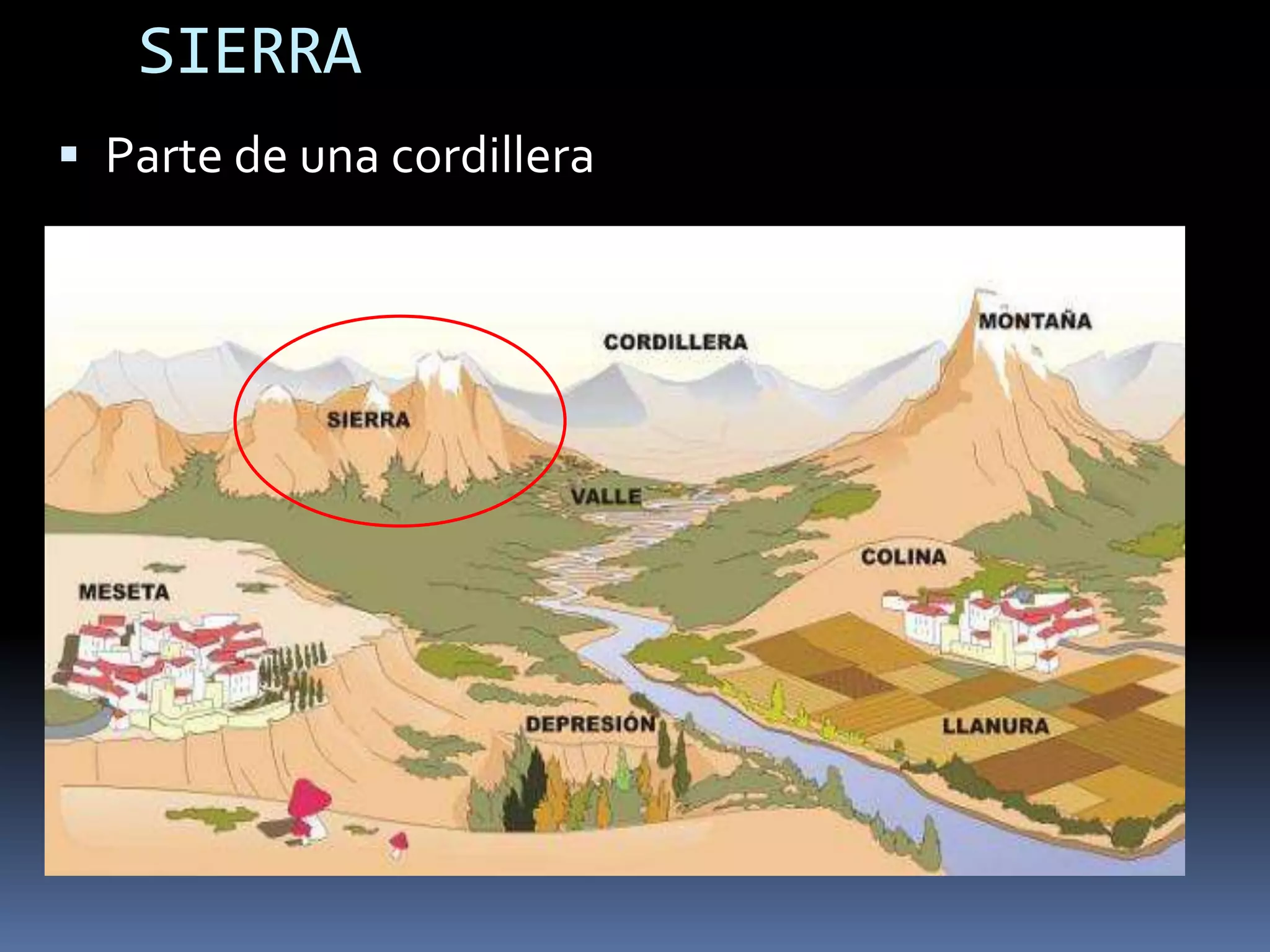
SIERRA
 Parte de una cordillera
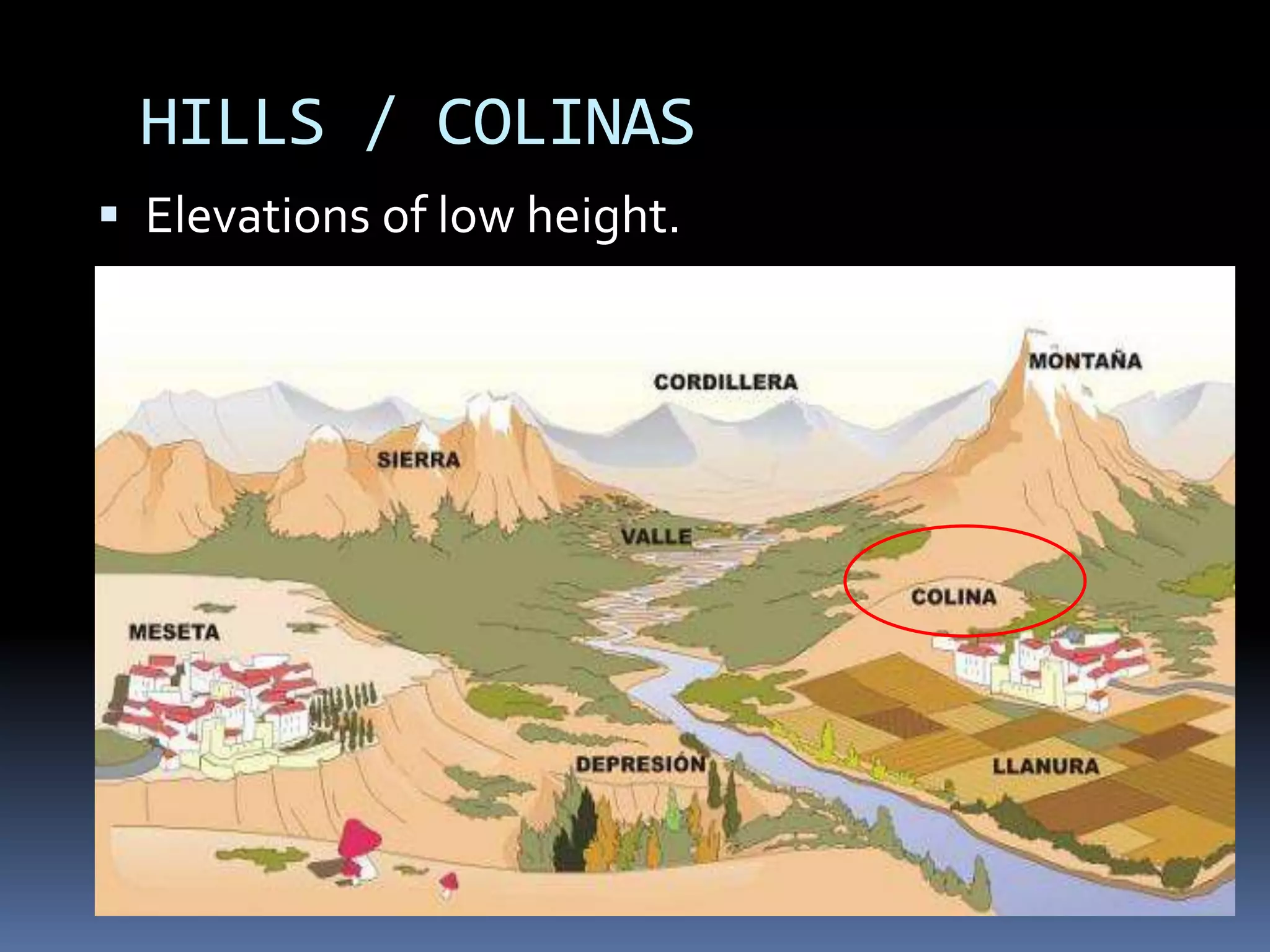
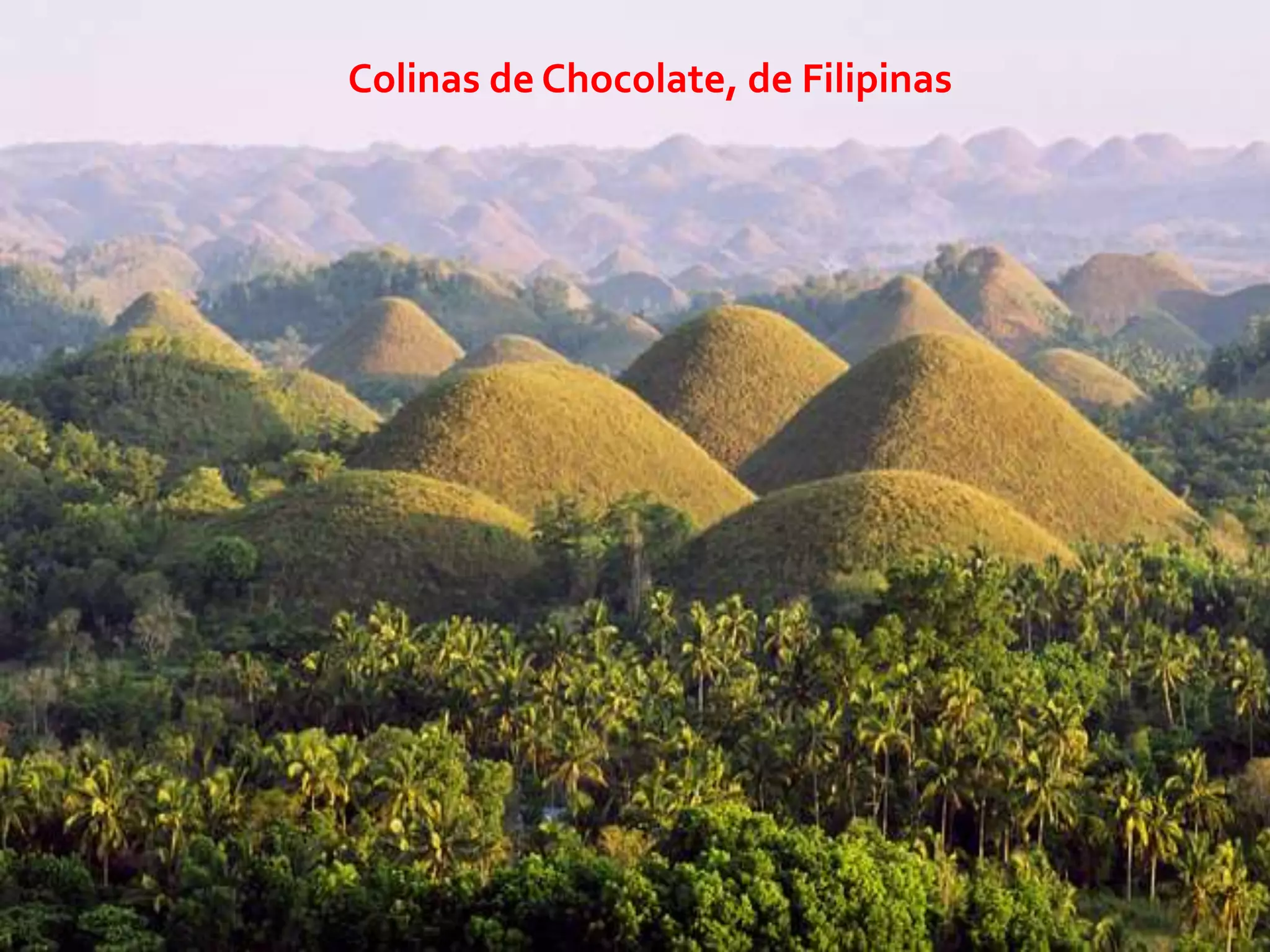
HILLS / COLINAS
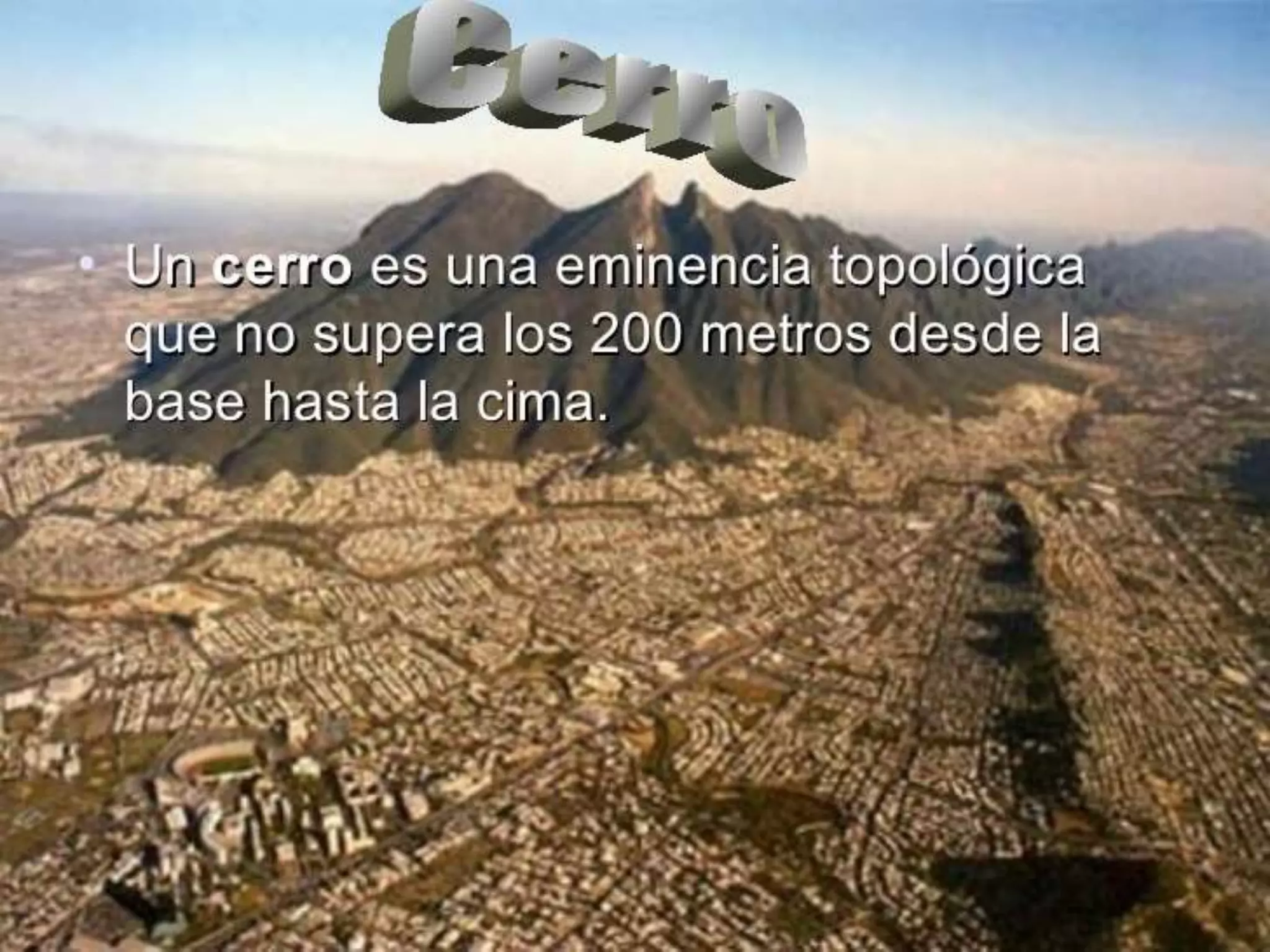
 Elevations of low height.
Colinas de Chocolate, de Filipinas
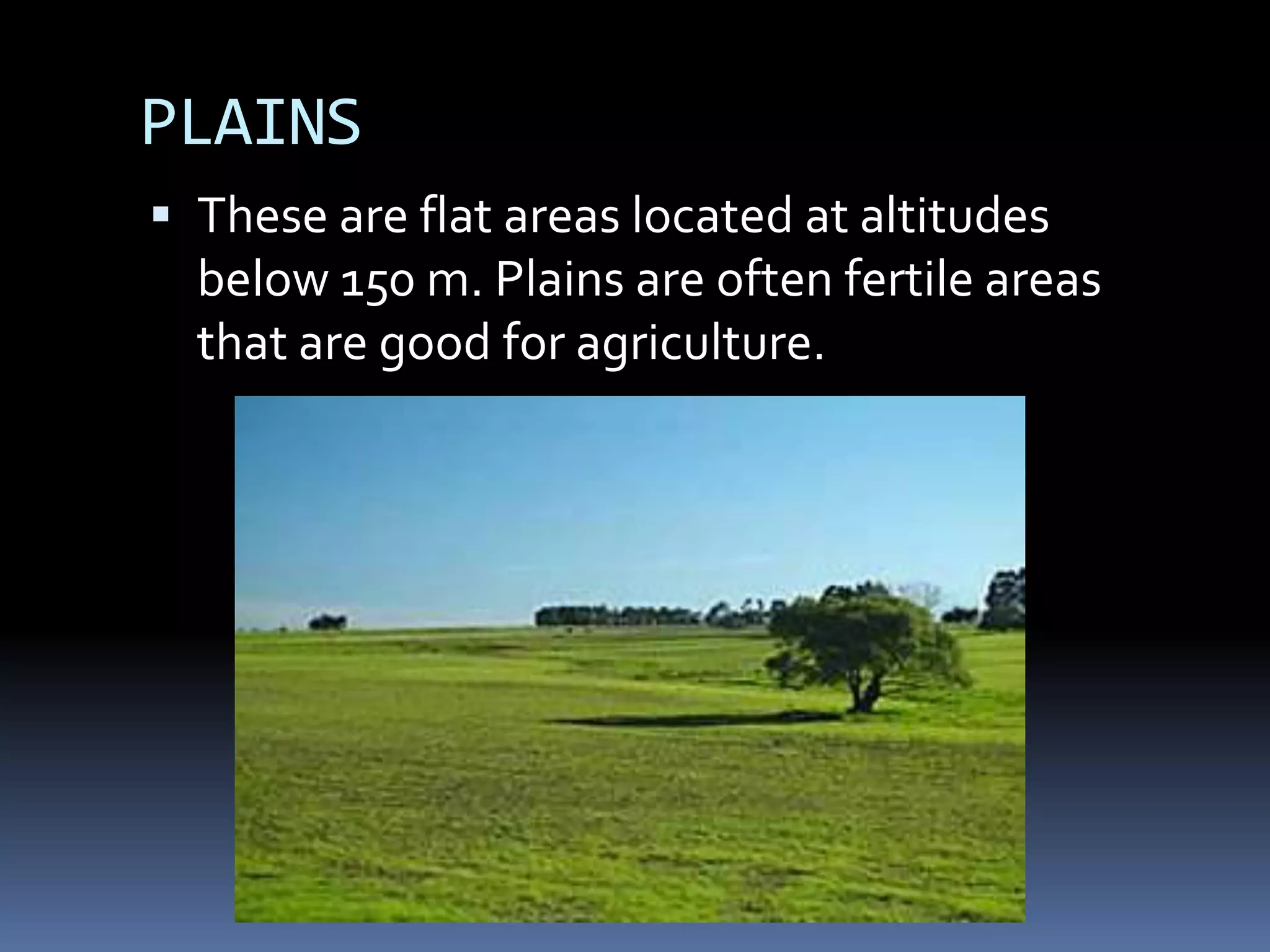
PLAINS
 These are flat areas located at altitudes
below 150 m. Plains are often fertile areas
that are good for agriculture.
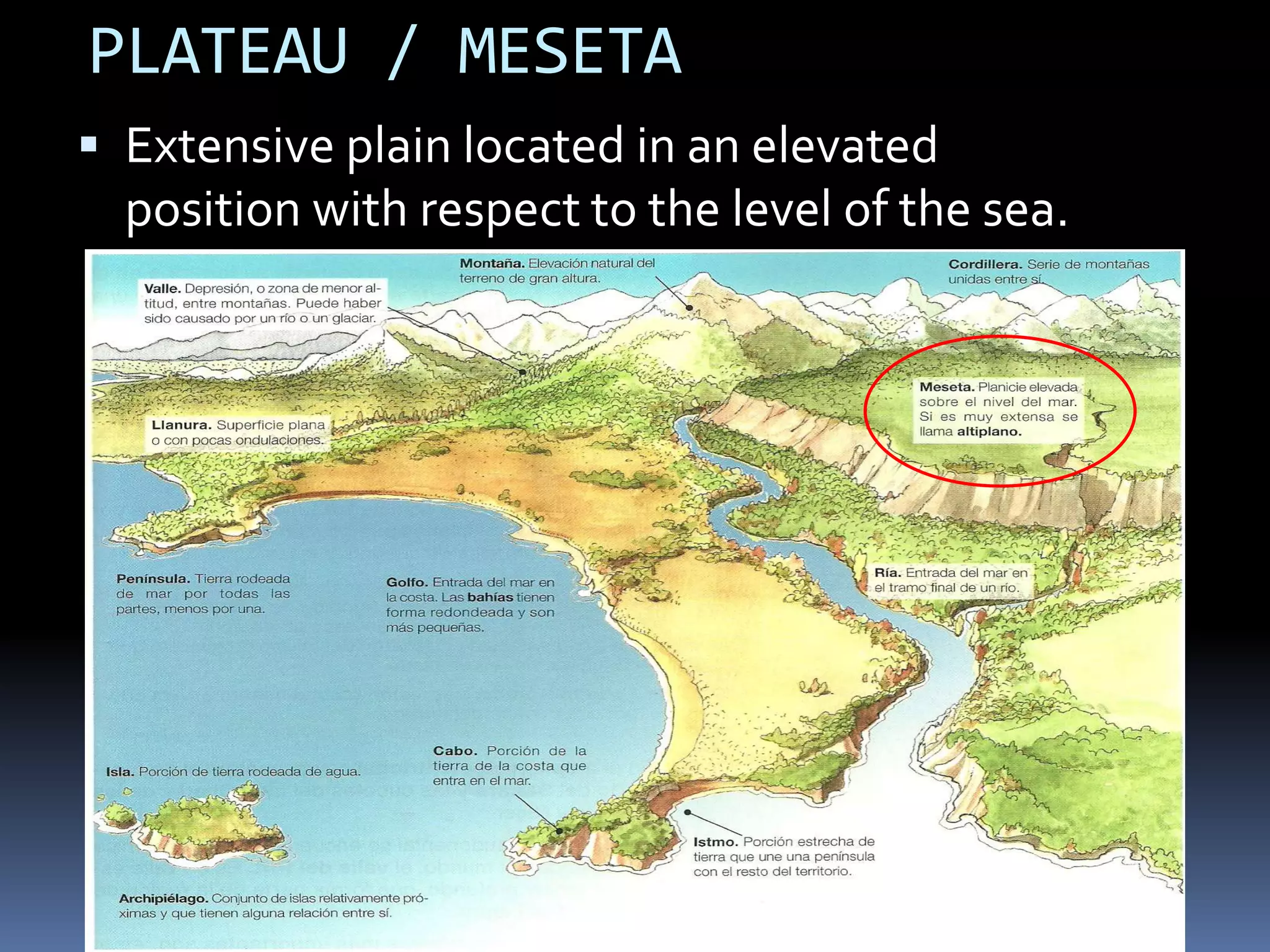
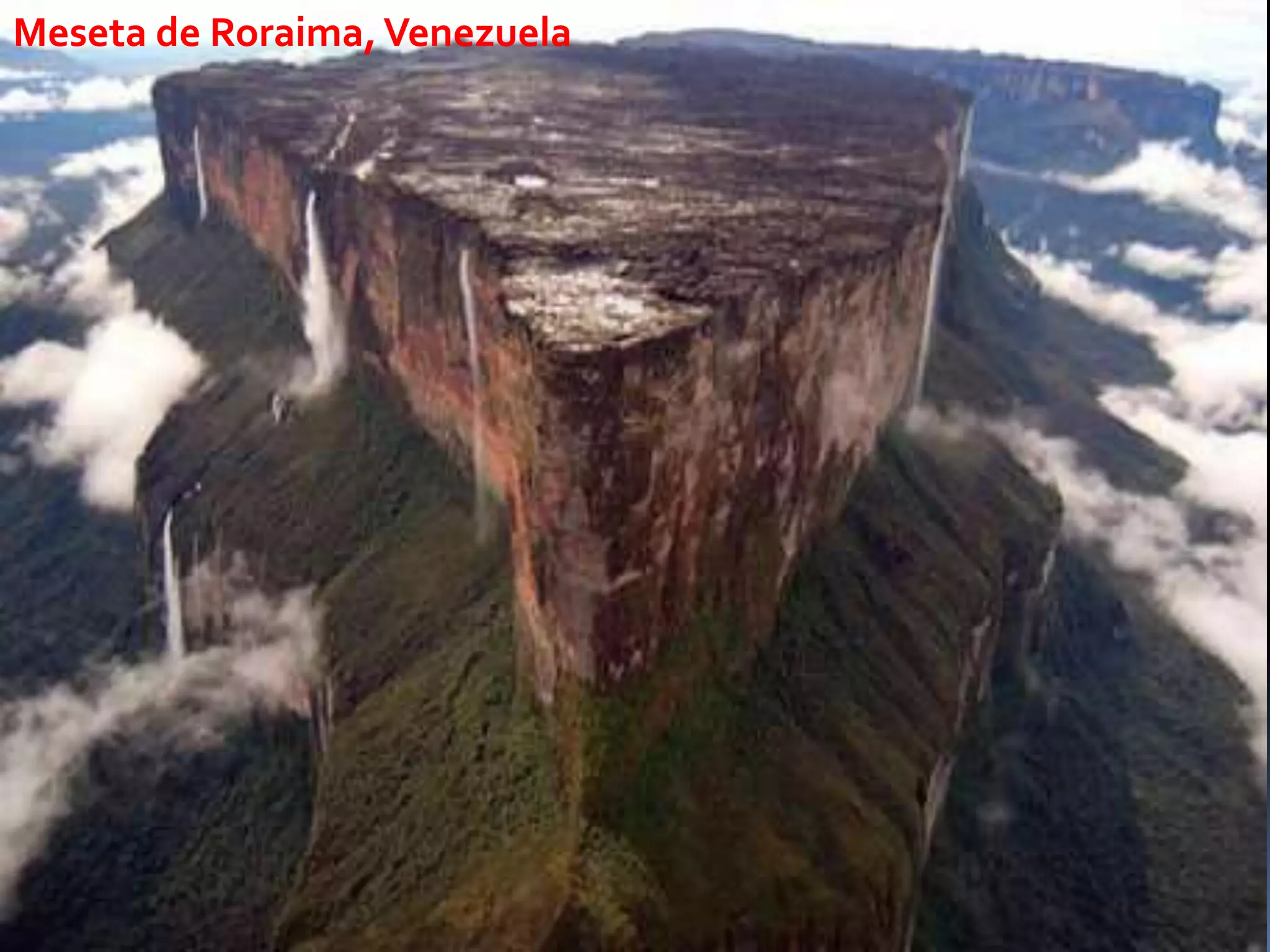
PLATEAU / MESETA
 Extensive plain located in an elevated
position with respect to the level of the sea.
Meseta de Roraima,Venezuela
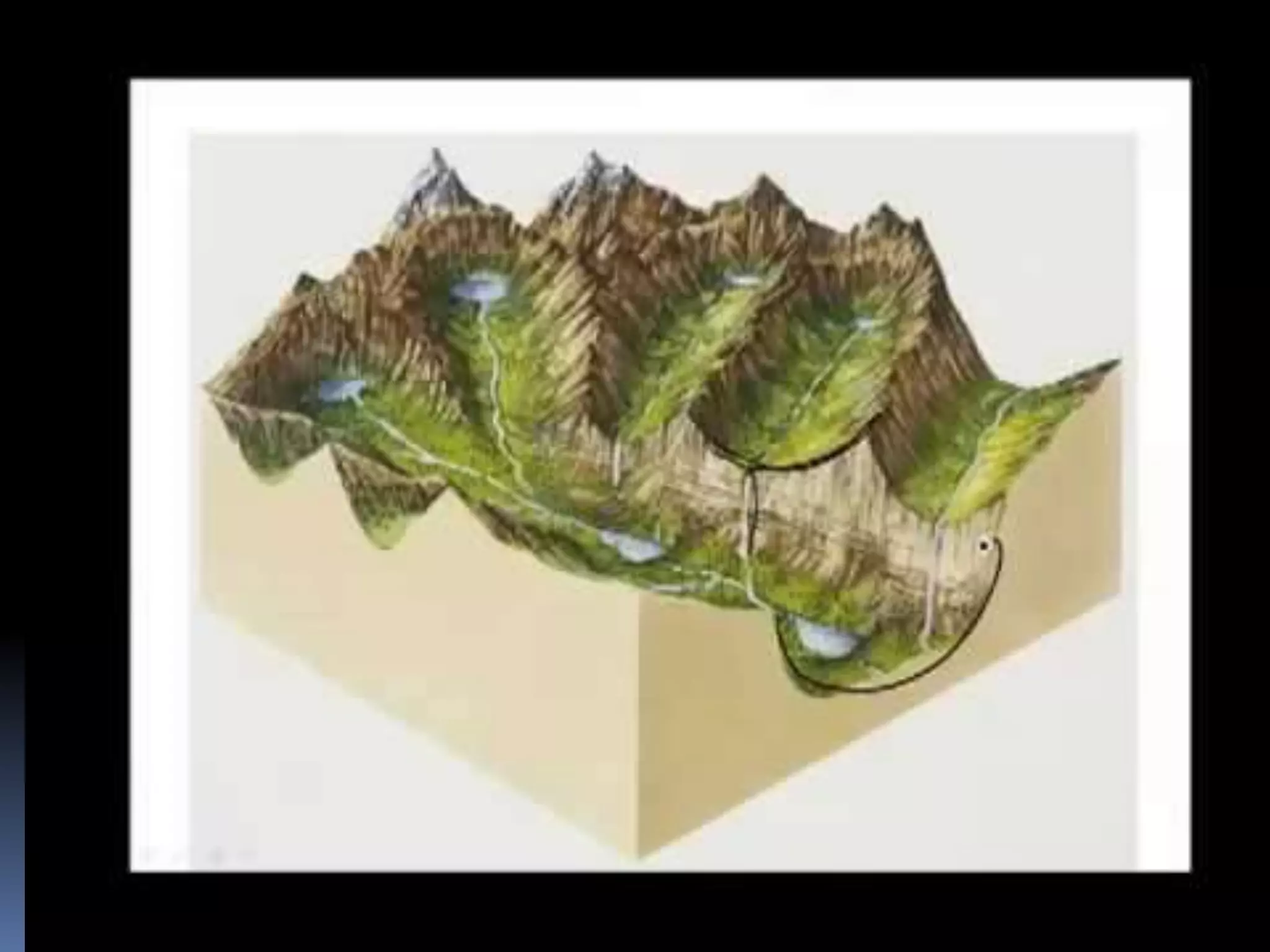
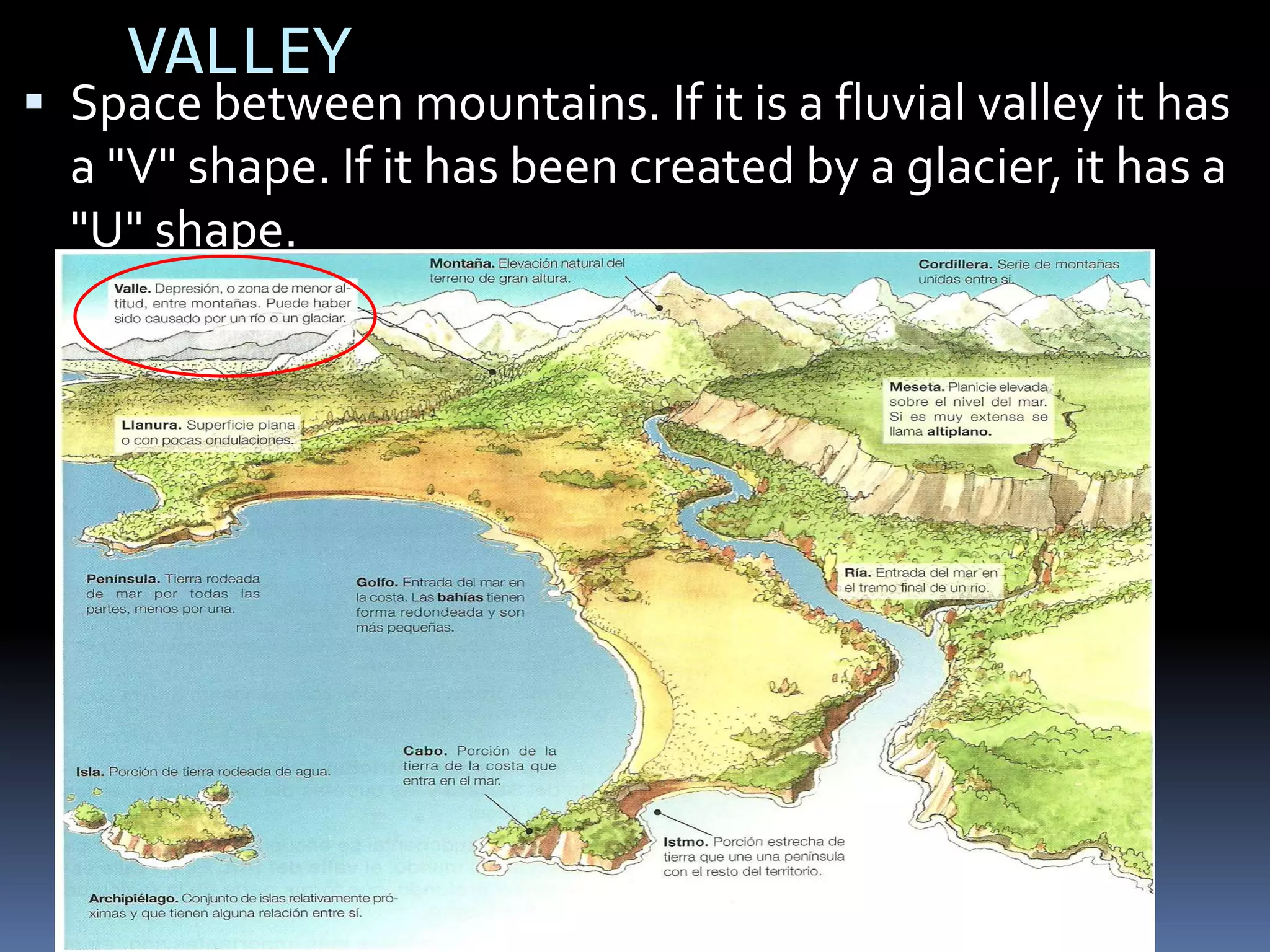
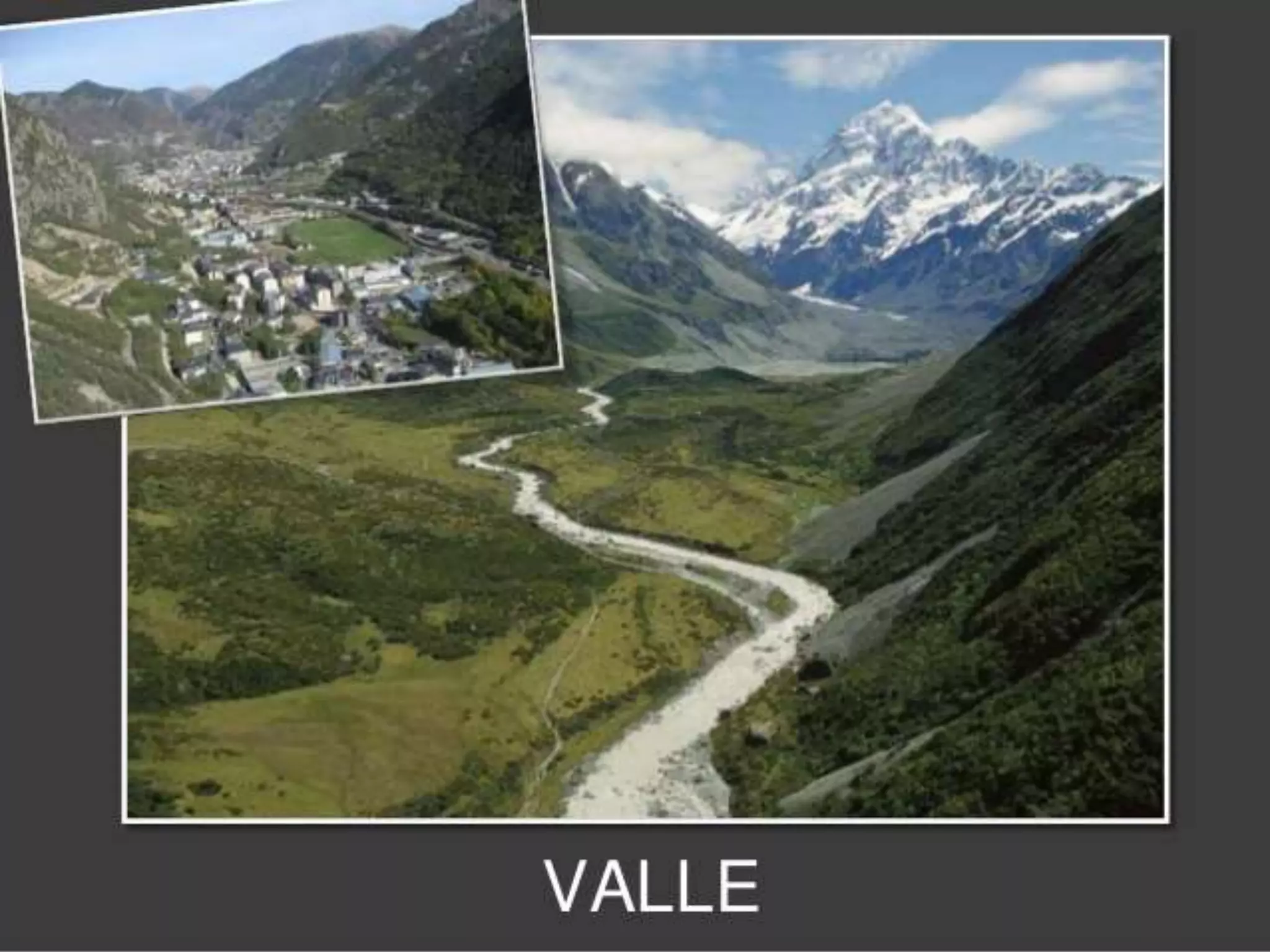
VALLEY
 Space between mountains. If it is a fluvial valley it has
a "V" shape. If it has been created by a glacier, it has a
"U" shape.
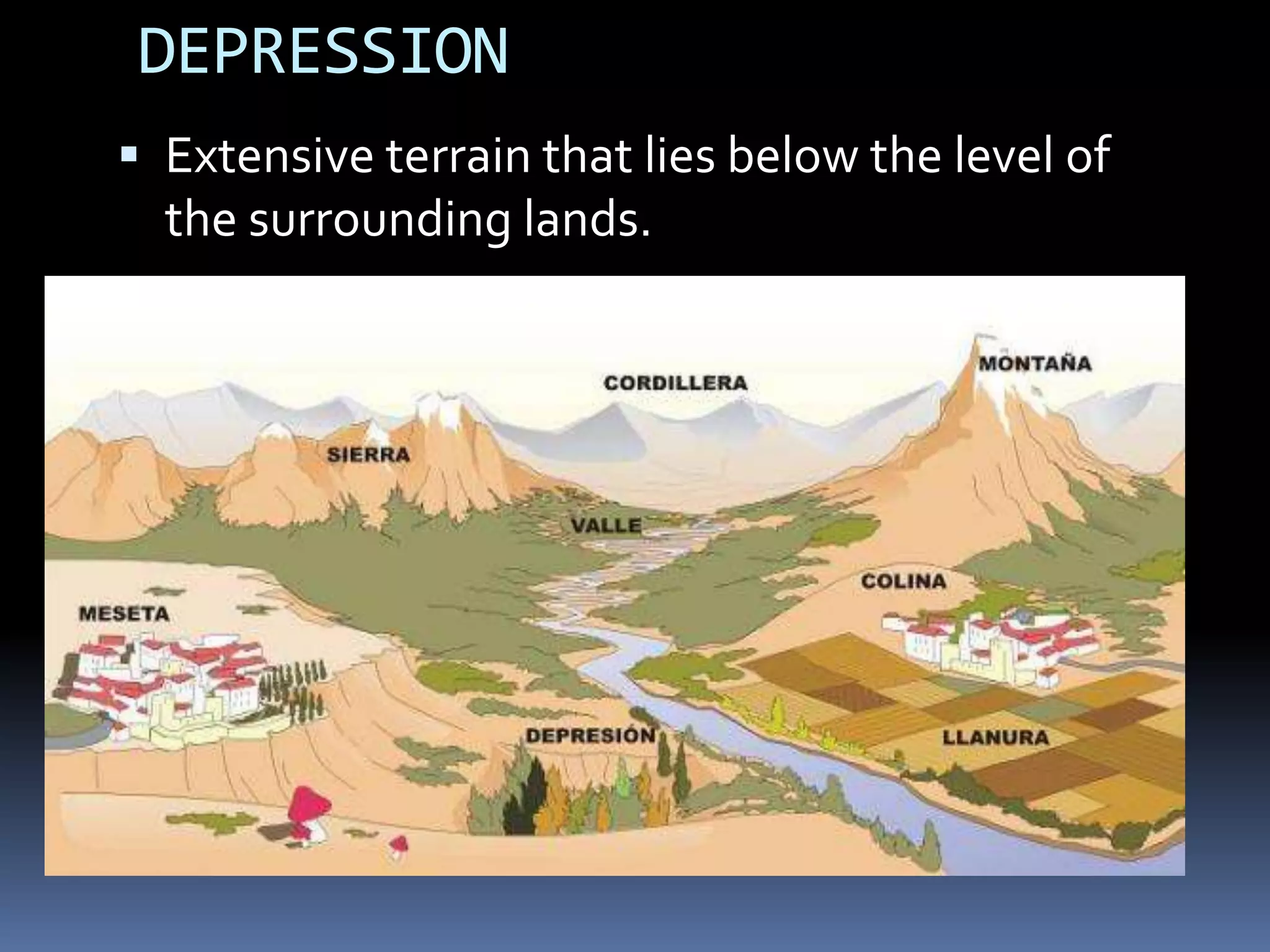
DEPRESSION
 Extensive terrain that lies below the level of
the surrounding lands.
 Coastal relief is located in areas where the
emerging land is in contact with the sea.
 If the continental area is flat and has a low altitude
dominated by beaches.
 If the continental area is mountainous  cliffs.
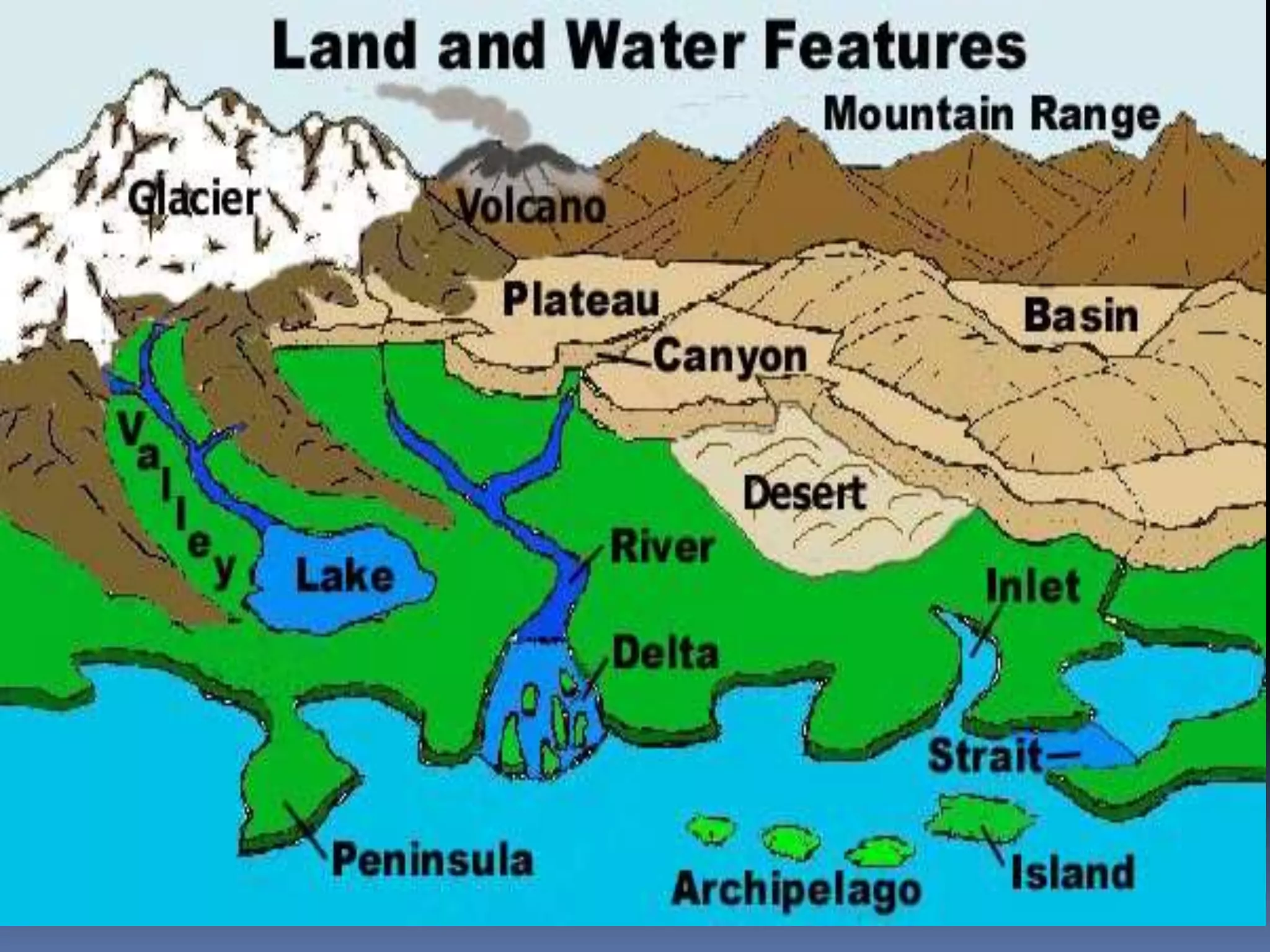
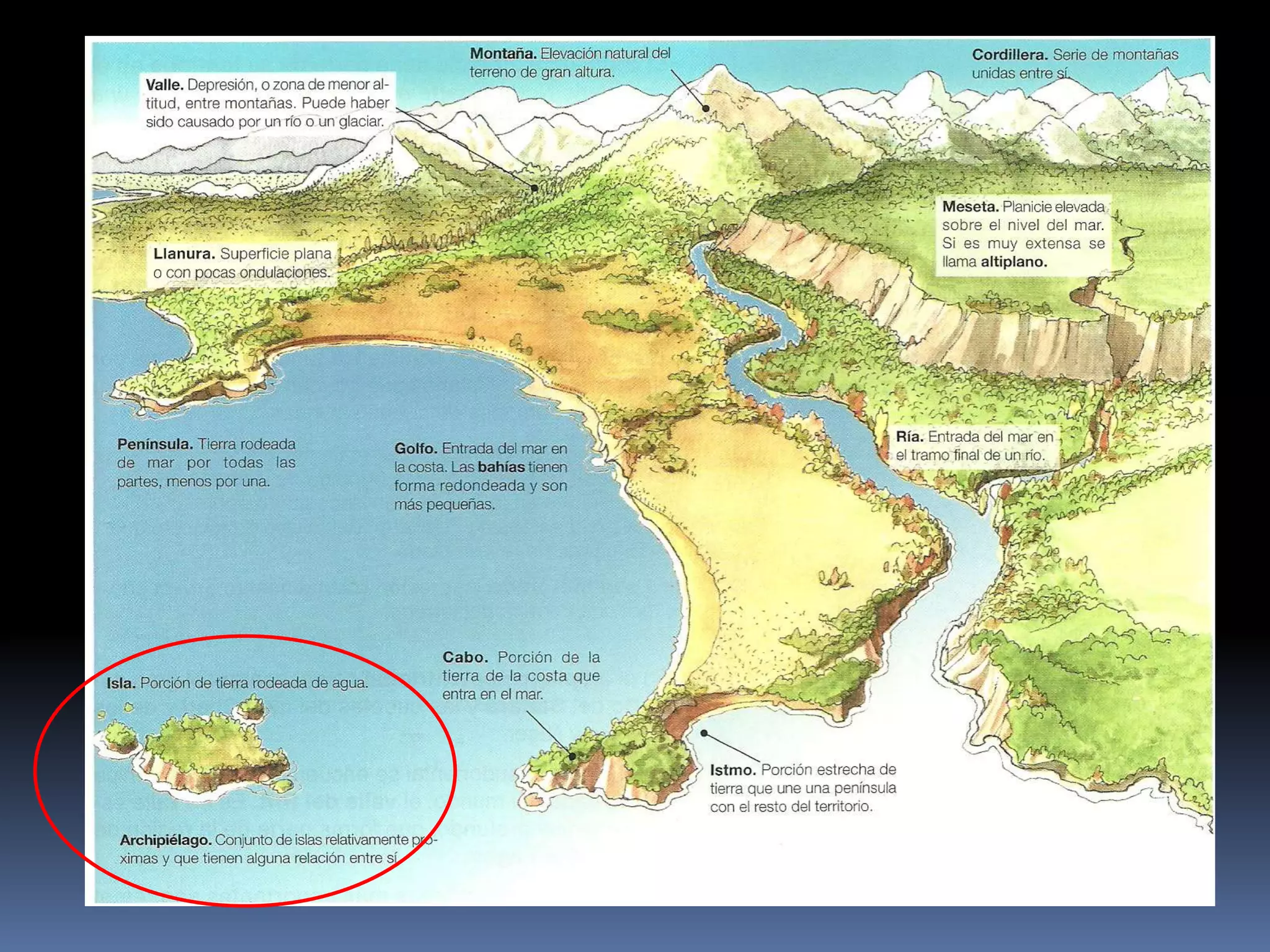
 They can be different forms: beaches, capes,
gulfs, peninsulas, inlets and fjords, islands and
archipelagos…
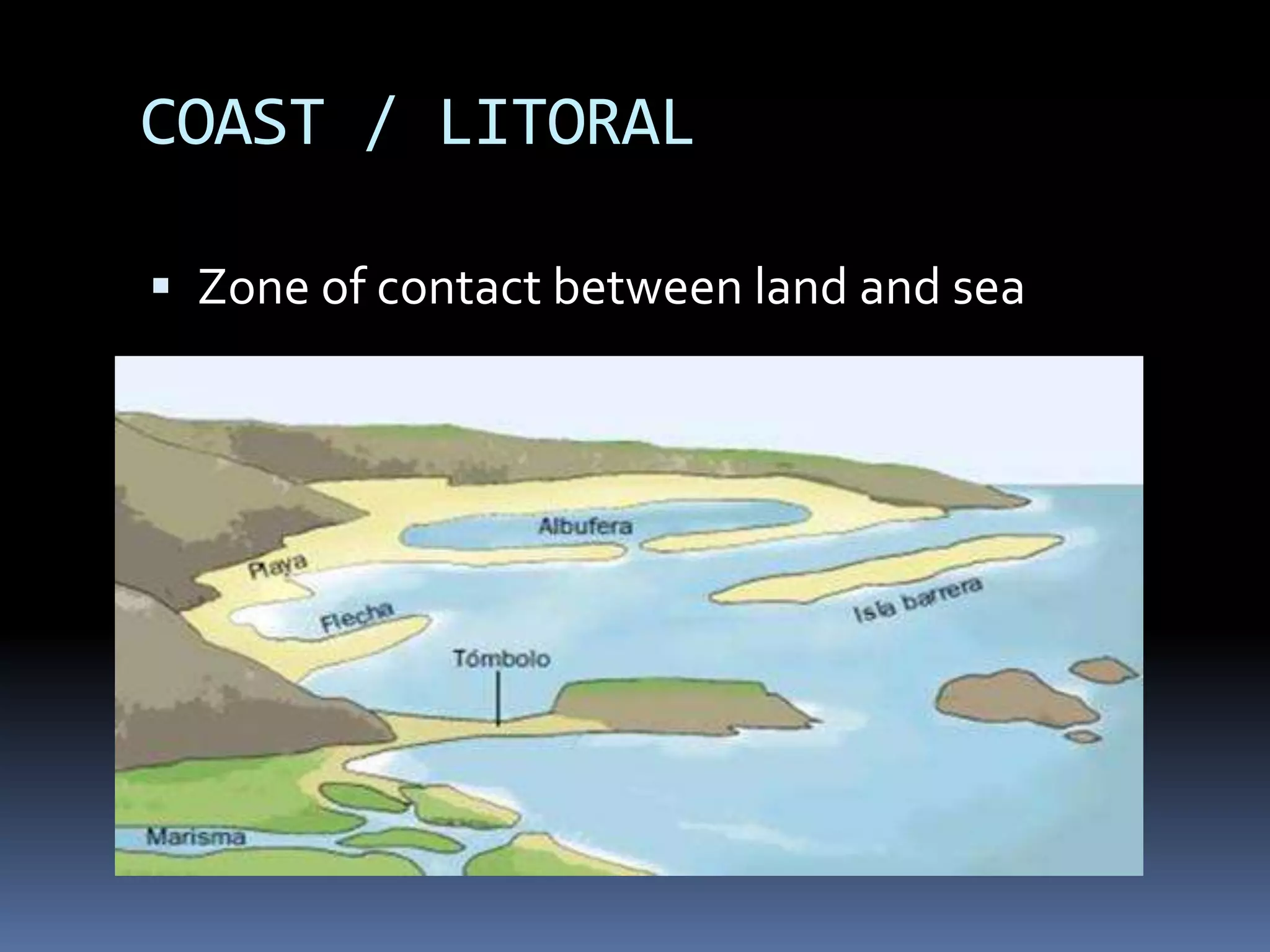
COAST / LITORAL
 Zone of contact between land and sea
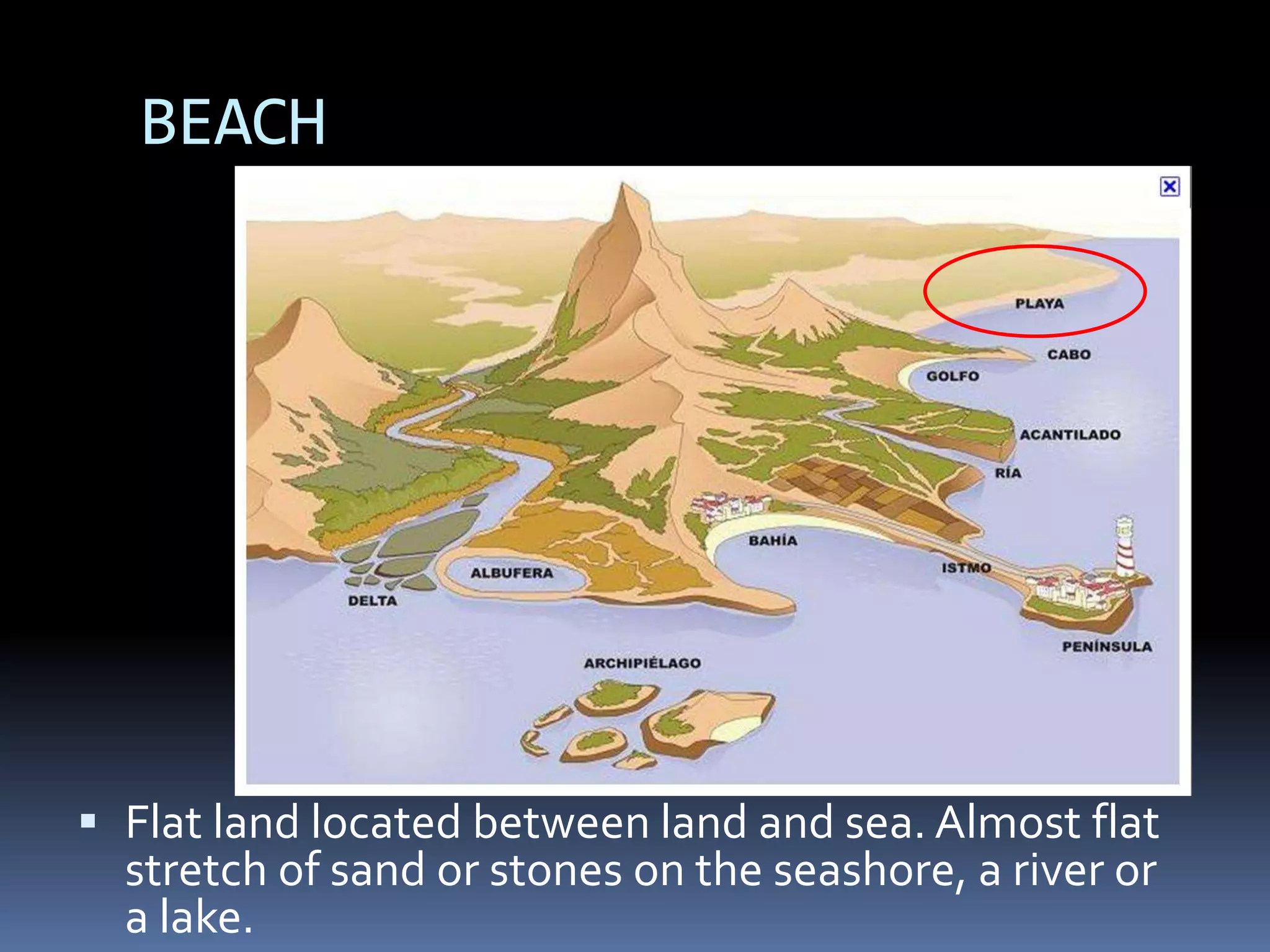
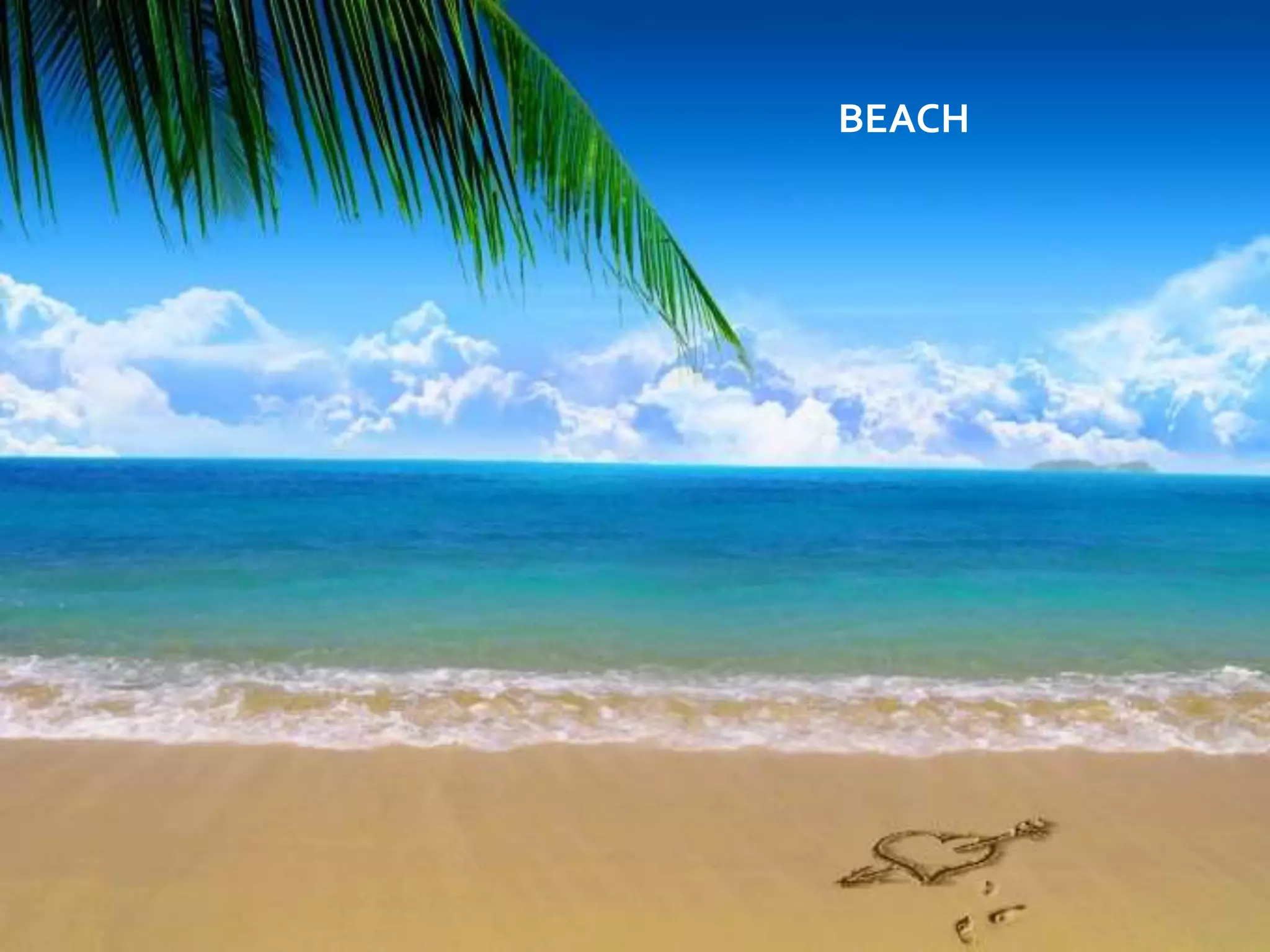
BEACH
 Flat land located between land and sea. Almost flat
stretch of sand or stones on the seashore, a river or
a lake.
BEACH
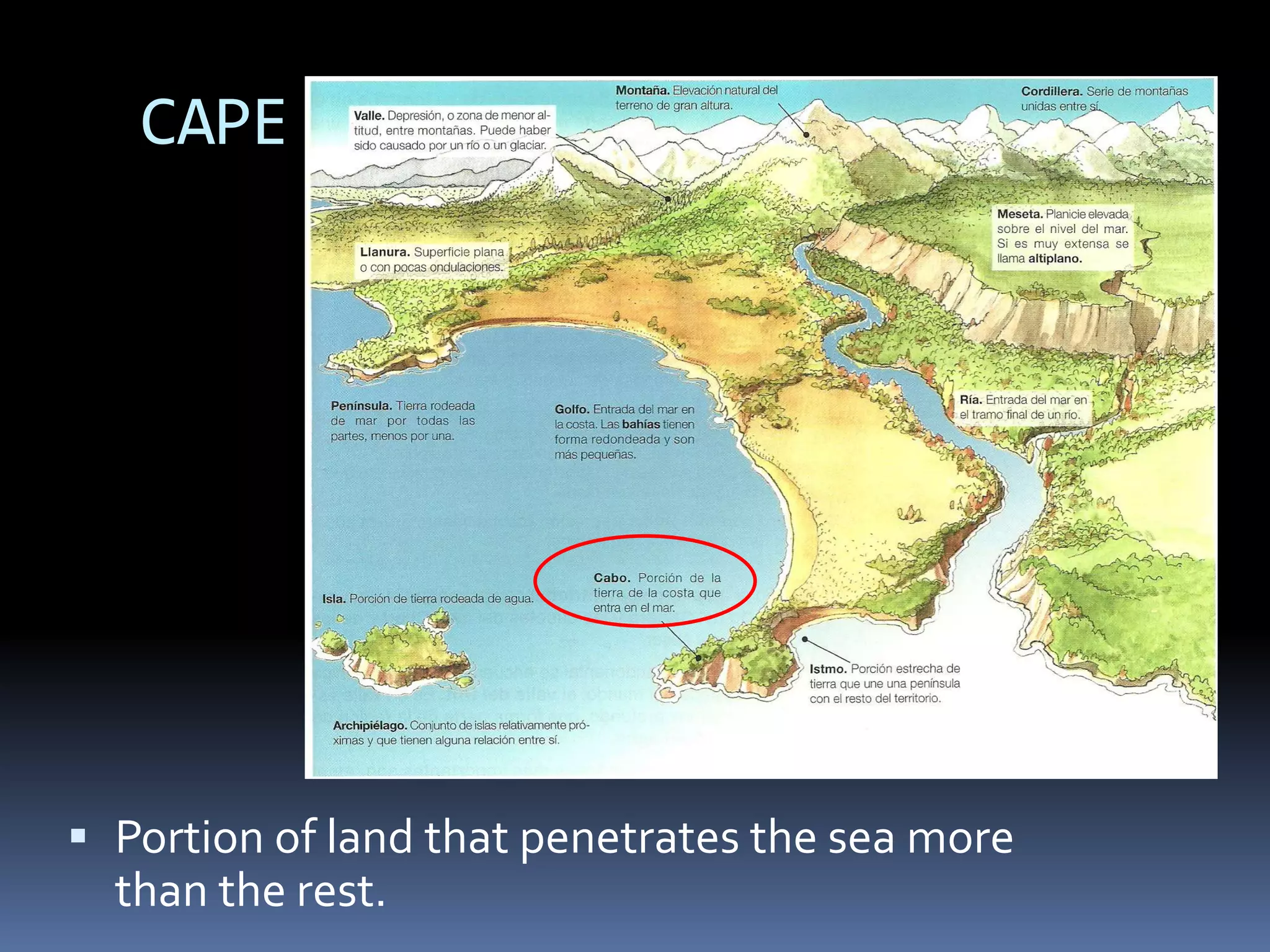
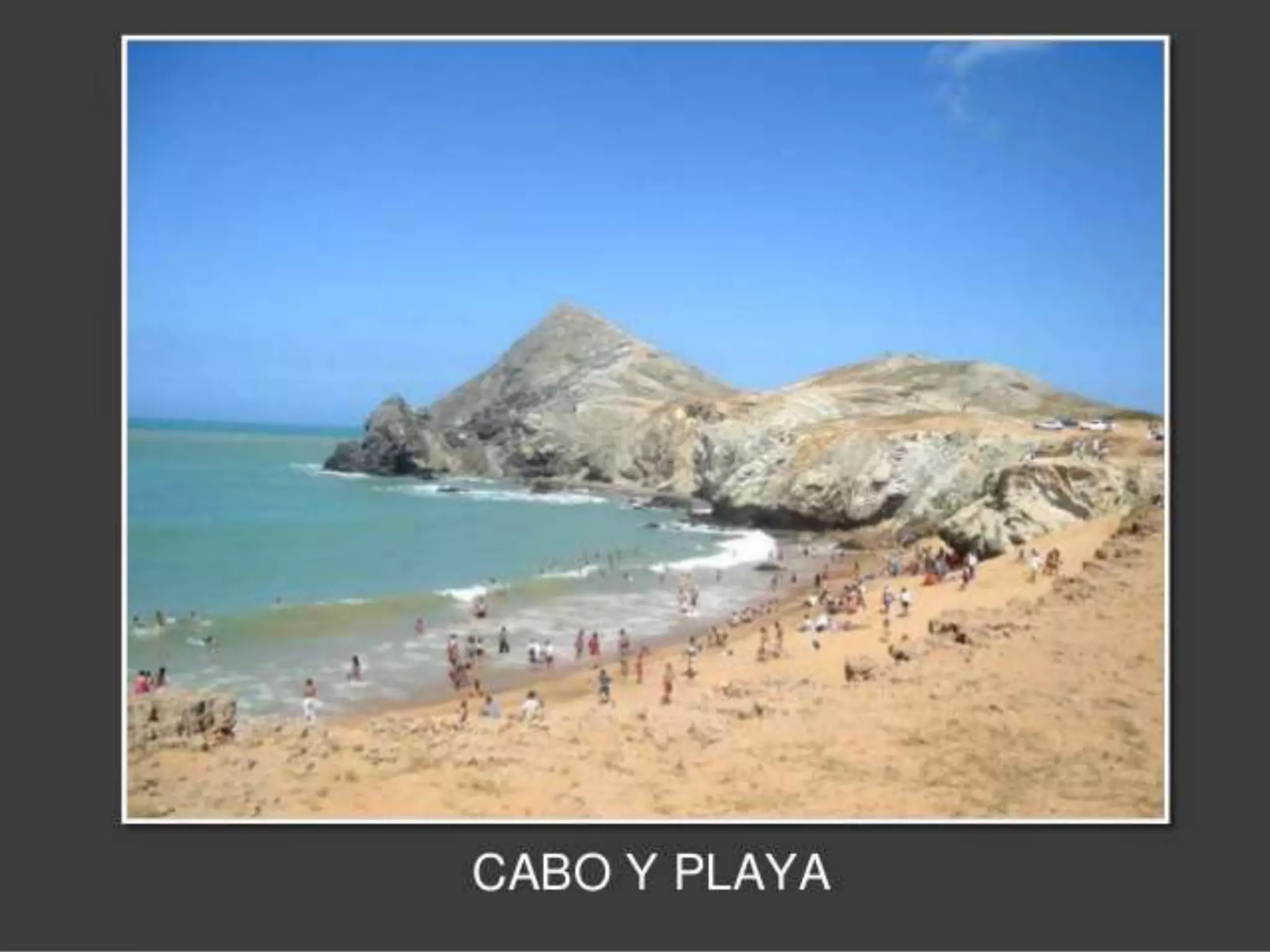
CAPE
 Portion of land that penetrates the sea more
than the rest.
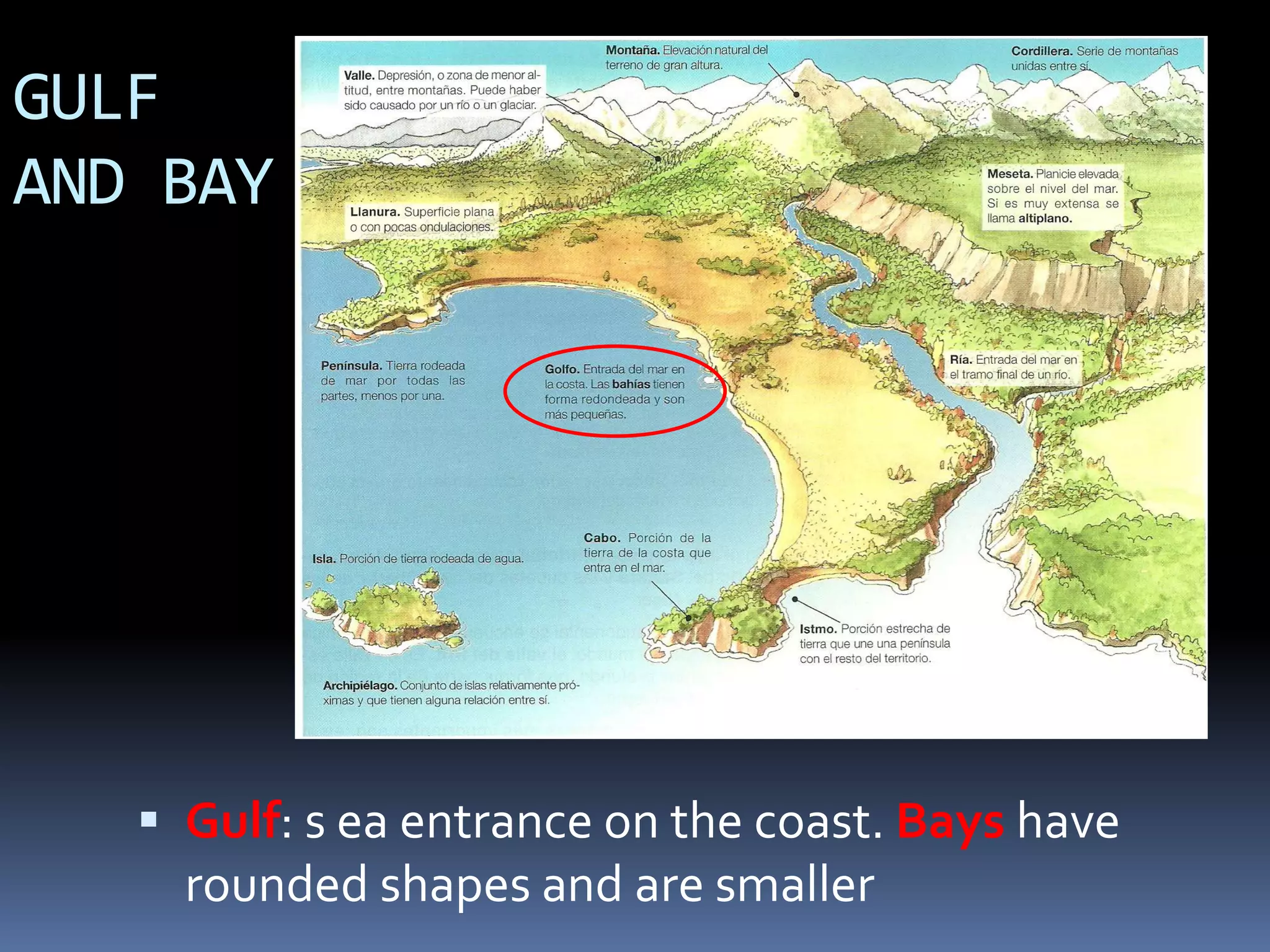
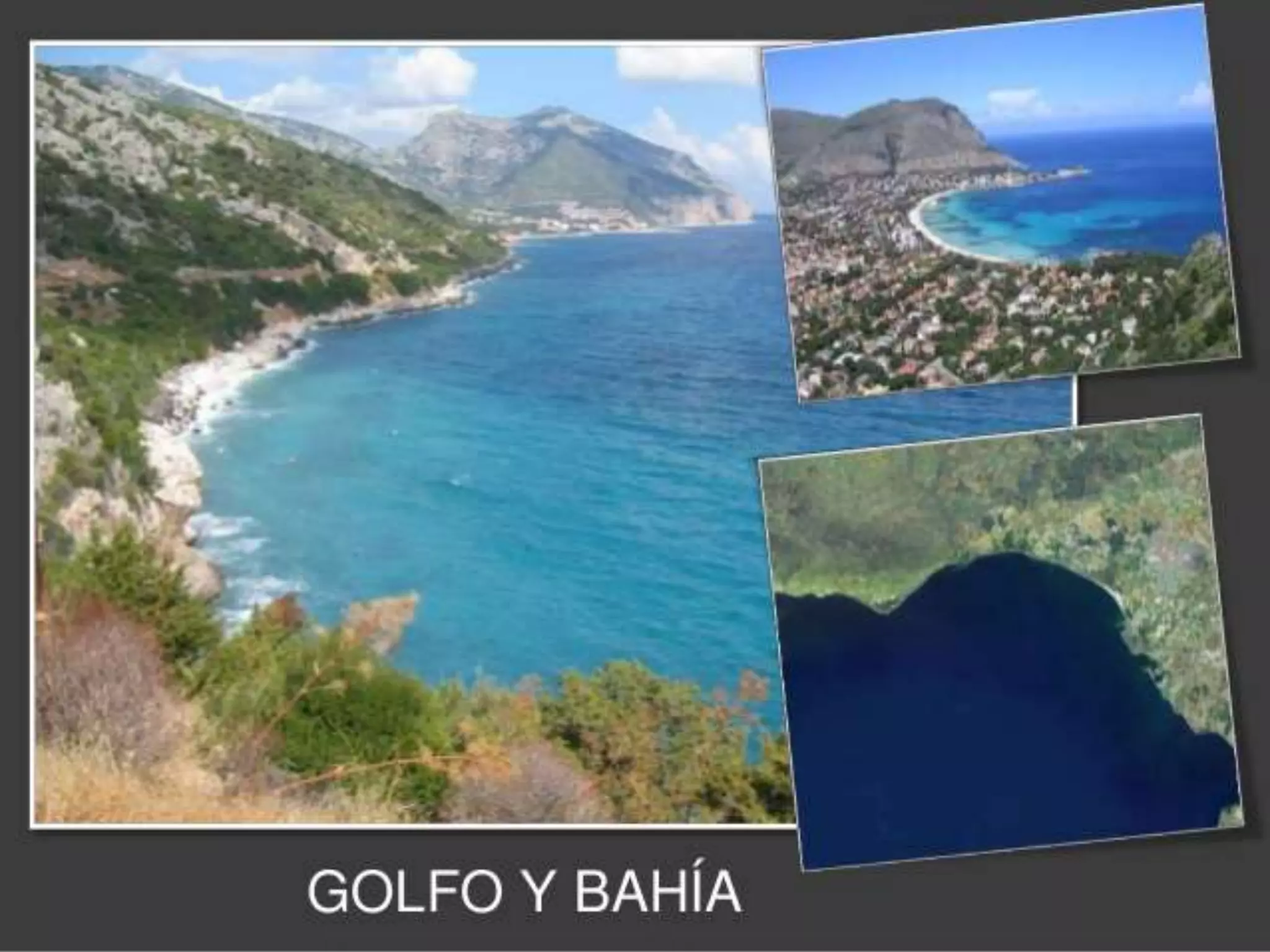
GULF
AND BAY
 Gulf: s ea entrance on the coast. Bays have
rounded shapes and are smaller
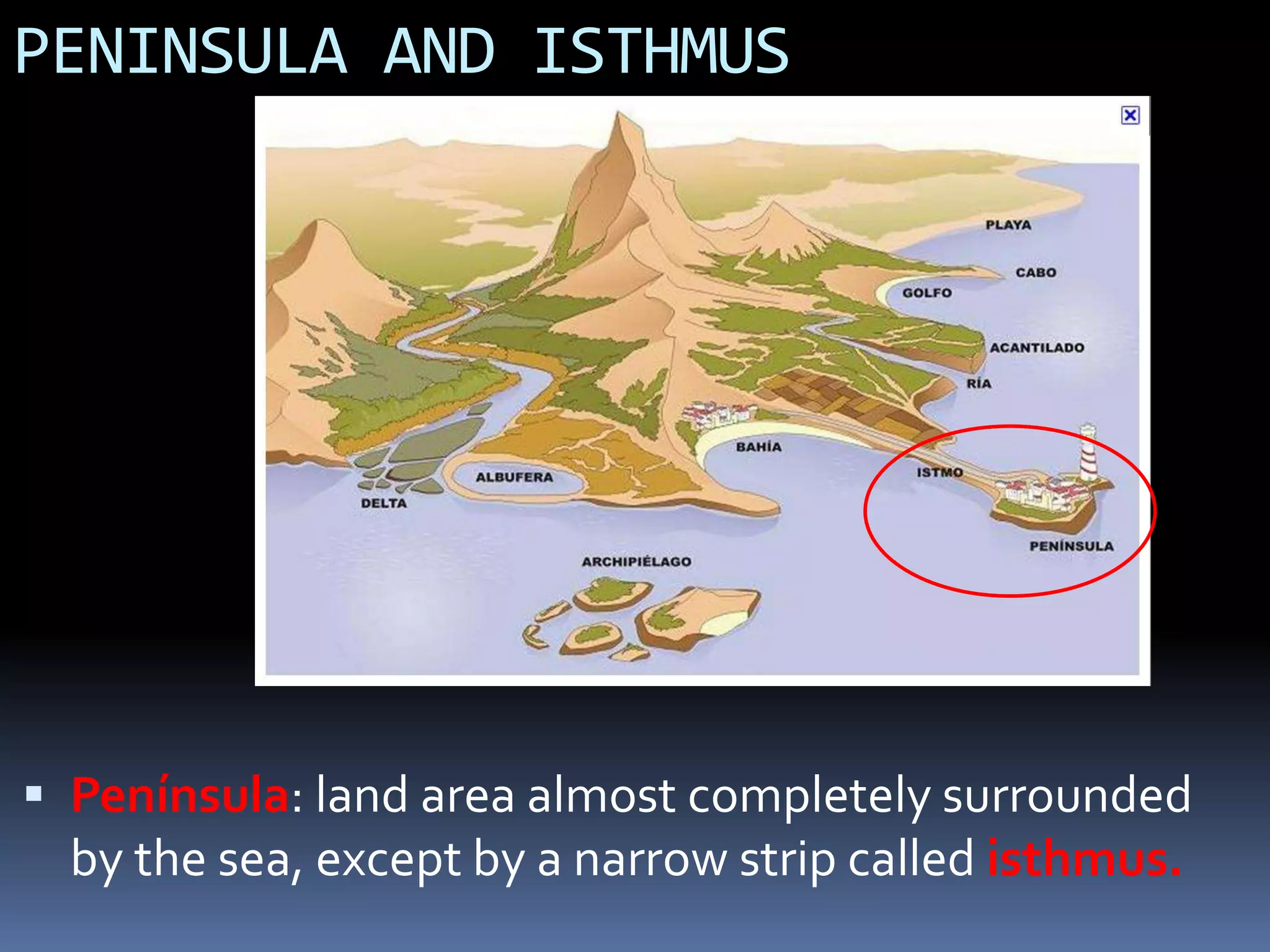
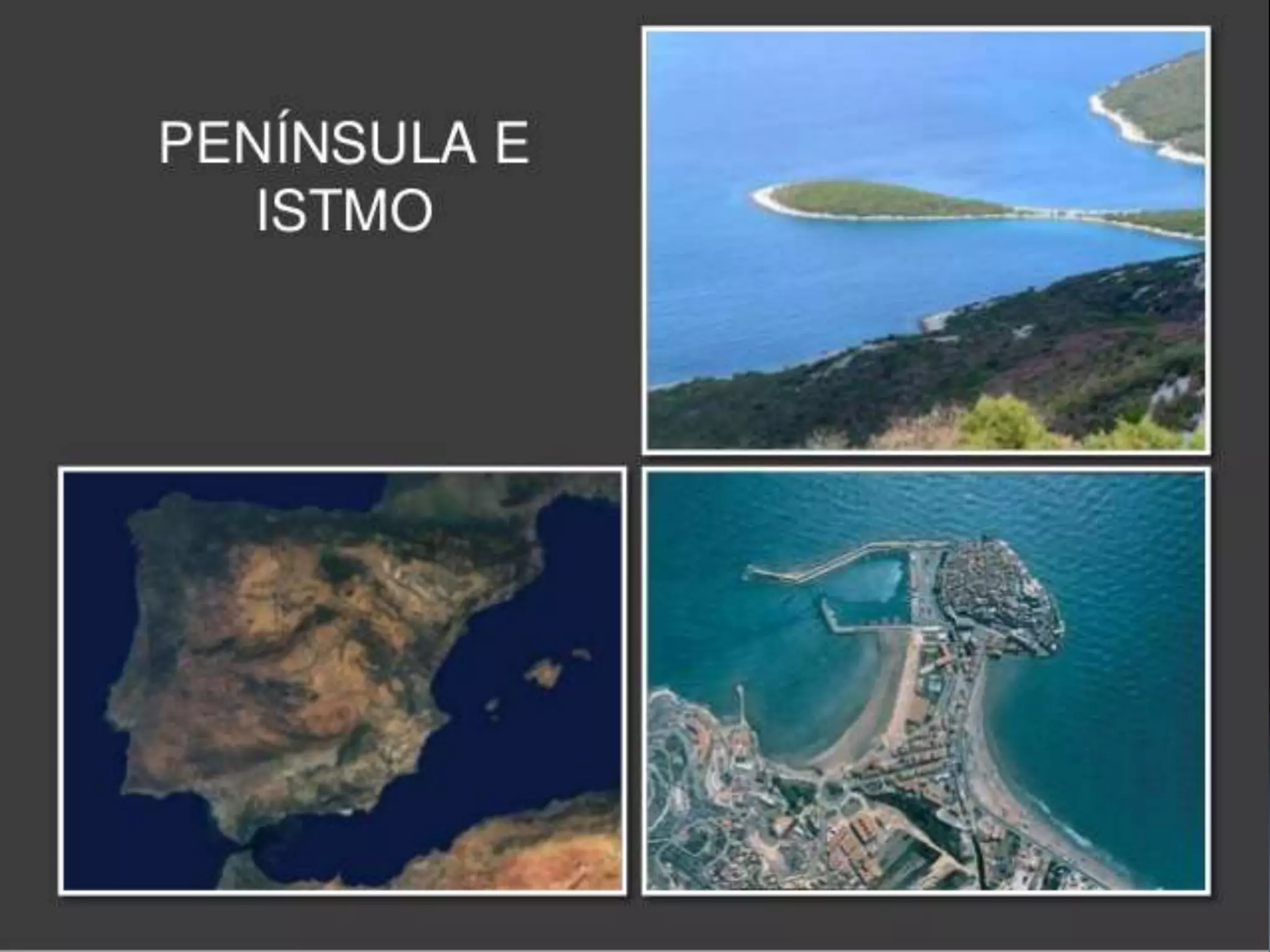
PENINSULA AND ISTHMUS
 Península: land area almost completely surrounded
by the sea, except by a narrow strip called isthmus.
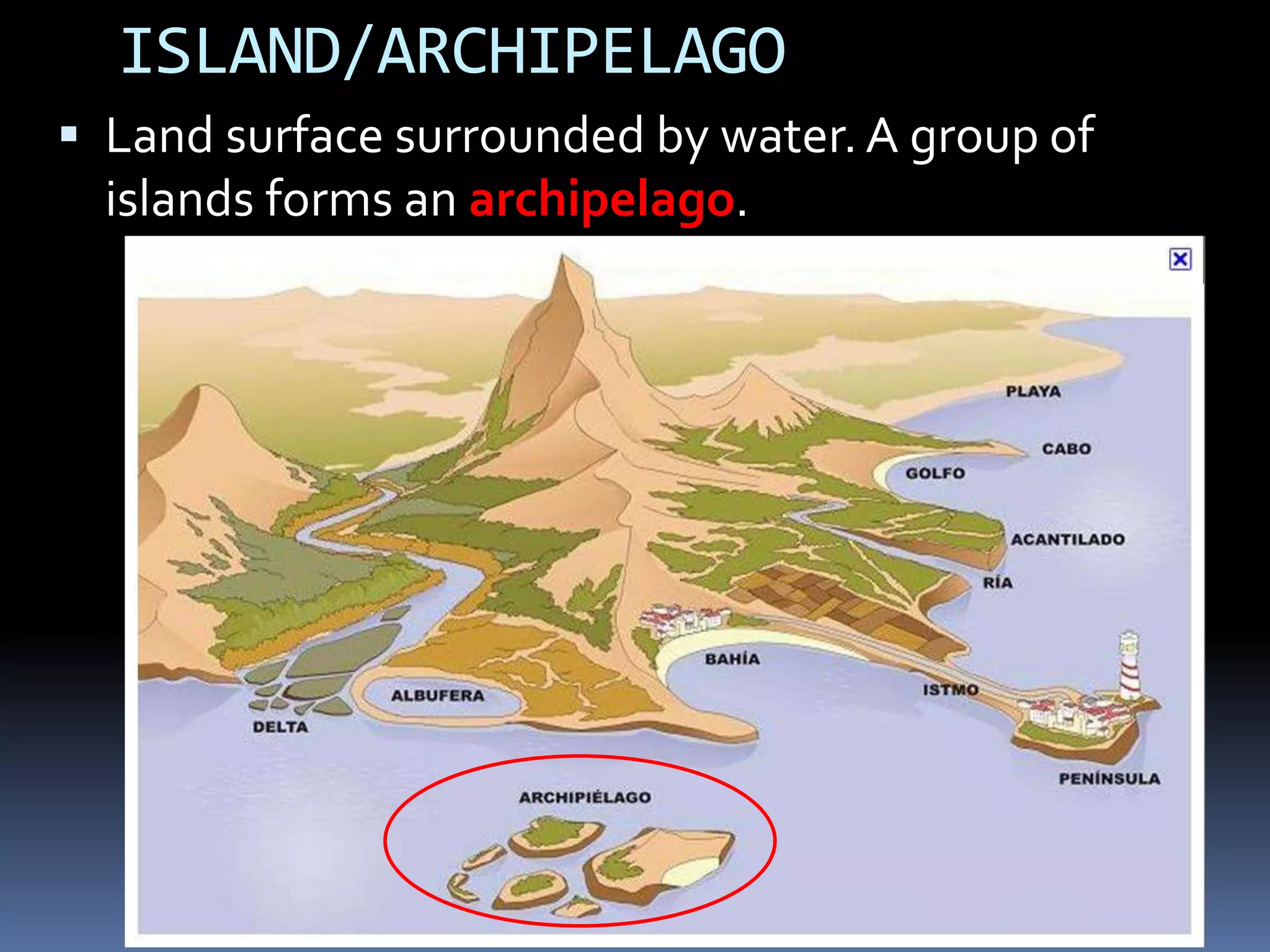
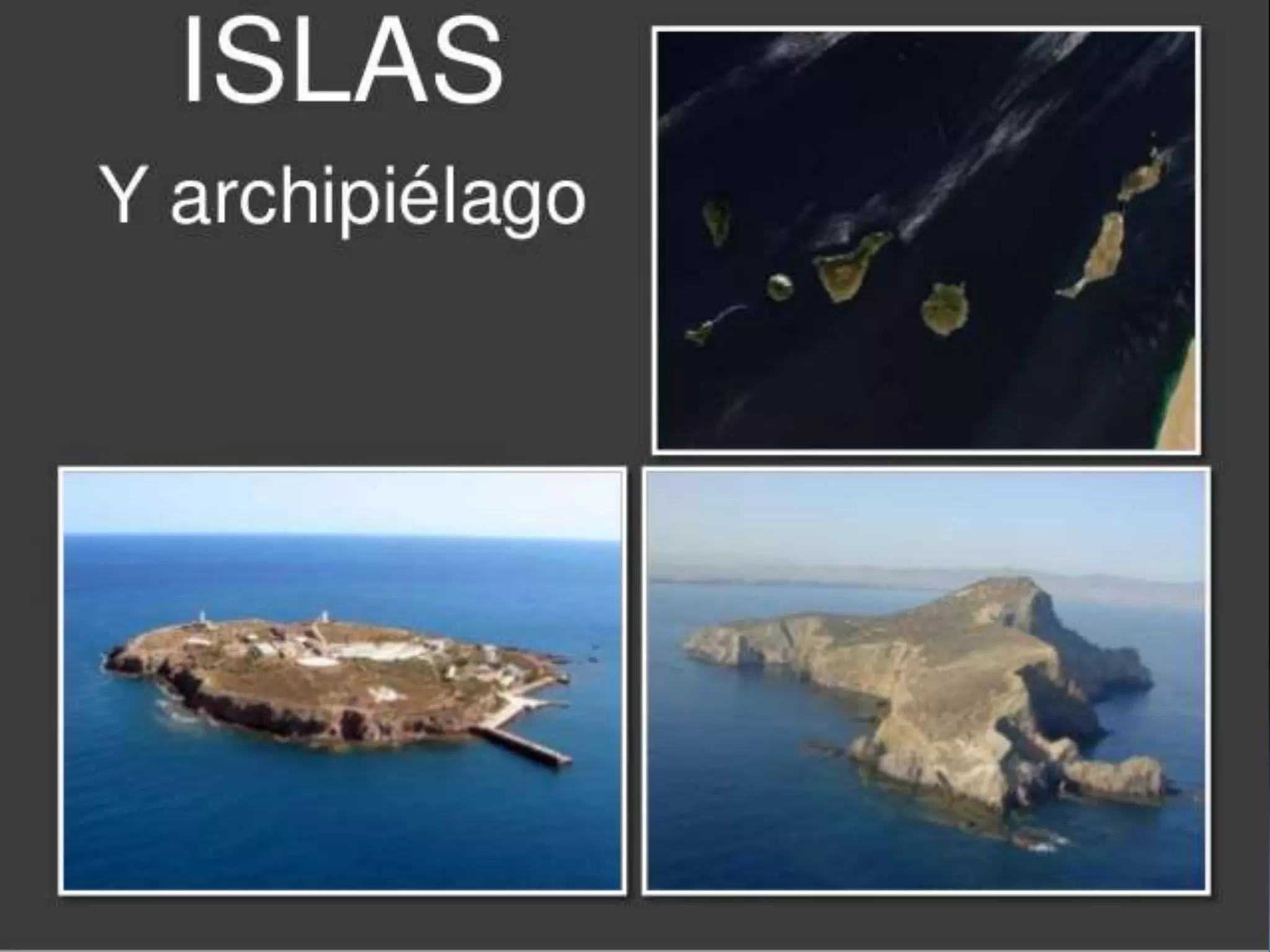
ISLAND/ARCHIPELAGO
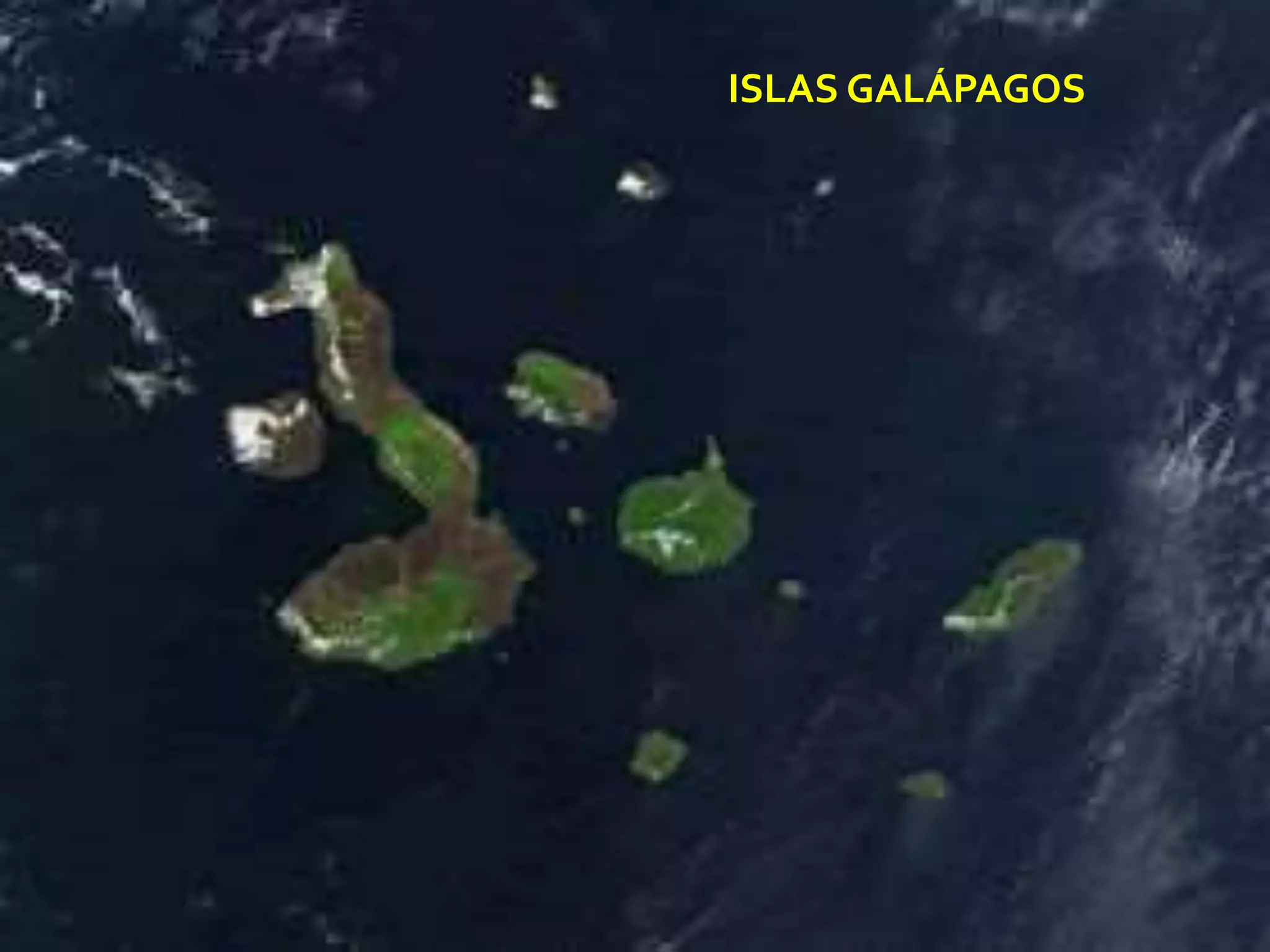
 Land surface surrounded by water. A group of
islands forms an archipelago.
ISLAS GALÁPAGOS
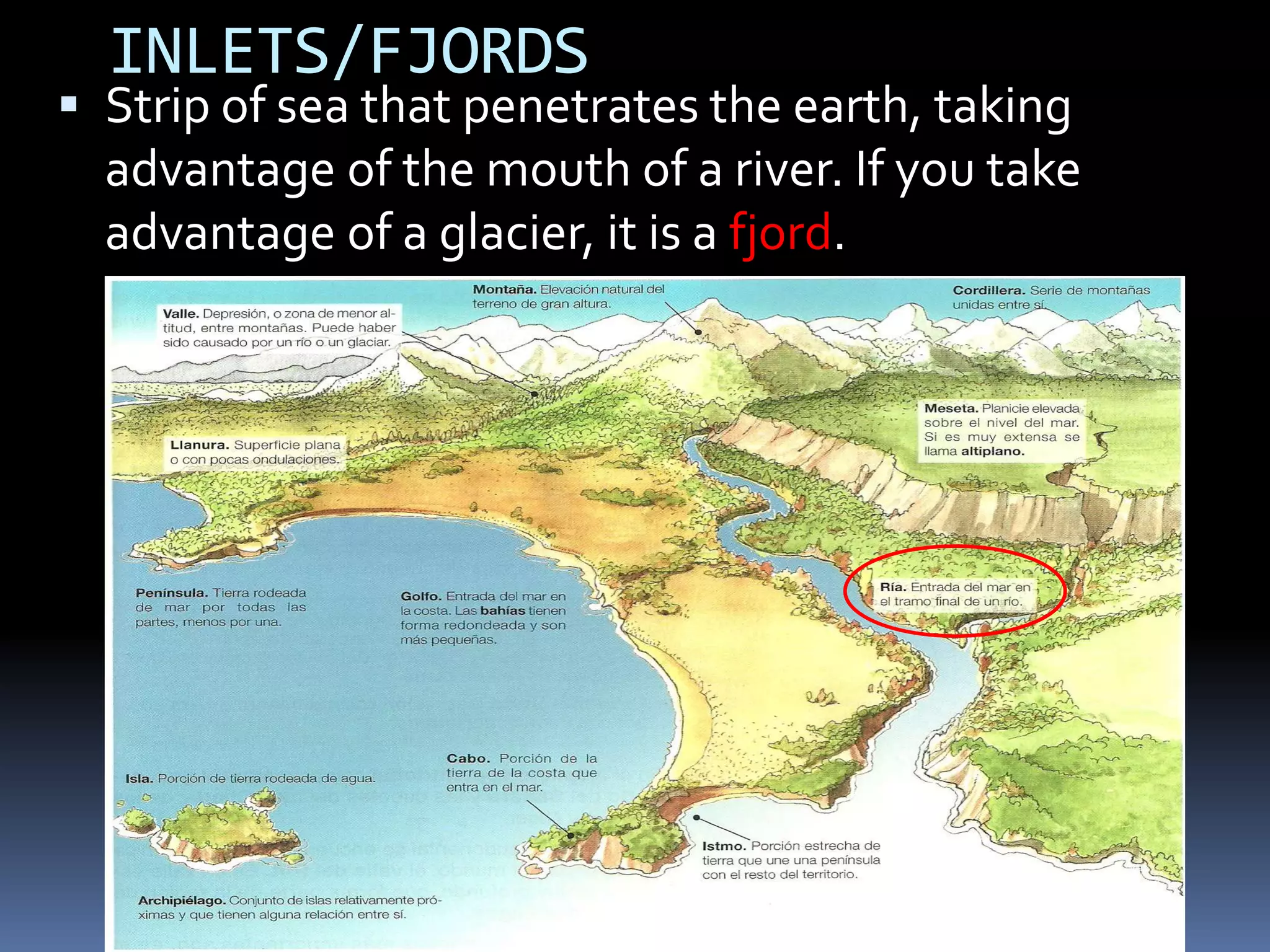
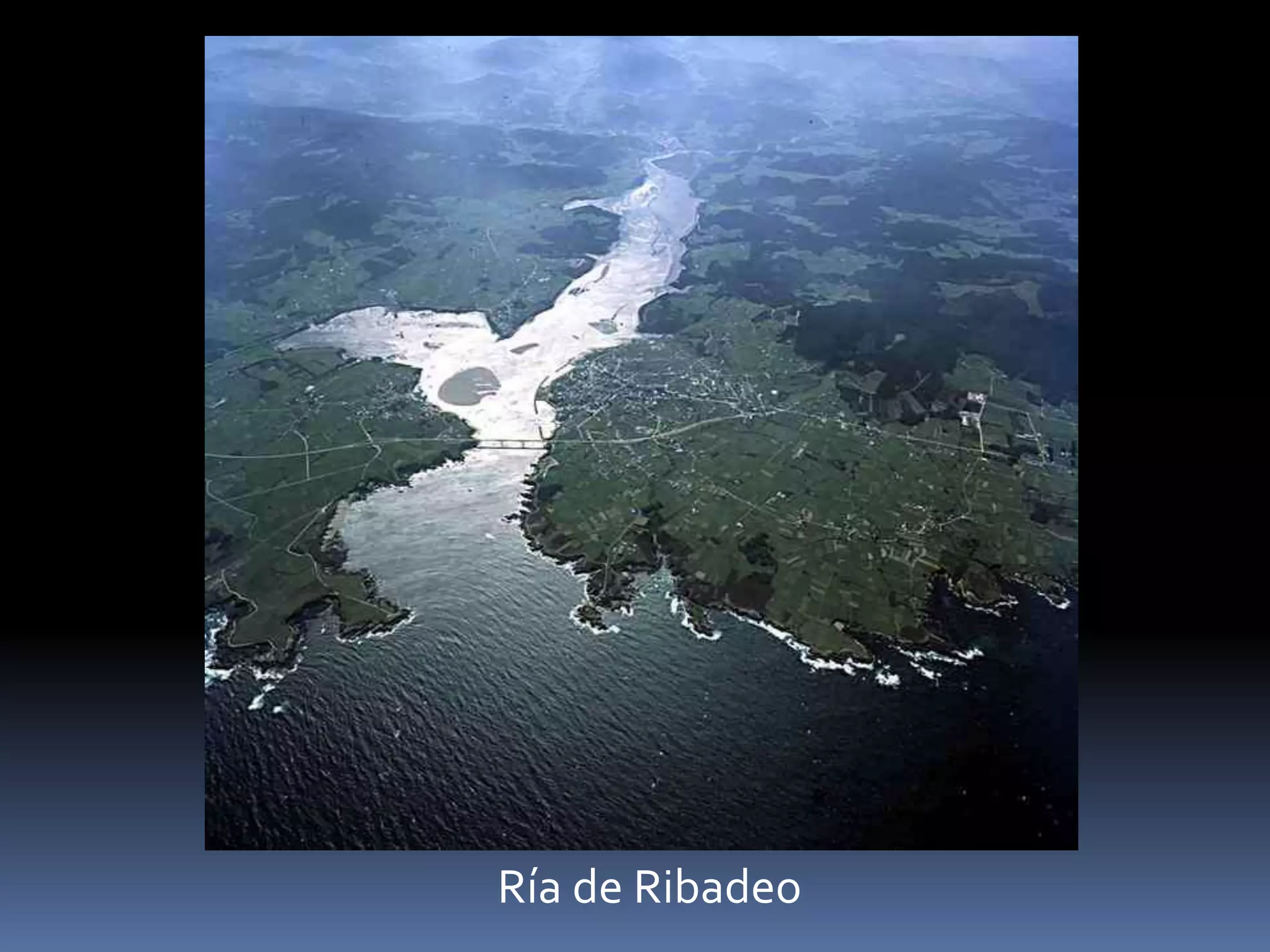
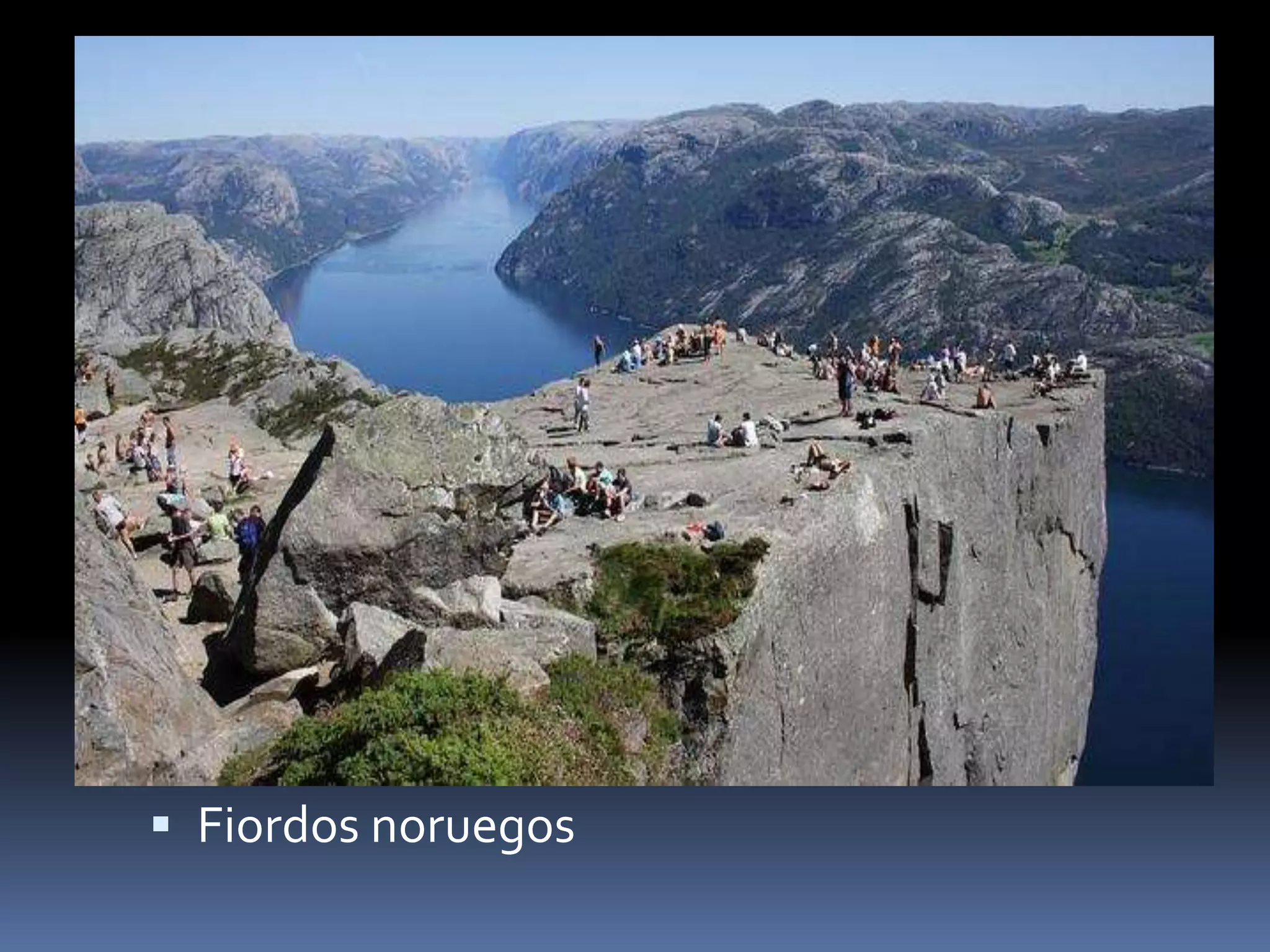
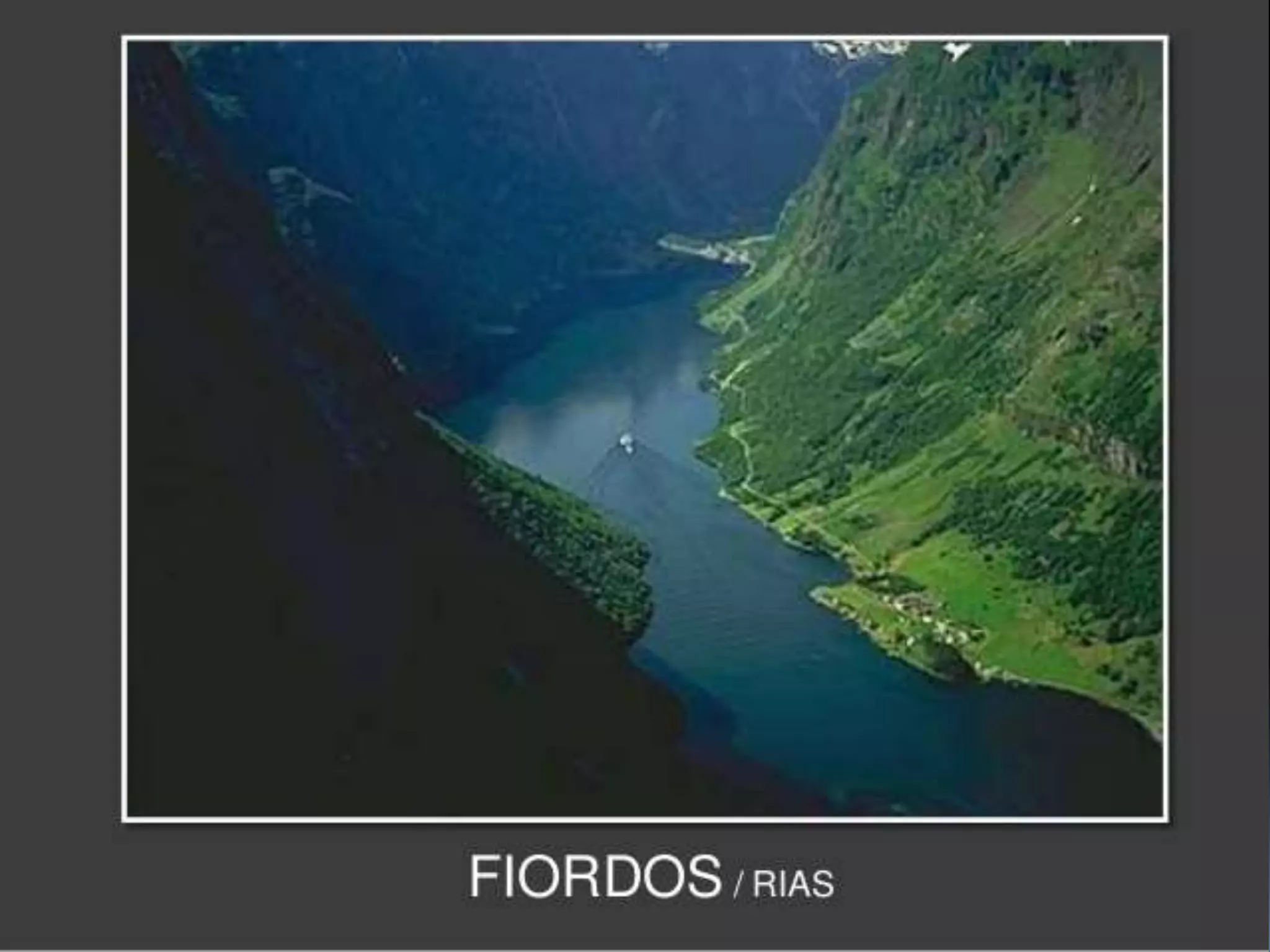
INLETS/FJORDS
 Strip of sea that penetrates the earth, taking
advantage of the mouth of a river. If you take
advantage of a glacier, it is a fjord.
Ría de Ribadeo
 Fiordos noruegos
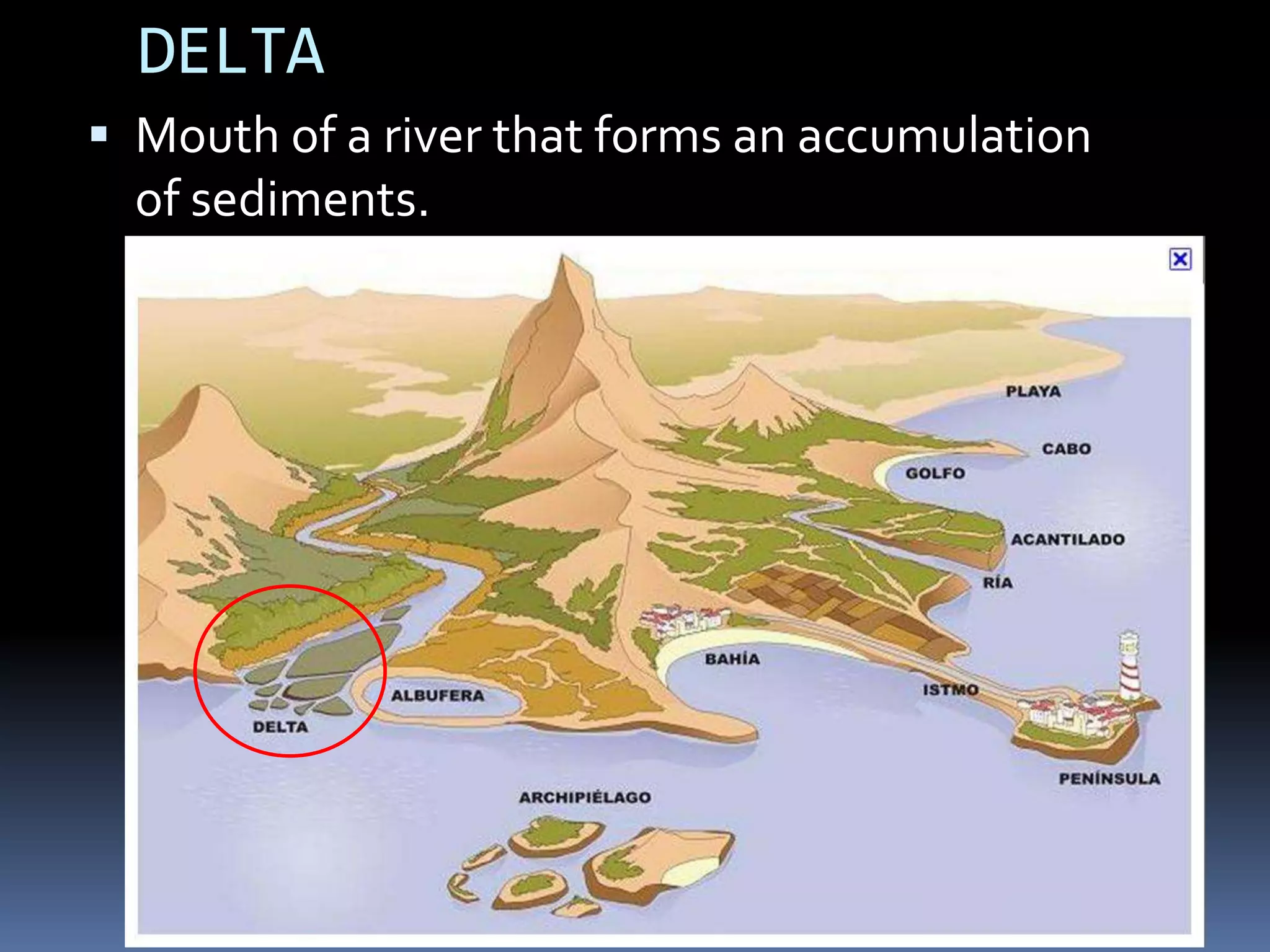
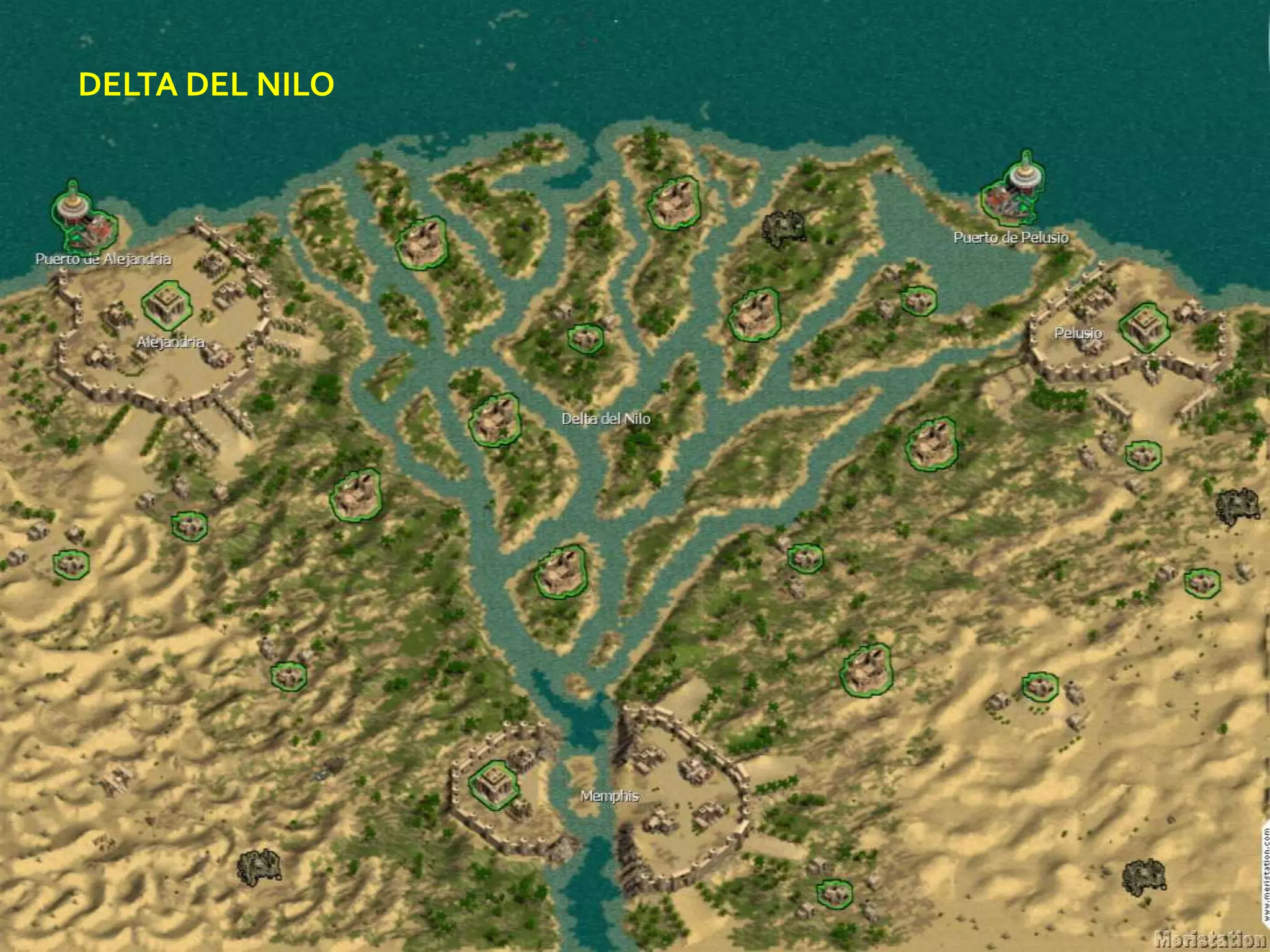
DELTA
 Mouth of a river that forms an accumulation
of sediments.
DELTA DEL NILO
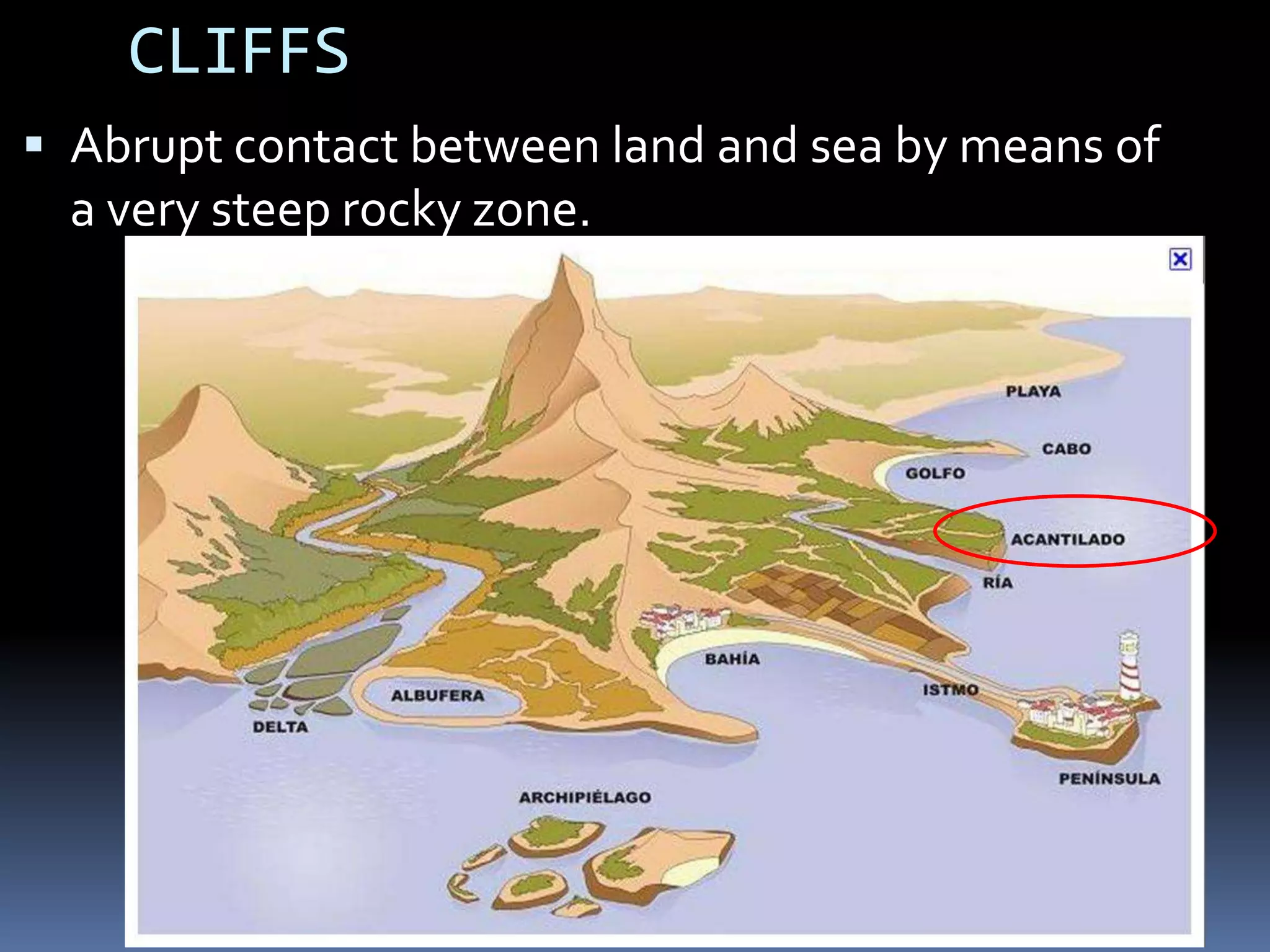
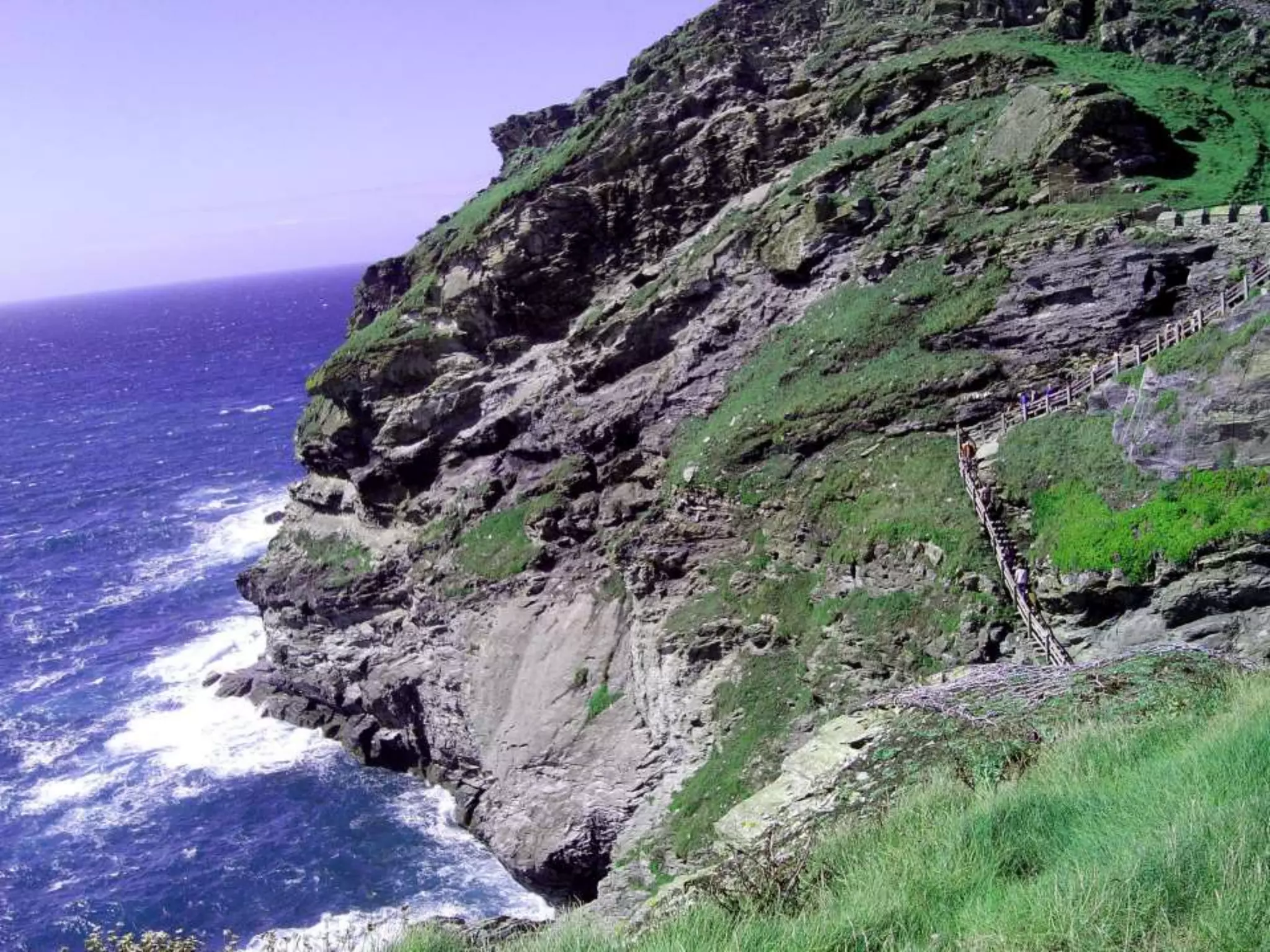
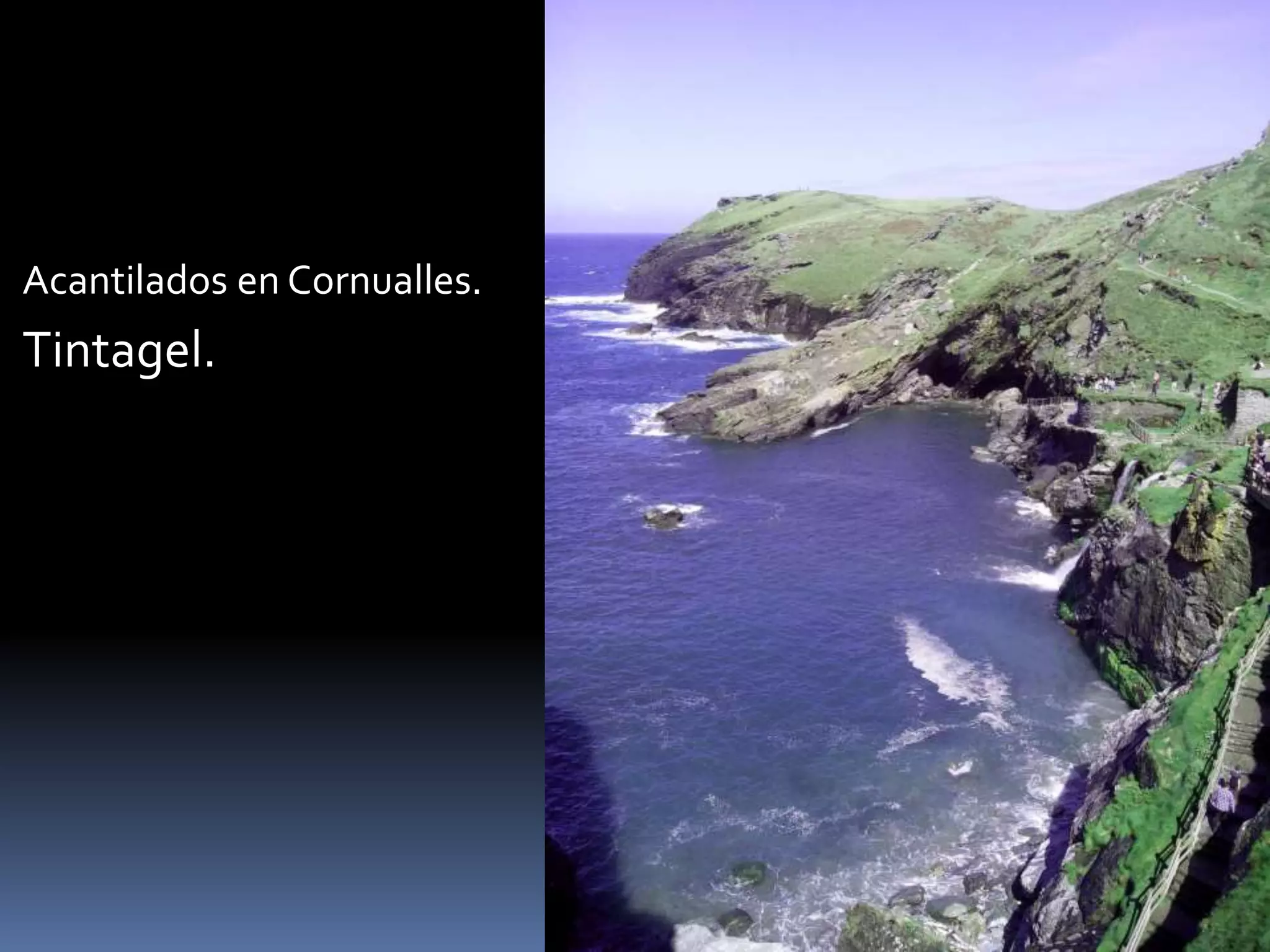
CLIFFS
 Abrupt contact between land and sea by means of
a very steep rocky zone.
Acantilados en Cornualles.
Tintagel.
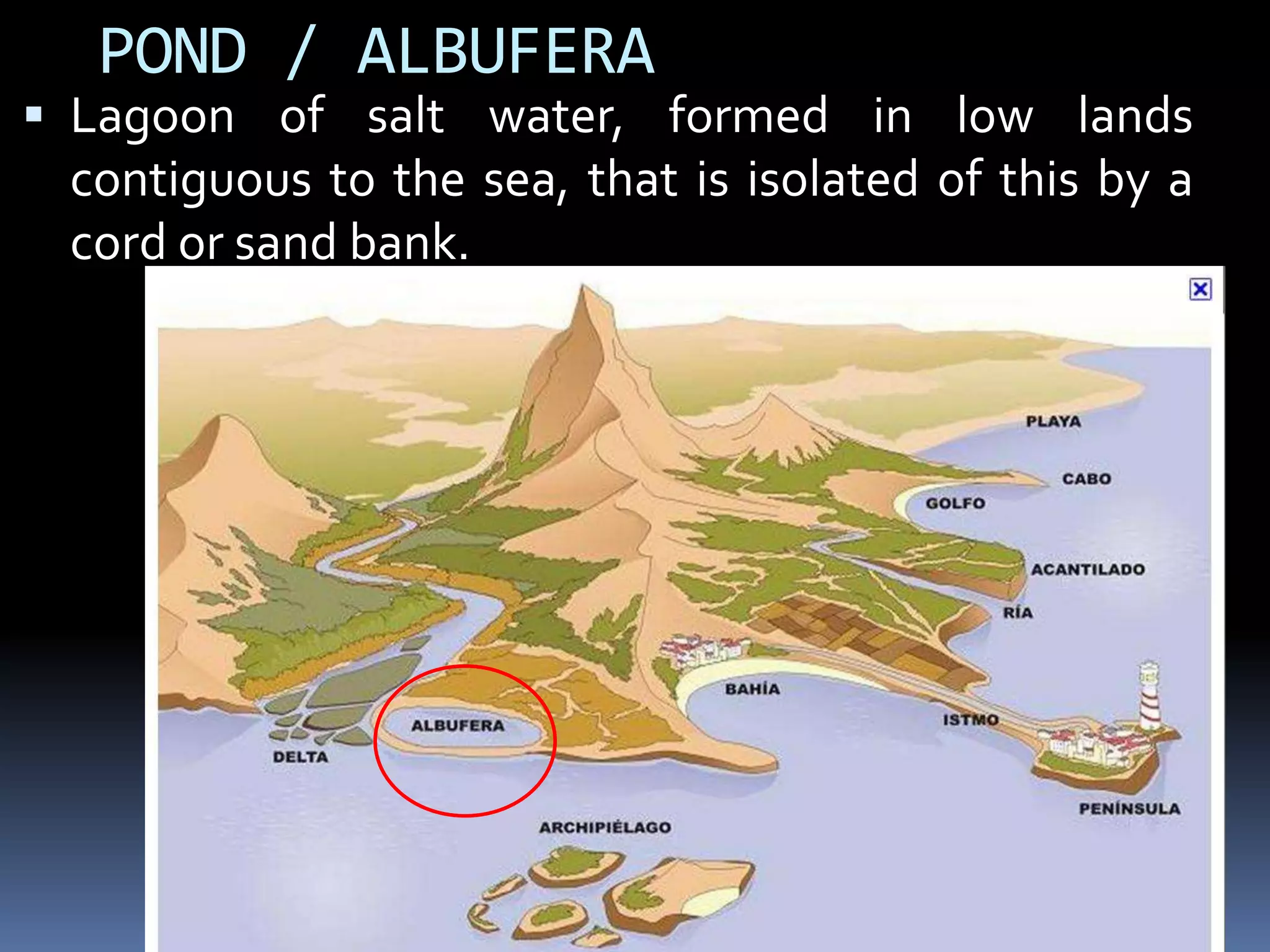
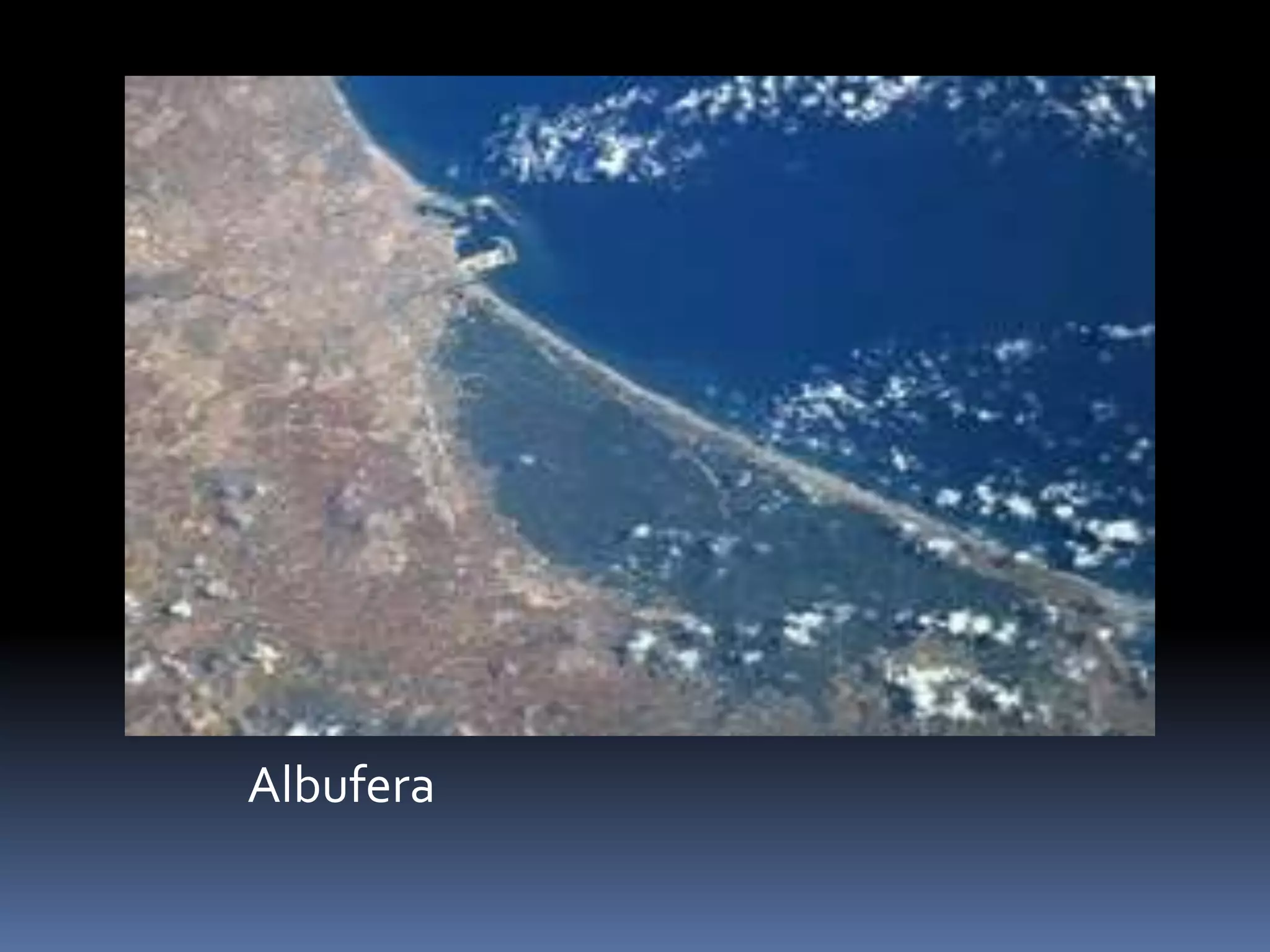
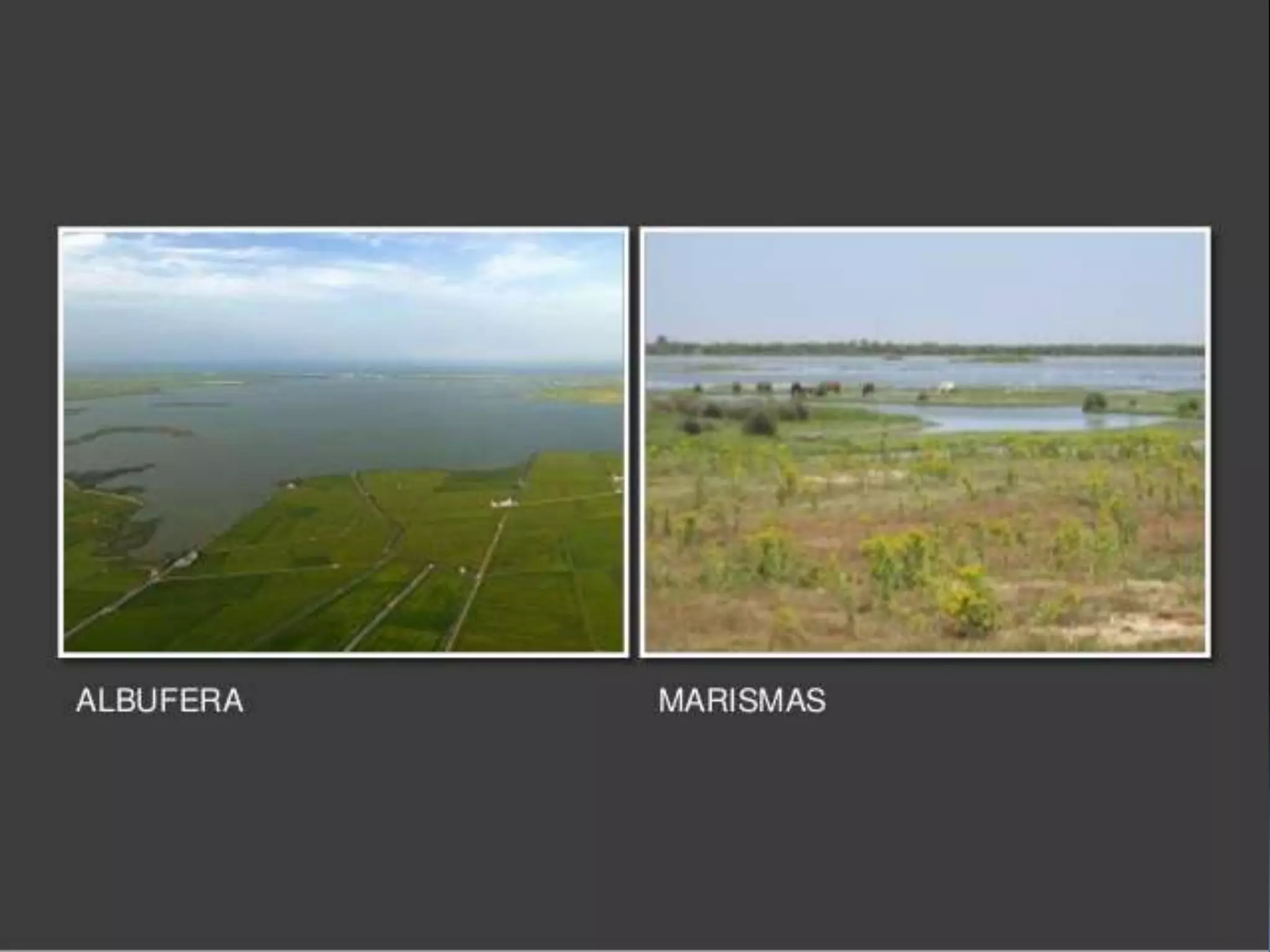
POND / ALBUFERA
 Lagoon of salt water, formed in low lands
contiguous to the sea, that is isolated of this by a
cord or sand bank.
Albufera
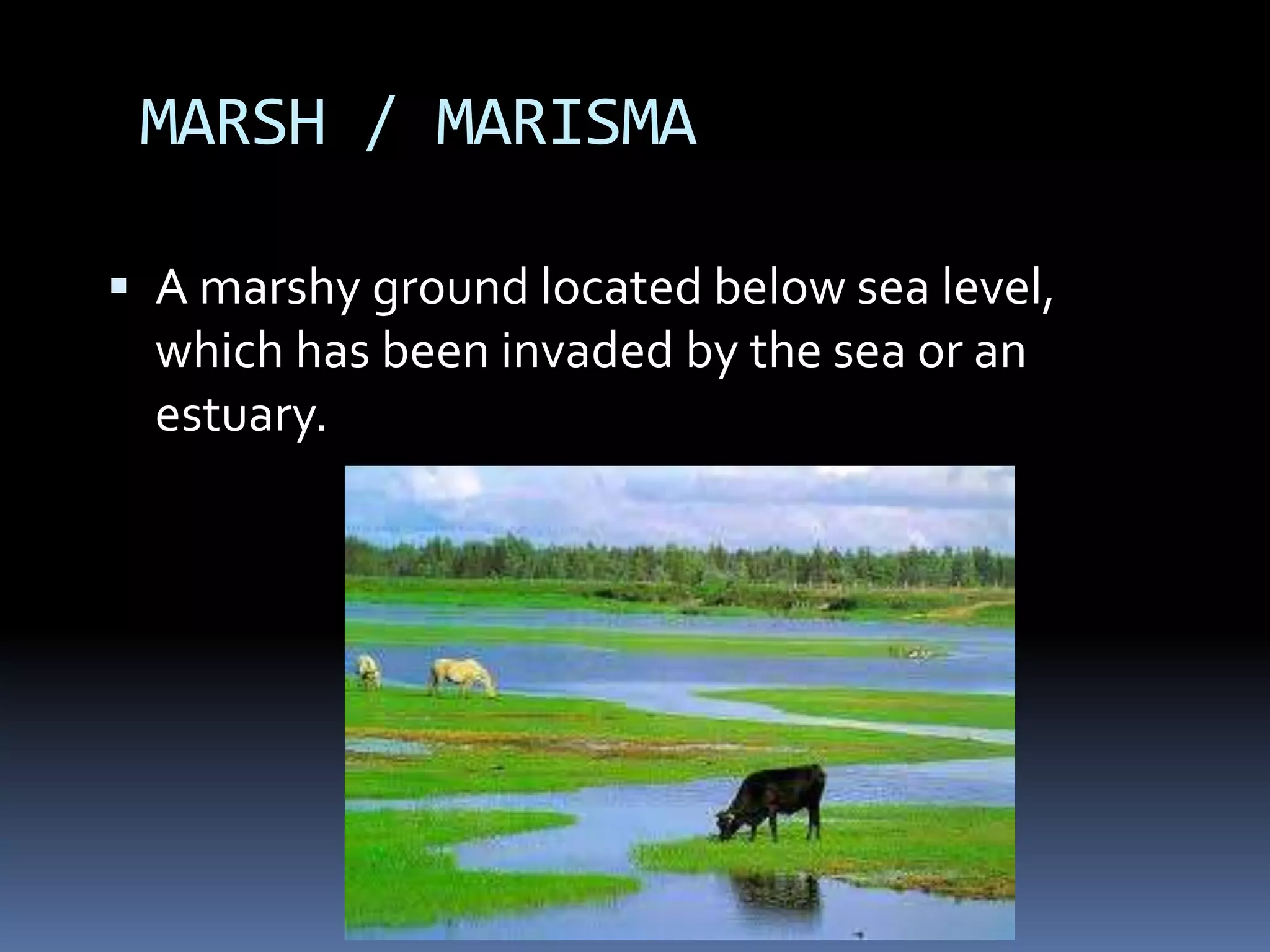
MARSH / MARISMA
 A marshy ground located below sea level,
which has been invaded by the sea or an
estuary.
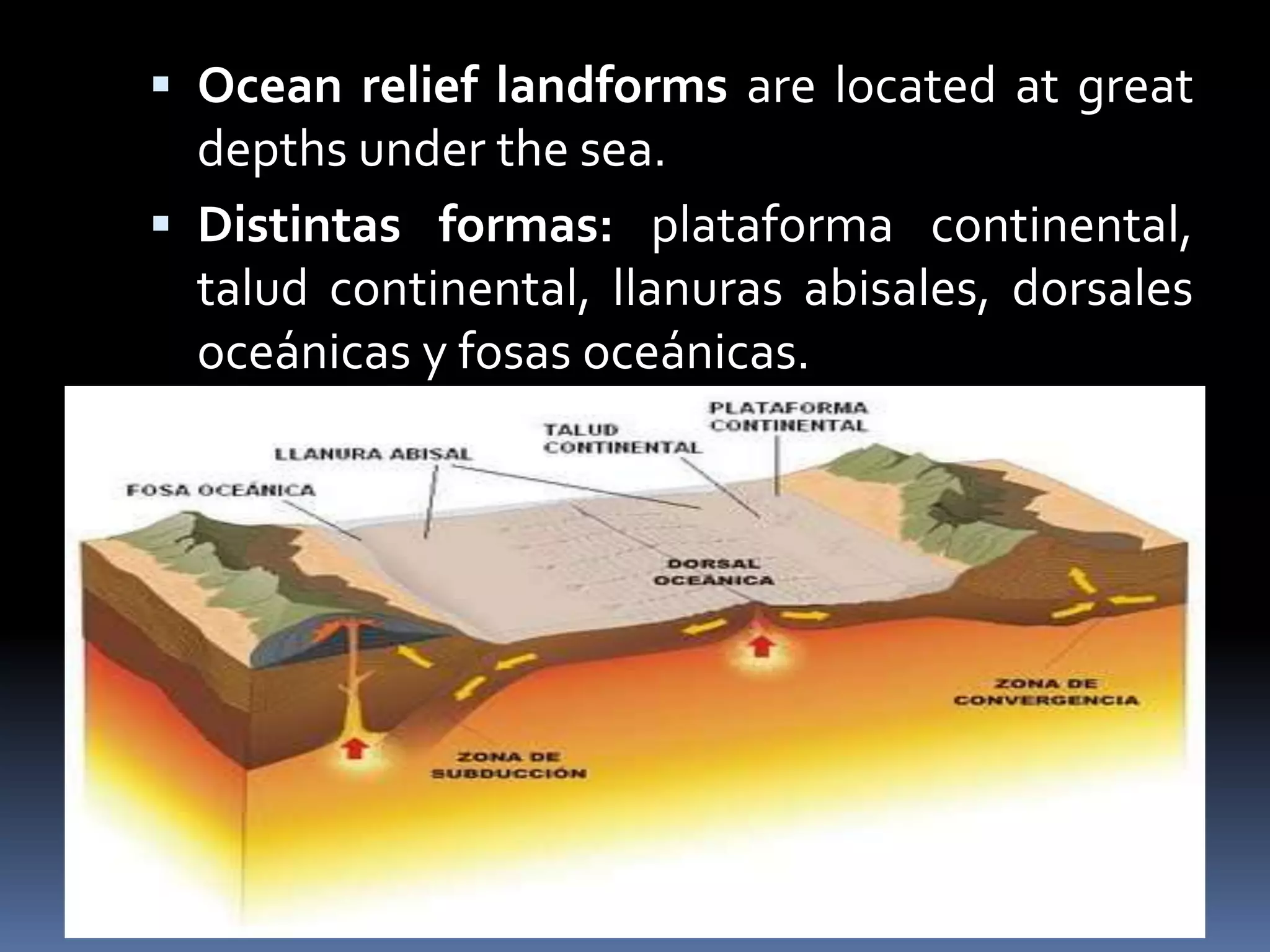
 Ocean relief landforms are located at great
depths under the sea.
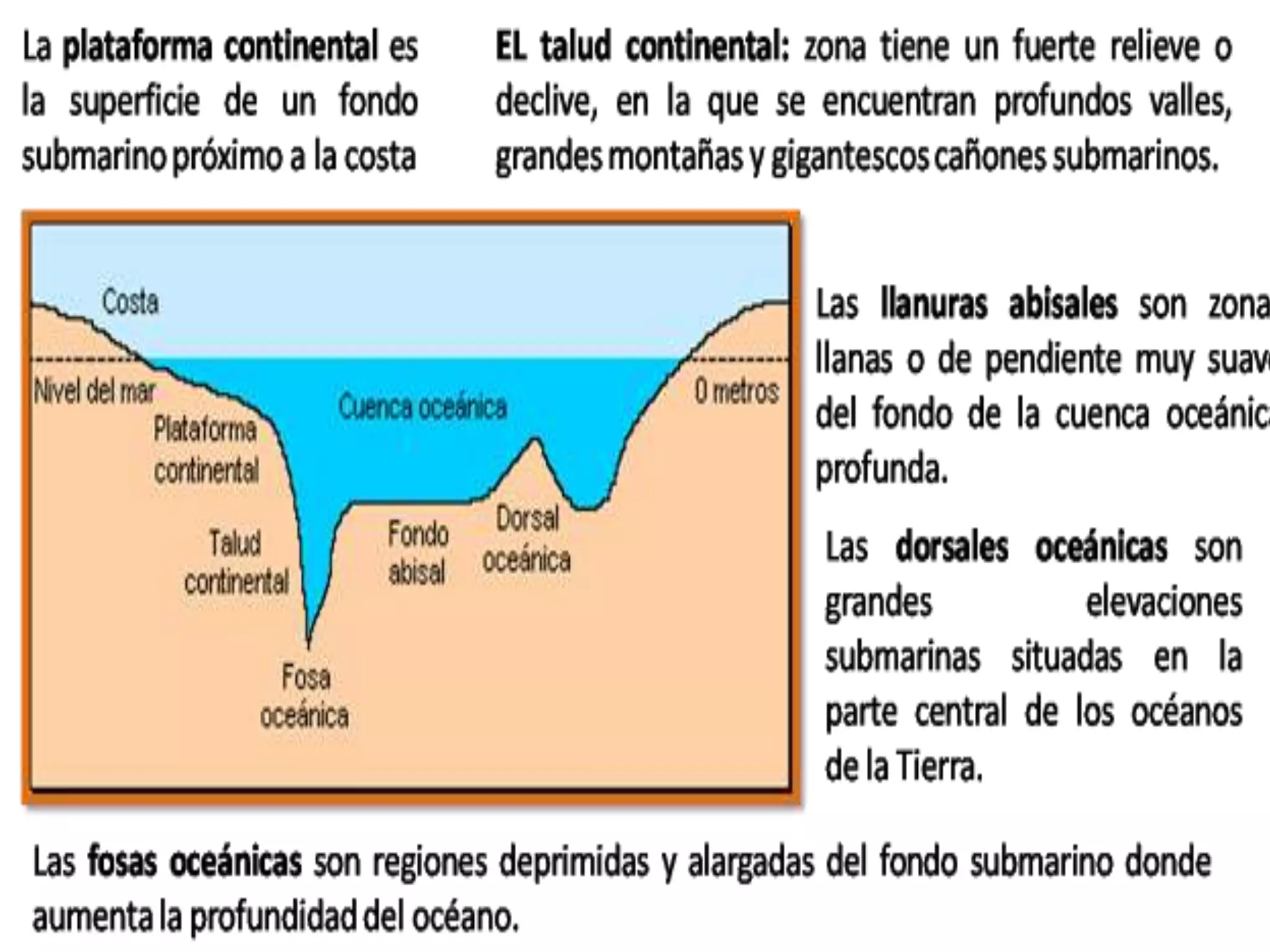
 Distintas formas: plataforma continental,
talud continental, llanuras abisales, dorsales
oceánicas y fosas oceánicas.
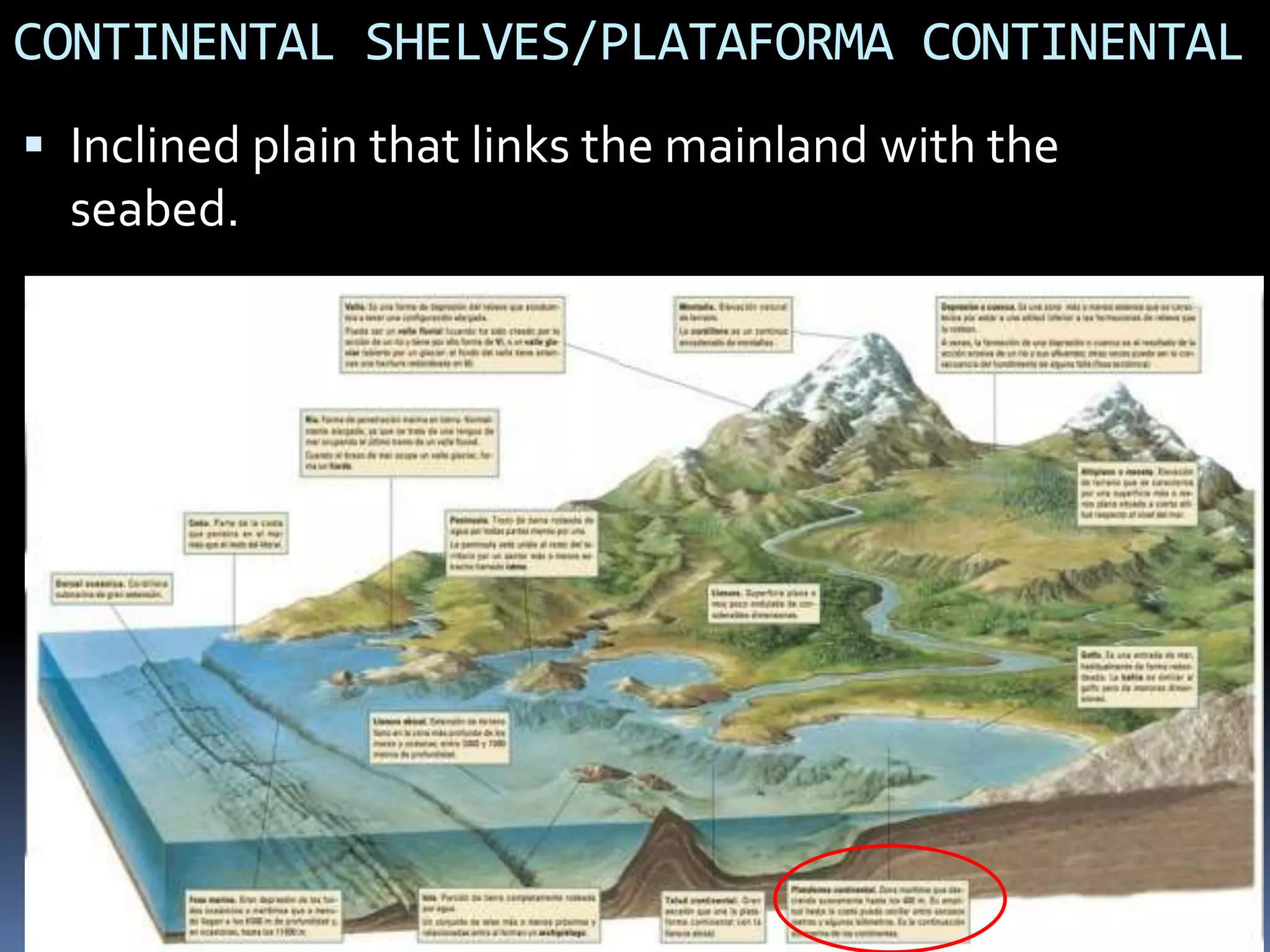
CONTINENTAL SHELVES/PLATAFORMA CONTINENTAL
 Inclined plain that links the mainland with the
seabed.
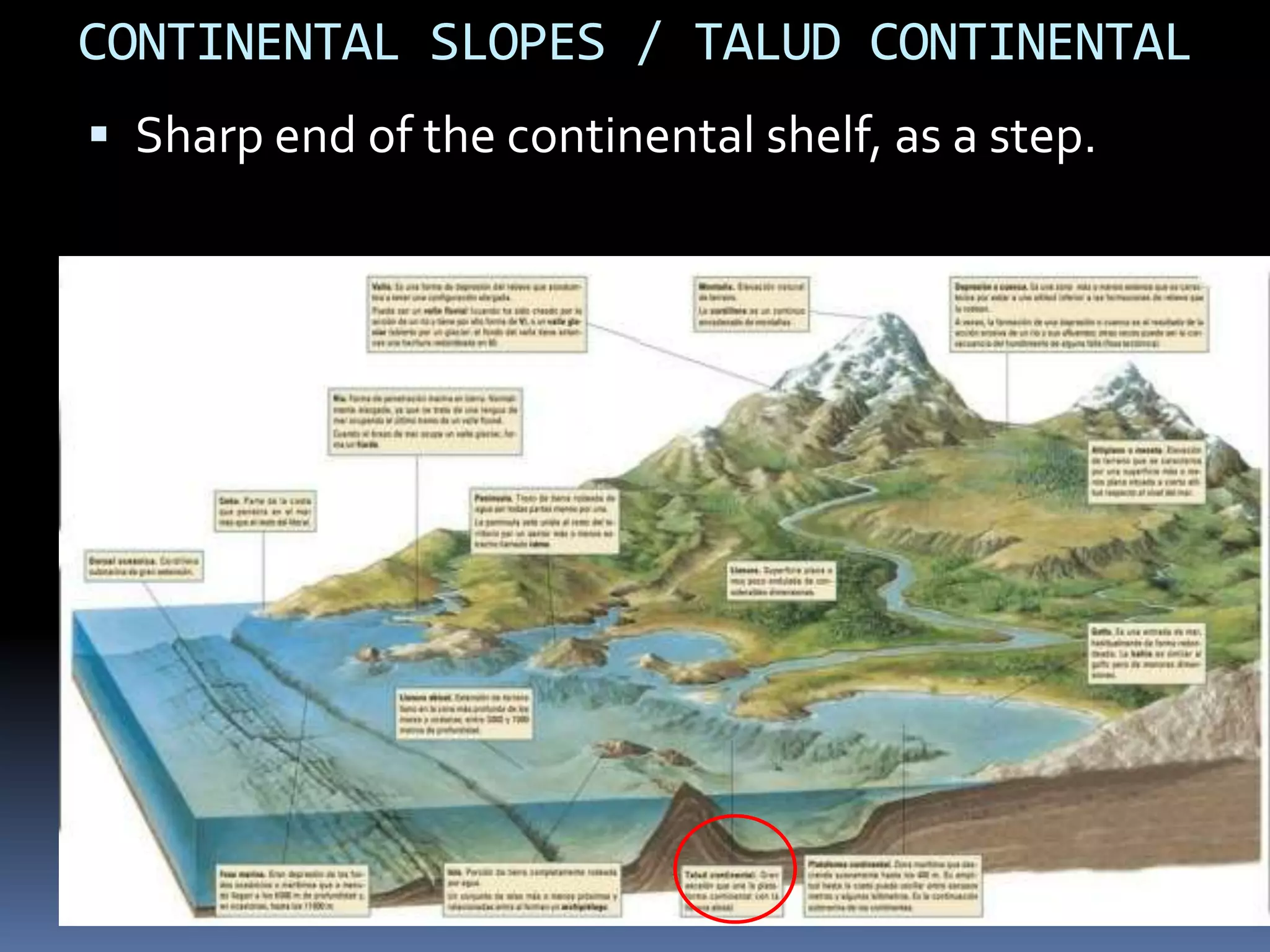
CONTINENTAL SLOPES / TALUD CONTINENTAL
 Sharp end of the continental shelf, as a step.
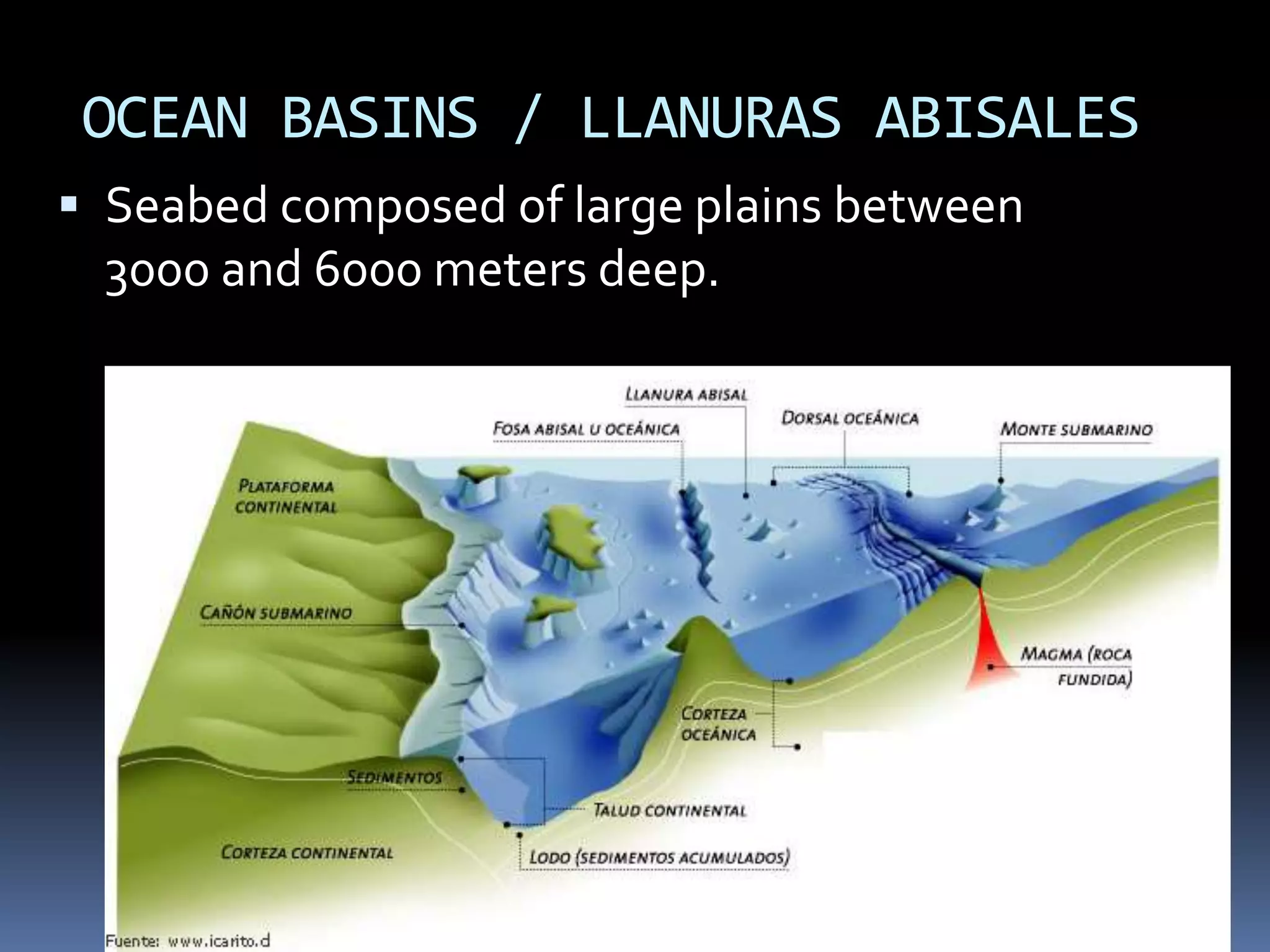
OCEAN BASINS / LLANURAS ABISALES
 Seabed composed of large plains between
3000 and 6000 meters deep.
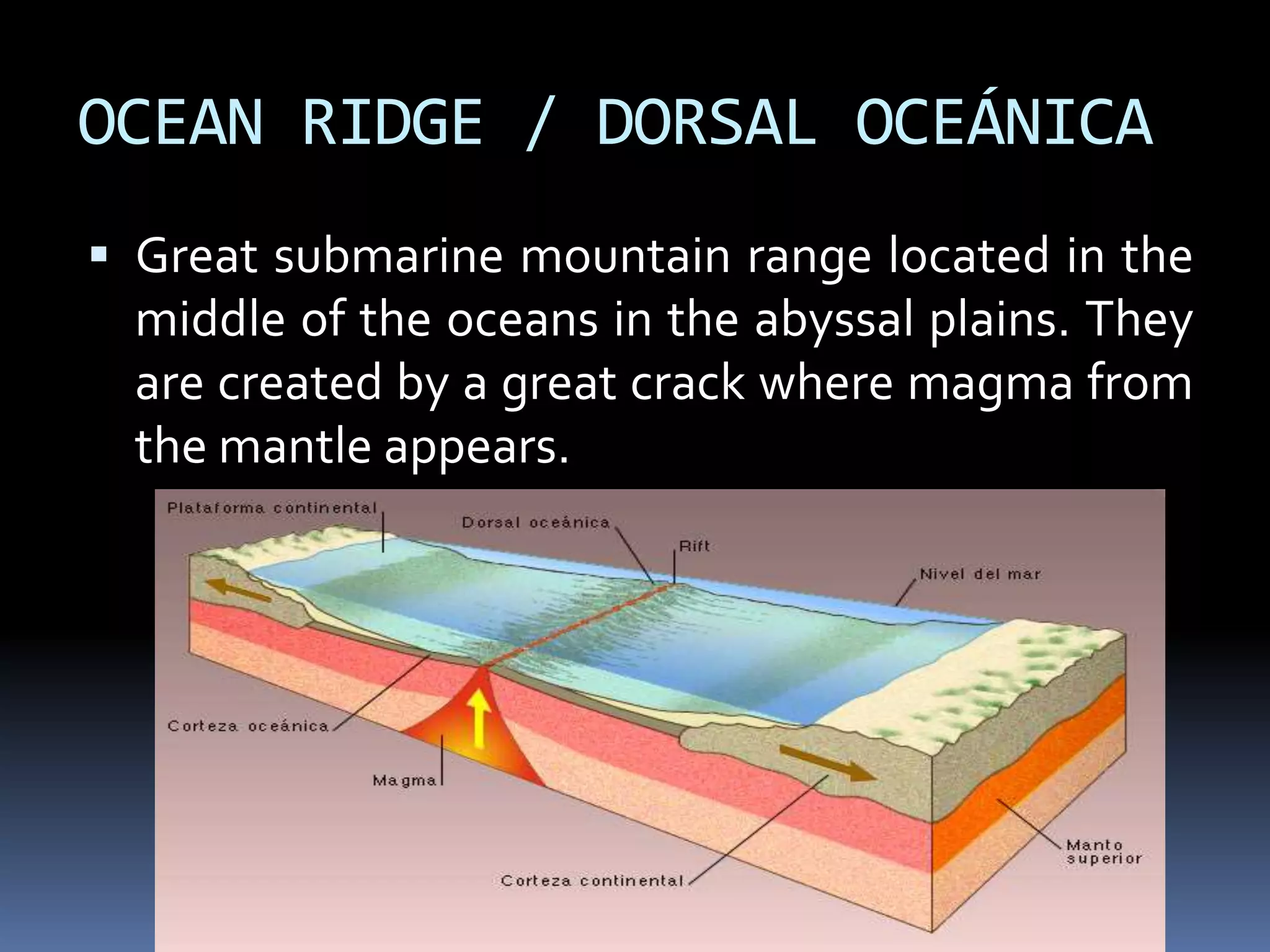
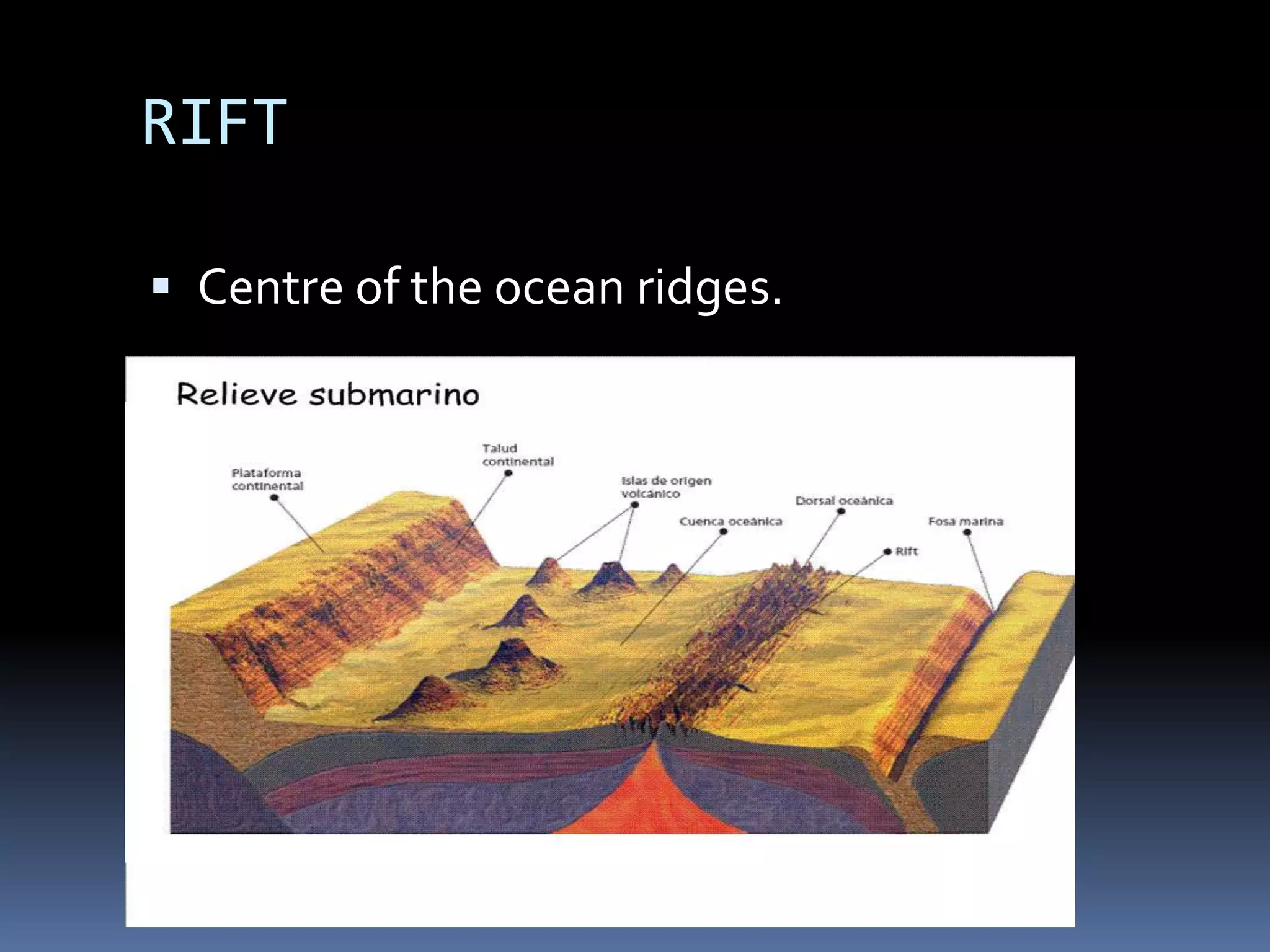
OCEAN RIDGE / DORSAL OCEÁNICA
 Great submarine mountain range located in the
middle of the oceans in the abyssal plains. They
are created by a great crack where magma from
the mantle appears.
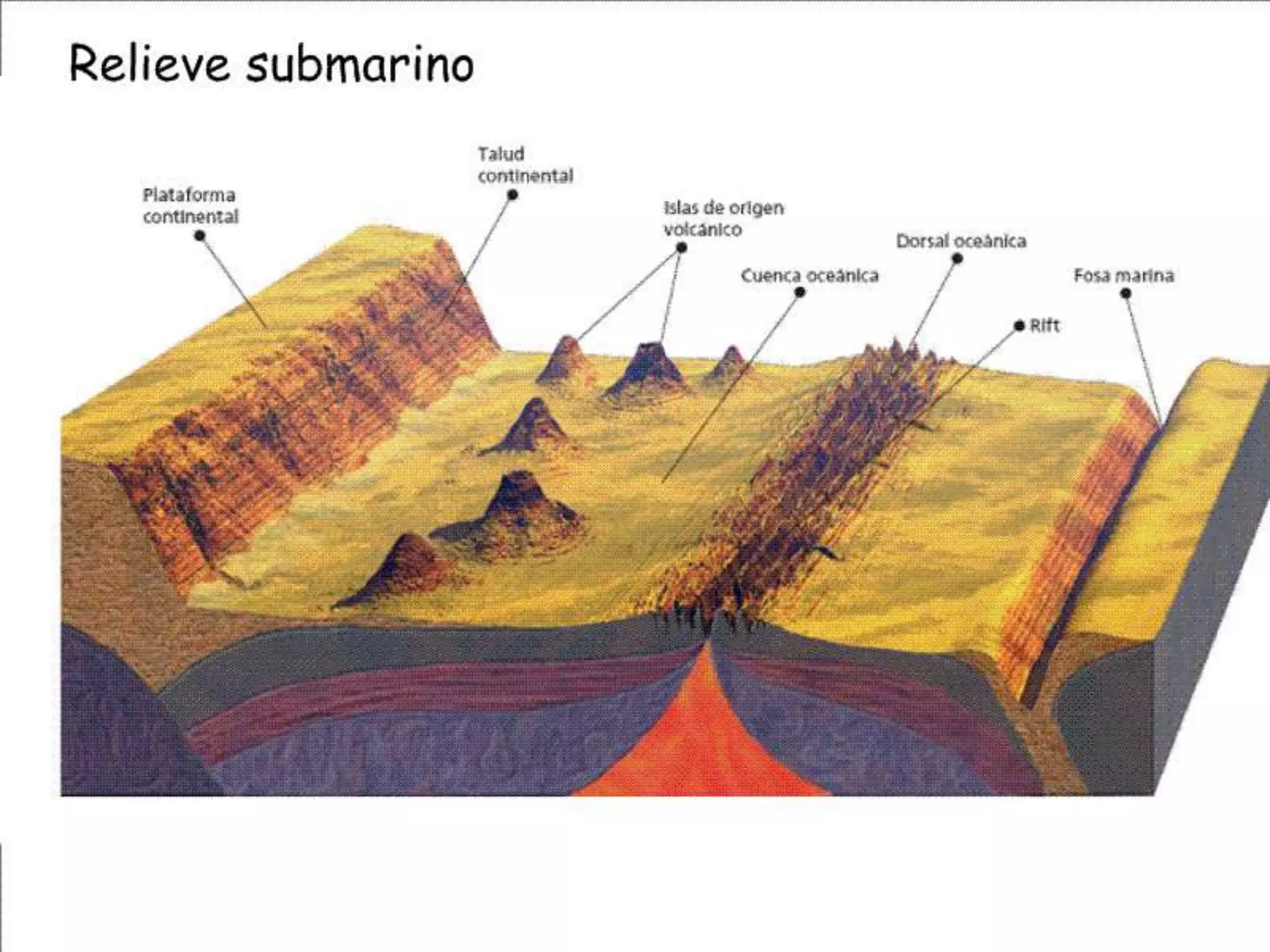
RIFT
 Centre of the ocean ridges.
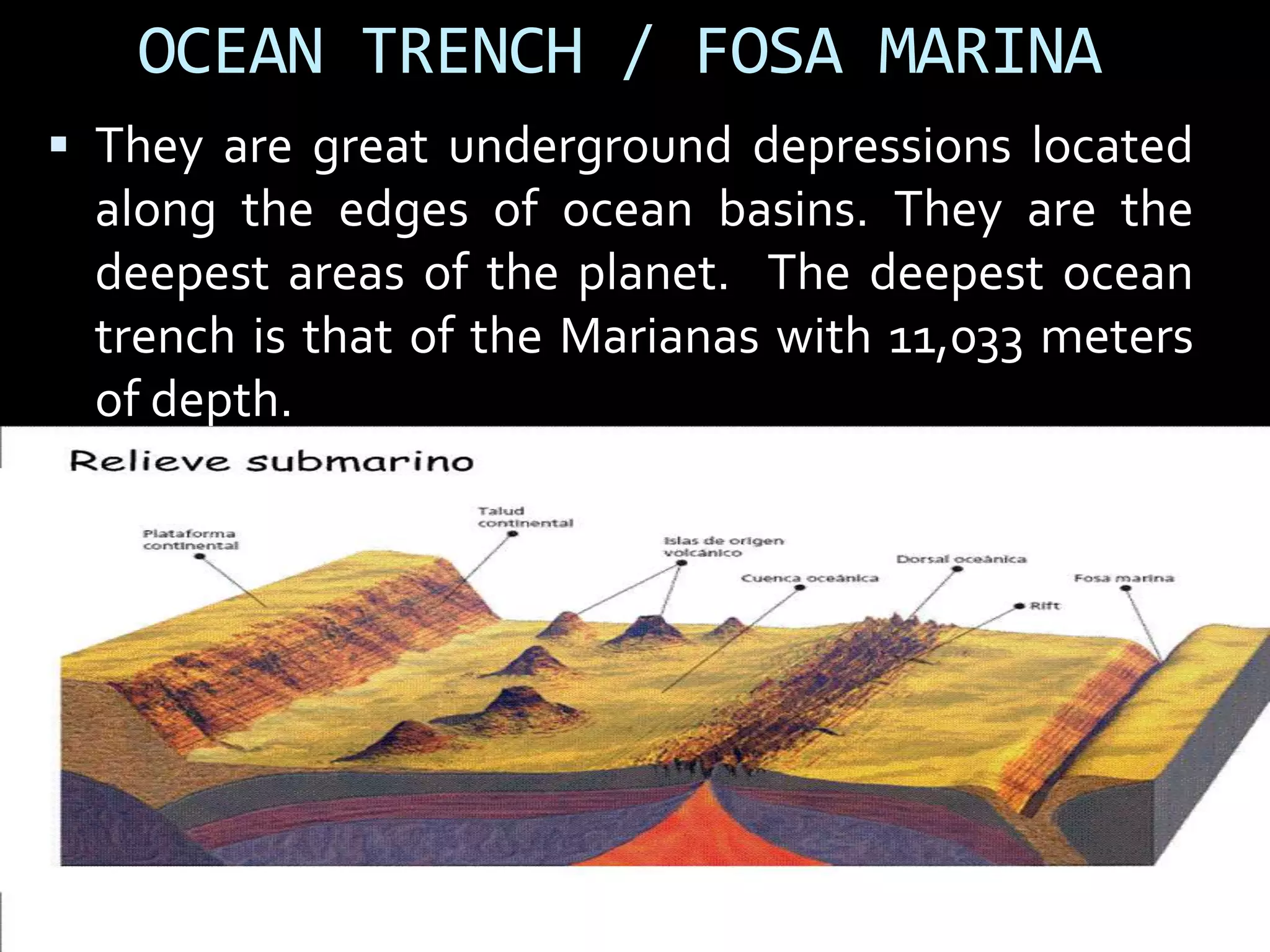
OCEAN TRENCH / FOSA MARINA
 They are great underground depressions located
along the edges of ocean basins. They are the
deepest areas of the planet. The deepest ocean
trench is that of the Marianas with 11,033 meters
of depth.
 https://www.youtube.com/watch?v=4GavORi
zkdw
 https://www.youtube.com/watch?v=3A_OBf
m04ck
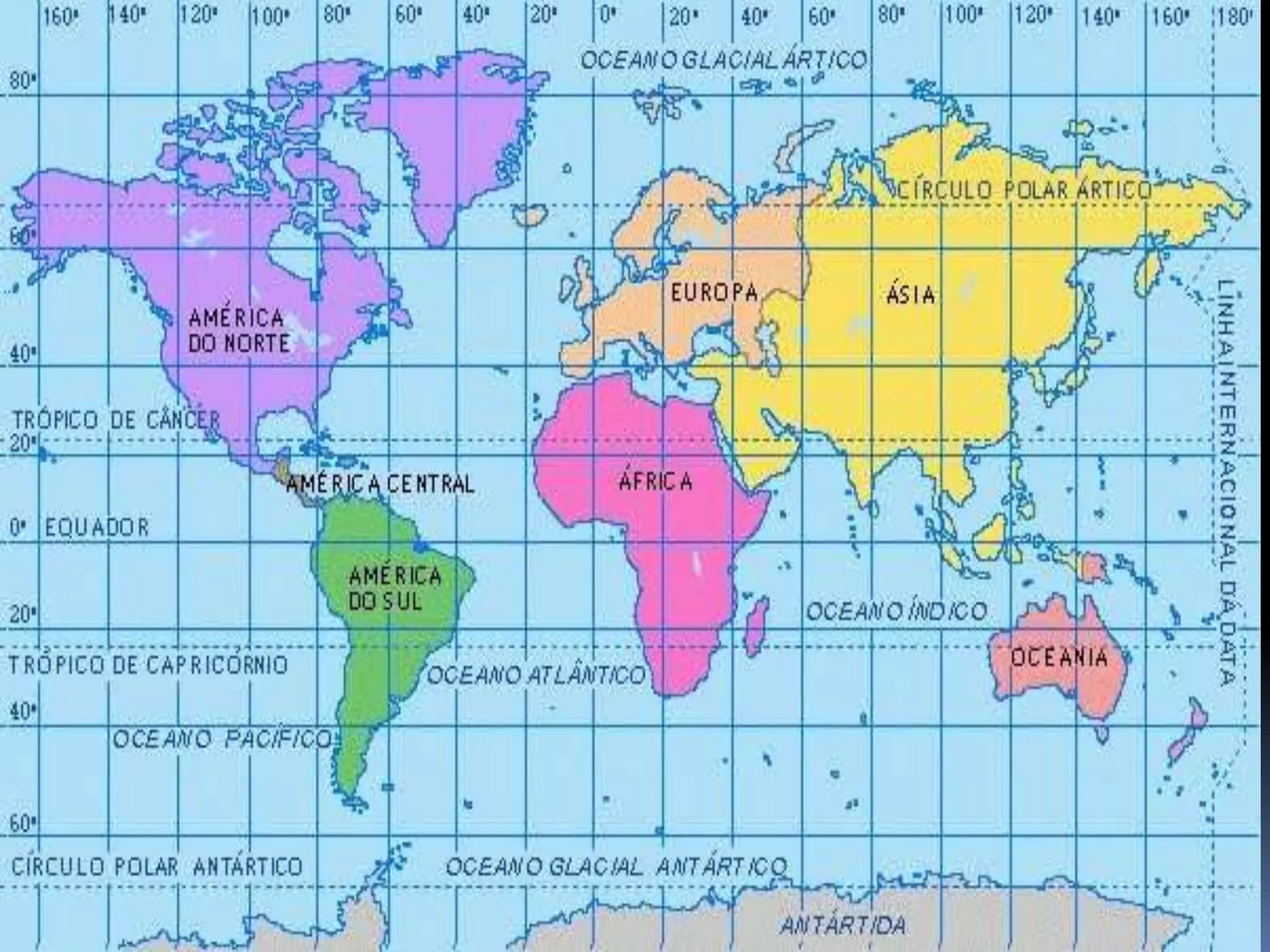
THE CONTINENTS OF THE EARTH
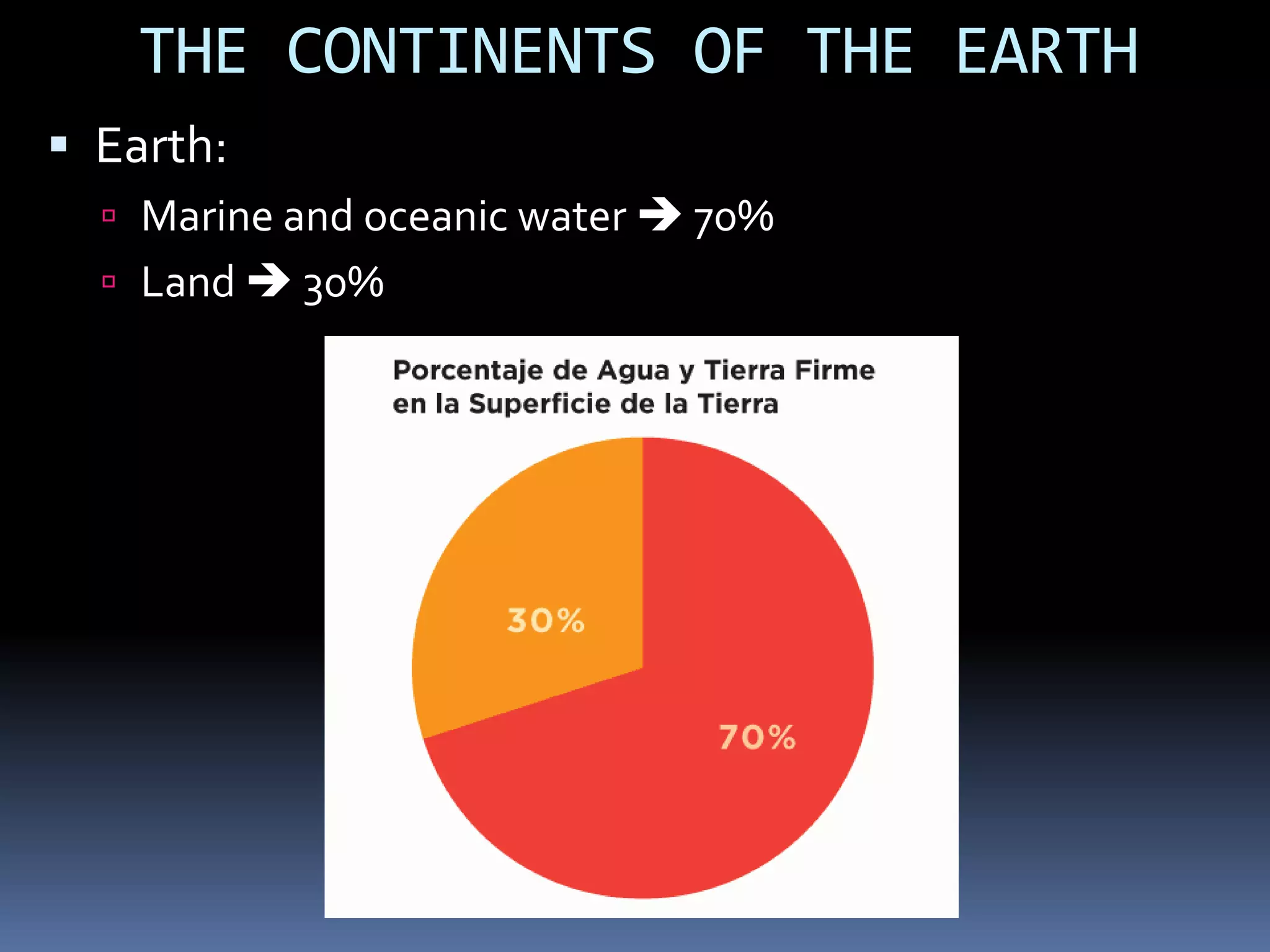
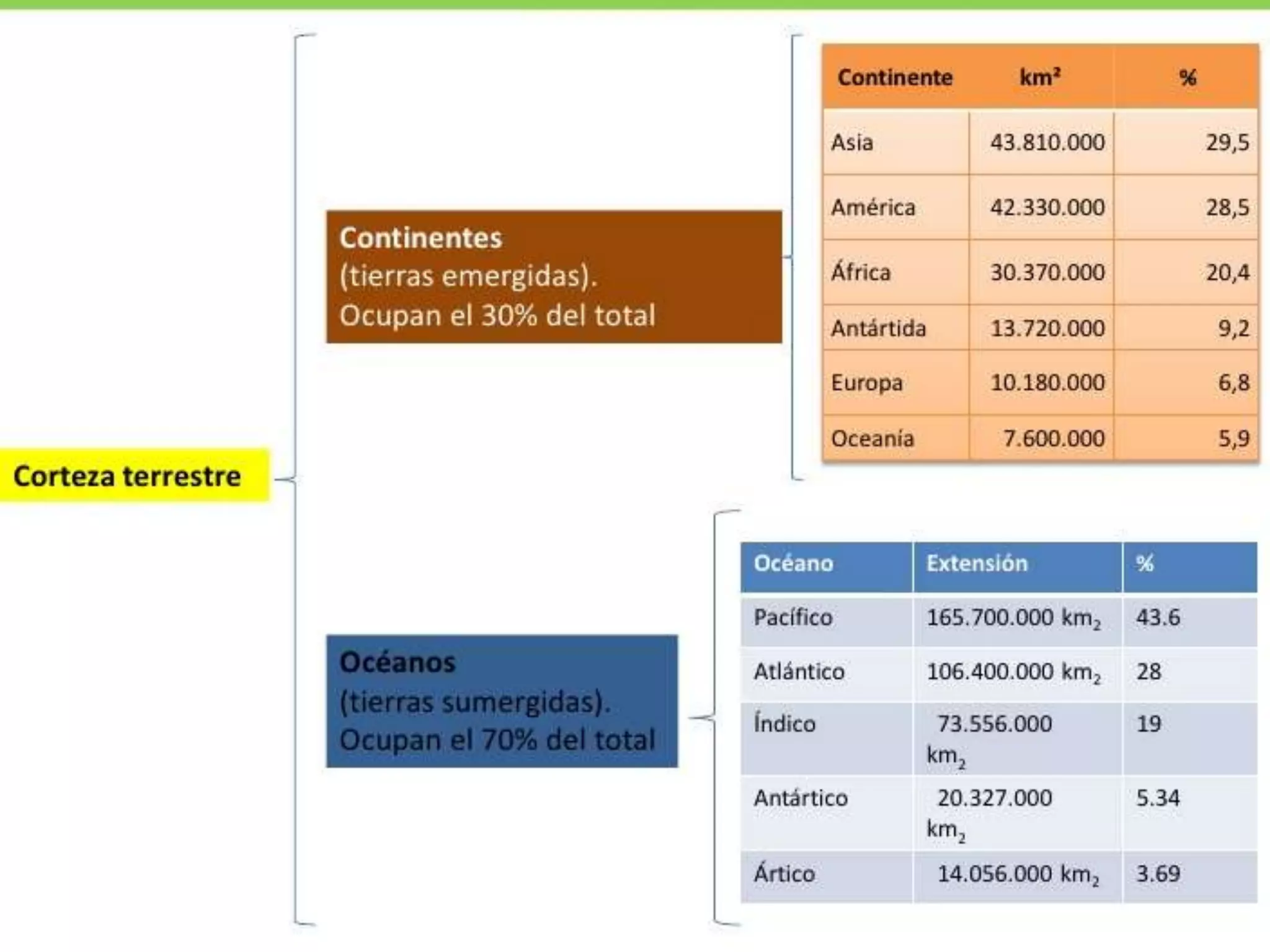
 Earth:
 Marine and oceanic water  70%
 Land  30%
 Most of the emerging lands  Continents.
 Continent: large areas of land surrounded by marine waters.
 In addition to continents, there are islands, which are
emerged lands, but smaller.
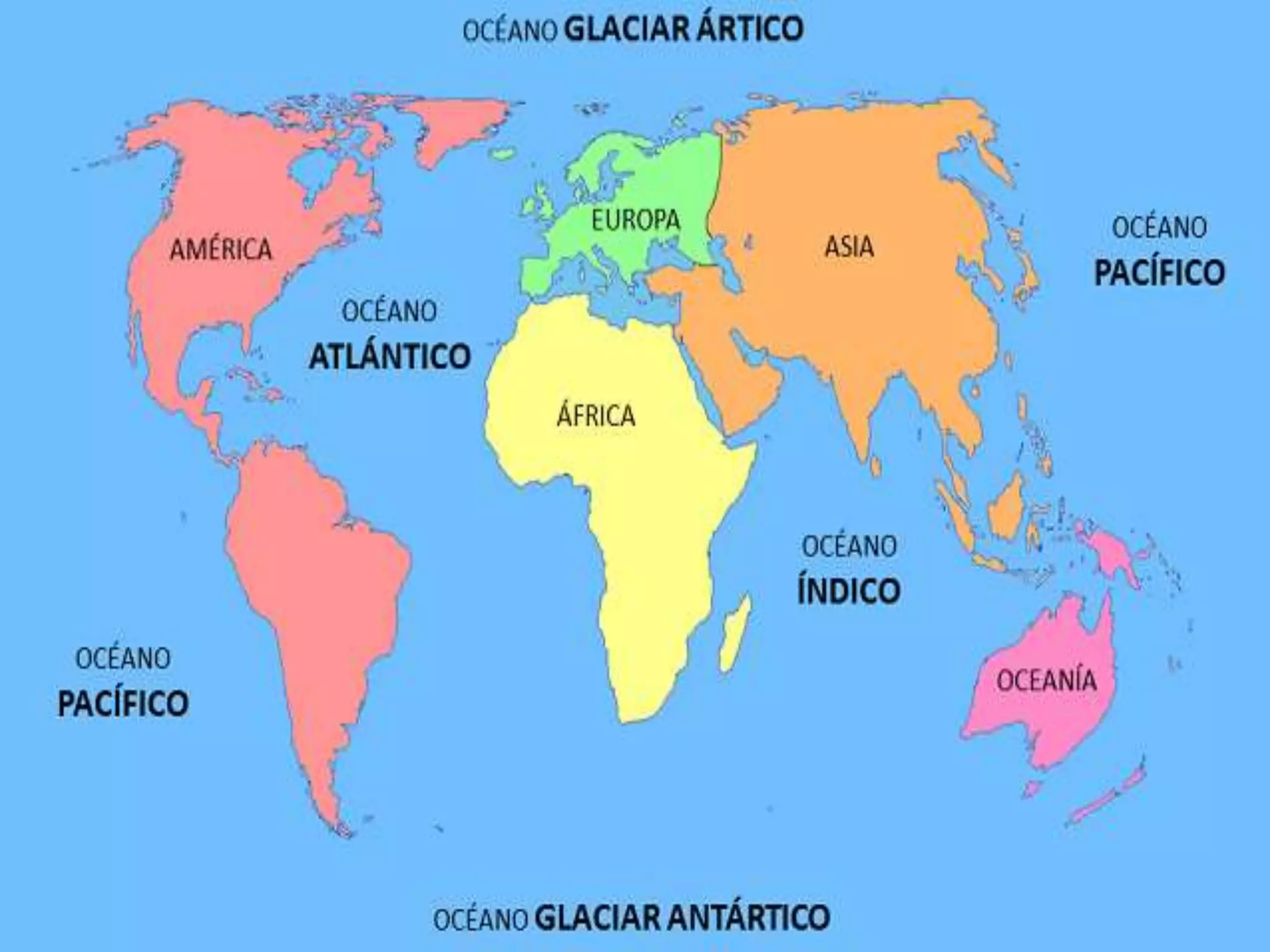
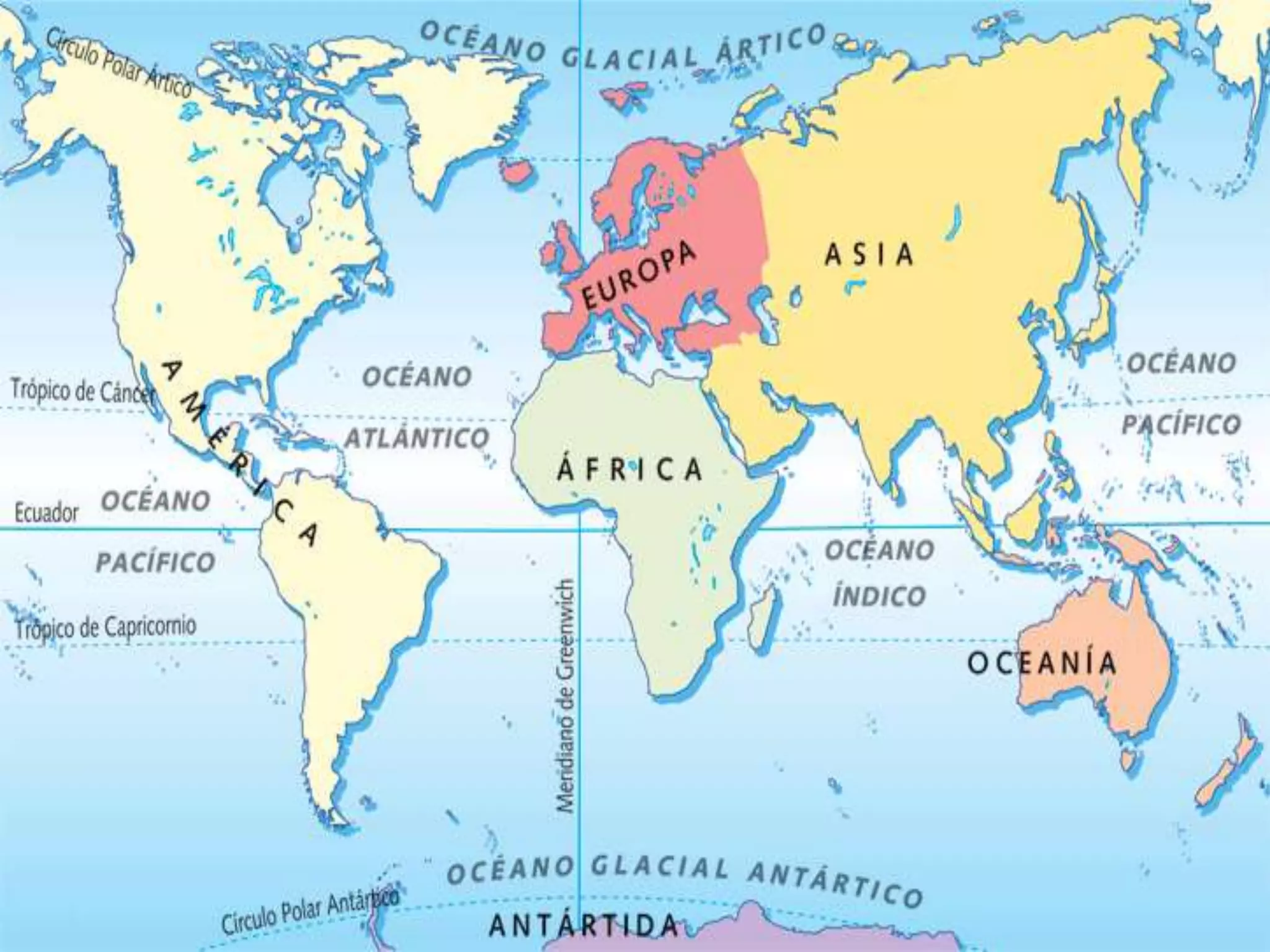
 The continents are: Asia, Africa, America, Europe,Antarctica
and Oceania.
 Europa y Asia formarían un conjunto:
Eurasia. Se consideran independientes.
 La mayor parte de los continentes se sitúa en
el hemisferio norte y en el hemisferio
occidental.
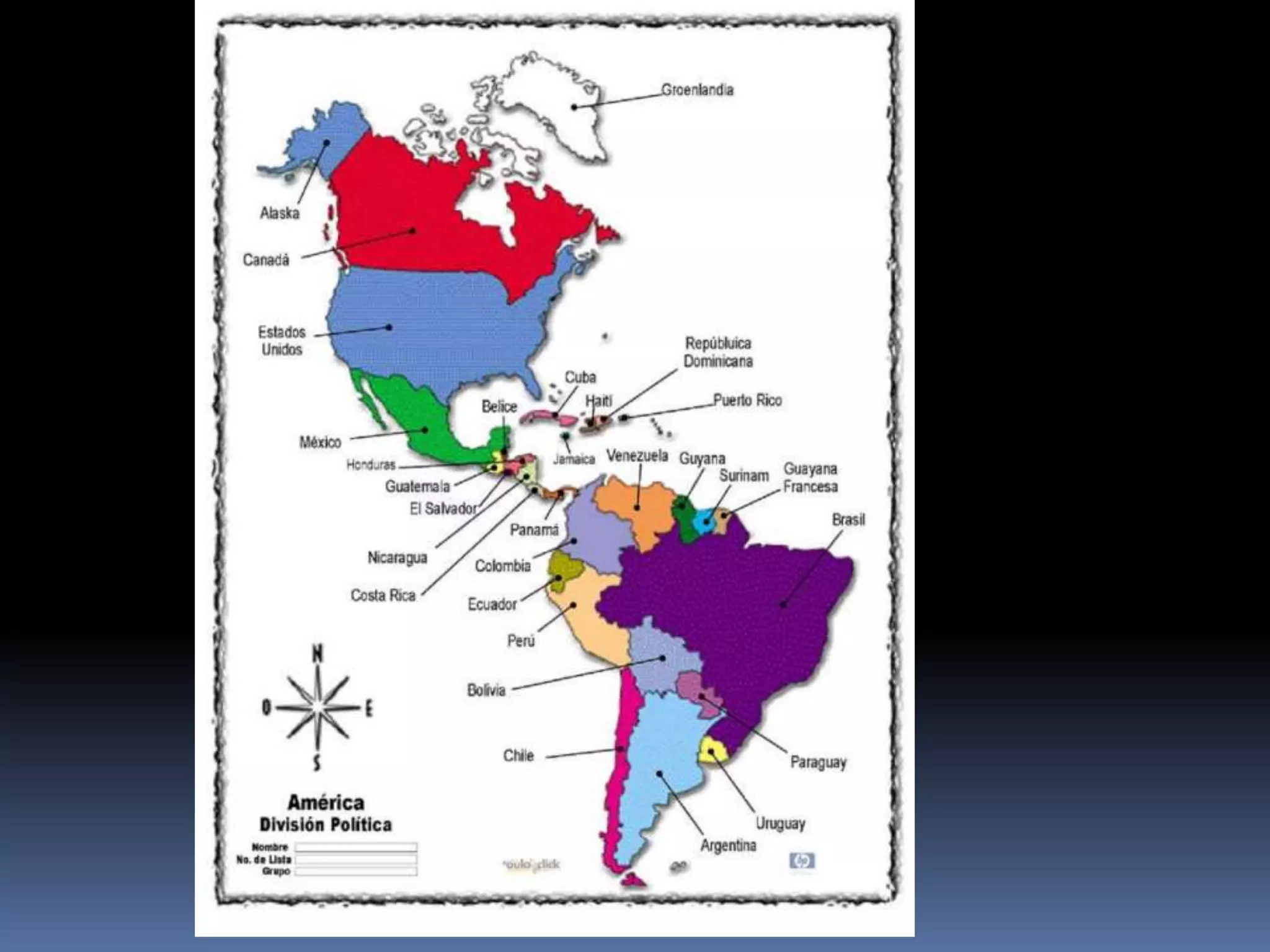
AMERICA
 It has an elongated shape from North to
South. It is located in the western
hemisphere.
 It has an area of more than 42 million km2.
 It limits to the north with the ArcticGlacial
Ocean; to the south with the O. Glacial
Antarctic; to the east, with the O. Atlántico;
to the west with the Pacific O., which
separates it from Asia by the Bering Strait.
 Most of its islands are in the Atlantic, the
Caribbean or the Canadian coast.
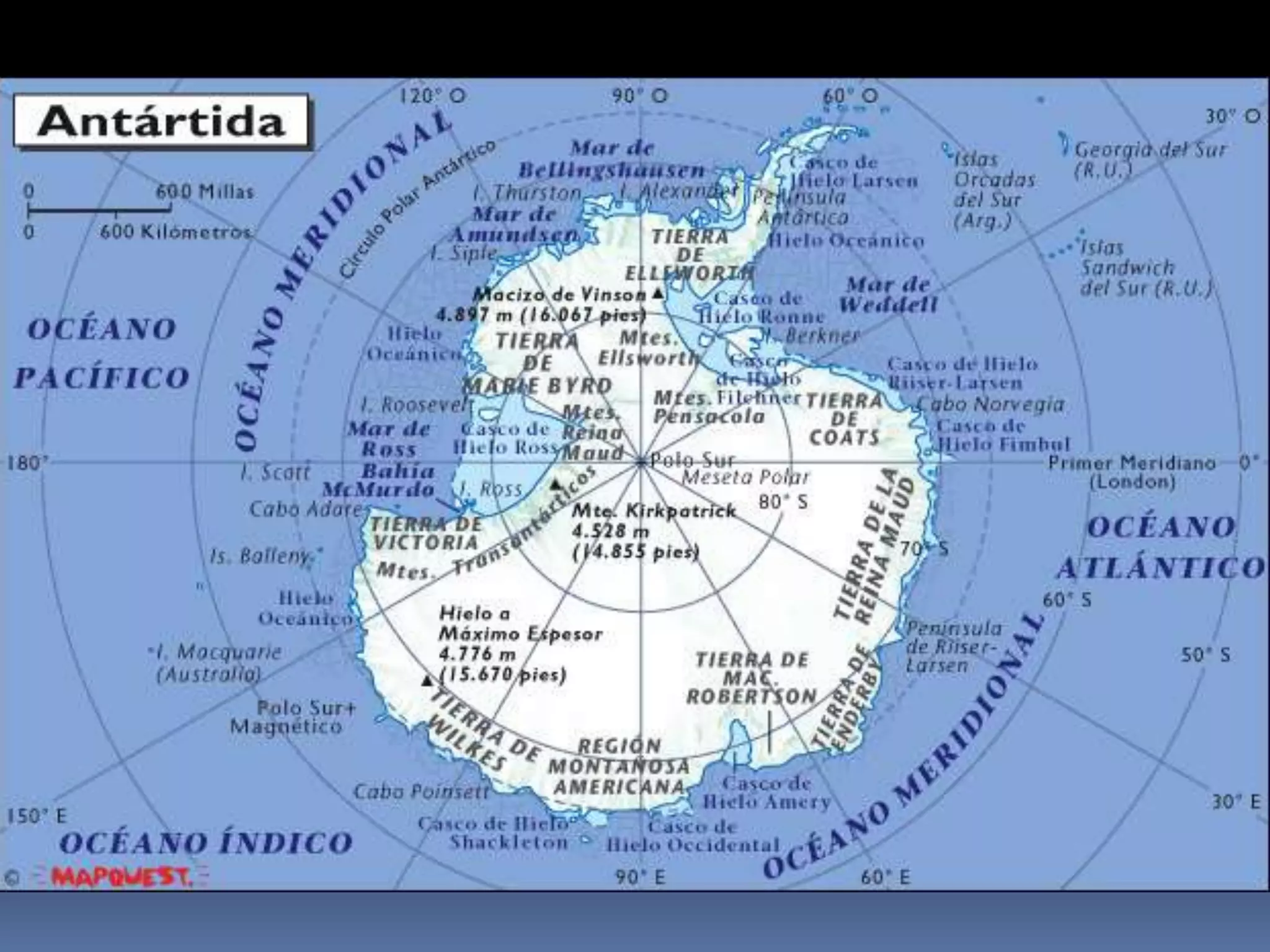
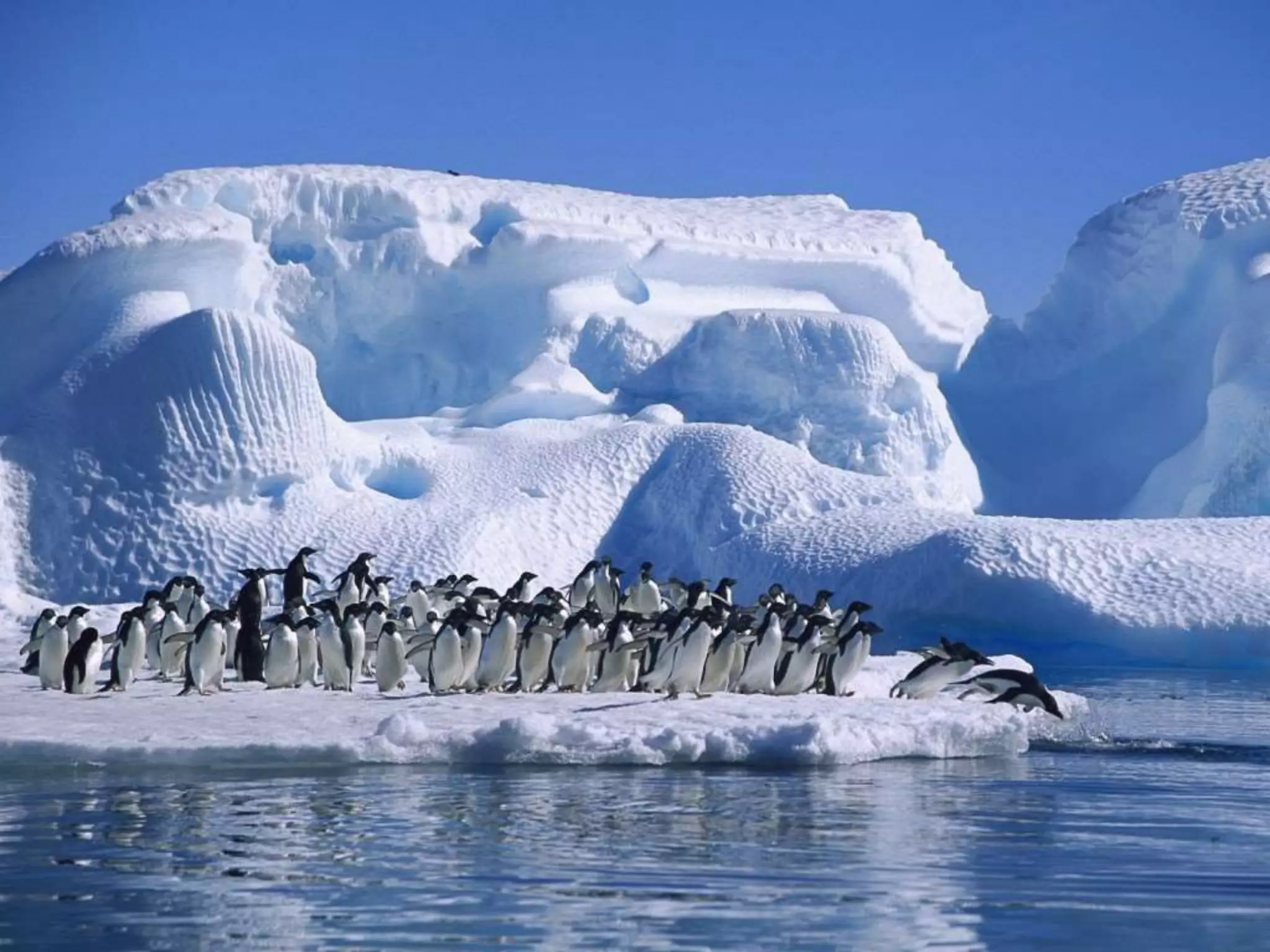
ANTARCTICA
 It contains an extension of more than 13
million km2.The Drake Strait, in the Pacific
Ocean, separates it from America.
 This continent is in the Antarctic Circle.
 It is covered with ice.
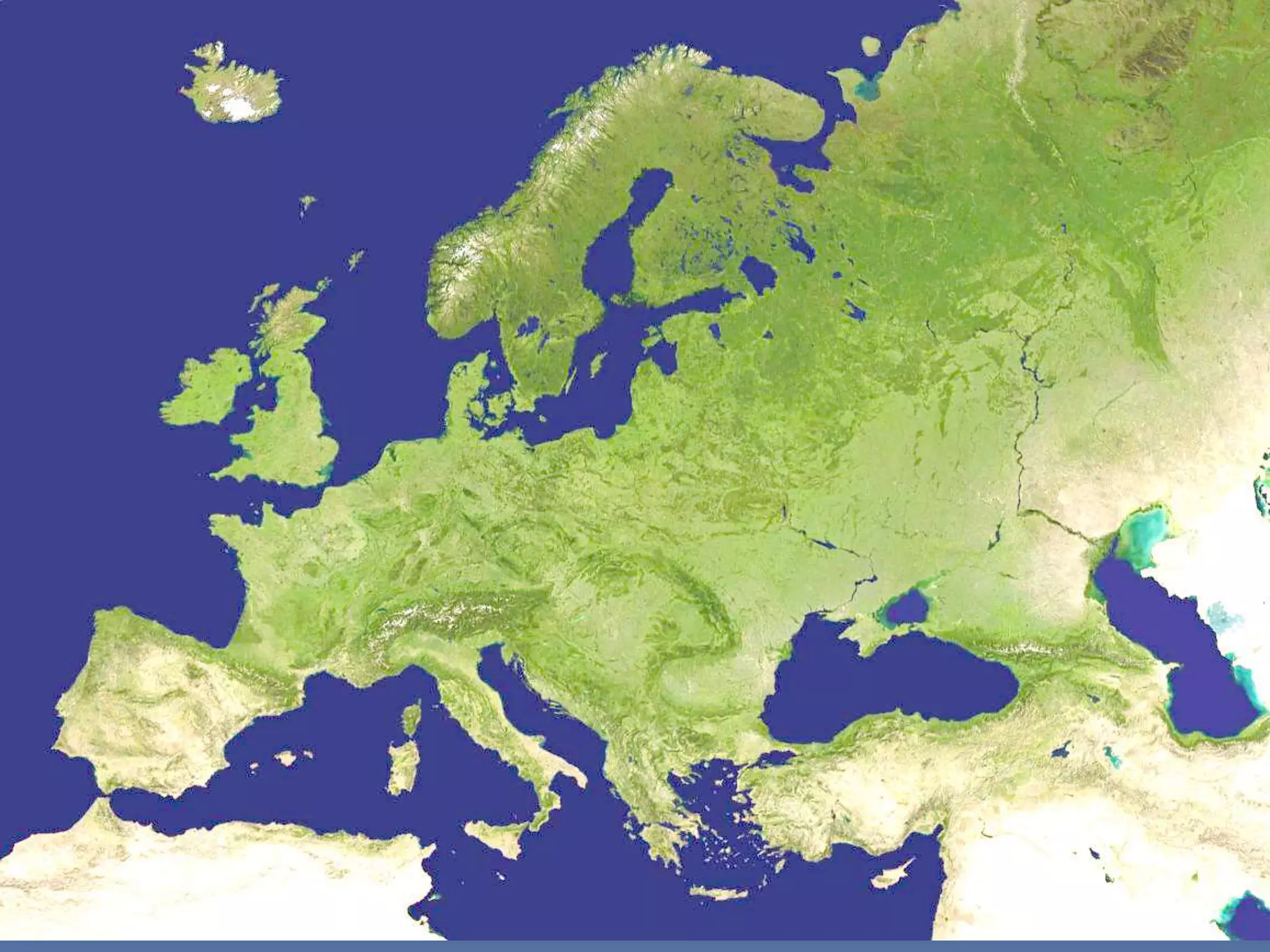
EUROPE
 It is the fifth continent in terms of its
extension.
 It has an area of more than 10 million km2.
 It borders on the Atlantic and Arctic Ocean, as
well as the Mediterranean Sea (that separates
it from Asia and Africa).
 Its islands in the Atlantic Ocean are large; of
smaller size those of the Mediterranean Sea.
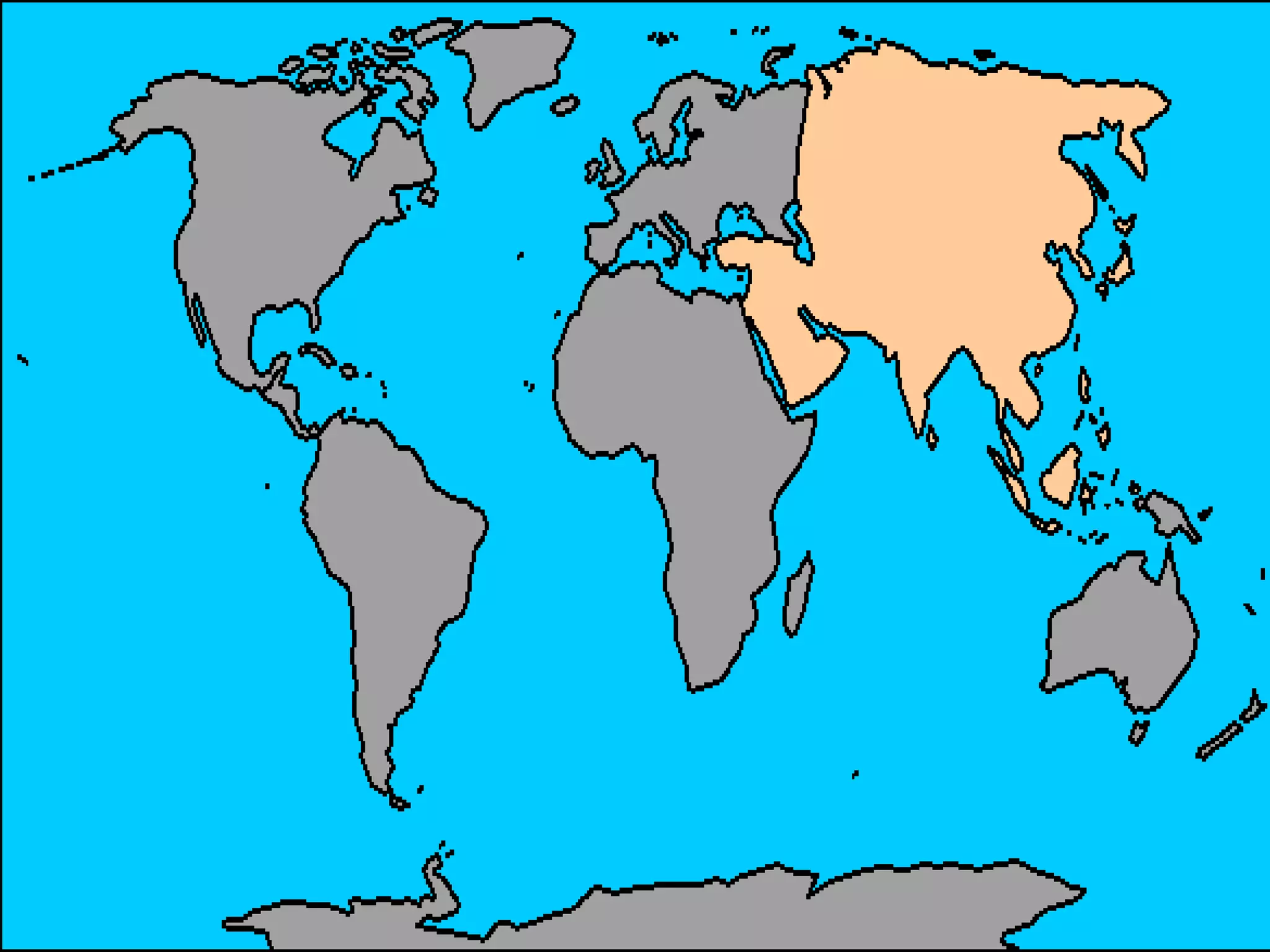
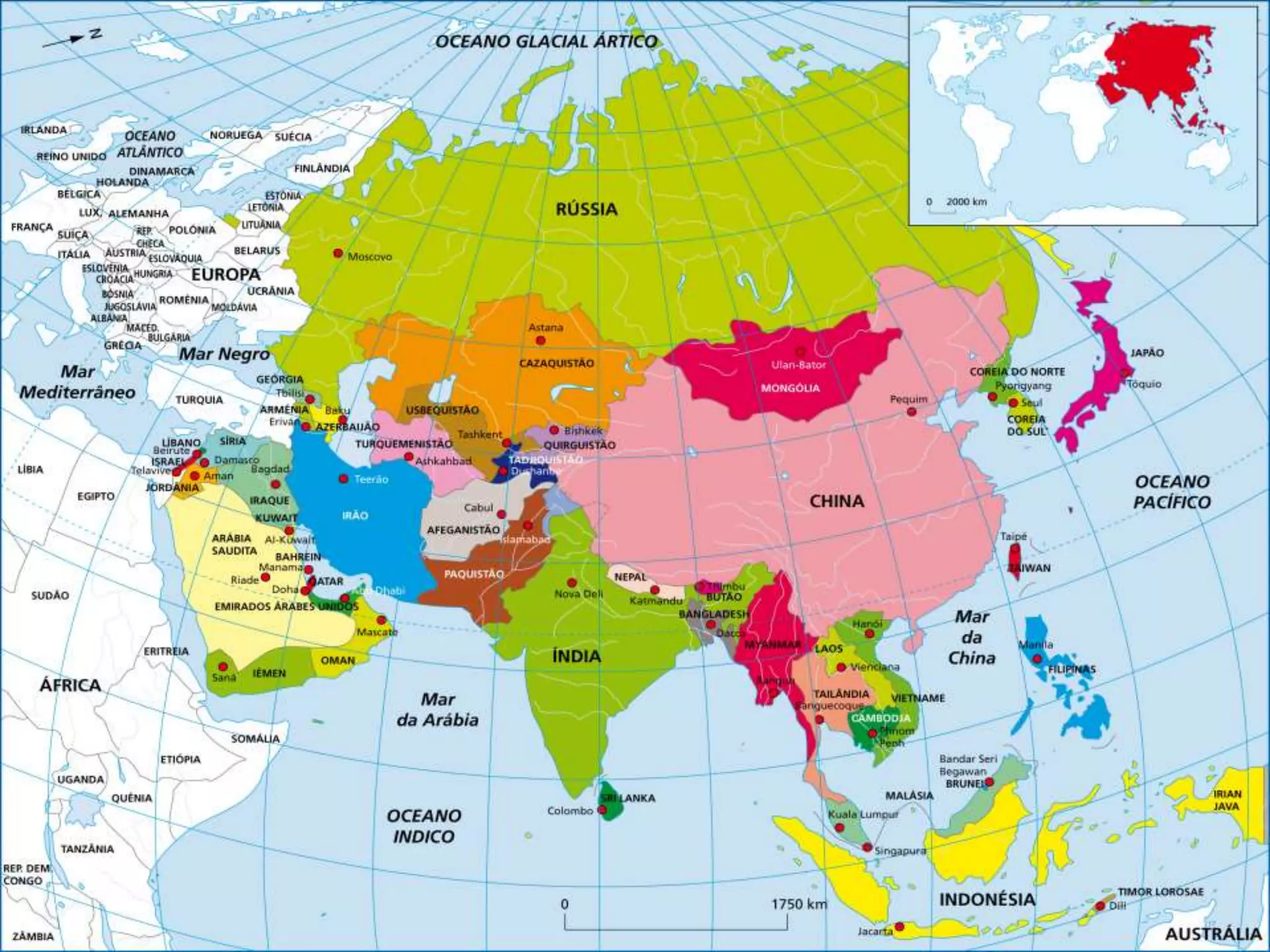
ASIA
 It is the continent of greater extension,
occupies more than 44 million km2.
 To the east and southeast of the continent
are the main archipelagos: Japan, the
Philippines and Indonesia.
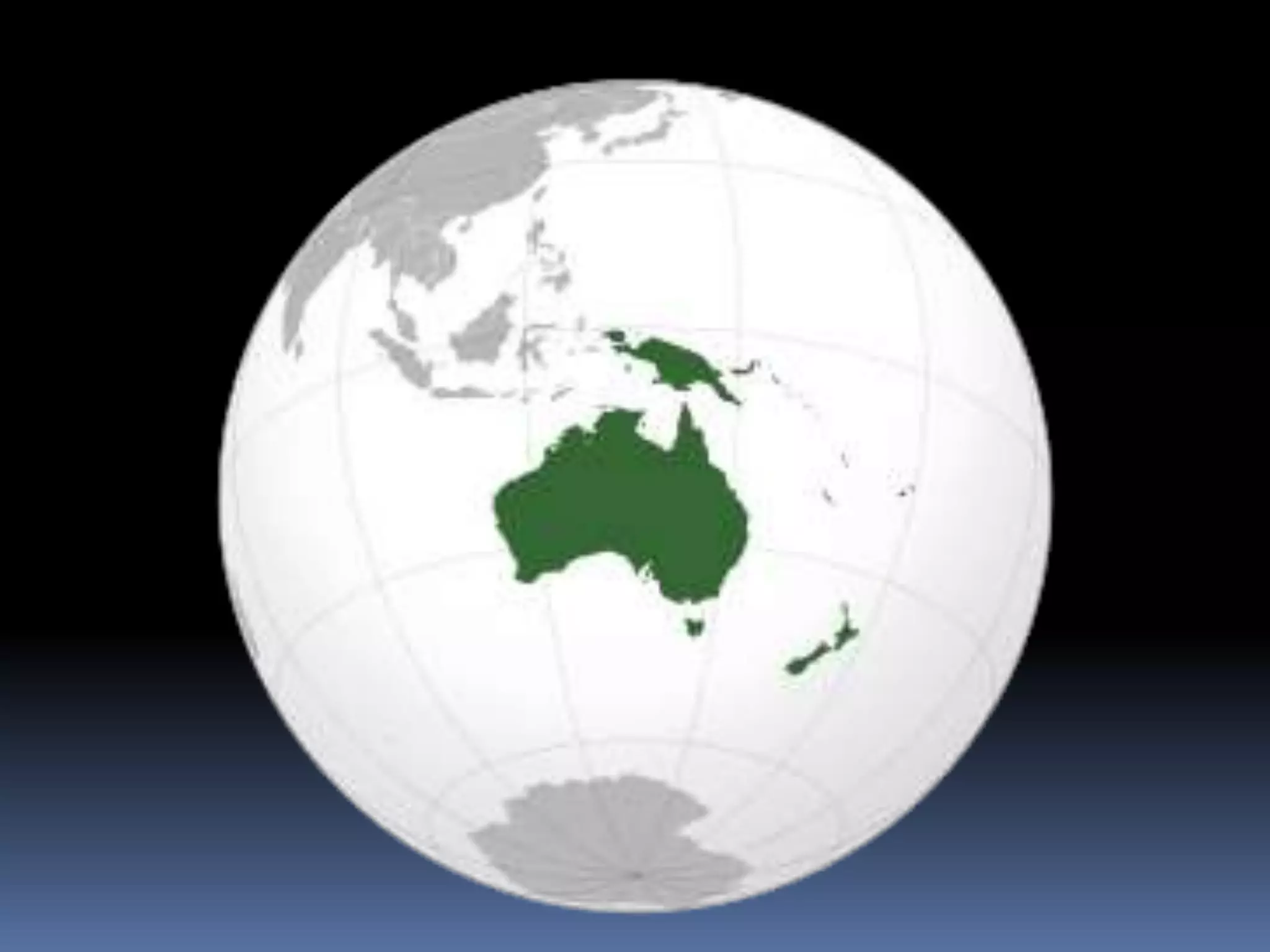
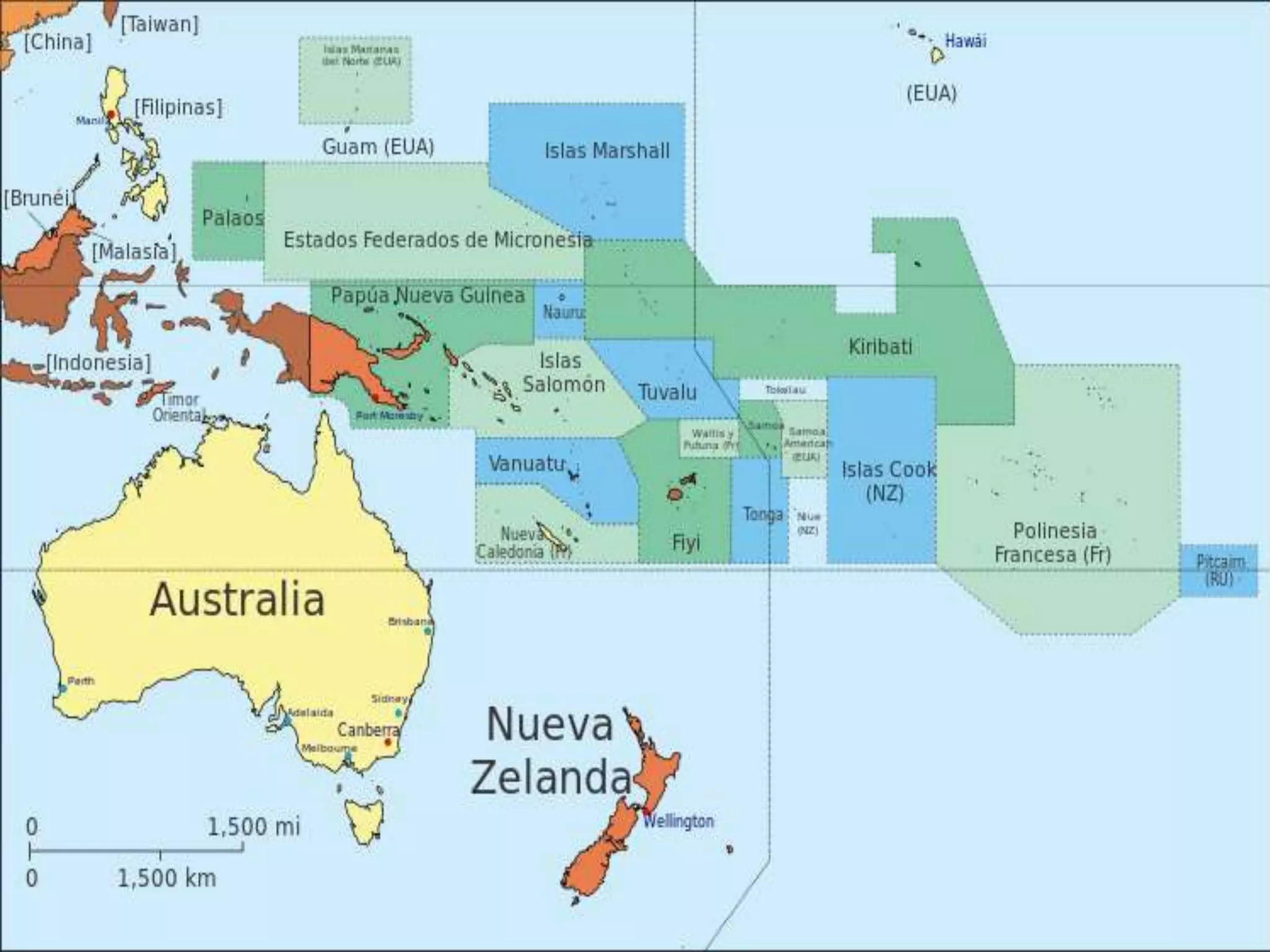
OCEANIA
 It is the continent of smaller extent,
occupying a little less than 9 million km2.
 Formed by islands. Highlights Australia, New
Guinea, New Zealand andTasmania.
 The island of Australia is the largest in the
world.
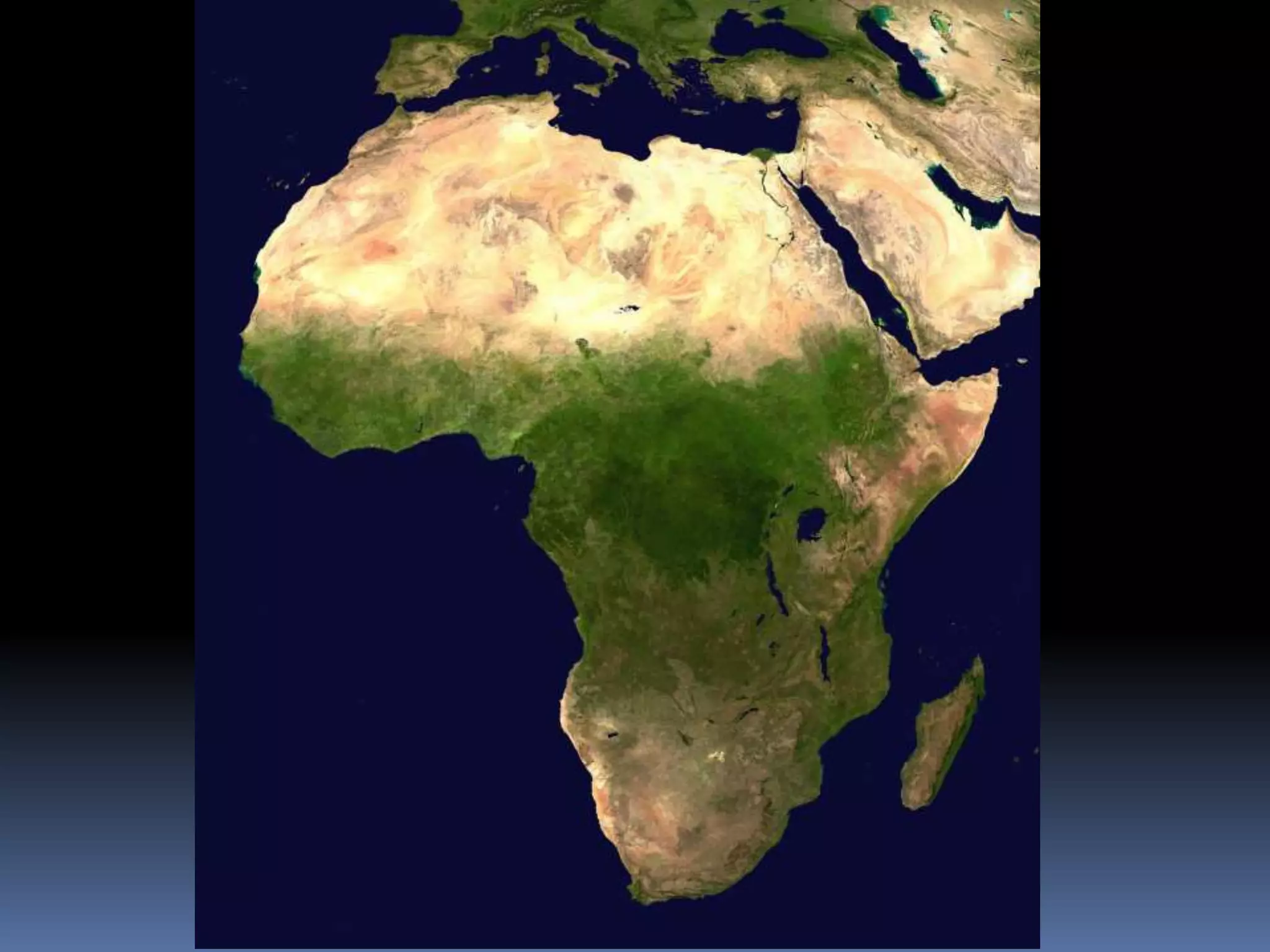
AFRICA
 It has an extension of more than 30 million
km2.
 The islands of the African continent are
scarce.The island of Madagascar stands out.
In addition to the archipelagos of the Canary
Islands, CapeVerde and the Seychelles.
 http://serbal.pntic.mec.es/ealg0027/mmundi1
e.html
 http://www.iesmariazambrano.org/Departam
entos/flash-educativos/terremotos.swf

UD3.- RELIEF AND LANDFORMS

  • 1.
  • 3.
    Stop and Think:What Would Earth Look Like if We Could Look Inside?
  • 4.
     According toits composition:  Crust: Between 6 and 70 km.  Mantle: It lies at a depth of 2900 km approximately.  Core: Lies at a depth between 2900 and 6370 km. It is divided in external and internal core.  According to its rigidity:  Lithosphere: Composed by the crust and the upper mantle, thickness of around 100 km.  Mesosphere: Inner mantle. Composed by magma.  Endosphere: It coincides with the core.
  • 5.
  • 9.
    TECTONIC PLATES/ PLACASTECTÓNICAS  The lithosphere (crust and the upper mantle) is divided into tectonic plates (placas tectónicas), which are blocks that float on top of the molten materials in the mantle.  The scientific study of the movements and changes of the lithosphere is called plate tectonics (tectónica de placas).
  • 12.
     The tectonicplates can be:  Continental plates (formed only by emerged lands).  Oceanic plates (formed by the lithosphere of the ocean floor).  Mixed plates (formed by continental and oceanic lithosphere).  The edges of the plates are zones of contact and of greater instability of the crust.
  • 14.
    RELIEF FORMATION  TheEarth’s relief consists of the natural forms and features that make up the surface of the planet. They are formed by:  Plate tectonics.  The action of external agents which change and shape them.
  • 16.
    OROGENESIS  It isthe process of formation of the Earth’s relief by the action of internal forces of the Earth.  Orogenesis’ processes: Volcanic mountain formation. Fault blocks. Folding
  • 17.
    VOLCANIC MOUNTAIN FORMATION Movimiento divergente o de separación  It occurs when two tectonic plates separate.  In the separation line a ridge (dorsal) is created.  Magma erupts from there, when it gets cold and solidifies, mountain ranges and volcanic cones are formed.
  • 18.
    OROGENIA VOLCÁNICA  Segenera cuando dos placas tectónicas se separan y dan origen a una zona de volcanes. A través de ellos emergen los materiales fundidos del manto. Cuando se solidifican forman cordilleras y conos volcánicos.
  • 19.
    FAULT BLOCKS  Movimientoconvergente o de choque:  It occurs when forces on blocks of hard materials which cannot fold.  These forces produce earthquakes.
  • 20.
    OROGENIA POR FALLA Se forman al colisionar dos placas formadas por materiales duros, no pueden plegarse, se fracturan y producen terremotos.  Bloques levantados y hundidos.
  • 21.
    FOLDING  Movimiento convergenteo de choque:  It occurs when two tectonic plates with edges made of relatively soft materials collide. The edges of the plates fold and rise, creating large mountains.
  • 22.
    OROGENIA POR PLEGAMIENTO Se produce al chocar dos placas tectónicas constituidas por materiales blandos. Da lugar a grandes montañas
  • 23.
    DERIVA CONTINENTAL  Esuna teoría que defiende que hace millones de años todos los continentes se hallaban unidos en un continente único (Pangea).  El continente se dividió inicialmente en dos: Laurasia y Gondwana (hace unos 150 millones de años).  Estas masas se fracturaron hasta que se formaron los actuales continentes.
  • 25.
     Vídeo:  https://www.youtube.com/watch?v=kwfNGat xUJI https://www.youtube.com/watch?v=tcPghqn nTVk  https://www.youtube.com/watch?v=alkXhmp pGMA  http://www.profesorfrancisco.es/2013/02/la- tectonica-de-placas-en-flash.html
  • 26.
  • 27.
     Elevated landformsare modified by the action of external agents.  The main external agents are: water, wind, temperatura and living beings.
  • 29.
    Processes that shapethe relief:  Erosion  Disintegration of relief shapes by the external agents.  Transport  Movement of the eroded materials.  Deposition  Deposit of transported materials.
  • 31.
    WATER EROSION  Pluvial It is caused by rainwater. Rainwater wears away the materials that are dragged by rivers and streams.  Glacial  It is caused by glaciers. Glaciers are masses of ice that move very slowly. They erode the surface and deposit sediment, forming moraines.  Coastal  caused by the movement of the sea, such as waves, tides and currents. The sea shapes the coasts, forming cliffs or depositing materials on the beaches.  Fluvial  Caused by rivers. It may form valleys and canyons.
  • 37.
    WIND EROSION  Itis caused by particles carried by the wind. The sediment transported by the wind is then deposited, forming piles of sand or dunes.
  • 38.
    TEMPERATURE EROSION  Freezingand thawing erosion is caused by water penetrating the crack son rocky surfaces.When the water freezes, its volumen increases producing bigger cracks in the earth and rocks.
  • 39.
    BIOLOGICAL EROSION  Itis caused by living things.  For example, plants break the soil with their roots.  Animals erode the soil when they build their dens.  Human activity is the most significant agents in shaping the Earth’s surface.Through the use of technology and heavy machinery, we shape the Earth according to our needs.
  • 40.
    Human activity isthe most significant agents in shaping the Earth’s surface. Through the use of technology and heavy machinery, we shape the Earth according to our needs. Human activity is the most significant agents in shaping the Earth’s surface. Through the use of technology and heavy machinery, we shape the Earth according to our needs.
  • 41.
  • 42.
    LAS FORMAS DELRELIEVE  The relief is the set of complex forms that compose the terrestrial surface.
  • 45.
    MOUNTAINS  Natural elevationsof the terrain with great height. más
  • 50.
    MOUNTAIN RANGE /CORDILLERA  Conjunto de montañas enlazadas entre sí.
  • 52.
    SIERRA  Parte deuna cordillera
  • 53.
    HILLS / COLINAS Elevations of low height.
  • 54.
  • 55.
    PLAINS  These areflat areas located at altitudes below 150 m. Plains are often fertile areas that are good for agriculture.
  • 57.
    PLATEAU / MESETA Extensive plain located in an elevated position with respect to the level of the sea.
  • 58.
  • 59.
    VALLEY  Space betweenmountains. If it is a fluvial valley it has a "V" shape. If it has been created by a glacier, it has a "U" shape.
  • 61.
    DEPRESSION  Extensive terrainthat lies below the level of the surrounding lands.
  • 65.
     Coastal reliefis located in areas where the emerging land is in contact with the sea.  If the continental area is flat and has a low altitude dominated by beaches.  If the continental area is mountainous  cliffs.  They can be different forms: beaches, capes, gulfs, peninsulas, inlets and fjords, islands and archipelagos…
  • 66.
    COAST / LITORAL Zone of contact between land and sea
  • 67.
    BEACH  Flat landlocated between land and sea. Almost flat stretch of sand or stones on the seashore, a river or a lake.
  • 68.
  • 69.
    CAPE  Portion ofland that penetrates the sea more than the rest.
  • 71.
    GULF AND BAY  Gulf:s ea entrance on the coast. Bays have rounded shapes and are smaller
  • 73.
    PENINSULA AND ISTHMUS Península: land area almost completely surrounded by the sea, except by a narrow strip called isthmus.
  • 75.
    ISLAND/ARCHIPELAGO  Land surfacesurrounded by water. A group of islands forms an archipelago.
  • 77.
  • 79.
    INLETS/FJORDS  Strip ofsea that penetrates the earth, taking advantage of the mouth of a river. If you take advantage of a glacier, it is a fjord.
  • 80.
  • 81.
  • 83.
    DELTA  Mouth ofa river that forms an accumulation of sediments.
  • 84.
  • 85.
    CLIFFS  Abrupt contactbetween land and sea by means of a very steep rocky zone.
  • 87.
  • 88.
    POND / ALBUFERA Lagoon of salt water, formed in low lands contiguous to the sea, that is isolated of this by a cord or sand bank.
  • 89.
  • 90.
    MARSH / MARISMA A marshy ground located below sea level, which has been invaded by the sea or an estuary.
  • 93.
     Ocean relieflandforms are located at great depths under the sea.  Distintas formas: plataforma continental, talud continental, llanuras abisales, dorsales oceánicas y fosas oceánicas.
  • 95.
    CONTINENTAL SHELVES/PLATAFORMA CONTINENTAL Inclined plain that links the mainland with the seabed.
  • 96.
    CONTINENTAL SLOPES /TALUD CONTINENTAL  Sharp end of the continental shelf, as a step.
  • 97.
    OCEAN BASINS /LLANURAS ABISALES  Seabed composed of large plains between 3000 and 6000 meters deep.
  • 98.
    OCEAN RIDGE /DORSAL OCEÁNICA  Great submarine mountain range located in the middle of the oceans in the abyssal plains. They are created by a great crack where magma from the mantle appears.
  • 100.
    RIFT  Centre ofthe ocean ridges.
  • 101.
    OCEAN TRENCH /FOSA MARINA  They are great underground depressions located along the edges of ocean basins. They are the deepest areas of the planet. The deepest ocean trench is that of the Marianas with 11,033 meters of depth.
  • 102.
  • 104.
    THE CONTINENTS OFTHE EARTH  Earth:  Marine and oceanic water  70%  Land  30%
  • 106.
     Most ofthe emerging lands  Continents.  Continent: large areas of land surrounded by marine waters.  In addition to continents, there are islands, which are emerged lands, but smaller.  The continents are: Asia, Africa, America, Europe,Antarctica and Oceania.
  • 108.
     Europa yAsia formarían un conjunto: Eurasia. Se consideran independientes.  La mayor parte de los continentes se sitúa en el hemisferio norte y en el hemisferio occidental.
  • 111.
    AMERICA  It hasan elongated shape from North to South. It is located in the western hemisphere.  It has an area of more than 42 million km2.  It limits to the north with the ArcticGlacial Ocean; to the south with the O. Glacial Antarctic; to the east, with the O. Atlántico; to the west with the Pacific O., which separates it from Asia by the Bering Strait.  Most of its islands are in the Atlantic, the Caribbean or the Canadian coast.
  • 113.
    ANTARCTICA  It containsan extension of more than 13 million km2.The Drake Strait, in the Pacific Ocean, separates it from America.  This continent is in the Antarctic Circle.  It is covered with ice.
  • 117.
    EUROPE  It isthe fifth continent in terms of its extension.  It has an area of more than 10 million km2.  It borders on the Atlantic and Arctic Ocean, as well as the Mediterranean Sea (that separates it from Asia and Africa).  Its islands in the Atlantic Ocean are large; of smaller size those of the Mediterranean Sea.
  • 119.
    ASIA  It isthe continent of greater extension, occupies more than 44 million km2.  To the east and southeast of the continent are the main archipelagos: Japan, the Philippines and Indonesia.
  • 122.
    OCEANIA  It isthe continent of smaller extent, occupying a little less than 9 million km2.  Formed by islands. Highlights Australia, New Guinea, New Zealand andTasmania.  The island of Australia is the largest in the world.
  • 125.
    AFRICA  It hasan extension of more than 30 million km2.  The islands of the African continent are scarce.The island of Madagascar stands out. In addition to the archipelagos of the Canary Islands, CapeVerde and the Seychelles.
  • 127.