Meaning and Scope of Geomorphology
• What is Geomorphology?
• Derived from a Greek word “geo” which is earth and “Morpho” which is
   form. Therefore geomorphology is a discourse on Earths Form.
• It is science that treats the general configuration of the earth's surface in
   terms of the classification and description of the nature, origin, and
   development of landforms and their relationships to underlying structures,
   and the history of geologic changes .
• By examining the above definition we can classify geomorphology in to
     Processes or functional Geomorphology
     Historical Geomorphology

• Therefore geomorphology studies form, processes and history about earth.
Scope of Geomorphology

 The scope of geomorphology is in dilemma that many of the earth scientists
   of the world have different perspective.

 some scientist says “ it must study about physical configuration, process and
   history of the earth only” some others says “ it studies about the forms and
   shape of the earth as well as other earth like planets like Mars, and Venus”

 Traditionally the scope of geomorphology is delimited to “terrestrial environment”
   due to its strong man - terrestrial environment relationship.

 However due to advancement in technology in mans recent life history the
   discipline has begun to study the “aquatic environments”.
Classification of Geomorphology
 Geomorphology has got different classification which made the study about the physical
   configuration of the of the earth well-heeled.

 Basically geomorphology is classified as functional or process geomorphology and
   historical geomorphology.
     A. Historical geomorphology: Traditionally, historical geomorphologists strove to workout
         landscape history by mapping morphological and sedimentary features. Their golden
         rule was the dictum that „the present is the key to the past‟.
     Some of the most notable scholars in this category are:
      William Davis Morris: he developed a theory of “Geographic cycle” which states that
        the Geomorphic processes, without further complications from tectonic movements, then
        gradually wear down the raw topography. Uplifting and denudation takes place
        alternately. In old ages uplands turn in to plain lands through planation processes.
      Walter Penck: he opposes the Daviasian Model by stating uplifting and denudation
        happens at the same time.
 According to him the continuous and gradual interaction of tectonic processes and
    denudation leads to a different model of landscape evolution, in which the evolution
    of individual slopes is thought to determine the evolution of the entire landscape.

 3 slope forms evolve with uplift and denudation rates.
     A. Convex slope profile: when uplifting exceeds rate of denudation.

     B.   Concave slope profile: when denudation exceeds rate of uplifting.

     C. Striate slope profile: when denudation and uplifting happens at the same rate at a time.

           B. Modern historical Geomorphology: It relies on various chronological analyses,
particularly those based on stratigraphic studies of Quaternary sediments, and upon a much fuller
appreciation of geomorphic and tectonic processes. (fig.1)

           C. Processes Geomorphology: is the study of the processes responsible for formation
of landforms. Grove Karl Gilbert was the first modern processes geomorphologist by studying
fluvial and its processes on Henry mountain in Utah, USA and investigated the transport of debris
down from up.
D. Applied Geomorphology: studies the interactions of humans with landscapes and
landforms.
 Three aspects of applied geomorphology have been brought into a sharp focus by
   the impending environmental change associated with global warming and illustrate
   the value of geomorphological know-how.

     1st applied geomorphologists are ideally placed to work on the mitigation of
       natural hazards of geomorphic origin, which may well increase in magnitude
       and frequency during the twenty-first century and beyond. Applied
       geomorphologists can address all these potentially damaging changes.
     2nd a worrying aspect of global warming is its effect on natural resources – water,
       vegetation, crops, and so on. Applied geomorphologists, equipped with such techniques
       as terrain mapping, remote sensing, and geographical information systems, can
       contribute to environmental management program..
     3rd applied geomorphologists are able to translate the predictions of global
      and regional temperature rises into predictions of critical boundary changes,
      such as the pole ward shift of the permafrost line and the tree-line, which can
      then guide decisions about tailoring economic activity to minimize the effects
      of global environmental change.

Other Geomorphologies

 Tectonic Geomorphology: interplay between tectonic and geomorphic processes
    in regions where the Earth‟s crust actively deforms.

 Submarine Geomorphology: studies about form, origin and dev‟t of sea floor.

 Planetary Geomorphology: is the study of landforms on planets and large
    moons with a solid crust, for example Venus, Mars, and some moons of Jupiter
    and Saturn.

 Etc.
Approaches to the study of Geomorphology
 There are two main approaches to the study of Geomorphology.
1. Description (field description and morphological mapping)
 The only way fully to appreciate landforms is to go into the field and see them.
 The mapping of landforms is an art.
 Such as karst depressions and volcanoes, may be represented as points. Others, such as
   faults and rivers, are linear features that are best depicted as lines.
 Morphological mapping attempts to identify basic landform units in the field, on aerial
   photographs, or on maps. It sees the ground surface as an assemblage of landform
   elements.
2. Mathematical representation( Geomorphometery).
 Studies quantitatively the form of the land surface.
 In the modern era it is traceable to the work of Alexander von Humboldt and Carl Ritter
   in the early and mid-nineteenth century.
 It has been „reinvented‟ with the advent of remotely sensed images and Geographical
   Information Systems (GIS) software.

 It is an important component of terrain analysis and surface modeling.

 Its specific applications include characterizing glacial troughs, mapping sea-floor terrain
   types, guiding missiles, assessing soil erosion, analyzing wildfire propagation and etc.

2.1. Digital elevation models

 The resurgence of Geomorphometery in 1970‟s is due to two basic reasons.

      1st the development of light speed development and GIS

      2nd EDM in surveying and more recently GPS

 A DEM is „an ordered array of numbers that represent the spatial distribution of
   elevations above some arbitrary datum in a landscape‟.

 DTMs are „ordered arrays of numbers that represent the spatial distribution of terrain
   attributes.‟
Importance of studying Geomorphology
 Studying Geomorphology has a great role. Some of the importance's of studying
  geomorphology are:
       Remote sensed scientific studies
       Soil science
       Agricultural studies
       Soil erosion protection mechanisms
       Rehabilitation projects
       Geology
       Petrology
       Evolutionary studies
       For prediction and forecasting
       etc…..
Origin of the Universe
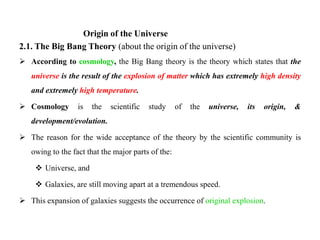
2.1. The Big Bang Theory (about the origin of the universe)
 According to cosmology, the Big Bang theory is the theory which states that the
   universe is the result of the explosion of matter which has extremely high density
   and extremely high temperature.

 Cosmology       is   the   scientific   study     of   the   universe,   its   origin,   &
   development/evolution.

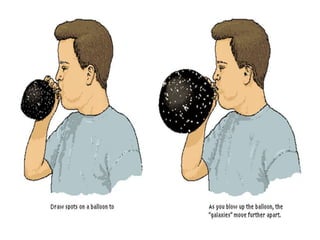
 The reason for the wide acceptance of the theory by the scientific community is
   owing to the fact that the major parts of the:

     Universe, and

     Galaxies, are still moving apart at a tremendous speed.

 This expansion of galaxies suggests the occurrence of original explosion.
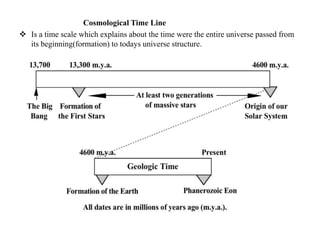
Cosmological Time Line
 Is a time scale which explains about the time were the entire universe passed from
  its beginning(formation) to todays universe structure.
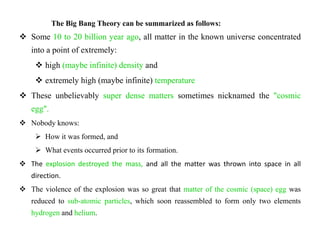
The Big Bang Theory can be summarized as follows:
 Some 10 to 20 billion year ago, all matter in the known universe concentrated
   into a point of extremely:
     high (maybe infinite) density and
     extremely high (maybe infinite) temperature
 These unbelievably super dense matters sometimes nicknamed the "cosmic
   egg".
 Nobody knows:
     How it was formed, and
     What events occurred prior to its formation.
 The explosion destroyed the mass, and all the matter was thrown into space in all
   direction.
 The violence of the explosion was so great that matter of the cosmic (space) egg was
   reduced to sub-atomic particles, which soon reassembled to form only two elements
   hydrogen and helium.
 The universe, shortly after explosion, comprised an expanding cloud of
   gases composed of nearly:

     73% hydrogen, and 27% helium.

 The expanding cloud gradually lost its homogeneity as it was drawn into
   many smaller gas clouds, each held together by its own gravitational
   attraction.

 Within these gas clouds, future Galaxies, gravity produced much denser
   and more localized concentrations of gas.
 As these Smaller gas clouds concentrated, their central cores were
  gradually heated by compression.
 When a temperature of approximately 11 million degree Celsius was
   reached, thermonuclear fusion (union) was spontaneously initiated, and
   stars were born.
Other Theories Stating About Universe
1. Geocentric Theory: by Ptolemy.

 They observed the stars, sun, and planets revolving around Earth. From this, they
   assumed that the Earth was motionless and all other objects they could see were
   moving around the Earth. Accordingly Earth is the Center of the Universe.

2. Heliocentric Universe: by Nicolas Copernicus (Poland). The sun is the center of the
universe.

3. The steady state theory: by Herman Bondi, Thomas Gold and Fred Hoyle(Austria,
and England)

 The theory states that matter is being continuously created, at the rate of a few
   hundred atoms per year. This would allow the density of the universe to remain
   constant as it expands.
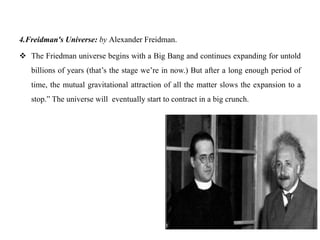
4.Freidman's Universe: by Alexander Freidman.

 The Friedman universe begins with a Big Bang and continues expanding for untold
   billions of years (that‟s the stage we‟re in now.) But after a long enough period of
   time, the mutual gravitational attraction of all the matter slows the expansion to a
   stop.” The universe will eventually start to contract in a big crunch.
THE THEORY OF ORIGIN OF SOLAR SYSTEM AND THE EARTH
Introduction
 The solar system comprises:
    1.   9 Planets,
    2.   Their satellites, and
    3.   Numerous small but interesting bodies including:
         Asteroids (common in Mars and Jupiter, their thickness ranges up
           to 500km)
         Comets (small icy body in space that sheds gas and dust)
         Meteorites
 These members of the solar system exhibit (show) a number of regular
   patterns (models).
 On the basis of these regularities of planets and planetary bodies with
   respect to the sun, various theories have been developed.
A few of the components of the regularity are as follows:

1.   All the planets revolve around the sun in the same direction (which is the
     direction the sun rotates).

2.   All the planets lie in nearly the same plane (flat surface) of revolution.

3.   Most of the planets rotate in the same direction as they orbit the sun, the
     exception being Venues, Uranus and Pluto.

4.   The majority of planetary satellites revolves around their parent planet in
     the same direction as the planets revolve around the sun (and as the
     planets rotate).

5.   Most satellites' orbits are in the equatorial plane of their planets.
 On the basis of these regularities of planets and planetary bodies with
   respect to the sun, various theories have been developed.

 In general, theories of the origin of the solar system (and the earth) can be
   divided in to two groups. These are:

    A. Evolutionary theories, and

    B. Catastrophic theories
A. Evolutionary Theories
• Evolutionary theories refer to those theories which suggest that the planets
   including the earth were formed during the evolutionary formation process
   of the sun.

• Here are some of thee theories which lies in the evolutionary theories.
1. Nebula Hypothesis
o The nebula hypothesis was put forward by Immanuel Kant, the German philosopher
   in 1755 and later revised by P.S. de Laplace, the French mathematician in 1796.

o This hypothesis suggests that the sun and planets, including the earth were formed
   from a disc-shaped rotating nebula.
The hypothesis may be shortened (condensed) as follows:
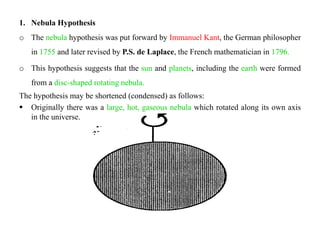
 Originally there was a large, hot, gaseous nebula which rotated along its own axis
   in the universe.
 About five billion years ago, the nebula lost energy by radiation (emission),
  became cooler and began to contract.
 As the nebula contracted inward under its own gravitational influence, its
  speed of rotation became faster and faster.
 Due to the effect of the centrifugal force, the nebula bulged in the
  equatorial zone.
                 Weakness of the hypothesis
 The hypothesis could not explain the energy distribution within the solar
  system.
       However, 98% of the angular drive is concentrated in the planets.
       The sun which possesses most of the mass (about 99.9%) of the solar
       system, should have gathered maximum angular momentum or
       energy.
B. Catastrophic Theories
• refer to those theories which suggest that planets were formed by some
     special accident or catastrophe, such as the close approach or collision of
     two stars.

• However, as the stars are so far apart from each other in the galaxy, the
     possibility of such a catastrophe is extremely rare.

• Examples of catastrophic theories are:

I.     Planetesimal hypothesis: This hypothesis was proposed by the
       American scientists Chamberlin and Moulton in 1904. According to this
       hypothesis, the planets were formed from:
       Collision and

       Union of numerous planetary fragments known as the planetesimals.
The main points of this hypothesis are as follows:
• The sun existed before the formation of planets. A large passing star
   approached very close to the sun.
• Due to the troublemaking forces of the sun and the strong gravitational pull
   of the passing star, giant mass of gas was worn out from the surface of pre-
   existing sun.
• The giant masses of gas broke in to a large number of small large pieces
   which on cooling gave rise to solid particles called "planetesimals".
• Planetesimals are one of the small objects that formed from the material of
   the sun from which planets evolved.
• By collision and Gravitational attraction, the larger planetesimals cleaned
   up the smaller pieces and thus planets were formed.
Major errors of planetesimal hypothesis are as follows:

• Most of the material which was ejected by explosive action of the sun
   would come from the interior. It would be so hot that the gases would
   disperse in the space rather than condense into planets.

• The space is so vast and therefore the probability of a close approach of
   two stars is extremely unlikely.

II. Gaseous-tidal (wave) hypothesis

• This hypothesis was proposed by Jeans and Jeffrey in 1925.

• According to this hypothesis, as a very large star progressively approached
   close to the sun, a gaseous tide (wave) was raised on the surface of the sun
   due to gravitational pull of the star.
• When the star began to move away, the gaseous tide (wave) was detached
   from the body of the sun.
• The spindle (thin stick) shaped gaseous tide (mass of wave) soon broke
   into:
     Ten pieces nine of which formed the nine planets, and
     The remaining one further broke in to small pieces, and formed the
       group of planetoids.
The followings are the main oppositions of the gaseous tidal hypothesis:
     The passing star is unable to pass on the proper angular momentum
       (energy) to the detached gaseous masses.
     The hot gaseous mass pulled away from the sun would not form solid
       planets but would drive away into the space.
III. Binary star hypothesis:
• This hypothesis was proposed by Lyttleton in 1938.

• It suggests that before the formation of planets, the sun had a friend star
   another star approached close to these double stars and pulled the friend
   star away.

• A gaseous thread was torn from the friend star and remained close to the
   Sun. The planets were originated from this gaseous thread in the same way
   as described in the gaseous tidal hypothesis.
2.3. Age of the Earth
    2.3.1. Geologic Time scale and Age Dating
• As the sun's first rays of thermonuclear light blazed across the galaxy 4.5
   billion years ago, the primal earth emerged from a spinning, turbulent
   cloud of gas, dust and planetoids that surrounded the new star.
• During the next 700 million years the cloud settled into a more tranquil
   solar system, and the sun's third planet began to solidify.
• The work of James Hutton has changed and brought new outlook on
   geological timing and shown as the geological processes takes extremely
   long time.
• He developed a principle of uniformitarianism and strongly argued that
   forces which appear small could over long span of time, produce effects
   that were just as great as those resulting from sudden catastrophic events.
•    According to cosmological timer line, the planet of earth that we are living on is
     formed some 4.6 billion years ago.
•    A hierarchical scale in which this 4.6 billion years history of the earth is divided
     into time units of varying duration is called Geologic Time Scale (see Table on
     page 15).

2.3.2. Techniques of Age dating
I.    Absolute Dating
 Absolute dating, sometimes called chronometric dating.
 refers to the assignment of calendar year dates to geological events.
 The process of assigning specific ages in years before the present to the various
     geologic events is termed as absolute dating.
       Is the result of the development of radiometric methods
       Used by geologists to determine the actual age of a material.
Other absolute age dating Techniques
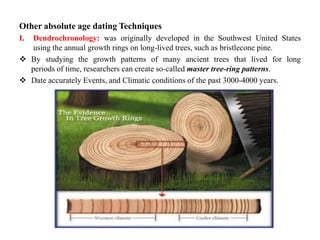
I. Dendrochronology: was originally developed in the Southwest United States
   using the annual growth rings on long-lived trees, such as bristlecone pine.
 By studying the growth patterns of many ancient trees that lived for long
  periods of time, researchers can create so-called master tree-ring patterns.
 Date accurately Events, and Climatic conditions of the past 3000-4000 years.
 Patterns in the: width, wood thickness, and hydrogen and oxygen isotopic
   composition of tree rings can be used to estimate temperature.

II. Varve Analysis
 This technique was developed by Swedish scientists in the early 20th century.

 Varves are layers of sediment deposited yearly in glacial lakes.

 Earth scientists extract cores of sediment from these glacial lakes and can count
   back the number of years since a certain geologic event took place.

 Cores drilled into these sediments can reveal:

    1. Small fossils, and

    2. Chemicals that can help in the interpretation of past climates.

 Counting and correlation of varves have been used to measure the age of
   Pleistocene glacial deposits.
III. Hydration dating
 This method is used to calculate ages in years by determining the thickness of rims
   (hydration rinds) produced by water vapor slowly diffusing into freshly chipped
   surfaces on artifacts made of obsidian, or recent volcanic glasses.
 Also referred to as hydration rind dating or obsidian dating.
 The method is applicable to glasses 200 to 200,000 years old.
IV. Thermo Luminescence dating
 This method is based on the phenomena of natural ionizing radiation inducing free
   electrons in a mineral that can be trapped in defects of the mineral‟s crystal
   lattice(3D geometric atom arrangement) structure.
 These trapped electrons escape as TL when heated to a temperature below
   incandescence, so that by recording the TL of a mineral such as quartz and
   assuming a constant natural radiation level, the last drainage of the trapped
   electrons can be dated back to several hundred thousand years.
V. Radiometric techniques of Dating
 Radiometric techniques were developed after the discovery of radioactivity in 1896.

 The regular rates of decay for unstable, radioactive elements were found to
   constitute virtual “clocks” within the earth‟s rocks.

 Radioactive elements such as uranium (U) and thorium (Th) decay naturally to
   form different elements or isotopes of the same element.

 This decay is accompanied by the emission of radiation or particles (alpha, beta, or
   gamma rays) from the nucleus, by nuclear capture, or by ejection of orbital
   electrons.

 At the end of the period constituting one half-life, half of the original quantity of
   radioactive element has decayed; after another half-life, half of what was left is
   halved again, leaving one-fourth of the original quantity, and so on.

 Every radioactive element has its own half-life.
A. Carbon-14 Technique
•   Radiocarbon dating techniques, first developed by the American chemist Willard F.
    Libby and his associates at the University of Chicago in 1947.
• Upon the organism‟s death, carbon-14 begins to disintegrate at a known rate, and no
    further replacement of carbon from atmospheric carbon dioxide can take place.
• Carbon-14 has half life of 5730 years.
• The rapid disintegration of carbon-14 generally limits the dating period to
    approximately 50,000 years, although the method is sometimes extended to 70,000
    years.
B. Potassium-Argon Technique
 The decay of radioactive potassium isotopes to argon is widely used for dating

    rocks.
 Geologists are able to date entire rock samples in this way, because potassium-40 is
    abundant in micas, feldspars, and hornblendes.

 Leakage of argon is a problem if the rock has been exposed to temperatures above
    125 C (257 F), because the age of the rock will then reflect the last episode of
    heating rather than the time of original rock formation
C. Fission-Tracking Technique
 Also known as spontaneous fission-track dating.

 Involves the paths, or tracks, of radiation damage made by nuclear particles
   in a mineral or glass by the spontaneous fission of uranium-238 impurities.

 Age in years is calculated by determining the ratio of spontaneous fission-
   track density to that of induced fission tracks.

 The method works best for micas, tektites, and meteorites.

 It has been used to help date the period from about 40,000 to 1 million
   years ago, an interval not covered by carbon-14 or potassium-argon
   methods.
Geomorophology presentation

Geomorophology presentation

  • 2.
    Meaning and Scopeof Geomorphology • What is Geomorphology? • Derived from a Greek word “geo” which is earth and “Morpho” which is form. Therefore geomorphology is a discourse on Earths Form. • It is science that treats the general configuration of the earth's surface in terms of the classification and description of the nature, origin, and development of landforms and their relationships to underlying structures, and the history of geologic changes . • By examining the above definition we can classify geomorphology in to  Processes or functional Geomorphology  Historical Geomorphology • Therefore geomorphology studies form, processes and history about earth.
  • 3.
    Scope of Geomorphology The scope of geomorphology is in dilemma that many of the earth scientists of the world have different perspective.  some scientist says “ it must study about physical configuration, process and history of the earth only” some others says “ it studies about the forms and shape of the earth as well as other earth like planets like Mars, and Venus”  Traditionally the scope of geomorphology is delimited to “terrestrial environment” due to its strong man - terrestrial environment relationship.  However due to advancement in technology in mans recent life history the discipline has begun to study the “aquatic environments”.
  • 4.
    Classification of Geomorphology Geomorphology has got different classification which made the study about the physical configuration of the of the earth well-heeled.  Basically geomorphology is classified as functional or process geomorphology and historical geomorphology. A. Historical geomorphology: Traditionally, historical geomorphologists strove to workout landscape history by mapping morphological and sedimentary features. Their golden rule was the dictum that „the present is the key to the past‟. Some of the most notable scholars in this category are:  William Davis Morris: he developed a theory of “Geographic cycle” which states that the Geomorphic processes, without further complications from tectonic movements, then gradually wear down the raw topography. Uplifting and denudation takes place alternately. In old ages uplands turn in to plain lands through planation processes.  Walter Penck: he opposes the Daviasian Model by stating uplifting and denudation happens at the same time.
  • 5.
     According tohim the continuous and gradual interaction of tectonic processes and denudation leads to a different model of landscape evolution, in which the evolution of individual slopes is thought to determine the evolution of the entire landscape.  3 slope forms evolve with uplift and denudation rates. A. Convex slope profile: when uplifting exceeds rate of denudation. B. Concave slope profile: when denudation exceeds rate of uplifting. C. Striate slope profile: when denudation and uplifting happens at the same rate at a time. B. Modern historical Geomorphology: It relies on various chronological analyses, particularly those based on stratigraphic studies of Quaternary sediments, and upon a much fuller appreciation of geomorphic and tectonic processes. (fig.1) C. Processes Geomorphology: is the study of the processes responsible for formation of landforms. Grove Karl Gilbert was the first modern processes geomorphologist by studying fluvial and its processes on Henry mountain in Utah, USA and investigated the transport of debris down from up.
  • 6.
    D. Applied Geomorphology:studies the interactions of humans with landscapes and landforms.  Three aspects of applied geomorphology have been brought into a sharp focus by the impending environmental change associated with global warming and illustrate the value of geomorphological know-how.  1st applied geomorphologists are ideally placed to work on the mitigation of natural hazards of geomorphic origin, which may well increase in magnitude and frequency during the twenty-first century and beyond. Applied geomorphologists can address all these potentially damaging changes.  2nd a worrying aspect of global warming is its effect on natural resources – water, vegetation, crops, and so on. Applied geomorphologists, equipped with such techniques as terrain mapping, remote sensing, and geographical information systems, can contribute to environmental management program..
  • 7.
    3rd applied geomorphologists are able to translate the predictions of global and regional temperature rises into predictions of critical boundary changes, such as the pole ward shift of the permafrost line and the tree-line, which can then guide decisions about tailoring economic activity to minimize the effects of global environmental change. Other Geomorphologies  Tectonic Geomorphology: interplay between tectonic and geomorphic processes in regions where the Earth‟s crust actively deforms.  Submarine Geomorphology: studies about form, origin and dev‟t of sea floor.  Planetary Geomorphology: is the study of landforms on planets and large moons with a solid crust, for example Venus, Mars, and some moons of Jupiter and Saturn.  Etc.
  • 8.
    Approaches to thestudy of Geomorphology  There are two main approaches to the study of Geomorphology. 1. Description (field description and morphological mapping)  The only way fully to appreciate landforms is to go into the field and see them.  The mapping of landforms is an art.  Such as karst depressions and volcanoes, may be represented as points. Others, such as faults and rivers, are linear features that are best depicted as lines.  Morphological mapping attempts to identify basic landform units in the field, on aerial photographs, or on maps. It sees the ground surface as an assemblage of landform elements. 2. Mathematical representation( Geomorphometery).  Studies quantitatively the form of the land surface.  In the modern era it is traceable to the work of Alexander von Humboldt and Carl Ritter in the early and mid-nineteenth century.
  • 9.
     It hasbeen „reinvented‟ with the advent of remotely sensed images and Geographical Information Systems (GIS) software.  It is an important component of terrain analysis and surface modeling.  Its specific applications include characterizing glacial troughs, mapping sea-floor terrain types, guiding missiles, assessing soil erosion, analyzing wildfire propagation and etc. 2.1. Digital elevation models  The resurgence of Geomorphometery in 1970‟s is due to two basic reasons.  1st the development of light speed development and GIS  2nd EDM in surveying and more recently GPS  A DEM is „an ordered array of numbers that represent the spatial distribution of elevations above some arbitrary datum in a landscape‟.  DTMs are „ordered arrays of numbers that represent the spatial distribution of terrain attributes.‟
  • 10.
    Importance of studyingGeomorphology  Studying Geomorphology has a great role. Some of the importance's of studying geomorphology are:  Remote sensed scientific studies  Soil science  Agricultural studies  Soil erosion protection mechanisms  Rehabilitation projects  Geology  Petrology  Evolutionary studies  For prediction and forecasting  etc…..
  • 12.
    Origin of theUniverse 2.1. The Big Bang Theory (about the origin of the universe)  According to cosmology, the Big Bang theory is the theory which states that the universe is the result of the explosion of matter which has extremely high density and extremely high temperature.  Cosmology is the scientific study of the universe, its origin, & development/evolution.  The reason for the wide acceptance of the theory by the scientific community is owing to the fact that the major parts of the:  Universe, and  Galaxies, are still moving apart at a tremendous speed.  This expansion of galaxies suggests the occurrence of original explosion.
  • 14.
    Cosmological Time Line Is a time scale which explains about the time were the entire universe passed from its beginning(formation) to todays universe structure.
  • 15.
    The Big BangTheory can be summarized as follows:  Some 10 to 20 billion year ago, all matter in the known universe concentrated into a point of extremely:  high (maybe infinite) density and  extremely high (maybe infinite) temperature  These unbelievably super dense matters sometimes nicknamed the "cosmic egg".  Nobody knows:  How it was formed, and  What events occurred prior to its formation.  The explosion destroyed the mass, and all the matter was thrown into space in all direction.  The violence of the explosion was so great that matter of the cosmic (space) egg was reduced to sub-atomic particles, which soon reassembled to form only two elements hydrogen and helium.
  • 16.
     The universe,shortly after explosion, comprised an expanding cloud of gases composed of nearly:  73% hydrogen, and 27% helium.  The expanding cloud gradually lost its homogeneity as it was drawn into many smaller gas clouds, each held together by its own gravitational attraction.  Within these gas clouds, future Galaxies, gravity produced much denser and more localized concentrations of gas.  As these Smaller gas clouds concentrated, their central cores were gradually heated by compression.  When a temperature of approximately 11 million degree Celsius was reached, thermonuclear fusion (union) was spontaneously initiated, and stars were born.
  • 17.
    Other Theories StatingAbout Universe 1. Geocentric Theory: by Ptolemy.  They observed the stars, sun, and planets revolving around Earth. From this, they assumed that the Earth was motionless and all other objects they could see were moving around the Earth. Accordingly Earth is the Center of the Universe. 2. Heliocentric Universe: by Nicolas Copernicus (Poland). The sun is the center of the universe. 3. The steady state theory: by Herman Bondi, Thomas Gold and Fred Hoyle(Austria, and England)  The theory states that matter is being continuously created, at the rate of a few hundred atoms per year. This would allow the density of the universe to remain constant as it expands.
  • 18.
    4.Freidman's Universe: byAlexander Freidman.  The Friedman universe begins with a Big Bang and continues expanding for untold billions of years (that‟s the stage we‟re in now.) But after a long enough period of time, the mutual gravitational attraction of all the matter slows the expansion to a stop.” The universe will eventually start to contract in a big crunch.
  • 19.
    THE THEORY OFORIGIN OF SOLAR SYSTEM AND THE EARTH Introduction  The solar system comprises: 1. 9 Planets, 2. Their satellites, and 3. Numerous small but interesting bodies including: Asteroids (common in Mars and Jupiter, their thickness ranges up to 500km) Comets (small icy body in space that sheds gas and dust) Meteorites  These members of the solar system exhibit (show) a number of regular patterns (models).  On the basis of these regularities of planets and planetary bodies with respect to the sun, various theories have been developed.
  • 20.
    A few ofthe components of the regularity are as follows: 1. All the planets revolve around the sun in the same direction (which is the direction the sun rotates). 2. All the planets lie in nearly the same plane (flat surface) of revolution. 3. Most of the planets rotate in the same direction as they orbit the sun, the exception being Venues, Uranus and Pluto. 4. The majority of planetary satellites revolves around their parent planet in the same direction as the planets revolve around the sun (and as the planets rotate). 5. Most satellites' orbits are in the equatorial plane of their planets.
  • 21.
     On thebasis of these regularities of planets and planetary bodies with respect to the sun, various theories have been developed.  In general, theories of the origin of the solar system (and the earth) can be divided in to two groups. These are: A. Evolutionary theories, and B. Catastrophic theories A. Evolutionary Theories • Evolutionary theories refer to those theories which suggest that the planets including the earth were formed during the evolutionary formation process of the sun. • Here are some of thee theories which lies in the evolutionary theories.
  • 22.
    1. Nebula Hypothesis oThe nebula hypothesis was put forward by Immanuel Kant, the German philosopher in 1755 and later revised by P.S. de Laplace, the French mathematician in 1796. o This hypothesis suggests that the sun and planets, including the earth were formed from a disc-shaped rotating nebula. The hypothesis may be shortened (condensed) as follows:  Originally there was a large, hot, gaseous nebula which rotated along its own axis in the universe.
  • 23.
     About fivebillion years ago, the nebula lost energy by radiation (emission), became cooler and began to contract.  As the nebula contracted inward under its own gravitational influence, its speed of rotation became faster and faster.  Due to the effect of the centrifugal force, the nebula bulged in the equatorial zone. Weakness of the hypothesis  The hypothesis could not explain the energy distribution within the solar system. However, 98% of the angular drive is concentrated in the planets. The sun which possesses most of the mass (about 99.9%) of the solar system, should have gathered maximum angular momentum or energy.
  • 24.
    B. Catastrophic Theories •refer to those theories which suggest that planets were formed by some special accident or catastrophe, such as the close approach or collision of two stars. • However, as the stars are so far apart from each other in the galaxy, the possibility of such a catastrophe is extremely rare. • Examples of catastrophic theories are: I. Planetesimal hypothesis: This hypothesis was proposed by the American scientists Chamberlin and Moulton in 1904. According to this hypothesis, the planets were formed from:  Collision and  Union of numerous planetary fragments known as the planetesimals.
  • 25.
    The main pointsof this hypothesis are as follows: • The sun existed before the formation of planets. A large passing star approached very close to the sun. • Due to the troublemaking forces of the sun and the strong gravitational pull of the passing star, giant mass of gas was worn out from the surface of pre- existing sun. • The giant masses of gas broke in to a large number of small large pieces which on cooling gave rise to solid particles called "planetesimals". • Planetesimals are one of the small objects that formed from the material of the sun from which planets evolved. • By collision and Gravitational attraction, the larger planetesimals cleaned up the smaller pieces and thus planets were formed.
  • 26.
    Major errors ofplanetesimal hypothesis are as follows: • Most of the material which was ejected by explosive action of the sun would come from the interior. It would be so hot that the gases would disperse in the space rather than condense into planets. • The space is so vast and therefore the probability of a close approach of two stars is extremely unlikely. II. Gaseous-tidal (wave) hypothesis • This hypothesis was proposed by Jeans and Jeffrey in 1925. • According to this hypothesis, as a very large star progressively approached close to the sun, a gaseous tide (wave) was raised on the surface of the sun due to gravitational pull of the star.
  • 27.
    • When thestar began to move away, the gaseous tide (wave) was detached from the body of the sun. • The spindle (thin stick) shaped gaseous tide (mass of wave) soon broke into:  Ten pieces nine of which formed the nine planets, and  The remaining one further broke in to small pieces, and formed the group of planetoids. The followings are the main oppositions of the gaseous tidal hypothesis:  The passing star is unable to pass on the proper angular momentum (energy) to the detached gaseous masses.  The hot gaseous mass pulled away from the sun would not form solid planets but would drive away into the space.
  • 28.
    III. Binary starhypothesis: • This hypothesis was proposed by Lyttleton in 1938. • It suggests that before the formation of planets, the sun had a friend star another star approached close to these double stars and pulled the friend star away. • A gaseous thread was torn from the friend star and remained close to the Sun. The planets were originated from this gaseous thread in the same way as described in the gaseous tidal hypothesis.
  • 29.
    2.3. Age ofthe Earth 2.3.1. Geologic Time scale and Age Dating • As the sun's first rays of thermonuclear light blazed across the galaxy 4.5 billion years ago, the primal earth emerged from a spinning, turbulent cloud of gas, dust and planetoids that surrounded the new star. • During the next 700 million years the cloud settled into a more tranquil solar system, and the sun's third planet began to solidify. • The work of James Hutton has changed and brought new outlook on geological timing and shown as the geological processes takes extremely long time. • He developed a principle of uniformitarianism and strongly argued that forces which appear small could over long span of time, produce effects that were just as great as those resulting from sudden catastrophic events.
  • 30.
    According to cosmological timer line, the planet of earth that we are living on is formed some 4.6 billion years ago. • A hierarchical scale in which this 4.6 billion years history of the earth is divided into time units of varying duration is called Geologic Time Scale (see Table on page 15). 2.3.2. Techniques of Age dating I. Absolute Dating  Absolute dating, sometimes called chronometric dating.  refers to the assignment of calendar year dates to geological events.  The process of assigning specific ages in years before the present to the various geologic events is termed as absolute dating.  Is the result of the development of radiometric methods  Used by geologists to determine the actual age of a material.
  • 31.
    Other absolute agedating Techniques I. Dendrochronology: was originally developed in the Southwest United States using the annual growth rings on long-lived trees, such as bristlecone pine.  By studying the growth patterns of many ancient trees that lived for long periods of time, researchers can create so-called master tree-ring patterns.  Date accurately Events, and Climatic conditions of the past 3000-4000 years.
  • 32.
     Patterns inthe: width, wood thickness, and hydrogen and oxygen isotopic composition of tree rings can be used to estimate temperature. II. Varve Analysis  This technique was developed by Swedish scientists in the early 20th century.  Varves are layers of sediment deposited yearly in glacial lakes.  Earth scientists extract cores of sediment from these glacial lakes and can count back the number of years since a certain geologic event took place.  Cores drilled into these sediments can reveal: 1. Small fossils, and 2. Chemicals that can help in the interpretation of past climates.  Counting and correlation of varves have been used to measure the age of Pleistocene glacial deposits.
  • 33.
    III. Hydration dating This method is used to calculate ages in years by determining the thickness of rims (hydration rinds) produced by water vapor slowly diffusing into freshly chipped surfaces on artifacts made of obsidian, or recent volcanic glasses.  Also referred to as hydration rind dating or obsidian dating.  The method is applicable to glasses 200 to 200,000 years old. IV. Thermo Luminescence dating  This method is based on the phenomena of natural ionizing radiation inducing free electrons in a mineral that can be trapped in defects of the mineral‟s crystal lattice(3D geometric atom arrangement) structure.  These trapped electrons escape as TL when heated to a temperature below incandescence, so that by recording the TL of a mineral such as quartz and assuming a constant natural radiation level, the last drainage of the trapped electrons can be dated back to several hundred thousand years.
  • 34.
    V. Radiometric techniquesof Dating  Radiometric techniques were developed after the discovery of radioactivity in 1896.  The regular rates of decay for unstable, radioactive elements were found to constitute virtual “clocks” within the earth‟s rocks.  Radioactive elements such as uranium (U) and thorium (Th) decay naturally to form different elements or isotopes of the same element.  This decay is accompanied by the emission of radiation or particles (alpha, beta, or gamma rays) from the nucleus, by nuclear capture, or by ejection of orbital electrons.  At the end of the period constituting one half-life, half of the original quantity of radioactive element has decayed; after another half-life, half of what was left is halved again, leaving one-fourth of the original quantity, and so on.  Every radioactive element has its own half-life.
  • 35.
    A. Carbon-14 Technique • Radiocarbon dating techniques, first developed by the American chemist Willard F. Libby and his associates at the University of Chicago in 1947. • Upon the organism‟s death, carbon-14 begins to disintegrate at a known rate, and no further replacement of carbon from atmospheric carbon dioxide can take place. • Carbon-14 has half life of 5730 years. • The rapid disintegration of carbon-14 generally limits the dating period to approximately 50,000 years, although the method is sometimes extended to 70,000 years. B. Potassium-Argon Technique  The decay of radioactive potassium isotopes to argon is widely used for dating rocks.  Geologists are able to date entire rock samples in this way, because potassium-40 is abundant in micas, feldspars, and hornblendes.  Leakage of argon is a problem if the rock has been exposed to temperatures above 125 C (257 F), because the age of the rock will then reflect the last episode of heating rather than the time of original rock formation
  • 36.
    C. Fission-Tracking Technique Also known as spontaneous fission-track dating.  Involves the paths, or tracks, of radiation damage made by nuclear particles in a mineral or glass by the spontaneous fission of uranium-238 impurities.  Age in years is calculated by determining the ratio of spontaneous fission- track density to that of induced fission tracks.  The method works best for micas, tektites, and meteorites.  It has been used to help date the period from about 40,000 to 1 million years ago, an interval not covered by carbon-14 or potassium-argon methods.