Chapter 6 Landforms
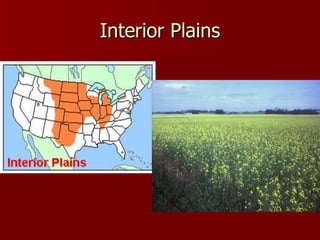
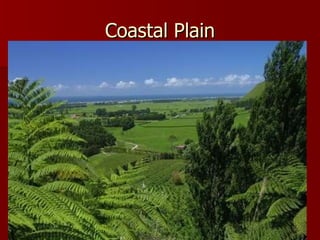
Plains Sec 6-1 H.W. pg 159 ques. 1-3 Plains are large, flat, often found in the interior regions of continents.  They are ideal for agriculture, and usually have thick, fertile soil, and large grassy meadows, that are ideal for grazing animals, like cows. When a plain is close to the ocean, it is called a coastal plain. Interior plains and coastal plains make up half of all the land in the U.S.
Interior Plains
Plains A coastal plain is also known as a lowland, because it is lower in elevation, than the land around it. We find interior plains between the Rocky Mountains and the Appalachian Mountains. The largest of all the plains, the Great Plains, lies between the Rockies and the Mississippi River. The Great Plains are also called the highlands because of their high elevation.
Coastal Plain
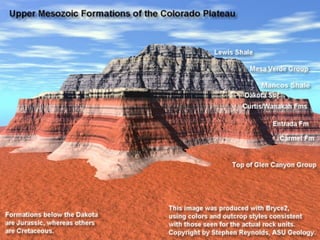
Plateaus Plateaus are flat, raised areas of land made up of nearly horizontal rocks that have been uplifted by forces within the Earth. They differ from plains because their edges rise steeply from the land around them. Because of their hight due to the uplifting, it is common for plateaus to be cut through by deep river valleys and canyons. Ex: The Colorado River cut deep into the rock layers of a plateau to form the Grand Canyon.
 
Mountains Mt. Everest is the tallest mountain at 8,800 meters above sea level. There are 4 types of mountains: Folded mountains Fault-block mountains Upwarped mountains Volcanic mountains
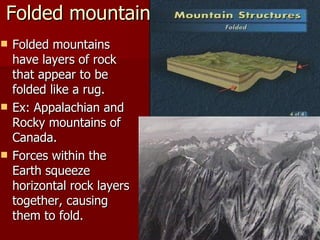
Folded mountains Folded mountains have layers of rock that appear to be folded like a rug. Ex: Appalachian and Rocky mountains of Canada. Forces within the Earth squeeze horizontal rock layers together, causing them to fold.
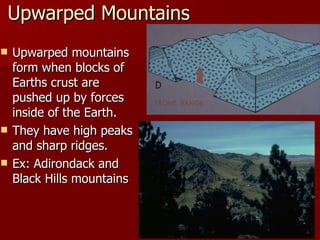
Upwarped Mountains Upwarped mountains form when blocks of Earths crust are pushed up by forces inside of the Earth. They have high peaks and sharp ridges. Ex: Adirondack and Black Hills mountains
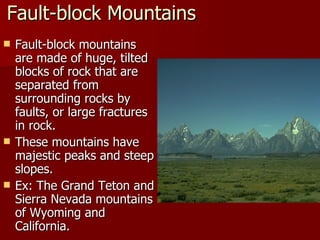
Fault-block Mountains Fault-block mountains are made of huge, tilted blocks of rock that are separated from surrounding rocks by faults, or large fractures in rock. These mountains have majestic peaks and steep slopes. Ex: The Grand Teton and Sierra Nevada mountains of Wyoming and California.
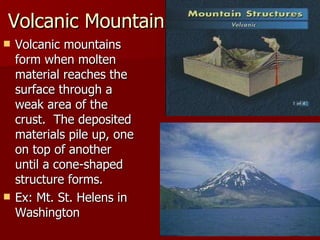
Volcanic Mountains Volcanic mountains form when molten material reaches the surface through a weak area of the crust.  The deposited materials pile up, one on top of another until a cone-shaped structure forms. Ex: Mt. St. Helens in Washington
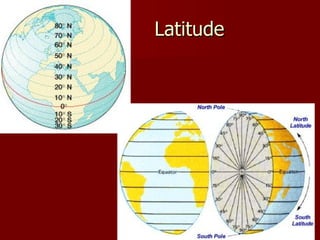
Latitude & Longitude Sec 6-2 H.W. pg 163 ques. 1-4 Latitude and longitude lines on the globe form an imaginary grid system that allows people to locate any place on Earth. Latitude lines, or parallels, are lines that run parallel to the Earth’s equator, which is a line that circles the Earth, half way between the North and South poles. The Equator separates the Earth into Northern and Southern Hemispheres.  Latitude lines never cross and are measured in degrees. O o  is the equator and each pole North and South is 90 0 . Go in 15 degree intervals. Below the equator is called South latitude and above the equator is North latitude.

Latitude
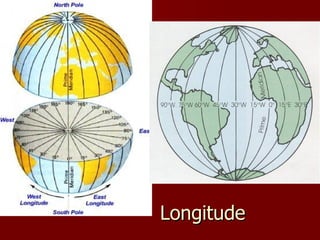
Latitude & Longitude Longitude lines or meridians, are vertical lines on either side of the prime meridian.  The prime meridian acts as a reference point for longitude lines, just like the equator was a reference line for latitude. The prime meridian is O 0  the longitude lines go up in intervals of 15 0  around the globe to 180 o . Areas east of the prime meridian are east longitudes and west of the meridian they are west longitudes.
Longitude
Prime Meridian The meridian does not circle the globe like the equator. It runs from the North pole, through Greenwich, England to the South pole. The meridian opposite the prime meridian is the 180 meridian. When giving latitude and longitude coordinates we always give the latitude position first.
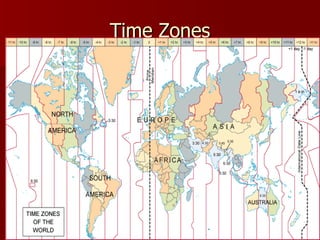
Time Zones Time is measured by tracking Earth’s movement in relation to the Sun. Each day is 24 hrs long, so we divide the Earth into 24 different time zones. Each time zone is 15 o  of longitude wide and is 1 hr different than the zones on either side of it.  The U.S. has 6 time zones.
Time Zones
International Date line You lose and gain time as you enter different time zones. If you travel far enough you will lose or gain a whole day.  The international date line is a transition line for calendar days and is near longitude line 180. If you travel West across the date line you move your calendar forward a day. If you travel east and cross the date line you move your calendar back a day.
Maps Section 6-3 pg 178 ques. 1-20 Maps are made as projections. A projection is made when points and lines on a globe are transferred to paper. Projections are made different ways and usually distort the shapes of the land masses on them.
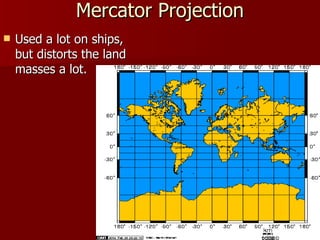
Mercator Projection Used a lot on ships, but distorts the land masses a lot.
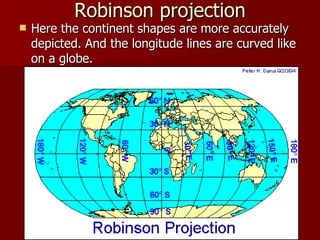
Robinson projection Here the continent shapes are more accurately depicted. And the longitude lines are curved like on a globe.
Conic Projection These are used to to produce maps of small areas, and are not good for mapping the poles.  They are made by projecting points and lines of a globe onto a cone.
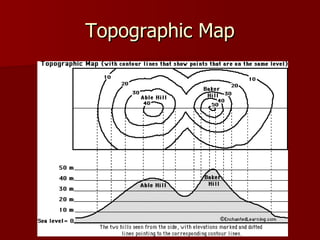
Topographic Maps These maps model the changes in elevation on Earth’s surface.  They help to identify hills, mountains, and valleys. These maps have contour lines that connect points of equal elevation. If the change in elevation is steep the contour lines are close together. If it is not steep but slight then the lines are farther apart. The difference in elevation b/w two contour lines is called a contour interval.
Topographic Map
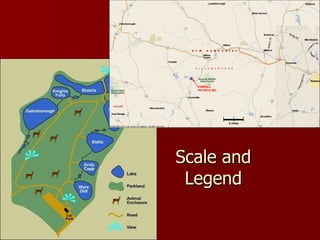
Map scales and Legends  H.W. pg 176-176 ques. 1-10  A map scale shows you how to calculate a distance on a map in comparison to actual distance on the Earth. Ex: 1 inch=10miles. A map legend is used to explain what symbols on a map mean.
Scale and  Legend
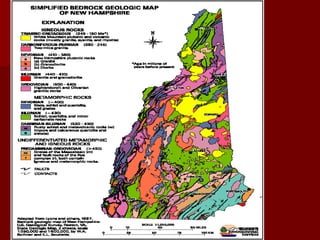
Geologic Maps These maps are used to show the arrangements and types of rocks that are at the Earth’s surface. These maps are used to locate and extract natural resources.
 
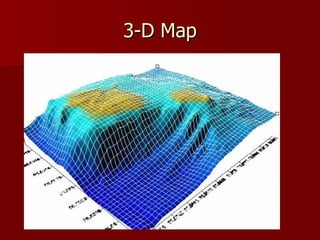
3-dimentional maps Sometimes 2-D maps like topographic and geological maps are not the best ways to depict an area.  So we use 3-D computerized maps to get a better idea of the surface features of land.
3-D Map
Test on chapter 6 in one  week!!!!!!!!!!!

Chapter 6- landforms

  • 1.
  • 2.
    Plains Sec 6-1H.W. pg 159 ques. 1-3 Plains are large, flat, often found in the interior regions of continents. They are ideal for agriculture, and usually have thick, fertile soil, and large grassy meadows, that are ideal for grazing animals, like cows. When a plain is close to the ocean, it is called a coastal plain. Interior plains and coastal plains make up half of all the land in the U.S.
  • 3.
  • 4.
    Plains A coastalplain is also known as a lowland, because it is lower in elevation, than the land around it. We find interior plains between the Rocky Mountains and the Appalachian Mountains. The largest of all the plains, the Great Plains, lies between the Rockies and the Mississippi River. The Great Plains are also called the highlands because of their high elevation.
  • 5.
  • 6.
    Plateaus Plateaus areflat, raised areas of land made up of nearly horizontal rocks that have been uplifted by forces within the Earth. They differ from plains because their edges rise steeply from the land around them. Because of their hight due to the uplifting, it is common for plateaus to be cut through by deep river valleys and canyons. Ex: The Colorado River cut deep into the rock layers of a plateau to form the Grand Canyon.
  • 7.
  • 8.
    Mountains Mt. Everestis the tallest mountain at 8,800 meters above sea level. There are 4 types of mountains: Folded mountains Fault-block mountains Upwarped mountains Volcanic mountains
  • 9.
    Folded mountains Foldedmountains have layers of rock that appear to be folded like a rug. Ex: Appalachian and Rocky mountains of Canada. Forces within the Earth squeeze horizontal rock layers together, causing them to fold.
  • 10.
    Upwarped Mountains Upwarpedmountains form when blocks of Earths crust are pushed up by forces inside of the Earth. They have high peaks and sharp ridges. Ex: Adirondack and Black Hills mountains
  • 11.
    Fault-block Mountains Fault-blockmountains are made of huge, tilted blocks of rock that are separated from surrounding rocks by faults, or large fractures in rock. These mountains have majestic peaks and steep slopes. Ex: The Grand Teton and Sierra Nevada mountains of Wyoming and California.
  • 12.
    Volcanic Mountains Volcanicmountains form when molten material reaches the surface through a weak area of the crust. The deposited materials pile up, one on top of another until a cone-shaped structure forms. Ex: Mt. St. Helens in Washington
  • 13.
    Latitude & LongitudeSec 6-2 H.W. pg 163 ques. 1-4 Latitude and longitude lines on the globe form an imaginary grid system that allows people to locate any place on Earth. Latitude lines, or parallels, are lines that run parallel to the Earth’s equator, which is a line that circles the Earth, half way between the North and South poles. The Equator separates the Earth into Northern and Southern Hemispheres. Latitude lines never cross and are measured in degrees. O o is the equator and each pole North and South is 90 0 . Go in 15 degree intervals. Below the equator is called South latitude and above the equator is North latitude.
  • 14.
  • 15.
    Latitude & LongitudeLongitude lines or meridians, are vertical lines on either side of the prime meridian. The prime meridian acts as a reference point for longitude lines, just like the equator was a reference line for latitude. The prime meridian is O 0 the longitude lines go up in intervals of 15 0 around the globe to 180 o . Areas east of the prime meridian are east longitudes and west of the meridian they are west longitudes.
  • 16.
  • 17.
    Prime Meridian Themeridian does not circle the globe like the equator. It runs from the North pole, through Greenwich, England to the South pole. The meridian opposite the prime meridian is the 180 meridian. When giving latitude and longitude coordinates we always give the latitude position first.
  • 18.
    Time Zones Timeis measured by tracking Earth’s movement in relation to the Sun. Each day is 24 hrs long, so we divide the Earth into 24 different time zones. Each time zone is 15 o of longitude wide and is 1 hr different than the zones on either side of it. The U.S. has 6 time zones.
  • 19.
  • 20.
    International Date lineYou lose and gain time as you enter different time zones. If you travel far enough you will lose or gain a whole day. The international date line is a transition line for calendar days and is near longitude line 180. If you travel West across the date line you move your calendar forward a day. If you travel east and cross the date line you move your calendar back a day.
  • 21.
    Maps Section 6-3pg 178 ques. 1-20 Maps are made as projections. A projection is made when points and lines on a globe are transferred to paper. Projections are made different ways and usually distort the shapes of the land masses on them.
  • 22.
    Mercator Projection Useda lot on ships, but distorts the land masses a lot.
  • 23.
    Robinson projection Herethe continent shapes are more accurately depicted. And the longitude lines are curved like on a globe.
  • 24.
    Conic Projection Theseare used to to produce maps of small areas, and are not good for mapping the poles. They are made by projecting points and lines of a globe onto a cone.
  • 25.
    Topographic Maps Thesemaps model the changes in elevation on Earth’s surface. They help to identify hills, mountains, and valleys. These maps have contour lines that connect points of equal elevation. If the change in elevation is steep the contour lines are close together. If it is not steep but slight then the lines are farther apart. The difference in elevation b/w two contour lines is called a contour interval.
  • 26.
  • 27.
    Map scales andLegends H.W. pg 176-176 ques. 1-10 A map scale shows you how to calculate a distance on a map in comparison to actual distance on the Earth. Ex: 1 inch=10miles. A map legend is used to explain what symbols on a map mean.
  • 28.
    Scale and Legend
  • 29.
    Geologic Maps Thesemaps are used to show the arrangements and types of rocks that are at the Earth’s surface. These maps are used to locate and extract natural resources.
  • 30.
  • 31.
    3-dimentional maps Sometimes2-D maps like topographic and geological maps are not the best ways to depict an area. So we use 3-D computerized maps to get a better idea of the surface features of land.
  • 32.
  • 33.
    Test on chapter6 in one week!!!!!!!!!!!