Genetics: The Science of
Heredity
7th Grade Life Science
SECTION 1: MENDEL’S WORK
By PresenterMedia.com
A. Gregor Mendel
1. The first recorded scientific study of how
traits pass from one generation to the next
was done by Gregor Mendel, a monk!
2. In 1856, he began experimenting with garden
peas.
I. Introduction to Genetics
2
3. He believed he could predict the kinds of flowers
and fruits a plant would produce.
a. To do this he believed that something had to be
known about the parents of the plants.
4. Each different form of a characteristic, such as a
stem height, is called a TRAIT.
5. Today, Mendel’s discoveries form the foundation
of Genetics.
a. Father of Genetics
I. Introduction to Genetics
3
B. Mendel’s Experiments
1. Fertilization occurs when egg and sperm
join.
a. Before this can happen in pea plants, pollen
must reach the pistil of the flower. This
process is called pollination.
2. Mendel developed a method by which he
cross pollinated, or “crossed” pea plants.
I. Introduction to Genetics
4
C. Crossing Pea Plants
1. An organism that always produces the same
traits in its offspring is called a PUREBRED.
a. Example: PUREBRED short pea plants
always come from short parent plants.
b. Tall plants that always produce tall plants are
considered PUREBRED tall plants.
I. Introduction to Genetics
5
C. Crossing Pea Plants
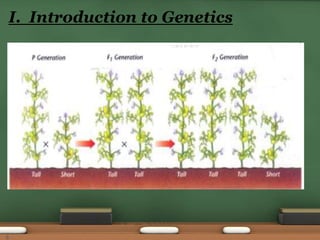
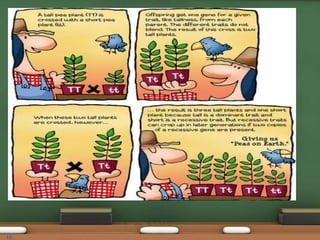
2. In one experiment, Mendel crossed
purebred tall plants with purebred short
plants.
a. Scientists call the parent plants the parental
generation or the “P generation”
b. The offspring from this cross are the first
fillial generation or the “F1 generation”.
i. Fillial comes from the word fillia: the
Latin word for daughter
c. All of the offspring from this cross were
TALL.
I. Introduction to Genetics
6
C. Crossing Pea Plants
3. When the plants in the F1 generation were
full grown, Mendel allowed them to self
pollinate.
a. Some of the plants in the F2 generation were
a mix of tall and short plants.
i. ¾ were tall
ii. ¼ were short.
I. Introduction to Genetics
7
I. Introduction to Genetics
8
D. Dominant and
Recessive Traits
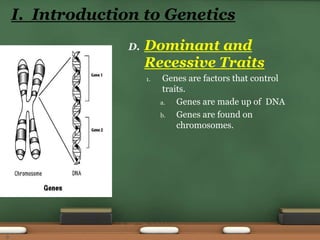
1. Genes are factors that control
traits.
a. Genes are made up of DNA
b. Genes are found on
chromosomes.
I. Introduction to Genetics
9
D. Dominant and Recessive Traits
2. The different forms a gene may have for a trait are its alleles.
3. Each new organism inherits two alleles from its parents.
a. One from the egg (mother) and the other from the sperm
(father).
b. A pea plant may inherit two alleles for tall stems, two alleles
for short stems, or one of each.
I. Introduction to Genetics
10
D. Dominant and Recessive Traits
4. An organisms traits are controlled by the alleles it inherits from
its parents.
a. Dominant Allele is one whose trait always shows up in the
organism when the allele is present.
b. Recessive Allele is hidden whenever the dominant allele is
present.
i. A trait controlled by a recessive allele will only show up
if the organism does not have the dominant allele.
I. Introduction to Genetics
11
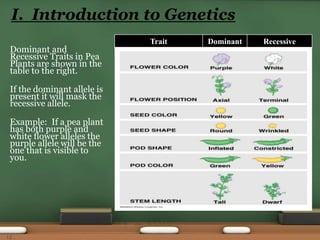
Trait Dominant Recessive
Dominant and
Recessive Traits in Pea
Plants are shown in the
table to the right.
If the dominant allele is
present it will mask the
recessive allele.
Example: If a pea plant
has both purple and
white flower alleles the
purple allele will be the
one that is visible to
you.
I. Introduction to Genetics
12
A. Probability
1. Probability is the number that describes how likely it is that
an event will occur.
2. Probability is different then the odds.
a. Probability = what you want / total chances
b. Odds= what you want: what you don’t want
II. Probability and Heredity
13
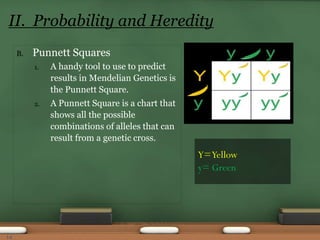
B. Punnett Squares
1. A handy tool to use to predict
results in Mendelian Genetics is
the Punnett Square.
2. A Punnett Square is a chart that
shows all the possible
combinations of alleles that can
result from a genetic cross.
II. Probability and Heredity
Y=Yellow
y= Green
14
B. Punnett Squares
3. Dominant alleles are
represented by capital letters.
4. Recessive alleles are
represented by lower case
letters.
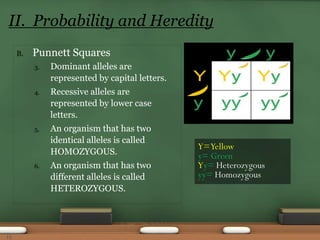
5. An organism that has two
identical alleles is called
HOMOZYGOUS.
6. An organism that has two
different alleles is called
HETEROZYGOUS.
II. Probability and Heredity
Y=Yellow
y= Green
Yy= Heterozygous
yy= Homozygous
15
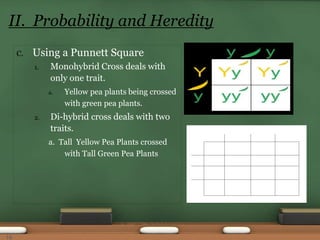
C. Using a Punnett Square
1. Monohybrid Cross deals with
only one trait.
a. Yellow pea plants being crossed
with green pea plants.
2. Di-hybrid cross deals with two
traits.
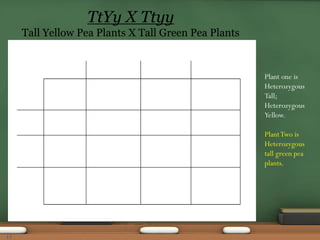
a. Tall Yellow Pea Plants crossed
with Tall Green Pea Plants
II. Probability and Heredity
16
TtYy X Ttyy
Tall Yellow Pea Plants X Tall Green Pea Plants
Plant one is
Heterozygous
Tall;
Heterozygous
Yellow.
PlantTwo is
Heterozygous
tall green pea
plants.
17
18
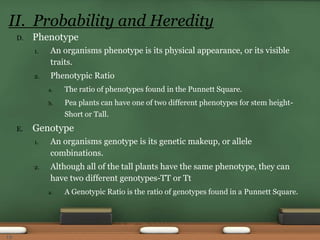
D. Phenotype
1. An organisms phenotype is its physical appearance, or its visible
traits.
2. Phenotypic Ratio
a. The ratio of phenotypes found in the Punnett Square.
b. Pea plants can have one of two different phenotypes for stem height-
Short or Tall.
E. Genotype
1. An organisms genotype is its genetic makeup, or allele
combinations.
2. Although all of the tall plants have the same phenotype, they can
have two different genotypes-TT or Tt
a. A Genotypic Ratio is the ratio of genotypes found in a Punnett Square.
II. Probability and Heredity
19
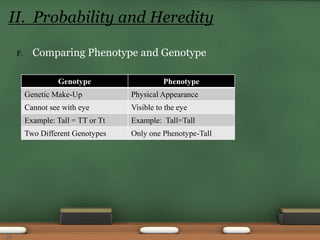
F. Comparing Phenotype and Genotype
II. Probability and Heredity
Genotype Phenotype
Genetic Make-Up Physical Appearance
Cannot see with eye Visible to the eye
Example: Tall = TT or Tt Example: Tall=Tall
Two Different Genotypes Only one Phenotype-Tall
20
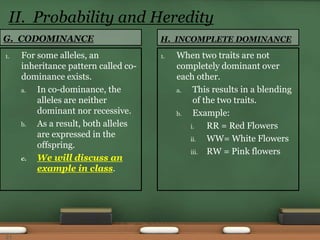
G. CODOMINANCE
1. For some alleles, an
inheritance pattern called co-
dominance exists.
a. In co-dominance, the
alleles are neither
dominant nor recessive.
b. As a result, both alleles
are expressed in the
offspring.
c. We will discuss an
example in class.
1. When two traits are not
completely dominant over
each other.
a. This results in a blending
of the two traits.
b. Example:
i. RR = Red Flowers
ii. WW= White Flowers
iii. RW = Pink flowers
H. INCOMPLETE DOMINANCE
II. Probability and Heredity
21

Chapter 5 Section 1 Notes (2016)

  • 1.
    Genetics: The Scienceof Heredity 7th Grade Life Science SECTION 1: MENDEL’S WORK By PresenterMedia.com
  • 2.
    A. Gregor Mendel 1.The first recorded scientific study of how traits pass from one generation to the next was done by Gregor Mendel, a monk! 2. In 1856, he began experimenting with garden peas. I. Introduction to Genetics 2
  • 3.
    3. He believedhe could predict the kinds of flowers and fruits a plant would produce. a. To do this he believed that something had to be known about the parents of the plants. 4. Each different form of a characteristic, such as a stem height, is called a TRAIT. 5. Today, Mendel’s discoveries form the foundation of Genetics. a. Father of Genetics I. Introduction to Genetics 3
  • 4.
    B. Mendel’s Experiments 1.Fertilization occurs when egg and sperm join. a. Before this can happen in pea plants, pollen must reach the pistil of the flower. This process is called pollination. 2. Mendel developed a method by which he cross pollinated, or “crossed” pea plants. I. Introduction to Genetics 4
  • 5.
    C. Crossing PeaPlants 1. An organism that always produces the same traits in its offspring is called a PUREBRED. a. Example: PUREBRED short pea plants always come from short parent plants. b. Tall plants that always produce tall plants are considered PUREBRED tall plants. I. Introduction to Genetics 5
  • 6.
    C. Crossing PeaPlants 2. In one experiment, Mendel crossed purebred tall plants with purebred short plants. a. Scientists call the parent plants the parental generation or the “P generation” b. The offspring from this cross are the first fillial generation or the “F1 generation”. i. Fillial comes from the word fillia: the Latin word for daughter c. All of the offspring from this cross were TALL. I. Introduction to Genetics 6
  • 7.
    C. Crossing PeaPlants 3. When the plants in the F1 generation were full grown, Mendel allowed them to self pollinate. a. Some of the plants in the F2 generation were a mix of tall and short plants. i. ¾ were tall ii. ¼ were short. I. Introduction to Genetics 7
  • 8.
  • 9.
    D. Dominant and RecessiveTraits 1. Genes are factors that control traits. a. Genes are made up of DNA b. Genes are found on chromosomes. I. Introduction to Genetics 9
  • 10.
    D. Dominant andRecessive Traits 2. The different forms a gene may have for a trait are its alleles. 3. Each new organism inherits two alleles from its parents. a. One from the egg (mother) and the other from the sperm (father). b. A pea plant may inherit two alleles for tall stems, two alleles for short stems, or one of each. I. Introduction to Genetics 10
  • 11.
    D. Dominant andRecessive Traits 4. An organisms traits are controlled by the alleles it inherits from its parents. a. Dominant Allele is one whose trait always shows up in the organism when the allele is present. b. Recessive Allele is hidden whenever the dominant allele is present. i. A trait controlled by a recessive allele will only show up if the organism does not have the dominant allele. I. Introduction to Genetics 11
  • 12.
    Trait Dominant Recessive Dominantand Recessive Traits in Pea Plants are shown in the table to the right. If the dominant allele is present it will mask the recessive allele. Example: If a pea plant has both purple and white flower alleles the purple allele will be the one that is visible to you. I. Introduction to Genetics 12
  • 13.
    A. Probability 1. Probabilityis the number that describes how likely it is that an event will occur. 2. Probability is different then the odds. a. Probability = what you want / total chances b. Odds= what you want: what you don’t want II. Probability and Heredity 13
  • 14.
    B. Punnett Squares 1.A handy tool to use to predict results in Mendelian Genetics is the Punnett Square. 2. A Punnett Square is a chart that shows all the possible combinations of alleles that can result from a genetic cross. II. Probability and Heredity Y=Yellow y= Green 14
  • 15.
    B. Punnett Squares 3.Dominant alleles are represented by capital letters. 4. Recessive alleles are represented by lower case letters. 5. An organism that has two identical alleles is called HOMOZYGOUS. 6. An organism that has two different alleles is called HETEROZYGOUS. II. Probability and Heredity Y=Yellow y= Green Yy= Heterozygous yy= Homozygous 15
  • 16.
    C. Using aPunnett Square 1. Monohybrid Cross deals with only one trait. a. Yellow pea plants being crossed with green pea plants. 2. Di-hybrid cross deals with two traits. a. Tall Yellow Pea Plants crossed with Tall Green Pea Plants II. Probability and Heredity 16
  • 17.
    TtYy X Ttyy TallYellow Pea Plants X Tall Green Pea Plants Plant one is Heterozygous Tall; Heterozygous Yellow. PlantTwo is Heterozygous tall green pea plants. 17
  • 18.
  • 19.
    D. Phenotype 1. Anorganisms phenotype is its physical appearance, or its visible traits. 2. Phenotypic Ratio a. The ratio of phenotypes found in the Punnett Square. b. Pea plants can have one of two different phenotypes for stem height- Short or Tall. E. Genotype 1. An organisms genotype is its genetic makeup, or allele combinations. 2. Although all of the tall plants have the same phenotype, they can have two different genotypes-TT or Tt a. A Genotypic Ratio is the ratio of genotypes found in a Punnett Square. II. Probability and Heredity 19
  • 20.
    F. Comparing Phenotypeand Genotype II. Probability and Heredity Genotype Phenotype Genetic Make-Up Physical Appearance Cannot see with eye Visible to the eye Example: Tall = TT or Tt Example: Tall=Tall Two Different Genotypes Only one Phenotype-Tall 20
  • 21.
    G. CODOMINANCE 1. Forsome alleles, an inheritance pattern called co- dominance exists. a. In co-dominance, the alleles are neither dominant nor recessive. b. As a result, both alleles are expressed in the offspring. c. We will discuss an example in class. 1. When two traits are not completely dominant over each other. a. This results in a blending of the two traits. b. Example: i. RR = Red Flowers ii. WW= White Flowers iii. RW = Pink flowers H. INCOMPLETE DOMINANCE II. Probability and Heredity 21