http://www.cpi-team.com
Science Art Religion Politics Scholarly Articles For Mathematics and
Productivity
http://www.twitlonger.com/show/n_1sp9pjo?new_post=true
MICROSOFT OneDrive PPT’s PDF’s BOOK LESSONS
Dr f Dejahang BSc CEng, BSc (Hons) Construction Mgmt, MSc, PhD
CAISSON
http://www.youtube.com/watch?v=N3msAkpUumI&feature=related
http://www.youtube.com/watch?v=6OAHO9zgeXM&feature=related
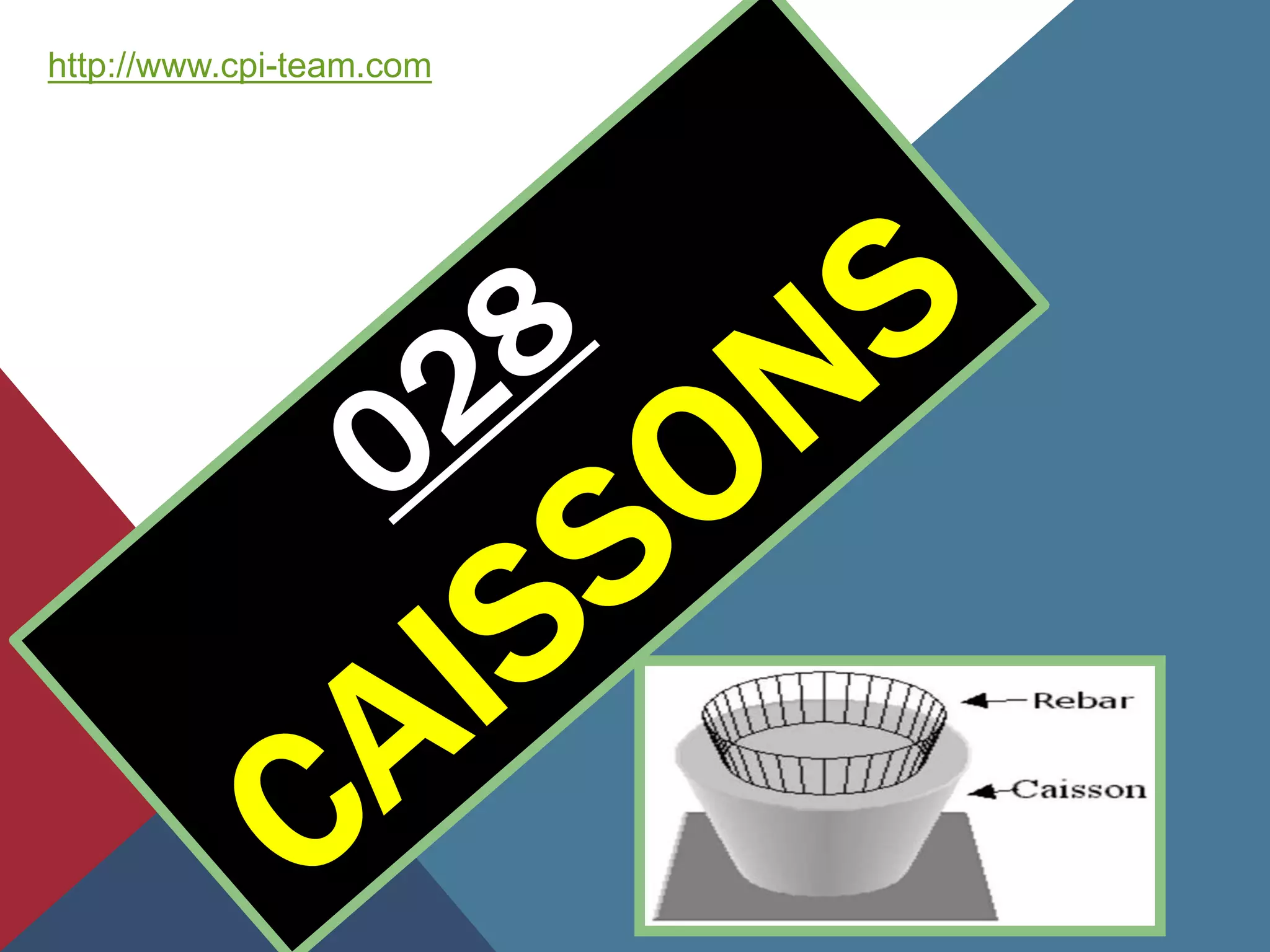
WHAT IS CAISSONS?
1
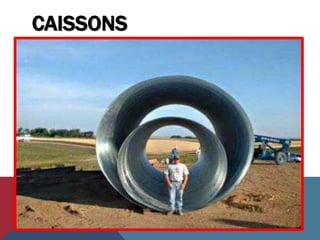
•It’s a
prefabricated
hollow box or
cylinder
WHAT IS CAISSONS?
2
• It is sunk into the
ground to some
desired depth
• Then filled
with concrete thus
forming a
foundation.
WHAT IS CAISSONS?
3
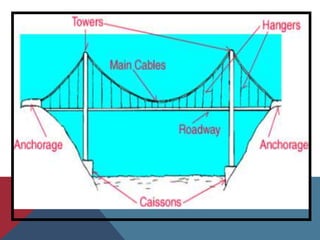
• Most often used in
the construction of
bridge piers
• Structures that
require foundation
beneath rivers &
other bodies of water
CAISSONS
4
•This is
because
caissons can
be floated to
the job site and
sunk into place
CAISSONS
5
•Similar to
pile foundatio
n but installed
using different
way
CAISSONS
6
•used when soil of
adequate bearing
strength is found
below surface
layers of weak
materials such as
fill
CAISSONS
It is then sunk to the required
level by excavating or dredging
material from within the
caisson
It’s a form of deep
foundation which are
constructed above ground
level
CAISSONS
A caisson foundation
consists of:
concrete columns
constructed in cylindrical
shafts excavated under the
proposed structural column
locations
CAISSONS
Caissons are drilled to
bedrock or deep into the
underlying strata
(if a geotech eng. find
the soil suitable to carry
the building load)
CAISSONS
2 or more ‘stick’ reinforcing bar are inserted
into and run the full length of the hole and the
concrete is poured into the caisson hole.
It’s created by auguring a
deep hole in the ground
CAISSONS
The
caisson foundations
carry the building loads
at their lower ends,
-are often bell-shaped-
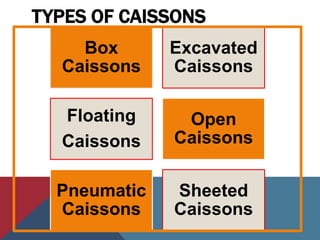
TYPES OF CAISSONS
Box
Caissons
Excavated
Caissons
Floating
Caissons
Open
Caissons
Pneumatic
Caissons
Sheeted
Caissons
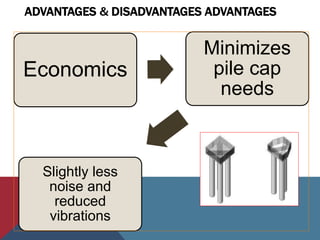
ADVANTAGES & DISADVANTAGES ADVANTAGES
Economics
Minimizes
pile cap
needs
Slightly less
noise and
reduced
vibrations
ADVANTAGES & DISADVANTAGES ADVANTAGES
High axial and
lateral loading
capacity
Easily
adaptable to
varying site
conditions
DISADVANTAGES
Extremely
sensitive to
construction
procedures
Not good for
contaminated
sites
Lack of
construction
expertise
Lack of Qualified
Inspectors
CAISSON FOUNDATIONS
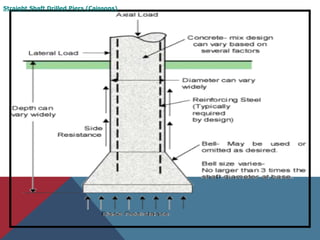
A drilled pier is-
•a deep foundation
system that is
constructed by
placing fresh Concrete
and reinforcing steel into
a drilled shaft.
CAISSON FOUNDATIONS
• The shaft is constructed by
rotary methods using either a
self-contained drill unit or a
crane mounted drill unit.
• The hole is advanced
through soil or rock to the
desired bearing stratum.
CAISSONS
• Temporary or permanent steel
casings may be used to maintain the
sides of the drilled excavation-if
caving soils or water infiltration
becomes a problem.
• Drilled shafts can be used to sustain
high axial and lateral loads.
• Typical shaft diameters range from 18
to 144 inches.
CAISSONS
• Caisson foundations are similar
in form to pile foundations, but
are installed using a different
method.
• Caissons (also sometimes called
“piers”) are created by auguring a
deep hole into the ground, and
then filling it with concrete.
CAISSONS
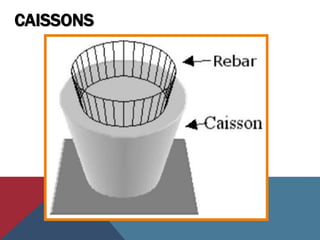
• Steel reinforcement is sometimes
utilized for a portion of the length of
the caisson.
• Caissons are drilled either to
bedrock (called “rock caissons”) or
deep into the underlying soil strata
if a geotechnical engineer finds the
soil suitable to carry the building
load.
CAISSONS
• When caissons rest on soil,
they are generally “belled” at
the bottom to spread the load
over a wider area.
• Special drilling bits are used
to remove the soil for these
“belled caissons”.
CAISSONS
• Drilled shafts (also called caissons, drilled
piers or bored piles)
• They have proven to be a cost effective
• excellent performing
• deep foundation system, that is utilized
world-wide.
• Typically they are used for bridges and
large structures, where large loads and
lateral resistance are major factors.
CAISSONS
• Caisson foundations are used when soil of
adequate bearing strength is found below surface
layers of weak materials such as fill or peat.
• A caisson foundation consists of concrete
columns constructed in cylindrical shafts
excavated under the proposed structural column
locations.
• The caisson foundations carry the building loads
at their lower ends, which are often bell-shaped
THE PROCESS: BUILDING A CAISSON
Concrete is placed (poured)
into steel forms built up along
the perimeter of the box.
After some initial form work and concrete
pours, the cutting edge is floated to the
breakwater by towboat and fastened to
the caisson guide.
CAISSONS
1
• With every concrete
placement, the box becomes
heavier and sinks into the
water along the caisson
guide.
2
• Forms are also built inside
the box around
the air domes and
concrete is placed in
between.
CAISSONS
3
•The resulting
open tubes
above the
air domes are
called dredge
wells
CAISSONS
4
• When the caisson
finally touches the
river bottom, the air
domes are removed
and earth is
excavated through
the long dredge well
tubes
CAISSONS
5
• The caisson sinks
into the river bottom
• Excavation
continues until the
caisson sinks to its
predetermined
depth
CAISSONS
6
• As a final step,
concrete is placed
(poured) into the
bottom 20m or more
of the hollow dredge
wells and the tops
are sealed.
CAISSONS
CAISSONS
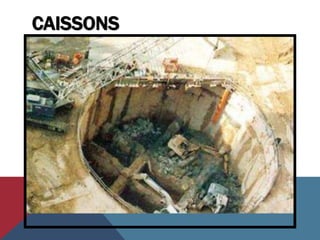
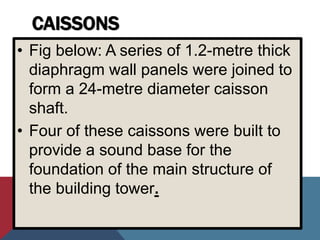
• Fig below: A series of 1.2-metre thick
diaphragm wall panels were joined to
form a 24-metre diameter caisson
shaft.
• Four of these caissons were built to
provide a sound base for the
foundation of the main structure of
the building tower.
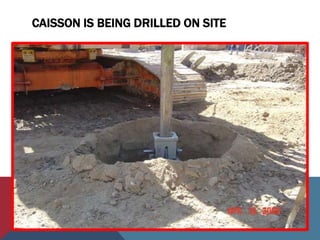
CAISSON IS BEING DRILLED ON SITE
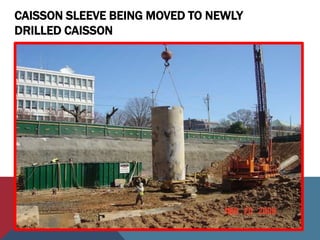
CAISSON SLEEVE BEING MOVED TO NEWLY
DRILLED CAISSON
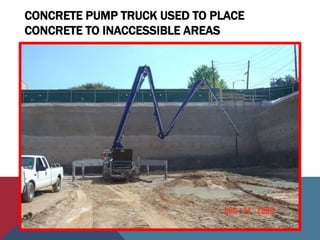
CONCRETE PUMP TRUCK USED TO PLACE
CONCRETE TO INACCESSIBLE AREAS
CAISSONS
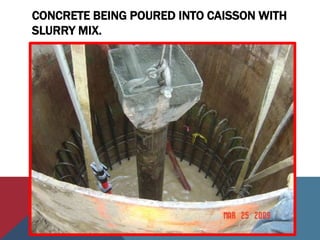
CONCRETE BEING POURED INTO CAISSON WITH
SLURRY MIX.
CAISSONS
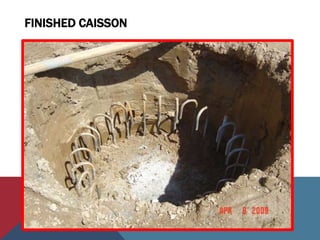
FINISHED CAISSON
Straight Shaft Drilled Piers (Caissons)

Caissons