1
Construction of Creek Bridge and
ROB of Creek Bridge and ROB
2
Content
 Description of substructure of the bridge:
1. Construction of pile foundation
a) What is pile?
b) Pile boring
c) Steel cage lowering
d) Tremie pipe fitting
e) Pile concreting and flushing
2. Construction of pile cap
a) What is pile cap?
b) Chipping and PCC
c) Shuttering and providing steel
d) Concreting
3
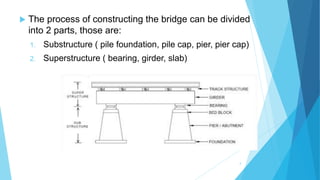
 The process of constructing the bridge can be divided
into 2 parts, those are:
1. Substructure ( pile foundation, pile cap, pier, pier cap)
2. Superstructure ( bearing, girder, slab)
4
1. Construction of Pile
Foundation
5
What is Pile?
I. Pile foundations are the part of a structure used to
carry and transfer the load of a structure to the
bearing ground located at some depth below ground
surface.
II. Pile are generally adopted for the following reasons:
a. Low bearing capacity of soil,
b. Non availability of proper bearing stratum at shallow
depths,
c. Heavy loads from the superstructure for which shallow
foundation may not be economical.
6
Pile Boring
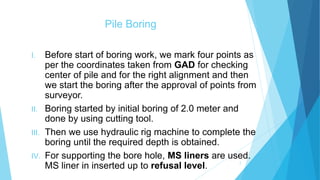
I. Before start of boring work, we mark four points as
per the coordinates taken from GAD for checking
center of pile and for the right alignment and then
we start the boring after the approval of points from
surveyor.
II. Boring started by initial boring of 2.0 meter and
done by using cutting tool.
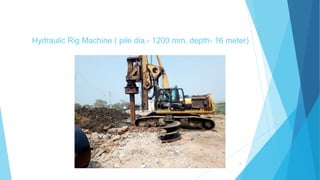
III. Then we use hydraulic rig machine to complete the
boring until the required depth is obtained.
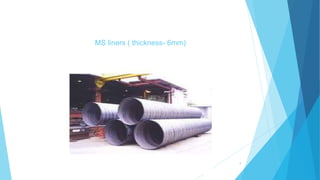
IV. For supporting the bore hole, MS liners are used.
MS liner in inserted up to refusal level. 7
Hydraulic Rig Machine ( pile dia.- 1200 mm, depth- 16 meter)
8
MS liners ( thickness- 6mm)
9
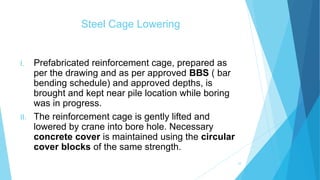
Steel Cage Lowering
I. Prefabricated reinforcement cage, prepared as
per the drawing and as per approved BBS ( bar
bending schedule) and approved depths, is
brought and kept near pile location while boring
was in progress.
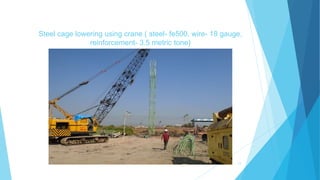
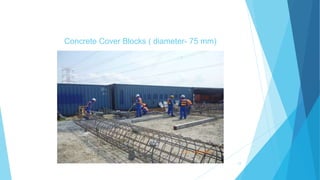
II. The reinforcement cage is gently lifted and
lowered by crane into bore hole. Necessary
concrete cover is maintained using the circular
cover blocks of the same strength.
10
Steel cage lowering using crane ( steel- fe500, wire- 18 gauge,
reinforcement- 3.5 metric tone)
11
Concrete Cover Blocks ( diameter- 75 mm)
12
Tremie Pipe Fitting
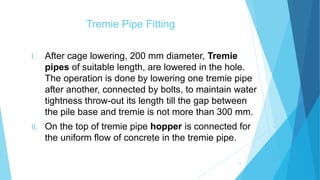
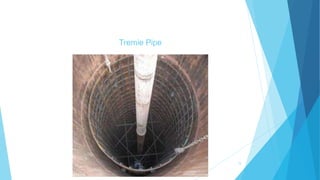
I. After cage lowering, 200 mm diameter, Tremie
pipes of suitable length, are lowered in the hole.
The operation is done by lowering one tremie pipe
after another, connected by bolts, to maintain water
tightness throw-out its length till the gap between
the pile base and tremie is not more than 300 mm.
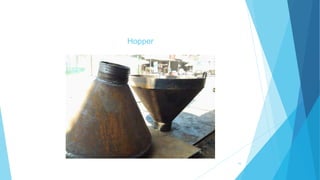
II. On the top of tremie pipe hopper is connected for
the uniform flow of concrete in the tremie pipe.
13
III. Checker plate is used to close the hopper mouth
so that at the time of start of concreting, whole
concrete can enter in tremie pipe and prevent air
bubbles or air gap.
14
Tremie Pipe
15
Hopper
16
Pile Concreting and Flushing
I. Before the start of concreting, few tests are done
on concrete to check concrete’s abilities and those
tests are- slump test and compressive strength
test, and the gathered values of the test are
recorded.
II. After passing through these tests, concrete is
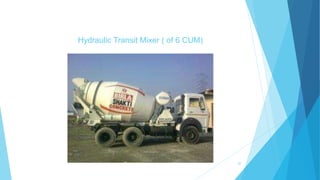
poured in the pile. Concrete is brought to the site by
hydraulic transit mixer and with its help we poured
the concrete into pile via tremie pipe.
17
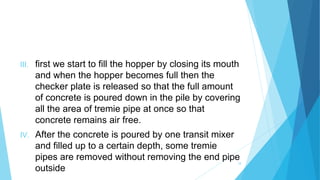
III. first we start to fill the hopper by closing its mouth
and when the hopper becomes full then the
checker plate is released so that the full amount
of concrete is poured down in the pile by covering
all the area of tremie pipe at once so that
concrete remains air free.
IV. After the concrete is poured by one transit mixer
and filled up to a certain depth, some tremie
pipes are removed without removing the end pipe
outside
18
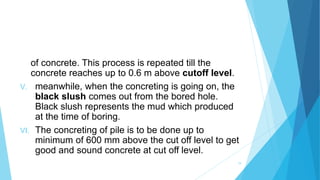
of concrete. This process is repeated till the
concrete reaches up to 0.6 m above cutoff level.
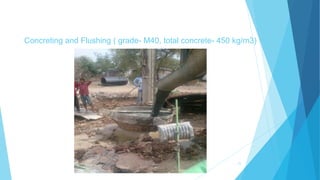
V. meanwhile, when the concreting is going on, the
black slush comes out from the bored hole.
Black slush represents the mud which produced
at the time of boring.
VI. The concreting of pile is to be done up to
minimum of 600 mm above the cut off level to get
good and sound concrete at cut off level.
19
Hydraulic Transit Mixer ( of 6 CUM)
20
Concreting and Flushing ( grade- M40, total concrete- 450 kg/m3)
21
2. Pile cap
22
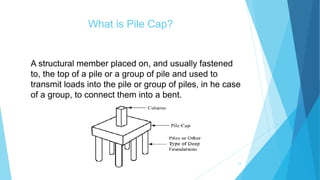
What is Pile Cap?
A structural member placed on, and usually fastened
to, the top of a pile or a group of pile and used to
transmit loads into the pile or group of piles, in he case
of a group, to connect them into a bent.
23
Chipping and PCC
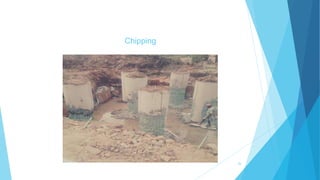
I. Excavation is done around the pile area so that
we can remove the extra pile portion by chipping.
Excavation is done by JCB machine.
II. Finally, we start chipping of the extra pile that is
above cutoff level, that we provided for the good
and sound concrete.
III. The main purpose of chipping is to remove the
surplus slushy concrete over cut off level.
24
IV. The labour chips the extra pile with help of chisel and
hammer.
V. After completion of chipping, we started doing P.C.C.
( plain cement concrete).
VI. PCC is done to provide bae for foundation to avoid
direct contact of foundation with soil and water.
VII. As the grade of concrete of PCC and foundation is
different it also provides material difference for
ground bacterial effect on foundation.
VIII. PCC works as a base for the pile cap.
25
Chipping
26
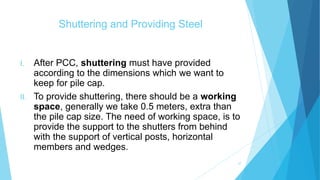
Shuttering and Providing Steel
I. After PCC, shuttering must have provided
according to the dimensions which we want to
keep for pile cap.
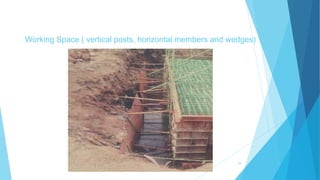
II. To provide shuttering, there should be a working
space, generally we take 0.5 meters, extra than
the pile cap size. The need of working space, is to
provide the support to the shutters from behind
with the support of vertical posts, horizontal
members and wedges.
27
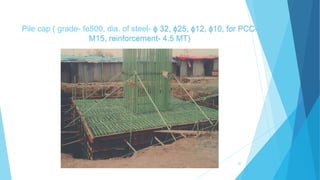
III. Steel bars are banded as per approved BBS.
IV. The size of the bottom bars is greater than the
size of top bars.
V. The bottom bars are bend upward and the top
bars are bend downwards with in pile cap. the
empty place between top bars and bottom bars is
filled with the shear rings, which we keep inside
the pile cap and also connected with top and
bottom bars.
28
Working Space ( vertical posts, horizontal members and wedges)
29
Pile cap ( grade- fe500, dia. of steel- ɸ 32, ɸ25, ɸ12, ɸ10, for PCC-
M15, reinforcement- 4.5 MT)
30
Concreting
I. Before concreting we do slump test to check the
concretes workability.
II. After checking, we pre the concrete with the help of
chute or pipe line attached to the pump.
III. While concreting compaction is done using needle
vibrator all over the pile cap to consolidate and
compact freshly placed concrete.
IV. Freshly placed concrete can contain 5 percent to 20
percent entrapped air, ultimately reducing the
concrete’s density.
31
Concrete with a high percentage of entrapped air will
likely have a educed strength and increased
permeability.
V. Hence concreting is done and we give time to set
completely.
Needle vibrator dia.- 60 mm
Vibrations- 12000/min
32
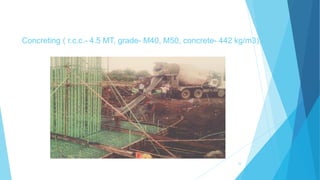
Concreting ( r.c.c.- 4.5 MT, grade- M40, M50, concrete- 442 kg/m3)
33
THANK YOU
34

pile foundation and pile cap presentation

  • 1.
  • 2.
    Construction of CreekBridge and ROB of Creek Bridge and ROB 2
  • 3.
    Content  Description ofsubstructure of the bridge: 1. Construction of pile foundation a) What is pile? b) Pile boring c) Steel cage lowering d) Tremie pipe fitting e) Pile concreting and flushing 2. Construction of pile cap a) What is pile cap? b) Chipping and PCC c) Shuttering and providing steel d) Concreting 3
  • 4.
     The processof constructing the bridge can be divided into 2 parts, those are: 1. Substructure ( pile foundation, pile cap, pier, pier cap) 2. Superstructure ( bearing, girder, slab) 4
  • 5.
    1. Construction ofPile Foundation 5
  • 6.
    What is Pile? I.Pile foundations are the part of a structure used to carry and transfer the load of a structure to the bearing ground located at some depth below ground surface. II. Pile are generally adopted for the following reasons: a. Low bearing capacity of soil, b. Non availability of proper bearing stratum at shallow depths, c. Heavy loads from the superstructure for which shallow foundation may not be economical. 6
  • 7.
    Pile Boring I. Beforestart of boring work, we mark four points as per the coordinates taken from GAD for checking center of pile and for the right alignment and then we start the boring after the approval of points from surveyor. II. Boring started by initial boring of 2.0 meter and done by using cutting tool. III. Then we use hydraulic rig machine to complete the boring until the required depth is obtained. IV. For supporting the bore hole, MS liners are used. MS liner in inserted up to refusal level. 7
  • 8.
    Hydraulic Rig Machine( pile dia.- 1200 mm, depth- 16 meter) 8
  • 9.
    MS liners (thickness- 6mm) 9
  • 10.
    Steel Cage Lowering I.Prefabricated reinforcement cage, prepared as per the drawing and as per approved BBS ( bar bending schedule) and approved depths, is brought and kept near pile location while boring was in progress. II. The reinforcement cage is gently lifted and lowered by crane into bore hole. Necessary concrete cover is maintained using the circular cover blocks of the same strength. 10
  • 11.
    Steel cage loweringusing crane ( steel- fe500, wire- 18 gauge, reinforcement- 3.5 metric tone) 11
  • 12.
    Concrete Cover Blocks( diameter- 75 mm) 12
  • 13.
    Tremie Pipe Fitting I.After cage lowering, 200 mm diameter, Tremie pipes of suitable length, are lowered in the hole. The operation is done by lowering one tremie pipe after another, connected by bolts, to maintain water tightness throw-out its length till the gap between the pile base and tremie is not more than 300 mm. II. On the top of tremie pipe hopper is connected for the uniform flow of concrete in the tremie pipe. 13
  • 14.
    III. Checker plateis used to close the hopper mouth so that at the time of start of concreting, whole concrete can enter in tremie pipe and prevent air bubbles or air gap. 14
  • 15.
  • 16.
  • 17.
    Pile Concreting andFlushing I. Before the start of concreting, few tests are done on concrete to check concrete’s abilities and those tests are- slump test and compressive strength test, and the gathered values of the test are recorded. II. After passing through these tests, concrete is poured in the pile. Concrete is brought to the site by hydraulic transit mixer and with its help we poured the concrete into pile via tremie pipe. 17
  • 18.
    III. first westart to fill the hopper by closing its mouth and when the hopper becomes full then the checker plate is released so that the full amount of concrete is poured down in the pile by covering all the area of tremie pipe at once so that concrete remains air free. IV. After the concrete is poured by one transit mixer and filled up to a certain depth, some tremie pipes are removed without removing the end pipe outside 18
  • 19.
    of concrete. Thisprocess is repeated till the concrete reaches up to 0.6 m above cutoff level. V. meanwhile, when the concreting is going on, the black slush comes out from the bored hole. Black slush represents the mud which produced at the time of boring. VI. The concreting of pile is to be done up to minimum of 600 mm above the cut off level to get good and sound concrete at cut off level. 19
  • 20.
  • 21.
    Concreting and Flushing( grade- M40, total concrete- 450 kg/m3) 21
  • 22.
  • 23.
    What is PileCap? A structural member placed on, and usually fastened to, the top of a pile or a group of pile and used to transmit loads into the pile or group of piles, in he case of a group, to connect them into a bent. 23
  • 24.
    Chipping and PCC I.Excavation is done around the pile area so that we can remove the extra pile portion by chipping. Excavation is done by JCB machine. II. Finally, we start chipping of the extra pile that is above cutoff level, that we provided for the good and sound concrete. III. The main purpose of chipping is to remove the surplus slushy concrete over cut off level. 24
  • 25.
    IV. The labourchips the extra pile with help of chisel and hammer. V. After completion of chipping, we started doing P.C.C. ( plain cement concrete). VI. PCC is done to provide bae for foundation to avoid direct contact of foundation with soil and water. VII. As the grade of concrete of PCC and foundation is different it also provides material difference for ground bacterial effect on foundation. VIII. PCC works as a base for the pile cap. 25
  • 26.
  • 27.
    Shuttering and ProvidingSteel I. After PCC, shuttering must have provided according to the dimensions which we want to keep for pile cap. II. To provide shuttering, there should be a working space, generally we take 0.5 meters, extra than the pile cap size. The need of working space, is to provide the support to the shutters from behind with the support of vertical posts, horizontal members and wedges. 27
  • 28.
    III. Steel barsare banded as per approved BBS. IV. The size of the bottom bars is greater than the size of top bars. V. The bottom bars are bend upward and the top bars are bend downwards with in pile cap. the empty place between top bars and bottom bars is filled with the shear rings, which we keep inside the pile cap and also connected with top and bottom bars. 28
  • 29.
    Working Space (vertical posts, horizontal members and wedges) 29
  • 30.
    Pile cap (grade- fe500, dia. of steel- ɸ 32, ɸ25, ɸ12, ɸ10, for PCC- M15, reinforcement- 4.5 MT) 30
  • 31.
    Concreting I. Before concretingwe do slump test to check the concretes workability. II. After checking, we pre the concrete with the help of chute or pipe line attached to the pump. III. While concreting compaction is done using needle vibrator all over the pile cap to consolidate and compact freshly placed concrete. IV. Freshly placed concrete can contain 5 percent to 20 percent entrapped air, ultimately reducing the concrete’s density. 31
  • 32.
    Concrete with ahigh percentage of entrapped air will likely have a educed strength and increased permeability. V. Hence concreting is done and we give time to set completely. Needle vibrator dia.- 60 mm Vibrations- 12000/min 32
  • 33.
    Concreting ( r.c.c.-4.5 MT, grade- M40, M50, concrete- 442 kg/m3) 33
  • 34.