Types of foundation 
 Er. Santosh Pataskar 
 (Civil Engineer)
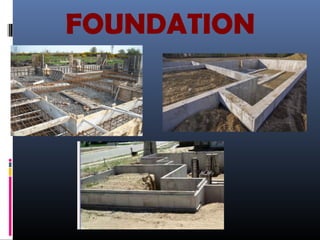
FOUNDATION
Content: 
Objectives and function of 
foundation 
Materials used for foundation 
Types of foundation
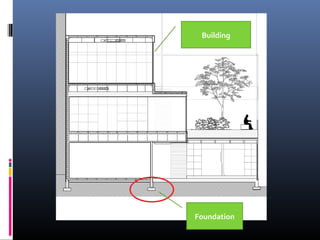
Building 
Foundation
Foundation Design Principles 
The main objectives of foundation design are to:- 
 ensure that the structural loads are transmitted 
to the subsoil safely, economically and without 
any unacceptable movement during the 
construction period and throughout the 
anticipated life of the building or structure
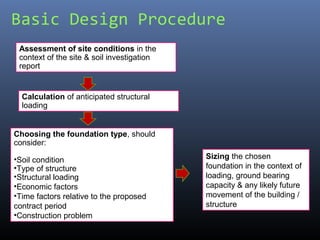
Basic Design Procedure 
Assessment of site conditions in the 
context of the site & soil investigation 
report 
Calculation of anticipated structural 
loading 
Choosing the foundation type, should 
consider: 
•Soil condition 
•Type of structure 
•Structural loading 
•Economic factors 
•Time factors relative to the proposed 
contract period 
•Construction problem 
Sizing the chosen 
foundation in the context of 
loading, ground bearing 
capacity & any likely future 
movement of the building / 
structure
Functions of foundation 
1. Distribution of loads 
2. Stability against sliding & overturning 
3. Minimize differential settlement 
4. Safe against undermining 
5. Provide level surface 
6. Minimize distress against soil movement
Distribution of 
loads 
 Foundation help to distribute the loads of super-structure 
to a large of the soil 
 Therefore, the intensity of load at its base does not 
exceed the safe bearing capacity of the soil 
 In the case of deep foundations, the super imposed 
loads are transmitted either through end bearing or 
both by side friction & end bearing
Stability against sliding & overturning 
 Foundation imparts lateral stability to the super 
structure by anchoring it to the ground 
 It increases the stability against sliding & 
overturning due to horizontal forces to wind, 
earthquake, etc.
Minimize differential 
settlement 
 Foundation distribute the super-imposed loads 
evenly on the sub-soil, even in the case of non-uniform 
loads 
 This can be achieved by constructing combined 
footing or raft foundation
Safe against undermining 
 Foundation provide safety against scouring or 
undermining by flood water or burrowing animals 
 It provides level surface over which super-structure 
can be raised
Minimize distress against soil 
movement 
 Distress or failure due to expansion or contraction 
of the sub-soil due to moisture variation in clayey & 
black cotton soils are minimized by the provision of 
special type foundations
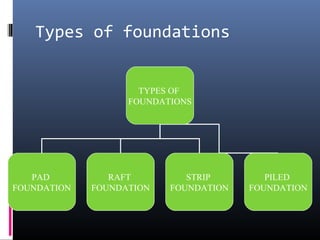
Types of foundations 
TYPES OF 
FOUNDATIONS 
PAD 
FOUNDATION 
RAFT 
FOUNDATION 
STRIP 
FOUNDATION 
PILED 
FOUNDATION
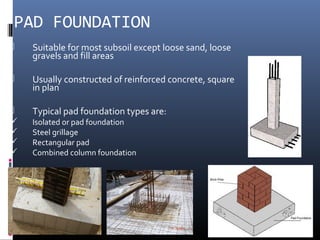
PAD FOUNDATION 
 Suitable for most subsoil except loose sand, loose 
gravels and fill areas 
 Usually constructed of reinforced concrete, square 
in plan 
 Typical pad foundation types are: 
 Isolated or pad foundation 
 Steel grillage 
 Rectangular pad 
 Combined column foundation
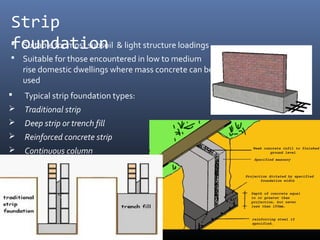
Strip 
foSuuitanbled foar mtosit soubnsoil & light structure loadings 
 Suitable for those encountered in low to medium 
rise domestic dwellings where mass concrete can be 
used 
 Typical strip foundation types: 
 Traditional strip 
 Deep strip or trench fill 
 Reinforced concrete strip 
 Continuous column
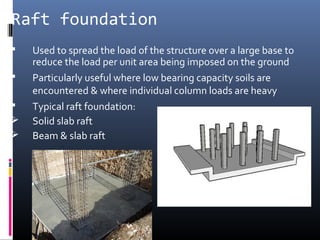
Raft foundation 
 Used to spread the load of the structure over a large base to 
reduce the load per unit area being imposed on the ground 
 Particularly useful where low bearing capacity soils are 
encountered & where individual column loads are heavy 
 Typical raft foundation: 
 Solid slab raft 
 Beam & slab raft
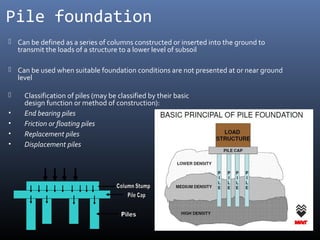
Pile foundation 
 Can be defined as a series of columns constructed or inserted into the ground to 
transmit the loads of a structure to a lower level of subsoil 
 Can be used when suitable foundation conditions are not presented at or near ground 
level 
 Classification of piles (may be classified by their basic 
design function or method of construction): 
• End bearing piles 
• Friction or floating piles 
• Replacement piles 
• Displacement piles
Materials used for 
foundation 
 Foundation must be constructed of a durable 
material of an adequate strength 
 The most suitable material is concrete 
 Concrete is a mixture of cement, aggregates 
& water in a controlled proportion
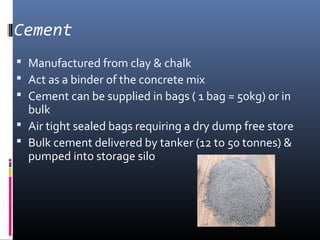
Cement 
 Manufactured from clay & chalk 
 Act as a binder of the concrete mix 
 Cement can be supplied in bags ( 1 bag = 50kg) or in 
bulk 
 Air tight sealed bags requiring a dry dump free store 
 Bulk cement delivered by tanker (12 to 50 tonnes) & 
pumped into storage silo
Aggregates 
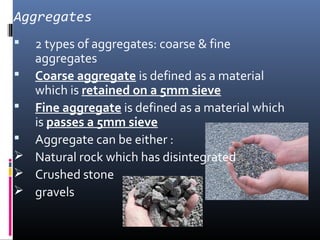
 2 types of aggregates: coarse & fine 
aggregates 
 Coarse aggregate is defined as a material 
which is retained on a 5mm sieve 
 Fine aggregate is defined as a material which 
is passes a 5mm sieve 
 Aggregate can be either : 
 Natural rock which has disintegrated 
 Crushed stone 
 gravels
Water 
 Must be of a good quality fit for drinking 
 Water is added to start the chemical reaction & 
to give workability 
 The amount of water used is called the 
water/cement ratios, usually about 0.4 to 0.5 
 Too much water will produce a weak concrete 
mix of low strength 
 Whereas too little water will produce a concrete 
mix of low & inadequate workability.
Concrete mix 
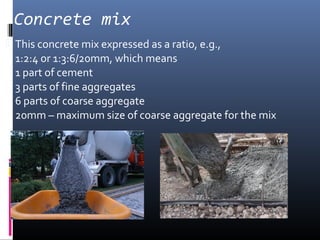
 This concrete mix expressed as a ratio, e.g., 
1:2:4 or 1:3:6/20mm, which means 
1 part of cement 
3 parts of fine aggregates 
6 parts of coarse aggregate 
20mm – maximum size of coarse aggregate for the mix
Er.SANTOSH PATASKAR 
(9098445611) 
 It is a different types of foundation for 
construction work. 
 THE END

TYPES OF FOUNDATION(PPT)

  • 1.
    Types of foundation  Er. Santosh Pataskar  (Civil Engineer)
  • 2.
  • 3.
    Content: Objectives andfunction of foundation Materials used for foundation Types of foundation
  • 4.
  • 5.
    Foundation Design Principles The main objectives of foundation design are to:-  ensure that the structural loads are transmitted to the subsoil safely, economically and without any unacceptable movement during the construction period and throughout the anticipated life of the building or structure
  • 6.
    Basic Design Procedure Assessment of site conditions in the context of the site & soil investigation report Calculation of anticipated structural loading Choosing the foundation type, should consider: •Soil condition •Type of structure •Structural loading •Economic factors •Time factors relative to the proposed contract period •Construction problem Sizing the chosen foundation in the context of loading, ground bearing capacity & any likely future movement of the building / structure
  • 7.
    Functions of foundation 1. Distribution of loads 2. Stability against sliding & overturning 3. Minimize differential settlement 4. Safe against undermining 5. Provide level surface 6. Minimize distress against soil movement
  • 8.
    Distribution of loads  Foundation help to distribute the loads of super-structure to a large of the soil  Therefore, the intensity of load at its base does not exceed the safe bearing capacity of the soil  In the case of deep foundations, the super imposed loads are transmitted either through end bearing or both by side friction & end bearing
  • 9.
    Stability against sliding& overturning  Foundation imparts lateral stability to the super structure by anchoring it to the ground  It increases the stability against sliding & overturning due to horizontal forces to wind, earthquake, etc.
  • 10.
    Minimize differential settlement  Foundation distribute the super-imposed loads evenly on the sub-soil, even in the case of non-uniform loads  This can be achieved by constructing combined footing or raft foundation
  • 11.
    Safe against undermining  Foundation provide safety against scouring or undermining by flood water or burrowing animals  It provides level surface over which super-structure can be raised
  • 12.
    Minimize distress againstsoil movement  Distress or failure due to expansion or contraction of the sub-soil due to moisture variation in clayey & black cotton soils are minimized by the provision of special type foundations
  • 13.
    Types of foundations TYPES OF FOUNDATIONS PAD FOUNDATION RAFT FOUNDATION STRIP FOUNDATION PILED FOUNDATION
  • 14.
    PAD FOUNDATION Suitable for most subsoil except loose sand, loose gravels and fill areas  Usually constructed of reinforced concrete, square in plan  Typical pad foundation types are:  Isolated or pad foundation  Steel grillage  Rectangular pad  Combined column foundation
  • 15.
    Strip foSuuitanbled foarmtosit soubnsoil & light structure loadings  Suitable for those encountered in low to medium rise domestic dwellings where mass concrete can be used  Typical strip foundation types:  Traditional strip  Deep strip or trench fill  Reinforced concrete strip  Continuous column
  • 16.
    Raft foundation Used to spread the load of the structure over a large base to reduce the load per unit area being imposed on the ground  Particularly useful where low bearing capacity soils are encountered & where individual column loads are heavy  Typical raft foundation:  Solid slab raft  Beam & slab raft
  • 17.
    Pile foundation Can be defined as a series of columns constructed or inserted into the ground to transmit the loads of a structure to a lower level of subsoil  Can be used when suitable foundation conditions are not presented at or near ground level  Classification of piles (may be classified by their basic design function or method of construction): • End bearing piles • Friction or floating piles • Replacement piles • Displacement piles
  • 18.
    Materials used for foundation  Foundation must be constructed of a durable material of an adequate strength  The most suitable material is concrete  Concrete is a mixture of cement, aggregates & water in a controlled proportion
  • 19.
    Cement  Manufacturedfrom clay & chalk  Act as a binder of the concrete mix  Cement can be supplied in bags ( 1 bag = 50kg) or in bulk  Air tight sealed bags requiring a dry dump free store  Bulk cement delivered by tanker (12 to 50 tonnes) & pumped into storage silo
  • 20.
    Aggregates  2types of aggregates: coarse & fine aggregates  Coarse aggregate is defined as a material which is retained on a 5mm sieve  Fine aggregate is defined as a material which is passes a 5mm sieve  Aggregate can be either :  Natural rock which has disintegrated  Crushed stone  gravels
  • 21.
    Water  Mustbe of a good quality fit for drinking  Water is added to start the chemical reaction & to give workability  The amount of water used is called the water/cement ratios, usually about 0.4 to 0.5  Too much water will produce a weak concrete mix of low strength  Whereas too little water will produce a concrete mix of low & inadequate workability.
  • 22.
    Concrete mix This concrete mix expressed as a ratio, e.g., 1:2:4 or 1:3:6/20mm, which means 1 part of cement 3 parts of fine aggregates 6 parts of coarse aggregate 20mm – maximum size of coarse aggregate for the mix
  • 23.
    Er.SANTOSH PATASKAR (9098445611)  It is a different types of foundation for construction work.  THE END