COFFERDAM
PRESENTED BY
JIAD
CIVIL - S5
COFFERDAMS
“A cofferdam is a temporary
structure designed to keep water
and/or soil out of the excavation in
which a bridge pier or other
structure is built”.
REQUIREMENTS
 Cofferdam should be reasonably watertight.
 Absolute water tightness is not desired in a cofferdam.
 Designed in maximum water level.
 Ground water or water lying above ground level should be
excluded.
 Materials – earth , timber , steel & concrete.
 Constructed at site of work.
 Depend- depth , soil condition , difference in water level,
availability of materials.
USES
• Pile driving operation.
• Place grillage & raft foundation.
• Construct new structures.
• Enclose space for removal.
• Constructing without disturbances.
FACTORS FOR CHOICE OF
TYPE OF COFFERDAMS
Area to be protected by a cofferdam.
Depth of water to be dealt.
Possibility of over topping.
Nature of velocity of flow.
Availability of materials at site of work.
Easy transportation.
TYPES OF COFFERDAMS
 DIKES
 SINGLE WALL COFFRDAM
 DOBLE WALL COFFERDAMS
 CELLULAR COFFERDAMS
 ROCK-FILLED CRIB COFFERDAMS
 CONCRETE COFFERDAMS
DIKES
Embankment of some materials.
• EARTH
• ROCK
• SAND-BAGS
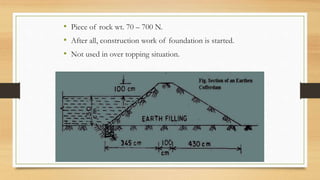
EARTH DIKES
• Shallow depth of water 1200 - 1500 mm.
• Low velocity of flow
• Free board-1m.
• Suitable side slope.
• Top width of bank.
• Material-mixture of clay &sand.
• Puddle – best material .
• Rip rap – protected against wind & wave actions.
• Piece of rock wt. 70 – 700 N.
• After all, construction work of foundation is started.
• Not used in over topping situation.
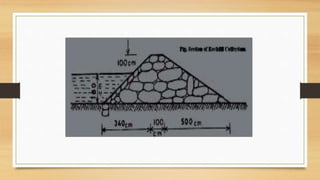
ROCK DIKES
• Depth about 3 m.
• Availability of rock.
• Not impervious.
• Impervious layers of earth are laid on side.
• Voids are filled by earth.
• Sometimes, core wall or steel sheet pile are used.
• Core wall – clay or concrete.
• Prevent over topping.
SAND – BAG DIKES
• Mixture of sand & clay in a bag.
 PRECAUTIONS
• Use empty cement bags.
• Voids of sand bag may exceed – 40%.
• Small depth.
• Joints filled with puddle.
SINGLE WALL COFFERDAM
• Preferred small area.
• Guide piles, wales , struts – wood.
• Sheet piles are of wood or steel.
• Wooden piles – depth about 10 m.
• More depth - steel piles( 25 m ).
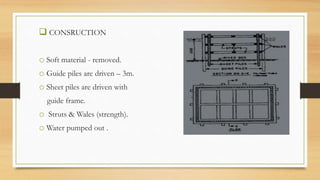
 CONSRUCTION
o Soft material - removed.
o Guide piles are driven – 3m.
o Sheet piles are driven with
guide frame.
o Struts & Wales (strength).
o Water pumped out .
DOUBLE WALL COFFERDAMS
• In large area.
• Ohio river type & wood or steel sheeting cofferdam.
OHIO RIVER TYPE COFFERDAM
• Ohio river in USA.
• Used in hard & soft bed (no erosion).
• Unsuitable in deep water & swift flow.
Construction
• Wales fixed at 1.50m vertically.
• Wale joints, double vertical planks are provided.
• Tie rods threaded & cross braces fixed.
• Fixes sheet piles.
• Berms (inside & outside)
• Removing safely.
 WOOD OR STEEL SHEETING
COFFERDAMS
• Depth ( 6-10 m)
• For small & ordinary type
• No possibility of driven of guide piles steel (depth) sheet
piles are used.
• Tie rods connects guide piles.
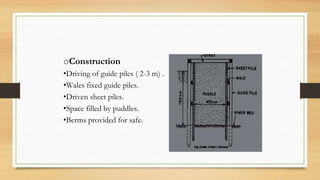
oConstruction
•Driving of guide piles ( 2-3 m) .
•Wales fixed guide piles.
•Driven sheet piles.
•Space filled by puddles.
•Berms provided for safe.
CELLULAR COFFERDAM
• Large areas.
• Steel sheet piles.
• Diaphragm cells & Circular cells.
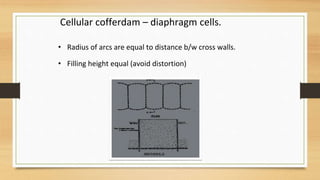
• Radius of arcs are equal to distance b/w cross walls.
• Filling height equal (avoid distortion)
Cellular cofferdam – diaphragm cells.
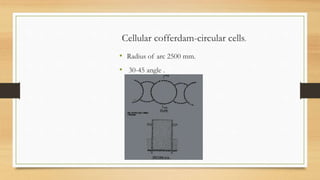
Cellular cofferdam-circular cells.
• Radius of arc 2500 mm.
• 30-45 angle .
 Advantages
Fast construction work of cells.
Self-supporting unit.
Less quantity of steel per running length (circular cells).
Little false work is required.
ROCK FILLED CRIB
COFFERDAM
• Crib is a box / a Cell open at bottom(timber).
• Rock / gravel / earth (overturning & sliding).
• Depth 10-20 m.
• Limited space.
• Cheap material (timber).
• Swift water flow.
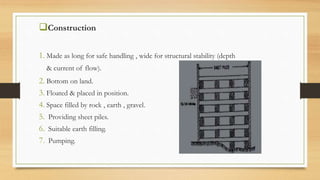
Construction
1. Made as long for safe handling , wide for structural stability (depth
& current of flow).
2. Bottom on land.
3. Floated & placed in position.
4. Space filled by rock , earth , gravel.
5. Providing sheet piles.
6. Suitable earth filling.
7. Pumping.
CONCRETE COFFERDAM
• Frame work of precast R.C.C. piles & sheets.
• Driven as steel sheet piles.
• Disadvantage (COSTLY).
• Avoid vibration (pile foundation).
PREVENTION OF
LEAKAGE IN COFFERDAM
Leakage through sheet piling & under flow.
 Fissures / cracks of rock – Pumping cement grout by pipes
(100mm dia ).
Clay , sand , ashes etc. – dumped around cofferdam.
Single wall cofferdam – Placing V- shaped wooden on outside
& Filling puddles.
Leakage in sheet piling – box(sawdust & ashes) hold near
joints , leads to sealing.
Interlocks of steel sheet piles – grease.
Double wall cofferdam –
• Driving piles through filling.
• Filling the holes with quick swelling material.
• Forcing clay cylinders for better compactness.
ADVANTAGES OF
COFFERDAM
 Poor environment.
 Safe environment.
 Design responsibility.
 Easy work.
 Re-usability of materials.
PUDDLE FOR COFFERDAM
o Clay & sand / clay & gravel.
o Clay - cohesive & impermeable.
 Test for cohesive – 40 mm dia 250 mm length cylinder
water(sufficient) .Suspended from one end(wet) ,not break-cohesion.
 Test for impermeability – Plastic mass spread ,water stored above .
Water held for some time –impermeable.
o Layers of 80 mm , well rammed (water should added).
FACTORS AFFECTING
DESIGN OF A COFFERDAM
Hydrostatic head of water
Dimensions of area.
Sub-soil condition.
Fluctuations of outside water level.
Possibility of erosion.
Floating logs.
Presence of ice.
CONCLUSION
Purely theoretically cofferdam will fail reasonably.
More than theory practical knowledge & experience are
necessary for good construction of cofferdams.
……THANK YOU

Cofferdam

  • 1.
  • 2.
    COFFERDAMS “A cofferdam isa temporary structure designed to keep water and/or soil out of the excavation in which a bridge pier or other structure is built”.
  • 3.
    REQUIREMENTS  Cofferdam shouldbe reasonably watertight.  Absolute water tightness is not desired in a cofferdam.  Designed in maximum water level.  Ground water or water lying above ground level should be excluded.  Materials – earth , timber , steel & concrete.  Constructed at site of work.  Depend- depth , soil condition , difference in water level, availability of materials.
  • 4.
    USES • Pile drivingoperation. • Place grillage & raft foundation. • Construct new structures. • Enclose space for removal. • Constructing without disturbances.
  • 5.
    FACTORS FOR CHOICEOF TYPE OF COFFERDAMS Area to be protected by a cofferdam. Depth of water to be dealt. Possibility of over topping. Nature of velocity of flow. Availability of materials at site of work. Easy transportation.
  • 6.
    TYPES OF COFFERDAMS DIKES  SINGLE WALL COFFRDAM  DOBLE WALL COFFERDAMS  CELLULAR COFFERDAMS  ROCK-FILLED CRIB COFFERDAMS  CONCRETE COFFERDAMS
  • 7.
    DIKES Embankment of somematerials. • EARTH • ROCK • SAND-BAGS
  • 8.
    EARTH DIKES • Shallowdepth of water 1200 - 1500 mm. • Low velocity of flow • Free board-1m. • Suitable side slope. • Top width of bank. • Material-mixture of clay &sand. • Puddle – best material . • Rip rap – protected against wind & wave actions.
  • 9.
    • Piece ofrock wt. 70 – 700 N. • After all, construction work of foundation is started. • Not used in over topping situation.
  • 10.
    ROCK DIKES • Depthabout 3 m. • Availability of rock. • Not impervious. • Impervious layers of earth are laid on side. • Voids are filled by earth. • Sometimes, core wall or steel sheet pile are used. • Core wall – clay or concrete. • Prevent over topping.
  • 12.
    SAND – BAGDIKES • Mixture of sand & clay in a bag.  PRECAUTIONS • Use empty cement bags. • Voids of sand bag may exceed – 40%. • Small depth. • Joints filled with puddle.
  • 13.
    SINGLE WALL COFFERDAM •Preferred small area. • Guide piles, wales , struts – wood. • Sheet piles are of wood or steel. • Wooden piles – depth about 10 m. • More depth - steel piles( 25 m ).
  • 14.
     CONSRUCTION o Softmaterial - removed. o Guide piles are driven – 3m. o Sheet piles are driven with guide frame. o Struts & Wales (strength). o Water pumped out .
  • 15.
    DOUBLE WALL COFFERDAMS •In large area. • Ohio river type & wood or steel sheeting cofferdam.
  • 16.
    OHIO RIVER TYPECOFFERDAM • Ohio river in USA. • Used in hard & soft bed (no erosion). • Unsuitable in deep water & swift flow. Construction • Wales fixed at 1.50m vertically. • Wale joints, double vertical planks are provided. • Tie rods threaded & cross braces fixed. • Fixes sheet piles. • Berms (inside & outside) • Removing safely.
  • 17.
     WOOD ORSTEEL SHEETING COFFERDAMS • Depth ( 6-10 m) • For small & ordinary type • No possibility of driven of guide piles steel (depth) sheet piles are used. • Tie rods connects guide piles.
  • 18.
    oConstruction •Driving of guidepiles ( 2-3 m) . •Wales fixed guide piles. •Driven sheet piles. •Space filled by puddles. •Berms provided for safe.
  • 19.
    CELLULAR COFFERDAM • Largeareas. • Steel sheet piles. • Diaphragm cells & Circular cells.
  • 20.
    • Radius ofarcs are equal to distance b/w cross walls. • Filling height equal (avoid distortion) Cellular cofferdam – diaphragm cells.
  • 21.
    Cellular cofferdam-circular cells. •Radius of arc 2500 mm. • 30-45 angle .
  • 22.
     Advantages Fast constructionwork of cells. Self-supporting unit. Less quantity of steel per running length (circular cells). Little false work is required.
  • 23.
    ROCK FILLED CRIB COFFERDAM •Crib is a box / a Cell open at bottom(timber). • Rock / gravel / earth (overturning & sliding). • Depth 10-20 m. • Limited space. • Cheap material (timber). • Swift water flow.
  • 24.
    Construction 1. Made aslong for safe handling , wide for structural stability (depth & current of flow). 2. Bottom on land. 3. Floated & placed in position. 4. Space filled by rock , earth , gravel. 5. Providing sheet piles. 6. Suitable earth filling. 7. Pumping.
  • 25.
    CONCRETE COFFERDAM • Framework of precast R.C.C. piles & sheets. • Driven as steel sheet piles. • Disadvantage (COSTLY). • Avoid vibration (pile foundation).
  • 26.
    PREVENTION OF LEAKAGE INCOFFERDAM Leakage through sheet piling & under flow.  Fissures / cracks of rock – Pumping cement grout by pipes (100mm dia ). Clay , sand , ashes etc. – dumped around cofferdam. Single wall cofferdam – Placing V- shaped wooden on outside & Filling puddles. Leakage in sheet piling – box(sawdust & ashes) hold near joints , leads to sealing.
  • 27.
    Interlocks of steelsheet piles – grease. Double wall cofferdam – • Driving piles through filling. • Filling the holes with quick swelling material. • Forcing clay cylinders for better compactness.
  • 28.
    ADVANTAGES OF COFFERDAM  Poorenvironment.  Safe environment.  Design responsibility.  Easy work.  Re-usability of materials.
  • 29.
    PUDDLE FOR COFFERDAM oClay & sand / clay & gravel. o Clay - cohesive & impermeable.  Test for cohesive – 40 mm dia 250 mm length cylinder water(sufficient) .Suspended from one end(wet) ,not break-cohesion.  Test for impermeability – Plastic mass spread ,water stored above . Water held for some time –impermeable. o Layers of 80 mm , well rammed (water should added).
  • 30.
    FACTORS AFFECTING DESIGN OFA COFFERDAM Hydrostatic head of water Dimensions of area. Sub-soil condition. Fluctuations of outside water level. Possibility of erosion. Floating logs. Presence of ice.
  • 31.
    CONCLUSION Purely theoretically cofferdamwill fail reasonably. More than theory practical knowledge & experience are necessary for good construction of cofferdams.
  • 32.