DEEP FOUNDATION

PRESENTED BY
SANA FATMA
B.ARCH 3RD YEAR
DEEP FOUNDATION
• When the soil at or near the ground surface is not capable of
supporting a structure a deep foundations are required to
transfer the loads to deeper strata.
• Deep foundations are also used when surface soil is
unsuitable for shallow foundation, a firm stratum is so deep
that it cannot be reached economically by shallow
foundations.
• Ground table is high.
TYPES OF DEEP FOUNDATION
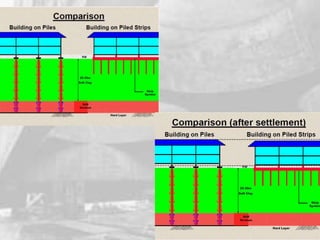
• The most common types of deep foundation are
piles, piers and caissons.
PILE FOUNDATION
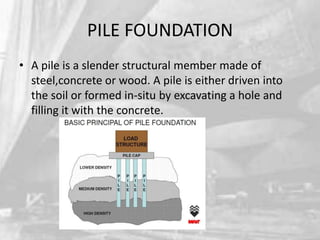
• A pile is a slender structural member made of
steel,concrete or wood. A pile is either driven into
the soil or formed in-situ by excavating a hole and
filling it with the concrete.
NECESSITY OF PILE FOUNDATIONS
• When the strata or just below the ground surface is highly
compressible and very weak to support the load
transmitted by the structure.
• When the plan of the structure is irregular relative to its
outline and load distribution.
• Pile foundations are required for the transmission of
structural loads through deep water .
• Piles are required when the soil conditions are such that a
wash out ,erosion of soil occur from underneath a shallow
foundation.
• Piles are used for the foundations of some structures such
as transmission towers, off shore platforms, which are
subjected to uplift.
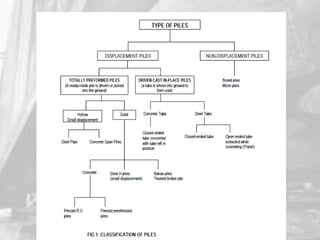
CLASSIFICATION OF PILES
• Classification according to material used
 Steel piles: steel piles are generally either in the
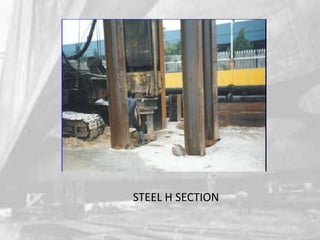
form of thick pipes or rolled steel H sections. Pipe
steel piles are driven into the ground with their
ends open or closed. Piles are provided with a
driving point or shoe at the lower end.
o Epoxy coatings are applied in the factory during
manufacture of pipes to reduce corrosion of steel
piles. Sometimes ,concrete encasement at site is
done as a protection against corrosion.
STEEL H SECTION
• CONCRETE PILES: Cement concrete is used in the
construction of concrete piles.
• Concrete piles are either pre cast or cast in situ.
• The reinforcement is provided to resist handling and driving
stresses.
• Precast piles can also be pre stressed using high strength
steel pre tensioned cables.
• A cast in situ pile is constructed by making hole in the
ground and then filling it with concrete. It may be cased or
uncased.
• A cased pile is constructed by driving a steel casing into the
ground and filling it with concrete.
• An uncased pile is constructed by driving the casing to
desired depth and gradually withdrawing casing when fresh
concrete is filled.
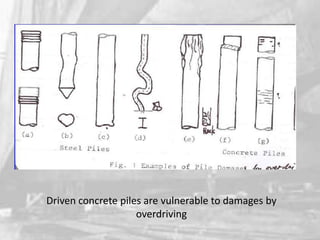
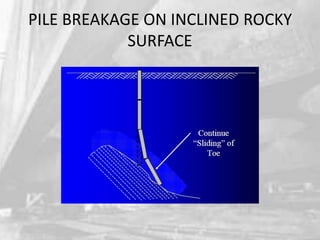
Driven concrete piles are vulnerable to damages by
overdriving
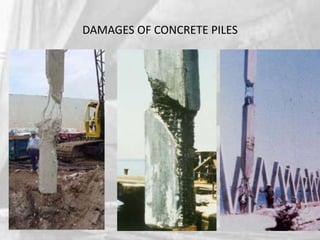
DAMAGES OF CONCRETE PILES
PILE BREAKAGE ON INCLINED ROCKY
SURFACE
Among the advantages of Cast-In-Place
Concrete are as follows:
•
•
•
•
•

Can sustain hard driving
Resistant to marine organism
Easily inspected
Length can be changed easily
Easy to handle and ship
• Timber piles: Timber piles are made from tree trunks
after proper trimming.
• The timber should be straight ,sound and free from
defects.
• Steel shoe are provided to prevent damage during
driving.
• The length of the pipe sleeve should be atleast five times
the diameter of the pile.
• Timber piles below the water table have generally long
life.
• Above the water table these are attacked by insects.
• Timber piles should not be used in marine environment
where these are attacked by various organisms
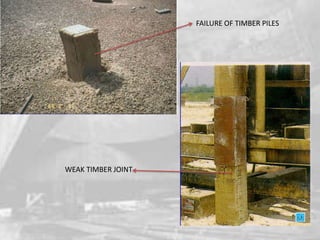
FAILURE OF TIMBER PILES

WEAK TIMBER JOINT
• Composite piles: There are made of two
materials.
• A composite pile may consist of the lower
portion of steel and the upper portion of cast
in-situ concrete.
• A composite may also have the lower portion of
timber below the water table and the upper
portion of concrete.
• It is because it is difficult to provide a proper
joint between two dissimilar materials.
• It is rarely used in practice.
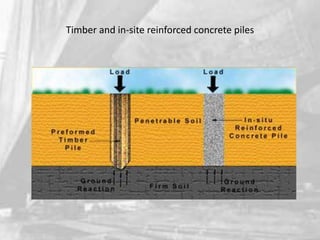
Timber and in-site reinforced concrete piles
• Amsterdam, built on wooden piles, and more recently
Shanghai built on deep concrete piles.
LOAD CAN BE TRANSFERRED BY PILE
TO THE GROUND BY 2 WAY THAT IS:
a) End Bearing Piles
- Pile will transmit load into the firm soil layer of
the ground such as rock, gravel, very dense
sand
b) Friction Piles
- Pile transmit the load from the structure to the
penetrable soil by means of skin friction or
cohesion between the soil & the embedded
surface of the pile.
METHOD OF INSTALLATION
a) Dropping Weight or Drop Hammers
- commonly used method of insertion of
displacement piles
b) Diesel Hammers
- Most suitable to drive pile in non cohesive
granular soil
c) Vibratory Hammers or vibratory method of pile
driving
- very effective in driving piles through non
cohesive granular soil
c) Jacking Method Of Insertion
DROP HAMMER
• A drop hammer is raised by a winch and allowed to drop on
the top of the pile under gravity from a certain height.
• During the driving operation ,a cap is fixed to the top of the
pile and cushion is generally provided between the pile and
the cap.
• Another cushion ,known as hammer cushion is placed on the
pile cap on which the hammer causes the impact.
DIESEL HAMMER
• Rapid controlled explosions can be produced by
the diesel hammer.
• The explosions raise a ram which is used to drive
the pile into the ground.
• Although the ram is smaller than the weight used
in the drop hammer the increased frequency of
the blows can make up for this inefficiency.
• This type of hammer is most suitable for driving
piles through non-cohesive granular soils where
the majority of the resistance is from end
bearing.
VIBRATORY METHOD OF PILE DRIVING
• Vibratory methods can prove to be very effective
in driving piles through non cohesive granular
soils.
• The vibration of the pile excites the soil grains
adjacent to the pile making the soil almost free
flowing thus significantly reducing friction along
the pile shaft.
• However the large energy resulting from the
vibrations can damage equipment, noise and
vibration propagation can also result in the
settlement of nearby buildings.
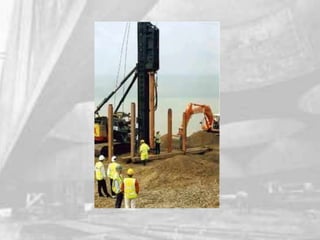
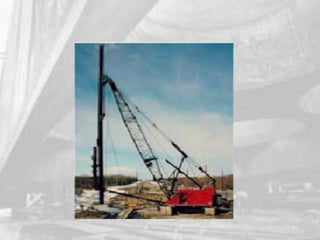
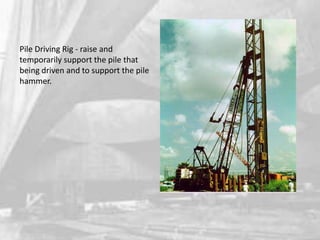
Pile Driving Rig - raise and
temporarily support the pile that
being driven and to support the pile
hammer.
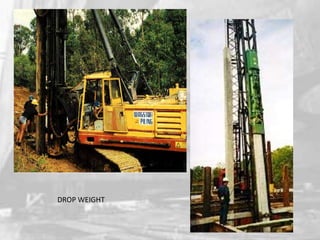
DROPPING WEIGHT / DROP HAMMERS
•

•

A weight approximately half that of the
pile is raised a suitable distance in a guide
and released to strike the pile head.
When driving a hollow pile tube the weight
usually acts on a plug at the bottom of the
pile thus reducing any excess stresses along
the length of the tube during insertion.
DROP WEIGHT
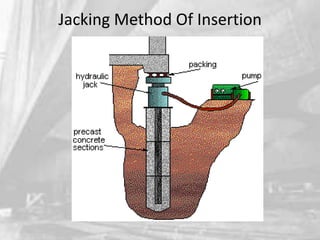
JACKING METHOD OF INSERTION
• Jacked Piles are most commonly used in
underpinning structures
• By excavating underneath a structure short
lengths of pile can be inserted and jacked
into the ground using the underside of the
existing structure as a reaction.
Jacking Method Of Insertion
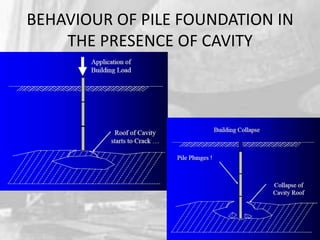
BEHAVIOUR OF PILE FOUNDATION IN
THE PRESENCE OF CAVITY
PIERS
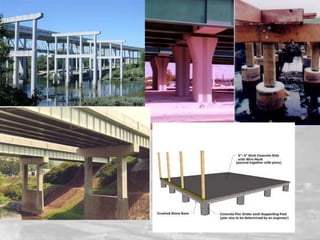
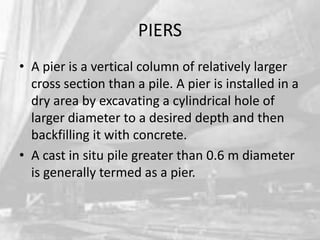
• A pier is a vertical column of relatively larger
cross section than a pile. A pier is installed in a
dry area by excavating a cylindrical hole of
larger diameter to a desired depth and then
backfilling it with concrete.
• A cast in situ pile greater than 0.6 m diameter
is generally termed as a pier.
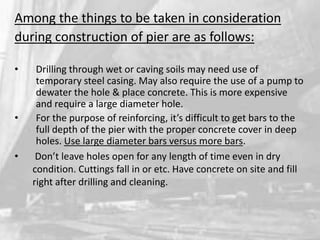
Among the things to be taken in consideration
during construction of pier are as follows:
•

•
•

Drilling through wet or caving soils may need use of
temporary steel casing. May also require the use of a pump to
dewater the hole & place concrete. This is more expensive
and require a large diameter hole.
For the purpose of reinforcing, it’s difficult to get bars to the
full depth of the pier with the proper concrete cover in deep
holes. Use large diameter bars versus more bars.
Don’t leave holes open for any length of time even in dry
condition. Cuttings fall in or etc. Have concrete on site and fill
right after drilling and cleaning.
• Advantages: Very affordable foundation
• Disadvantages: Can not be used with
conventional construction where walls are
framed with studs, unless a heavy structural
grade beam is installed first.
CAISSON
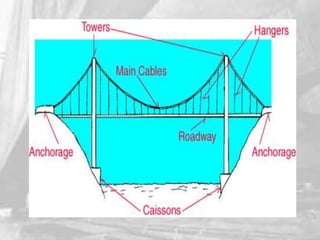
• A caisson is a hollow ,watertight box or chamber
,which is sunk through the ground for laying
foundation under the water.
• It is sunk into the ground to some desired depth
and then filled with concrete thus forming a
foundation.
• Most often used in the construction of bridge
piers & other structures that require foundation
beneath rivers & other bodies of water.
• This is because caissons can be floated to the job
site and sunk into place.
• It’s created by auguring a deep hole in the ground.
• Then, 2 or more ‘stick’ reinforcing bar are inserted
into and run the full length of the hole and the
concrete is poured into the caisson hole.
• The caisson foundations carry the building loads at
their lower ends, which are often bell-shaped.
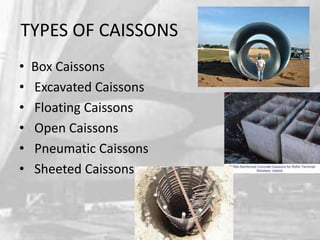
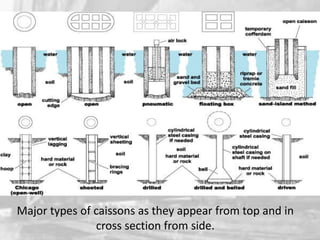
TYPES OF CAISSONS
•
•
•
•
•
•

Box Caissons
Excavated Caissons
Floating Caissons
Open Caissons
Pneumatic Caissons
Sheeted Caissons
Major types of caissons as they appear from top and in
cross section from side.
BIBLIOGRAPHY
• REINFORCED CONCRETE DESIGN –PILLAI
MENON
• WIKIPEDIA
THANK YOU

Presentation tos

  • 1.
    DEEP FOUNDATION PRESENTED BY SANAFATMA B.ARCH 3RD YEAR
  • 2.
    DEEP FOUNDATION • Whenthe soil at or near the ground surface is not capable of supporting a structure a deep foundations are required to transfer the loads to deeper strata. • Deep foundations are also used when surface soil is unsuitable for shallow foundation, a firm stratum is so deep that it cannot be reached economically by shallow foundations. • Ground table is high.
  • 3.
    TYPES OF DEEPFOUNDATION • The most common types of deep foundation are piles, piers and caissons.
  • 4.
    PILE FOUNDATION • Apile is a slender structural member made of steel,concrete or wood. A pile is either driven into the soil or formed in-situ by excavating a hole and filling it with the concrete.
  • 6.
    NECESSITY OF PILEFOUNDATIONS • When the strata or just below the ground surface is highly compressible and very weak to support the load transmitted by the structure. • When the plan of the structure is irregular relative to its outline and load distribution. • Pile foundations are required for the transmission of structural loads through deep water . • Piles are required when the soil conditions are such that a wash out ,erosion of soil occur from underneath a shallow foundation. • Piles are used for the foundations of some structures such as transmission towers, off shore platforms, which are subjected to uplift.
  • 7.
    CLASSIFICATION OF PILES •Classification according to material used  Steel piles: steel piles are generally either in the form of thick pipes or rolled steel H sections. Pipe steel piles are driven into the ground with their ends open or closed. Piles are provided with a driving point or shoe at the lower end. o Epoxy coatings are applied in the factory during manufacture of pipes to reduce corrosion of steel piles. Sometimes ,concrete encasement at site is done as a protection against corrosion.
  • 8.
  • 9.
    • CONCRETE PILES:Cement concrete is used in the construction of concrete piles. • Concrete piles are either pre cast or cast in situ. • The reinforcement is provided to resist handling and driving stresses. • Precast piles can also be pre stressed using high strength steel pre tensioned cables. • A cast in situ pile is constructed by making hole in the ground and then filling it with concrete. It may be cased or uncased. • A cased pile is constructed by driving a steel casing into the ground and filling it with concrete. • An uncased pile is constructed by driving the casing to desired depth and gradually withdrawing casing when fresh concrete is filled.
  • 10.
    Driven concrete pilesare vulnerable to damages by overdriving
  • 11.
  • 12.
    PILE BREAKAGE ONINCLINED ROCKY SURFACE
  • 13.
    Among the advantagesof Cast-In-Place Concrete are as follows: • • • • • Can sustain hard driving Resistant to marine organism Easily inspected Length can be changed easily Easy to handle and ship
  • 14.
    • Timber piles:Timber piles are made from tree trunks after proper trimming. • The timber should be straight ,sound and free from defects. • Steel shoe are provided to prevent damage during driving. • The length of the pipe sleeve should be atleast five times the diameter of the pile. • Timber piles below the water table have generally long life. • Above the water table these are attacked by insects. • Timber piles should not be used in marine environment where these are attacked by various organisms
  • 15.
    FAILURE OF TIMBERPILES WEAK TIMBER JOINT
  • 16.
    • Composite piles:There are made of two materials. • A composite pile may consist of the lower portion of steel and the upper portion of cast in-situ concrete. • A composite may also have the lower portion of timber below the water table and the upper portion of concrete. • It is because it is difficult to provide a proper joint between two dissimilar materials. • It is rarely used in practice.
  • 17.
    Timber and in-sitereinforced concrete piles
  • 18.
    • Amsterdam, builton wooden piles, and more recently Shanghai built on deep concrete piles.
  • 19.
    LOAD CAN BETRANSFERRED BY PILE TO THE GROUND BY 2 WAY THAT IS: a) End Bearing Piles - Pile will transmit load into the firm soil layer of the ground such as rock, gravel, very dense sand b) Friction Piles - Pile transmit the load from the structure to the penetrable soil by means of skin friction or cohesion between the soil & the embedded surface of the pile.
  • 20.
    METHOD OF INSTALLATION a)Dropping Weight or Drop Hammers - commonly used method of insertion of displacement piles b) Diesel Hammers - Most suitable to drive pile in non cohesive granular soil c) Vibratory Hammers or vibratory method of pile driving - very effective in driving piles through non cohesive granular soil c) Jacking Method Of Insertion
  • 21.
    DROP HAMMER • Adrop hammer is raised by a winch and allowed to drop on the top of the pile under gravity from a certain height. • During the driving operation ,a cap is fixed to the top of the pile and cushion is generally provided between the pile and the cap. • Another cushion ,known as hammer cushion is placed on the pile cap on which the hammer causes the impact.
  • 23.
    DIESEL HAMMER • Rapidcontrolled explosions can be produced by the diesel hammer. • The explosions raise a ram which is used to drive the pile into the ground. • Although the ram is smaller than the weight used in the drop hammer the increased frequency of the blows can make up for this inefficiency. • This type of hammer is most suitable for driving piles through non-cohesive granular soils where the majority of the resistance is from end bearing.
  • 25.
    VIBRATORY METHOD OFPILE DRIVING • Vibratory methods can prove to be very effective in driving piles through non cohesive granular soils. • The vibration of the pile excites the soil grains adjacent to the pile making the soil almost free flowing thus significantly reducing friction along the pile shaft. • However the large energy resulting from the vibrations can damage equipment, noise and vibration propagation can also result in the settlement of nearby buildings.
  • 26.
    Pile Driving Rig- raise and temporarily support the pile that being driven and to support the pile hammer.
  • 27.
    DROPPING WEIGHT /DROP HAMMERS • • A weight approximately half that of the pile is raised a suitable distance in a guide and released to strike the pile head. When driving a hollow pile tube the weight usually acts on a plug at the bottom of the pile thus reducing any excess stresses along the length of the tube during insertion.
  • 28.
  • 29.
    JACKING METHOD OFINSERTION • Jacked Piles are most commonly used in underpinning structures • By excavating underneath a structure short lengths of pile can be inserted and jacked into the ground using the underside of the existing structure as a reaction.
  • 30.
  • 31.
    BEHAVIOUR OF PILEFOUNDATION IN THE PRESENCE OF CAVITY
  • 33.
    PIERS • A pieris a vertical column of relatively larger cross section than a pile. A pier is installed in a dry area by excavating a cylindrical hole of larger diameter to a desired depth and then backfilling it with concrete. • A cast in situ pile greater than 0.6 m diameter is generally termed as a pier.
  • 34.
    Among the thingsto be taken in consideration during construction of pier are as follows: • • • Drilling through wet or caving soils may need use of temporary steel casing. May also require the use of a pump to dewater the hole & place concrete. This is more expensive and require a large diameter hole. For the purpose of reinforcing, it’s difficult to get bars to the full depth of the pier with the proper concrete cover in deep holes. Use large diameter bars versus more bars. Don’t leave holes open for any length of time even in dry condition. Cuttings fall in or etc. Have concrete on site and fill right after drilling and cleaning.
  • 35.
    • Advantages: Veryaffordable foundation • Disadvantages: Can not be used with conventional construction where walls are framed with studs, unless a heavy structural grade beam is installed first.
  • 37.
    CAISSON • A caissonis a hollow ,watertight box or chamber ,which is sunk through the ground for laying foundation under the water. • It is sunk into the ground to some desired depth and then filled with concrete thus forming a foundation. • Most often used in the construction of bridge piers & other structures that require foundation beneath rivers & other bodies of water. • This is because caissons can be floated to the job site and sunk into place.
  • 38.
    • It’s createdby auguring a deep hole in the ground. • Then, 2 or more ‘stick’ reinforcing bar are inserted into and run the full length of the hole and the concrete is poured into the caisson hole. • The caisson foundations carry the building loads at their lower ends, which are often bell-shaped.
  • 39.
    TYPES OF CAISSONS • • • • • • BoxCaissons Excavated Caissons Floating Caissons Open Caissons Pneumatic Caissons Sheeted Caissons
  • 41.
    Major types ofcaissons as they appear from top and in cross section from side.
  • 42.
    BIBLIOGRAPHY • REINFORCED CONCRETEDESIGN –PILLAI MENON • WIKIPEDIA
  • 43.