A buffer solution is one which maintains
its pH fairly constant even upon the
addition of small amounts of acid or
base.
There are two types of buffer solution.
1. Acidic Buffer
2. Basic Buffer
Acidic Buffer:
A weak acid together with a salt of
the same acid with a strong base.These are
called Acidic Buffer.
For Example.
CH3COOH CH3COONa.
Basic Buffers:
A weak base and its salt with a strong
acid.These are called Basic Buffers.
For Example.
NH4OH+NH4CL
Let us illustrate buffer action by taking
example of a common buffer system
consisting of solution of acetic acid and
sodium acetate.
CH3COOH ⇌ H+ + CH3COO-
CH3COONa Na+ + CH3COO-
Since the salt is comletely ionized,it
provides the common ion CH3COO in
excess.
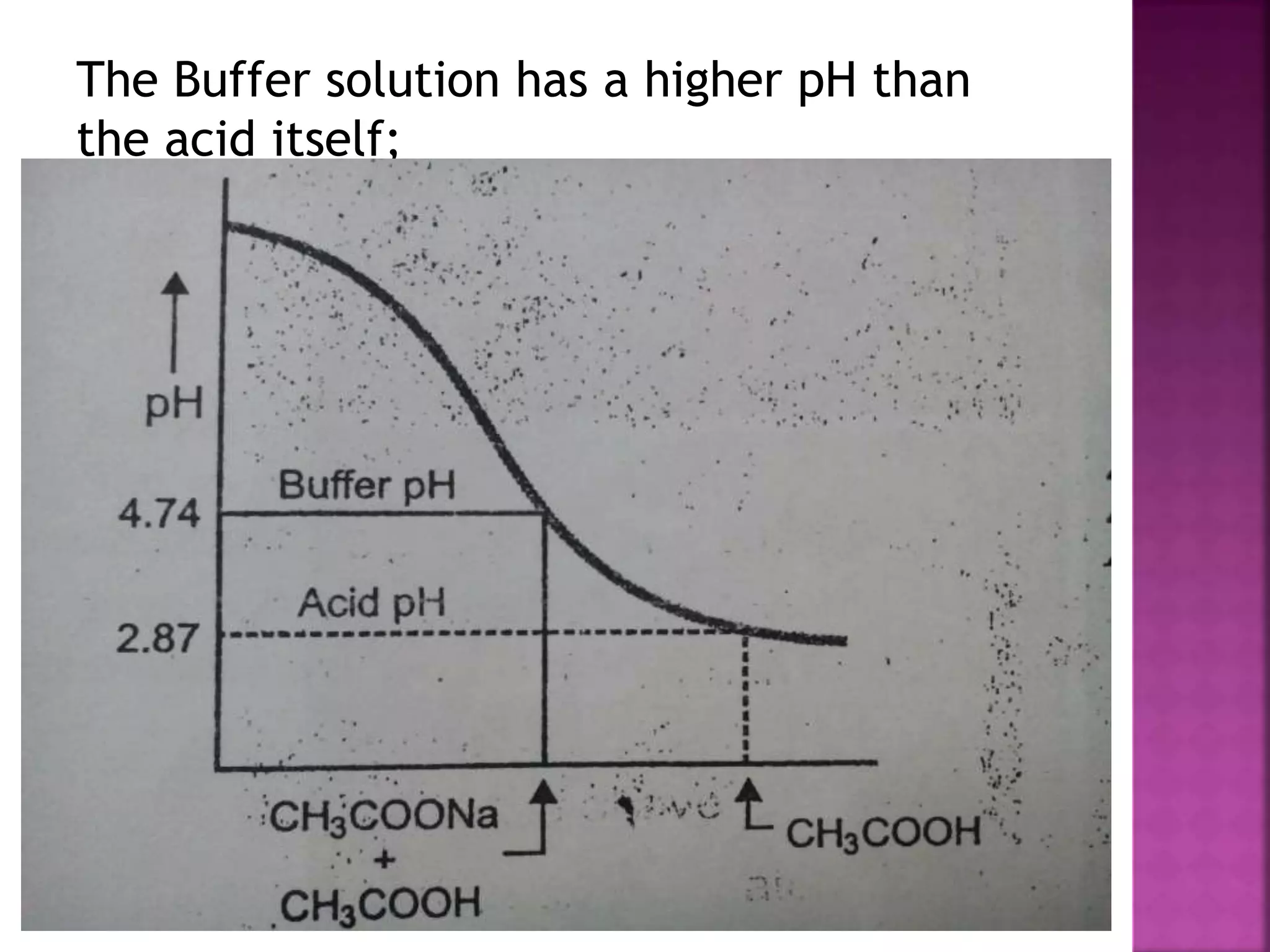
The Buffer solution has a higher pH than
the acid itself;
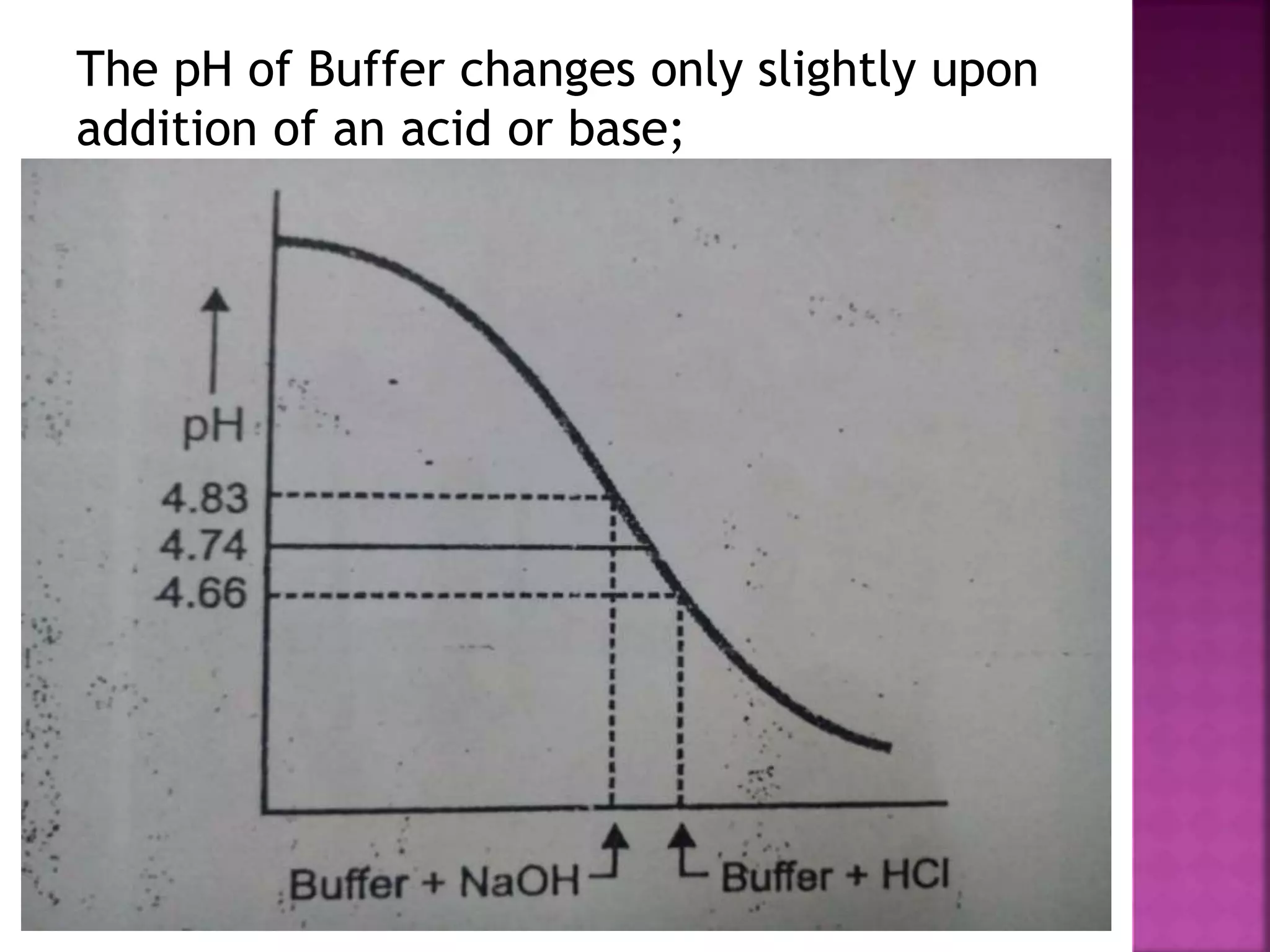
The pH of Buffer changes only slightly upon
addition of an acid or base;
We have already stated that a buffer solution
containing equimolar amounts (0.10M) of acetic acid
and sodium acetate has pH 4.74.Now we proceed to
discuss how the addition of a small amount of HCl
or NaOH to the buffer solution affects its Ph.
The pH of the buffer is governed by the
equillibrium
CH3COOH ⇌ CH3COO + H
The buffer solution has a large excess of
CH3COO ions produced by complete ionization
of sodium acetate,
CH3COONa CH3COO+Na
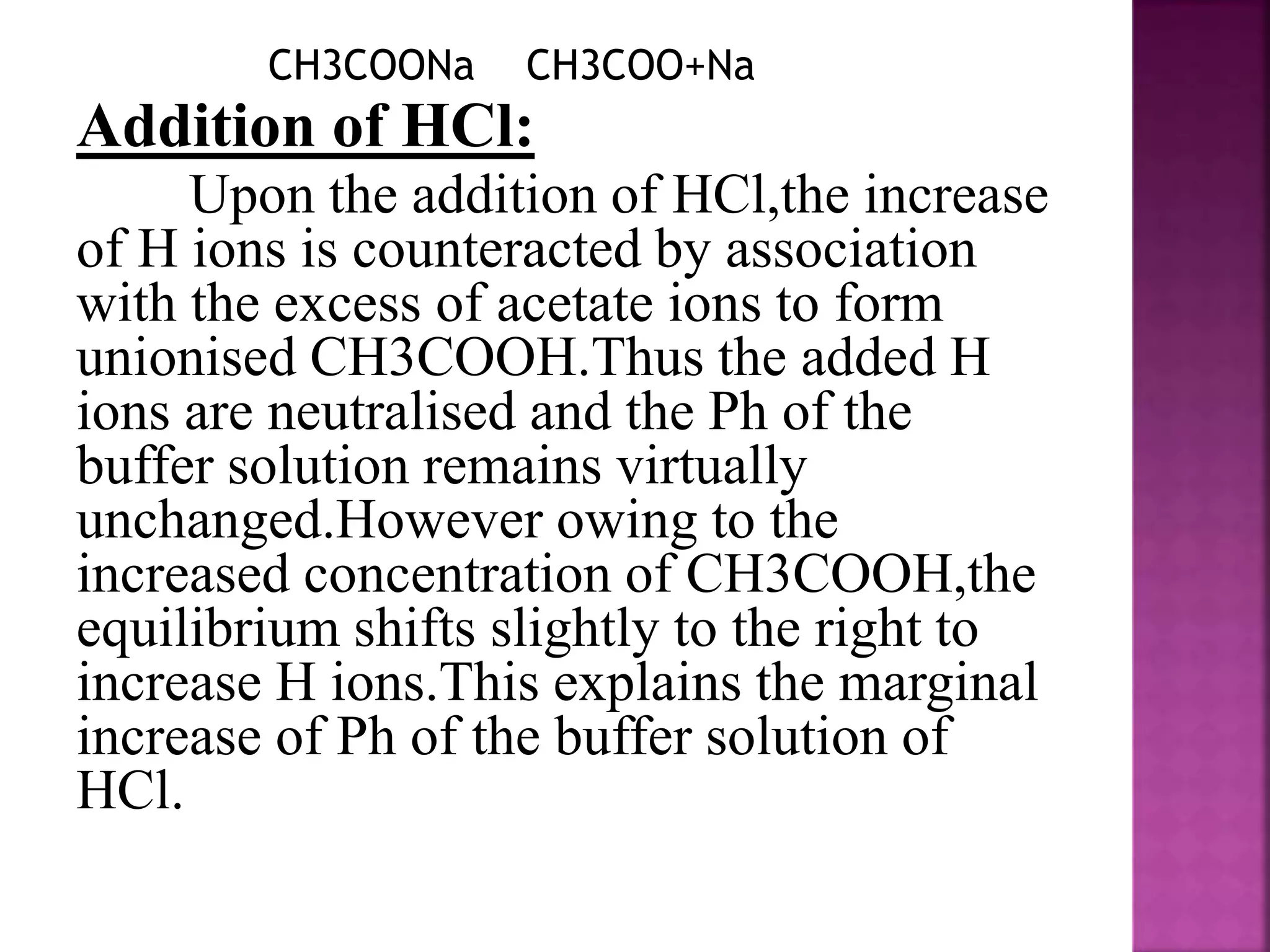
Addition of HCl:
Upon the addition of HCl,the increase
of H ions is counteracted by association
with the excess of acetate ions to form
unionised CH3COOH.Thus the added H
ions are neutralised and the Ph of the
buffer solution remains virtually
unchanged.However owing to the
increased concentration of CH3COOH,the
equilibrium shifts slightly to the right to
increase H ions.This explains the marginal
increase of Ph of the buffer solution of
HCl.
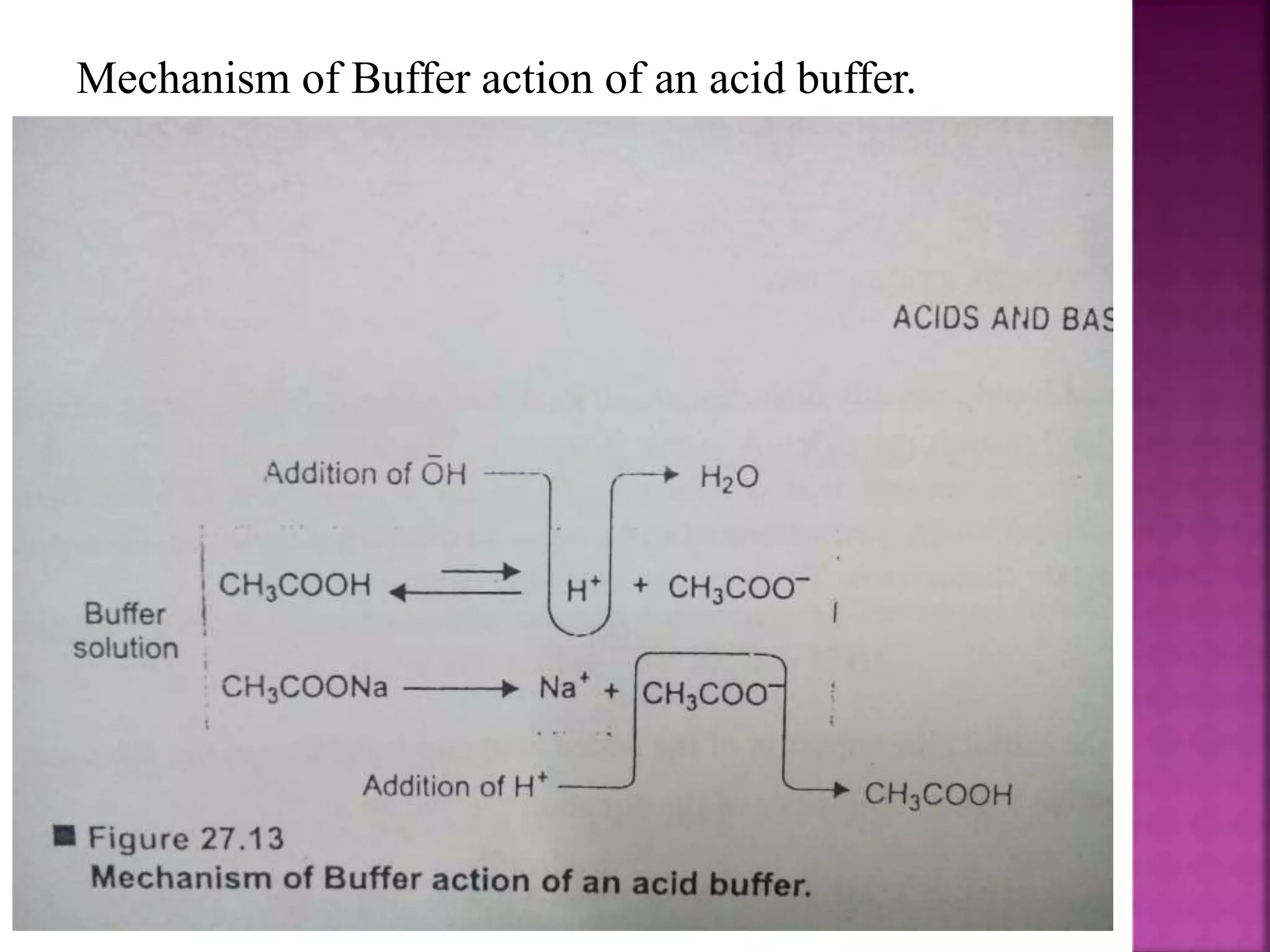
Mechanism of Buffer action of an acid buffer.
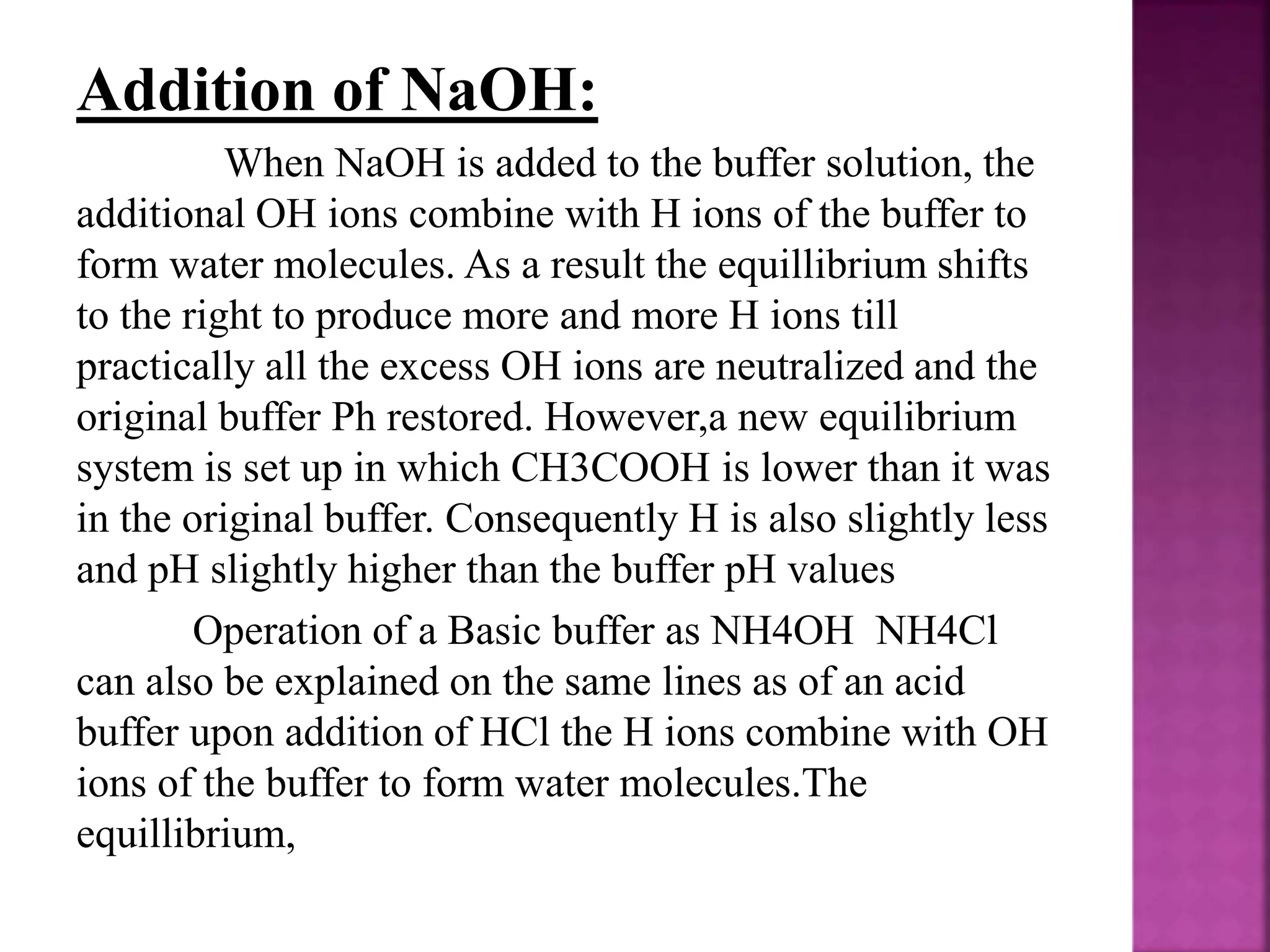
Addition of NaOH:
When NaOH is added to the buffer solution, the
additional OH ions combine with H ions of the buffer to
form water molecules. As a result the equillibrium shifts
to the right to produce more and more H ions till
practically all the excess OH ions are neutralized and the
original buffer Ph restored. However,a new equilibrium
system is set up in which CH3COOH is lower than it was
in the original buffer. Consequently H is also slightly less
and pH slightly higher than the buffer pH values
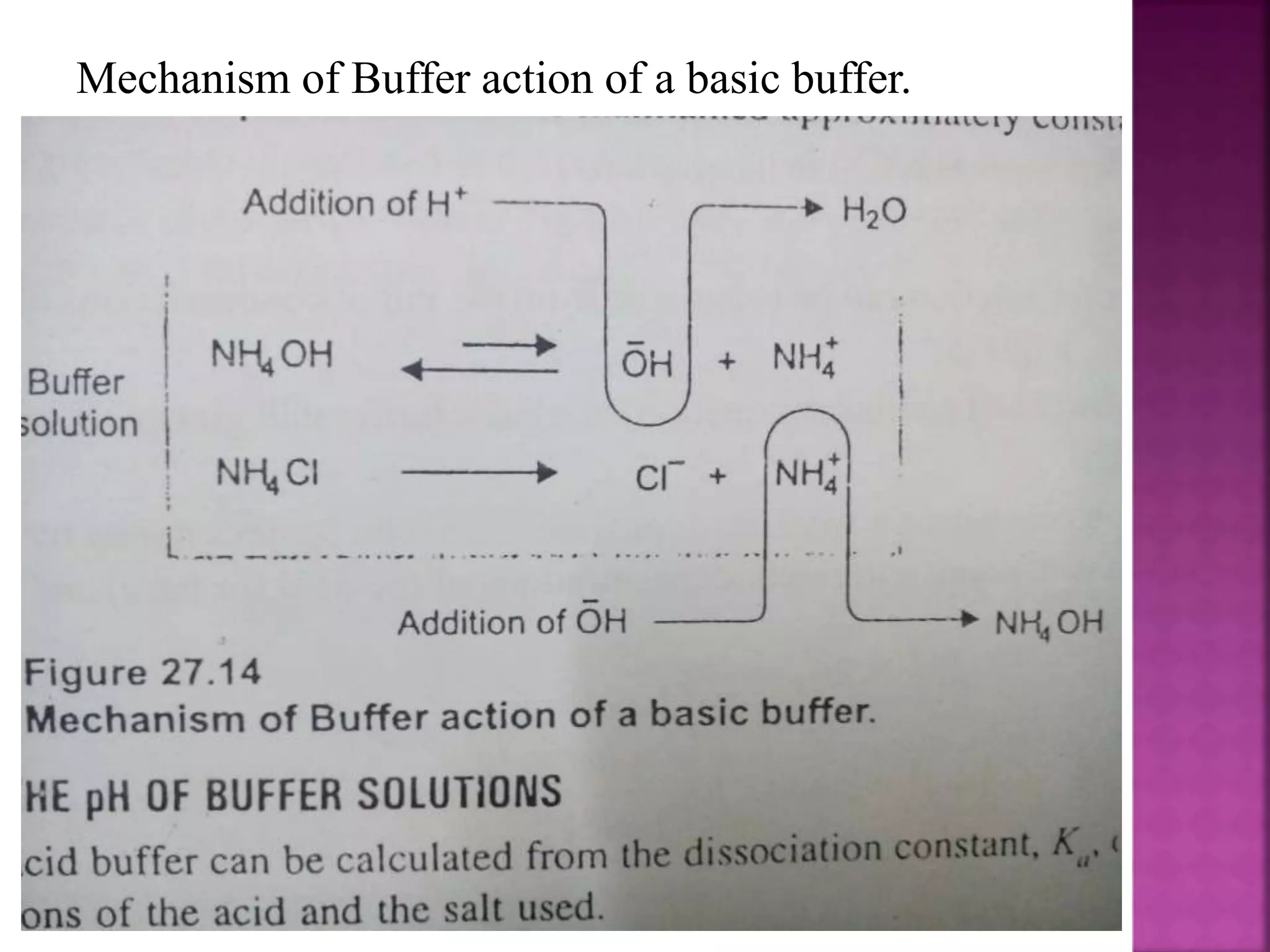
Operation of a Basic buffer as NH4OH NH4Cl
can also be explained on the same lines as of an acid
buffer upon addition of HCl the H ions combine with OH
ions of the buffer to form water molecules.The
equillibrium,
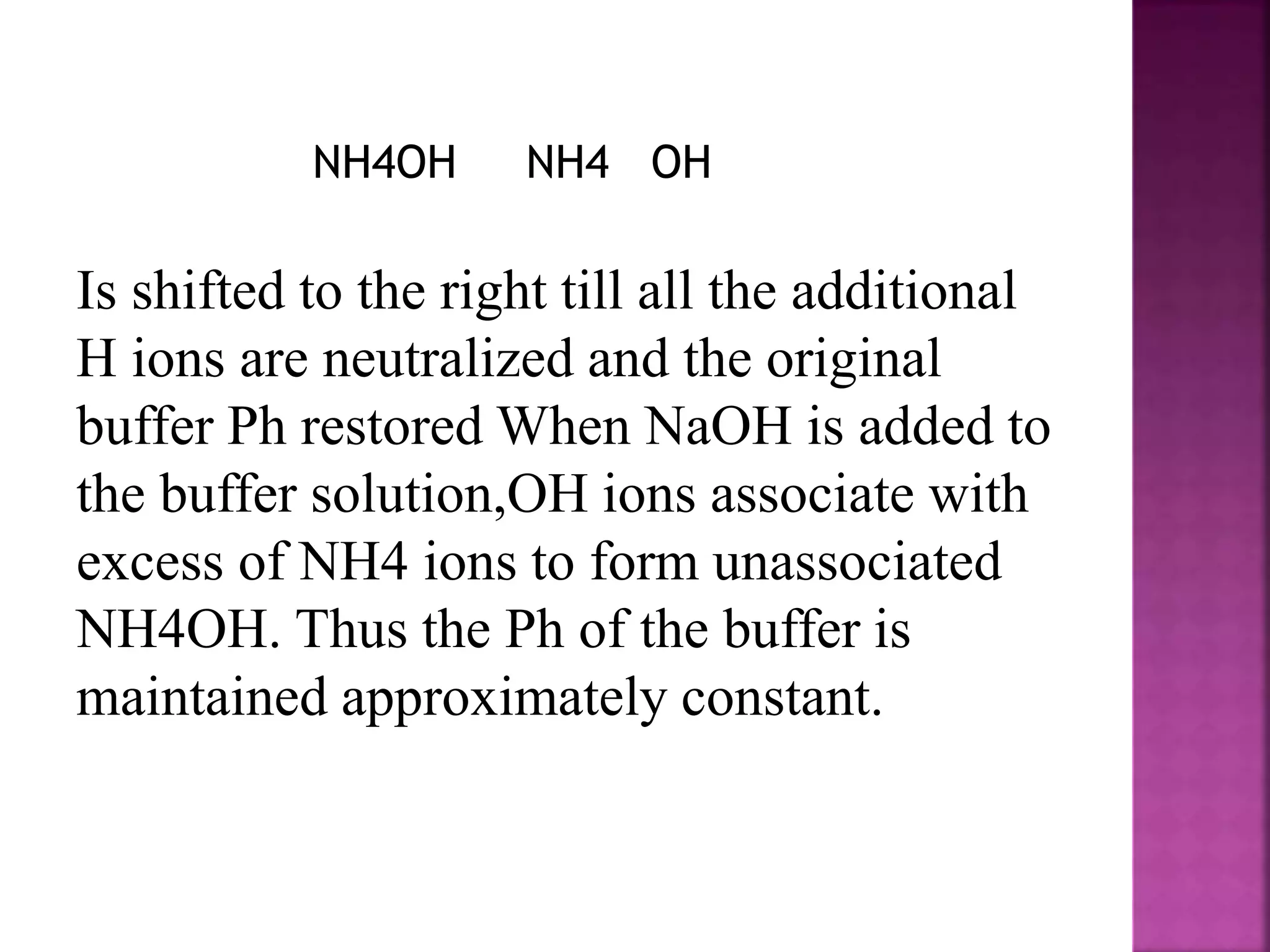
NH4OH NH4 OH
Is shifted to the right till all the additional
H ions are neutralized and the original
buffer Ph restored When NaOH is added to
the buffer solution,OH ions associate with
excess of NH4 ions to form unassociated
NH4OH. Thus the Ph of the buffer is
maintained approximately constant.
Mechanism of Buffer action of a basic buffer.
It can be defined as the ability of a
buffer to resist the change of potential of
hydrogen.
Mathematically it can be expressed as;
How it can be determined?
Buffer capacity of a buffer solution is
determined by the size of actual molarities.
How do you calculate the Buffer Capacity?
Buffer Capacity refers to the maximum
amount of a strong acid or a strong base that is
added so that a significant change in pH occur.
IMPORTANCE:
It is important in chemical as well as in
biological term.
Buffer Capacity of water:
As the purity of fresh water increases,the buffer
capacity decreases and 100 percent pure fresh water is no
buffer at all.
What factors determined buffer capacity ?
The concentration of the buffer (the higher the
concentration,the larger the buffering capacity) and how
close the pka of buffer is compared to the pH of solution.
What determines buffering capacity?
The titration curve determines
buffering capacity
An acid base is an organic dye that
signals the end point by a visual change in
colour.
Two common examples of acid base indicator
ď‚§ Phenophthalein
ď‚§ Methyl orange
PH Range:
Most indicators do not change colour at a
particular pH.They do so over a range of pH from
two to three units this is called the pH range.
It was different for various indicators.
PH Curve And Indicators Range:
During an acid base titration the pH
of solution in the receiver flask changes with
the addition of the titrant from the burette.A
plot of Ph against the vol. of the solution being
added is known as pH curve or Titration Curve
e.g phenophthaline litmus and methyl orange
may be used as indicators for acid base
titrations.
End Point:
In an acid base titration the base solution
can be added gradually from a burette into an acid
solution contained in a receiver flask. When the
amount of base added equals the amount of an acid
in the flask the end point is reached.
The end point of a titration is shown by
colour change of an indicator.
we may have the titration of:
ď‚§ a strong acid with a strong base
ď‚§ a weak acid with a strong base
ď‚§ a strong acid with a weak base
ď‚§ a weak acid with a weak base
Titration a strong acid with a strong base:
In this titration both methyl orange and
phenophthalein are suitable indicators
Titration a weak acid with a strong base:
In this titration phenophthalein is a suitable
indicator, while methyl orange is not.
Titration a strong acid with a weak base:
In this titration, evidently methyl orange and
methyl red are suitable indicators.
Titration a acid with a weak base:
Under these condition, all indicators change
colour only gradually and no indicator is suitable.
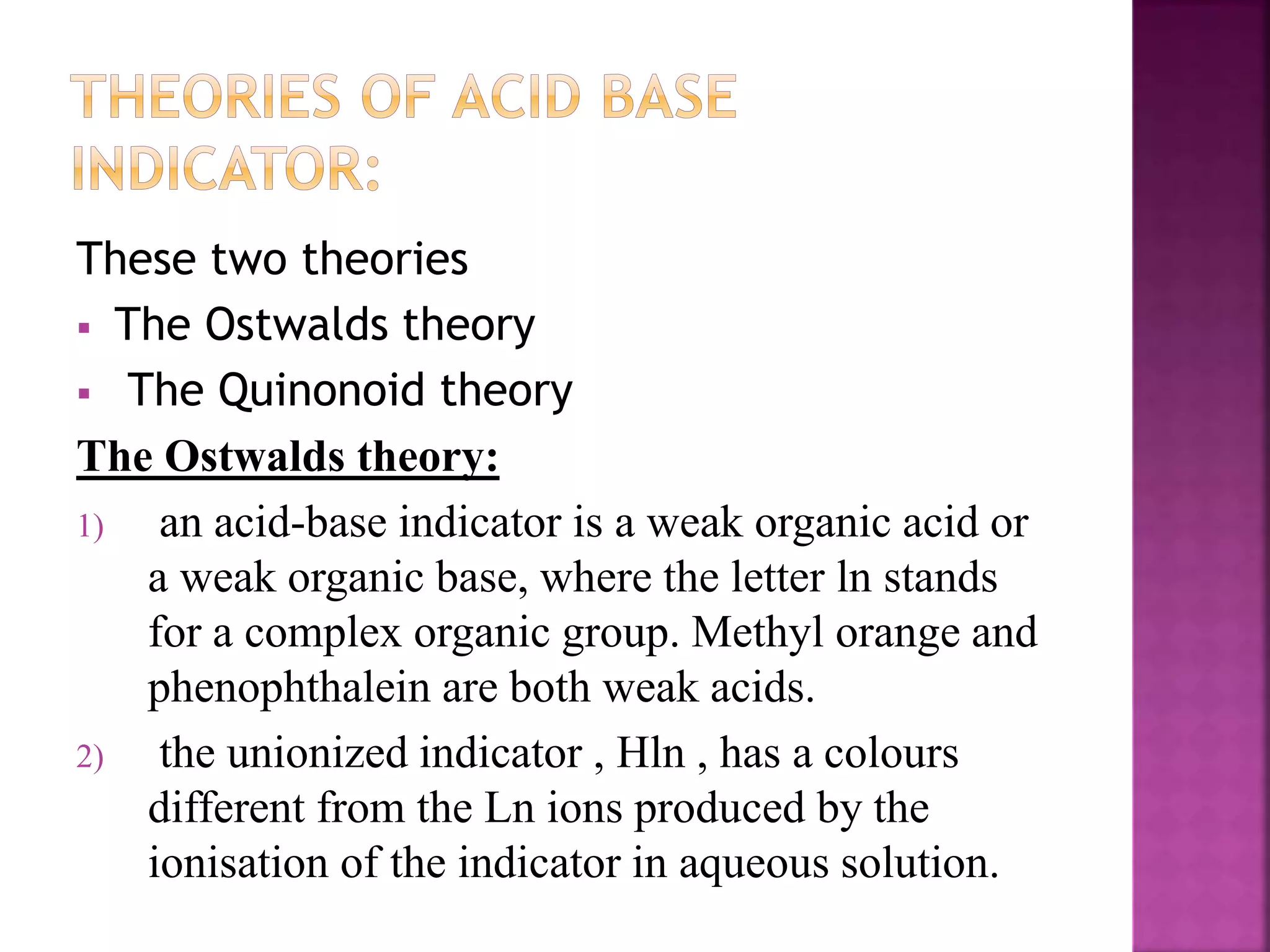
These two theories
ď‚§ The Ostwalds theory
ď‚§ The Quinonoid theory
The Ostwalds theory:
1) an acid-base indicator is a weak organic acid or
a weak organic base, where the letter ln stands
for a complex organic group. Methyl orange and
phenophthalein are both weak acids.
2) the unionized indicator , Hln , has a colours
different from the Ln ions produced by the
ionisation of the indicator in aqueous solution.
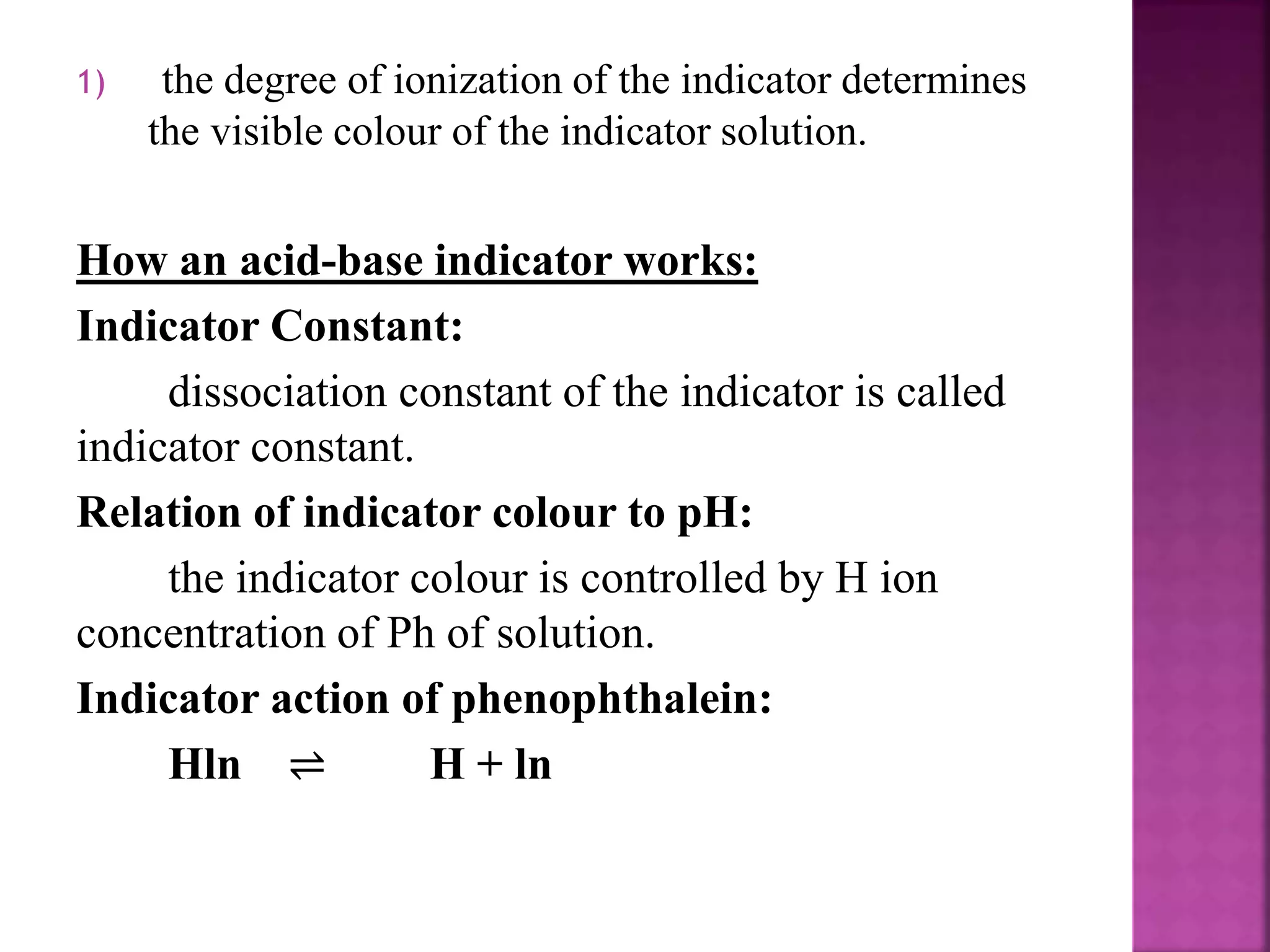
1) the degree of ionization of the indicator determines
the visible colour of the indicator solution.
How an acid-base indicator works:
Indicator Constant:
dissociation constant of the indicator is called
indicator constant.
Relation of indicator colour to pH:
the indicator colour is controlled by H ion
concentration of Ph of solution.
Indicator action of phenophthalein:
Hln ⇌ H + ln
Quinonoid theory of indicator colour change:
the owstwald thery takes care of the
quantitative aspect of indicator action.
While on the hand quinonoid theory tells the
cause of colour change of an indicator in acid-
base solutions.
Buffer solution

Buffer solution

  • 1.
    A buffer solutionis one which maintains its pH fairly constant even upon the addition of small amounts of acid or base. There are two types of buffer solution. 1. Acidic Buffer 2. Basic Buffer
  • 2.
    Acidic Buffer: A weakacid together with a salt of the same acid with a strong base.These are called Acidic Buffer. For Example. CH3COOH CH3COONa. Basic Buffers: A weak base and its salt with a strong acid.These are called Basic Buffers.
  • 3.
    For Example. NH4OH+NH4CL Let usillustrate buffer action by taking example of a common buffer system consisting of solution of acetic acid and sodium acetate. CH3COOH ⇌ H+ + CH3COO- CH3COONa Na+ + CH3COO- Since the salt is comletely ionized,it provides the common ion CH3COO in excess.
  • 4.
    The Buffer solutionhas a higher pH than the acid itself;
  • 5.
    The pH ofBuffer changes only slightly upon addition of an acid or base;
  • 6.
    We have alreadystated that a buffer solution containing equimolar amounts (0.10M) of acetic acid and sodium acetate has pH 4.74.Now we proceed to discuss how the addition of a small amount of HCl or NaOH to the buffer solution affects its Ph. The pH of the buffer is governed by the equillibrium CH3COOH ⇌ CH3COO + H The buffer solution has a large excess of CH3COO ions produced by complete ionization of sodium acetate,
  • 7.
    CH3COONa CH3COO+Na Addition ofHCl: Upon the addition of HCl,the increase of H ions is counteracted by association with the excess of acetate ions to form unionised CH3COOH.Thus the added H ions are neutralised and the Ph of the buffer solution remains virtually unchanged.However owing to the increased concentration of CH3COOH,the equilibrium shifts slightly to the right to increase H ions.This explains the marginal increase of Ph of the buffer solution of HCl.
  • 8.
    Mechanism of Bufferaction of an acid buffer.
  • 9.
    Addition of NaOH: WhenNaOH is added to the buffer solution, the additional OH ions combine with H ions of the buffer to form water molecules. As a result the equillibrium shifts to the right to produce more and more H ions till practically all the excess OH ions are neutralized and the original buffer Ph restored. However,a new equilibrium system is set up in which CH3COOH is lower than it was in the original buffer. Consequently H is also slightly less and pH slightly higher than the buffer pH values Operation of a Basic buffer as NH4OH NH4Cl can also be explained on the same lines as of an acid buffer upon addition of HCl the H ions combine with OH ions of the buffer to form water molecules.The equillibrium,
  • 10.
    NH4OH NH4 OH Isshifted to the right till all the additional H ions are neutralized and the original buffer Ph restored When NaOH is added to the buffer solution,OH ions associate with excess of NH4 ions to form unassociated NH4OH. Thus the Ph of the buffer is maintained approximately constant.
  • 11.
    Mechanism of Bufferaction of a basic buffer.
  • 12.
    It can bedefined as the ability of a buffer to resist the change of potential of hydrogen. Mathematically it can be expressed as; How it can be determined? Buffer capacity of a buffer solution is determined by the size of actual molarities. How do you calculate the Buffer Capacity? Buffer Capacity refers to the maximum amount of a strong acid or a strong base that is added so that a significant change in pH occur.
  • 13.
    IMPORTANCE: It is importantin chemical as well as in biological term. Buffer Capacity of water: As the purity of fresh water increases,the buffer capacity decreases and 100 percent pure fresh water is no buffer at all. What factors determined buffer capacity ? The concentration of the buffer (the higher the concentration,the larger the buffering capacity) and how close the pka of buffer is compared to the pH of solution.
  • 14.
    What determines bufferingcapacity? The titration curve determines buffering capacity
  • 15.
    An acid baseis an organic dye that signals the end point by a visual change in colour. Two common examples of acid base indicator ď‚§ Phenophthalein ď‚§ Methyl orange PH Range: Most indicators do not change colour at a particular pH.They do so over a range of pH from two to three units this is called the pH range.
  • 16.
    It was differentfor various indicators. PH Curve And Indicators Range: During an acid base titration the pH of solution in the receiver flask changes with the addition of the titrant from the burette.A plot of Ph against the vol. of the solution being added is known as pH curve or Titration Curve e.g phenophthaline litmus and methyl orange may be used as indicators for acid base titrations.
  • 17.
    End Point: In anacid base titration the base solution can be added gradually from a burette into an acid solution contained in a receiver flask. When the amount of base added equals the amount of an acid in the flask the end point is reached. The end point of a titration is shown by colour change of an indicator.
  • 18.
    we may havethe titration of: ď‚§ a strong acid with a strong base ď‚§ a weak acid with a strong base ď‚§ a strong acid with a weak base ď‚§ a weak acid with a weak base Titration a strong acid with a strong base: In this titration both methyl orange and phenophthalein are suitable indicators
  • 19.
    Titration a weakacid with a strong base: In this titration phenophthalein is a suitable indicator, while methyl orange is not. Titration a strong acid with a weak base: In this titration, evidently methyl orange and methyl red are suitable indicators. Titration a acid with a weak base: Under these condition, all indicators change colour only gradually and no indicator is suitable.
  • 20.
    These two theories ď‚§The Ostwalds theory ď‚§ The Quinonoid theory The Ostwalds theory: 1) an acid-base indicator is a weak organic acid or a weak organic base, where the letter ln stands for a complex organic group. Methyl orange and phenophthalein are both weak acids. 2) the unionized indicator , Hln , has a colours different from the Ln ions produced by the ionisation of the indicator in aqueous solution.
  • 21.
    1) the degreeof ionization of the indicator determines the visible colour of the indicator solution. How an acid-base indicator works: Indicator Constant: dissociation constant of the indicator is called indicator constant. Relation of indicator colour to pH: the indicator colour is controlled by H ion concentration of Ph of solution. Indicator action of phenophthalein: Hln ⇌ H + ln
  • 22.
    Quinonoid theory ofindicator colour change: the owstwald thery takes care of the quantitative aspect of indicator action. While on the hand quinonoid theory tells the cause of colour change of an indicator in acid- base solutions.