STK1094 Analytical Chemistry 1
Dayang Norafizan binti Awang Chee
Faculty of Resource Science and Technology
Universiti Malaysia Sarawak
This OpenCourseWare@UNIMAS and its related course materials are licensed under
a Creative Commons Attribution-NonCommercial-ShareAlike 4.0 International License.
Learning Objectives
At the end of this lesson, students should be able to:
 Describe the difference between an “endpoint” and an
“equivalence point” in an acid-base titration
 Identify the equivalence point in an acid-base titration
from the pH titration curve
 Illustrate titration of a weak acid with a strong base.
Defining Terms
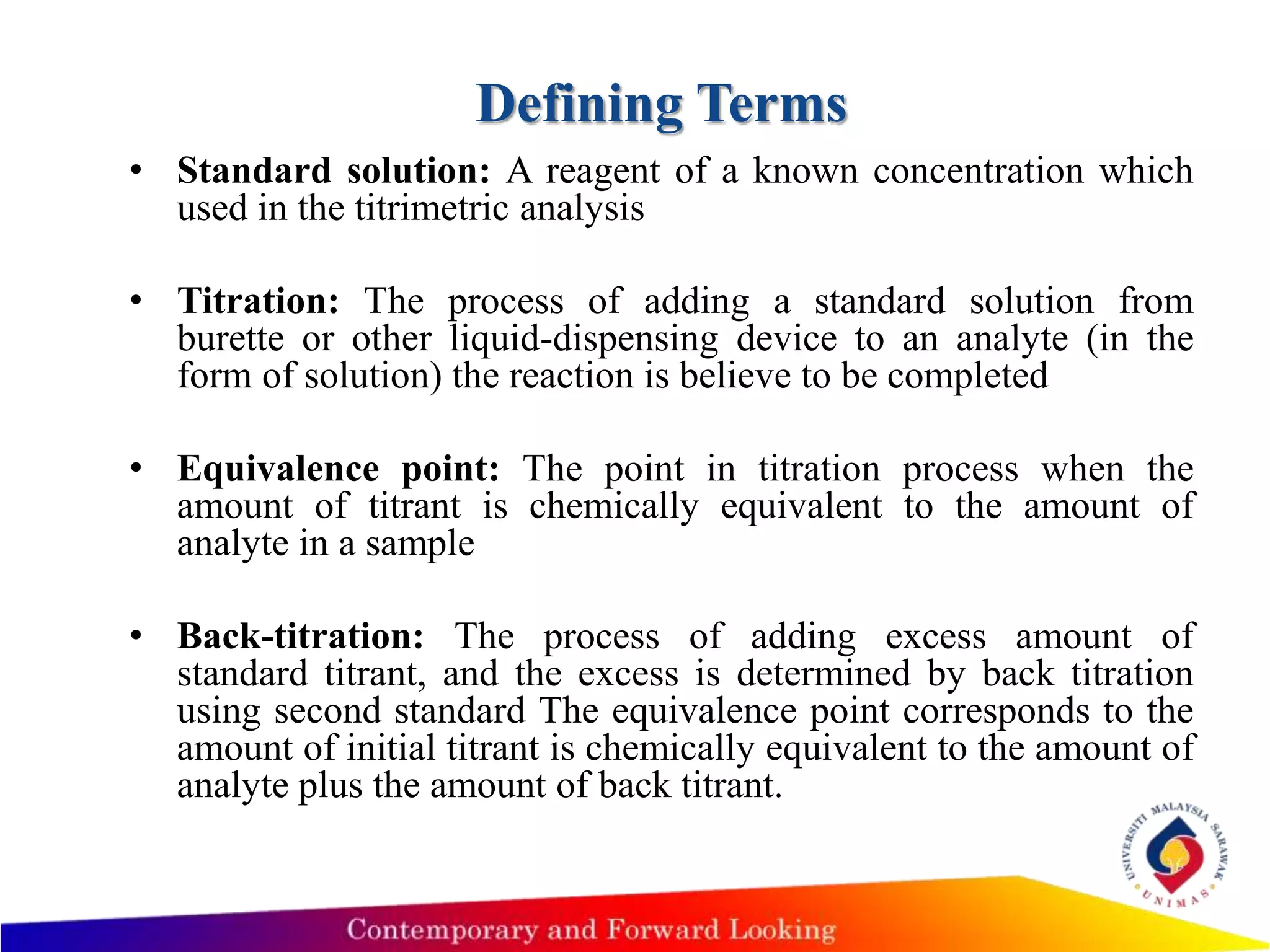
• Standard solution: A reagent of a known concentration which
used in the titrimetric analysis
• Titration: The process of adding a standard solution from
burette or other liquid-dispensing device to an analyte (in the
form of solution) the reaction is believe to be completed
• Equivalence point: The point in titration process when the
amount of titrant is chemically equivalent to the amount of
analyte in a sample
• Back-titration: The process of adding excess amount of
standard titrant, and the excess is determined by back titration
using second standard The equivalence point corresponds to the
amount of initial titrant is chemically equivalent to the amount of
analyte plus the amount of back titrant.
Defining Terms
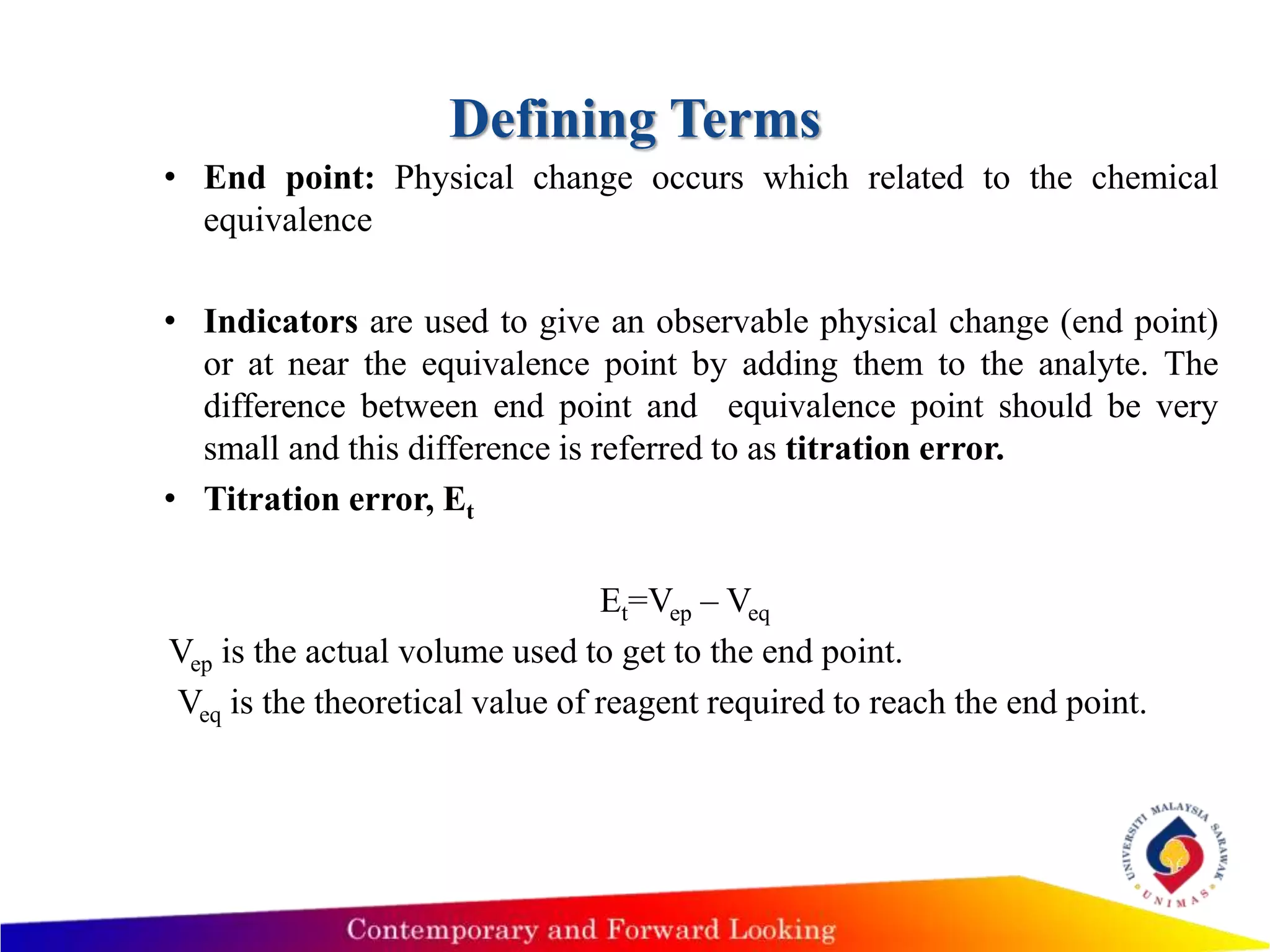
• End point: Physical change occurs which related to the chemical
equivalence
• Indicators are used to give an observable physical change (end point)
or at near the equivalence point by adding them to the analyte. The
difference between end point and equivalence point should be very
small and this difference is referred to as titration error.
• Titration error, Et
Et=Vep – Veq
Vep is the actual volume used to get to the end point.
Veq is the theoretical value of reagent required to reach the end point.
5
Acid-Base Titrations
• A quick and accurate method for determining acidic
or basic substances in many samples.
• The titrant is typically a strong acid or base.
• The sample species can be either a strong or weak
acid or base.
6
Acid-Base Titration
Types of acid-base titrations:
1)strong acid – strong base titration
2)weak acid – strong base titration
3)strong acid – weak base titration
4) polyprotic acid – strong base titration
5) polybasic base – strong acid titration
7
Strong Acid - Strong Base Titration
In strong acid – strong base titration, there are three
regions of the titration curve that represent different kinds
of calculations :
- before equivalence point
- at equivalence point
- after equivalence point
Titration curve
Strong acid titrated with a strong base:
• The net reaction is
H3O++ OH- → 2H2O
• Before the equivalence point, acid is present in excess
• pH is determined by the concentration of excess HCl
[𝐻3 𝑂+
] =
𝑚𝑚𝑜𝑙𝑒𝑠 𝑎𝑐𝑖𝑑−𝑚𝑚𝑜𝑙𝑒𝑠 𝑏𝑎𝑠𝑒
𝑡𝑜𝑡𝑎𝑙 𝑣𝑜𝑙𝑢𝑚𝑒
8
Strong acid titrated with a strong base
• At equivalence point, moles of acid and moles of base are
equal.
• At equivalence point,
[H3O+] = [OH- ]
pKw = 14 = pH + pOH
pH = 7
• So, the equivalence point for strong acid/base is always a
pH=7
9
Strong acid titrated with a strong base
Overtitration
 Pass the equivalence point, we don’t have any acid remaining. All that we are doing
is diluting our titrant.
[𝑶𝑯−
] =
𝒎𝒎𝒐𝒍𝒆𝒔 𝒆𝒙𝒄𝒆𝒔𝒔
𝒕𝒐𝒕𝒂𝒍 𝒗𝒐𝒍𝒖𝒎𝒆
pH = 14-pOH
Eg. Construct a titration curve for the titration of 100 mL 0.1 M HCl with 0.1 M NaOH
1) Volume of NaOH needed to reach eq. point
Moles HCl = moles NaOH
VNaOH = 100.0 mL
2) Before addition of NaOH
pH = - log [0.1] = 1
3) After addition of 10mL NaOH
[𝐻3 𝑂+] =
100 𝑚𝑙 0.10𝑀 −(10𝑚𝑙)(0.10𝑀)
100 𝑚𝑙+10 𝑚𝑙
= 0.082 M, pH= 1.09
10
11
mL
titrant
Total mL [H3O+] pH
0 100 0.10 1.00
10 110 0.082 1.09
20 120 0.067 1.17
30 130 0.054 1.28
40 140 0.043 1.37
50 150 0.033 1.48
60 160 0.025 1.60
70 170 0.018 1.74
80 180 0.011 1.96
90 190 0.0053 2.28
Titration curve
4) At equivalence point
• Equivalence point, moles of
HCl= moles of NaOH
• Since neither is in excess, pH is
determined by Kw
Kw = 1.00 x 10-14 =
[H3O+][OH-] = [H3O+]2
[H3O+] = 1.00 x 10⁻⁷
pH= 7
• Note that for the first 90 mL of
titration, pH = 2.28
• At eq. point, the pH value jump
of 4.72 pH unit
12
Titration curve
5) Overtitration
• Account for the dilution of titrant
• 10 mL overtitration
[OH-] = moles excess NaOH = MVNaOH- MVHCl
Vtotal
= (0.1M)(110mL)-(0.1M)(100mL)
210 mL
= 0.0048M
pOH = 2.32
pH = 14-2.32 = 11.68
13
14
mL
titrant
Total
volume
[OH-] pH
110 210 0.0048 11.68
120 220 0.0091 11.96
130 230 0.013 12.11
140 240 0.017 12.23
150 250 0.020 12.30
160 260 0.023 12.36
170 270 0.026 12.41
180 280 0.029 12.46
190 290 0.031 12.49
200 300 0.033 12.52
Titration curve
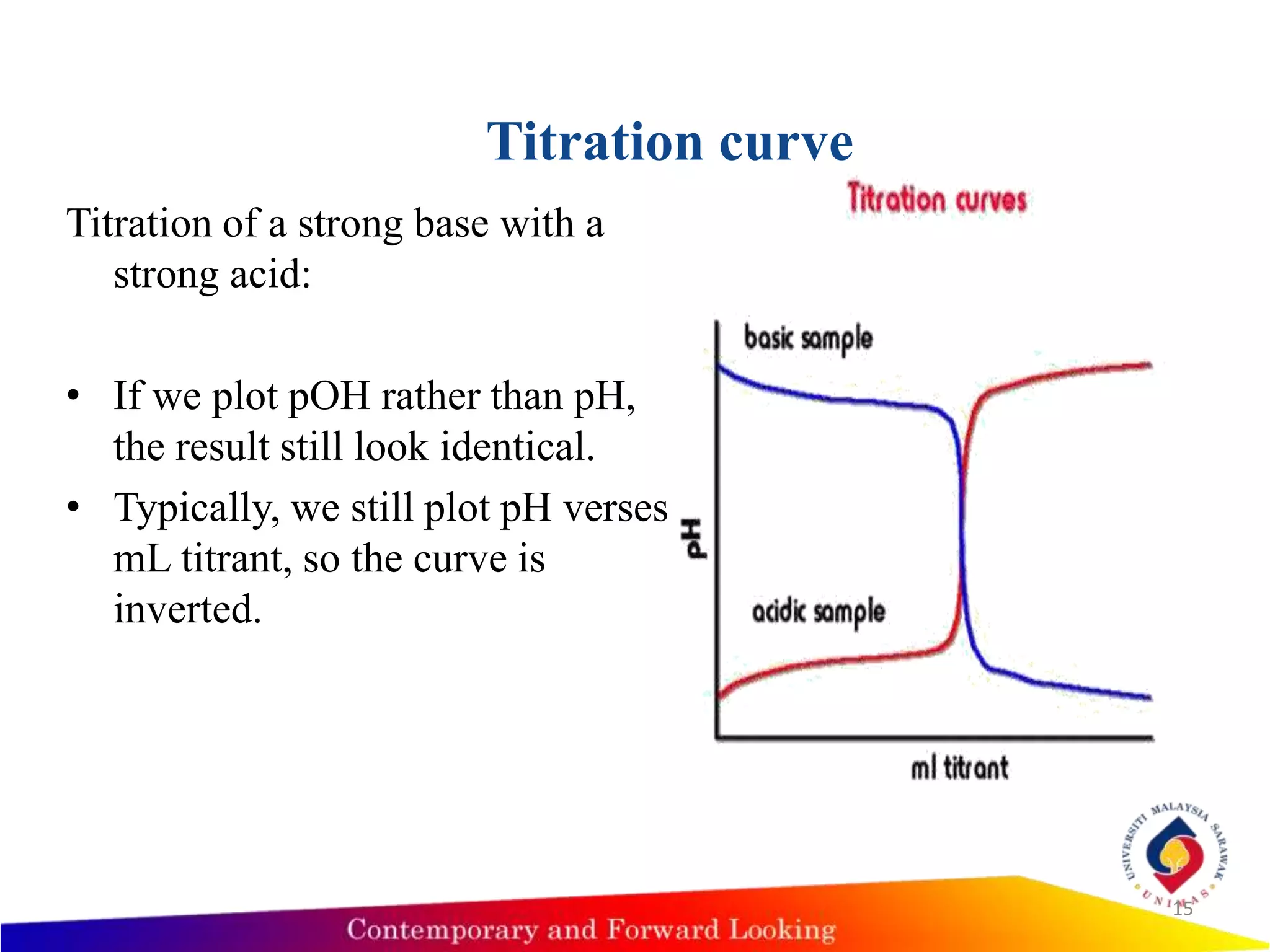
Titration of a strong base with a
strong acid:
• If we plot pOH rather than pH,
the result still look identical.
• Typically, we still plot pH verses
mL titrant, so the curve is
inverted.
15
Titration of weak acids & weak bases with
strong titrant
• Must concerned with conjugate acid/base pairs & their
equilibrium
16
Titration of weak acids & weak bases with
strong titrant
Before titration:
• If the sample is weak acid, then use
• 𝐾𝐴=
𝐻3 𝑂+ [𝐴−]
[𝐻𝐴]
• [H3O+]=[A-]
• Calculate the pH value
17
• If the sample is weak base, then use
• 𝐾 𝐵=
𝑂𝐻− [𝐻𝐴−]
[𝐴−]
• [OH-]=[HA]
• Calculate the pH value = 14 - pOH
Titration of weak acids & weak bases
with strong titrant
Before equivalence point:
• Equilibrium expression used is the Henderson-
Hasselbalch equation
• Starting with an acid
• pH= 𝑝𝐾 𝐴 + log
[𝐴−]
[𝐻𝐴]
• Starting with base
• pH= 14 − (𝑝𝐾 𝐵 + log
[𝐻𝐴]
[𝐴−]
)
18
Titration of weak acids & weak bases
with strong titrant
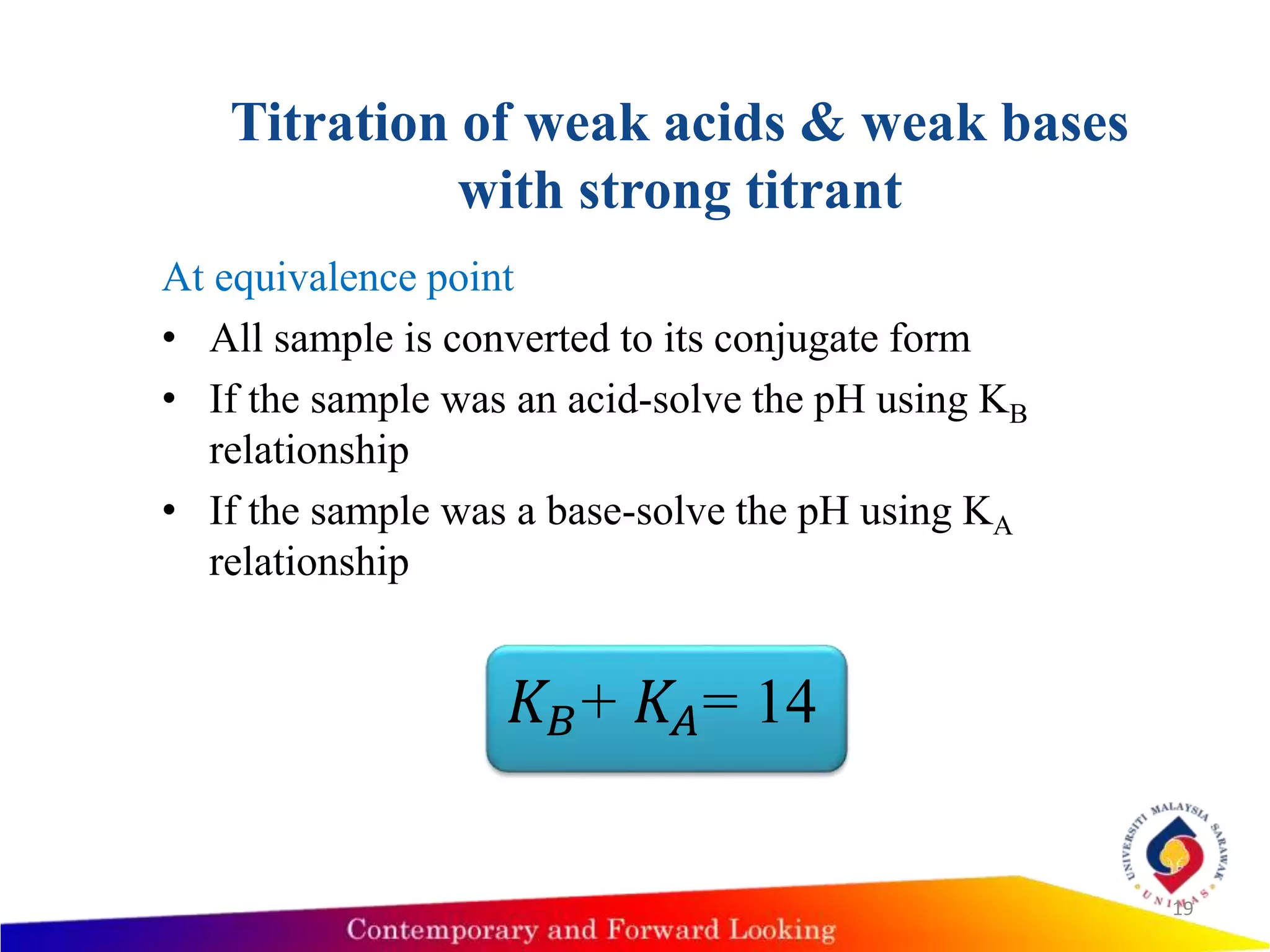
At equivalence point
• All sample is converted to its conjugate form
• If the sample was an acid-solve the pH using KB
relationship
• If the sample was a base-solve the pH using KA
relationship
𝐾 𝐵+ 𝐾𝐴= 14
19
Titration of weak acids & weak bases with
strong titrant
Overtitration:
• Identical to strong acid/strong base example.
• Need to account for the amount of excess titrant & how much it
has been diluted.
• Eg. 100 mL solution of 0.1 M benzoic acid is titrated with 0.1 M
NaOH. Construct a titration curve.
For benzoic acid
Ka=6.31 x 10⁻⁵
pKa=4.20
1) Volume of NaOH needed to reach eq. point
Moles C5H6COOH = moles NaOH
VNaOH = 100.0 mL
20
Titration of weak acids & weak bases with
strong titrant
2) Before titration:
• 𝐾𝐴=
𝐻3 𝑂+ [𝐴−]
[𝐻𝐴]
• [𝐻3 𝑂+]= [𝐴−]
• Assume [A-] is negligible compared to [HA]
𝐾𝐴= 6.31 × 10−5=
𝑥2
0.10
= 6.31 × 10⁻⁵ (0.10)
= 0.025 M
pH= 2.60
21
Titration of weak acids & weak bases with
strong titrant
3) After addition of 10mL NaOH
Henderson-Hasselbalch equation
pH = pKa + log [C5H6COO-]
[C5H6COOH]
[C5H6COOH] = moles unreacted C5H6COOH = MVC5H6COOH- MVNaOH
Vtotal Vtotal
= (0.1M)(100mL)-(0.1M)(10mL)
110 mL
= 0.082M
[C5H6COO-] = moles NaOH added = MVNaOH
Vtotal Vtotal
= (0.1M)(10mL)
110 mL
= 0.009M
pH = 4.2 + log (0.009/0.082) = 3.24
• Calculate other point by repeating this process
22
Titration of weak acids & weak bases with
strong titrant
23
mL
titrant
pH
0 2.60
10 3.24
20 3.60
30 3.83
40 4.02
50 4.20
60 4.38
70 4.57
80 4.80
90 5.15
mL titrant
Titration of weak acids & weak bases with
strong titrant
4) At equivalence point
100mL titrant:
• All acid has been converted to its conjugate base – benzoate
• Use KB relationship.
• 𝐾 𝐵=
[𝑂𝐻−][𝐻𝐴]
[𝐴−]
• 𝐾 𝐵= 𝐾 𝑊/𝐾𝐴= 1.58 × 10⁻¹⁰
n benzoic acid = n NaOH
• Predominate ion in solution is A-, which is a weak base
[A-] = moles acid/ total volume = 0.05M
• We have diluted the sample & the total volume at this point is 200 mL.
• We can assume that [benzoic acid] is negligible compared to [benzoate].
24
Titration of weak acids & weak bases with
strong titrant
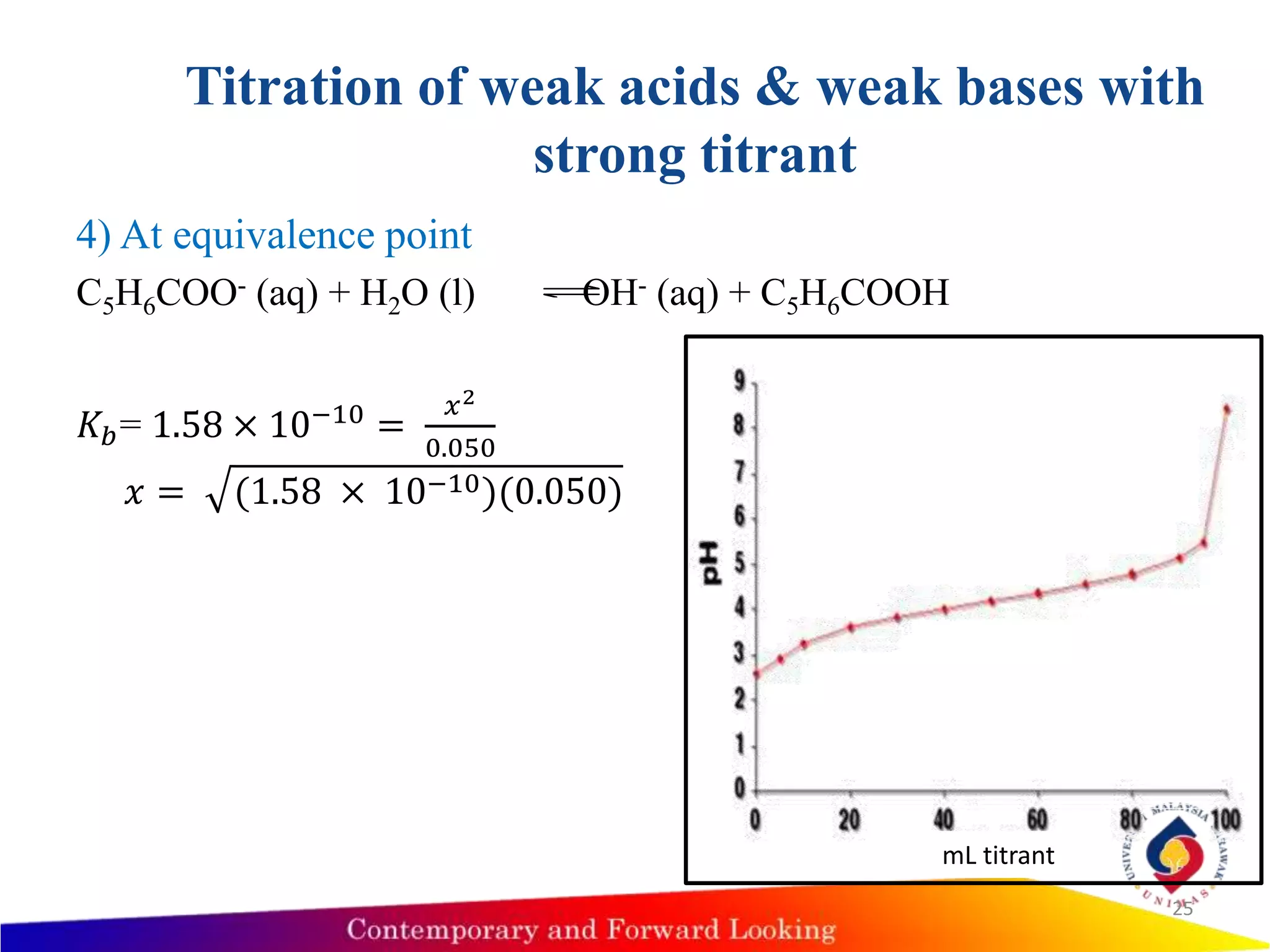
4) At equivalence point
C5H6COO- (aq) + H2O (l) OH- (aq) + C5H6COOH
𝐾𝑏= 1.58 × 10−10
=
𝑥2
0.050
𝑥 = (1.58 × 10⁻¹⁰)(0.050)
25
mL titrant
Titration of weak acids or weak bases with
strong titrant
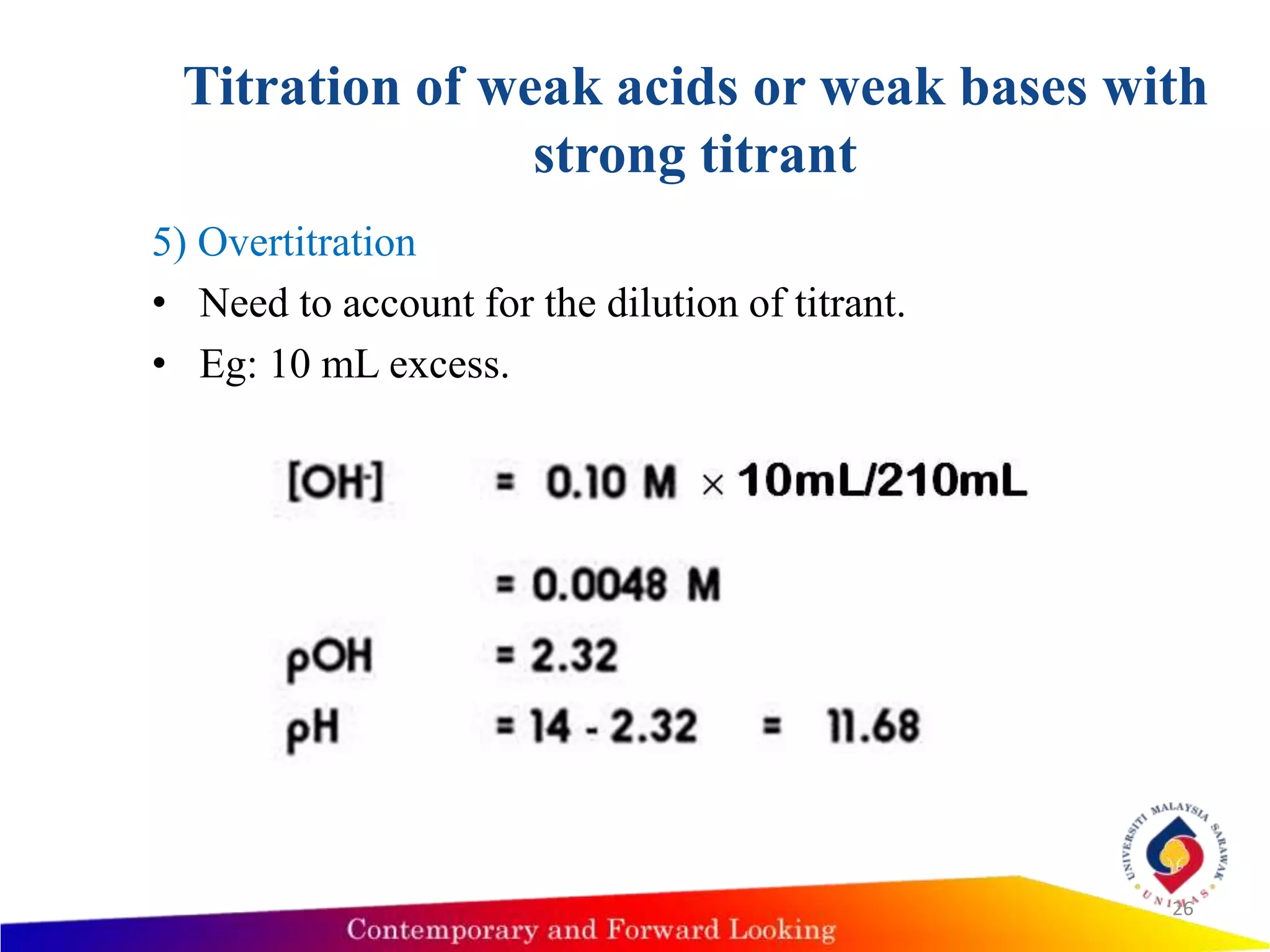
5) Overtitration
• Need to account for the dilution of titrant.
• Eg: 10 mL excess.
26
Titration of weak acids or weak bases with
strong titrant
27
mL
titrant
Total
volume
[OH-] pH
110 210 0.0048 11.68
120 220 0.0091 11.96
130 230 0.013 12.11
140 240 0.017 12.23
150 250 0.020 12.30
Acid base titration

Acid base titration

  • 1.
    STK1094 Analytical Chemistry1 Dayang Norafizan binti Awang Chee Faculty of Resource Science and Technology Universiti Malaysia Sarawak This OpenCourseWare@UNIMAS and its related course materials are licensed under a Creative Commons Attribution-NonCommercial-ShareAlike 4.0 International License.
  • 2.
    Learning Objectives At theend of this lesson, students should be able to:  Describe the difference between an “endpoint” and an “equivalence point” in an acid-base titration  Identify the equivalence point in an acid-base titration from the pH titration curve  Illustrate titration of a weak acid with a strong base.
  • 3.
    Defining Terms • Standardsolution: A reagent of a known concentration which used in the titrimetric analysis • Titration: The process of adding a standard solution from burette or other liquid-dispensing device to an analyte (in the form of solution) the reaction is believe to be completed • Equivalence point: The point in titration process when the amount of titrant is chemically equivalent to the amount of analyte in a sample • Back-titration: The process of adding excess amount of standard titrant, and the excess is determined by back titration using second standard The equivalence point corresponds to the amount of initial titrant is chemically equivalent to the amount of analyte plus the amount of back titrant.
  • 4.
    Defining Terms • Endpoint: Physical change occurs which related to the chemical equivalence • Indicators are used to give an observable physical change (end point) or at near the equivalence point by adding them to the analyte. The difference between end point and equivalence point should be very small and this difference is referred to as titration error. • Titration error, Et Et=Vep – Veq Vep is the actual volume used to get to the end point. Veq is the theoretical value of reagent required to reach the end point.
  • 5.
    5 Acid-Base Titrations • Aquick and accurate method for determining acidic or basic substances in many samples. • The titrant is typically a strong acid or base. • The sample species can be either a strong or weak acid or base.
  • 6.
    6 Acid-Base Titration Types ofacid-base titrations: 1)strong acid – strong base titration 2)weak acid – strong base titration 3)strong acid – weak base titration 4) polyprotic acid – strong base titration 5) polybasic base – strong acid titration
  • 7.
    7 Strong Acid -Strong Base Titration In strong acid – strong base titration, there are three regions of the titration curve that represent different kinds of calculations : - before equivalence point - at equivalence point - after equivalence point
  • 8.
    Titration curve Strong acidtitrated with a strong base: • The net reaction is H3O++ OH- → 2H2O • Before the equivalence point, acid is present in excess • pH is determined by the concentration of excess HCl [𝐻3 𝑂+ ] = 𝑚𝑚𝑜𝑙𝑒𝑠 𝑎𝑐𝑖𝑑−𝑚𝑚𝑜𝑙𝑒𝑠 𝑏𝑎𝑠𝑒 𝑡𝑜𝑡𝑎𝑙 𝑣𝑜𝑙𝑢𝑚𝑒 8
  • 9.
    Strong acid titratedwith a strong base • At equivalence point, moles of acid and moles of base are equal. • At equivalence point, [H3O+] = [OH- ] pKw = 14 = pH + pOH pH = 7 • So, the equivalence point for strong acid/base is always a pH=7 9
  • 10.
    Strong acid titratedwith a strong base Overtitration  Pass the equivalence point, we don’t have any acid remaining. All that we are doing is diluting our titrant. [𝑶𝑯− ] = 𝒎𝒎𝒐𝒍𝒆𝒔 𝒆𝒙𝒄𝒆𝒔𝒔 𝒕𝒐𝒕𝒂𝒍 𝒗𝒐𝒍𝒖𝒎𝒆 pH = 14-pOH Eg. Construct a titration curve for the titration of 100 mL 0.1 M HCl with 0.1 M NaOH 1) Volume of NaOH needed to reach eq. point Moles HCl = moles NaOH VNaOH = 100.0 mL 2) Before addition of NaOH pH = - log [0.1] = 1 3) After addition of 10mL NaOH [𝐻3 𝑂+] = 100 𝑚𝑙 0.10𝑀 −(10𝑚𝑙)(0.10𝑀) 100 𝑚𝑙+10 𝑚𝑙 = 0.082 M, pH= 1.09 10
  • 11.
    11 mL titrant Total mL [H3O+]pH 0 100 0.10 1.00 10 110 0.082 1.09 20 120 0.067 1.17 30 130 0.054 1.28 40 140 0.043 1.37 50 150 0.033 1.48 60 160 0.025 1.60 70 170 0.018 1.74 80 180 0.011 1.96 90 190 0.0053 2.28
  • 12.
    Titration curve 4) Atequivalence point • Equivalence point, moles of HCl= moles of NaOH • Since neither is in excess, pH is determined by Kw Kw = 1.00 x 10-14 = [H3O+][OH-] = [H3O+]2 [H3O+] = 1.00 x 10⁻⁷ pH= 7 • Note that for the first 90 mL of titration, pH = 2.28 • At eq. point, the pH value jump of 4.72 pH unit 12
  • 13.
    Titration curve 5) Overtitration •Account for the dilution of titrant • 10 mL overtitration [OH-] = moles excess NaOH = MVNaOH- MVHCl Vtotal = (0.1M)(110mL)-(0.1M)(100mL) 210 mL = 0.0048M pOH = 2.32 pH = 14-2.32 = 11.68 13
  • 14.
    14 mL titrant Total volume [OH-] pH 110 2100.0048 11.68 120 220 0.0091 11.96 130 230 0.013 12.11 140 240 0.017 12.23 150 250 0.020 12.30 160 260 0.023 12.36 170 270 0.026 12.41 180 280 0.029 12.46 190 290 0.031 12.49 200 300 0.033 12.52
  • 15.
    Titration curve Titration ofa strong base with a strong acid: • If we plot pOH rather than pH, the result still look identical. • Typically, we still plot pH verses mL titrant, so the curve is inverted. 15
  • 16.
    Titration of weakacids & weak bases with strong titrant • Must concerned with conjugate acid/base pairs & their equilibrium 16
  • 17.
    Titration of weakacids & weak bases with strong titrant Before titration: • If the sample is weak acid, then use • 𝐾𝐴= 𝐻3 𝑂+ [𝐴−] [𝐻𝐴] • [H3O+]=[A-] • Calculate the pH value 17 • If the sample is weak base, then use • 𝐾 𝐵= 𝑂𝐻− [𝐻𝐴−] [𝐴−] • [OH-]=[HA] • Calculate the pH value = 14 - pOH
  • 18.
    Titration of weakacids & weak bases with strong titrant Before equivalence point: • Equilibrium expression used is the Henderson- Hasselbalch equation • Starting with an acid • pH= 𝑝𝐾 𝐴 + log [𝐴−] [𝐻𝐴] • Starting with base • pH= 14 − (𝑝𝐾 𝐵 + log [𝐻𝐴] [𝐴−] ) 18
  • 19.
    Titration of weakacids & weak bases with strong titrant At equivalence point • All sample is converted to its conjugate form • If the sample was an acid-solve the pH using KB relationship • If the sample was a base-solve the pH using KA relationship 𝐾 𝐵+ 𝐾𝐴= 14 19
  • 20.
    Titration of weakacids & weak bases with strong titrant Overtitration: • Identical to strong acid/strong base example. • Need to account for the amount of excess titrant & how much it has been diluted. • Eg. 100 mL solution of 0.1 M benzoic acid is titrated with 0.1 M NaOH. Construct a titration curve. For benzoic acid Ka=6.31 x 10⁻⁵ pKa=4.20 1) Volume of NaOH needed to reach eq. point Moles C5H6COOH = moles NaOH VNaOH = 100.0 mL 20
  • 21.
    Titration of weakacids & weak bases with strong titrant 2) Before titration: • 𝐾𝐴= 𝐻3 𝑂+ [𝐴−] [𝐻𝐴] • [𝐻3 𝑂+]= [𝐴−] • Assume [A-] is negligible compared to [HA] 𝐾𝐴= 6.31 × 10−5= 𝑥2 0.10 = 6.31 × 10⁻⁵ (0.10) = 0.025 M pH= 2.60 21
  • 22.
    Titration of weakacids & weak bases with strong titrant 3) After addition of 10mL NaOH Henderson-Hasselbalch equation pH = pKa + log [C5H6COO-] [C5H6COOH] [C5H6COOH] = moles unreacted C5H6COOH = MVC5H6COOH- MVNaOH Vtotal Vtotal = (0.1M)(100mL)-(0.1M)(10mL) 110 mL = 0.082M [C5H6COO-] = moles NaOH added = MVNaOH Vtotal Vtotal = (0.1M)(10mL) 110 mL = 0.009M pH = 4.2 + log (0.009/0.082) = 3.24 • Calculate other point by repeating this process 22
  • 23.
    Titration of weakacids & weak bases with strong titrant 23 mL titrant pH 0 2.60 10 3.24 20 3.60 30 3.83 40 4.02 50 4.20 60 4.38 70 4.57 80 4.80 90 5.15 mL titrant
  • 24.
    Titration of weakacids & weak bases with strong titrant 4) At equivalence point 100mL titrant: • All acid has been converted to its conjugate base – benzoate • Use KB relationship. • 𝐾 𝐵= [𝑂𝐻−][𝐻𝐴] [𝐴−] • 𝐾 𝐵= 𝐾 𝑊/𝐾𝐴= 1.58 × 10⁻¹⁰ n benzoic acid = n NaOH • Predominate ion in solution is A-, which is a weak base [A-] = moles acid/ total volume = 0.05M • We have diluted the sample & the total volume at this point is 200 mL. • We can assume that [benzoic acid] is negligible compared to [benzoate]. 24
  • 25.
    Titration of weakacids & weak bases with strong titrant 4) At equivalence point C5H6COO- (aq) + H2O (l) OH- (aq) + C5H6COOH 𝐾𝑏= 1.58 × 10−10 = 𝑥2 0.050 𝑥 = (1.58 × 10⁻¹⁰)(0.050) 25 mL titrant
  • 26.
    Titration of weakacids or weak bases with strong titrant 5) Overtitration • Need to account for the dilution of titrant. • Eg: 10 mL excess. 26
  • 27.
    Titration of weakacids or weak bases with strong titrant 27 mL titrant Total volume [OH-] pH 110 210 0.0048 11.68 120 220 0.0091 11.96 130 230 0.013 12.11 140 240 0.017 12.23 150 250 0.020 12.30