HENDERSON HASSELBALCH
EQUATION


   Prepared by :-
   Rajina Shakya
   Bachelor In Pharamcy
   4th year, 7th semester
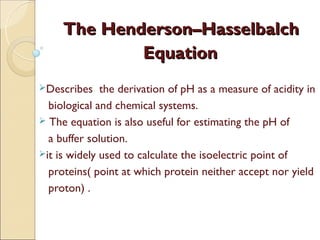
The Henderson–Hasselbalch
             Equation 
             Equation
Describes    the derivation of pH as a measure of acidity in
  biological and chemical systems.
 The equation is also useful for estimating the pH of
  a buffer solution.
it is widely used to calculate the isoelectric point of
  proteins( point at which protein neither accept nor yield
  proton) .
The Henderson hasselbalch equation for acid is :-

           pH = pKa + log [ Aˉ ]
                          [HA]

       Here, pKa= -log(Ka)  

    where Ka  is the acid dissociation constant, that is

             pKa= -log [H3O+][A-]
                          [HA]

 for the non-specific Brønsted acid-base reaction: 

             HA + H20             A- + H3O+
          ( Acid )   ( Conjugate base )
The Henderson Hasselbalch Equation for base is :

         pOH = pKb + log [ BH+ ]
                           [B]

    where BH+ denotes the conjugate acid of the
corresponding base B.

             B + H2O+        BH + OH-
        (Base )   (Conjugate acid)
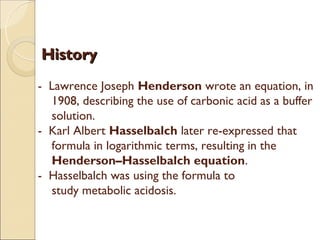
History
- Lawrence Joseph Henderson wrote an equation, in
  1908, describing the use of carbonic acid as a buffer
  solution. 
- Karl Albert Hasselbalch later re-expressed that
  formula in logarithmic terms, resulting in the
  Henderson–Hasselbalch equation.
- Hasselbalch was using the formula to
  study metabolic acidosis.
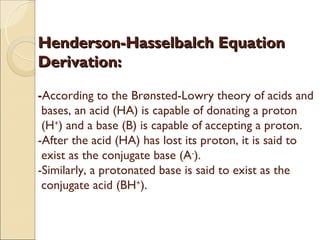
Henderson-Hasselbalch Equation
Derivation:

-According to the Brønsted-Lowry theory of acids and
 bases, an acid (HA) is capable of donating a proton
 (H+) and a base (B) is capable of accepting a proton.
-After the acid (HA) has lost its proton, it is said to
 exist as the conjugate base (A-).
-Similarly, a protonated base is said to exist as the
 conjugate acid (BH+).
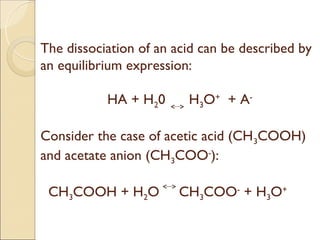
The dissociation of an acid can be described by
an equilibrium expression:

           HA + H20      H3O+ + A-

Consider the case of acetic acid (CH 3COOH)
and acetate anion (CH3COO-):

 CH3COOH + H2O          CH3COO- + H3O+
Acetate is the conjugate base of acetic acid. Acetic acid
and acetate are a conjugate acid/base pair. We can
describe this relationship with an equilibrium constant:

              Ka = [H3O+][A-]
                     [HA]

Taking the negative log of both sides of the equation
gives
           -logKa = -log [H3O+][A-]
                           [HA]

       or, -logKa = -log [H3O+] + (-log [A-] )
                                        [HA]
By definition,
pKa = -logKa and pH = -log[H3O+], so

               pka=pH – log [A-]
                           [HA]

 This equation can then be rearranged to give
the Henderson-Hasselbalch equation:

pH = pKa + log [A-]   = pKa + log [conjugate base]
              [HA]                     [acid]
Estimating blood pH
A modified version of the Henderson–Hasselbalch
equation can be used to relate the pH of blood to
constituents of the bicarbonate buffering system.
        pH = pKaH2CO3 + log [HCO3-]
                                 [H2CO3]
, where:
-pKa H2CO3 is the acid dissociation constant of carbonic
acid. It is equal to 6.1.
[HCO3-] is the concentration of bicarbonate in the
blood
[H2CO3] is the concentration of carbonic acid in the blood
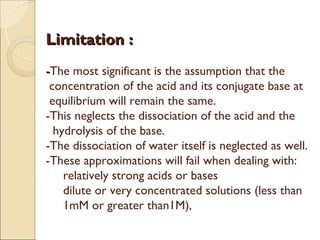
Limitation :
-The most significant is the assumption that the
 concentration of the acid and its conjugate base at
 equilibrium will remain the same.
-This neglects the dissociation of the acid and the
  hydrolysis of the base.
-The dissociation of water itself is neglected as well.
-These approximations will fail when dealing with:
    relatively strong acids or bases
    dilute or very concentrated solutions (less than
    1mM or greater than1M),

Henderson Hasselbalch Equation

  • 1.
    HENDERSON HASSELBALCH EQUATION Prepared by :- Rajina Shakya Bachelor In Pharamcy 4th year, 7th semester
  • 2.
    The Henderson–Hasselbalch Equation  Equation Describes the derivation of pH as a measure of acidity in biological and chemical systems.  The equation is also useful for estimating the pH of a buffer solution. it is widely used to calculate the isoelectric point of proteins( point at which protein neither accept nor yield proton) .
  • 3.
    The Henderson hasselbalchequation for acid is :- pH = pKa + log [ Aˉ ] [HA] Here, pKa= -log(Ka)   where Ka  is the acid dissociation constant, that is pKa= -log [H3O+][A-] [HA]  for the non-specific Brønsted acid-base reaction:  HA + H20 A- + H3O+ ( Acid ) ( Conjugate base )
  • 4.
    The Henderson HasselbalchEquation for base is : pOH = pKb + log [ BH+ ] [B] where BH+ denotes the conjugate acid of the corresponding base B. B + H2O+ BH + OH- (Base ) (Conjugate acid)
  • 5.
    History - Lawrence JosephHenderson wrote an equation, in 1908, describing the use of carbonic acid as a buffer solution.  - Karl Albert Hasselbalch later re-expressed that formula in logarithmic terms, resulting in the Henderson–Hasselbalch equation. - Hasselbalch was using the formula to study metabolic acidosis.
  • 6.
    Henderson-Hasselbalch Equation Derivation: -According tothe Brønsted-Lowry theory of acids and bases, an acid (HA) is capable of donating a proton (H+) and a base (B) is capable of accepting a proton. -After the acid (HA) has lost its proton, it is said to exist as the conjugate base (A-). -Similarly, a protonated base is said to exist as the conjugate acid (BH+).
  • 7.
    The dissociation ofan acid can be described by an equilibrium expression: HA + H20 H3O+ + A- Consider the case of acetic acid (CH 3COOH) and acetate anion (CH3COO-): CH3COOH + H2O CH3COO- + H3O+
  • 8.
    Acetate is theconjugate base of acetic acid. Acetic acid and acetate are a conjugate acid/base pair. We can describe this relationship with an equilibrium constant: Ka = [H3O+][A-] [HA] Taking the negative log of both sides of the equation gives -logKa = -log [H3O+][A-] [HA] or, -logKa = -log [H3O+] + (-log [A-] ) [HA]
  • 9.
    By definition, pKa = -logKa andpH = -log[H3O+], so pka=pH – log [A-] [HA] This equation can then be rearranged to give the Henderson-Hasselbalch equation: pH = pKa + log [A-] = pKa + log [conjugate base] [HA] [acid]
  • 10.
    Estimating blood pH Amodified version of the Henderson–Hasselbalch equation can be used to relate the pH of blood to constituents of the bicarbonate buffering system. pH = pKaH2CO3 + log [HCO3-] [H2CO3] , where: -pKa H2CO3 is the acid dissociation constant of carbonic acid. It is equal to 6.1. [HCO3-] is the concentration of bicarbonate in the blood [H2CO3] is the concentration of carbonic acid in the blood
  • 11.
    Limitation : -The mostsignificant is the assumption that the concentration of the acid and its conjugate base at equilibrium will remain the same. -This neglects the dissociation of the acid and the hydrolysis of the base. -The dissociation of water itself is neglected as well. -These approximations will fail when dealing with: relatively strong acids or bases dilute or very concentrated solutions (less than 1mM or greater than1M),