Volumetric Analysis
Precipitation Titrations
(Mohr's Method)
Prepared By
Hemn Khalid Qadir
MSc.Analytical Chemistry
Hawler Medical University - College of pharmacy
Precipitation Titration
A special type of titrimetric procedure involves the
formation of precipitates during the course of
titration. The titrant reacts with the analyte
forming an insoluble material and the titration
continues till the very last amount of analyte is
consumed. The first drop of titrant in excess will
react with an indicator resulting in a color change
and announcing the termination of the titration.
Example : AgNO3 + NaCl  AgCl +
NaNO3
3
Precipitation Titrations
(Mohr's Method)
Titrations in which precipitates are formed are called
precipitation titrations. The most frequent application
of this type of titration uses silver ions to determine
chloride. Therefore, these titrations are called
argentometric titrations.
• Argentometry is a type of titration involving the silver(I) ion.
Typically, it is used to determine the amount of chloride present in
a sample. The sample solution is titrated against a solution of silver
nitrate of known concentration. Chloride ions react with silver(I) ions
to give the insoluble silver chloride:
Ag+ (aq) + Cl- (aq) → AgCl (s)
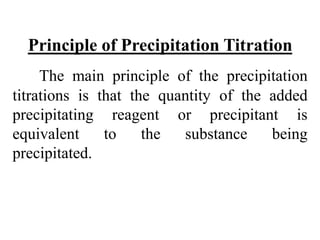
Principle of Precipitation Titration
The main principle of the precipitation
titrations is that the quantity of the added
precipitating reagent or precipitant is
equivalent to the substance being
precipitated.
5
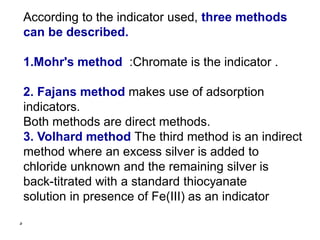
According to the indicator used, three methods
can be described.
1.Mohr's method :Chromate is the indicator .
2. Fajans method makes use of adsorption
indicators.
Both methods are direct methods.
3. Volhard method The third method is an indirect
method where an excess silver is added to
chloride unknown and the remaining silver is
back-titrated with a standard thiocyanate
solution in presence of Fe(III) as an indicator
6
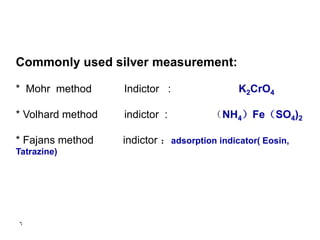
Commonly used silver measurement:
* Mohr method Indictor : K2CrO4
* Volhard method indictor : (NH4)Fe(SO4)2
* Fajans method indictor :adsorption indicator( Eosin,
Tatrazine)
7
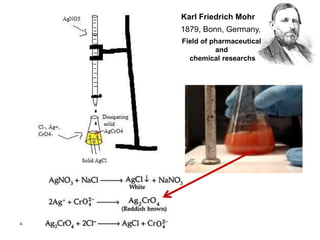
of Mohr’s method
Principle
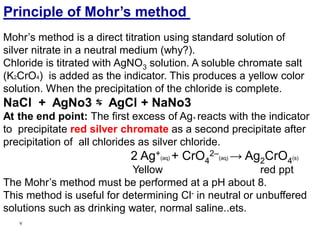
Mohr’s method is a direct titration using standard solution of
silver nitrate in a neutral medium (why?).
Chloride is titrated with AgNO3 solution. A soluble chromate salt
(K2CrO4) is added as the indicator. This produces a yellow color
solution. When the precipitation of the chloride is complete.
NaCl + AgNo3 ⇆ AgCl + NaNo3
At the end point: The first excess of Ag+ reacts with the indicator
to precipitate red silver chromate as a second precipitate after
precipitation of all chlorides as silver chloride.
2 Ag+(aq) + CrO4
2–(aq) → Ag2CrO4(s)
Yellow red ppt
The Mohr’s method must be performed at a pH about 8.
This method is useful for determining Cl- in neutral or unbuffered
solutions such as drinking water, normal saline..ets.
8
Karl Friedrich Mohr
1879, Bonn, Germany,
Field of pharmaceutical
and
chemical researchs
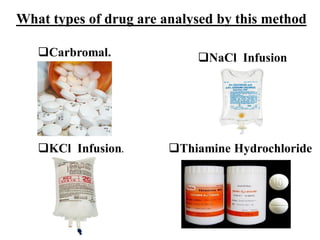
What types of drug are analysed by this method
Carbromal.
KCl Infusion.
NaCl Infusion
Thiamine Hydrochloride
10
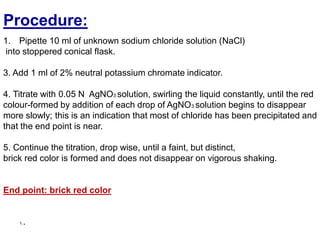
Procedure:
1. Pipette 10 ml of unknown sodium chloride solution (NaCl)
into stoppered conical flask.
3. Add 1 ml of 2% neutral potassium chromate indicator.
4. Titrate with 0.05 N AgNO3 solution, swirling the liquid constantly, until the red
colour-formed by addition of each drop of AgNO3 solution begins to disappear
more slowly; this is an indication that most of chloride has been precipitated and
that the end point is near.
5. Continue the titration, drop wise, until a faint, but distinct,
brick red color is formed and does not disappear on vigorous shaking.
End point: brick red color
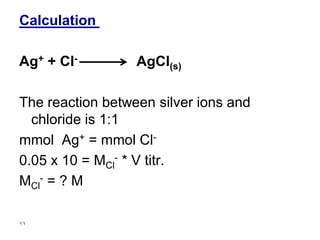
Calculation
Ag+ + Cl- AgCl(s)
The reaction between silver ions and
chloride is 1:1
mmol Ag+ = mmol Cl-
0.05 x 10 = MCl
- * V titr.
MCl
- = ? M
11
Home Work?
1.Adsorption indicators.
2.Mohr’s method is a direct titration using standard
solution of silver nitrate in a neutral medium (why?).
•
3. Definition of Fajans method
•
4. Definition Volhard method
12
13
The End…………….
14
In this method, neutral medium should be
used since, in alkaline solutions, silver will
react with the hydroxide ions forming
AgOH. In acidic solutions, chromate will
be converted to dichromate. Therefore,
the pH of solution should be kept at about
7. There is always some error in this
method because a dilute chromate
solution is used due to the intense color of
the indicator. This will require additional
amount of Ag+ for the Ag2CrO4 to form.
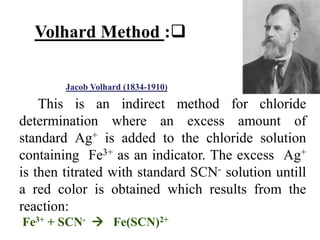
This is an indirect method for chloride
determination where an excess amount of
standard Ag+ is added to the chloride solution
containing Fe3+ as an indicator. The excess Ag+
is then titrated with standard SCN- solution untill
a red color is obtained which results from the
reaction:
Fe3+ + SCN-  Fe(SCN)2+

:
Volhard Method
)
1910
-
1834
(
Volhard
Jacob

The indicator system is very sensitive and
usually good results are obtained. The medium
should be acidic to avoid the formation of Fe(OH)3
However, the use of acidic medium together
with added SCN- titrant increase the solubility of
the precipitate leading to significant errors. This
problem had been overcome by two main
procedures.
Fluorescein and its derivatives are adsorbed to the
surface of colloidal AgCl. After all chloride is used, the
first drop of Ag+ will react with fluorescein (FI-) forming
a reddish color.
Ag+ + FI-  AgF
Among these methods, the Volhard Method is
widely used because we can detect the end point of
precepitation titration very well.

:
Fajans Method
)
1975
-
1887
(
Fajans
Kazimierz

Precepitation titration mohrs method

  • 1.
    Volumetric Analysis Precipitation Titrations (Mohr'sMethod) Prepared By Hemn Khalid Qadir MSc.Analytical Chemistry Hawler Medical University - College of pharmacy
  • 2.
    Precipitation Titration A specialtype of titrimetric procedure involves the formation of precipitates during the course of titration. The titrant reacts with the analyte forming an insoluble material and the titration continues till the very last amount of analyte is consumed. The first drop of titrant in excess will react with an indicator resulting in a color change and announcing the termination of the titration. Example : AgNO3 + NaCl  AgCl + NaNO3
  • 3.
    3 Precipitation Titrations (Mohr's Method) Titrationsin which precipitates are formed are called precipitation titrations. The most frequent application of this type of titration uses silver ions to determine chloride. Therefore, these titrations are called argentometric titrations. • Argentometry is a type of titration involving the silver(I) ion. Typically, it is used to determine the amount of chloride present in a sample. The sample solution is titrated against a solution of silver nitrate of known concentration. Chloride ions react with silver(I) ions to give the insoluble silver chloride: Ag+ (aq) + Cl- (aq) → AgCl (s)
  • 4.
    Principle of PrecipitationTitration The main principle of the precipitation titrations is that the quantity of the added precipitating reagent or precipitant is equivalent to the substance being precipitated.
  • 5.
    5 According to theindicator used, three methods can be described. 1.Mohr's method :Chromate is the indicator . 2. Fajans method makes use of adsorption indicators. Both methods are direct methods. 3. Volhard method The third method is an indirect method where an excess silver is added to chloride unknown and the remaining silver is back-titrated with a standard thiocyanate solution in presence of Fe(III) as an indicator
  • 6.
    6 Commonly used silvermeasurement: * Mohr method Indictor : K2CrO4 * Volhard method indictor : (NH4)Fe(SO4)2 * Fajans method indictor :adsorption indicator( Eosin, Tatrazine)
  • 7.
    7 of Mohr’s method Principle Mohr’smethod is a direct titration using standard solution of silver nitrate in a neutral medium (why?). Chloride is titrated with AgNO3 solution. A soluble chromate salt (K2CrO4) is added as the indicator. This produces a yellow color solution. When the precipitation of the chloride is complete. NaCl + AgNo3 ⇆ AgCl + NaNo3 At the end point: The first excess of Ag+ reacts with the indicator to precipitate red silver chromate as a second precipitate after precipitation of all chlorides as silver chloride. 2 Ag+(aq) + CrO4 2–(aq) → Ag2CrO4(s) Yellow red ppt The Mohr’s method must be performed at a pH about 8. This method is useful for determining Cl- in neutral or unbuffered solutions such as drinking water, normal saline..ets.
  • 8.
    8 Karl Friedrich Mohr 1879,Bonn, Germany, Field of pharmaceutical and chemical researchs
  • 9.
    What types ofdrug are analysed by this method Carbromal. KCl Infusion. NaCl Infusion Thiamine Hydrochloride
  • 10.
    10 Procedure: 1. Pipette 10ml of unknown sodium chloride solution (NaCl) into stoppered conical flask. 3. Add 1 ml of 2% neutral potassium chromate indicator. 4. Titrate with 0.05 N AgNO3 solution, swirling the liquid constantly, until the red colour-formed by addition of each drop of AgNO3 solution begins to disappear more slowly; this is an indication that most of chloride has been precipitated and that the end point is near. 5. Continue the titration, drop wise, until a faint, but distinct, brick red color is formed and does not disappear on vigorous shaking. End point: brick red color
  • 11.
    Calculation Ag+ + Cl-AgCl(s) The reaction between silver ions and chloride is 1:1 mmol Ag+ = mmol Cl- 0.05 x 10 = MCl - * V titr. MCl - = ? M 11
  • 12.
    Home Work? 1.Adsorption indicators. 2.Mohr’smethod is a direct titration using standard solution of silver nitrate in a neutral medium (why?). • 3. Definition of Fajans method • 4. Definition Volhard method 12
  • 13.
  • 14.
    14 In this method,neutral medium should be used since, in alkaline solutions, silver will react with the hydroxide ions forming AgOH. In acidic solutions, chromate will be converted to dichromate. Therefore, the pH of solution should be kept at about 7. There is always some error in this method because a dilute chromate solution is used due to the intense color of the indicator. This will require additional amount of Ag+ for the Ag2CrO4 to form.
  • 15.
    This is anindirect method for chloride determination where an excess amount of standard Ag+ is added to the chloride solution containing Fe3+ as an indicator. The excess Ag+ is then titrated with standard SCN- solution untill a red color is obtained which results from the reaction: Fe3+ + SCN-  Fe(SCN)2+  : Volhard Method ) 1910 - 1834 ( Volhard Jacob
  • 16.
     The indicator systemis very sensitive and usually good results are obtained. The medium should be acidic to avoid the formation of Fe(OH)3 However, the use of acidic medium together with added SCN- titrant increase the solubility of the precipitate leading to significant errors. This problem had been overcome by two main procedures.
  • 17.
    Fluorescein and itsderivatives are adsorbed to the surface of colloidal AgCl. After all chloride is used, the first drop of Ag+ will react with fluorescein (FI-) forming a reddish color. Ag+ + FI-  AgF Among these methods, the Volhard Method is widely used because we can detect the end point of precepitation titration very well.  : Fajans Method ) 1975 - 1887 ( Fajans Kazimierz