Sterilization Methods of
Parenterals
Presented by
Saravanan.S
M.Pharm Ist
Year
Department of Pharmaceutics
Sri Ramachandra college of Pharmacy
Sri Ramachandra University
Tankertanker Design
Tankertanker Design
Tankertanker Design
Introduction
Sterilization:
Sterilization is the process deigned to produce a sterile
state. Sterilization can be defined as that effectively kills or
completely eliminates the micro-organisms such as fungus, bacteria,
viruses from a surface, equipment, foods, medications, and
biological culture medium.
Bio-burden 
it is defined as the number of bacteria living on a surface,
that has not been sterilized. The aim of bio-burden testing is to
measure the total number of viable microorganisms on a medical
device, and then use the number to determine the most appropriate
parameters for its final sterilization.
2
Tankertanker Design
Tankertanker Design
Tankertanker Design
Definitions
Antiseptic: A substance that arrests or prevents the growth of
microorganisms by inhibiting their activity without necessarily destroying
them. Can be applied on human body.
Bactericide: Anything that kills bacteria.
Bacteriostatic: Anything that arrests or retards the growth of bacteria.
Disinfection: A process that removes infection potential by destroying
microorganisms but not ordinarily bacterial spores. Disinfectants are
generally meant for application on inanimate objects.
Germicides: A substance that kills disease causing microorganisms (i.e.
pathogens / germs) but not necessarily bacterial spores.
Sterility: The absence of viable organisms.
Sterilization: A process by which all viable forms of microorganisms are
removed or destroyed.
Viable = growing bacteria (or microorganisms) + spores
Vegetative microorganisms = growing organism
3
Tankertanker Design
Tankertanker Design
Tankertanker Design
4
Tankertanker Design
Tankertanker Design
Tankertanker Design
Dry heat sterilization
Principle:
The killing of microorganisms by heat is a function of the time-
temperature combination used. If the temperature is increased then the
time required for killing all the bacteria will be decreased.
Condition: Cycles recommended as per BP 1988 are:
A minimum of 1800
C for not less than 30 minutes.
A minimum of 1700
C for not less than 1 hour.
A minimum of 1600
C for not less than 2 minutes.
Mechanism of killing the bacteria:
The vital constituents of cells such as proteins (enzymes) and
nucleic acids are denatured by oxidation.
5
Tankertanker Design
Tankertanker Design
Tankertanker Design
Applications
Dry heat is used to sterilize Glass ware ( e.g. test tubes, Pasteur-
pippettes, petridishes, flasks, glass syringes etc )
The glass wares should be prewashed with apyrogenic water.
Porcelain and metal equipment such as forceps, scalpels, scissors
etc.
Fats, oils and greasy materials (like petroleum jelly) those are
impermeable to moisture.
Dry heat sterilization
6
Tankertanker Design
Tankertanker Design
Tankertanker Design
Dry heat sterilization is not used in the following cases:
Aqueous solution cannot be sterilized by dry heat because the
water will evaporate if the container is kept open. If the container is
kept close then it may burst due to pressure developed by the
steam.
Surgical dressings cannot be sterilized by dry heat because cotton
or other cellulosic material will get charred at the high
temperature.
Powders that cannot withstand the high temperature are not
sterilized by dry heat method.
Dry heat sterilization
7
Tankertanker Design
Tankertanker Design
Tankertanker Design
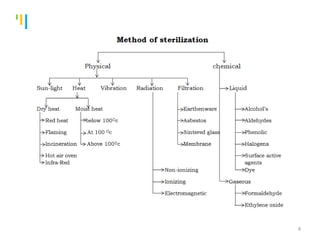
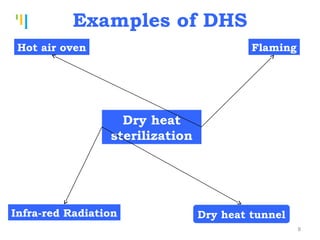
Dry heat
sterilization
Hot air oven Flaming
Infra-red Radiation
Examples of DHS
Dry heat tunnel
8
Tankertanker Design
Tankertanker Design
Tankertanker Design
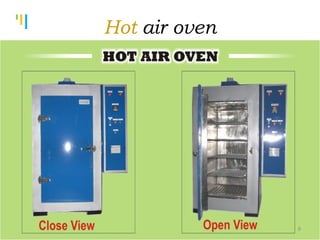
Hot air oven
9
Tankertanker Design
Tankertanker Design
Tankertanker Design
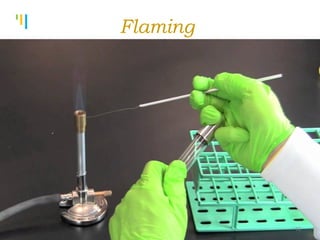
Flaming
10
Tankertanker Design
Tankertanker Design
Tankertanker Design
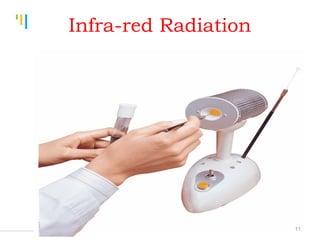
Infra-red Radiation
11
Tankertanker Design
Tankertanker Design
Tankertanker Design
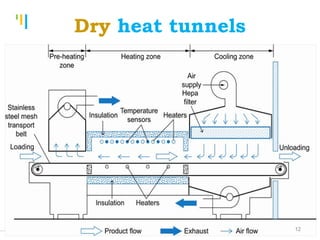
Dry heat tunnels
12
Tankertanker Design
Tankertanker Design
Tankertanker Design
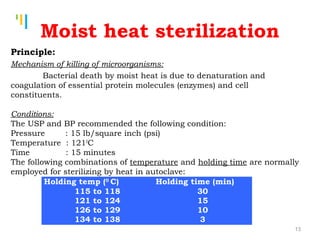
Moist heat sterilization
Principle:
Mechanism of killing of microorganisms:
Bacterial death by moist heat is due to denaturation and
coagulation of essential protein molecules (enzymes) and cell
constituents.
Conditions:
The USP and BP recommended the following condition:
Pressure : 15 lb/square inch (psi)
Temperature : 1210
C
Time : 15 minutes
The following combinations of temperature and holding time are normally
employed for sterilizing by heat in autoclave:
Holding temp (0
C) Holding time (min)
115 to 118
121 to 124
126 to 129
134 to 138
30
15
10
3
13
Tankertanker Design
Tankertanker Design
Tankertanker Design
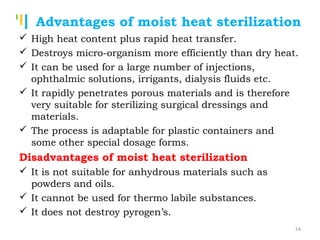
 High heat content plus rapid heat transfer.
 Destroys micro-organism more efficiently than dry heat.
 It can be used for a large number of injections,
ophthalmic solutions, irrigants, dialysis fluids etc.
 It rapidly penetrates porous materials and is therefore
very suitable for sterilizing surgical dressings and
materials.
 The process is adaptable for plastic containers and
some other special dosage forms.
Disadvantages of moist heat sterilization
 It is not suitable for anhydrous materials such as
powders and oils.
 It cannot be used for thermo labile substances.
 It does not destroy pyrogen’s.
Advantages of moist heat sterilization
14
Tankertanker Design
Tankertanker Design
Tankertanker Design
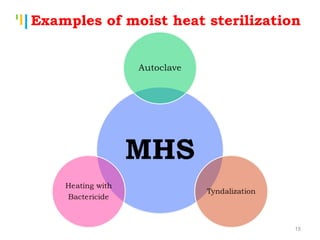
Examples of moist heat sterilization
15
Tankertanker Design
Tankertanker Design
Tankertanker Design
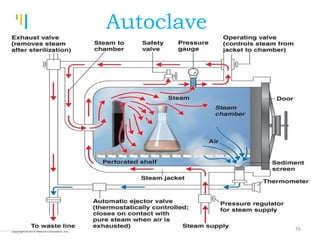
Autoclave
16
Tankertanker Design
Tankertanker Design
Tankertanker Design
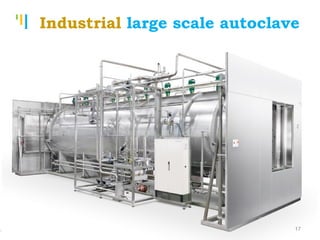
Industrial large scale autoclave
17
Tankertanker Design
Tankertanker Design
Tankertanker Design
Applications of autoclave
 It is used to sterilize anything, which is not injured by
steam and high temperature of sterilization. These
includes, Aqueous parenteral solutions e.g. distilled
water, saline solutions.
 Aqueous liquid media e.g. liquid media with or
without carbohydrate and gelatin.
 Surgical dressings and fabrics.
 Plastic and rubber closures.
 Metal instruments.
 Glass apparatus and containers.
18
Tankertanker Design
Tankertanker Design
Tankertanker Design
HEATING WITH A BACTERICIDE
This method is used for sterilizing aqueous solutions that are
thermo labile to withstand normal autoclaving temperature.
Condition:
Temperature: 98 to 1000
C boiling water
Time: 30 minutes
Bactericides: Bactericide that is compatible with the
product, container and closure:
e.g. for injection
Chlorocresol 0.2%(w/v)
Phenylmercuric nitrate (PMN) 0.002%(w/v)
Phenylmercuric acetate (PMA) 0.002%(w/v)
e.g. for eye drop
Thiomersal 0.01%(w/v)
Chlorhexidine acetate 0.01%(w/v)
PMA and PMN 0.002%(w/v)
Benzalkonium chloride (BAC) 0.01%(w/v)
In the following cases this method can be used:
 Injection fluids in the final container (i.e. terminal sterilization).
 Eye drops.
19
Tankertanker Design
Tankertanker Design
Tankertanker Design
In the following cases this method cannot be
used:
Solution of medicaments intended for intrathecal, intra-
atrial, peridural, intra-peritoneal, intra-cisternal and any
other route of injection giving access to the cerebro-spinal
fluid and for intracardiac and intra-ocularly.
Large volume parenteral fluids having a volume greater
than 15 ml is not recommended to use bactericide
because, though the concentration of the bactericide in
the solution is less but the total amount entering into the
system may be considerable due to large volume. e.g.
bactericides are not used in saline solutions.
20
Tankertanker Design
Tankertanker Design
Tankertanker Design
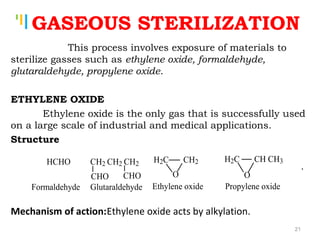
GASEOUS STERILIZATION
This process involves exposure of materials to
sterilize gasses such as ethylene oxide, formaldehyde,
glutaraldehyde, propylene oxide.
 
ETHYLENE OXIDE
Ethylene oxide is the only gas that is successfully used
on a large scale of industrial and medical applications.
Structure
Mechanism of action:Ethylene oxide acts by alkylation.
HCHO H2C CH2
O
H2C CH CH3
O
Formaldehyde Ethylene oxide Propylene oxide
CH2 CH2 CH2
CHO CHO
Glutaraldehyde
.
21
Tankertanker Design
Tankertanker Design
Tankertanker Design
Factors affecting gaseous
sterilization
Sterilization efficiency is influenced by the
concentration of ethylene-oxide
the humidity of the sterilizing atmosphere
the temperature of sterilization
time of exposure
physical nature and permeability of the load.
atmospheric preconditioning of the load
before sterilization.
22
Tankertanker Design
Tankertanker Design
Tankertanker Design
STERILIZATION BY RADIATION
Radiation can be divided into two groups:
1. Electromagnetic waves: (i) infra-red radiation (IR)
(ii) ultraviolet radiation (UV)
(iii)X-rays
(iv)gamma rays
2. Streams of particulate matter (i) alpha radiation
(ii) beta radiation
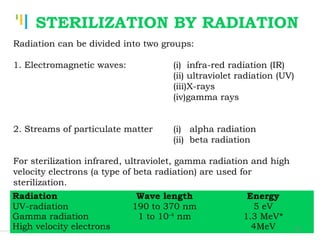
For sterilization infrared, ultraviolet, gamma radiation and high
velocity electrons (a type of beta radiation) are used for
sterilization.
Radiation Wave length Energy
UV-radiation
Gamma radiation
High velocity electrons
190 to 370 nm
1 to 10-4
nm
 
5 eV
1.3 MeV*
4MeV 23
Tankertanker Design
Tankertanker Design
Tankertanker Design
ULTRAVIOLET RADIATION
 Source: Low current of high voltage is passed through
mercury vapor in an evacuated tube made of borosilicate
glass.
 Dose of sterilizing radiation: 10 to 60 microwatts / cm2
reduce the populations of vegetative cells by 90% in a short
period.
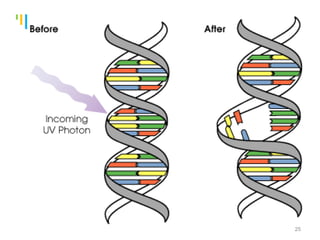
 Mode of action: Only a narrow range of wavelength (220 to
280 nm) is effective in killing micro-organisms, and
wavelengths close to 253.7 nm are the most effective. It has
been found that a maximum biological efficiency exists at
253.7 nm, which is also the absorption peak of isolated DNA,
this suggests strongly therefore that DNA or the nucleic acid
is the target for UV-induced lethal events.
24
Tankertanker Design
Tankertanker Design
Tankertanker Design
25
Tankertanker Design
Tankertanker Design
Tankertanker Design
Use:
Surface sterilization,
Sterilization of clean air and water in thin layers.
Disadvantages:
It has very poor penetration power.
UV-light sterilization is not absolutely reliable because DNA may
get repaired in some favorable condition
IONIZING RADIATION
Mode of action of ionizing radiation:
Ionizing radiation can cause excitations, ionization and
where water is present free radical formation. Free radicals are
powerful oxidizing ( OH, HO2) and reducing (H) agents, which are
capable of damaging essential molecules (enzymes and DNAs) in
living cells. This results in cell death.
26
Tankertanker Design
Tankertanker Design
Tankertanker Design
GAMMA RAYS
Source: Radiation from the radioactive isotope of
Cobalt 60
Co, is used as a source of gamma emission.
Dose: 1.25 MeV,
Some users take the adequate dose as 2.5 Mrad
(Mega radiation unit)
Procedure: Articles for sterilization by radiation are
packed in boxes of standard size, which are
suspended from a monorail and sterilized by slow-
passage around the gamma-ray source.
27
Tankertanker Design
Tankertanker Design
Tankertanker Design
STERILIZATION BY FILTRATION
 This method is used for sterilizing thermo-labile solutions, which
will otherwise be degraded by other conventional heating
methods.
 The drug solutions are passed through the sterile bacteria proof
filter unit and subsequently transferring the product aseptically
into the sterile containers which are then sealed.
 The process involves considerable hazards. Hence IP and BP
require that the tests for sterility be carried out on the filtered
product
Procedure:
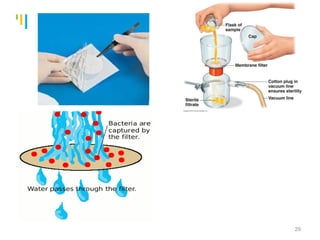
The solutions to be sterilized is passed through the filter and
collected in the sterile receiver by the application of positive
pressure to the nonsterile compartment or negative pressure to
the sterile side.
28
Tankertanker Design
Tankertanker Design
Tankertanker Design
29
Tankertanker Design
Tankertanker Design
Tankertanker Design
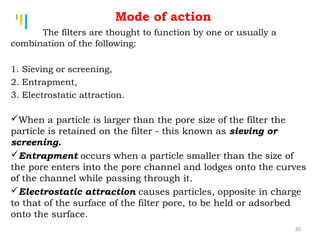
The filters are thought to function by one or usually a
combination of the following:
1. Sieving or screening,
2. Entrapment,
3. Electrostatic attraction.
When a particle is larger than the pore size of the filter the
particle is retained on the filter - this known as sieving or
screening.
Entrapment occurs when a particle smaller than the size of
the pore enters into the pore channel and lodges onto the curves
of the channel while passing through it.
Electrostatic attraction causes particles, opposite in charge
to that of the surface of the filter pore, to be held or adsorbed
onto the surface.
Mode of action
30
Tankertanker Design
Tankertanker Design
Tankertanker Design Membrane filters are made of cellulose-derivative (acetate or
nitrate). They are very fine. They are fixed in some suitable
holders.
 Nominal pore size is 0. 22 ± 0. 02 mm or less is required.
 The membranes are brittle when dry. In this condition they
can be stored for years together. They become very tough
when dipped in water.
 They are sterilized by autoclaving or by ethylene oxide gas.
They cannot be sterilized by dry heat as they decompose above
1200
C.
 They are suitable for sterilizing aqueous and oily solutions but
not for organic solvents such as alcohol, chloroform etc.
MEMBRANE FILTERS
31
Tankertanker Design
Tankertanker Design
Tankertanker Design
 Membrane filters are generally blocked by dirt particles and
organisms. Pre-filtration (through glass-fibre paper prefilter)
reduces the risks of blockage of the final filter.
Examples of membrane filters:
MF-Millipore – it is a mixture of cellulose esters
Sartorius Regular --– it is made of cellulose nitrate
Gelmen Triacetate Metricel – cellulose triacetate
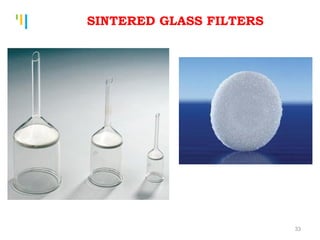
SINTERED (or FRITTED) GLASS FILTERS
Borosilicate glass is finely powdered in a ball-mill and the
particles of required size are separated. This is packed into disc
mounted and heated till the particles get fused. The disc thus
made have pore size of 2 mm and are used for filtration.
They are cleaned with the help of sulfuric acid.
MEMBRANE FILTERS
32
Tankertanker Design
Tankertanker Design
Tankertanker Design
SINTERED GLASS FILTERS
33
Tankertanker Design
Tankertanker Design
Tankertanker Design
SEITZ FILTER
They are made of asbestos pad.
[For further details see Cooper & Gunn Dispensing pp. 582]
 
34
Tankertanker Design
Tankertanker Design
Tankertanker Design
CERAMIC FILTER
35
Tankertanker Design
Tankertanker Design
Tankertanker Design
How to evaluate filters
The BP requires that the integrity of an assembled sterilizing filter
be verified before use and confirmed after use by means of a suitable test.
 
Bacteriological test:
A diluted solution of broth culture of Serratia marcescens is passed
though the filter and the filtrate is collected aseptically and incubated at 250
C for 5 days. The filter passes this test if no growth is found after 5 days of
incubation.
 
Bubble point test:
The bubble point of a test filter is the pressure at which the largest
pore of a wetted filter is able to pass air.
Objectives:
1. Filtration should normally be performed at pressures lower than the
bubble point of a membrane. This prevents gas from passing through the
filter at the end of a filtration cycle and thereby prevents excessive
foaming.
36
Tankertanker Design
Tankertanker Design
Tankertanker Design
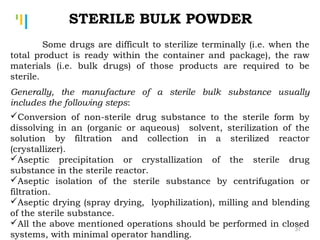
STERILE BULK POWDER
Some drugs are difficult to sterilize terminally (i.e. when the
total product is ready within the container and package), the raw
materials (i.e. bulk drugs) of those products are required to be
sterile.
Generally, the manufacture of a sterile bulk substance usually
includes the following steps:
Conversion of non-sterile drug substance to the sterile form by
dissolving in an (organic or aqueous) solvent, sterilization of the
solution by filtration and collection in a sterilized reactor
(crystallizer).
Aseptic precipitation or crystallization of the sterile drug
substance in the sterile reactor.
Aseptic isolation of the sterile substance by centrifugation or
filtration.
Aseptic drying (spray drying, lyophilization), milling and blending
of the sterile substance.
All the above mentioned operations should be performed in closed
systems, with minimal operator handling.
37
Tankertanker Design
Tankertanker Design
Tankertanker Design
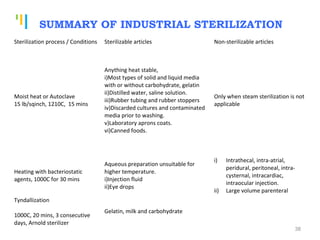
SUMMARY OF INDUSTRIAL STERILIZATION
Sterilization process / Conditions Sterilizable articles Non-sterilizable articles
Moist heat or Autoclave
15 lb/sqinch, 1210C, 15 mins
Anything heat stable,
i)Most types of solid and liquid media
with or without carbohydrate, gelatin
ii)Distilled water, saline solution.
iii)Rubber tubing and rubber stoppers
iv)Discarded cultures and contaminated
media prior to washing.
v)Laboratory aprons coats.
vi)Canned foods.
Only when steam sterilization is not
applicable
Heating with bacteriostatic
agents, 1000C for 30 mins
Aqueous preparation unsuitable for
higher temperature.
i)Injection fluid
ii)Eye drops
i) Intrathecal, intra-atrial,
peridural, peritoneal, intra-
cysternal, intracardiac,
intraocular injection.
ii) Large volume parenteral
Tyndallization
1000C, 20 mins, 3 consecutive
days, Arnold sterilizer
Gelatin, milk and carbohydrate
38
Tankertanker Design
Tankertanker Design
Tankertanker Design
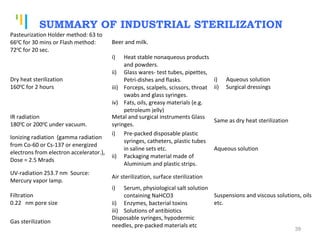
SUMMARY OF INDUSTRIAL STERILIZATION
Pasteurization Holder method: 63 to
660
C for 30 mins or Flash method:
720
C for 20 sec.
Beer and milk.
Dry heat sterilization
1600
C for 2 hours
i) Heat stable nonaqueous products
and powders.
ii) Glass wares- test tubes, pipettes,
Petri-dishes and flasks.
iii) Forceps, scalpels, scissors, throat
swabs and glass syringes.
iv) Fats, oils, greasy materials (e.g.
petroleum jelly)
i) Aqueous solution
ii) Surgical dressings
IR radiation
1800
C or 2000
C under vacuum.
Metal and surgical instruments Glass
syringes.
Same as dry heat sterilization
Ionizing radiation (gamma radiation
from Co-60 or Cs-137 or energized
electrons from electron accelerator.),
Dose = 2.5 Mrads
i) Pre-packed disposable plastic
syringes, catheters, plastic tubes
in saline sets etc.
ii) Packaging material made of
Aluminium and plastic strips.
Aqueous solution
UV-radiation 253.7 nm Source:
Mercury vapor lamp.
Air sterilization, surface sterilization
Filtration
0.22 nm pore size
i) Serum, physiological salt solution
containing NaHCO3
ii) Enzymes, bacterial toxins
iii) Solutions of antibiotics
Suspensions and viscous solutions, oils
etc.
Gas sterilization
Disposable syringes, hypodermic
needles, pre-packed materials etc
39
Tankertanker Design
Tankertanker Design
Tankertanker Design
Reference’s
40
Tankertanker Design
Tankertanker Design
Tankertanker Design
Reference’s
41
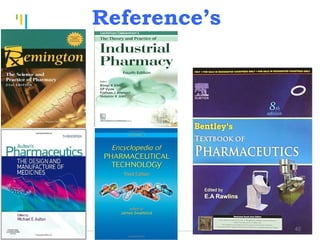
1. Industrial Pharmacy, lachman / liberman’s, Fourth
edition. 814-876.
2. Remington: The Science and Practice of Pharmacy.
3. Pharmaceutics: Design and manufacture of
medicine;Aulton’s.
4. Encyclopedia of pharmaceutical technology.
5. Text book of pharmaceutics. Bentleys.
Thank You

Sterilization methods of parenterals

  • 1.
    Sterilization Methods of Parenterals Presentedby Saravanan.S M.Pharm Ist Year Department of Pharmaceutics Sri Ramachandra college of Pharmacy Sri Ramachandra University
  • 2.
    Tankertanker Design Tankertanker Design TankertankerDesign Introduction Sterilization: Sterilization is the process deigned to produce a sterile state. Sterilization can be defined as that effectively kills or completely eliminates the micro-organisms such as fungus, bacteria, viruses from a surface, equipment, foods, medications, and biological culture medium. Bio-burden  it is defined as the number of bacteria living on a surface, that has not been sterilized. The aim of bio-burden testing is to measure the total number of viable microorganisms on a medical device, and then use the number to determine the most appropriate parameters for its final sterilization. 2
  • 3.
    Tankertanker Design Tankertanker Design TankertankerDesign Definitions Antiseptic: A substance that arrests or prevents the growth of microorganisms by inhibiting their activity without necessarily destroying them. Can be applied on human body. Bactericide: Anything that kills bacteria. Bacteriostatic: Anything that arrests or retards the growth of bacteria. Disinfection: A process that removes infection potential by destroying microorganisms but not ordinarily bacterial spores. Disinfectants are generally meant for application on inanimate objects. Germicides: A substance that kills disease causing microorganisms (i.e. pathogens / germs) but not necessarily bacterial spores. Sterility: The absence of viable organisms. Sterilization: A process by which all viable forms of microorganisms are removed or destroyed. Viable = growing bacteria (or microorganisms) + spores Vegetative microorganisms = growing organism 3
  • 4.
  • 5.
    Tankertanker Design Tankertanker Design TankertankerDesign Dry heat sterilization Principle: The killing of microorganisms by heat is a function of the time- temperature combination used. If the temperature is increased then the time required for killing all the bacteria will be decreased. Condition: Cycles recommended as per BP 1988 are: A minimum of 1800 C for not less than 30 minutes. A minimum of 1700 C for not less than 1 hour. A minimum of 1600 C for not less than 2 minutes. Mechanism of killing the bacteria: The vital constituents of cells such as proteins (enzymes) and nucleic acids are denatured by oxidation. 5
  • 6.
    Tankertanker Design Tankertanker Design TankertankerDesign Applications Dry heat is used to sterilize Glass ware ( e.g. test tubes, Pasteur- pippettes, petridishes, flasks, glass syringes etc ) The glass wares should be prewashed with apyrogenic water. Porcelain and metal equipment such as forceps, scalpels, scissors etc. Fats, oils and greasy materials (like petroleum jelly) those are impermeable to moisture. Dry heat sterilization 6
  • 7.
    Tankertanker Design Tankertanker Design TankertankerDesign Dry heat sterilization is not used in the following cases: Aqueous solution cannot be sterilized by dry heat because the water will evaporate if the container is kept open. If the container is kept close then it may burst due to pressure developed by the steam. Surgical dressings cannot be sterilized by dry heat because cotton or other cellulosic material will get charred at the high temperature. Powders that cannot withstand the high temperature are not sterilized by dry heat method. Dry heat sterilization 7
  • 8.
    Tankertanker Design Tankertanker Design TankertankerDesign Dry heat sterilization Hot air oven Flaming Infra-red Radiation Examples of DHS Dry heat tunnel 8
  • 9.
  • 10.
  • 11.
  • 12.
  • 13.
    Tankertanker Design Tankertanker Design TankertankerDesign Moist heat sterilization Principle: Mechanism of killing of microorganisms: Bacterial death by moist heat is due to denaturation and coagulation of essential protein molecules (enzymes) and cell constituents. Conditions: The USP and BP recommended the following condition: Pressure : 15 lb/square inch (psi) Temperature : 1210 C Time : 15 minutes The following combinations of temperature and holding time are normally employed for sterilizing by heat in autoclave: Holding temp (0 C) Holding time (min) 115 to 118 121 to 124 126 to 129 134 to 138 30 15 10 3 13
  • 14.
    Tankertanker Design Tankertanker Design TankertankerDesign  High heat content plus rapid heat transfer.  Destroys micro-organism more efficiently than dry heat.  It can be used for a large number of injections, ophthalmic solutions, irrigants, dialysis fluids etc.  It rapidly penetrates porous materials and is therefore very suitable for sterilizing surgical dressings and materials.  The process is adaptable for plastic containers and some other special dosage forms. Disadvantages of moist heat sterilization  It is not suitable for anhydrous materials such as powders and oils.  It cannot be used for thermo labile substances.  It does not destroy pyrogen’s. Advantages of moist heat sterilization 14
  • 15.
    Tankertanker Design Tankertanker Design TankertankerDesign Examples of moist heat sterilization 15
  • 16.
  • 17.
    Tankertanker Design Tankertanker Design TankertankerDesign Industrial large scale autoclave 17
  • 18.
    Tankertanker Design Tankertanker Design TankertankerDesign Applications of autoclave  It is used to sterilize anything, which is not injured by steam and high temperature of sterilization. These includes, Aqueous parenteral solutions e.g. distilled water, saline solutions.  Aqueous liquid media e.g. liquid media with or without carbohydrate and gelatin.  Surgical dressings and fabrics.  Plastic and rubber closures.  Metal instruments.  Glass apparatus and containers. 18
  • 19.
    Tankertanker Design Tankertanker Design TankertankerDesign HEATING WITH A BACTERICIDE This method is used for sterilizing aqueous solutions that are thermo labile to withstand normal autoclaving temperature. Condition: Temperature: 98 to 1000 C boiling water Time: 30 minutes Bactericides: Bactericide that is compatible with the product, container and closure: e.g. for injection Chlorocresol 0.2%(w/v) Phenylmercuric nitrate (PMN) 0.002%(w/v) Phenylmercuric acetate (PMA) 0.002%(w/v) e.g. for eye drop Thiomersal 0.01%(w/v) Chlorhexidine acetate 0.01%(w/v) PMA and PMN 0.002%(w/v) Benzalkonium chloride (BAC) 0.01%(w/v) In the following cases this method can be used:  Injection fluids in the final container (i.e. terminal sterilization).  Eye drops. 19
  • 20.
    Tankertanker Design Tankertanker Design TankertankerDesign In the following cases this method cannot be used: Solution of medicaments intended for intrathecal, intra- atrial, peridural, intra-peritoneal, intra-cisternal and any other route of injection giving access to the cerebro-spinal fluid and for intracardiac and intra-ocularly. Large volume parenteral fluids having a volume greater than 15 ml is not recommended to use bactericide because, though the concentration of the bactericide in the solution is less but the total amount entering into the system may be considerable due to large volume. e.g. bactericides are not used in saline solutions. 20
  • 21.
    Tankertanker Design Tankertanker Design TankertankerDesign GASEOUS STERILIZATION This process involves exposure of materials to sterilize gasses such as ethylene oxide, formaldehyde, glutaraldehyde, propylene oxide.   ETHYLENE OXIDE Ethylene oxide is the only gas that is successfully used on a large scale of industrial and medical applications. Structure Mechanism of action:Ethylene oxide acts by alkylation. HCHO H2C CH2 O H2C CH CH3 O Formaldehyde Ethylene oxide Propylene oxide CH2 CH2 CH2 CHO CHO Glutaraldehyde . 21
  • 22.
    Tankertanker Design Tankertanker Design TankertankerDesign Factors affecting gaseous sterilization Sterilization efficiency is influenced by the concentration of ethylene-oxide the humidity of the sterilizing atmosphere the temperature of sterilization time of exposure physical nature and permeability of the load. atmospheric preconditioning of the load before sterilization. 22
  • 23.
    Tankertanker Design Tankertanker Design TankertankerDesign STERILIZATION BY RADIATION Radiation can be divided into two groups: 1. Electromagnetic waves: (i) infra-red radiation (IR) (ii) ultraviolet radiation (UV) (iii)X-rays (iv)gamma rays 2. Streams of particulate matter (i) alpha radiation (ii) beta radiation For sterilization infrared, ultraviolet, gamma radiation and high velocity electrons (a type of beta radiation) are used for sterilization. Radiation Wave length Energy UV-radiation Gamma radiation High velocity electrons 190 to 370 nm 1 to 10-4 nm   5 eV 1.3 MeV* 4MeV 23
  • 24.
    Tankertanker Design Tankertanker Design TankertankerDesign ULTRAVIOLET RADIATION  Source: Low current of high voltage is passed through mercury vapor in an evacuated tube made of borosilicate glass.  Dose of sterilizing radiation: 10 to 60 microwatts / cm2 reduce the populations of vegetative cells by 90% in a short period.  Mode of action: Only a narrow range of wavelength (220 to 280 nm) is effective in killing micro-organisms, and wavelengths close to 253.7 nm are the most effective. It has been found that a maximum biological efficiency exists at 253.7 nm, which is also the absorption peak of isolated DNA, this suggests strongly therefore that DNA or the nucleic acid is the target for UV-induced lethal events. 24
  • 25.
  • 26.
    Tankertanker Design Tankertanker Design TankertankerDesign Use: Surface sterilization, Sterilization of clean air and water in thin layers. Disadvantages: It has very poor penetration power. UV-light sterilization is not absolutely reliable because DNA may get repaired in some favorable condition IONIZING RADIATION Mode of action of ionizing radiation: Ionizing radiation can cause excitations, ionization and where water is present free radical formation. Free radicals are powerful oxidizing ( OH, HO2) and reducing (H) agents, which are capable of damaging essential molecules (enzymes and DNAs) in living cells. This results in cell death. 26
  • 27.
    Tankertanker Design Tankertanker Design TankertankerDesign GAMMA RAYS Source: Radiation from the radioactive isotope of Cobalt 60 Co, is used as a source of gamma emission. Dose: 1.25 MeV, Some users take the adequate dose as 2.5 Mrad (Mega radiation unit) Procedure: Articles for sterilization by radiation are packed in boxes of standard size, which are suspended from a monorail and sterilized by slow- passage around the gamma-ray source. 27
  • 28.
    Tankertanker Design Tankertanker Design TankertankerDesign STERILIZATION BY FILTRATION  This method is used for sterilizing thermo-labile solutions, which will otherwise be degraded by other conventional heating methods.  The drug solutions are passed through the sterile bacteria proof filter unit and subsequently transferring the product aseptically into the sterile containers which are then sealed.  The process involves considerable hazards. Hence IP and BP require that the tests for sterility be carried out on the filtered product Procedure: The solutions to be sterilized is passed through the filter and collected in the sterile receiver by the application of positive pressure to the nonsterile compartment or negative pressure to the sterile side. 28
  • 29.
  • 30.
    Tankertanker Design Tankertanker Design TankertankerDesign The filters are thought to function by one or usually a combination of the following: 1. Sieving or screening, 2. Entrapment, 3. Electrostatic attraction. When a particle is larger than the pore size of the filter the particle is retained on the filter - this known as sieving or screening. Entrapment occurs when a particle smaller than the size of the pore enters into the pore channel and lodges onto the curves of the channel while passing through it. Electrostatic attraction causes particles, opposite in charge to that of the surface of the filter pore, to be held or adsorbed onto the surface. Mode of action 30
  • 31.
    Tankertanker Design Tankertanker Design TankertankerDesign Membrane filters are made of cellulose-derivative (acetate or nitrate). They are very fine. They are fixed in some suitable holders.  Nominal pore size is 0. 22 ± 0. 02 mm or less is required.  The membranes are brittle when dry. In this condition they can be stored for years together. They become very tough when dipped in water.  They are sterilized by autoclaving or by ethylene oxide gas. They cannot be sterilized by dry heat as they decompose above 1200 C.  They are suitable for sterilizing aqueous and oily solutions but not for organic solvents such as alcohol, chloroform etc. MEMBRANE FILTERS 31
  • 32.
    Tankertanker Design Tankertanker Design TankertankerDesign  Membrane filters are generally blocked by dirt particles and organisms. Pre-filtration (through glass-fibre paper prefilter) reduces the risks of blockage of the final filter. Examples of membrane filters: MF-Millipore – it is a mixture of cellulose esters Sartorius Regular --– it is made of cellulose nitrate Gelmen Triacetate Metricel – cellulose triacetate SINTERED (or FRITTED) GLASS FILTERS Borosilicate glass is finely powdered in a ball-mill and the particles of required size are separated. This is packed into disc mounted and heated till the particles get fused. The disc thus made have pore size of 2 mm and are used for filtration. They are cleaned with the help of sulfuric acid. MEMBRANE FILTERS 32
  • 33.
  • 34.
    Tankertanker Design Tankertanker Design TankertankerDesign SEITZ FILTER They are made of asbestos pad. [For further details see Cooper & Gunn Dispensing pp. 582]   34
  • 35.
  • 36.
    Tankertanker Design Tankertanker Design TankertankerDesign How to evaluate filters The BP requires that the integrity of an assembled sterilizing filter be verified before use and confirmed after use by means of a suitable test.   Bacteriological test: A diluted solution of broth culture of Serratia marcescens is passed though the filter and the filtrate is collected aseptically and incubated at 250 C for 5 days. The filter passes this test if no growth is found after 5 days of incubation.   Bubble point test: The bubble point of a test filter is the pressure at which the largest pore of a wetted filter is able to pass air. Objectives: 1. Filtration should normally be performed at pressures lower than the bubble point of a membrane. This prevents gas from passing through the filter at the end of a filtration cycle and thereby prevents excessive foaming. 36
  • 37.
    Tankertanker Design Tankertanker Design TankertankerDesign STERILE BULK POWDER Some drugs are difficult to sterilize terminally (i.e. when the total product is ready within the container and package), the raw materials (i.e. bulk drugs) of those products are required to be sterile. Generally, the manufacture of a sterile bulk substance usually includes the following steps: Conversion of non-sterile drug substance to the sterile form by dissolving in an (organic or aqueous) solvent, sterilization of the solution by filtration and collection in a sterilized reactor (crystallizer). Aseptic precipitation or crystallization of the sterile drug substance in the sterile reactor. Aseptic isolation of the sterile substance by centrifugation or filtration. Aseptic drying (spray drying, lyophilization), milling and blending of the sterile substance. All the above mentioned operations should be performed in closed systems, with minimal operator handling. 37
  • 38.
    Tankertanker Design Tankertanker Design TankertankerDesign SUMMARY OF INDUSTRIAL STERILIZATION Sterilization process / Conditions Sterilizable articles Non-sterilizable articles Moist heat or Autoclave 15 lb/sqinch, 1210C, 15 mins Anything heat stable, i)Most types of solid and liquid media with or without carbohydrate, gelatin ii)Distilled water, saline solution. iii)Rubber tubing and rubber stoppers iv)Discarded cultures and contaminated media prior to washing. v)Laboratory aprons coats. vi)Canned foods. Only when steam sterilization is not applicable Heating with bacteriostatic agents, 1000C for 30 mins Aqueous preparation unsuitable for higher temperature. i)Injection fluid ii)Eye drops i) Intrathecal, intra-atrial, peridural, peritoneal, intra- cysternal, intracardiac, intraocular injection. ii) Large volume parenteral Tyndallization 1000C, 20 mins, 3 consecutive days, Arnold sterilizer Gelatin, milk and carbohydrate 38
  • 39.
    Tankertanker Design Tankertanker Design TankertankerDesign SUMMARY OF INDUSTRIAL STERILIZATION Pasteurization Holder method: 63 to 660 C for 30 mins or Flash method: 720 C for 20 sec. Beer and milk. Dry heat sterilization 1600 C for 2 hours i) Heat stable nonaqueous products and powders. ii) Glass wares- test tubes, pipettes, Petri-dishes and flasks. iii) Forceps, scalpels, scissors, throat swabs and glass syringes. iv) Fats, oils, greasy materials (e.g. petroleum jelly) i) Aqueous solution ii) Surgical dressings IR radiation 1800 C or 2000 C under vacuum. Metal and surgical instruments Glass syringes. Same as dry heat sterilization Ionizing radiation (gamma radiation from Co-60 or Cs-137 or energized electrons from electron accelerator.), Dose = 2.5 Mrads i) Pre-packed disposable plastic syringes, catheters, plastic tubes in saline sets etc. ii) Packaging material made of Aluminium and plastic strips. Aqueous solution UV-radiation 253.7 nm Source: Mercury vapor lamp. Air sterilization, surface sterilization Filtration 0.22 nm pore size i) Serum, physiological salt solution containing NaHCO3 ii) Enzymes, bacterial toxins iii) Solutions of antibiotics Suspensions and viscous solutions, oils etc. Gas sterilization Disposable syringes, hypodermic needles, pre-packed materials etc 39
  • 40.
  • 41.
    Tankertanker Design Tankertanker Design TankertankerDesign Reference’s 41 1. Industrial Pharmacy, lachman / liberman’s, Fourth edition. 814-876. 2. Remington: The Science and Practice of Pharmacy. 3. Pharmaceutics: Design and manufacture of medicine;Aulton’s. 4. Encyclopedia of pharmaceutical technology. 5. Text book of pharmaceutics. Bentleys.
  • 42.