Definitio
n
🠶“Buffers are compoundsor
mixtures of compounds that by
their presence in the solution
resist changes in the pH upon the
addition of small quantities of acid
or alkali.”
3.
Necessity of abuffer system:
🠶 Sometimes it is necessary that a solution of a definite pH
be prepared and stored. The preservation of such a
solution is even more difficult than its preparation. If
solution comes in contact with air, it will absorb CO2 and
becomes acidic. On the other hand, if solution is stored in
a glass bottle, alkaline impurities from the glass may
alter its pH. Due to these reasons, pharmaceutical
solutions are buffered as the buffer solutions are capable
of maintaining pH at some fairly constant value when
even small amounts of acid or base are added.
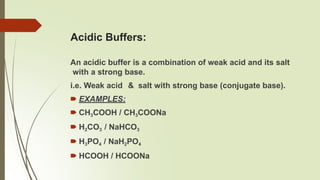
Acidic Buffers:
An acidicbuffer is a combination of weak acid and its salt
with a strong base.
i.e. Weak acid & salt with strong base (conjugate base).
🠶 EXAMPLES:
🠶 CH3COOH / CH3COONa
🠶 H2CO3 / NaHCO3
🠶 H3PO4 / NaH2PO4
🠶 HCOOH / HCOONa
6.
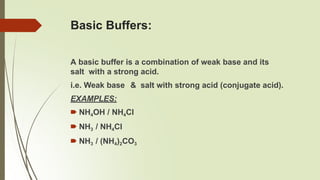
Basic Buffers:
A basicbuffer is a combination of weak base and its
salt with a strong acid.
i.e. Weak base & salt with strong acid (conjugate acid).
EXAMPLES:
🠶 NH4OH / NH4Cl
🠶 NH3 / NH4Cl
🠶 NH3 / (NH4)2CO3
7.
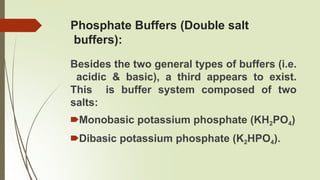
Phosphate Buffers (Doublesalt
buffers):
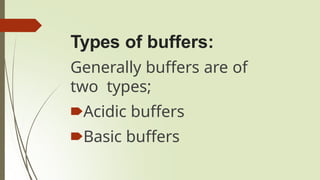
Besides the two general types of buffers (i.e.
acidic & basic), a third appears to exist.
This is buffer system composed of two
salts:
🠶Monobasic potassium phosphate (KH2PO4)
🠶Dibasic potassium phosphate (K2HPO4).
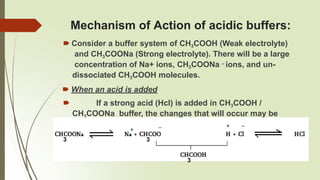
Mechanism of Actionof acidic buffers:
🠶 Consider a buffer system of CH3COOH (Weak electrolyte)
and CH3COONa (Strong electrolyte). There will be a large
concentration of Na+ ions, CH3COONa – ions, and un-
dissociated CH3COOH molecules.
🠶 When an acid is added
🠶 If a strong acid (Hcl) is added in CH3COOH /
CH3COONa buffer, the changes that will occur may be
represented as:
3 3
3
+
_ + _
10.
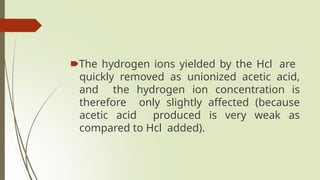
🠶The hydrogen ionsyielded by the Hcl are
quickly removed as unionized acetic acid,
and the hydrogen ion concentration is
therefore only slightly affected (because
acetic acid produced is very weak as
compared to Hcl added).
11.
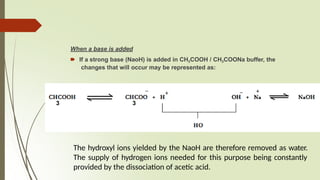
When a baseis added
🠶 If a strong base (NaoH) is added in CH3COOH / CH3COONa buffer, the
changes that will occur may be represented as:
3 3
The hydroxyl ions yielded by the NaoH are therefore removed as water.
The supply of hydrogen ions needed for this purpose being constantly
provided by the dissociation of acetic acid.
_
+
_ +
12.
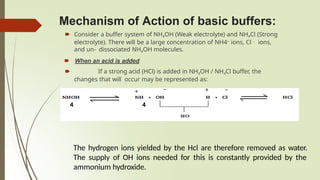
Mechanism of Actionof basic buffers:
🠶 Consider a buffer system of NH4OH (Weak electrolyte) and NH4Cl (Strong
electrolyte). There will be a large concentration of NH4+ ions, Cl – ions,
and un- dissociated NH4OH molecules.
🠶 When an acid is added
🠶 If a strong acid (HCl) is added in NH4OH / NH4Cl buffer, the
changes that will occur may be represented as:
4 4
The hydrogen ions yielded by the Hcl are therefore removed as water.
The supply of OH ions needed for this is constantly provided by the
ammonium hydroxide.
+
_
+ _
13.
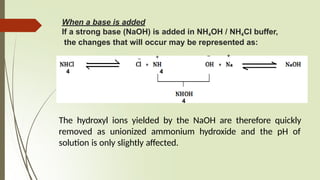
When a baseis added
If a strong base (NaOH) is added in NH4OH / NH4Cl buffer,
the changes that will occur may be represented as:
4 4
4
The hydroxyl ions yielded by the NaOH are therefore quickly
removed as unionized ammonium hydroxide and the pH of
solution is only slightly affected.
+
_ +
_
14.
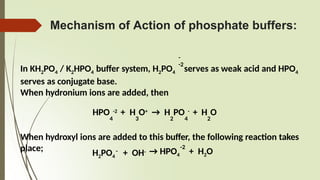
Mechanism of Actionof phosphate buffers:
-
-2
In KH2PO4 / K2HPO4 buffer system, H2PO4 serves as weak acid and HPO4
serves as conjugate base.
When hydronium ions are added, then
HPO -2 + H O+ → H PO - + H O
4 3 2 4 2
When hydroxyl ions are added to this buffer, the following reaction takes
place; -
H2PO4 + OH-
-2
→ HPO4 + H2O
For Acid Buffers:
ThepH of acid buffer can be calculated from the dissociation
constant, Ka of the weak acid and the concentrations of the acid
and salt used.
🠶 The dissociation expression of the weak acid can be
represented as:
🠶 HA ↔ H+ + A-
🠶 Ka = [H+] [A-] / [HA]
🠶 Or
🠶 [H+] = Ka [HA] / [A-] ------------- (1)
17.
🠶 A weakacid is only slightly dissociated, and its dissociation
is further depressed by the addition of
the salt (XA) which
A-
provides ion (common ion effect) as a result the
equilibrium concentration of the unionized acid is nearly
equal to the initial concentration of the acid. The equilibrium
concentration of A- is assumed to be equal to the initial
concentration of the salt added since it is completely
dissociated. Therefore, in above equation (1), we represent
concentration of A- by salt concentration.
18.
🠶 [H+] =Ka. [Acid] / [Salt] --------- (2)
🠶 Taking log on both sides, we get:
🠶 log[H+] = logKa + log [Acid] / [Salt]
🠶 multiplying both sides by –ve sign,
🠶 -log[H+] = -logKa - log [Acid] / [Salt]
🠶 As -log[H+] = pH & -logKa = pka
🠶 pH = pka - log[Acid] / [Salt] OR
pH = pka + log[Salt] / [Acid] ---------- (3)
Eq. (3) is called as Henderson – Hasselbalch equation.
It helps in calculating the pH value of buffer
solution,
19.
For Basic Buffers:
Bufferequation for basic buffer can be calculated in same way as that
for acidic buffers.
Consider a basic buffer composed of a mixture of weak base (BOH)
and its salt (BA). The dissociation constant for base can be written as,
BOH ↔ B+ + OH-
Kb = [B+] [OH-] / [BOH]
OR
[OH-] = Kb [BOH] / [B+] ------------- (1)
20.
🠶 A weakbase is only slightly dissociated, and its
dissociation is further depressed by the addition of the
salt (BA) which provides B+ ion (common ion effect) as a
result the equilibrium concentration of the unionized
base is nearly equal to the initial concentration of the
base. The equilibrium concentration of B+ is assumed to
be equal to the initial concentration of the salt added
since it is completely dissociated. Therefore, in above
equation (1), we represent concentration of B+ by salt
concentration.
21.
[OH-] = Kb.[Base] / [Salt] --------- (2)
Taking log on both sides, we get:
log[OH-] = logKb + log [Base] /
[Salt] multiplying both sides by –ve
sign,
-log[OH-] = -logKb - log [Base] /
[Salt]
As -log[OH-] = pOH & -logKb
= pkb
pOH = pkb – log [Base] /
[Salt] Or
pOH = pkb + log[Salt] / [Base] ---------- (3)
22.
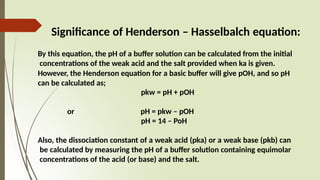
Significance of Henderson– Hasselbalch equation:
By this equation, the pH of a buffer solution can be calculated from the initial
concentrations of the weak acid and the salt provided when ka is given.
However, the Henderson equation for a basic buffer will give pOH, and so pH
can be calculated as;
pkw = pH + pOH
or pH = pkw – pOH
pH = 14 – PoH
Also, the dissociation constant of a weak acid (pka) or a weak base (pkb) can
be calculated by measuring the pH of a buffer solution containing equimolar
concentrations of the acid (or base) and the salt.
23.
EXAMPLE:
🠶 Calculate thepH of a buffer solution containing 0.03 moles/litre of acetic acid
and 0.1 moles/litre of sodium acetate. pka for CH3COOH is 4.57.
Solution:
🠶 Conc. Of acid = 0.03 M
🠶 Conc. Of salt = 0.1 M
🠶 So,
🠶 pH = pka + log [salt] / [acid]
🠶
🠶
🠶
= 4.57 + log 0.1 /
0.03
= 4.57 + 0.52
= 5.09
🠶 Result →The pH of the buffer solution containing 0.03 M of acetic acid and 0.1
M of sodium acetate is 5.09.
24.
🠶 EXAMPLE:
🠶 Calculatethe pH of a buffer solution containing 0.25 moles / litre of formic
acid (HCOOH) and 0.10 moles / litre of sodium formate (HCOONa). Ka for
formic acid is 1.8 × 10 -4.
🠶 Solution:
🠶 Conc. Of acid = 0.25 M
🠶 Conc. Of salt = 0.10 M
🠶 Ka = 1.8 × 10 -4
🠶 & pka is
🠶 pka = -log ka = -log 1.8 × 10 -4
🠶 = - (log 1.8 × 10 -4) = - (log 1.8 + log 10 -4) = - [0.25 + (-4)] = - (- 3.75) = 3.75
🠶 So,
🠶 pH = pka + log [salt] / [acid]
🠶 = 3.75 + log 0.10 / 0.25 = 3.75 – 0.397 = 3.34
🠶 Result → The pH of a buffer solution containing 0.25 M of formic acid and
0.10 M of sodium formate is 3.34.
🠶
25.
BUFFER CAPACITY
🠶 Thebuffer capacity of a buffer solution is “a measure of its magnitude of its
resistance to change in the pH on an addition of an acid or a base.”
🠶 Buffer capacity is also referred as buffer index, buffer value, buffer efficiency or
buffer coefficient.
🠶 The buffer capacity represented by ‘β’ may also be defined as:
🠶 “The ratio of the increment (amount added) of strong acid or base to the small
change in pH (ΔpH) brought about by this addition”.
🠶 β = ΔA or ΔB / ΔpH
🠶
🠶 Where, ΔA or ΔB represents the small increment (in gram equivalents / litre of
strong acid or base added) to the buffer to bring about a pH change of ΔpH.
🠶 According to the above equation, a solution has a buffer capacity of 1 when one
litre of it requires one gram equivalent of a strong acid or base to change the pH
by one unit. So, smaller the pH change in a solution upon the addition of an acid
or base, greater is the buffer capacity and vice versa.
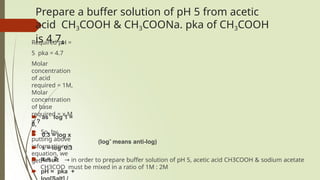
26.
Prepare a buffersolution of pH 5 from acetic
acid CH3COOH & CH3COONa. pka of CH3COOH
is 4.7.
Required pH =
5 pka = 4.7
Molar
concentration
of acid
required = 1M,
Molar
concentration
of base
required = x M
= ?
🠶 So, by
putting above
information in
equation, we
get:
🠶 pH = pka +
(log- means anti-log)
🠶 as log 1 =
0,
🠶 0.3 = log x
🠶 x = log- 0.3
🠶 x = 2
🠶 Result → in order to prepare buffer solution of pH 5, acetic acid CH3COOH & sodium acetate
CH3COO must be mixed in a ratio of 1M : 2M
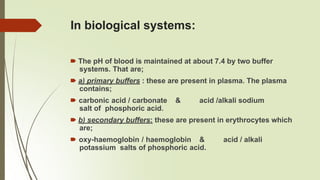
In biological systems:
🠶The pH of blood is maintained at about 7.4 by two buffer
systems. That are;
🠶 a) primary buffers : these are present in plasma. The plasma
contains;
🠶 carbonic acid / carbonate & acid /alkali sodium
salt of phosphoric acid.
🠶 b) secondary buffers: these are present in erythrocytes which
are;
🠶 oxy-haemoglobin / haemoglobin & acid / alkali
potassium salts of phosphoric acid.
29.
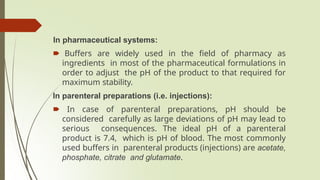
In pharmaceutical systems:
🠶Buffers are widely used in the field of pharmacy as
ingredients in most of the pharmaceutical formulations in
order to adjust the pH of the product to that required for
maximum stability.
In parenteral preparations (i.e. injections):
🠶 In case of parenteral preparations, pH should be
considered carefully as large deviations of pH may lead to
serious consequences. The ideal pH of a parenteral
product is 7.4, which is pH of blood. The most commonly
used buffers in parenteral products (injections) are acetate,
phosphate, citrate and glutamate.
30.
In ophthalmic preparations(i.e. eye preparations):
🠶 Buffers are generally used in ophthalmic preparations to maintain the
pH within the physiological pH range of lacrimal fluid (i.e. eye fluid).
The lacrimal fluid has a pH in rang 7 – 8 , but it has good buffering
capacity and can tolerate preparations having pH values between 3.5
– 10.5 with little discomfort. Out side this range (i.e. 3.5 – 10.5),
increase lacrimation may occur with other complications.
🠶 The buffering agents most commonly used in ophthalmic
preparations
include borate, carbonate and phosphates.
In ointments and creams:
🠶 Topical products (which are used on skins) such as ointments and
creams are also buffered to ensure stability of the formulation. The
most commonly used buffers in ointments and creams are citric
acid / its salts & phosphoric acid / its salts.
![For Acid Buffers:
The pH of acid buffer can be calculated from the dissociation
constant, Ka of the weak acid and the concentrations of the acid
and salt used.
🠶 The dissociation expression of the weak acid can be
represented as:
🠶 HA ↔ H+ + A-
🠶 Ka = [H+] [A-] / [HA]
🠶 Or
🠶 [H+] = Ka [HA] / [A-] ------------- (1)](https://image.slidesharecdn.com/buffers-160329123505-250519210930-9ef16e78/85/buffer-solution-definition-and-exercices-16-320.jpg)
![🠶 [H+] = Ka. [Acid] / [Salt] --------- (2)
🠶 Taking log on both sides, we get:
🠶 log[H+] = logKa + log [Acid] / [Salt]
🠶 multiplying both sides by –ve sign,
🠶 -log[H+] = -logKa - log [Acid] / [Salt]
🠶 As -log[H+] = pH & -logKa = pka
🠶 pH = pka - log[Acid] / [Salt] OR
pH = pka + log[Salt] / [Acid] ---------- (3)
Eq. (3) is called as Henderson – Hasselbalch equation.
It helps in calculating the pH value of buffer
solution,](https://image.slidesharecdn.com/buffers-160329123505-250519210930-9ef16e78/85/buffer-solution-definition-and-exercices-18-320.jpg)
![For Basic Buffers:
Buffer equation for basic buffer can be calculated in same way as that
for acidic buffers.
Consider a basic buffer composed of a mixture of weak base (BOH)
and its salt (BA). The dissociation constant for base can be written as,
BOH ↔ B+ + OH-
Kb = [B+] [OH-] / [BOH]
OR
[OH-] = Kb [BOH] / [B+] ------------- (1)](https://image.slidesharecdn.com/buffers-160329123505-250519210930-9ef16e78/85/buffer-solution-definition-and-exercices-19-320.jpg)
![[OH-] = Kb. [Base] / [Salt] --------- (2)
Taking log on both sides, we get:
log[OH-] = logKb + log [Base] /
[Salt] multiplying both sides by –ve
sign,
-log[OH-] = -logKb - log [Base] /
[Salt]
As -log[OH-] = pOH & -logKb
= pkb
pOH = pkb – log [Base] /
[Salt] Or
pOH = pkb + log[Salt] / [Base] ---------- (3)](https://image.slidesharecdn.com/buffers-160329123505-250519210930-9ef16e78/85/buffer-solution-definition-and-exercices-21-320.jpg)
![EXAMPLE:
🠶 Calculate the pH of a buffer solution containing 0.03 moles/litre of acetic acid
and 0.1 moles/litre of sodium acetate. pka for CH3COOH is 4.57.
Solution:
🠶 Conc. Of acid = 0.03 M
🠶 Conc. Of salt = 0.1 M
🠶 So,
🠶 pH = pka + log [salt] / [acid]
🠶
🠶
🠶
= 4.57 + log 0.1 /
0.03
= 4.57 + 0.52
= 5.09
🠶 Result →The pH of the buffer solution containing 0.03 M of acetic acid and 0.1
M of sodium acetate is 5.09.](https://image.slidesharecdn.com/buffers-160329123505-250519210930-9ef16e78/85/buffer-solution-definition-and-exercices-23-320.jpg)
![🠶 EXAMPLE:
🠶 Calculate the pH of a buffer solution containing 0.25 moles / litre of formic
acid (HCOOH) and 0.10 moles / litre of sodium formate (HCOONa). Ka for
formic acid is 1.8 × 10 -4.
🠶 Solution:
🠶 Conc. Of acid = 0.25 M
🠶 Conc. Of salt = 0.10 M
🠶 Ka = 1.8 × 10 -4
🠶 & pka is
🠶 pka = -log ka = -log 1.8 × 10 -4
🠶 = - (log 1.8 × 10 -4) = - (log 1.8 + log 10 -4) = - [0.25 + (-4)] = - (- 3.75) = 3.75
🠶 So,
🠶 pH = pka + log [salt] / [acid]
🠶 = 3.75 + log 0.10 / 0.25 = 3.75 – 0.397 = 3.34
🠶 Result → The pH of a buffer solution containing 0.25 M of formic acid and
0.10 M of sodium formate is 3.34.
🠶](https://image.slidesharecdn.com/buffers-160329123505-250519210930-9ef16e78/85/buffer-solution-definition-and-exercices-24-320.jpg)


![Polymer [ बहुलक ] Chemistry Notes PDF - Irfanullah Mehar - JJ Sir Chemistry.pdf](https://cdn.slidesharecdn.com/ss_thumbnails/polymerchemistrynotespdf-irfanullahmehar-jjsirchemistry-260210172118-3f9b37f7-thumbnail.jpg?width=640&height=640&fit=bounds)


