Gene Transformation
techniques
Introduction:
• Gene alteration or modification is known
as gene transformation.
• Frederick Griffith 1928 revealed genetic
transformation in bacterial strains .
• Gene transformation are of two types
• Natural transformation
• Artificial transformation
Natural transformation
• Conjugation
Genetic exchange by cellular contacts
Transduction
Genetic exchange through a vehicle
Like plasmid or vector
• Agrobacterium mediated gene transfer
Why gene transformation
• science of transformation starts in
1970 with discovery of restriction
enzymes by H-Smith
• main purpose includes
• Cloning of gene
• Production of desired proteins
• Enhancement of products
• GMOs
Types
• Stable transformation
integration of gene permanently.
e.g. agrobacterium mediated
• Transient
Temporary transformation
Liposome mediated
Genetic transformation
techniques
• Three categories
• Biological means
• Physical means
• Chemical means
Modes of gene
transformation
• Indirect method
It uses carriers
e.g. plasmids, vectors, liposome's,
• Direct
carrier free method
e.g. microinjections
Gene gun
Biological Means of transformation
• This technique uses biological systems for
gene transfer.
• E.g.
• Plasmids
• Vectors
• Cosmid
• Phagemids
• BACs and YACs
• Modified Replication deficient viruses
Physical means of gene
transformation
Introduction
• It uses physical tools
• Operates direct transformation
• Auto regulation of genes i.e. auto
integration
• It overcomes the work-burden unlike
biological means
• No side effect and pathogenicity
Types
• The well known physical means of gene
transformation techniques include,
• Gene Gun , Biolistic / Ballistic or Golden
Gun method
• Microinjections
• Electroporation.
• Laser beam technique
• Ultrasound / Sonication etc
Gene gun/Golden gun
Biolistics
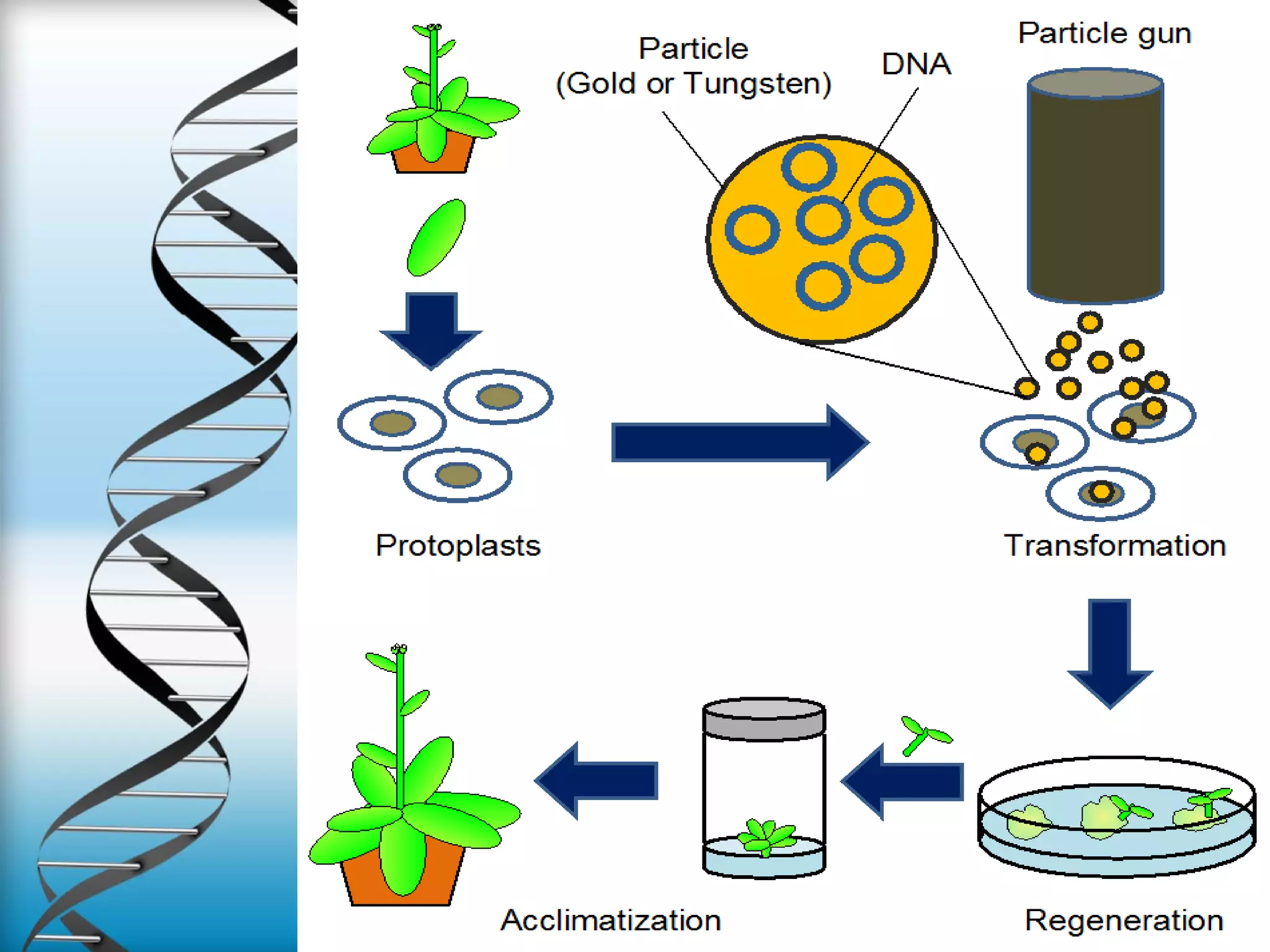
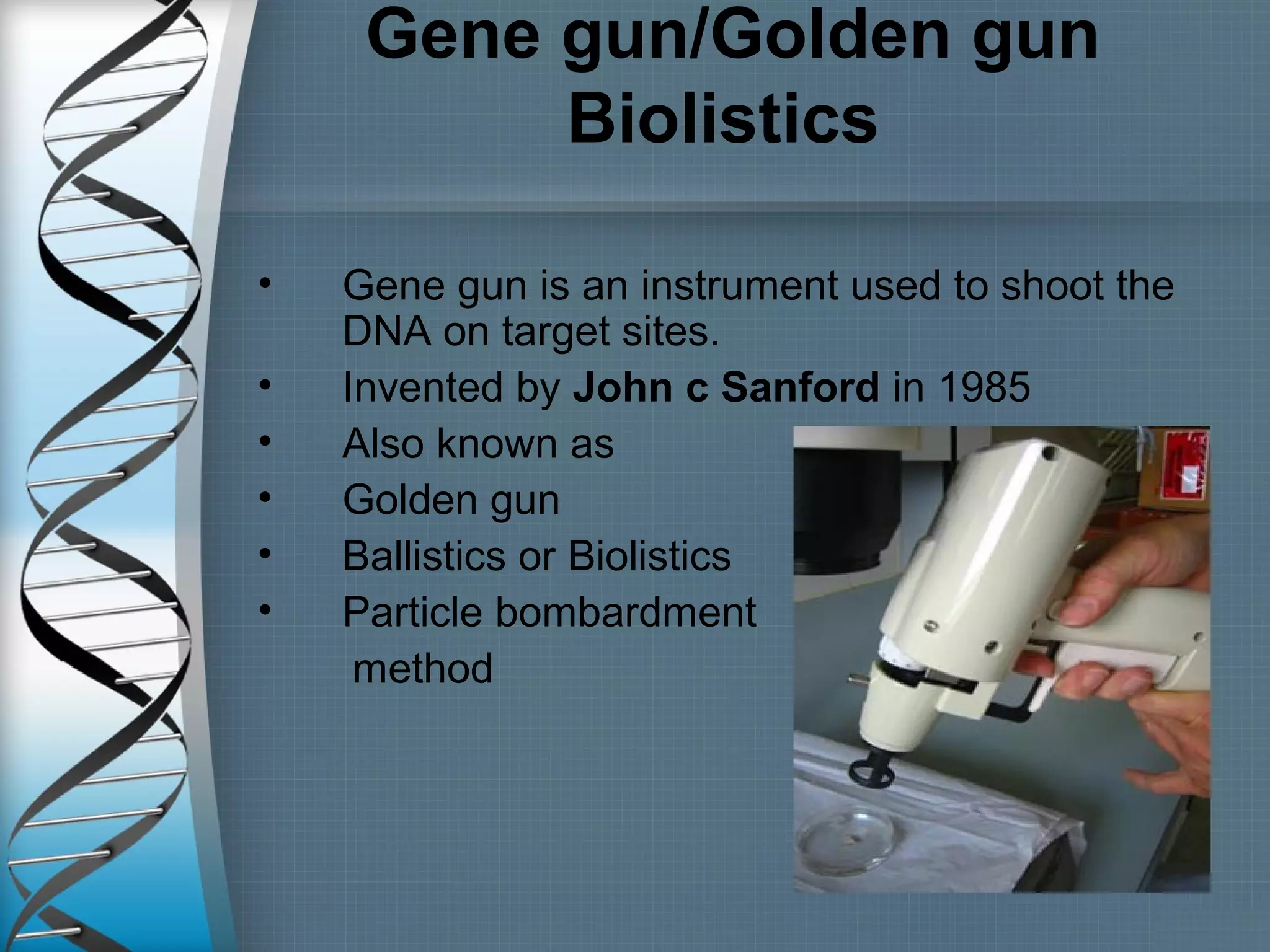
• Gene gun is an instrument used to shoot the
DNA on target sites.
• Invented by John c Sanford in 1985
• Also known as
• Golden gun
• Ballistics or Biolistics
• Particle bombardment
method
Gene gun
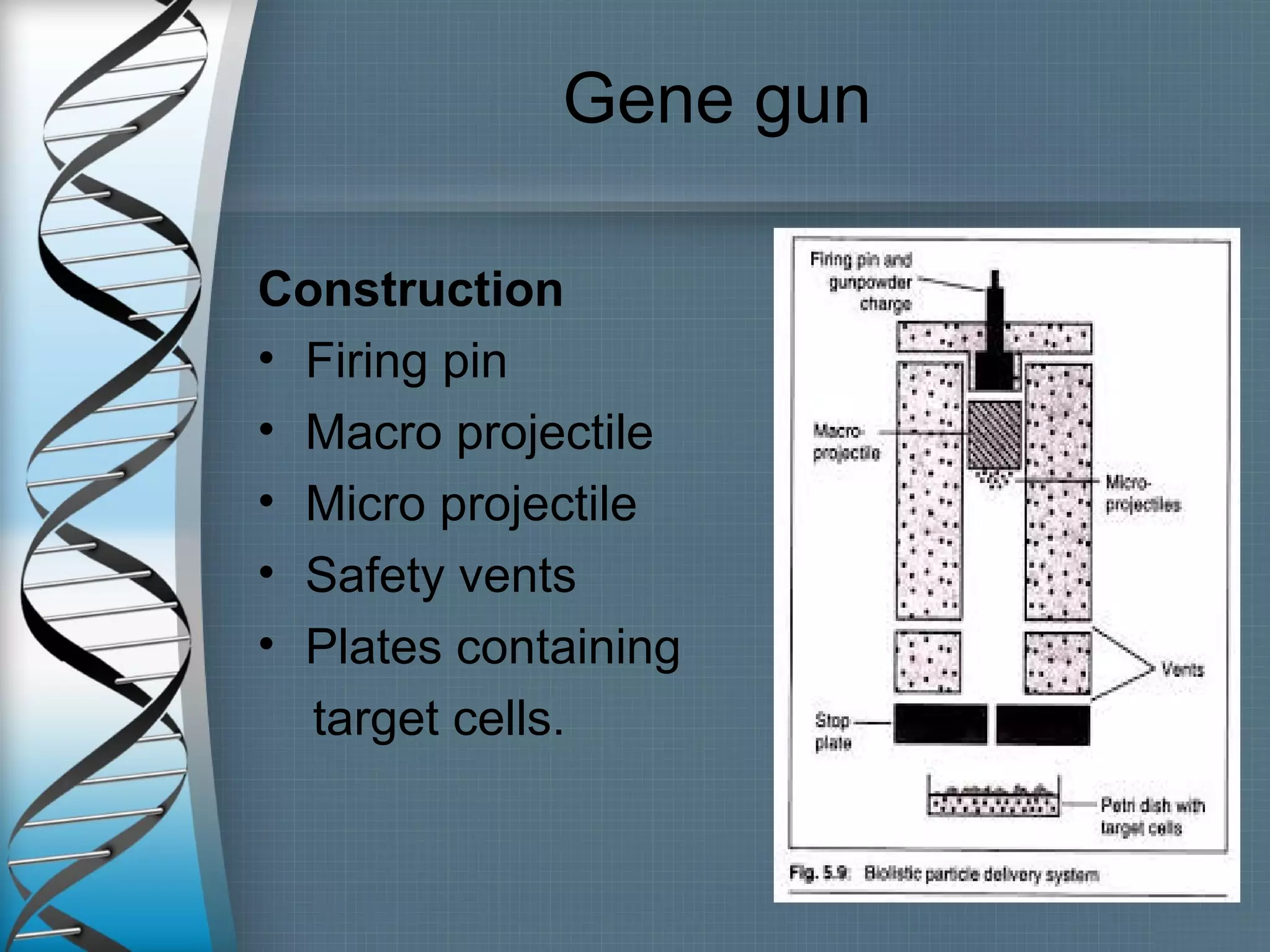
Construction
• Firing pin
• Macro projectile
• Micro projectile
• Safety vents
• Plates containing
target cells.
Operating procedure
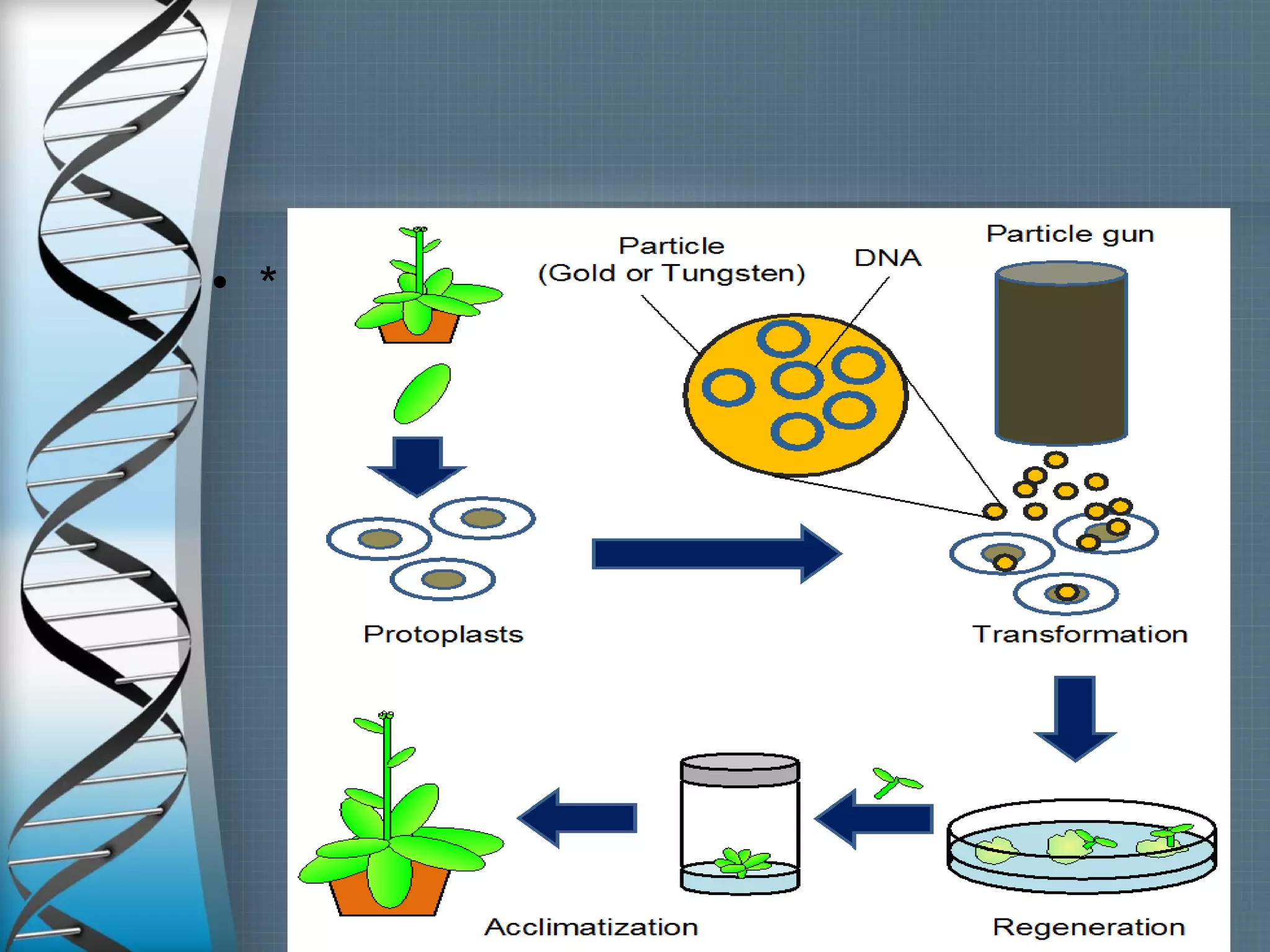
The gene transfer is followed by four basic
operating steps.
• Preparation of DNA loaded beads
• Preparation of plastic tubes.
• Loading of Macro projectile
• Shooting or Transformation
DNA Beads formation
• 250mg gold particles in tube that
are 1.6 micro meter in size.
• Add spermadine
• Prepare DNA solution
• Mix (adhering occur)
• Add IM Cacl2
• Centrifugation
Plastic tube preparation
• Add polyvinyl pyridine to solution
• Inert, dried tubes are used
• Solution is transferred in to tube
• Adhering occur
• Rotation and refurnished
• Incubation
• Cutting of tubes
Loading in macro projectile
• It act as cartridge
• Specified DNA beads in tubes are
loaded in it
Shooting
• Pressurized gas is used
• Distance and pressure ere optimized
• Transfection of cell is done by shooting.
• Ready for transfection.
Success rate is 30 to 50 %
Examples
Nerve cells
Liver cells were transformed
• *
Other methods
Micro injection
• Introduced by Dr Marshall Barber
• Physical technique of
transformation
• Direct transformation of both plant
and animal cells
• It uses micromanipulators
• Syringes of 0.5µm-5µm in diameter
size
Operating mechanism
• Operate under observing lens
• Micromanipulators hold plates
containing target cells and injection
pipettes.
Application
Can be transferred to fertilized ovum
e.g ;as in Dolly fish.
Simple and Cheaper Method .
Easy Handling
Feasible
Visible
Ultrasound
• In 1988 Weber
• It uses ultraviolet micro laser
• (200-400nm)
• Laser induce permeability in cell
• Uptake of DNA
• Example
• Brassica napus
• Less efficient
• Advantages and Disadvantages,
• Physical methods of transformations
Direct method
• Efficient success rate. 30-40 percent.
• Quick gene transfer.
• The limitation are
• Availability
• cost effective tools.
• requires expertise.
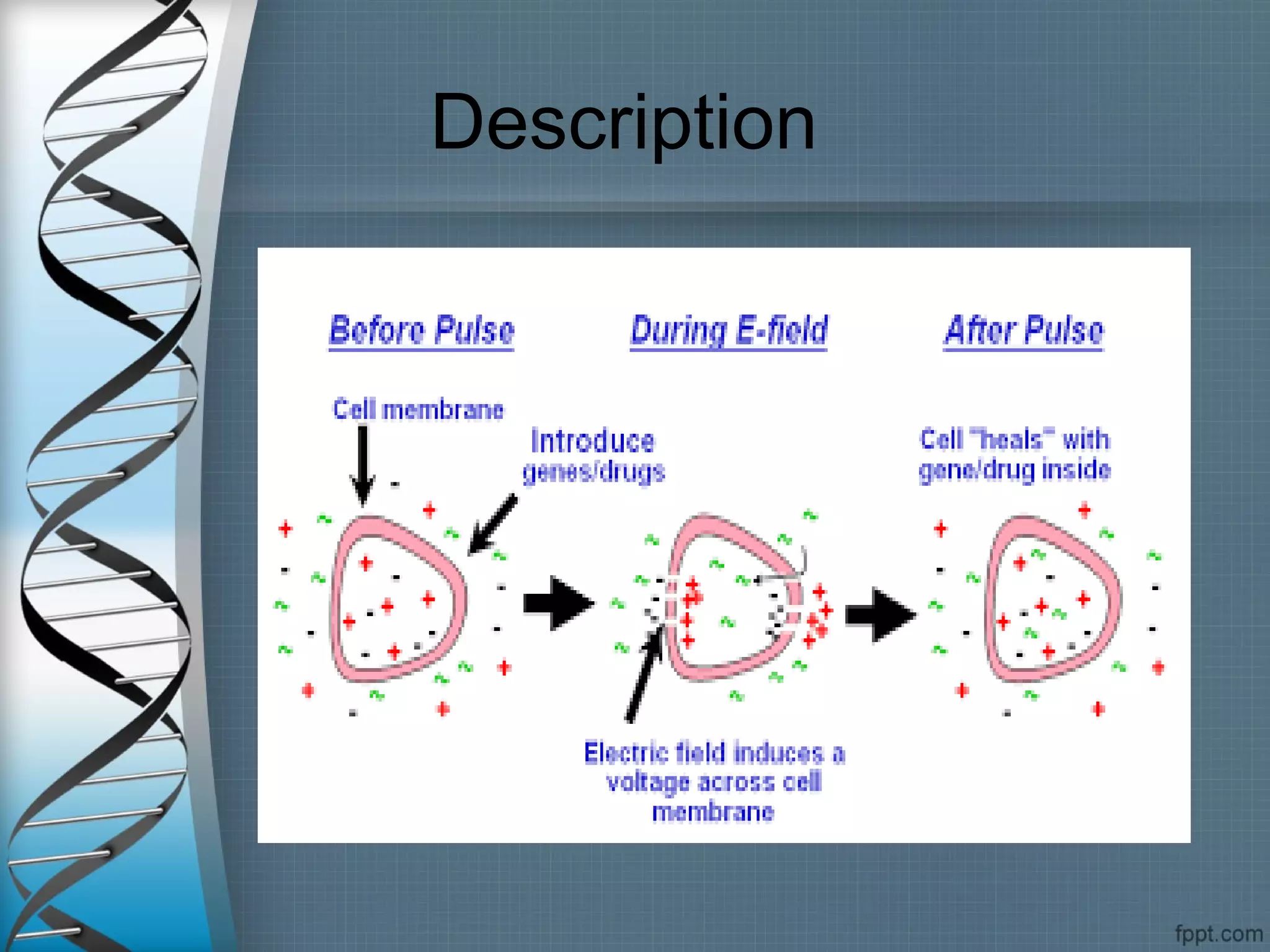
Electroporation
• Physical mean
• Dr Neumann 1982
• Uses electric pulse
• Observed under microscope
• known as electro-permeabilization
• Usually applied for protoplast
transformation
Operating procedure
• Parameters are optimized
• 60-75 Celsius.
• Voltage of 150-160 volt
Description
Stem cell
• Applied on Stem cells
• Are totipotent
• Uses physical tools
• Direct transformation
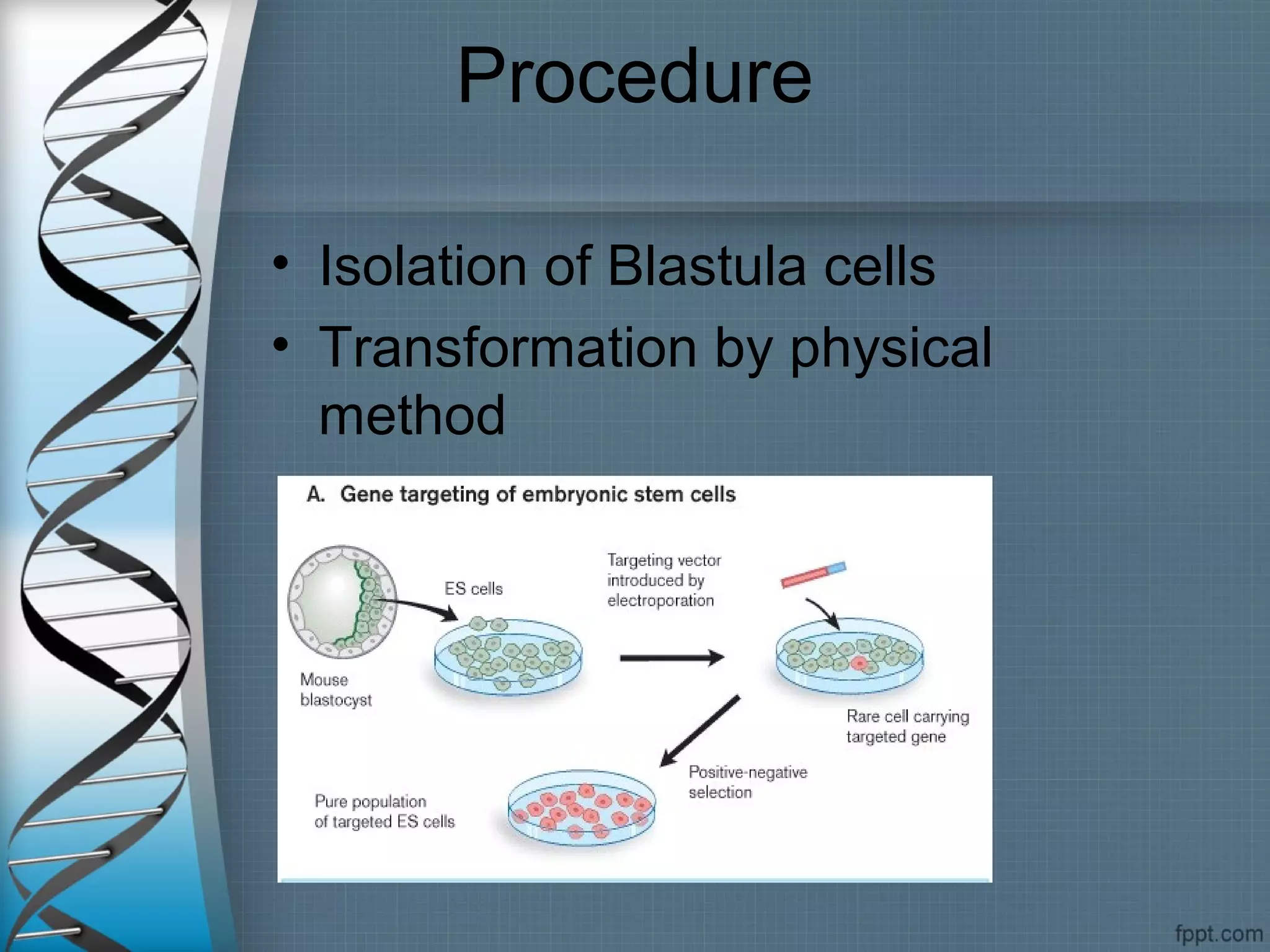
• Embryonic stem cell mediated gene
transfer
Procedure
• Isolation of Blastula cells
• Transformation by physical
method
• Success depend on transformation
tools
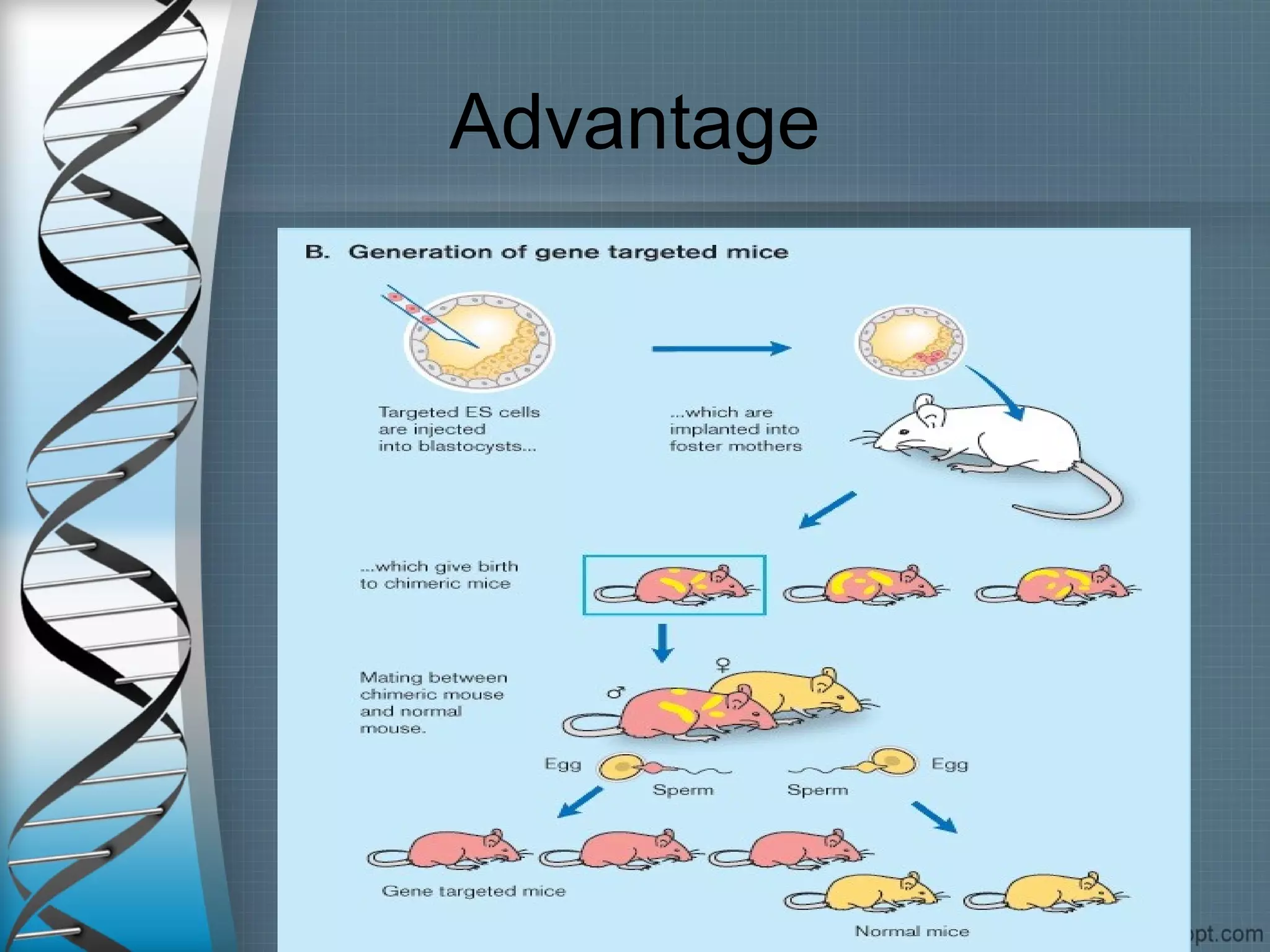
• confirmation of positive clone
• Positive clones are cultures
• Re implantation of positive clones in
blastula
Advantage
Advantages
Transgenic progeny
Short time production
Efficient success rate
Chemical means of gene
transfer
Introduction
• Uses chemical reagents
• targeted delivery
• Less side effects
• Works on binding affinity
Examples
• DEAE dextran
• Calcium phosphate
• Silicon carbide whiskers method.
• Poly-l-ornithine
• Polyethyelenimine
• Polyethylene glycol method
• Liposome’s mediated gene transfer
PEG
• Used for plant transformation
• Fusiogenic chemical
• 40% w/V
• Medium of mannitol
• Chloroplast and protoplast
transformation
Liposome's
• Lipid in nature
• Small in size 5µm-10 µm
• Use for target delivery
• Significance is bilayer
• Lipid soluble layer
• Core i.e. water soluble layer
Liposome
preparation
• Preparation of core
• Preparation of lipid bilayer
• Sonication
• preparation immune-protective
specie
• Addition of homing peptides
• Confirmation
Applications of gene
transfer
• Transgenic animals
• Transgenic crops
• Gene therapy
• Cloning
Examples
• Onions : Agrobacterium
• Barely (Hordeum vulgare)
electroporation
• Insulin by plasmids
• Sorghum by biolistics
• Sunflower by PEG
• . Bibliography
The given facts and figure are sort out from different sources which are given
below accordingly
• GENETIC ENGINEERING principles, procedure and consequences
Author: Gurbachan S.Migalani , published by Narosa
• Genetic Transformation of Plants
Edited by J.F.Jackson and H.F.Linksens by Springer (chapter 2)
• Gene Transfer techniques by Hongbao Ma, Guozhong Chen
[Nature and Science. 2005;3(1):25-31]
• URL:
https://www.google.com.pk/url?sa=t&rct=j&q=&esrc=s&source=web&cd=19&
Question?
If any. Feel free to ask.
Gene transformation techniques

Gene transformation techniques

  • 1.
  • 3.
    Introduction: • Gene alterationor modification is known as gene transformation. • Frederick Griffith 1928 revealed genetic transformation in bacterial strains . • Gene transformation are of two types • Natural transformation • Artificial transformation
  • 4.
    Natural transformation • Conjugation Geneticexchange by cellular contacts Transduction Genetic exchange through a vehicle Like plasmid or vector • Agrobacterium mediated gene transfer
  • 5.
    Why gene transformation •science of transformation starts in 1970 with discovery of restriction enzymes by H-Smith • main purpose includes • Cloning of gene • Production of desired proteins • Enhancement of products • GMOs
  • 6.
    Types • Stable transformation integrationof gene permanently. e.g. agrobacterium mediated • Transient Temporary transformation Liposome mediated
  • 7.
    Genetic transformation techniques • Threecategories • Biological means • Physical means • Chemical means
  • 8.
    Modes of gene transformation •Indirect method It uses carriers e.g. plasmids, vectors, liposome's, • Direct carrier free method e.g. microinjections Gene gun
  • 9.
    Biological Means oftransformation • This technique uses biological systems for gene transfer. • E.g. • Plasmids • Vectors • Cosmid • Phagemids • BACs and YACs • Modified Replication deficient viruses
  • 10.
    Physical means ofgene transformation
  • 11.
    Introduction • It usesphysical tools • Operates direct transformation • Auto regulation of genes i.e. auto integration • It overcomes the work-burden unlike biological means • No side effect and pathogenicity
  • 12.
    Types • The wellknown physical means of gene transformation techniques include, • Gene Gun , Biolistic / Ballistic or Golden Gun method • Microinjections • Electroporation. • Laser beam technique • Ultrasound / Sonication etc
  • 13.
    Gene gun/Golden gun Biolistics •Gene gun is an instrument used to shoot the DNA on target sites. • Invented by John c Sanford in 1985 • Also known as • Golden gun • Ballistics or Biolistics • Particle bombardment method
  • 14.
    Gene gun Construction • Firingpin • Macro projectile • Micro projectile • Safety vents • Plates containing target cells.
  • 15.
    Operating procedure The genetransfer is followed by four basic operating steps. • Preparation of DNA loaded beads • Preparation of plastic tubes. • Loading of Macro projectile • Shooting or Transformation
  • 16.
    DNA Beads formation •250mg gold particles in tube that are 1.6 micro meter in size. • Add spermadine • Prepare DNA solution • Mix (adhering occur) • Add IM Cacl2 • Centrifugation
  • 17.
    Plastic tube preparation •Add polyvinyl pyridine to solution • Inert, dried tubes are used • Solution is transferred in to tube • Adhering occur • Rotation and refurnished • Incubation • Cutting of tubes
  • 18.
    Loading in macroprojectile • It act as cartridge • Specified DNA beads in tubes are loaded in it
  • 19.
    Shooting • Pressurized gasis used • Distance and pressure ere optimized • Transfection of cell is done by shooting. • Ready for transfection. Success rate is 30 to 50 % Examples Nerve cells Liver cells were transformed
  • 20.
  • 21.
  • 22.
    Micro injection • Introducedby Dr Marshall Barber • Physical technique of transformation • Direct transformation of both plant and animal cells • It uses micromanipulators • Syringes of 0.5µm-5µm in diameter size
  • 24.
    Operating mechanism • Operateunder observing lens • Micromanipulators hold plates containing target cells and injection pipettes.
  • 25.
    Application Can be transferredto fertilized ovum e.g ;as in Dolly fish. Simple and Cheaper Method . Easy Handling Feasible Visible
  • 26.
    Ultrasound • In 1988Weber • It uses ultraviolet micro laser • (200-400nm) • Laser induce permeability in cell • Uptake of DNA • Example • Brassica napus • Less efficient
  • 27.
    • Advantages andDisadvantages, • Physical methods of transformations Direct method • Efficient success rate. 30-40 percent. • Quick gene transfer. • The limitation are • Availability • cost effective tools. • requires expertise.
  • 28.
    Electroporation • Physical mean •Dr Neumann 1982 • Uses electric pulse • Observed under microscope • known as electro-permeabilization • Usually applied for protoplast transformation
  • 29.
    Operating procedure • Parametersare optimized • 60-75 Celsius. • Voltage of 150-160 volt
  • 30.
  • 31.
    Stem cell • Appliedon Stem cells • Are totipotent • Uses physical tools • Direct transformation • Embryonic stem cell mediated gene transfer
  • 32.
    Procedure • Isolation ofBlastula cells • Transformation by physical method
  • 33.
    • Success dependon transformation tools • confirmation of positive clone • Positive clones are cultures • Re implantation of positive clones in blastula
  • 34.
  • 35.
    Advantages Transgenic progeny Short timeproduction Efficient success rate
  • 36.
    Chemical means ofgene transfer
  • 37.
    Introduction • Uses chemicalreagents • targeted delivery • Less side effects • Works on binding affinity
  • 38.
    Examples • DEAE dextran •Calcium phosphate • Silicon carbide whiskers method. • Poly-l-ornithine • Polyethyelenimine • Polyethylene glycol method • Liposome’s mediated gene transfer
  • 39.
    PEG • Used forplant transformation • Fusiogenic chemical • 40% w/V • Medium of mannitol • Chloroplast and protoplast transformation
  • 40.
    Liposome's • Lipid innature • Small in size 5µm-10 µm • Use for target delivery • Significance is bilayer • Lipid soluble layer • Core i.e. water soluble layer
  • 41.
  • 42.
    preparation • Preparation ofcore • Preparation of lipid bilayer • Sonication • preparation immune-protective specie • Addition of homing peptides • Confirmation
  • 44.
    Applications of gene transfer •Transgenic animals • Transgenic crops • Gene therapy • Cloning
  • 45.
    Examples • Onions :Agrobacterium • Barely (Hordeum vulgare) electroporation • Insulin by plasmids • Sorghum by biolistics • Sunflower by PEG
  • 46.
    • . Bibliography Thegiven facts and figure are sort out from different sources which are given below accordingly • GENETIC ENGINEERING principles, procedure and consequences Author: Gurbachan S.Migalani , published by Narosa • Genetic Transformation of Plants Edited by J.F.Jackson and H.F.Linksens by Springer (chapter 2) • Gene Transfer techniques by Hongbao Ma, Guozhong Chen [Nature and Science. 2005;3(1):25-31] • URL: https://www.google.com.pk/url?sa=t&rct=j&q=&esrc=s&source=web&cd=19&
  • 47.