RECOVERY &
PURIFICATION OF
FERMENTATION
PRODUCTS
Aqeela Ashraf
Introduction to Purification
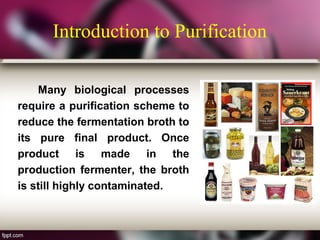
Many biological processes
require a purification scheme to
reduce the fermentation broth to
its pure final product. Once
product is made in the
production fermenter, the broth
is still highly contaminated.
Factors for deciding the extraction
method
• The value of the final product.
• The degree of purity required.
• The chemical and physical properties of the
product.
• The location of the product in the mixture i.e.
whether it is free within the medium or is cell-
bound.
• The location and properties of the impurities.
• The cost-effectiveness of the available alternate
isolation procedures.
Extraction
Extraction is used to liberate a product of microbial growth from
the cells or cellular constituents that served as the enzyme source
either by mechanical or non-mechanical means.
Mechanical Extraction
• Mechanical disruption of the cell is easy to achieve on a small
scale but can fail when used industrially
• High Pressure Homogenizer
- A positive displacement pump with an adjustable valve, has been used
to break microorganisms like Aspergillus niger, Escherichia coli, and
Bacillus megatherium.
- When cell concentration is high, the spores or mycelia from the
microorganism can clog the valve
• High Speed Ball Mill
- Used for release of proteins within yeast
Extraction
Non-mechanical Extraction
• Desiccation
- Air drying that must be followed by buffer extraction
• Physical and Chemical Lysis
- Osmotic shock produced by an abrupt change in salt
concentration of the medium
• Solvent Extraction
- Liquid extraction of a product from soluble particles within the
cell
- Must choose solvent accordingly, and purification efforts will
follow to recover product from solvent
Cell disruption (for intracellular
enzymes)
• Sonication
– Use of high frequency sound waves to disrupt cell walls and
membranes
• Can be used as continuous lysis method
• Better suited to small (lab-scale) operations
• Can damage sensitive proteins
• Pressure cells
– Apply apply high pressure to cells; cells fracture as pressure is
abruptly released
• Readily adapted to large-scale and continuous operations
• Industry standard (Manton-Gaulin cell disruptor)
• Enzymic lysis
– Certain enzymes lyse cell walls
• Lysozyme for bacteria; chitinase for fungi
• Only useful on small laboratory scale
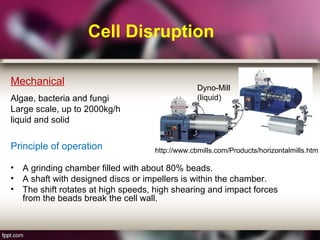
Cell Disruption
Mechanical
Algae, bacteria and fungi
Large scale, up to 2000kg/h
liquid and solid
Principle of operation
• A grinding chamber filled with about 80% beads.
• A shaft with designed discs or impellers is within the chamber.
• The shift rotates at high speeds, high shearing and impact forces
from the beads break the cell wall.
http://www.cbmills.com/Products/horizontalmills.htm
Dyno-Mill
(liquid)
Cell Disruption
Mechanical
Ball Mill
Solid Frozen cell paste, cells attached to or within a solid
matrix.
Large scale
http://www.unitednuclear.com/mills.htm
Cell Disruption
Challenge: Damage to the product
- Heat denaturation
- Oxidation of the product
- Unhindered release of all intracellular products
Precipitation
Precipitation is a procedure where the addition of a ionic solution
to an ionic fermentation broth forms insoluble particles, where
the desired product is usually contained within those particles.
Ionic fermentation broths usually consist of enzymes or proteins.
The ways to precipitate out a product can vary from simple pH
and temperature changes to chemical reactions involving metal
ions. Precipitation reactions are carried out in reactors,
continuous and batch.
Precipitation
Precipitation by Organic Solvents
• By adding an organic solvent to an aqueous fermentation broth, the
dielectric constant will decrease causing the solubility to decrease
• Often used industrially because it’s inexpensive and simple
Precipitation by Metal Ions
• Metal salts with lower solubilities can formed by enzymes and
proteins
• Nucleic acids, which are present in microbial cells, must be
removed prior to this type of precipitation because they reduce the
resolution of separation
• Salts can be used to selectively precipitate out those nucleic acids
Coagulation and Flocculation
Coagulation is defined for biological processes to be when small
particles directly adhere to each other, while flocculation is when
an agent acts as a bridge that joins particles together.
Coagulation and flocculation techniques are usually applied to
either whole cells, cell debris, or soluble proteins.
Whole Cells
• Many flocculation agents are used to separate products, such as
anionic and cationic electrolytes, polyamines, alumina, and
synthetic polymers
• Less information is known about coagulants, but some studied
inorganic coagulants have been alum, ferric salts, and calcium salts
Coagulation and Flocculation
Cell Debris and Proteins
• Coagulation and flocculation are useful techniques in
removing the cell debris that can be produced during
mechanical agitation
• Coagulation and flocculation can be used alternatively
to precipitation methods to remove enzymes
• The same agents for whole cell removal can be applied
to cell debris and protein removal
Centrifugation
Centrifugation involves separation of liquids and particles
based on density. Centrifugation can be used to separate cells
from a culture liquid, cell debris from a broth, and a group of
precipitates
• Tubular Bowl Centrifuge
• Disc Bowl Centrifuge
• Perforate Bowl Basket Centrifuge
Filtration
Filters use a filter cloth or some porous material along with
applied pressure to push smaller particles through the filter, thus
separating elements of the solution based on size. Filtration for
biological materials is generally completed using batch filtration,
rotary drum filtration, or ultra filtration methods e.g..,
Batch Filtration
Rotary Drum Filtration
Ultra filtration
purification of products in the
soluble portion
Separation of Soluble Products
:
Reduce the product solubility in the fermentation
broth by adding chemicals.
Applicable: separate proteins or antibiotics from
fermentation broth.
Separation of Soluble Products
Membrane separation
- Microfiltration: 0.1 - 10 µm, bacterial and yeast cells.
- Ultrafiltration: macromolecules (2000 <MW< 500,000)
- Dialysis: removal of low-MW solutes: organic acids
(100<MW<500) and inorganic ions (10<MW<100).
- Reverse osmosis: a pressure is applied onto a salt-containing
phase, which drives water from a low to a high concentration
region. MW < 300.
Chromatography
To separate the solutes based on the different rate of movement
of the solutes in the column with adsorbent materials.
Principles
Chromatographic processes involve a stationary phase and a
mobile phase.
Stationary phase can be adsorbent, ion-exchange resin, porous
solid, or gel usually packed in a cylindrical column.
Mobile phase is the solution containing solutes to be separated
and the eluant that carriers the solution through the stationary
phase.
Applicable for protein, organics separation.
Separation of Soluble Products
• Adsorption chromatography
– Ion exchange chromatography – binding
and separation of proteins based on
charge-charge interactions
– Proteins bind at low ionic strength, and
are eluted at high ionic strength
Protein purification
Affinity chromatography
Binding of a protein to a matrix via a protein-specific
ligand
• Substrate or product analogue
• Antibody
• Inhibitor analogue
• Cofactor/coenzyme
Specific protein is eluted by adding reagent which
competes with binding
Gel permeation chromatography
(GPC)
• Also known as ‘size exclusion chromatography’
and ‘gel filtration chromatography’
• Separates molecules on the basis of molecular
size
• Separation is based on the use of a porous
matrix. Small molecules penetrate into the matrix
more, and their path length of elution is longer.
• Large molecules appear first, smaller molecules
later
Separation of Soluble Products
Electrophoresis
To separate charged solutes based on their specific migration
rates in an electrical field.
Positive charged solutes are attracted to anode and negative
charged solutes to cathode.
Factors: electric field strength, electric charge of the solutes,
viscosity of liquid and the particles size.
Applicable for protein separation.
Recovery and Purification of Bio-
Products
Crystallization
Last step in producing highly purified products such as antibiotics.
Supersaturated solution, low temperature, Crystals are separated by
filters.
Drying
To remove solvent from purified wet product such as crystal or
dissolved solute.
Vaccum-tray dryers: pharmaceutical products
Freezing drying: by sublimation (from solid ice to vapor), antibiotics,
enzyme, bacteria
Spray dryer: heat-sensitive materials
Downstream processing depends
on product use
1. Enzyme preparations for animal feed
supplementation (e.g., phytase) are not purified
2. Enzymes for industrial use may be partially
purified (e.g., amylase for starch industry)
3. Enzymes for analytical use (e.g., glucose
oxidase) and pharmaceutical proteins (e.g.,
TPA) are very highly purified
Summary of separation and
purification
• Liquid-Solid Separation
- Filtration: micro- and ultra- filtration
- Centrifugation
• Cell disruption
- Mechanical: ultrasonication, milling, homogenization
- Nonmechanical: chemicals, enzyme and osmotic
shock
Summary of separation and
purification
• Separation of soluble products
- Precipitation
- Adsorption
- Membrane separation: ultra filtration, dialysis, reverse
osmosis
- Chromatography
- Electrophoresis
• Crystallization and drying
Fermentation

Fermentation

  • 1.
  • 2.
    Introduction to Purification Manybiological processes require a purification scheme to reduce the fermentation broth to its pure final product. Once product is made in the production fermenter, the broth is still highly contaminated.
  • 3.
    Factors for decidingthe extraction method • The value of the final product. • The degree of purity required. • The chemical and physical properties of the product. • The location of the product in the mixture i.e. whether it is free within the medium or is cell- bound. • The location and properties of the impurities. • The cost-effectiveness of the available alternate isolation procedures.
  • 4.
    Extraction Extraction is usedto liberate a product of microbial growth from the cells or cellular constituents that served as the enzyme source either by mechanical or non-mechanical means. Mechanical Extraction • Mechanical disruption of the cell is easy to achieve on a small scale but can fail when used industrially • High Pressure Homogenizer - A positive displacement pump with an adjustable valve, has been used to break microorganisms like Aspergillus niger, Escherichia coli, and Bacillus megatherium. - When cell concentration is high, the spores or mycelia from the microorganism can clog the valve • High Speed Ball Mill - Used for release of proteins within yeast
  • 5.
    Extraction Non-mechanical Extraction • Desiccation -Air drying that must be followed by buffer extraction • Physical and Chemical Lysis - Osmotic shock produced by an abrupt change in salt concentration of the medium • Solvent Extraction - Liquid extraction of a product from soluble particles within the cell - Must choose solvent accordingly, and purification efforts will follow to recover product from solvent
  • 6.
    Cell disruption (forintracellular enzymes) • Sonication – Use of high frequency sound waves to disrupt cell walls and membranes • Can be used as continuous lysis method • Better suited to small (lab-scale) operations • Can damage sensitive proteins • Pressure cells – Apply apply high pressure to cells; cells fracture as pressure is abruptly released • Readily adapted to large-scale and continuous operations • Industry standard (Manton-Gaulin cell disruptor) • Enzymic lysis – Certain enzymes lyse cell walls • Lysozyme for bacteria; chitinase for fungi • Only useful on small laboratory scale
  • 7.
    Cell Disruption Mechanical Algae, bacteriaand fungi Large scale, up to 2000kg/h liquid and solid Principle of operation • A grinding chamber filled with about 80% beads. • A shaft with designed discs or impellers is within the chamber. • The shift rotates at high speeds, high shearing and impact forces from the beads break the cell wall. http://www.cbmills.com/Products/horizontalmills.htm Dyno-Mill (liquid)
  • 8.
    Cell Disruption Mechanical Ball Mill SolidFrozen cell paste, cells attached to or within a solid matrix. Large scale http://www.unitednuclear.com/mills.htm
  • 9.
    Cell Disruption Challenge: Damageto the product - Heat denaturation - Oxidation of the product - Unhindered release of all intracellular products
  • 10.
    Precipitation Precipitation is aprocedure where the addition of a ionic solution to an ionic fermentation broth forms insoluble particles, where the desired product is usually contained within those particles. Ionic fermentation broths usually consist of enzymes or proteins. The ways to precipitate out a product can vary from simple pH and temperature changes to chemical reactions involving metal ions. Precipitation reactions are carried out in reactors, continuous and batch.
  • 11.
    Precipitation Precipitation by OrganicSolvents • By adding an organic solvent to an aqueous fermentation broth, the dielectric constant will decrease causing the solubility to decrease • Often used industrially because it’s inexpensive and simple Precipitation by Metal Ions • Metal salts with lower solubilities can formed by enzymes and proteins • Nucleic acids, which are present in microbial cells, must be removed prior to this type of precipitation because they reduce the resolution of separation • Salts can be used to selectively precipitate out those nucleic acids
  • 12.
    Coagulation and Flocculation Coagulationis defined for biological processes to be when small particles directly adhere to each other, while flocculation is when an agent acts as a bridge that joins particles together. Coagulation and flocculation techniques are usually applied to either whole cells, cell debris, or soluble proteins. Whole Cells • Many flocculation agents are used to separate products, such as anionic and cationic electrolytes, polyamines, alumina, and synthetic polymers • Less information is known about coagulants, but some studied inorganic coagulants have been alum, ferric salts, and calcium salts
  • 13.
    Coagulation and Flocculation CellDebris and Proteins • Coagulation and flocculation are useful techniques in removing the cell debris that can be produced during mechanical agitation • Coagulation and flocculation can be used alternatively to precipitation methods to remove enzymes • The same agents for whole cell removal can be applied to cell debris and protein removal
  • 14.
    Centrifugation Centrifugation involves separationof liquids and particles based on density. Centrifugation can be used to separate cells from a culture liquid, cell debris from a broth, and a group of precipitates • Tubular Bowl Centrifuge • Disc Bowl Centrifuge • Perforate Bowl Basket Centrifuge
  • 15.
    Filtration Filters use afilter cloth or some porous material along with applied pressure to push smaller particles through the filter, thus separating elements of the solution based on size. Filtration for biological materials is generally completed using batch filtration, rotary drum filtration, or ultra filtration methods e.g.., Batch Filtration Rotary Drum Filtration Ultra filtration
  • 16.
    purification of productsin the soluble portion
  • 17.
    Separation of SolubleProducts : Reduce the product solubility in the fermentation broth by adding chemicals. Applicable: separate proteins or antibiotics from fermentation broth.
  • 18.
    Separation of SolubleProducts Membrane separation - Microfiltration: 0.1 - 10 µm, bacterial and yeast cells. - Ultrafiltration: macromolecules (2000 <MW< 500,000) - Dialysis: removal of low-MW solutes: organic acids (100<MW<500) and inorganic ions (10<MW<100). - Reverse osmosis: a pressure is applied onto a salt-containing phase, which drives water from a low to a high concentration region. MW < 300.
  • 19.
    Chromatography To separate thesolutes based on the different rate of movement of the solutes in the column with adsorbent materials. Principles Chromatographic processes involve a stationary phase and a mobile phase. Stationary phase can be adsorbent, ion-exchange resin, porous solid, or gel usually packed in a cylindrical column. Mobile phase is the solution containing solutes to be separated and the eluant that carriers the solution through the stationary phase. Applicable for protein, organics separation. Separation of Soluble Products
  • 20.
    • Adsorption chromatography –Ion exchange chromatography – binding and separation of proteins based on charge-charge interactions – Proteins bind at low ionic strength, and are eluted at high ionic strength Protein purification
  • 21.
    Affinity chromatography Binding ofa protein to a matrix via a protein-specific ligand • Substrate or product analogue • Antibody • Inhibitor analogue • Cofactor/coenzyme Specific protein is eluted by adding reagent which competes with binding
  • 22.
    Gel permeation chromatography (GPC) •Also known as ‘size exclusion chromatography’ and ‘gel filtration chromatography’ • Separates molecules on the basis of molecular size • Separation is based on the use of a porous matrix. Small molecules penetrate into the matrix more, and their path length of elution is longer. • Large molecules appear first, smaller molecules later
  • 23.
    Separation of SolubleProducts Electrophoresis To separate charged solutes based on their specific migration rates in an electrical field. Positive charged solutes are attracted to anode and negative charged solutes to cathode. Factors: electric field strength, electric charge of the solutes, viscosity of liquid and the particles size. Applicable for protein separation.
  • 24.
    Recovery and Purificationof Bio- Products Crystallization Last step in producing highly purified products such as antibiotics. Supersaturated solution, low temperature, Crystals are separated by filters. Drying To remove solvent from purified wet product such as crystal or dissolved solute. Vaccum-tray dryers: pharmaceutical products Freezing drying: by sublimation (from solid ice to vapor), antibiotics, enzyme, bacteria Spray dryer: heat-sensitive materials
  • 25.
    Downstream processing depends onproduct use 1. Enzyme preparations for animal feed supplementation (e.g., phytase) are not purified 2. Enzymes for industrial use may be partially purified (e.g., amylase for starch industry) 3. Enzymes for analytical use (e.g., glucose oxidase) and pharmaceutical proteins (e.g., TPA) are very highly purified
  • 26.
    Summary of separationand purification • Liquid-Solid Separation - Filtration: micro- and ultra- filtration - Centrifugation • Cell disruption - Mechanical: ultrasonication, milling, homogenization - Nonmechanical: chemicals, enzyme and osmotic shock
  • 27.
    Summary of separationand purification • Separation of soluble products - Precipitation - Adsorption - Membrane separation: ultra filtration, dialysis, reverse osmosis - Chromatography - Electrophoresis • Crystallization and drying

Editor's Notes

  • #10 Wiki-pedia: As the difficulty of disruption increases (e.g. E. coli), more force is required to efficiently disrupt the cells. For even more difficult samples (e.g. yeast), there is a parallel increase in the processor power and cost. The most difficult samples (e.g. spores) require mechanical forces combined with chemical or enzymatic efforts, often with limited disruption efficiency.