The document presents different methods for expressing concentrations of solutions, including normality, molarity, molality, percent solutions, formal concentration, and parts per million (ppm). Each method is defined with examples, particularly using sodium hydroxide (NaOH) and hydrochloric acid (HCl). References for further reading on the topic are also provided.
Method of ExpressingConcentrations
Presentation by,
Mr. Prashant B. Patil
Assistant Professor
H R Patel Institute of Pharmaceutical Education and Research, Shirpur
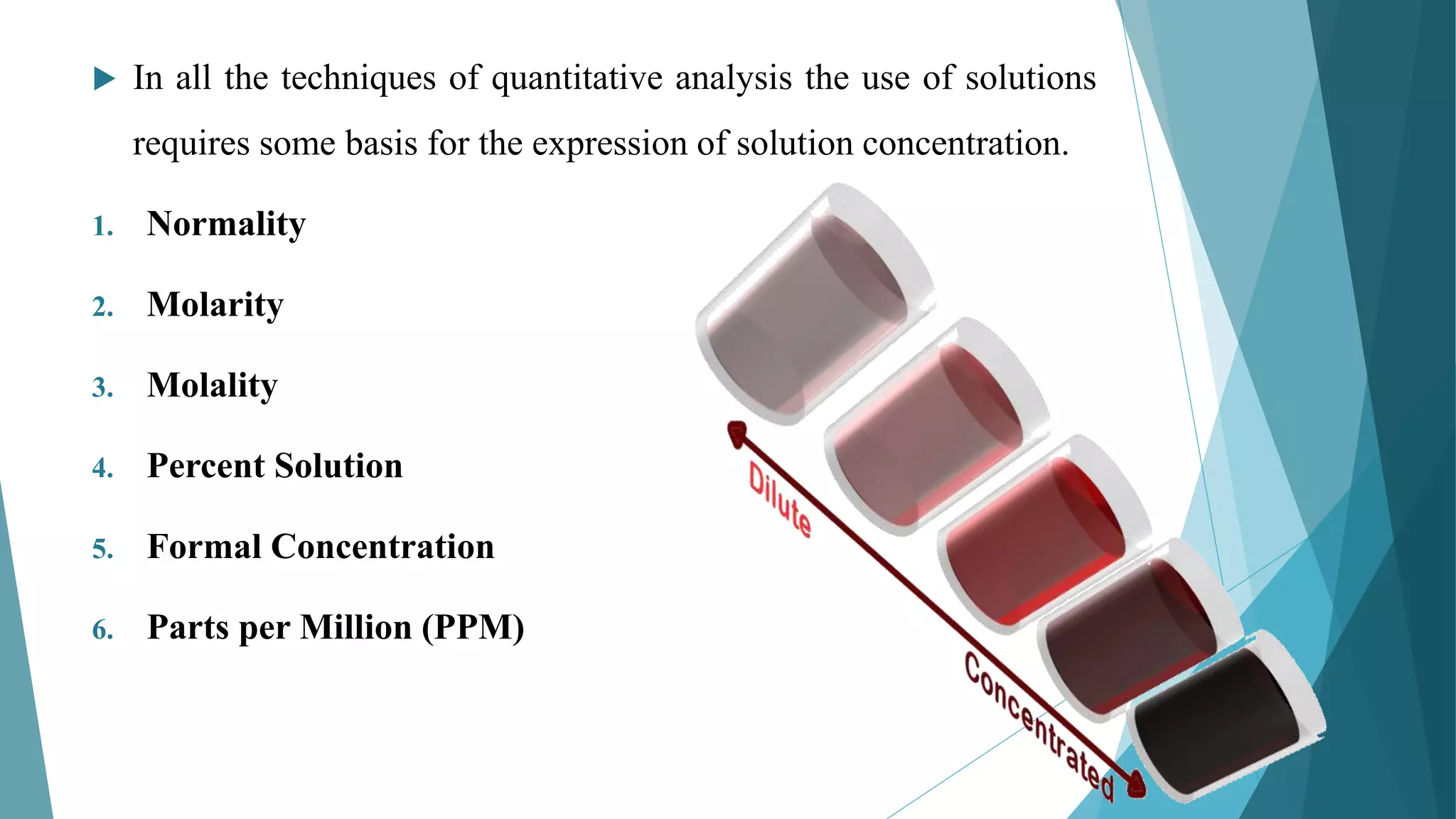
In allthe techniques of quantitative analysis the use of solutions
requires some basis for the expression of solution concentration.
1. Normality
2. Molarity
3. Molality
4. Percent Solution
5. Formal Concentration
6. Parts per Million (PPM)
4.
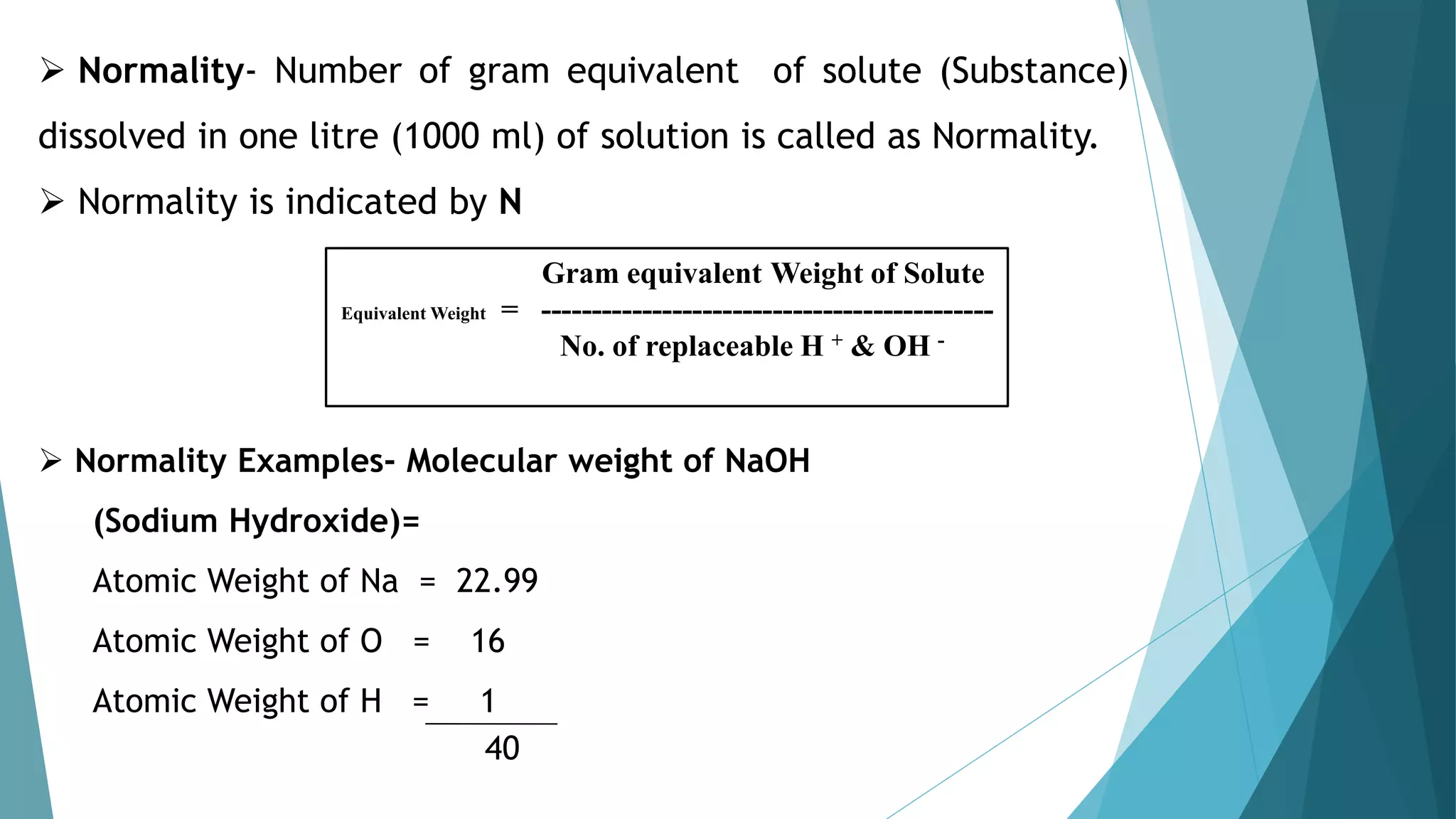
Normality- Numberof gram equivalent of solute (Substance)
dissolved in one litre (1000 ml) of solution is called as Normality.
Normality is indicated by N
Normality Examples- Molecular weight of NaOH
(Sodium Hydroxide)=
Atomic Weight of Na = 22.99
Atomic Weight of O = 16
Atomic Weight of H = 1
40
Gram equivalent Weight of Solute
Equivalent Weight = ---------------------------------------------
No. of replaceable H + & OH -
5.
- 1N =40 gm of NaOH is Dissolved in 1000 ml of water (H2O)
- 0.1 N = 4 gm of NaOH is Dissolved in 1000 ml of water
(H2O)
- 0.01N = 0.4 gm of NaOH is Dissolved in 1000 ml of water
(H2O)
6.
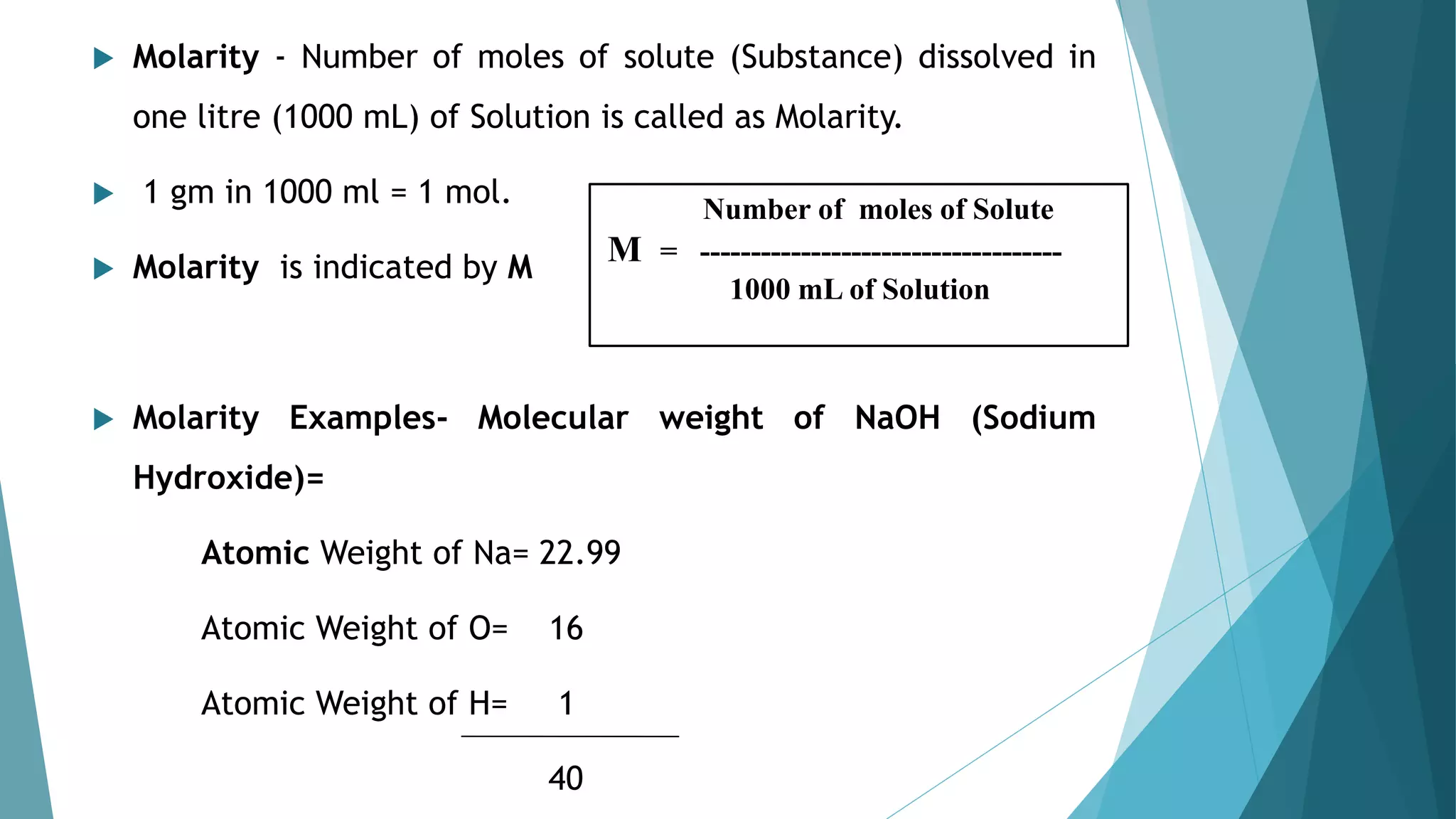
Molarity -Number of moles of solute (Substance) dissolved in
one litre (1000 mL) of Solution is called as Molarity.
1 gm in 1000 ml = 1 mol.
Molarity is indicated by M
Molarity Examples- Molecular weight of NaOH (Sodium
Hydroxide)=
Atomic Weight of Na= 22.99
Atomic Weight of O= 16
Atomic Weight of H= 1
40
Number of moles of Solute
M = ------------------------------------
1000 mL of Solution
7.
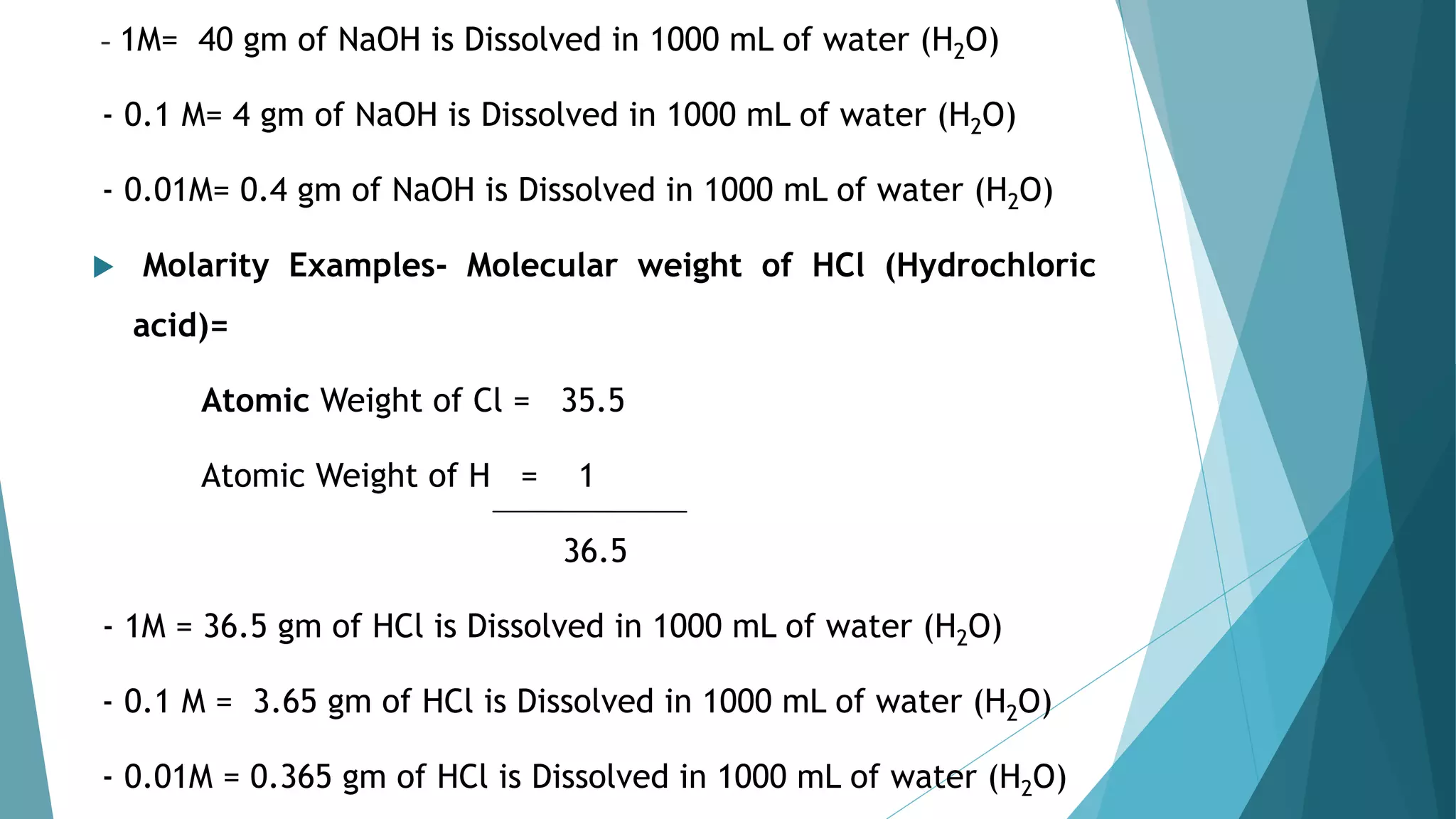
- 1M= 40gm of NaOH is Dissolved in 1000 mL of water (H2O)
- 0.1 M= 4 gm of NaOH is Dissolved in 1000 mL of water (H2O)
- 0.01M= 0.4 gm of NaOH is Dissolved in 1000 mL of water (H2O)
Molarity Examples- Molecular weight of HCl (Hydrochloric
acid)=
Atomic Weight of Cl = 35.5
Atomic Weight of H = 1
36.5
- 1M = 36.5 gm of HCl is Dissolved in 1000 mL of water (H2O)
- 0.1 M = 3.65 gm of HCl is Dissolved in 1000 mL of water (H2O)
- 0.01M = 0.365 gm of HCl is Dissolved in 1000 mL of water (H2O)
8.
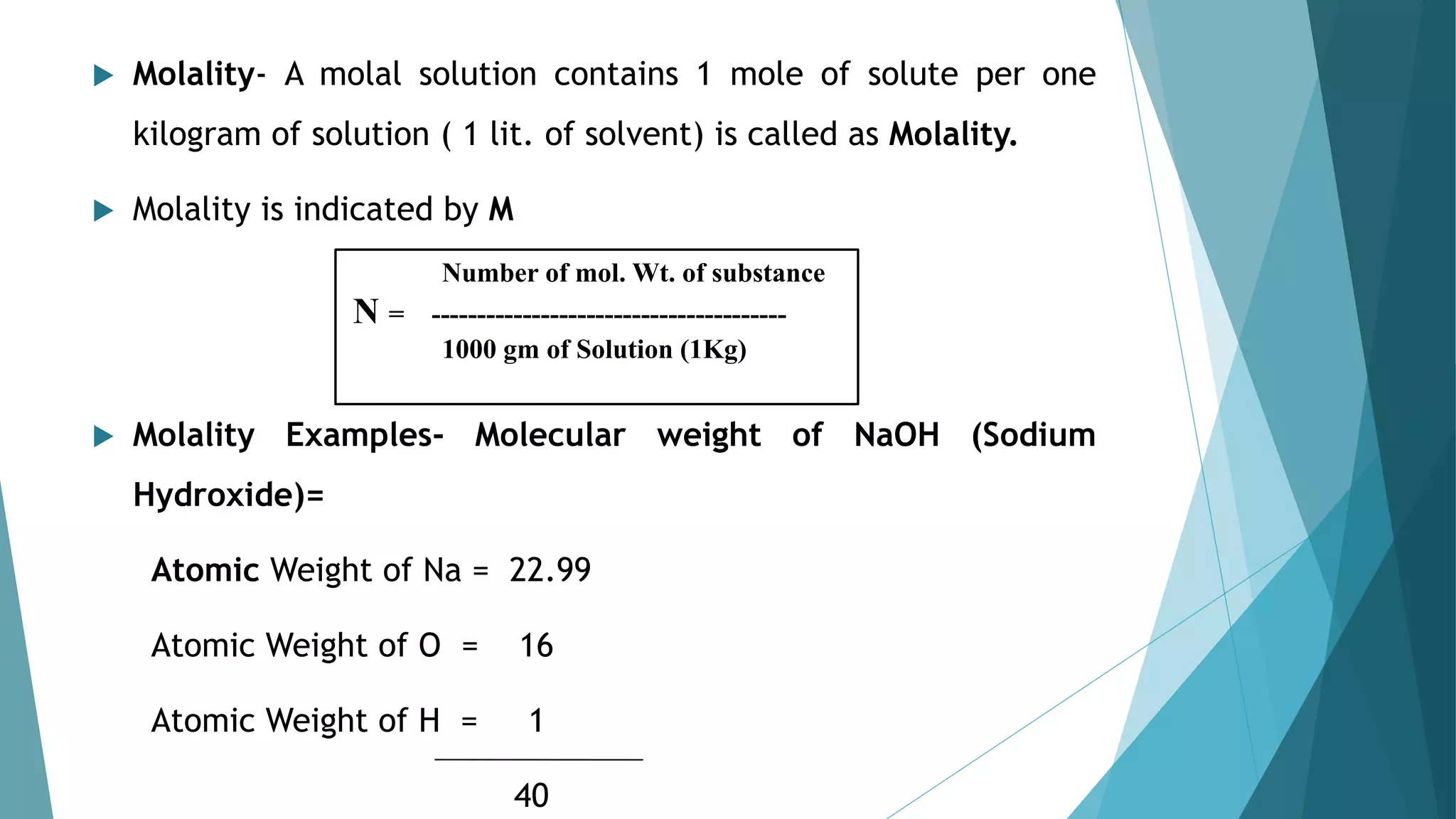
Molality- Amolal solution contains 1 mole of solute per one
kilogram of solution ( 1 lit. of solvent) is called as Molality.
Molality is indicated by M
Molality Examples- Molecular weight of NaOH (Sodium
Hydroxide)=
Atomic Weight of Na = 22.99
Atomic Weight of O = 16
Atomic Weight of H = 1
40
Number of mol. Wt. of substance
N = ---------------------------------------
1000 gm of Solution (1Kg)
9.
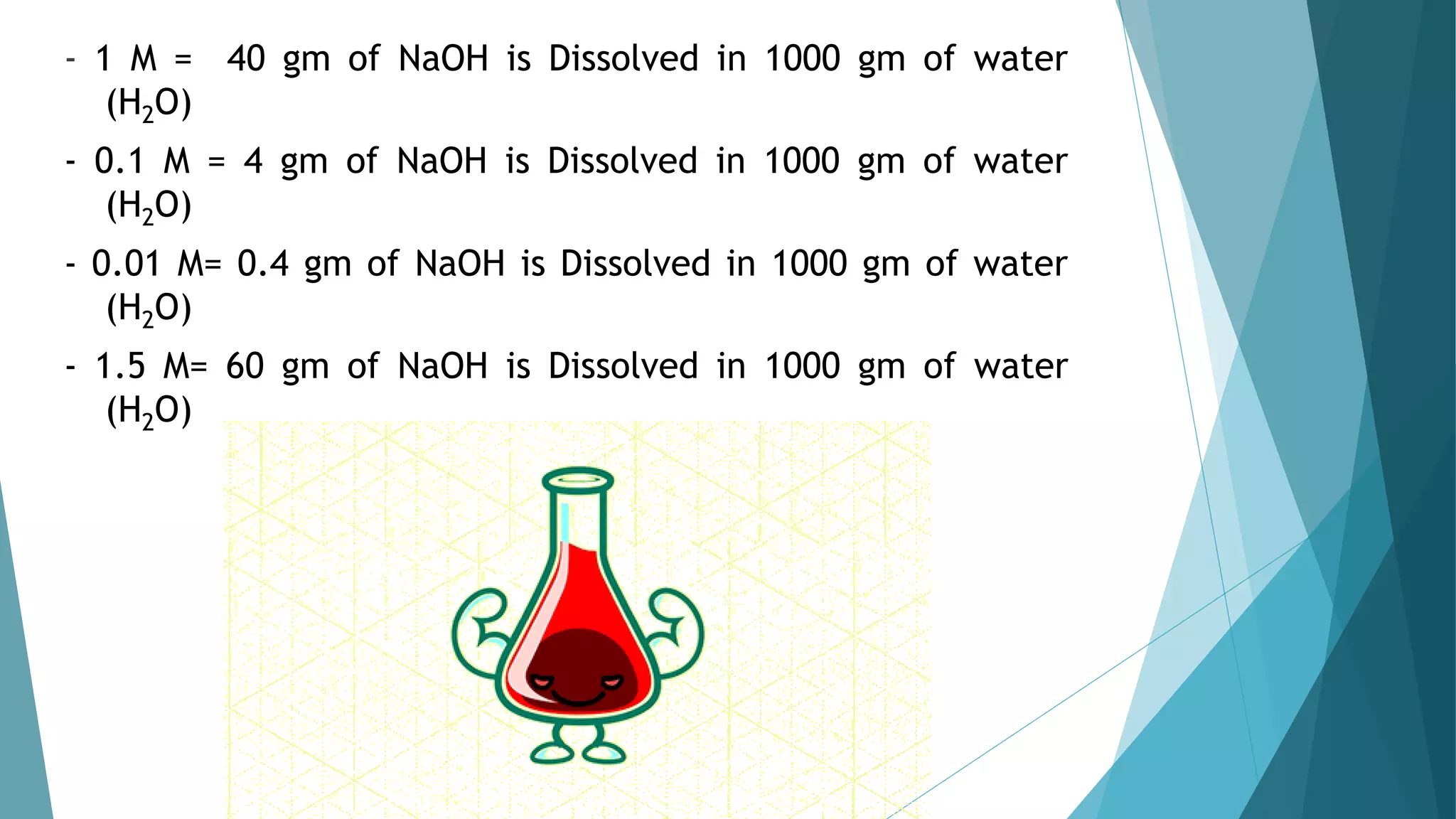
- 1 M= 40 gm of NaOH is Dissolved in 1000 gm of water
(H2O)
- 0.1 M = 4 gm of NaOH is Dissolved in 1000 gm of water
(H2O)
- 0.01 M= 0.4 gm of NaOH is Dissolved in 1000 gm of water
(H2O)
- 1.5 M= 60 gm of NaOH is Dissolved in 1000 gm of water
(H2O)
10.
Percent (%)Solution
Sometimes the concentration is expressed in terms of per cent
(parts per hundred) also. Per cent Composition of a solution can
be expressed as:
1. Per cent W/W = Weight of solute/ Weight of solution X 100
2. Per cent V/V = Volume of solute/ Volume of solution X 100
3. Per cent W/V= Weight of solute/ Volume of solution X 100
1 %= 1gm of KCl ----------- in 100 ml of water
10 % = 10 gm of KCl ----------- in 100 ml of water
100 % = 100 gm of KCl ----------- in 100 ml of water
11.
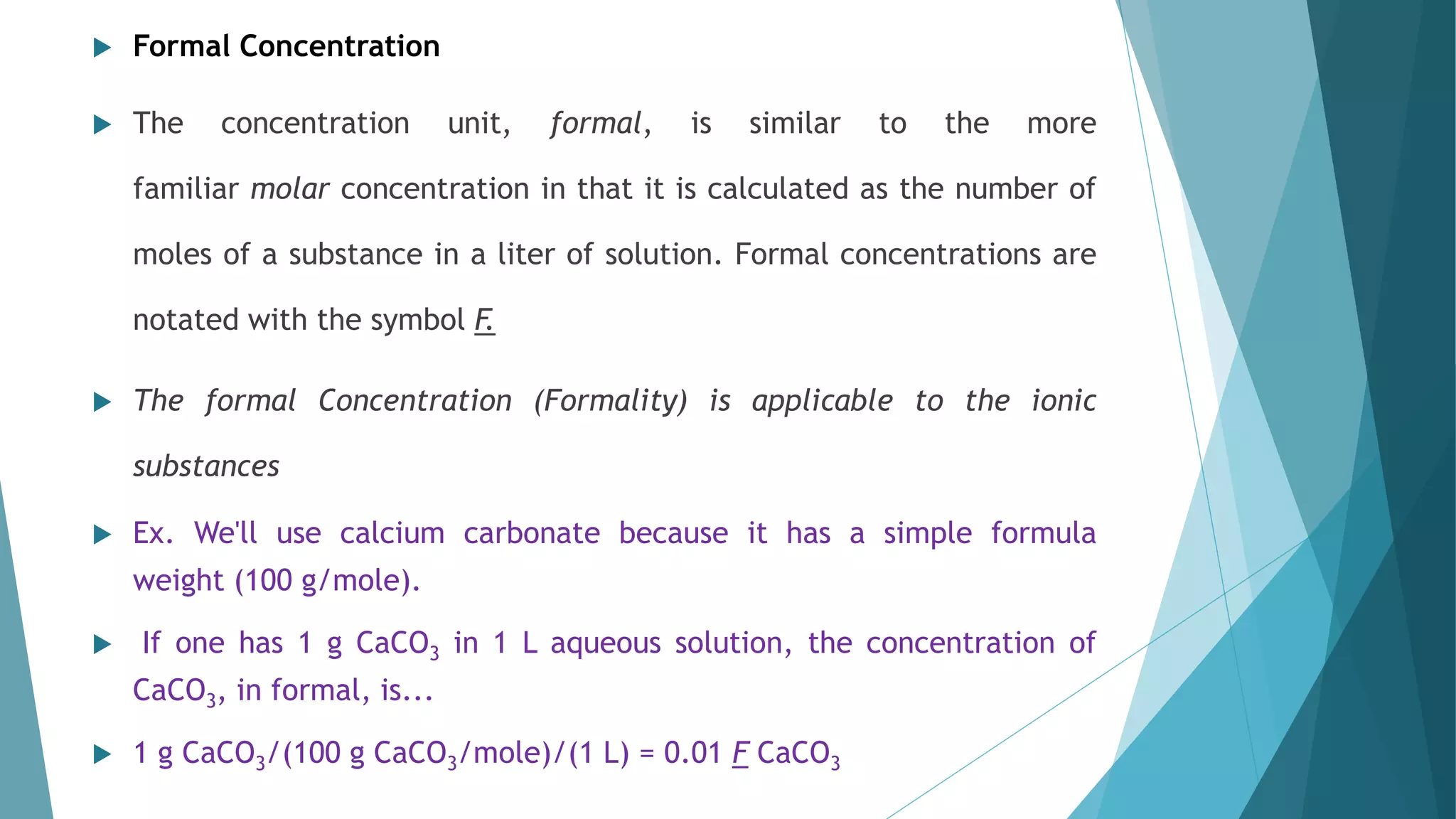
Formal Concentration
The concentration unit, formal, is similar to the more
familiar molar concentration in that it is calculated as the number of
moles of a substance in a liter of solution. Formal concentrations are
notated with the symbol F.
The formal Concentration (Formality) is applicable to the ionic
substances
Ex. We'll use calcium carbonate because it has a simple formula
weight (100 g/mole).
If one has 1 g CaCO3 in 1 L aqueous solution, the concentration of
CaCO3, in formal, is...
1 g CaCO3/(100 g CaCO3/mole)/(1 L) = 0.01 F CaCO3
12.
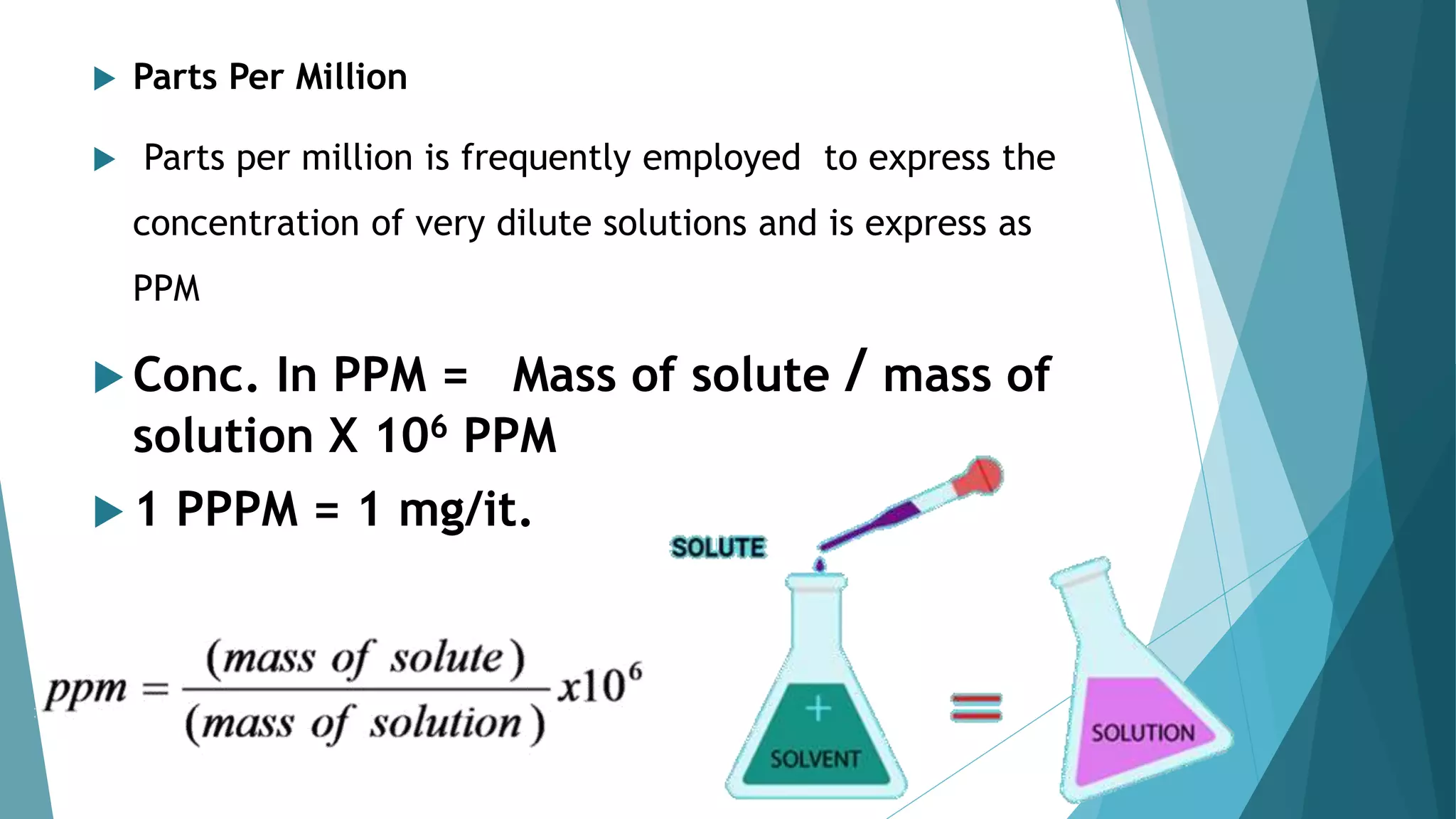
Parts PerMillion
Parts per million is frequently employed to express the
concentration of very dilute solutions and is express as
PPM
Conc. In PPM = Mass of solute / mass of
solution X 106 PPM
1 PPPM = 1 mg/it.
13.
References
• A.H.Beckett & J.B. Stenlake's, Practical Pharmaceutical Chemistry Vol
I & II, Stahlone Press of University of London
• A.I. Vogel, Text Book of Quantitative Inorganic analysis
• P. Gundu Rao, Inorganic Pharmaceutical Chemistry
• Bentley and Driver's Textbook of Pharmaceutical Chemistry
• John H. Kennedy, Analytical chemistry principles
• Indian Pharmacopoeia