Paper Chromatography
Introduction
• First introduced by the German scientist
Christian Friedrich Schonbien in 1865.
• It is a type of simplest Chromatography. It is
the most simplest and widely used type of
chromatography procedures which runs on
specialized paper.
Definition
• Analytical method used to separate colored
chemicals and substances.
• Applicability to isolation, identification, and
Quantitative determination of organic and
inorganic compounds.
Two Principles of Paper
Chromatography
1). Paper Partition Chromatography.
Paper impregnated with alumina and silica act
as absorbent ( stationary phase ) and solvent
as mobile phase.
2).Paper Adsorption Chromatography.
The moisture or water present in pores of
cellulose fibers present in filter paper act as
stationary phase and another solvent as
mobile phase.
Principle of separation
• Principle of separation is mainly partition rather
than adsorption.
Types of paper Chromatography
1). Ascending
2).Descending
3). Ascending-Descending mode.
4).Radial mode
5). Two-Dimensional chromatography
Ascending Chromatography
• As the name indicates ,the chromatogram
ascends .Here the development of paper
occurs due to the solvent movement or travel
in upward direction on the paper.
• Descending Chromatography
Development of papers occurs due to solvent
travels downward on the papers.
Ascending Descending mode
• In it the solvent first travels upward and then
downward on the paper.
• Radial Mode
Here the solvent travels from center
(midpoint) towards the periphery of Circular
chromatographic paper.
Two Dimensional Chromatography
• Here the chromatogram development occurs
in two directions at right angles.
Applications
• Used in forensic studies.
• In analytical chemistry for identifying and
separating colored mixtures like pigments.
• Sugars, amino acids, lipids and nucleic acids and
other biomolecules can be easily identified by
spraying with appropriate reagents to detect
these specific compounds.
• Paper chromatography can be reproduced easily
as long as the conditions are controlled and
maintained.
Retention Factor
• Indicated by
Rf= Distance travelled by applicant from application point
Distance travelled by solvent from application point
APPLICATioNS:
• Among all the chromatography methods paper
chromatography is an inexpensive and rapid method
that provides graphic and clear results.
• Used as a qualitative method for identifying the
components in a mixture.
• Used in several scientific studies in identification of
unknown organic and inorganic compounds from a
mixture.
Column Chromatography
• Is a method used to purify chemical compounds
from mixture of compounds on the basis of their
polarity.
• Large scale application.
• This is a solid liquid technique in which
Stationary phase is a solid
Mobile phase is liquid
• Vertical glass columns is used support the
stationary phase
Principle
• The principle of column chromatography is adsoption.
• Mixture of components dissolved in M.P is introduced in
column.
• Components move according to their relative affinity.
• Components adsorbed with the statonary phase
Weakly adsorbed components move faster separated
first
Apparatus
1. Column
2. Stopcock
• Cotton prevent solid materials to pass
• Sand provide level surface.
• Stationary phase ( silica , alumina )
• Mobile phase ( solvent )
Gels
• Silica and alumina are both polar adsorbents.
• Silica gel is less polar than alumina.
• Silicais preferentially retains basic compounds.
• Alumina preferentially retains acidic
compounds.
Non Polar compounds elute first
Steps
1. Packing column
 Bottom portion of the column is packed with cotton wool.
 Then sand is added
 Packing can be either
1. Dry
Add dry solid phase to the column and pass buffer to
saturate the solid
2. Wet
Mix both liquid and solid outside of the column and pour it
into the column.
2. Loading column
• is loaded using pipette to make sure even layer on top of silica gel.
• Then mobile phase is poured.
• Stop cock is opened and solvent start moving along sample which will
separat different components according to their relative affinity with
stationary phase.
• components that strongly interacts with the stationary phase retained
in the column thus moves slowly
• But when the interactions are weak the components elutes easily so,
exits first
3. Analyzing
• Depend on the type of molecules separated
• protein or DNA gel
• Plant extracts run a TLC plate
Factors Affecting Column Efficiency
1. Dimension of the column (length/width
ratio )
2. Particle size of column packing.
3. Activity of the adsorbent.
4. Temperature of the column.
5. Packing of the column.
6. Quality of solvents (low viscosity )
Advantages
Any type of mixture can be separated
 Any quantity of mixture can be separated
Wider choice of Mobile Phase
 Automation is possible
Disadvantages
Time consuming
 more amount of Mobile Phase are required
 Automation makes the techniques more
complicated
 Expensive
High-Performance Liquid
Chromatography
(HPLC)
HPLC
• HPLC stands for High performance liquid
chromatography sometimes referred as High
Pressure Liquid Chromatography.
• HPLC is a powerful tool in analysis because it
yields high performance as compared to
traditional column chromatography.
• It can separate mixture of compounds.
Conti...
• High performance liquid chromatography is
improved form of column chromatography.
• It pumps a sample mixture in a solvent (known
as the mobile phase) at high pressure through a
column with chromatographic packing material
(stationary phase).
• HPLC has the ability to separate, and identify
compounds that are present in any sample that
can be dissolved in a liquid in trace
concentrations.
Instrumentation
The components use in HPLC system include:
 the solvent reservoir or multiple reservoirs
 a high-pressure pump
 a column
 injector system
 the detector.
HPLC work
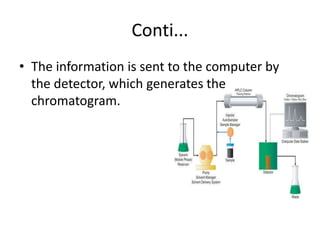
• A reservoir holds the solvent. A pump is used to
generate a specified flow of the mobile phase.
• An injector is able to inject the sample into the
continuously flowing mobile phase stream that carries
the sample into the HPLC column.
• The column contains the chromatographic packing
material needed to effect the separation.
• This packing material is known as stationary phase.
• Then a detector is needed to see the separated
compound bands as they elute from the high pressure
column.
Conti...
• The information is sent to the computer by
the detector, which generates the
chromatogram.
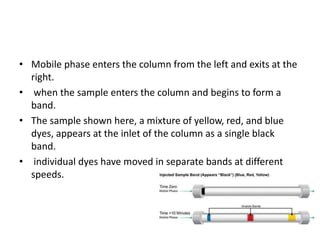
• Mobile phase enters the column from the left and exits at the
right.
• when the sample enters the column and begins to form a
band.
• The sample shown here, a mixture of yellow, red, and blue
dyes, appears at the inlet of the column as a single black
band.
• individual dyes have moved in separate bands at different
speeds.
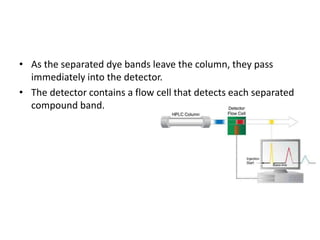
• As the separated dye bands leave the column, they pass
immediately into the detector.
• The detector contains a flow cell that detects each separated
compound band.
AFFINITY CHROMATOGRAPHY
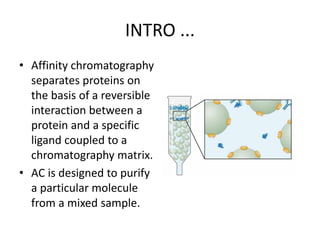
INTRO ...
• Affinity chromatography
separates proteins on
the basis of a reversible
interaction between a
protein and a specific
ligand coupled to a
chromatography matrix.
• AC is designed to purify
a particular molecule
from a mixed sample.
• The technique can be
used to separate active
biomolecules from
denatured or functionally
different forms, to isolate
pure substances present
at low concentration in
large volumes of crude
sample and also to
remove specific
contaminants.
Principle ...
• Affinity chromatography is principally based
on the molecular recognition of a target
molecule by a molecule bound to a column.
• It relies on the reversible interactions between
the protein to be purified and the affinity
ligand coupled to chromatographic matrix.
• Binding is;
** Reversible, &
** Specific.
Components ...
While affinity chromatography is used for the
purification and separation of large
biomolecules from complex mixtures, these
components is to be considered;
• The support (matrix),
• Spacer arms, and
• Ligand.
Matrix ...
• chemical inertness; does not react (or bind) with
sample.
• chemical stability; resistance toward microbial and
enzymatic attack.
• Chemical reactivity allowing ligands and spacers to be
introduced .
• Good flow properties for rapid separation
Such as;
 Agarose,
 Polyacrylamide,
 Cellulose, and silica.
Ligands ...
• Ligands are ions or neutral molecules attach to
the matrix that bond to a biomolecule
(protein).
The selection of the ligand for affinity chromatography is influenced by
two factors:
o the ligand must exhibit specific and reversible binding affinity for
the target substance
o and it must have chemically modifiable groups that allow it to be
attached to the matrix without destroying binding activity.
Spacer Arms ...
• The binding sites of the
target molecule are
sometimes deeply located
and difficult to access due
to steric hindrance, a
spacer arm is often
incorporated between the
matrix and ligand to
facilitate efficient binding
and create a more
effective and better
binding environment.
Steps:
Affinity purification involves 3 main steps:
• Incubation of a crude sample with the affinity
support to allow the target molecule in the
sample to bind to the immobilized ligand.
• Washing away non-bound sample components
from the support.
• Elution (dissociation and recovery) of the target
molecule from the immobilized ligand by altering
the buffer conditions so that the binding
interaction no longer occurs.
• Step 1. Loading affinity
column
• Step 2. Proteins sieve
through matrix of
affinity beads.
• Step 3. Proteins interact
with affinity ligand with
some binding loosely
and others tightly.
• Step 4. Wash off
proteins that do not
bind and that are
loosely bond.
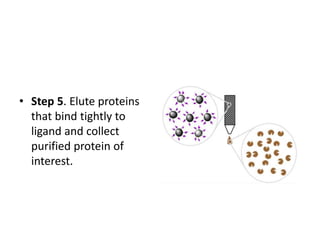
• Step 5. Elute proteins
that bind tightly to
ligand and collect
purified protein of
interest.
Kinds of ELUTION ...
• Elution by change in buffer composition that
elutes the bound substance without harming
it .
• pH Elution; high pH applied that elute the
substance but damage it either temporary or
permentaly.
• Competitive elution; by addition of substance
that competes for binding to protein with
ligand.
Ion Exchange Chromatography
• The separation of molecules based on their
total charge.
• This technique enables the separation of
similar types of molecules that would be
difficult to separate by other techniques
because the charge carried by the molecule of
interest can be readily manipulated by
changing buffer pH.
• Used in separation of proteins.
Protein
• Made of 20 type of Amino Acids
• Amino acid carry different charges based on
their side chains
• Protein carry net –ive or +ive charge
depending on types of AA present
• Protein differ by charge from one another
• separated by ion exchange
Stationary phase
• Solid phase
• Gel beads – 0.30 to 0.85nm in diameter
• Carbohydrate polymers
• Cellulose
• Agarose
• Fixed and inert
• Side chains added to make them +ive or –ive
charge
Stationary phase
• Anion exchange
Matrix
X - A+ ………… B-
Mixture:
D- E+
Ion Exchange:
X - A+ ……. D-
B- E+
• Cation exchange
Matrix
X – A- ………… C+
Mixture:
D- E+
Ion Exchange:
X – A- ……. E+
C+ D-
Elute Elute
• Assembly
• Funnel
• Colum filled with gel beads
• Eluent collected at bottom
Process(eg cationic exchange)
• Mixture of 3 types of protein
• Coloumn filled with –ively charged resins
• Pour mixture in funnel
• Initially they will collect at top
• After sometime move downward due to gravity
• The negative protein repels the resin and
move fastest, collected at bottom
• Slightly positive will bind to resin at middle
and move downward after sometime
• Strongly positive will bind at top
• To seprate bound proteins elution is carried
out
Elusion
• Two types
– Salt gradient
– PH gradient
Salt gradient
• Principle: increase net +ive ions
• Salt solution poured in column e.g. NaCl
• Na+ Ions produced, compete with protein ions
to bind with resin
• Less strongly bound protein elute first
• Concentration of salt increased and more
strongly bound proteins separate
• Proteins collected at bottom
PH Gradient
• Principle:
• Mixture of buffer added
– Binding Buffer, low pH
– Elusion Buffer, high pH
• pH gradient produced
– cationic exchange: low pH to High pH buffer
– Anionic exchange: high pH to low pH buffer
Example of cationic exchange
• Low pH buffer added first, causes formation of
more +ive charge on protein
• Then high pH buffer added, it generates pH
gradient
• protein moves to region that is equal to their
isoelectric point
• More elusion buffer added that cause increase in
pH and protein now carry negative charge
• Proteins desorb and elute from column
Chromatography

Chromatography

  • 1.
  • 2.
    Introduction • First introducedby the German scientist Christian Friedrich Schonbien in 1865. • It is a type of simplest Chromatography. It is the most simplest and widely used type of chromatography procedures which runs on specialized paper.
  • 3.
    Definition • Analytical methodused to separate colored chemicals and substances. • Applicability to isolation, identification, and Quantitative determination of organic and inorganic compounds.
  • 4.
    Two Principles ofPaper Chromatography 1). Paper Partition Chromatography. Paper impregnated with alumina and silica act as absorbent ( stationary phase ) and solvent as mobile phase. 2).Paper Adsorption Chromatography. The moisture or water present in pores of cellulose fibers present in filter paper act as stationary phase and another solvent as mobile phase.
  • 5.
    Principle of separation •Principle of separation is mainly partition rather than adsorption. Types of paper Chromatography 1). Ascending 2).Descending 3). Ascending-Descending mode. 4).Radial mode 5). Two-Dimensional chromatography
  • 6.
    Ascending Chromatography • Asthe name indicates ,the chromatogram ascends .Here the development of paper occurs due to the solvent movement or travel in upward direction on the paper. • Descending Chromatography Development of papers occurs due to solvent travels downward on the papers.
  • 9.
    Ascending Descending mode •In it the solvent first travels upward and then downward on the paper. • Radial Mode Here the solvent travels from center (midpoint) towards the periphery of Circular chromatographic paper.
  • 11.
    Two Dimensional Chromatography •Here the chromatogram development occurs in two directions at right angles.
  • 12.
    Applications • Used inforensic studies. • In analytical chemistry for identifying and separating colored mixtures like pigments. • Sugars, amino acids, lipids and nucleic acids and other biomolecules can be easily identified by spraying with appropriate reagents to detect these specific compounds. • Paper chromatography can be reproduced easily as long as the conditions are controlled and maintained.
  • 13.
    Retention Factor • Indicatedby Rf= Distance travelled by applicant from application point Distance travelled by solvent from application point
  • 14.
    APPLICATioNS: • Among allthe chromatography methods paper chromatography is an inexpensive and rapid method that provides graphic and clear results. • Used as a qualitative method for identifying the components in a mixture. • Used in several scientific studies in identification of unknown organic and inorganic compounds from a mixture.
  • 15.
    Column Chromatography • Isa method used to purify chemical compounds from mixture of compounds on the basis of their polarity. • Large scale application. • This is a solid liquid technique in which Stationary phase is a solid Mobile phase is liquid • Vertical glass columns is used support the stationary phase
  • 16.
    Principle • The principleof column chromatography is adsoption. • Mixture of components dissolved in M.P is introduced in column. • Components move according to their relative affinity. • Components adsorbed with the statonary phase Weakly adsorbed components move faster separated first
  • 17.
    Apparatus 1. Column 2. Stopcock •Cotton prevent solid materials to pass • Sand provide level surface. • Stationary phase ( silica , alumina ) • Mobile phase ( solvent )
  • 18.
    Gels • Silica andalumina are both polar adsorbents. • Silica gel is less polar than alumina. • Silicais preferentially retains basic compounds. • Alumina preferentially retains acidic compounds. Non Polar compounds elute first
  • 19.
    Steps 1. Packing column Bottom portion of the column is packed with cotton wool.  Then sand is added  Packing can be either 1. Dry Add dry solid phase to the column and pass buffer to saturate the solid 2. Wet Mix both liquid and solid outside of the column and pour it into the column.
  • 21.
    2. Loading column •is loaded using pipette to make sure even layer on top of silica gel. • Then mobile phase is poured. • Stop cock is opened and solvent start moving along sample which will separat different components according to their relative affinity with stationary phase. • components that strongly interacts with the stationary phase retained in the column thus moves slowly • But when the interactions are weak the components elutes easily so, exits first
  • 23.
    3. Analyzing • Dependon the type of molecules separated • protein or DNA gel • Plant extracts run a TLC plate
  • 24.
    Factors Affecting ColumnEfficiency 1. Dimension of the column (length/width ratio ) 2. Particle size of column packing. 3. Activity of the adsorbent. 4. Temperature of the column. 5. Packing of the column. 6. Quality of solvents (low viscosity )
  • 25.
    Advantages Any type ofmixture can be separated  Any quantity of mixture can be separated Wider choice of Mobile Phase  Automation is possible
  • 26.
    Disadvantages Time consuming  moreamount of Mobile Phase are required  Automation makes the techniques more complicated  Expensive
  • 27.
  • 28.
    HPLC • HPLC standsfor High performance liquid chromatography sometimes referred as High Pressure Liquid Chromatography. • HPLC is a powerful tool in analysis because it yields high performance as compared to traditional column chromatography. • It can separate mixture of compounds.
  • 29.
    Conti... • High performanceliquid chromatography is improved form of column chromatography. • It pumps a sample mixture in a solvent (known as the mobile phase) at high pressure through a column with chromatographic packing material (stationary phase). • HPLC has the ability to separate, and identify compounds that are present in any sample that can be dissolved in a liquid in trace concentrations.
  • 30.
    Instrumentation The components usein HPLC system include:  the solvent reservoir or multiple reservoirs  a high-pressure pump  a column  injector system  the detector.
  • 32.
    HPLC work • Areservoir holds the solvent. A pump is used to generate a specified flow of the mobile phase. • An injector is able to inject the sample into the continuously flowing mobile phase stream that carries the sample into the HPLC column. • The column contains the chromatographic packing material needed to effect the separation. • This packing material is known as stationary phase. • Then a detector is needed to see the separated compound bands as they elute from the high pressure column.
  • 33.
    Conti... • The informationis sent to the computer by the detector, which generates the chromatogram.
  • 34.
    • Mobile phaseenters the column from the left and exits at the right. • when the sample enters the column and begins to form a band. • The sample shown here, a mixture of yellow, red, and blue dyes, appears at the inlet of the column as a single black band. • individual dyes have moved in separate bands at different speeds.
  • 35.
    • As theseparated dye bands leave the column, they pass immediately into the detector. • The detector contains a flow cell that detects each separated compound band.
  • 36.
  • 37.
    INTRO ... • Affinitychromatography separates proteins on the basis of a reversible interaction between a protein and a specific ligand coupled to a chromatography matrix. • AC is designed to purify a particular molecule from a mixed sample.
  • 38.
    • The techniquecan be used to separate active biomolecules from denatured or functionally different forms, to isolate pure substances present at low concentration in large volumes of crude sample and also to remove specific contaminants.
  • 39.
    Principle ... • Affinitychromatography is principally based on the molecular recognition of a target molecule by a molecule bound to a column. • It relies on the reversible interactions between the protein to be purified and the affinity ligand coupled to chromatographic matrix. • Binding is; ** Reversible, & ** Specific.
  • 40.
    Components ... While affinitychromatography is used for the purification and separation of large biomolecules from complex mixtures, these components is to be considered; • The support (matrix), • Spacer arms, and • Ligand.
  • 41.
    Matrix ... • chemicalinertness; does not react (or bind) with sample. • chemical stability; resistance toward microbial and enzymatic attack. • Chemical reactivity allowing ligands and spacers to be introduced . • Good flow properties for rapid separation Such as;  Agarose,  Polyacrylamide,  Cellulose, and silica.
  • 42.
    Ligands ... • Ligandsare ions or neutral molecules attach to the matrix that bond to a biomolecule (protein). The selection of the ligand for affinity chromatography is influenced by two factors: o the ligand must exhibit specific and reversible binding affinity for the target substance o and it must have chemically modifiable groups that allow it to be attached to the matrix without destroying binding activity.
  • 43.
    Spacer Arms ... •The binding sites of the target molecule are sometimes deeply located and difficult to access due to steric hindrance, a spacer arm is often incorporated between the matrix and ligand to facilitate efficient binding and create a more effective and better binding environment.
  • 44.
    Steps: Affinity purification involves3 main steps: • Incubation of a crude sample with the affinity support to allow the target molecule in the sample to bind to the immobilized ligand. • Washing away non-bound sample components from the support. • Elution (dissociation and recovery) of the target molecule from the immobilized ligand by altering the buffer conditions so that the binding interaction no longer occurs.
  • 45.
    • Step 1.Loading affinity column
  • 46.
    • Step 2.Proteins sieve through matrix of affinity beads.
  • 47.
    • Step 3.Proteins interact with affinity ligand with some binding loosely and others tightly.
  • 48.
    • Step 4.Wash off proteins that do not bind and that are loosely bond.
  • 49.
    • Step 5.Elute proteins that bind tightly to ligand and collect purified protein of interest.
  • 50.
    Kinds of ELUTION... • Elution by change in buffer composition that elutes the bound substance without harming it . • pH Elution; high pH applied that elute the substance but damage it either temporary or permentaly. • Competitive elution; by addition of substance that competes for binding to protein with ligand.
  • 51.
    Ion Exchange Chromatography •The separation of molecules based on their total charge. • This technique enables the separation of similar types of molecules that would be difficult to separate by other techniques because the charge carried by the molecule of interest can be readily manipulated by changing buffer pH. • Used in separation of proteins.
  • 52.
    Protein • Made of20 type of Amino Acids • Amino acid carry different charges based on their side chains • Protein carry net –ive or +ive charge depending on types of AA present • Protein differ by charge from one another • separated by ion exchange
  • 53.
    Stationary phase • Solidphase • Gel beads – 0.30 to 0.85nm in diameter • Carbohydrate polymers • Cellulose • Agarose • Fixed and inert • Side chains added to make them +ive or –ive charge
  • 54.
  • 55.
    • Anion exchange Matrix X- A+ ………… B- Mixture: D- E+ Ion Exchange: X - A+ ……. D- B- E+ • Cation exchange Matrix X – A- ………… C+ Mixture: D- E+ Ion Exchange: X – A- ……. E+ C+ D- Elute Elute
  • 56.
    • Assembly • Funnel •Colum filled with gel beads • Eluent collected at bottom
  • 57.
    Process(eg cationic exchange) •Mixture of 3 types of protein • Coloumn filled with –ively charged resins • Pour mixture in funnel • Initially they will collect at top • After sometime move downward due to gravity
  • 58.
    • The negativeprotein repels the resin and move fastest, collected at bottom • Slightly positive will bind to resin at middle and move downward after sometime • Strongly positive will bind at top • To seprate bound proteins elution is carried out
  • 60.
    Elusion • Two types –Salt gradient – PH gradient
  • 61.
    Salt gradient • Principle:increase net +ive ions • Salt solution poured in column e.g. NaCl • Na+ Ions produced, compete with protein ions to bind with resin • Less strongly bound protein elute first • Concentration of salt increased and more strongly bound proteins separate • Proteins collected at bottom
  • 63.
  • 64.
    • Mixture ofbuffer added – Binding Buffer, low pH – Elusion Buffer, high pH • pH gradient produced – cationic exchange: low pH to High pH buffer – Anionic exchange: high pH to low pH buffer
  • 65.
    Example of cationicexchange • Low pH buffer added first, causes formation of more +ive charge on protein • Then high pH buffer added, it generates pH gradient • protein moves to region that is equal to their isoelectric point • More elusion buffer added that cause increase in pH and protein now carry negative charge • Proteins desorb and elute from column