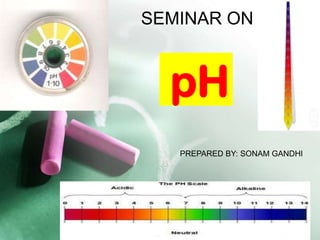
SEMINAR ON


  pH
   PREPARED BY: SONAM GANDHI
pH and Sorensen’s scale

• Electrolyte undergo               dissociation         in   water
  producing ions.
• Acids   undergo ionization in water                         giving
  hydrogen ions or hydronium ions.
• The thermodynamics definition for pH is
• pH is defined as negative logarithm of activity of
  hydrogen ions.
• Mathematically pH = -log aH+ --------------------(1)
• where aH+ = activity of hydronium ion
• The activity of hydronium ion = hydronium ion
  concentration x rational activity coefficient .
•        aH+    = c x γ ± ----------------(2)
• Substituting equation (2) in equation (1) gives
• pH    = -log(c x γ ± )   ------------------(3)
         for practical purpose , activities are equal
to concentration in dilute solution( when salts are
not added) , because ionic strength is small.
When neutral salt are added, the hydronium ions
activity is affected and, hence activity coefficient
should be employed, i.e. equation (3).
• Sorenson defined pH as the
        logarithm of the reciprocal of the hydrogen
ion concentration.
Mathematically pH is expressed as a
       pH = log       1         -------- (4)
                    [H3O+]
Equation (4) may be rearranged as:
     pH = log 1- log[H3O+] ----------------(5)
• Since log 1 is zero, equation (5) is written as :
        pH = -log[H30+] ------------------(6)
 Thus , pH defined as negative logarithm of
hydrogen ion concentration.
 Sorensen established the term pH , to represent
hydrogen ion potential. The term p used to
express the negative logarithm .
The concentration of the H30+ is expressed in
molarity, moles/liter etc.
Why in pH symbol p is small and
H is capital?
• The 'p' in pH stands for "potenz" meaning
  "power" in Danish. Since the scale was given
  by a Danish Chemist Sorensen. H stands for
  Hydrogen and is its symbol. Hence H is written
  in capital letter.
SORENSEN’S pH SCALE

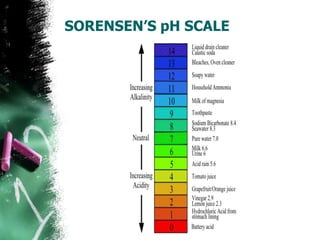
• Based on the pH values and different concentration
  of H30+ ions, a scale is devised and named after
  Sorenson, who had developed it.
• The scale starts with a zero pH, i.e., hydrogen ion
  concentration is 1(or 100). It means the solution is
  strongly acidic.
• At the other end of the scale , pH is 14 i.e., hydrogen
  ion concentration is 10-14 .It means the solution is
  strongly alkaline.
• The central point pH in the scale is 7.0, because
  [H3O+] is equal to [OH], i.e., hydrogen ion
  concentration is 10-7.
SORENSEN’S pH SCALE
• pH = 7 means neutral.
• The region with pH values below 7 is
  designated as a acidic and above pH 7.0 is
  designated as basic (or alkaline).
• The pH numbers obtained by measuring
  solutions containing colloids and non aqueous
  solutions have little correlation on the activity
  scale.
APPLICATION OF pH:

• Enhancing solubility
• Increasing stability
• Improving purity
• Optimizing biological activity
• Comforting the body
• Storage of products
THANK YOU

pH

  • 1.
    SEMINAR ON pH PREPARED BY: SONAM GANDHI
  • 2.
    pH and Sorensen’sscale • Electrolyte undergo dissociation in water producing ions. • Acids undergo ionization in water giving hydrogen ions or hydronium ions. • The thermodynamics definition for pH is • pH is defined as negative logarithm of activity of hydrogen ions. • Mathematically pH = -log aH+ --------------------(1) • where aH+ = activity of hydronium ion
  • 3.
    • The activityof hydronium ion = hydronium ion concentration x rational activity coefficient . • aH+ = c x γ ± ----------------(2) • Substituting equation (2) in equation (1) gives • pH = -log(c x γ ± ) ------------------(3) for practical purpose , activities are equal to concentration in dilute solution( when salts are not added) , because ionic strength is small. When neutral salt are added, the hydronium ions activity is affected and, hence activity coefficient should be employed, i.e. equation (3).
  • 4.
    • Sorenson definedpH as the logarithm of the reciprocal of the hydrogen ion concentration. Mathematically pH is expressed as a pH = log 1 -------- (4) [H3O+] Equation (4) may be rearranged as: pH = log 1- log[H3O+] ----------------(5)
  • 5.
    • Since log1 is zero, equation (5) is written as : pH = -log[H30+] ------------------(6) Thus , pH defined as negative logarithm of hydrogen ion concentration. Sorensen established the term pH , to represent hydrogen ion potential. The term p used to express the negative logarithm . The concentration of the H30+ is expressed in molarity, moles/liter etc.
  • 7.
    Why in pHsymbol p is small and H is capital? • The 'p' in pH stands for "potenz" meaning "power" in Danish. Since the scale was given by a Danish Chemist Sorensen. H stands for Hydrogen and is its symbol. Hence H is written in capital letter.
  • 8.
    SORENSEN’S pH SCALE •Based on the pH values and different concentration of H30+ ions, a scale is devised and named after Sorenson, who had developed it. • The scale starts with a zero pH, i.e., hydrogen ion concentration is 1(or 100). It means the solution is strongly acidic. • At the other end of the scale , pH is 14 i.e., hydrogen ion concentration is 10-14 .It means the solution is strongly alkaline. • The central point pH in the scale is 7.0, because [H3O+] is equal to [OH], i.e., hydrogen ion concentration is 10-7.
  • 9.
  • 10.
    • pH =7 means neutral. • The region with pH values below 7 is designated as a acidic and above pH 7.0 is designated as basic (or alkaline). • The pH numbers obtained by measuring solutions containing colloids and non aqueous solutions have little correlation on the activity scale.
  • 11.
    APPLICATION OF pH: •Enhancing solubility • Increasing stability • Improving purity • Optimizing biological activity • Comforting the body • Storage of products
  • 12.