USE OF BUFFER
SOLUTIONS
BY:
JERT ALLONES
NESSY ALIDO
JOMMEL REOLA
CLARENZE CARL SANOY
RAJA JULIANA TOLEDO
OBJECTIVES:
• Describe how buffer solution maintains its
pH
• Calculate the pH of a buffer solution using
the Henderson Hasselbalch equation
Buffer solutions
• A solution of weak acid or weak base and its salt.
• A buffered solution is one that resists a change in its pH when either
hydroxide ions or protons (H3O+ ) are added.
• Very little change in pH is witnessed even when a strong acid or base
is added.
• The components of a buffer are a conjugate acid-base pair.
• Buffer solutions function effectively since they contain comparable
amounts of acid and its conjugate base over a limited Ph range called
buffer capacity.
Buffer Solution
• EXAMPLES:
HF and NaF
CH₃COOH and CH₃COONa
HCN and NaCN
NH₃ and NH₄Cl
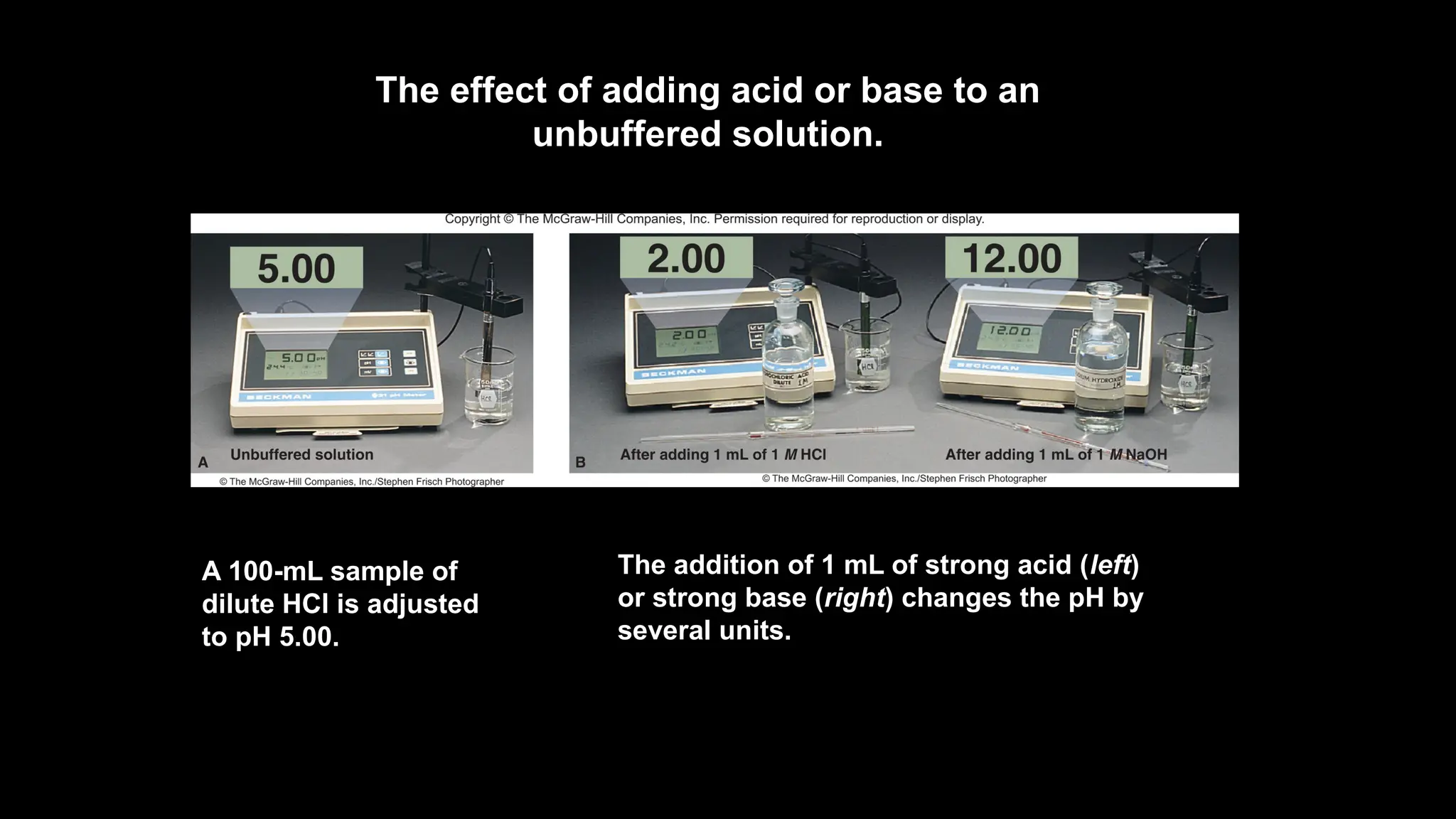
The effect of adding acid or base to an
unbuffered solution.
A 100-mL sample of
dilute HCl is adjusted
to pH 5.00.
The addition of 1 mL of strong acid (left)
or strong base (right) changes the pH by
several units.
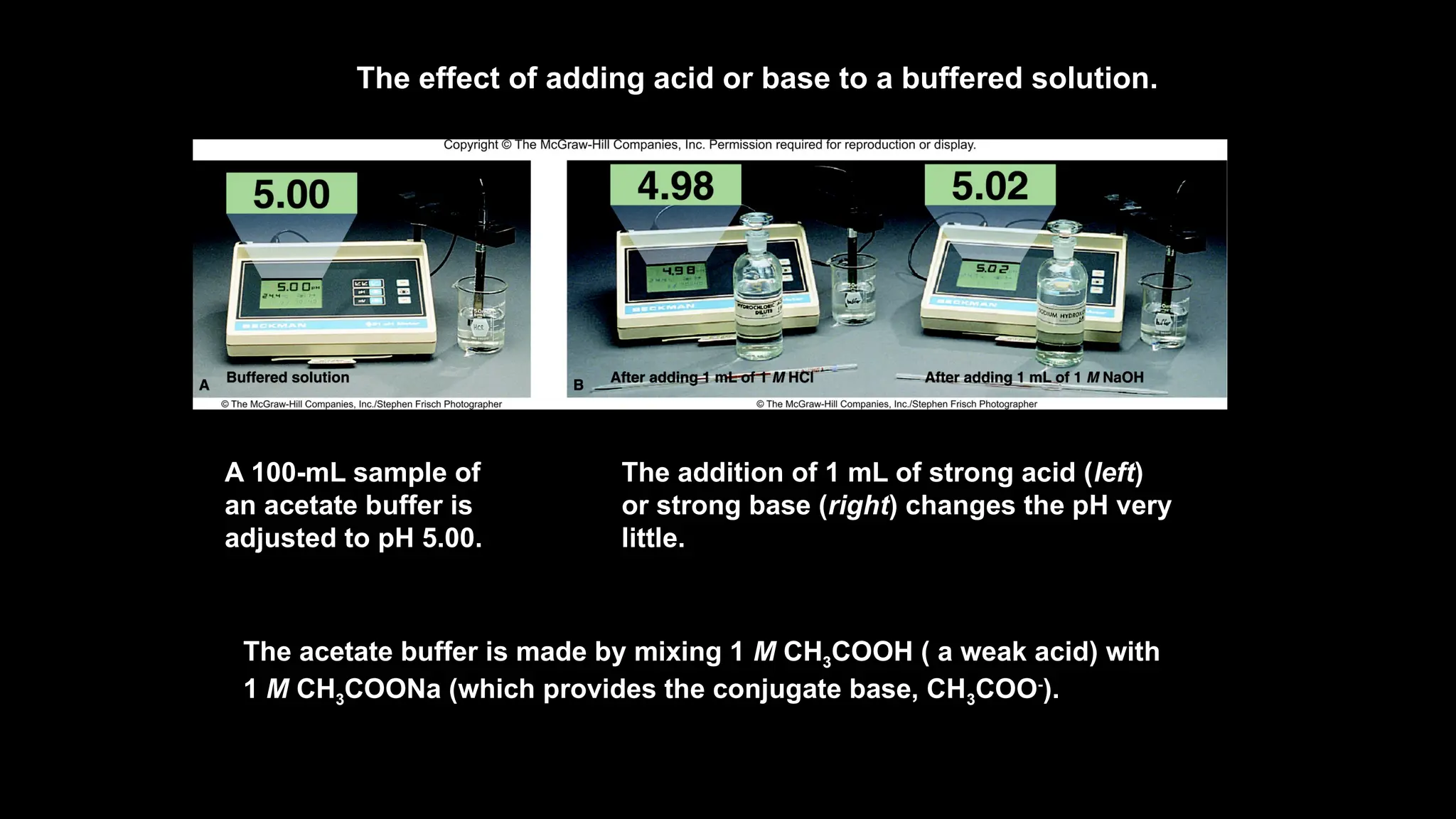
The effect of adding acid or base to a buffered solution.
A 100-mL sample of
an acetate buffer is
adjusted to pH 5.00.
The addition of 1 mL of strong acid (left)
or strong base (right) changes the pH very
little.
The acetate buffer is made by mixing 1 M CH3COOH ( a weak acid) with
1 M CH3COONa (which provides the conjugate base, CH3COO-
).
Acid-Base Buffer
Systems
Buffers function by reducing changes in [H3O+
]
that result from additions of acid or base to the solution.
Buffers are composed of the conjugate
acid-base pair of a weak acid.
Buffers function via the common ion effect.
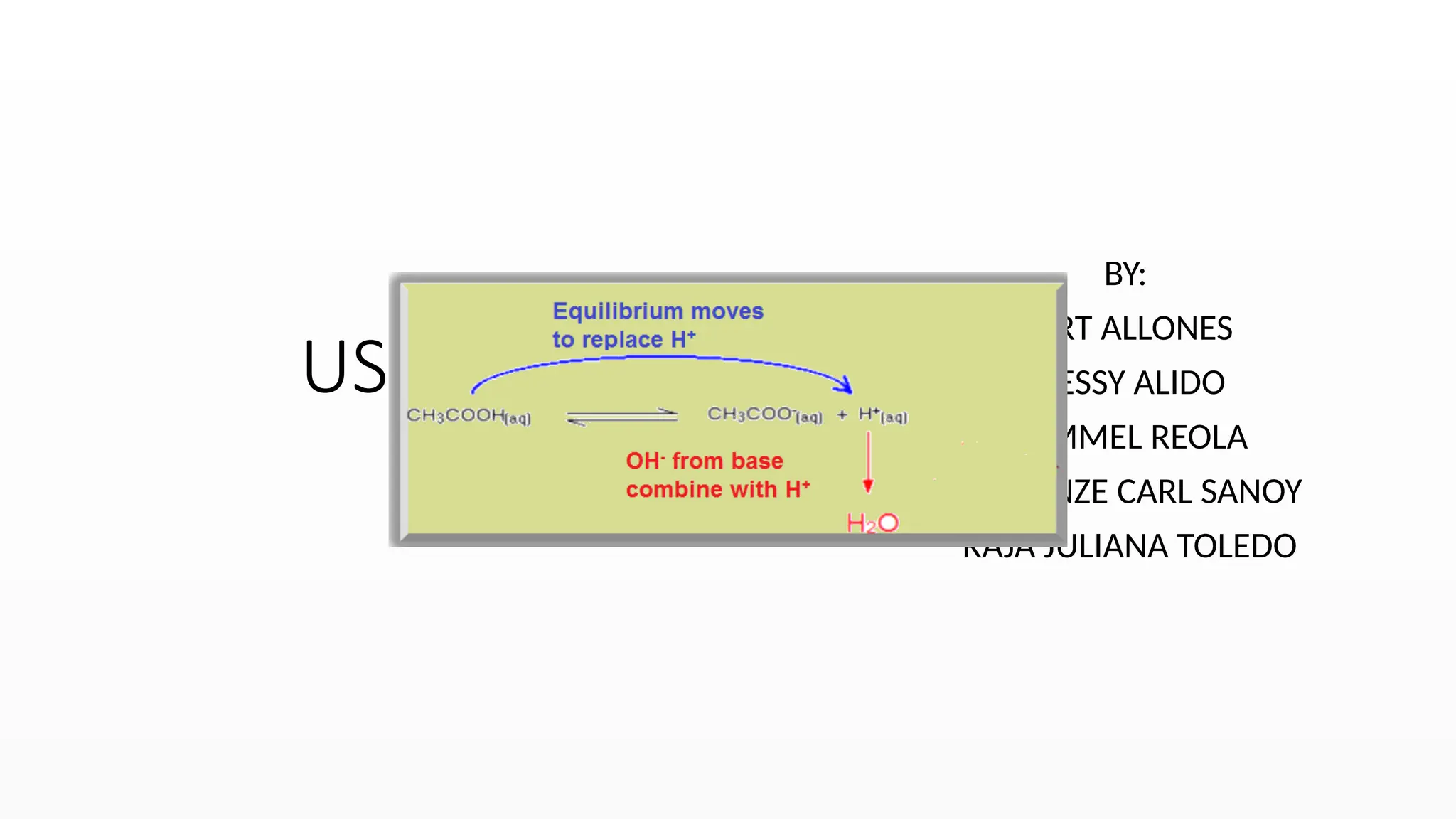
CH3COOH(aq) + H2O(l) CH3COO-
(aq) + H3O+
(aq)
The common ion effect occurs when a reactant containing
a given ion is added to an equilibrium mixture that already
contains that ion and the position of the equilibrium shifts
away from forming more of it.
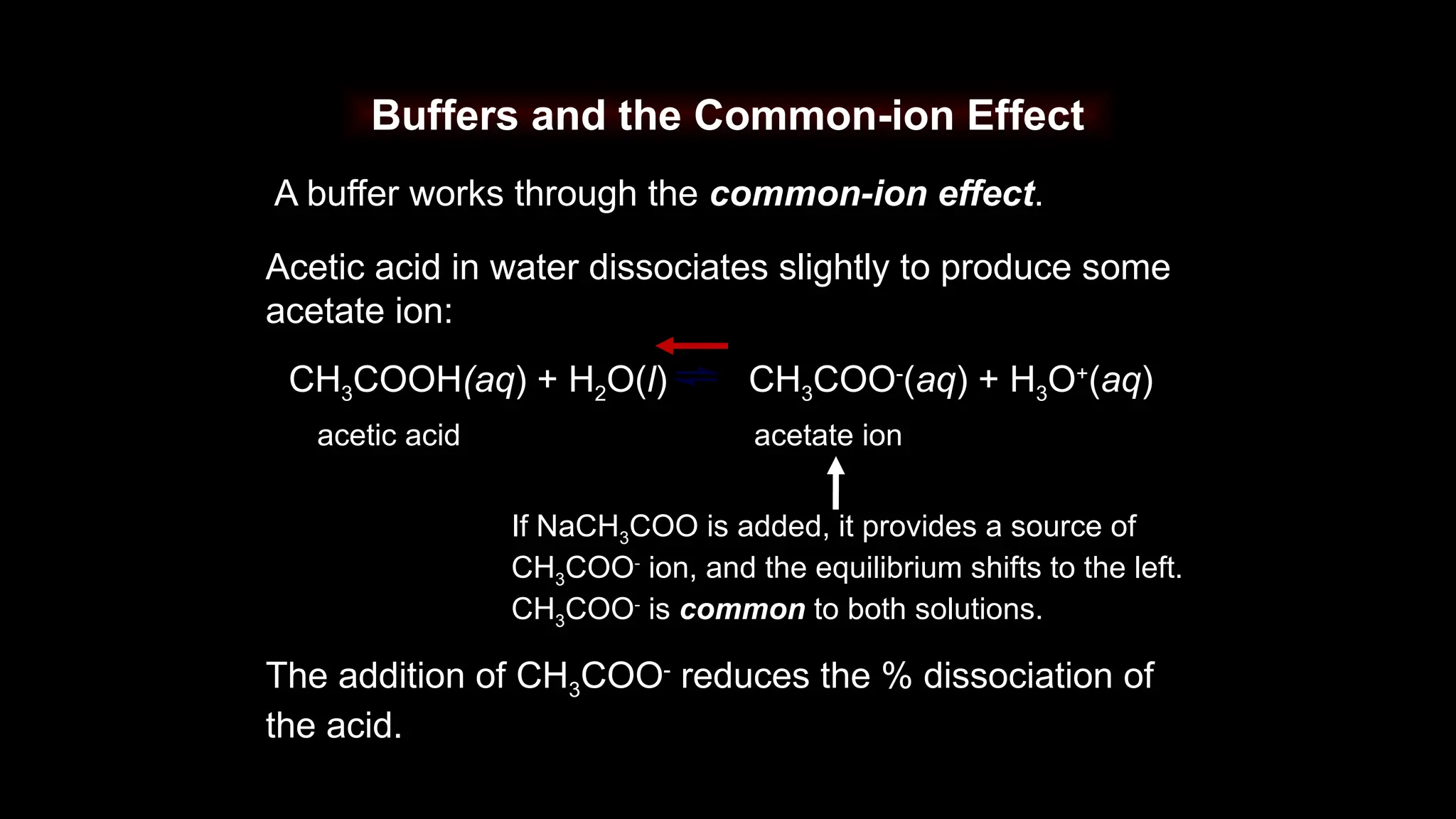
Buffers and the Common-ion Effect
A buffer works through the common-ion effect.
CH3COOH(aq) + H2O(l) CH3COO-
(aq) + H3O+
(aq)
acetic acid acetate ion
Acetic acid in water dissociates slightly to produce some
acetate ion:
If NaCH3COO is added, it provides a source of
CH3COO-
ion, and the equilibrium shifts to the left.
CH3COO-
is common to both solutions.
The addition of CH3COO-
reduces the % dissociation of
the acid.
The Effect of Added Acetate Ion on the
Dissociation of Acetic Acid
[CH3COOH]init [CH3COO-
]added % Dissociation*
[H3O+
] pH
0.10 0.00 1.3 1.3x10⁻³
2.89
0.10 0.050 0.036 3.6x10⁻⁵
4.44
0.10 0.10 0.018 1.8x10⁻⁵
4.74
0.10 0.15 0.012 1.2x10¹⁵
4.92
*
% Dissociation =
[CH3COOH]dissoc
[CH3COOH]init
x 100
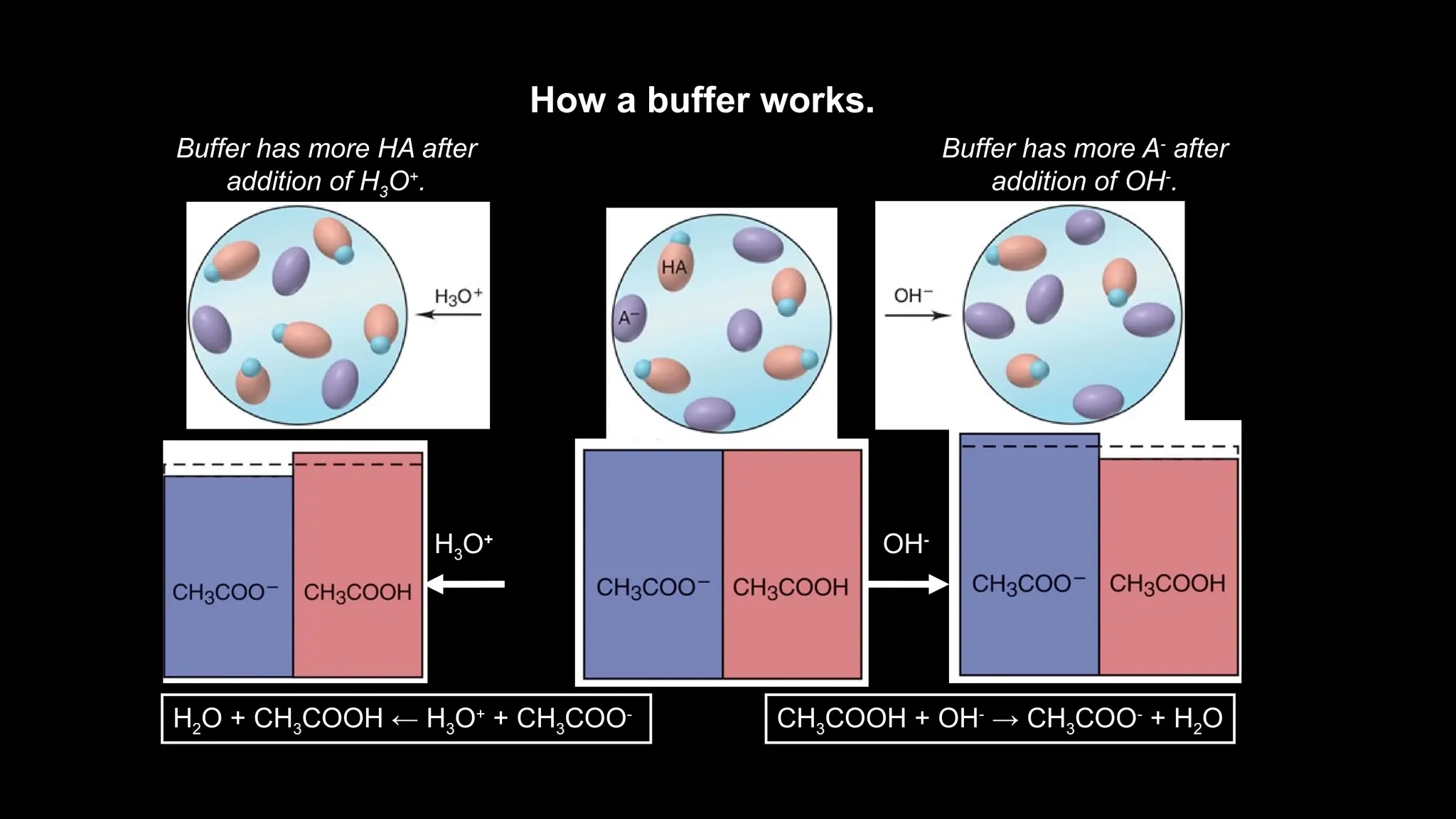
How a buffer works.
Buffer has equal
concentrations of A-
and HA.
H3O+
Buffer has more HA after
addition of H3O+
.
H2O + CH3COOH ← H3O+
+ CH3COO-
OH-
Buffer has more A-
after
addition of OH-
.
CH3COOH + OH-
→ CH3COO-
+ H2O
How a Buffer Works
The buffer components (HA and A-
) are able to consume
small amounts of added OH-
or H3O+
by a shift in
equilibrium position.
CH3COOH(aq) + H2O(l) CH3COO-
(aq) + H3O+
(aq)
Added H3O+
reacts with
CH3COO-
, causing a
shift to the left.
Added OH-
reacts with
CH3COOH, causing a shift to
the right.
The shift in equilibrium position absorbs the change in
[H3O+
] or [OH-
], and the pH changes only slightly.
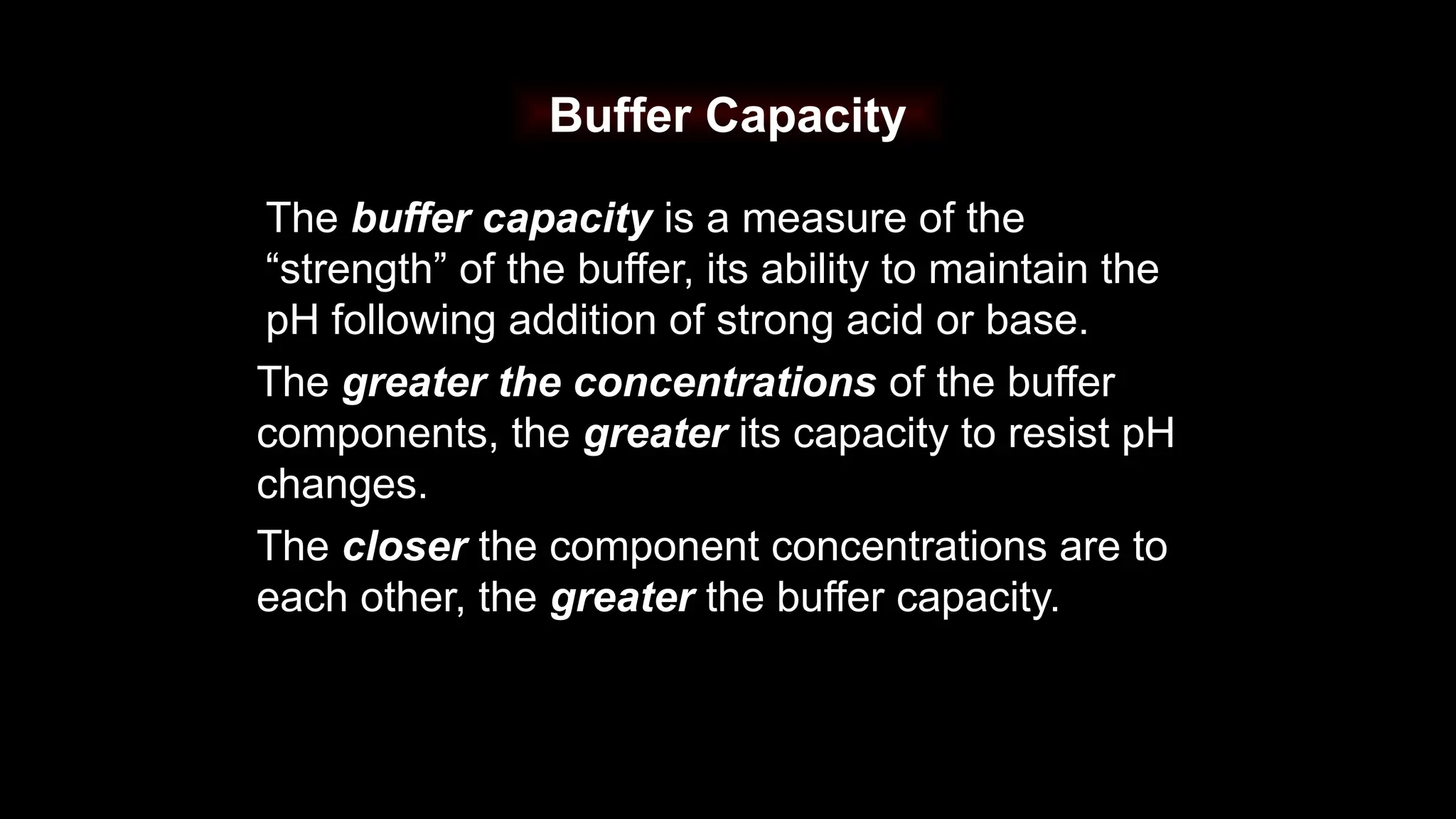
Buffer Capacity
The buffer capacity is a measure of the
“strength” of the buffer, its ability to maintain the
pH following addition of strong acid or base.
The greater the concentrations of the buffer
components, the greater its capacity to resist pH
changes.
The closer the component concentrations are to
each other, the greater the buffer capacity.
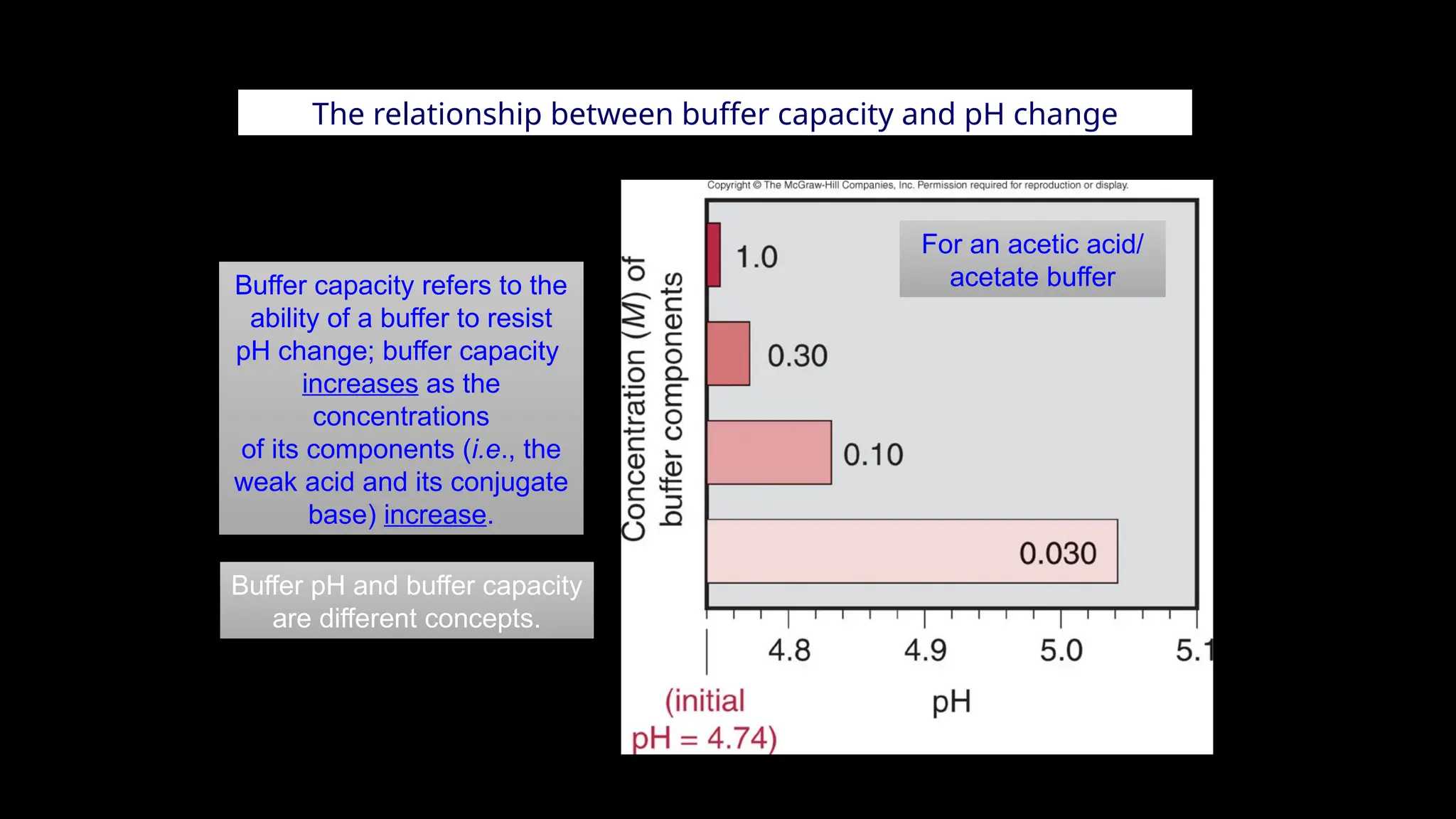
The relationship between buffer capacity and pH change
Buffer capacity refers to the
ability of a buffer to resist
pH change; buffer capacity
increases as the
concentrations
of its components (i.e., the
weak acid and its conjugate
base) increase.
Buffer pH and buffer capacity
are different concepts.
For an acetic acid/
acetate buffer
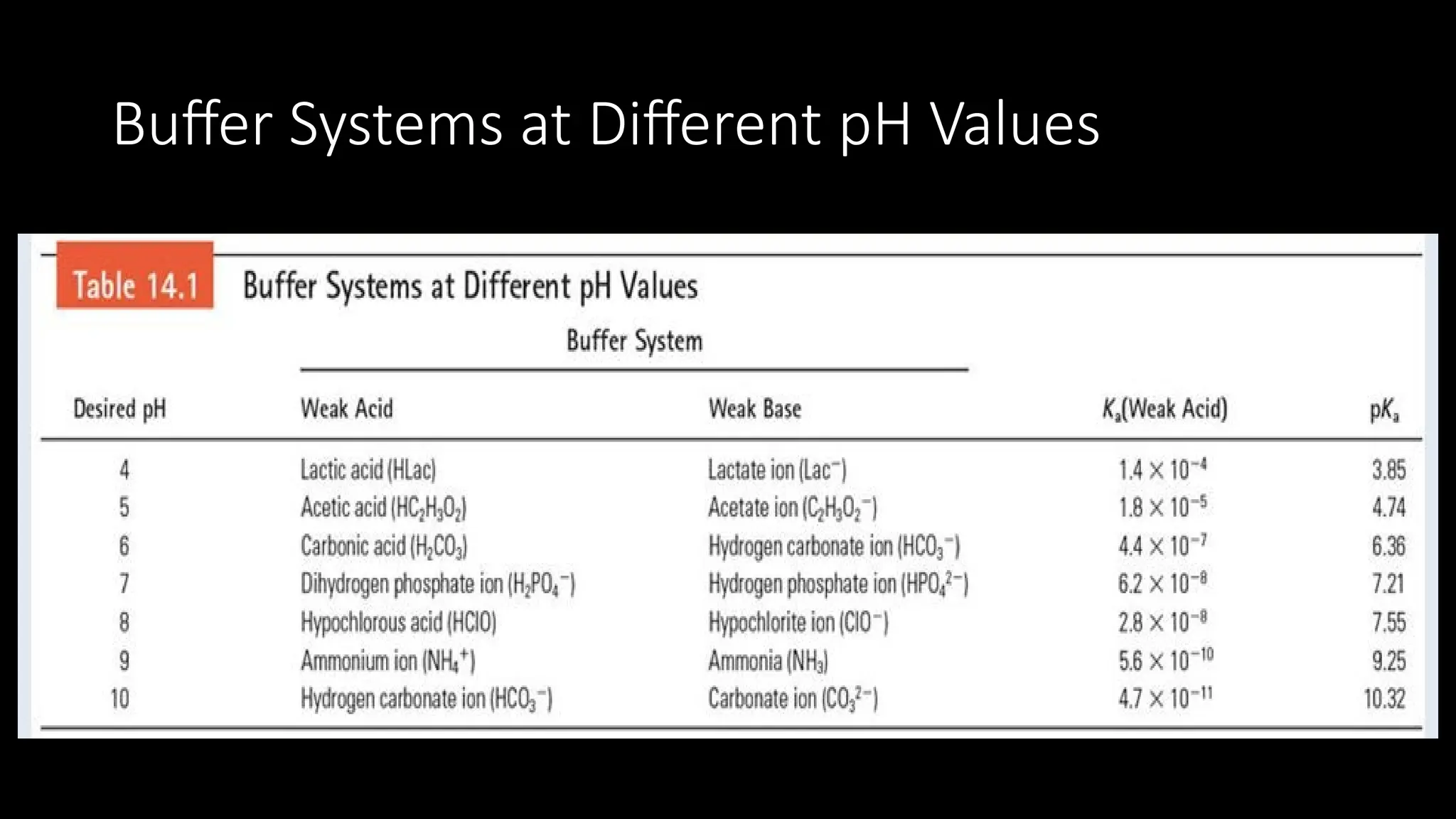
Buffer Systems at Different pH Values
The Henderson-Hasselbalch
Equation
An equation that relates pH, pKa and the ratio of
weak acid to its conjugate base for a buffer solution.
HA + H2O H3O+
+ A-
Ka = [H3O+
][A-
]/[HA]
[H3O+
] = Ka x [HA]/[A-
]
-log [H3O+
] = -log Ka - log ([HA]/[A-
])
pH = pKa + log ([A-
]/[HA])
pH = pKa + log ([base]/[acid])
Special case:
when [base] =
[acid], the pH of
the buffer
solution equals
the pKa of the
weak acid.
or
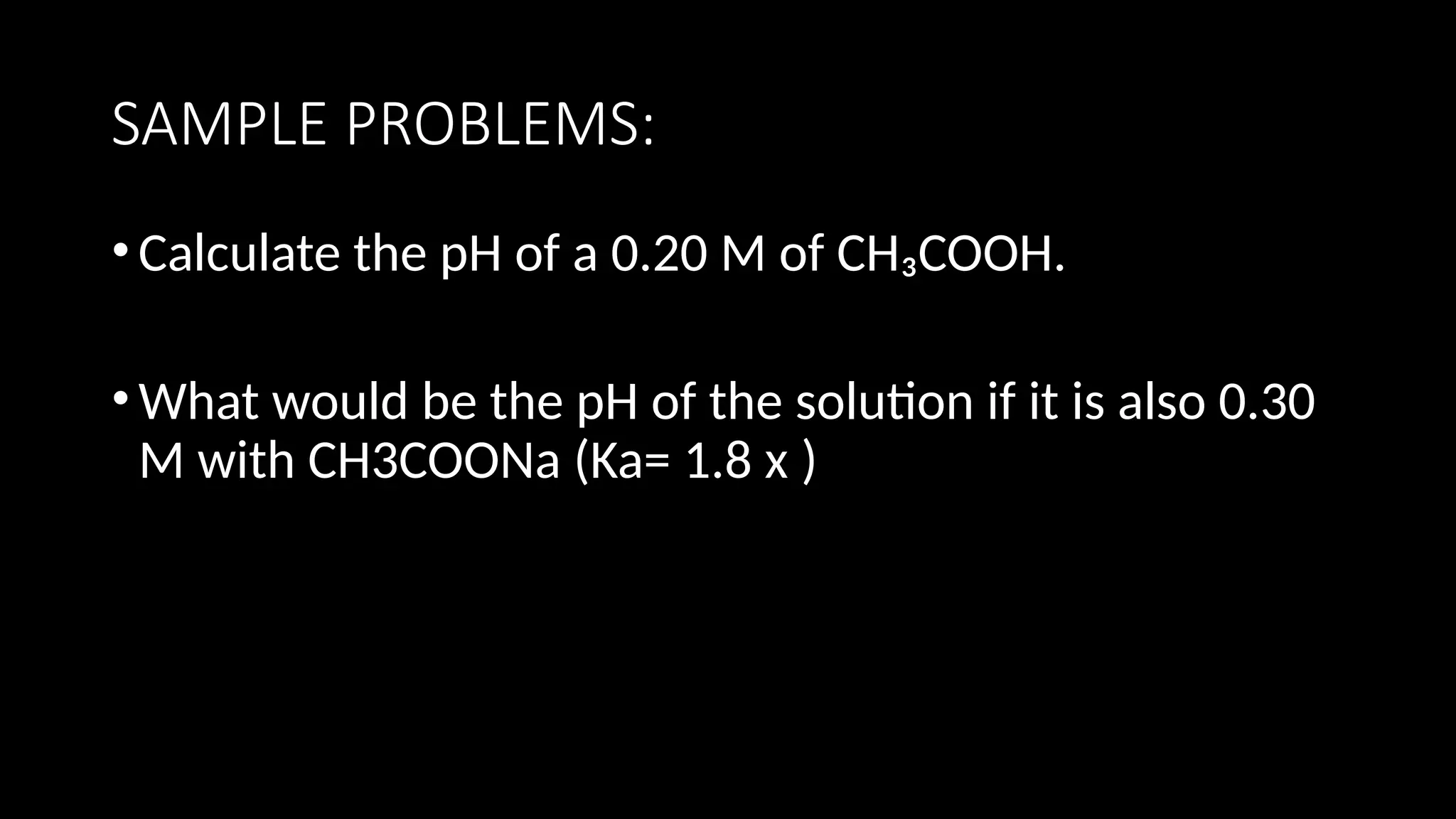
SAMPLE PROBLEMS:
•Calculate the pH of a 0.20 M of CH₃COOH.
•What would be the pH of the solution if it is also 0.30
M with CH3COONa (Ka= 1.8 x )
SOLUTION:
Let a = [] at equilibrium
CH3COOH(aq) + H2O(l) CH3COO-
(aq) + H3O+
(aq)
Ka =
I 0.20 0 0
C - a +a +a
E 0.20 - a a a
buffer solutions report presentation.pptx

buffer solutions report presentation.pptx

  • 2.
    USE OF BUFFER SOLUTIONS BY: JERTALLONES NESSY ALIDO JOMMEL REOLA CLARENZE CARL SANOY RAJA JULIANA TOLEDO
  • 3.
    OBJECTIVES: • Describe howbuffer solution maintains its pH • Calculate the pH of a buffer solution using the Henderson Hasselbalch equation
  • 5.
    Buffer solutions • Asolution of weak acid or weak base and its salt. • A buffered solution is one that resists a change in its pH when either hydroxide ions or protons (H3O+ ) are added. • Very little change in pH is witnessed even when a strong acid or base is added. • The components of a buffer are a conjugate acid-base pair. • Buffer solutions function effectively since they contain comparable amounts of acid and its conjugate base over a limited Ph range called buffer capacity.
  • 6.
    Buffer Solution • EXAMPLES: HFand NaF CH₃COOH and CH₃COONa HCN and NaCN NH₃ and NH₄Cl
  • 7.
    The effect ofadding acid or base to an unbuffered solution. A 100-mL sample of dilute HCl is adjusted to pH 5.00. The addition of 1 mL of strong acid (left) or strong base (right) changes the pH by several units.
  • 8.
    The effect ofadding acid or base to a buffered solution. A 100-mL sample of an acetate buffer is adjusted to pH 5.00. The addition of 1 mL of strong acid (left) or strong base (right) changes the pH very little. The acetate buffer is made by mixing 1 M CH3COOH ( a weak acid) with 1 M CH3COONa (which provides the conjugate base, CH3COO- ).
  • 9.
    Acid-Base Buffer Systems Buffers functionby reducing changes in [H3O+ ] that result from additions of acid or base to the solution. Buffers are composed of the conjugate acid-base pair of a weak acid. Buffers function via the common ion effect. CH3COOH(aq) + H2O(l) CH3COO- (aq) + H3O+ (aq) The common ion effect occurs when a reactant containing a given ion is added to an equilibrium mixture that already contains that ion and the position of the equilibrium shifts away from forming more of it.
  • 10.
    Buffers and theCommon-ion Effect A buffer works through the common-ion effect. CH3COOH(aq) + H2O(l) CH3COO- (aq) + H3O+ (aq) acetic acid acetate ion Acetic acid in water dissociates slightly to produce some acetate ion: If NaCH3COO is added, it provides a source of CH3COO- ion, and the equilibrium shifts to the left. CH3COO- is common to both solutions. The addition of CH3COO- reduces the % dissociation of the acid.
  • 11.
    The Effect ofAdded Acetate Ion on the Dissociation of Acetic Acid [CH3COOH]init [CH3COO- ]added % Dissociation* [H3O+ ] pH 0.10 0.00 1.3 1.3x10⁻³ 2.89 0.10 0.050 0.036 3.6x10⁻⁵ 4.44 0.10 0.10 0.018 1.8x10⁻⁵ 4.74 0.10 0.15 0.012 1.2x10¹⁵ 4.92 * % Dissociation = [CH3COOH]dissoc [CH3COOH]init x 100
  • 12.
    How a bufferworks. Buffer has equal concentrations of A- and HA. H3O+ Buffer has more HA after addition of H3O+ . H2O + CH3COOH ← H3O+ + CH3COO- OH- Buffer has more A- after addition of OH- . CH3COOH + OH- → CH3COO- + H2O
  • 13.
    How a BufferWorks The buffer components (HA and A- ) are able to consume small amounts of added OH- or H3O+ by a shift in equilibrium position. CH3COOH(aq) + H2O(l) CH3COO- (aq) + H3O+ (aq) Added H3O+ reacts with CH3COO- , causing a shift to the left. Added OH- reacts with CH3COOH, causing a shift to the right. The shift in equilibrium position absorbs the change in [H3O+ ] or [OH- ], and the pH changes only slightly.
  • 14.
    Buffer Capacity The buffercapacity is a measure of the “strength” of the buffer, its ability to maintain the pH following addition of strong acid or base. The greater the concentrations of the buffer components, the greater its capacity to resist pH changes. The closer the component concentrations are to each other, the greater the buffer capacity.
  • 15.
    The relationship betweenbuffer capacity and pH change Buffer capacity refers to the ability of a buffer to resist pH change; buffer capacity increases as the concentrations of its components (i.e., the weak acid and its conjugate base) increase. Buffer pH and buffer capacity are different concepts. For an acetic acid/ acetate buffer
  • 16.
    Buffer Systems atDifferent pH Values
  • 17.
    The Henderson-Hasselbalch Equation An equationthat relates pH, pKa and the ratio of weak acid to its conjugate base for a buffer solution. HA + H2O H3O+ + A- Ka = [H3O+ ][A- ]/[HA] [H3O+ ] = Ka x [HA]/[A- ] -log [H3O+ ] = -log Ka - log ([HA]/[A- ]) pH = pKa + log ([A- ]/[HA]) pH = pKa + log ([base]/[acid]) Special case: when [base] = [acid], the pH of the buffer solution equals the pKa of the weak acid. or
  • 18.
    SAMPLE PROBLEMS: •Calculate thepH of a 0.20 M of CH₃COOH. •What would be the pH of the solution if it is also 0.30 M with CH3COONa (Ka= 1.8 x )
  • 19.
    SOLUTION: Let a =[] at equilibrium CH3COOH(aq) + H2O(l) CH3COO- (aq) + H3O+ (aq) Ka = I 0.20 0 0 C - a +a +a E 0.20 - a a a