pH and Buffers
Presented by-Prajapati Sapana.m
CBO-406
M.Sc (sem-1)Botany
Department of life sciences,
H.N.G.U.,Patan
Content
• pH
-Introduction
-pH value
-The pH scale
-Measurement of pH
• Buffers
-Introduction
-Types of buffers
-Buffer Capacity
-Henderson-Hasselbalch Equation
-Biological buffer systems
pH
Cont…
• The concept of pH was first introduced by the danish
chemist sorenson in 1909.
• P means “puissance d” and H mean “Hydrogen”.it is the
french word,which means strength/power of hydrogen.
• Defination :-The formal defination of pH is the
negative logarithm of the hydrogen
ion activity.
pH = ¯log [Hᶧ]
• pH is a unit of measure which describes the degree of
acidity or alkalinity(basic) of a solution.
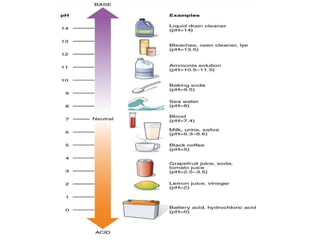
• It is measured on a scale of 0 to14.
pH value
• The pH value of a substance is directly related to the ratio of
the hydrogen ion and hydroxyl ion concentrations.
• Low pH values correspond to high concentrations of Hᶧ and
high pH values correspond to low concentrations of Hᶧ.
• If the Hᶧ concentration is higher then OH¯ the material is
acidic and the pH is less than 7
• If the OH¯ concentration is higher than Hᶧ the material is
basic and the pH is more than 7
• Number of Hᶧ equals the number of OH¯ 7 is neutral < is
acidic > 7 is basic.
The pH scale
• The ion product of water, Kw is the basic for the pH
scale.
• The pH scale corresponds to the concentration of
hydrogen ions.
• It is a covenient means of designating the actual
concentration of Hᶧ in any aqueous solution in the range
between 1.0MHᶧ and 1.0M OH¯.
• Sorensen, used a logarithmic scale for expressing the Hᶧ
concentration this scale was called pH.
Measurement of pH
• The pH can be measured by :
(1) pH strips
(2) pH indicators
(3) pH meter
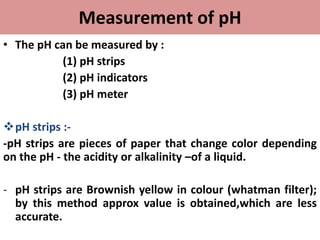
pH strips :-
-pH strips are pieces of paper that change color depending
on the pH - the acidity or alkalinity –of a liquid.
- pH strips are Brownish yellow in colour (whatman filter);
by this method approx value is obtained,which are less
accurate.
Cont…
Ph indicators:-
-indicators are the organic compounds of natural or synthetic
origin whose colour is dependent on pH.
-The pH indicators are either weak acids or weak baseshaving
different colours in undissocisted and dissociated forms :
Hln ↔ Hᶧ + ln¯
(colour-A) (colour-B)
Cont…
• pH meter :-
-The pH meter is a laboratory equipment which used to
measure acidity or alkalinity of a solution.
-The pH meter measures
The concentration of
Hydrogen ions [Hᶧ] using
An ion-sensitive electrode .
-It is the most reliable and
Convenient method for
Measuring ph.
Buffer
Types of buffers
• Buffers are 2 types :
(1)ACIDIC BUFFERS –
solution of a mixture of a weak acids with
their salt with a strong base.
E.g CH₃COOH + CH₃COONa
(Weak acid) (Salt)
(2)BASIC BUFFERS -
solution of a mixture of a weak bases with their
salt with a strong acid.
E.g NH₄OH + NH₄CL
(Weak base) (salt)
How buffers work :-
• Equilibrium between acid and base.
• Example : ACETATE BUFFER
CH₃COOH ↔ CH₃COO¯ + Hᶧ
• If more Hᶧ is added to this solution,it simply shifts
the equilibrium to the left,absorbing Hᶧ,so the [Hᶧ]
remains unchanged.
• If Hᶧ is removed (e.g. by adding OH¯)then the
equilibrium shifts to the right,releasing Hᶧ to keep
the pH constant.
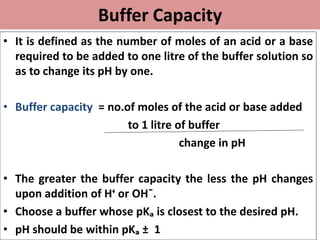
Buffer Capacity
• It is defined as the number of moles of an acid or a base
required to be added to one litre of the buffer solution so
as to change its pH by one.
• Buffer capacity = no.of moles of the acid or base added
to 1 litre of buffer
change in pH
• The greater the buffer capacity the less the pH changes
upon addition of Hᶧ or OH¯.
• Choose a buffer whose pKₐ is closest to the desired pH.
• pH should be within pKₐ ± 1
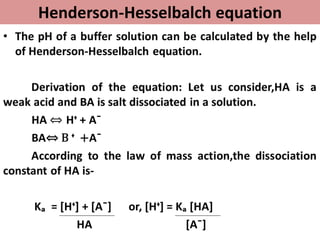
Henderson-Hesselbalch equation
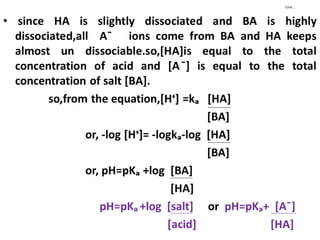
Cont…
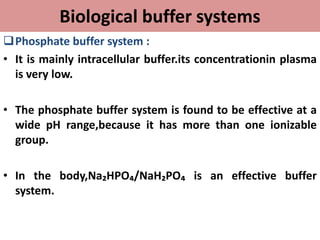
Biological buffer systems
Phosphate buffer system :
• It is mainly intracellular buffer.its concentrationin plasma
is very low.
• The phosphate buffer system is found to be effective at a
wide pH range,because it has more than one ionizable
group.
• In the body,Na₂HPO₄/NaH₂PO₄ is an effective buffer
system.
Cont…
Protein buffer system :-
• The protein buffers are very important in the plasma and
the intracellular fluids but their concentration is very low
in cerebrospinal fluid,lymph and interstitial fluids.
• The proteins exist as anions serving as conjugate
bases(Pr) at the blood pH 7.4 and from conjugate
acids(HPr) accepting Hᶧ.
• They have the capacity to buffer some H₂co₃ in the blood.
H₂CO₃ + Pr¯ ⇌ HCO₃¯ + HPr
cont
• Refrences :-
• Fundamentals of Biochemistry by: J.L.JAIN
SUNJAY JAIN
NITIN JAIN
• https://www.slideshare.net
p H and buffers

p H and buffers

  • 1.
    pH and Buffers Presentedby-Prajapati Sapana.m CBO-406 M.Sc (sem-1)Botany Department of life sciences, H.N.G.U.,Patan
  • 2.
    Content • pH -Introduction -pH value -ThepH scale -Measurement of pH • Buffers -Introduction -Types of buffers -Buffer Capacity -Henderson-Hasselbalch Equation -Biological buffer systems
  • 3.
  • 4.
    Cont… • The conceptof pH was first introduced by the danish chemist sorenson in 1909. • P means “puissance d” and H mean “Hydrogen”.it is the french word,which means strength/power of hydrogen. • Defination :-The formal defination of pH is the negative logarithm of the hydrogen ion activity. pH = ¯log [Hᶧ] • pH is a unit of measure which describes the degree of acidity or alkalinity(basic) of a solution. • It is measured on a scale of 0 to14.
  • 5.
    pH value • ThepH value of a substance is directly related to the ratio of the hydrogen ion and hydroxyl ion concentrations. • Low pH values correspond to high concentrations of Hᶧ and high pH values correspond to low concentrations of Hᶧ. • If the Hᶧ concentration is higher then OH¯ the material is acidic and the pH is less than 7 • If the OH¯ concentration is higher than Hᶧ the material is basic and the pH is more than 7 • Number of Hᶧ equals the number of OH¯ 7 is neutral < is acidic > 7 is basic.
  • 6.
    The pH scale •The ion product of water, Kw is the basic for the pH scale. • The pH scale corresponds to the concentration of hydrogen ions. • It is a covenient means of designating the actual concentration of Hᶧ in any aqueous solution in the range between 1.0MHᶧ and 1.0M OH¯. • Sorensen, used a logarithmic scale for expressing the Hᶧ concentration this scale was called pH.
  • 8.
    Measurement of pH •The pH can be measured by : (1) pH strips (2) pH indicators (3) pH meter pH strips :- -pH strips are pieces of paper that change color depending on the pH - the acidity or alkalinity –of a liquid. - pH strips are Brownish yellow in colour (whatman filter); by this method approx value is obtained,which are less accurate.
  • 9.
    Cont… Ph indicators:- -indicators arethe organic compounds of natural or synthetic origin whose colour is dependent on pH. -The pH indicators are either weak acids or weak baseshaving different colours in undissocisted and dissociated forms : Hln ↔ Hᶧ + ln¯ (colour-A) (colour-B)
  • 10.
    Cont… • pH meter:- -The pH meter is a laboratory equipment which used to measure acidity or alkalinity of a solution. -The pH meter measures The concentration of Hydrogen ions [Hᶧ] using An ion-sensitive electrode . -It is the most reliable and Convenient method for Measuring ph.
  • 11.
  • 12.
    Types of buffers •Buffers are 2 types : (1)ACIDIC BUFFERS – solution of a mixture of a weak acids with their salt with a strong base. E.g CH₃COOH + CH₃COONa (Weak acid) (Salt) (2)BASIC BUFFERS - solution of a mixture of a weak bases with their salt with a strong acid. E.g NH₄OH + NH₄CL (Weak base) (salt)
  • 13.
    How buffers work:- • Equilibrium between acid and base. • Example : ACETATE BUFFER CH₃COOH ↔ CH₃COO¯ + Hᶧ • If more Hᶧ is added to this solution,it simply shifts the equilibrium to the left,absorbing Hᶧ,so the [Hᶧ] remains unchanged. • If Hᶧ is removed (e.g. by adding OH¯)then the equilibrium shifts to the right,releasing Hᶧ to keep the pH constant.
  • 14.
    Buffer Capacity • Itis defined as the number of moles of an acid or a base required to be added to one litre of the buffer solution so as to change its pH by one. • Buffer capacity = no.of moles of the acid or base added to 1 litre of buffer change in pH • The greater the buffer capacity the less the pH changes upon addition of Hᶧ or OH¯. • Choose a buffer whose pKₐ is closest to the desired pH. • pH should be within pKₐ ± 1
  • 15.
  • 16.
  • 17.
    Biological buffer systems Phosphatebuffer system : • It is mainly intracellular buffer.its concentrationin plasma is very low. • The phosphate buffer system is found to be effective at a wide pH range,because it has more than one ionizable group. • In the body,Na₂HPO₄/NaH₂PO₄ is an effective buffer system.
  • 18.
    Cont… Protein buffer system:- • The protein buffers are very important in the plasma and the intracellular fluids but their concentration is very low in cerebrospinal fluid,lymph and interstitial fluids. • The proteins exist as anions serving as conjugate bases(Pr) at the blood pH 7.4 and from conjugate acids(HPr) accepting Hᶧ. • They have the capacity to buffer some H₂co₃ in the blood. H₂CO₃ + Pr¯ ⇌ HCO₃¯ + HPr
  • 19.
    cont • Refrences :- •Fundamentals of Biochemistry by: J.L.JAIN SUNJAY JAIN NITIN JAIN • https://www.slideshare.net