Molecular Breeding and Marker Assisted
Selection
Molecular Breeding and Marker Assisted
Selection
Bawonpon C.
Outline
• DNA Fingerprinting
• Marker Assisted Selection (MAS)
• Marker Assisted Backcross (MABC)
• Marker Assisted Pyramiding
• Quantitative Trait Loci (QTL)
• Marker Assisted Recurrent Selection(MARS)
• Genomic Selection
• DNA Fingerprinting
• Marker Assisted Selection (MAS)
• Marker Assisted Backcross (MABC)
• Marker Assisted Pyramiding
• Quantitative Trait Loci (QTL)
• Marker Assisted Recurrent Selection(MARS)
• Genomic Selection
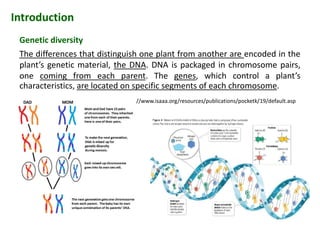
The differences that distinguish one plant from another are encoded in the
plant’s genetic material, the DNA. DNA is packaged in chromosome pairs,
one coming from each parent. The genes, which control a plant’s
characteristics, are located on specific segments of each chromosome.
Introduction
Genetic diversity
The differences that distinguish one plant from another are encoded in the
plant’s genetic material, the DNA. DNA is packaged in chromosome pairs,
one coming from each parent. The genes, which control a plant’s
characteristics, are located on specific segments of each chromosome.
http://www.isaaa.org/resources/publications/pocketk/19/default.asp
DNA Fingerprinting
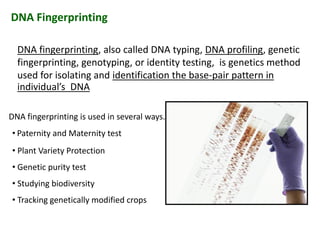
DNA fingerprinting, also called DNA typing, DNA profiling, genetic
fingerprinting, genotyping, or identity testing, is genetics method
used for isolating and identification the base-pair pattern in
individual’s DNA
• Paternity and Maternity test
• Plant Variety Protection
• Genetic purity test
• Studying biodiversity
• Tracking genetically modified crops
DNA fingerprinting is used in several ways.
DNA fingerprinting, also called DNA typing, DNA profiling, genetic
fingerprinting, genotyping, or identity testing, is genetics method
used for isolating and identification the base-pair pattern in
individual’s DNA
• Paternity and Maternity test
• Plant Variety Protection
• Genetic purity test
• Studying biodiversity
• Tracking genetically modified crops
DNA Fingerprinting
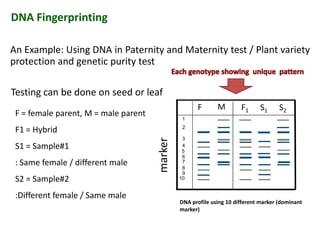
An Example: Using DNA in Paternity and Maternity test / Plant variety
protection and genetic purity test
marker
F1F M
1
2
3
4
5
6
S1 S2
F = female parent, M = male parent
F1 = Hybrid
S1 = Sample#1
: Same female / different male
S2 = Sample#2
:Different female / Same male
Testing can be done on seed or leaf
marker
5
6
7
8
9
10
DNA profile using 10 different marker (dominant
marker)
F = female parent, M = male parent
F1 = Hybrid
S1 = Sample#1
: Same female / different male
S2 = Sample#2
:Different female / Same male
DNA Fingerprinting
Genotype(variety)
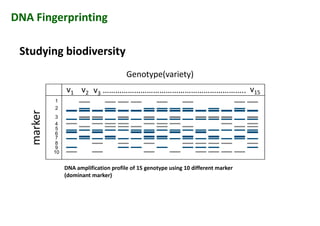
Studying biodiversity
marker
Genotype(variety)
v3 ………………………………………………………….. v15v1 v2
1
2
3
4
5
6
7
8
9
10
marker
DNA amplification profile of 15 genotype using 10 different marker
(dominant marker)
9
10
DNA Fingerprinting
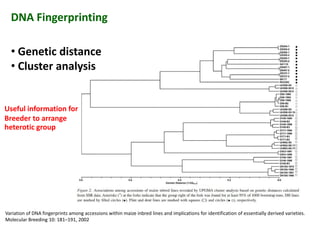
• Genetic distance
• Cluster analysis
Useful information for
Breeder to arrange
heterotic group
Variation of DNA fingerprints among accessions within maize inbred lines and implications for identification of essentially derived varieties.
Molecular Breeding 10: 181–191, 2002
Molecular Breeding
Molecular breeding (MB) may be defined in a broad-sense as the use of
genetic manipulation performed at DNA molecular levels to improve characters of
interest in plants and animals (MAB+GMO)
Marker-assisted breeding (MAB) and is defined as the application of
molecular biotechnologies, specifically molecular markers, in combination with
linkage maps and genomics, to improve plant or animal traits on the basis of
genotypic assays this term is covered several modern breeding strategies,
including marker-assisted selection (MAS), marker-assisted backcrossing (MABC),
marker-assisted recurrent selection (MARS), and genome-wide selection (GWS) or
genomic selection (GS) (Ribaut et al., 2010)
Molecular breeding (MB) may be defined in a broad-sense as the use of
genetic manipulation performed at DNA molecular levels to improve characters of
interest in plants and animals (MAB+GMO)
Marker-assisted breeding (MAB) and is defined as the application of
molecular biotechnologies, specifically molecular markers, in combination with
linkage maps and genomics, to improve plant or animal traits on the basis of
genotypic assays this term is covered several modern breeding strategies,
including marker-assisted selection (MAS), marker-assisted backcrossing (MABC),
marker-assisted recurrent selection (MARS), and genome-wide selection (GWS) or
genomic selection (GS) (Ribaut et al., 2010)
Molecular breeding (MB) may be defined in a broad-sense as the use of
genetic manipulation performed at DNA molecular levels to improve characters of
interest in plants and animals (MAB+GMO)
Marker-assisted breeding (MAB) and is defined as the application of
molecular biotechnologies, specifically molecular markers, in combination with
linkage maps and genomics, to improve plant or animal traits on the basis of
genotypic assays this term is covered several modern breeding strategies,
including marker-assisted selection (MAS), marker-assisted backcrossing (MABC),
marker-assisted recurrent selection (MARS), and genome-wide selection (GWS) or
genomic selection (GS) (Ribaut et al., 2010)
Guo-Liang Jiang: Molecular Markers and Marker-Assisted Breeding in Plants
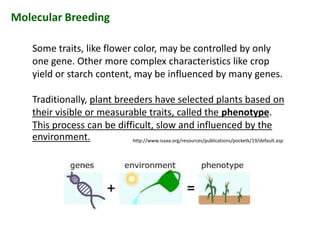
Some traits, like flower color, may be controlled by only
one gene. Other more complex characteristics like crop
yield or starch content, may be influenced by many genes.
Traditionally, plant breeders have selected plants based on
their visible or measurable traits, called the phenotype.
This process can be difficult, slow and influenced by the
environment.
Molecular Breeding
Some traits, like flower color, may be controlled by only
one gene. Other more complex characteristics like crop
yield or starch content, may be influenced by many genes.
Traditionally, plant breeders have selected plants based on
their visible or measurable traits, called the phenotype.
This process can be difficult, slow and influenced by the
environment. http://www.isaaa.org/resources/publications/pocketk/19/default.asp
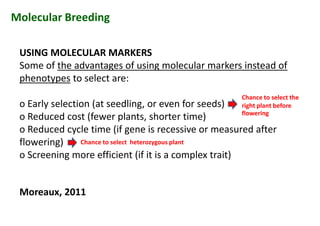
USING MOLECULAR MARKERS
Some of the advantages of using molecular markers instead of
phenotypes to select are:
o Early selection (at seedling, or even for seeds)
o Reduced cost (fewer plants, shorter time)
o Reduced cycle time (if gene is recessive or measured after
flowering)
o Screening more efficient (if it is a complex trait)
Moreaux, 2011
Molecular Breeding
USING MOLECULAR MARKERS
Some of the advantages of using molecular markers instead of
phenotypes to select are:
o Early selection (at seedling, or even for seeds)
o Reduced cost (fewer plants, shorter time)
o Reduced cycle time (if gene is recessive or measured after
flowering)
o Screening more efficient (if it is a complex trait)
Moreaux, 2011
Chance to select the
right plant before
flowering
Chance to select heterozygous plant
USING MOLECULAR MARKERS
Some of the advantages of using molecular markers instead of
phenotypes to select are:
o Early selection (at seedling, or even for seeds)
o Reduced cost (fewer plants, shorter time)
o Reduced cycle time (if gene is recessive or measured after
flowering)
o Screening more efficient (if it is a complex trait)
Moreaux, 2011
• Marker Assisted Selection (MAS)
• Marker Assisted Backcross (MABC)
• Marker Assisted Pyramiding
• Marker Assisted Recurrent Selection (MARS)
• Quantitative Trait Loci (QTL)
• Genomic Selection
Molecular Breeding Method
Molecular Breeding
• Marker Assisted Selection (MAS)
• Marker Assisted Backcross (MABC)
• Marker Assisted Pyramiding
• Marker Assisted Recurrent Selection (MARS)
• Quantitative Trait Loci (QTL)
• Genomic Selection
• Marker Assisted Selection (MAS)
• Marker Assisted Backcross (MABC)
• Marker Assisted Pyramiding
• Marker Assisted Recurrent Selection (MARS)
• Quantitative Trait Loci (QTL)
• Genomic Selection
Marker Assisted Selection (MAS)
The use of DNA markers that are tightly-linked to
target loci as a substitute for or to assist phenotypic
screening or selection.
Molecular Breeding Method
Marker Assisted Selection (MAS)
The use of DNA markers that are tightly-linked to
target loci as a substitute for or to assist phenotypic
screening or selection.
Marker Assisted Selection
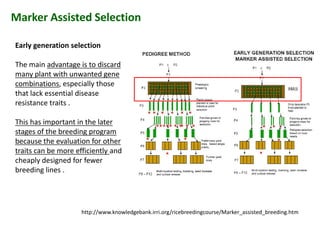
Early generation selection
The main advantage is to discard
many plant with unwanted gene
combinations, especially those
that lack essential disease
resistance traits .
This has important in the later
stages of the breeding program
because the evaluation for other
traits can be more efficiently and
cheaply designed for fewer
breeding lines .
Early generation selection
The main advantage is to discard
many plant with unwanted gene
combinations, especially those
that lack essential disease
resistance traits .
This has important in the later
stages of the breeding program
because the evaluation for other
traits can be more efficiently and
cheaply designed for fewer
breeding lines .
http://www.knowledgebank.irri.org/ricebreedingcourse/Marker_assisted_breeding.htm
Early generation selection
The main advantage is to discard
many plant with unwanted gene
combinations, especially those
that lack essential disease
resistance traits .
This has important in the later
stages of the breeding program
because the evaluation for other
traits can be more efficiently and
cheaply designed for fewer
breeding lines .
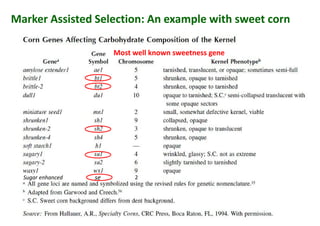
Marker Assisted Selection: An example with sweet corn
Most well known sweetness gene
se 2Sugar enhanced
Marker Assisted Selection
Category Gene Sweetness Texture Flavor Germination
/Vigor
Shelf life
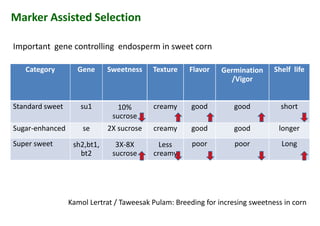
Important gene controlling endosperm in sweet corn
Germination
/Vigor
Standard sweet su1 10%
sucrose
creamy good good short
Sugar-enhanced se 2X sucrose creamy good good longer
Super sweet sh2,bt1,
bt2
3X-8X
sucrose
Less
creamy
poor poor Longsh2,bt1,
bt2
3X-8X
sucrose
Less
creamy
Kamol Lertrat / Taweesak Pulam: Breeding for incresing sweetness in corn
Marker Assisted Selection
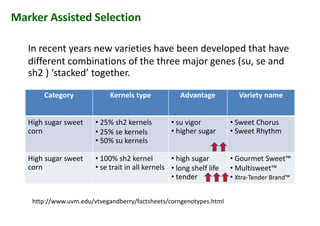
In recent years new varieties have been developed that have
different combinations of the three major genes (su, se and
sh2 ) ‘stacked’ together.
In recent years new varieties have been developed that have
different combinations of the three major genes (su, se and
sh2 ) ‘stacked’ together.
Category Kernels type Advantage Variety name
High sugar sweet
corn
• 25% sh2 kernels
• 25% se kernels
• 50% su kernels
• su vigor
• higher sugar
• Sweet Chorus
• Sweet Rhythm
High sugar sweet
corn
• 100% sh2 kernel
• se trait in all kernels
• high sugar
• long shelf life
• tender
• Gourmet Sweet™
• Multisweet™
• Xtra-Tender Brand™
http://www.uvm.edu/vtvegandberry/factsheets/corngenotypes.html
Marker Assisted Backcross (MABC)
MABC aims to transfer one or a few genes/QTLs of
Interest from one genetic source into a superior
cultivar or elite breeding line to improve the
targeted trait.
Molecular Breeding Method
Marker Assisted Backcross (MABC)
MABC aims to transfer one or a few genes/QTLs of
Interest from one genetic source into a superior
cultivar or elite breeding line to improve the
targeted trait.
Two levels of selection in which markers may be applied in
backcross breeding.
• Select backcross progeny carrying the target gene which
tightly-linked to flanking markers (foreground selection).
• Select backcross progeny with background markers
(background selection) to accelerate the recovery of the
recurrent parent genome.
Marker Assisted Backcross
Two levels of selection in which markers may be applied in
backcross breeding.
• Select backcross progeny carrying the target gene which
tightly-linked to flanking markers (foreground selection).
• Select backcross progeny with background markers
(background selection) to accelerate the recovery of the
recurrent parent genome.
Two levels of selection in which markers may be applied in
backcross breeding.
• Select backcross progeny carrying the target gene which
tightly-linked to flanking markers (foreground selection).
• Select backcross progeny with background markers
(background selection) to accelerate the recovery of the
recurrent parent genome.
Marker Assisted Backcross (MABC)
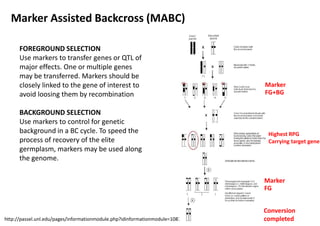
FOREGROUND SELECTION
Use markers to transfer genes or QTL of
major effects. One or multiple genes
may be transferred. Markers should be
closely linked to the gene of interest to
avoid loosing them by recombination
BACKGROUND SELECTION
Use markers to control for genetic
background in a BC cycle. To speed the
process of recovery of the elite
germplasm, markers may be used along
the genome.
FOREGROUND SELECTION
Use markers to transfer genes or QTL of
major effects. One or multiple genes
may be transferred. Markers should be
closely linked to the gene of interest to
avoid loosing them by recombination
BACKGROUND SELECTION
Use markers to control for genetic
background in a BC cycle. To speed the
process of recovery of the elite
germplasm, markers may be used along
the genome.
Marker
FG+BG
Highest RPG
Carrying target gene
http://passel.unl.edu/pages/informationmodule.php?idinformationmodule=1087488148&topicorder=7&maxto=10
FOREGROUND SELECTION
Use markers to transfer genes or QTL of
major effects. One or multiple genes
may be transferred. Markers should be
closely linked to the gene of interest to
avoid loosing them by recombination
BACKGROUND SELECTION
Use markers to control for genetic
background in a BC cycle. To speed the
process of recovery of the elite
germplasm, markers may be used along
the genome.
Marker
FG
Conversion
completed
resistance donor P1 X P2 F1 BC1F1 BC2F1 BC3F1
Marker Assisted Backcross (MABC)
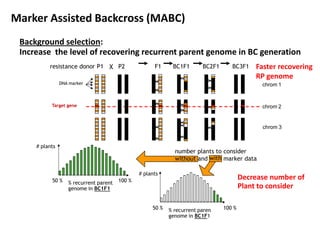
Background selection:
Increase the level of recovering recurrent parent genome in BC generation
Faster recovering
RP genome
DNA marker chrom 1
Target gene chrom 2
chrom 3
# plants
number plants to consider
Faster recovering
RP genome
number plants to consider
without and marker data
# plants
50 % 100 %% recurrent parent
genome in BC1F1
50 % 100 %% recurrent paren
genome in BC1F1
with
Decrease number of
Plant to consider
Marker Assisted Pyramiding
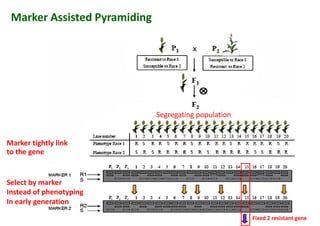
Pyramiding is the process of combining multiple genes/QTLs together
into a single genotype. This is possible through conventional breeding
but extremely difficult or impossible at early generations. DNA markers
may facilitate selection because :
• DNA marker assays are non-destructive
• Markers for multiple specific genes/QTLs can be tested without
phenotyping.
• The most widespread application for pyramiding has been for
combining multiple disease resistance genes in order to develop durable
disease resistance.
Molecular Breeding Method
Pyramiding is the process of combining multiple genes/QTLs together
into a single genotype. This is possible through conventional breeding
but extremely difficult or impossible at early generations. DNA markers
may facilitate selection because :
• DNA marker assays are non-destructive
• Markers for multiple specific genes/QTLs can be tested without
phenotyping.
• The most widespread application for pyramiding has been for
combining multiple disease resistance genes in order to develop durable
disease resistance.
Pyramiding is the process of combining multiple genes/QTLs together
into a single genotype. This is possible through conventional breeding
but extremely difficult or impossible at early generations. DNA markers
may facilitate selection because :
• DNA marker assays are non-destructive
• Markers for multiple specific genes/QTLs can be tested without
phenotyping.
• The most widespread application for pyramiding has been for
combining multiple disease resistance genes in order to develop durable
disease resistance.
http://www.knowledgebank.irri.org/ricebreedingcourse/Marker_assisted_breeding.htm
Marker Assisted Pyramiding
Segregating population
Marker tightly link
to the gene
Marker tightly link
to the gene
Select by marker
Instead of phenotyping
In early generation
Fixed 2 resistant gene
Marker Assisted Pyramiding
Gene pyramiding in major crop
Marker Assisted Pyramiding
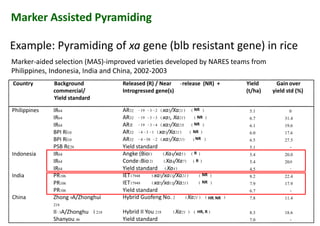
Marker-aided selection (MAS)-improved varieties developed by NARES teams from
Philippines, Indonesia, India and China, 2002-2003
Example: Pyramiding of xa gene (blb resistant gene) in rice
Country Background
commercial/
Yield standard
Released (R) / Near -release (NR) +
Introgressed gene(s)
Yield
(t/ha)
Gain over
yield std (%)
Philippines IR64 AR32 -19 -3 -2 (xa5/Xa21) ( NR ) 5.1 0
IR64 AR32 -19 -3 -3 (xa5, Xa21) ( NR ) 6.7 31.4
IR64 AR32 -19 -3 -4 (xa5/Xa21) ( NR ) 6.1 19.6
BPI Ri10 AR32 -4 -3 -1 (xa5/Xa21) ( NR ) 6.0 17.6
BPI Ri10 AR32 -4 -58 -2 (xa5/Xa21) (NR ) 6.5 27.5
PSB Rc28 Yield standard 5.1 -
Indonesia IR64 Angke (Bio1) (Xa4/xa5) ( R ) 5.4 20.0
5.1 -
Indonesia IR64 Angke (Bio1) (Xa4/xa5) ( R ) 5.4 20.0
IR64 Conde (Bio2) (Xa4/Xa7) ( R ) 5.4 20.0
IR64 Yield standard (Xa4) 4.5 -
India PR106 IET17948 (xa5/xa13/Xa21) ( NR ) 8.2 22.4
PR106 IET17949 (xa5/xa13/Xa21) NR ) 7.9 17.9
PR106 Yield standard 6.7 -
China Zhong 9A/Zhonghui
218
Hybrid Guofeng No. 2 (Xa21 ) ( HR, NR ) 7.8 11.4
II-3A/Zhonghu i 218 Hybrid II You 218 (Xa21 ) ( HR, R ) 8.3 18.6
Shanyou 46 Yield standard 7.0 -
(
Marker Assisted Pyramiding
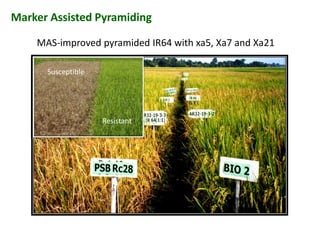
MAS-improved pyramided IR64 with xa5, Xa7 and Xa21
Susceptible
Resistant
Susceptible
Quantitative Trait Loci (QTL)
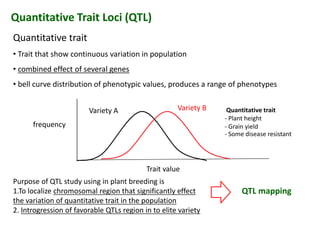
Quantitative trait
• Trait that show continuous variation in population
• combined effect of several genes
• bell curve distribution of phenotypic values, produces a range of phenotypes
Quantitative trait
• Trait that show continuous variation in population
• combined effect of several genes
• bell curve distribution of phenotypic values, produces a range of phenotypes
Variety A Variety B Quantitative trait
- Plant height
- Grain yield
- Some disease resistant
frequency
Trait value
Purpose of QTL study using in plant breeding is
1.To localize chromosomal region that significantly effect
the variation of quantitative trait in the population
2. Introgression of favorable QTLs region in to elite variety
QTL mapping
Quantitative Trait Loci (QTL)
A quantitative trait locus/loci (QTL) is the location or
region of individual locus or multiple loci in the genome that
affects a trait that is measured on a quantitative .
• Develop mapping population (F2, DH, NIL, BC, RIL)
• Genotyping (Polymorphic marker)
• Constructing of linkage maps (linkage between marker)
• Phenotyping (screen in field)
• QTLs analysis
- Test association between phenotypic trait and marker
- Identify major /minor QTL
QTLs mapping process
A quantitative trait locus/loci (QTL) is the location or
region of individual locus or multiple loci in the genome that
affects a trait that is measured on a quantitative .
• Develop mapping population (F2, DH, NIL, BC, RIL)
• Genotyping (Polymorphic marker)
• Constructing of linkage maps (linkage between marker)
• Phenotyping (screen in field)
• QTLs analysis
- Test association between phenotypic trait and marker
- Identify major /minor QTL
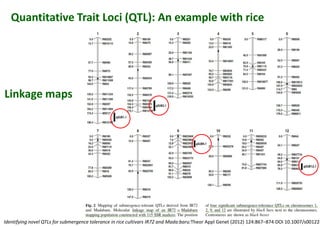
Quantitative Trait Loci (QTL): An example with rice
Linkage maps
Identifying novel QTLs for submergence tolerance in rice cultivars IR72 and Mada:baru:Theor Appl Genet (2012) 124:867–874 DOI 10.1007/s00122-
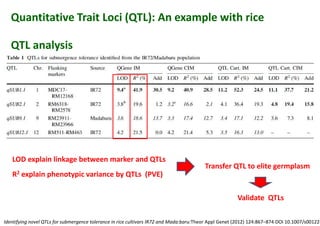
Quantitative Trait Loci (QTL): An example with rice
QTL analysis
Identifying novel QTLs for submergence tolerance in rice cultivars IR72 and Mada:baru:Theor Appl Genet (2012) 124:867–874 DOI 10.1007/s00122-
LOD explain linkage between marker and QTLs
R2 explain phenotypic variance by QTLs (PVE)
Transfer QTL to elite germplasm
Validate QTLs
Marker Assisted Recurrent Selection (MARS)
When much of the variation is controlled by many
minor QTLs ( 20-30 QTLs), MABC has limited applicability
because estimates of QTL effects are inconsistent and
gene pyramiding becomes increasingly difficult as the
number of QTLs increases.
A more effective strategy is to deploy MARS to
increase the frequency of favorable marker alleles in
the population.
When much of the variation is controlled by many
minor QTLs ( 20-30 QTLs), MABC has limited applicability
because estimates of QTL effects are inconsistent and
gene pyramiding becomes increasingly difficult as the
number of QTLs increases.
A more effective strategy is to deploy MARS to
increase the frequency of favorable marker alleles in
the population.
Roberto Tuberosa: Dept. of Agroenvironmental Sciences and Technology , University of Bologna, Italy
When much of the variation is controlled by many
minor QTLs ( 20-30 QTLs), MABC has limited applicability
because estimates of QTL effects are inconsistent and
gene pyramiding becomes increasingly difficult as the
number of QTLs increases.
A more effective strategy is to deploy MARS to
increase the frequency of favorable marker alleles in
the population.
Marker Assisted Recurrent Selection (MARS)
MARS involves:
• Defining a selection index for F2 or F2-derived
progenies, use index to weight significant marker for
target QTLs (20-30 QTLs)
• Recombining selfed progenies of the selected
individuals
• Repeat the procedure for a number of cycles
MARS involves:
• Defining a selection index for F2 or F2-derived
progenies, use index to weight significant marker for
target QTLs (20-30 QTLs)
• Recombining selfed progenies of the selected
individuals
• Repeat the procedure for a number of cycles
Roberto Tuberosa: Dept. of Agroenvironmental Sciences and Technology , University of Bologna, Italy
Marker Assisted Recurrent Selection (MARS)
Steps in a MARS in Maize:
1. MAS in Cycle 0
• Create an F2 (Cycle 0)
• Test-cross the F2
• Evaluate progeny in multiple environments
• Identify markers associated with trait of interest
• Create an index weighting significant markers
by their effect using multiple linear regression
(Lande and Thompson 1990).
• Recombine best progeny (best individuals from Cycle 0)
2. Select in greenhouse or off-season nursery (up to 3
cycles in low h2 environment).
1. MAS in Cycle 0
• Create an F2 (Cycle 0)
• Test-cross the F2
• Evaluate progeny in multiple environments
• Identify markers associated with trait of interest
• Create an index weighting significant markers
by their effect using multiple linear regression
(Lande and Thompson 1990).
• Recombine best progeny (best individuals from Cycle 0)
2. Select in greenhouse or off-season nursery (up to 3
cycles in low h2 environment).
Patricio J. Mayor and Rex Bernardo:
Genomewide Selection and Marker-Assisted Recurrent Selection in Doubled Haploid
versus F2 Populations
1. MAS in Cycle 0
• Create an F2 (Cycle 0)
• Test-cross the F2
• Evaluate progeny in multiple environments
• Identify markers associated with trait of interest
• Create an index weighting significant markers
by their effect using multiple linear regression
(Lande and Thompson 1990).
• Recombine best progeny (best individuals from Cycle 0)
2. Select in greenhouse or off-season nursery (up to 3
cycles in low h2 environment).
Genomic Selection
Genomic selection (GS) is a new approach for
improving quantitative traits in large plant
breeding populations that uses whole genome
molecular markers and combines marker data
with phenotypic data in an attempt to increase
the accuracy of the prediction of breeding and
genotypic values.
Genomic selection (GS) is a new approach for
improving quantitative traits in large plant
breeding populations that uses whole genome
molecular markers and combines marker data
with phenotypic data in an attempt to increase
the accuracy of the prediction of breeding and
genotypic values.
Genomic selection (GS) is a new approach for
improving quantitative traits in large plant
breeding populations that uses whole genome
molecular markers and combines marker data
with phenotypic data in an attempt to increase
the accuracy of the prediction of breeding and
genotypic values.
http://genomics.cimmyt.org/
Genomic Selection
Objective of GS is to predict the breeding value of each
individual instead of identifying QTL for use in a traditional
marker-assisted selection (MAS) program
• Requires high-density molecular markers (LD level)
• GS considers the effects of all markers together and captures most of
the additive variation
• Marker effects are first estimated based on a so-called
“training population” that needs to be sufficiently large (> 300)
• Breeding value is then predicted for each genotype in the
“testing population” using the estimated marker effects
Objective of GS is to predict the breeding value of each
individual instead of identifying QTL for use in a traditional
marker-assisted selection (MAS) program
• Requires high-density molecular markers (LD level)
• GS considers the effects of all markers together and captures most of
the additive variation
• Marker effects are first estimated based on a so-called
“training population” that needs to be sufficiently large (> 300)
• Breeding value is then predicted for each genotype in the
“testing population” using the estimated marker effects
Roberto Tuberosa: Dept. of Agroenvironmental Sciences and Technology , University of Bologna, Italy
Genomic Selection Scheme
Statistic model
Genomic Selection Scheme
Predict trait value
base on genotype
result
Selection or intermate for
Next cycle
Predict trait value
base on genotype
result
THANKSTHANKS
Thanks!

Molecular plant breeding some basic information

  • 1.
    Molecular Breeding andMarker Assisted Selection Molecular Breeding and Marker Assisted Selection Bawonpon C.
  • 2.
    Outline • DNA Fingerprinting •Marker Assisted Selection (MAS) • Marker Assisted Backcross (MABC) • Marker Assisted Pyramiding • Quantitative Trait Loci (QTL) • Marker Assisted Recurrent Selection(MARS) • Genomic Selection • DNA Fingerprinting • Marker Assisted Selection (MAS) • Marker Assisted Backcross (MABC) • Marker Assisted Pyramiding • Quantitative Trait Loci (QTL) • Marker Assisted Recurrent Selection(MARS) • Genomic Selection
  • 3.
    The differences thatdistinguish one plant from another are encoded in the plant’s genetic material, the DNA. DNA is packaged in chromosome pairs, one coming from each parent. The genes, which control a plant’s characteristics, are located on specific segments of each chromosome. Introduction Genetic diversity The differences that distinguish one plant from another are encoded in the plant’s genetic material, the DNA. DNA is packaged in chromosome pairs, one coming from each parent. The genes, which control a plant’s characteristics, are located on specific segments of each chromosome. http://www.isaaa.org/resources/publications/pocketk/19/default.asp
  • 4.
    DNA Fingerprinting DNA fingerprinting,also called DNA typing, DNA profiling, genetic fingerprinting, genotyping, or identity testing, is genetics method used for isolating and identification the base-pair pattern in individual’s DNA • Paternity and Maternity test • Plant Variety Protection • Genetic purity test • Studying biodiversity • Tracking genetically modified crops DNA fingerprinting is used in several ways. DNA fingerprinting, also called DNA typing, DNA profiling, genetic fingerprinting, genotyping, or identity testing, is genetics method used for isolating and identification the base-pair pattern in individual’s DNA • Paternity and Maternity test • Plant Variety Protection • Genetic purity test • Studying biodiversity • Tracking genetically modified crops
  • 5.
    DNA Fingerprinting An Example:Using DNA in Paternity and Maternity test / Plant variety protection and genetic purity test marker F1F M 1 2 3 4 5 6 S1 S2 F = female parent, M = male parent F1 = Hybrid S1 = Sample#1 : Same female / different male S2 = Sample#2 :Different female / Same male Testing can be done on seed or leaf marker 5 6 7 8 9 10 DNA profile using 10 different marker (dominant marker) F = female parent, M = male parent F1 = Hybrid S1 = Sample#1 : Same female / different male S2 = Sample#2 :Different female / Same male
  • 6.
    DNA Fingerprinting Genotype(variety) Studying biodiversity marker Genotype(variety) v3………………………………………………………….. v15v1 v2 1 2 3 4 5 6 7 8 9 10 marker DNA amplification profile of 15 genotype using 10 different marker (dominant marker) 9 10
  • 7.
    DNA Fingerprinting • Geneticdistance • Cluster analysis Useful information for Breeder to arrange heterotic group Variation of DNA fingerprints among accessions within maize inbred lines and implications for identification of essentially derived varieties. Molecular Breeding 10: 181–191, 2002
  • 8.
    Molecular Breeding Molecular breeding(MB) may be defined in a broad-sense as the use of genetic manipulation performed at DNA molecular levels to improve characters of interest in plants and animals (MAB+GMO) Marker-assisted breeding (MAB) and is defined as the application of molecular biotechnologies, specifically molecular markers, in combination with linkage maps and genomics, to improve plant or animal traits on the basis of genotypic assays this term is covered several modern breeding strategies, including marker-assisted selection (MAS), marker-assisted backcrossing (MABC), marker-assisted recurrent selection (MARS), and genome-wide selection (GWS) or genomic selection (GS) (Ribaut et al., 2010) Molecular breeding (MB) may be defined in a broad-sense as the use of genetic manipulation performed at DNA molecular levels to improve characters of interest in plants and animals (MAB+GMO) Marker-assisted breeding (MAB) and is defined as the application of molecular biotechnologies, specifically molecular markers, in combination with linkage maps and genomics, to improve plant or animal traits on the basis of genotypic assays this term is covered several modern breeding strategies, including marker-assisted selection (MAS), marker-assisted backcrossing (MABC), marker-assisted recurrent selection (MARS), and genome-wide selection (GWS) or genomic selection (GS) (Ribaut et al., 2010) Molecular breeding (MB) may be defined in a broad-sense as the use of genetic manipulation performed at DNA molecular levels to improve characters of interest in plants and animals (MAB+GMO) Marker-assisted breeding (MAB) and is defined as the application of molecular biotechnologies, specifically molecular markers, in combination with linkage maps and genomics, to improve plant or animal traits on the basis of genotypic assays this term is covered several modern breeding strategies, including marker-assisted selection (MAS), marker-assisted backcrossing (MABC), marker-assisted recurrent selection (MARS), and genome-wide selection (GWS) or genomic selection (GS) (Ribaut et al., 2010) Guo-Liang Jiang: Molecular Markers and Marker-Assisted Breeding in Plants
  • 9.
    Some traits, likeflower color, may be controlled by only one gene. Other more complex characteristics like crop yield or starch content, may be influenced by many genes. Traditionally, plant breeders have selected plants based on their visible or measurable traits, called the phenotype. This process can be difficult, slow and influenced by the environment. Molecular Breeding Some traits, like flower color, may be controlled by only one gene. Other more complex characteristics like crop yield or starch content, may be influenced by many genes. Traditionally, plant breeders have selected plants based on their visible or measurable traits, called the phenotype. This process can be difficult, slow and influenced by the environment. http://www.isaaa.org/resources/publications/pocketk/19/default.asp
  • 10.
    USING MOLECULAR MARKERS Someof the advantages of using molecular markers instead of phenotypes to select are: o Early selection (at seedling, or even for seeds) o Reduced cost (fewer plants, shorter time) o Reduced cycle time (if gene is recessive or measured after flowering) o Screening more efficient (if it is a complex trait) Moreaux, 2011 Molecular Breeding USING MOLECULAR MARKERS Some of the advantages of using molecular markers instead of phenotypes to select are: o Early selection (at seedling, or even for seeds) o Reduced cost (fewer plants, shorter time) o Reduced cycle time (if gene is recessive or measured after flowering) o Screening more efficient (if it is a complex trait) Moreaux, 2011 Chance to select the right plant before flowering Chance to select heterozygous plant USING MOLECULAR MARKERS Some of the advantages of using molecular markers instead of phenotypes to select are: o Early selection (at seedling, or even for seeds) o Reduced cost (fewer plants, shorter time) o Reduced cycle time (if gene is recessive or measured after flowering) o Screening more efficient (if it is a complex trait) Moreaux, 2011
  • 11.
    • Marker AssistedSelection (MAS) • Marker Assisted Backcross (MABC) • Marker Assisted Pyramiding • Marker Assisted Recurrent Selection (MARS) • Quantitative Trait Loci (QTL) • Genomic Selection Molecular Breeding Method Molecular Breeding • Marker Assisted Selection (MAS) • Marker Assisted Backcross (MABC) • Marker Assisted Pyramiding • Marker Assisted Recurrent Selection (MARS) • Quantitative Trait Loci (QTL) • Genomic Selection • Marker Assisted Selection (MAS) • Marker Assisted Backcross (MABC) • Marker Assisted Pyramiding • Marker Assisted Recurrent Selection (MARS) • Quantitative Trait Loci (QTL) • Genomic Selection
  • 12.
    Marker Assisted Selection(MAS) The use of DNA markers that are tightly-linked to target loci as a substitute for or to assist phenotypic screening or selection. Molecular Breeding Method Marker Assisted Selection (MAS) The use of DNA markers that are tightly-linked to target loci as a substitute for or to assist phenotypic screening or selection.
  • 13.
    Marker Assisted Selection Earlygeneration selection The main advantage is to discard many plant with unwanted gene combinations, especially those that lack essential disease resistance traits . This has important in the later stages of the breeding program because the evaluation for other traits can be more efficiently and cheaply designed for fewer breeding lines . Early generation selection The main advantage is to discard many plant with unwanted gene combinations, especially those that lack essential disease resistance traits . This has important in the later stages of the breeding program because the evaluation for other traits can be more efficiently and cheaply designed for fewer breeding lines . http://www.knowledgebank.irri.org/ricebreedingcourse/Marker_assisted_breeding.htm Early generation selection The main advantage is to discard many plant with unwanted gene combinations, especially those that lack essential disease resistance traits . This has important in the later stages of the breeding program because the evaluation for other traits can be more efficiently and cheaply designed for fewer breeding lines .
  • 14.
    Marker Assisted Selection:An example with sweet corn Most well known sweetness gene se 2Sugar enhanced
  • 15.
    Marker Assisted Selection CategoryGene Sweetness Texture Flavor Germination /Vigor Shelf life Important gene controlling endosperm in sweet corn Germination /Vigor Standard sweet su1 10% sucrose creamy good good short Sugar-enhanced se 2X sucrose creamy good good longer Super sweet sh2,bt1, bt2 3X-8X sucrose Less creamy poor poor Longsh2,bt1, bt2 3X-8X sucrose Less creamy Kamol Lertrat / Taweesak Pulam: Breeding for incresing sweetness in corn
  • 16.
    Marker Assisted Selection Inrecent years new varieties have been developed that have different combinations of the three major genes (su, se and sh2 ) ‘stacked’ together. In recent years new varieties have been developed that have different combinations of the three major genes (su, se and sh2 ) ‘stacked’ together. Category Kernels type Advantage Variety name High sugar sweet corn • 25% sh2 kernels • 25% se kernels • 50% su kernels • su vigor • higher sugar • Sweet Chorus • Sweet Rhythm High sugar sweet corn • 100% sh2 kernel • se trait in all kernels • high sugar • long shelf life • tender • Gourmet Sweet™ • Multisweet™ • Xtra-Tender Brand™ http://www.uvm.edu/vtvegandberry/factsheets/corngenotypes.html
  • 17.
    Marker Assisted Backcross(MABC) MABC aims to transfer one or a few genes/QTLs of Interest from one genetic source into a superior cultivar or elite breeding line to improve the targeted trait. Molecular Breeding Method Marker Assisted Backcross (MABC) MABC aims to transfer one or a few genes/QTLs of Interest from one genetic source into a superior cultivar or elite breeding line to improve the targeted trait.
  • 18.
    Two levels ofselection in which markers may be applied in backcross breeding. • Select backcross progeny carrying the target gene which tightly-linked to flanking markers (foreground selection). • Select backcross progeny with background markers (background selection) to accelerate the recovery of the recurrent parent genome. Marker Assisted Backcross Two levels of selection in which markers may be applied in backcross breeding. • Select backcross progeny carrying the target gene which tightly-linked to flanking markers (foreground selection). • Select backcross progeny with background markers (background selection) to accelerate the recovery of the recurrent parent genome. Two levels of selection in which markers may be applied in backcross breeding. • Select backcross progeny carrying the target gene which tightly-linked to flanking markers (foreground selection). • Select backcross progeny with background markers (background selection) to accelerate the recovery of the recurrent parent genome.
  • 19.
    Marker Assisted Backcross(MABC) FOREGROUND SELECTION Use markers to transfer genes or QTL of major effects. One or multiple genes may be transferred. Markers should be closely linked to the gene of interest to avoid loosing them by recombination BACKGROUND SELECTION Use markers to control for genetic background in a BC cycle. To speed the process of recovery of the elite germplasm, markers may be used along the genome. FOREGROUND SELECTION Use markers to transfer genes or QTL of major effects. One or multiple genes may be transferred. Markers should be closely linked to the gene of interest to avoid loosing them by recombination BACKGROUND SELECTION Use markers to control for genetic background in a BC cycle. To speed the process of recovery of the elite germplasm, markers may be used along the genome. Marker FG+BG Highest RPG Carrying target gene http://passel.unl.edu/pages/informationmodule.php?idinformationmodule=1087488148&topicorder=7&maxto=10 FOREGROUND SELECTION Use markers to transfer genes or QTL of major effects. One or multiple genes may be transferred. Markers should be closely linked to the gene of interest to avoid loosing them by recombination BACKGROUND SELECTION Use markers to control for genetic background in a BC cycle. To speed the process of recovery of the elite germplasm, markers may be used along the genome. Marker FG Conversion completed
  • 20.
    resistance donor P1X P2 F1 BC1F1 BC2F1 BC3F1 Marker Assisted Backcross (MABC) Background selection: Increase the level of recovering recurrent parent genome in BC generation Faster recovering RP genome DNA marker chrom 1 Target gene chrom 2 chrom 3 # plants number plants to consider Faster recovering RP genome number plants to consider without and marker data # plants 50 % 100 %% recurrent parent genome in BC1F1 50 % 100 %% recurrent paren genome in BC1F1 with Decrease number of Plant to consider
  • 21.
    Marker Assisted Pyramiding Pyramidingis the process of combining multiple genes/QTLs together into a single genotype. This is possible through conventional breeding but extremely difficult or impossible at early generations. DNA markers may facilitate selection because : • DNA marker assays are non-destructive • Markers for multiple specific genes/QTLs can be tested without phenotyping. • The most widespread application for pyramiding has been for combining multiple disease resistance genes in order to develop durable disease resistance. Molecular Breeding Method Pyramiding is the process of combining multiple genes/QTLs together into a single genotype. This is possible through conventional breeding but extremely difficult or impossible at early generations. DNA markers may facilitate selection because : • DNA marker assays are non-destructive • Markers for multiple specific genes/QTLs can be tested without phenotyping. • The most widespread application for pyramiding has been for combining multiple disease resistance genes in order to develop durable disease resistance. Pyramiding is the process of combining multiple genes/QTLs together into a single genotype. This is possible through conventional breeding but extremely difficult or impossible at early generations. DNA markers may facilitate selection because : • DNA marker assays are non-destructive • Markers for multiple specific genes/QTLs can be tested without phenotyping. • The most widespread application for pyramiding has been for combining multiple disease resistance genes in order to develop durable disease resistance. http://www.knowledgebank.irri.org/ricebreedingcourse/Marker_assisted_breeding.htm
  • 22.
    Marker Assisted Pyramiding Segregatingpopulation Marker tightly link to the gene Marker tightly link to the gene Select by marker Instead of phenotyping In early generation Fixed 2 resistant gene
  • 23.
    Marker Assisted Pyramiding Genepyramiding in major crop
  • 24.
    Marker Assisted Pyramiding Marker-aidedselection (MAS)-improved varieties developed by NARES teams from Philippines, Indonesia, India and China, 2002-2003 Example: Pyramiding of xa gene (blb resistant gene) in rice Country Background commercial/ Yield standard Released (R) / Near -release (NR) + Introgressed gene(s) Yield (t/ha) Gain over yield std (%) Philippines IR64 AR32 -19 -3 -2 (xa5/Xa21) ( NR ) 5.1 0 IR64 AR32 -19 -3 -3 (xa5, Xa21) ( NR ) 6.7 31.4 IR64 AR32 -19 -3 -4 (xa5/Xa21) ( NR ) 6.1 19.6 BPI Ri10 AR32 -4 -3 -1 (xa5/Xa21) ( NR ) 6.0 17.6 BPI Ri10 AR32 -4 -58 -2 (xa5/Xa21) (NR ) 6.5 27.5 PSB Rc28 Yield standard 5.1 - Indonesia IR64 Angke (Bio1) (Xa4/xa5) ( R ) 5.4 20.0 5.1 - Indonesia IR64 Angke (Bio1) (Xa4/xa5) ( R ) 5.4 20.0 IR64 Conde (Bio2) (Xa4/Xa7) ( R ) 5.4 20.0 IR64 Yield standard (Xa4) 4.5 - India PR106 IET17948 (xa5/xa13/Xa21) ( NR ) 8.2 22.4 PR106 IET17949 (xa5/xa13/Xa21) NR ) 7.9 17.9 PR106 Yield standard 6.7 - China Zhong 9A/Zhonghui 218 Hybrid Guofeng No. 2 (Xa21 ) ( HR, NR ) 7.8 11.4 II-3A/Zhonghu i 218 Hybrid II You 218 (Xa21 ) ( HR, R ) 8.3 18.6 Shanyou 46 Yield standard 7.0 - (
  • 25.
    Marker Assisted Pyramiding MAS-improvedpyramided IR64 with xa5, Xa7 and Xa21 Susceptible Resistant Susceptible
  • 26.
    Quantitative Trait Loci(QTL) Quantitative trait • Trait that show continuous variation in population • combined effect of several genes • bell curve distribution of phenotypic values, produces a range of phenotypes Quantitative trait • Trait that show continuous variation in population • combined effect of several genes • bell curve distribution of phenotypic values, produces a range of phenotypes Variety A Variety B Quantitative trait - Plant height - Grain yield - Some disease resistant frequency Trait value Purpose of QTL study using in plant breeding is 1.To localize chromosomal region that significantly effect the variation of quantitative trait in the population 2. Introgression of favorable QTLs region in to elite variety QTL mapping
  • 27.
    Quantitative Trait Loci(QTL) A quantitative trait locus/loci (QTL) is the location or region of individual locus or multiple loci in the genome that affects a trait that is measured on a quantitative . • Develop mapping population (F2, DH, NIL, BC, RIL) • Genotyping (Polymorphic marker) • Constructing of linkage maps (linkage between marker) • Phenotyping (screen in field) • QTLs analysis - Test association between phenotypic trait and marker - Identify major /minor QTL QTLs mapping process A quantitative trait locus/loci (QTL) is the location or region of individual locus or multiple loci in the genome that affects a trait that is measured on a quantitative . • Develop mapping population (F2, DH, NIL, BC, RIL) • Genotyping (Polymorphic marker) • Constructing of linkage maps (linkage between marker) • Phenotyping (screen in field) • QTLs analysis - Test association between phenotypic trait and marker - Identify major /minor QTL
  • 28.
    Quantitative Trait Loci(QTL): An example with rice Linkage maps Identifying novel QTLs for submergence tolerance in rice cultivars IR72 and Mada:baru:Theor Appl Genet (2012) 124:867–874 DOI 10.1007/s00122-
  • 29.
    Quantitative Trait Loci(QTL): An example with rice QTL analysis Identifying novel QTLs for submergence tolerance in rice cultivars IR72 and Mada:baru:Theor Appl Genet (2012) 124:867–874 DOI 10.1007/s00122- LOD explain linkage between marker and QTLs R2 explain phenotypic variance by QTLs (PVE) Transfer QTL to elite germplasm Validate QTLs
  • 30.
    Marker Assisted RecurrentSelection (MARS) When much of the variation is controlled by many minor QTLs ( 20-30 QTLs), MABC has limited applicability because estimates of QTL effects are inconsistent and gene pyramiding becomes increasingly difficult as the number of QTLs increases. A more effective strategy is to deploy MARS to increase the frequency of favorable marker alleles in the population. When much of the variation is controlled by many minor QTLs ( 20-30 QTLs), MABC has limited applicability because estimates of QTL effects are inconsistent and gene pyramiding becomes increasingly difficult as the number of QTLs increases. A more effective strategy is to deploy MARS to increase the frequency of favorable marker alleles in the population. Roberto Tuberosa: Dept. of Agroenvironmental Sciences and Technology , University of Bologna, Italy When much of the variation is controlled by many minor QTLs ( 20-30 QTLs), MABC has limited applicability because estimates of QTL effects are inconsistent and gene pyramiding becomes increasingly difficult as the number of QTLs increases. A more effective strategy is to deploy MARS to increase the frequency of favorable marker alleles in the population.
  • 31.
    Marker Assisted RecurrentSelection (MARS) MARS involves: • Defining a selection index for F2 or F2-derived progenies, use index to weight significant marker for target QTLs (20-30 QTLs) • Recombining selfed progenies of the selected individuals • Repeat the procedure for a number of cycles MARS involves: • Defining a selection index for F2 or F2-derived progenies, use index to weight significant marker for target QTLs (20-30 QTLs) • Recombining selfed progenies of the selected individuals • Repeat the procedure for a number of cycles Roberto Tuberosa: Dept. of Agroenvironmental Sciences and Technology , University of Bologna, Italy
  • 32.
    Marker Assisted RecurrentSelection (MARS) Steps in a MARS in Maize: 1. MAS in Cycle 0 • Create an F2 (Cycle 0) • Test-cross the F2 • Evaluate progeny in multiple environments • Identify markers associated with trait of interest • Create an index weighting significant markers by their effect using multiple linear regression (Lande and Thompson 1990). • Recombine best progeny (best individuals from Cycle 0) 2. Select in greenhouse or off-season nursery (up to 3 cycles in low h2 environment). 1. MAS in Cycle 0 • Create an F2 (Cycle 0) • Test-cross the F2 • Evaluate progeny in multiple environments • Identify markers associated with trait of interest • Create an index weighting significant markers by their effect using multiple linear regression (Lande and Thompson 1990). • Recombine best progeny (best individuals from Cycle 0) 2. Select in greenhouse or off-season nursery (up to 3 cycles in low h2 environment). Patricio J. Mayor and Rex Bernardo: Genomewide Selection and Marker-Assisted Recurrent Selection in Doubled Haploid versus F2 Populations 1. MAS in Cycle 0 • Create an F2 (Cycle 0) • Test-cross the F2 • Evaluate progeny in multiple environments • Identify markers associated with trait of interest • Create an index weighting significant markers by their effect using multiple linear regression (Lande and Thompson 1990). • Recombine best progeny (best individuals from Cycle 0) 2. Select in greenhouse or off-season nursery (up to 3 cycles in low h2 environment).
  • 33.
    Genomic Selection Genomic selection(GS) is a new approach for improving quantitative traits in large plant breeding populations that uses whole genome molecular markers and combines marker data with phenotypic data in an attempt to increase the accuracy of the prediction of breeding and genotypic values. Genomic selection (GS) is a new approach for improving quantitative traits in large plant breeding populations that uses whole genome molecular markers and combines marker data with phenotypic data in an attempt to increase the accuracy of the prediction of breeding and genotypic values. Genomic selection (GS) is a new approach for improving quantitative traits in large plant breeding populations that uses whole genome molecular markers and combines marker data with phenotypic data in an attempt to increase the accuracy of the prediction of breeding and genotypic values. http://genomics.cimmyt.org/
  • 34.
    Genomic Selection Objective ofGS is to predict the breeding value of each individual instead of identifying QTL for use in a traditional marker-assisted selection (MAS) program • Requires high-density molecular markers (LD level) • GS considers the effects of all markers together and captures most of the additive variation • Marker effects are first estimated based on a so-called “training population” that needs to be sufficiently large (> 300) • Breeding value is then predicted for each genotype in the “testing population” using the estimated marker effects Objective of GS is to predict the breeding value of each individual instead of identifying QTL for use in a traditional marker-assisted selection (MAS) program • Requires high-density molecular markers (LD level) • GS considers the effects of all markers together and captures most of the additive variation • Marker effects are first estimated based on a so-called “training population” that needs to be sufficiently large (> 300) • Breeding value is then predicted for each genotype in the “testing population” using the estimated marker effects Roberto Tuberosa: Dept. of Agroenvironmental Sciences and Technology , University of Bologna, Italy
  • 35.
    Genomic Selection Scheme Statisticmodel Genomic Selection Scheme Predict trait value base on genotype result Selection or intermate for Next cycle Predict trait value base on genotype result
  • 36.