Bonding Models
for
Transition metal compounds
Part 1
1
Christoph Sontag PhD, Phayao
University Aug. 2013
e-mail: c.sontag@web.de
Office SCI 2201
2
 Review: electronic structure and periodic table
 VB Theory
 Crystal Field Theory
 Spectrochemical Series
 UV/VIS spectroscopy
 Ligand Field Theory
3
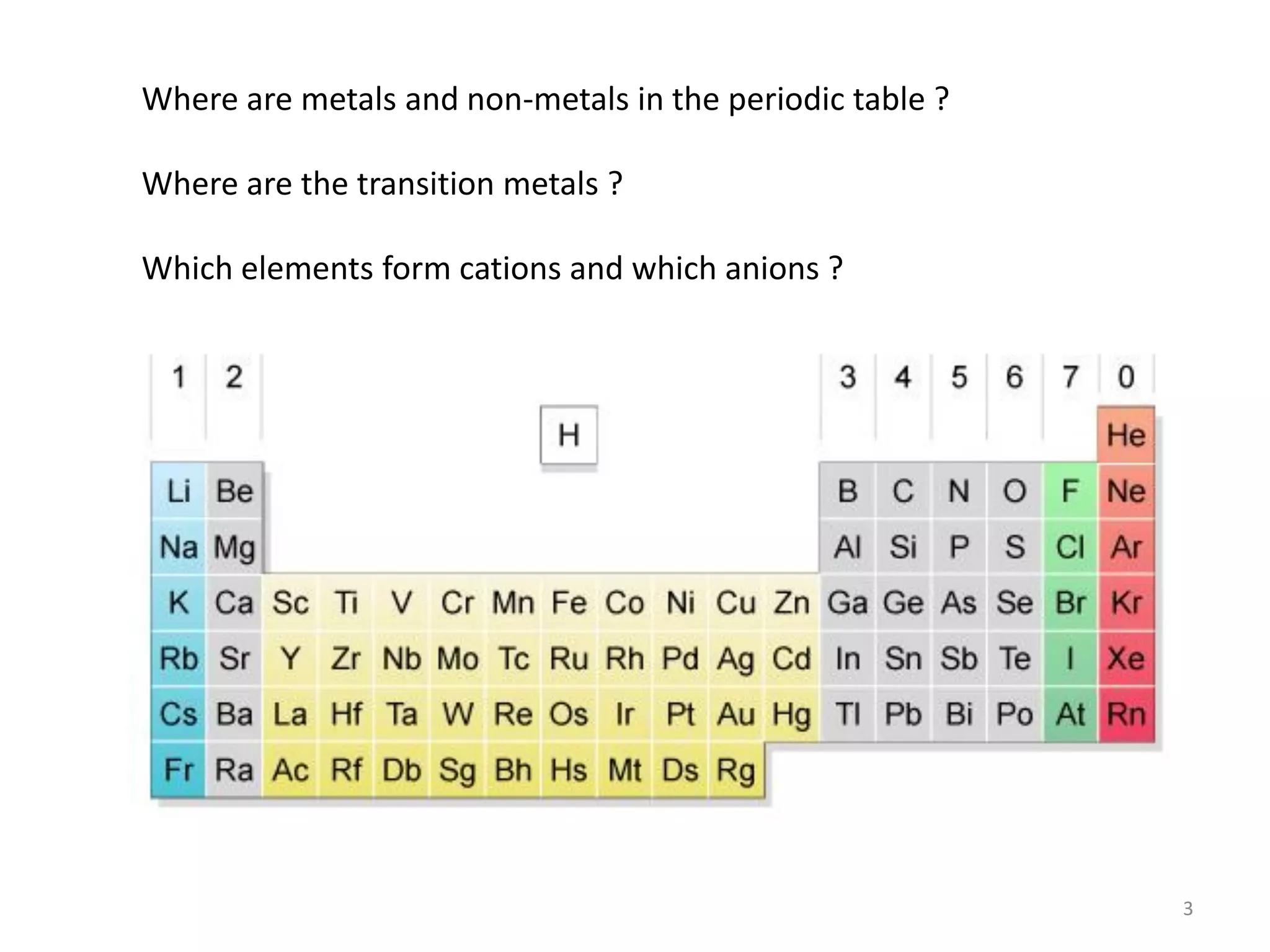
Where are metals and non-metals in the periodic table ?
Where are the transition metals ?
Which elements form cations and which anions ?
How atoms form bonds ?
Watch tutorial videos on my website
http://myphayao.com  “Chemical Bonding”
Atoms use their VALENCE ELECTRONS to
exchange or share electrons to form bonds !
Examples: how many VE are in these elements ?
Na Ca Cl Ar C N S P
Which rule can we find for the main group
elements ?
4
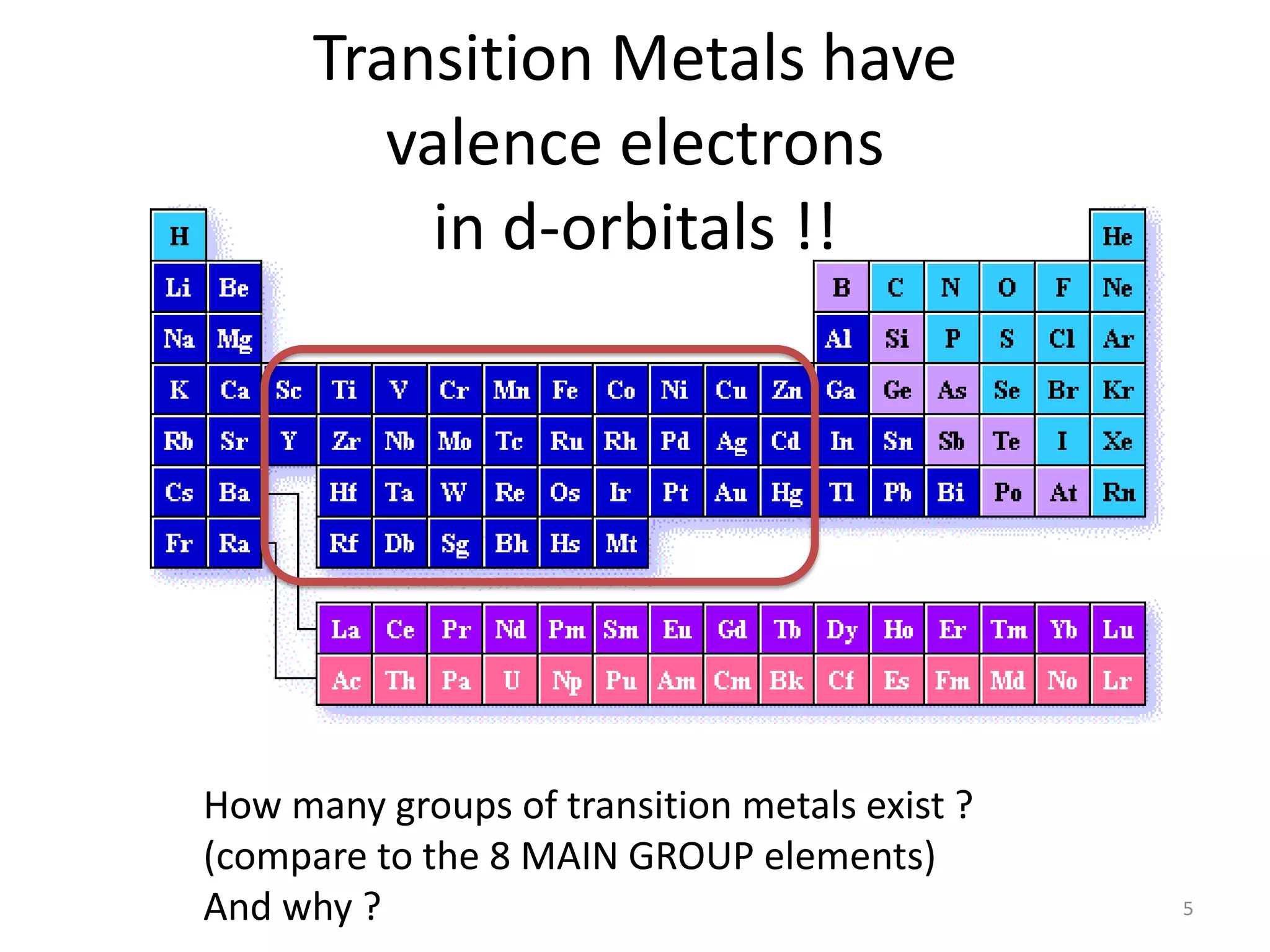
Transition Metals have
valence electrons
in d-orbitals !!
5
How many groups of transition metals exist ?
(compare to the 8 MAIN GROUP elements)
And why ?
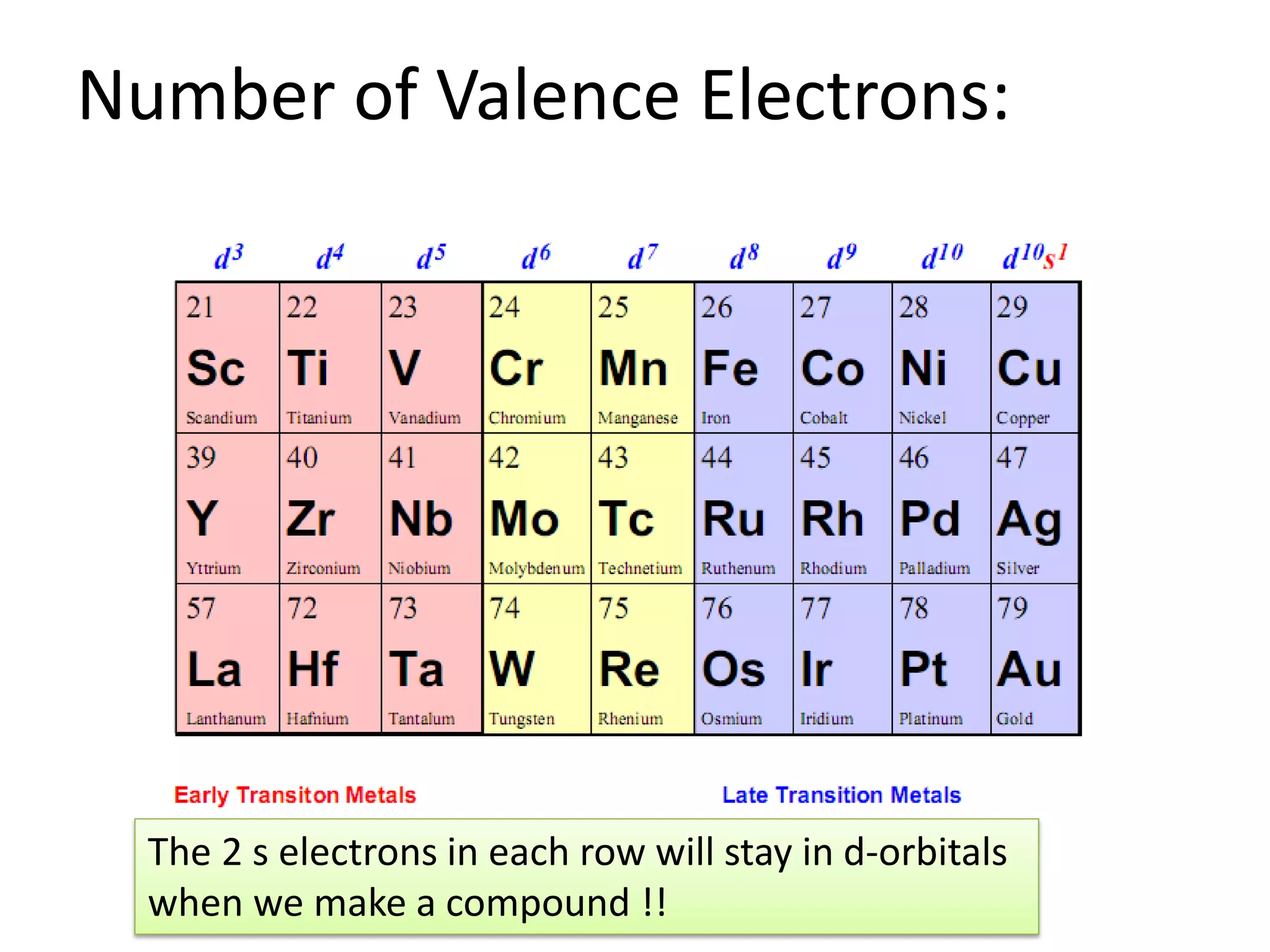
Number of Valence Electrons:
The 2 s electrons in each row will stay in d-orbitals
when we make a compound !!
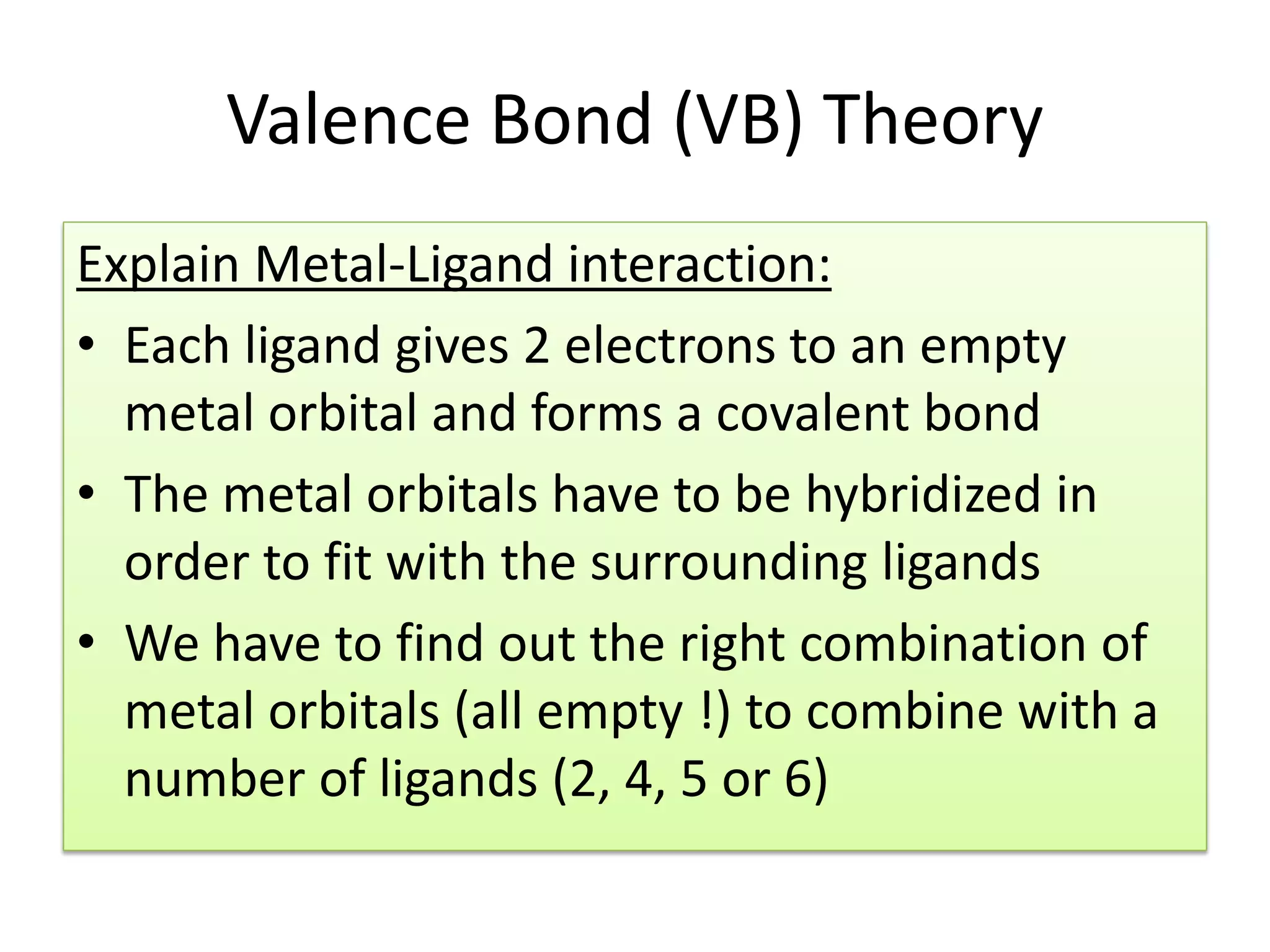
Valence Bond (VB) Theory
Explain Metal-Ligand interaction:
• Each ligand gives 2 electrons to an empty
metal orbital and forms a covalent bond
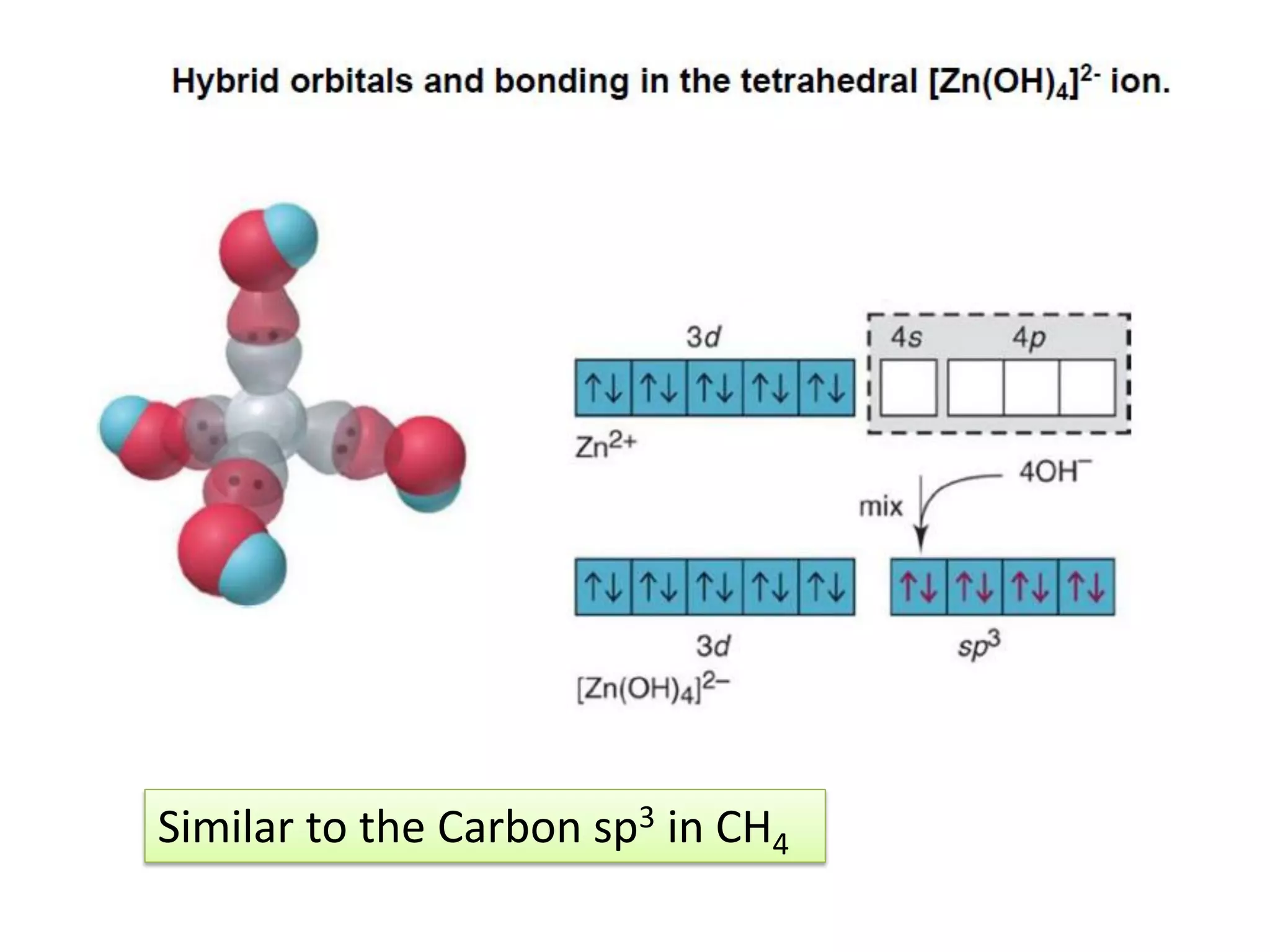
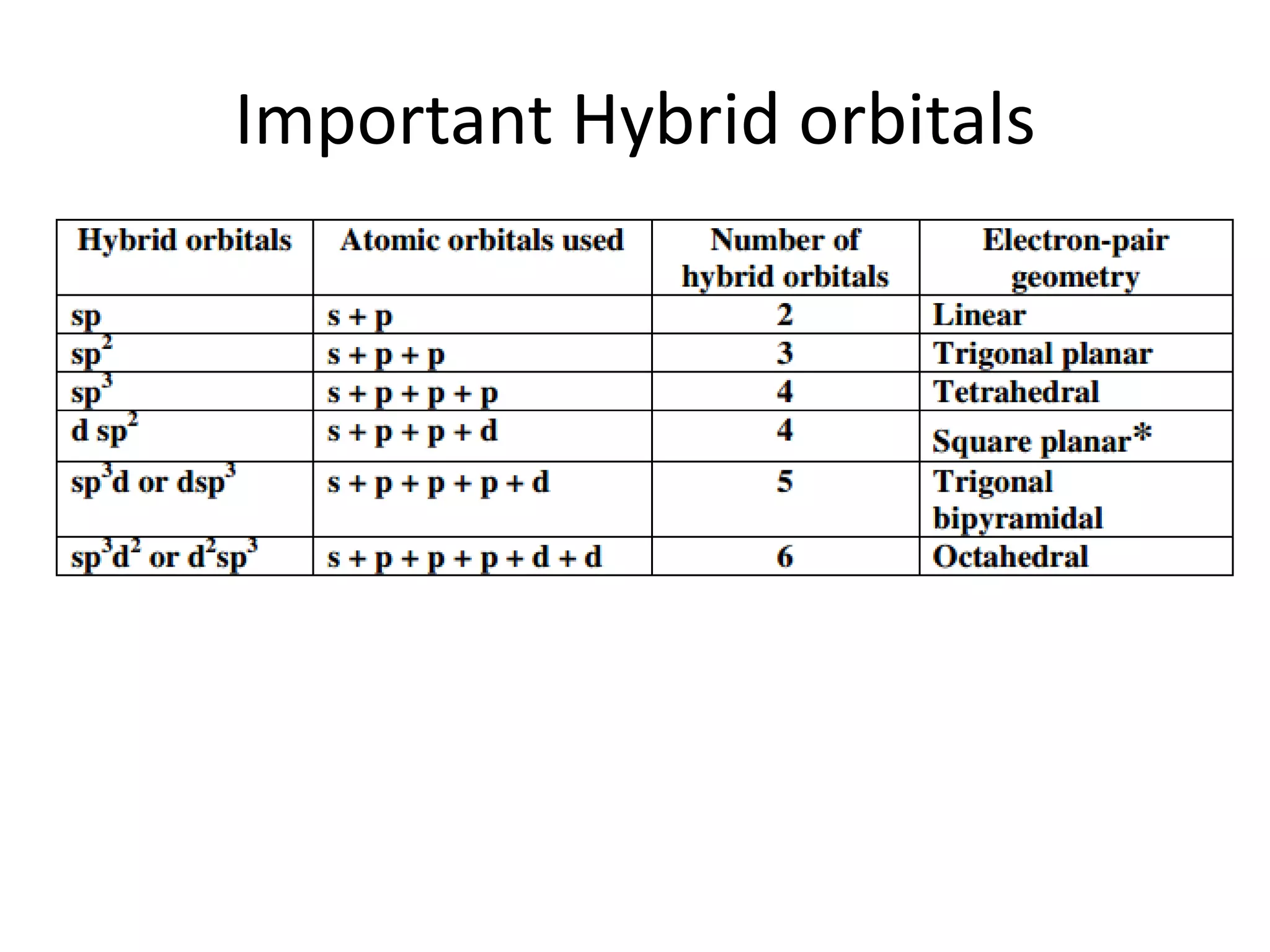
• The metal orbitals have to be hybridized in
order to fit with the surrounding ligands
• We have to find out the right combination of
metal orbitals (all empty !) to combine with a
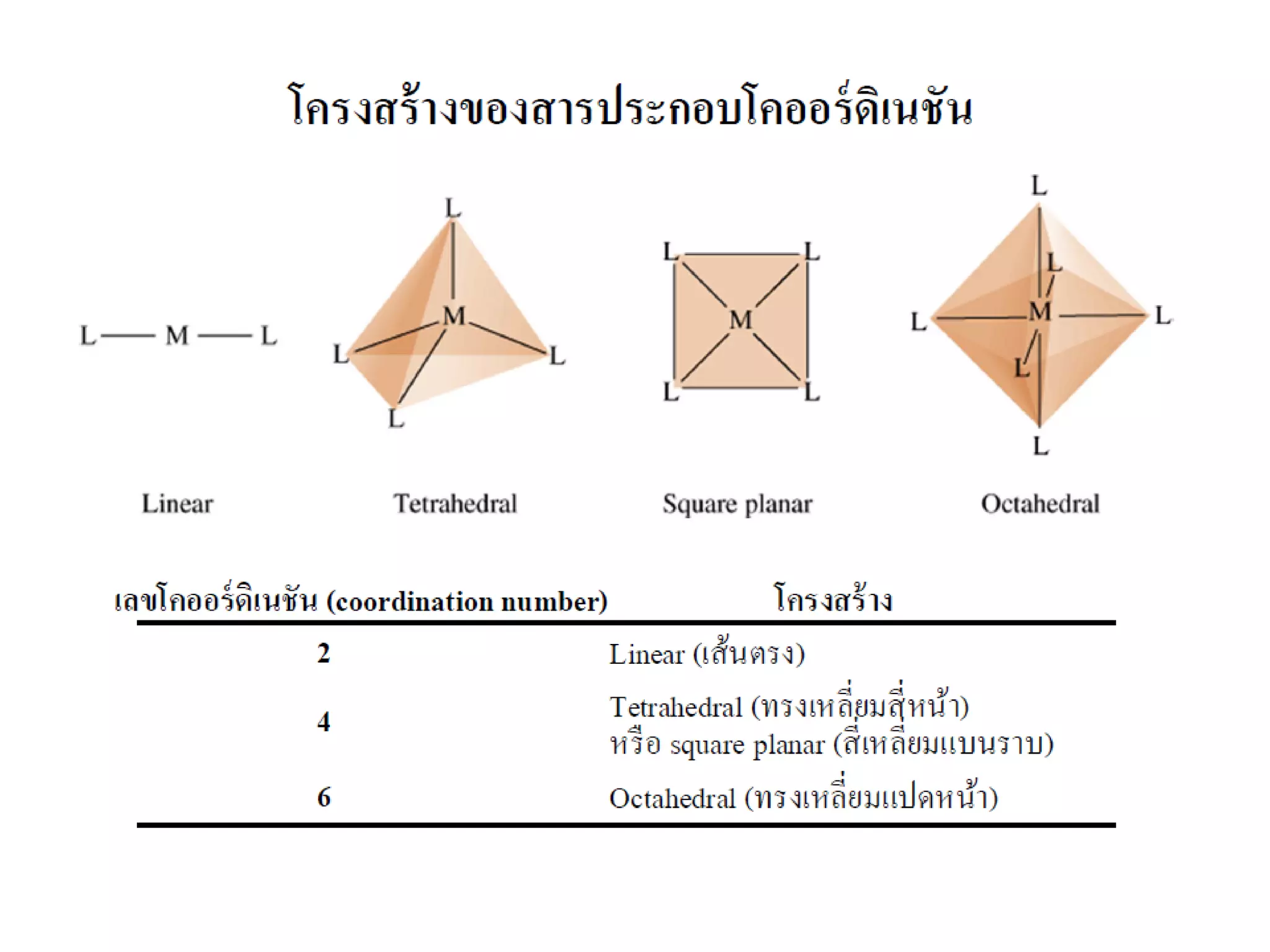
number of ligands (2, 4, 5 or 6)
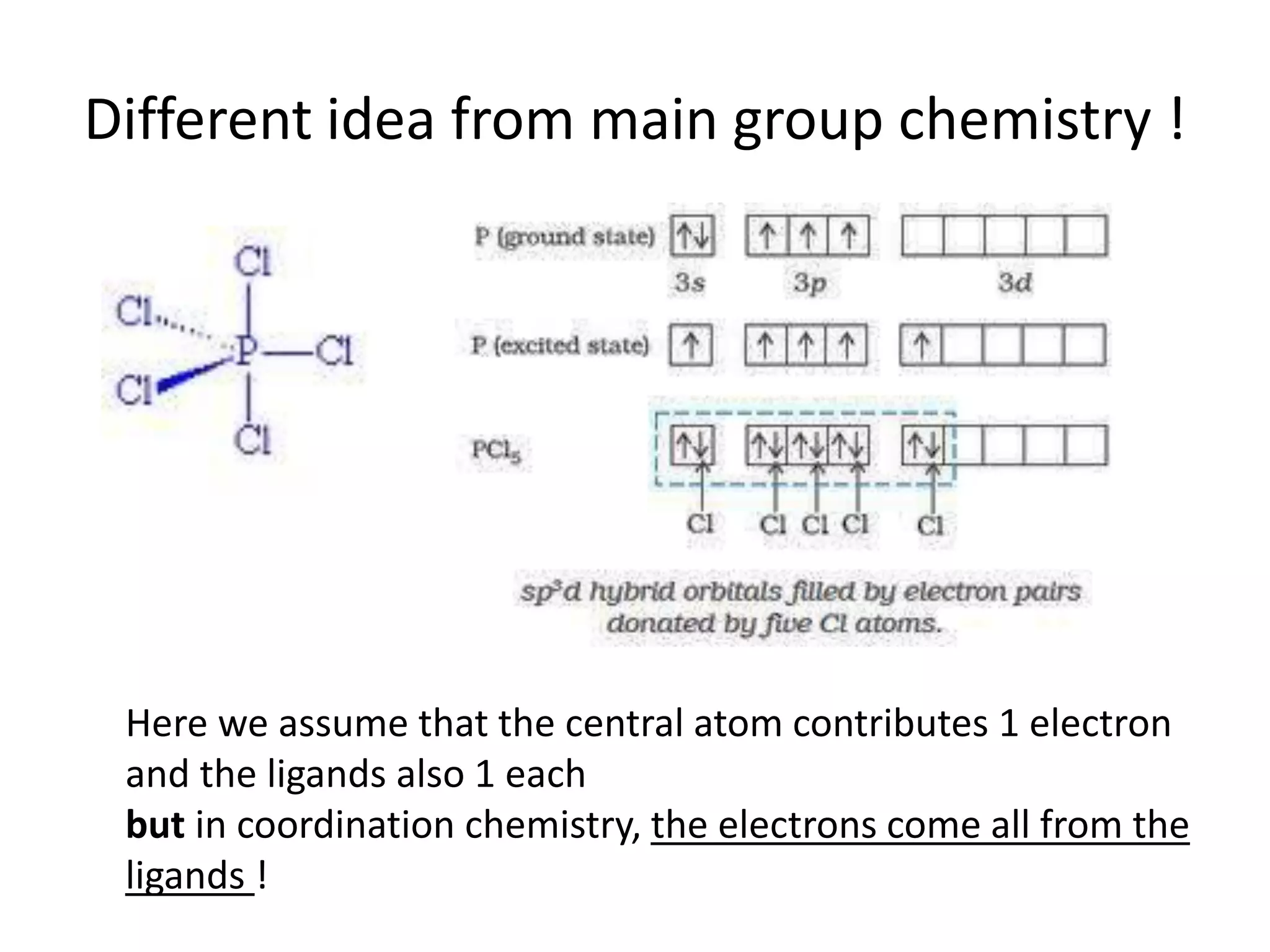
Different idea from main group chemistry !
Here we assume that the central atom contributes 1 electron
and the ligands also 1 each
but in coordination chemistry, the electrons come all from the
ligands !
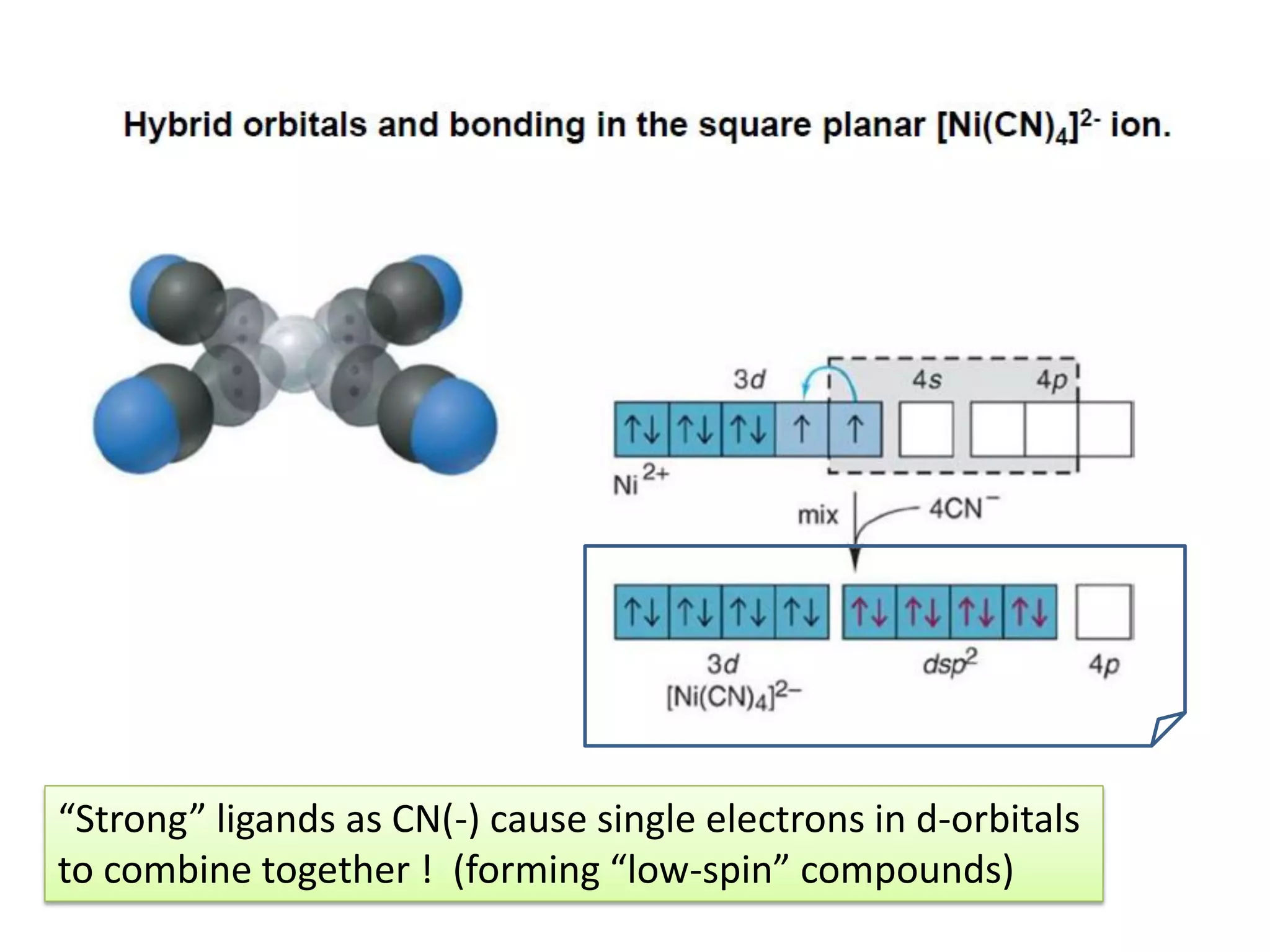
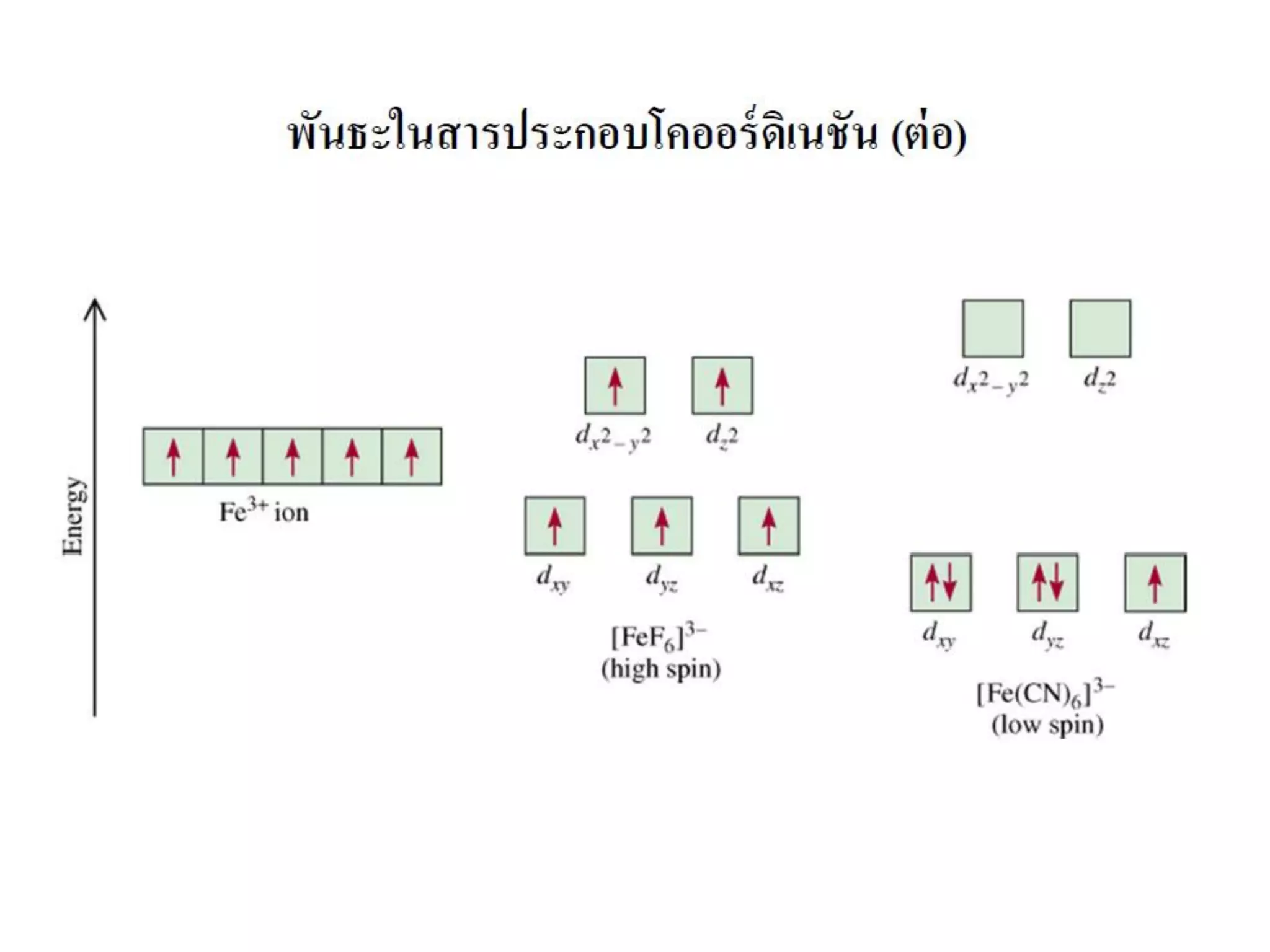
“Strong” ligands as CN(-) cause single electrons in d-orbitals
to combine together ! (forming “low-spin” compounds)
Similar to the Carbon sp3 in CH4
Important Hybrid orbitals
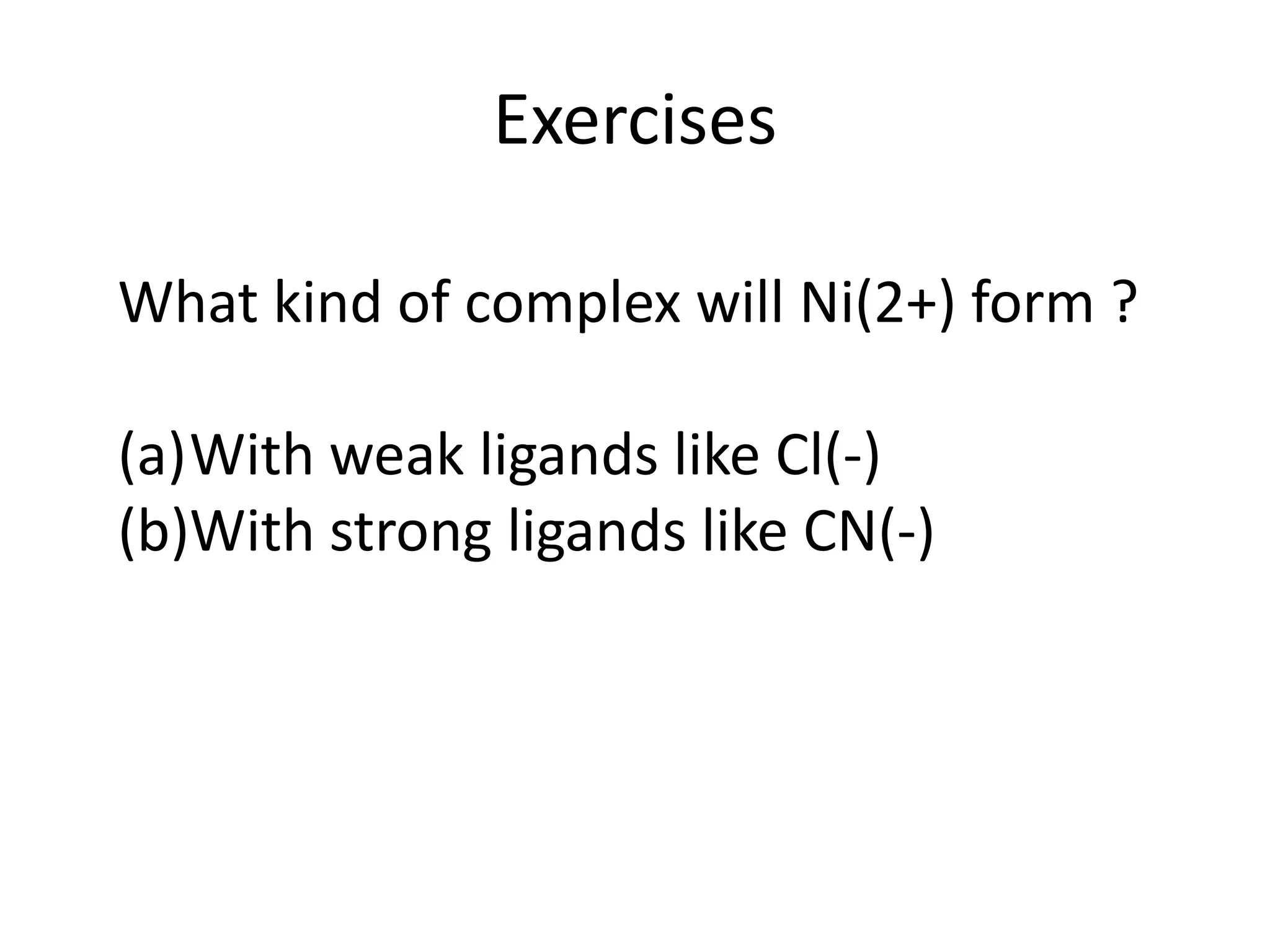
Exercises
What kind of complex will Ni(2+) form ?
(a)With weak ligands like Cl(-)
(b)With strong ligands like CN(-)
Possible answers:
(a) Consider [NiCl4]2+:
Ni0 = 4s2 3d8  Ni2+ = 4s0 3d8
3d 4s 4p
sp3
(b) Consider [Ni(CN)4]2-:
Ni0 = 4s2 3d8  Ni2+ = 4s0 3d8
3d 4s 4p
dsp2 4pz3d
Strong ligands
cause electron
pairing
Octahedral compounds
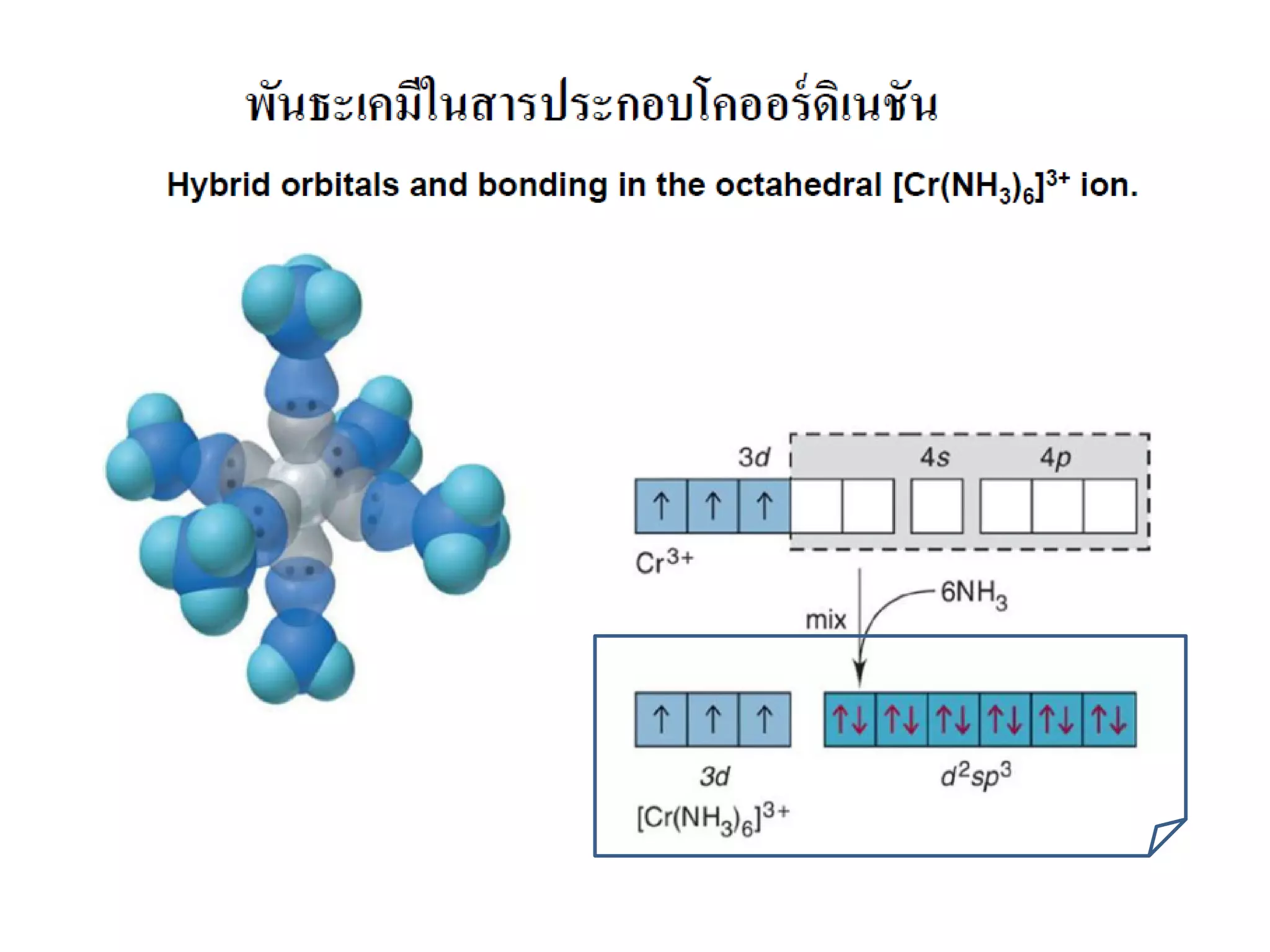
We need 6 empty hybrid orbitals on the metal
-> for octahedral shape, we need:
(a) d2sp3 (“inner shell”) or (b) sp3d2 (“outer shell”)
Example: [CoF6]3- (weak ligands)
How would [Co(NH3)6]3+ look like ?
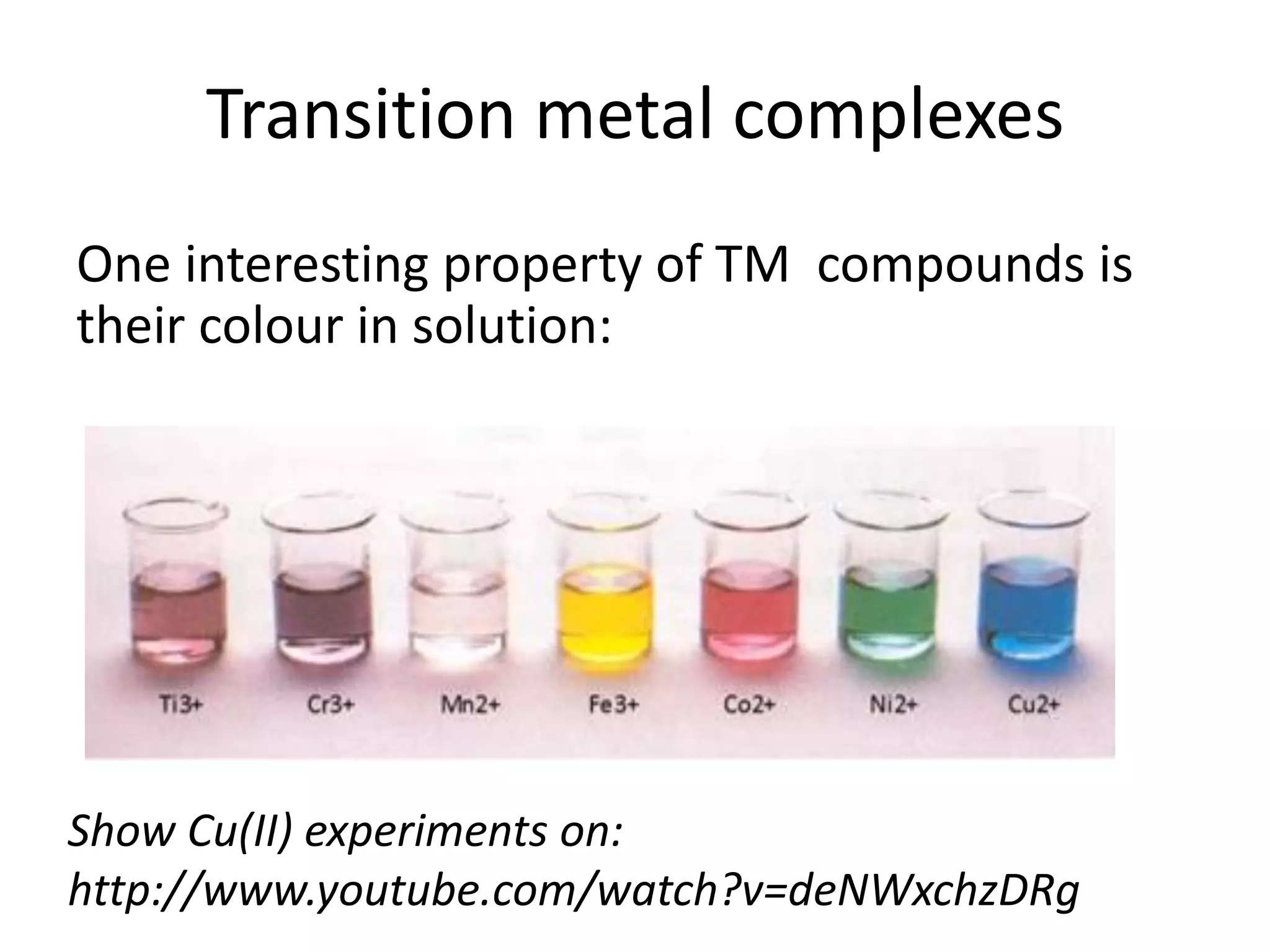
Transition metal complexes
One interesting property of TM compounds is
their colour in solution:
Show Cu(II) experiments on:
http://www.youtube.com/watch?v=deNWxchzDRg
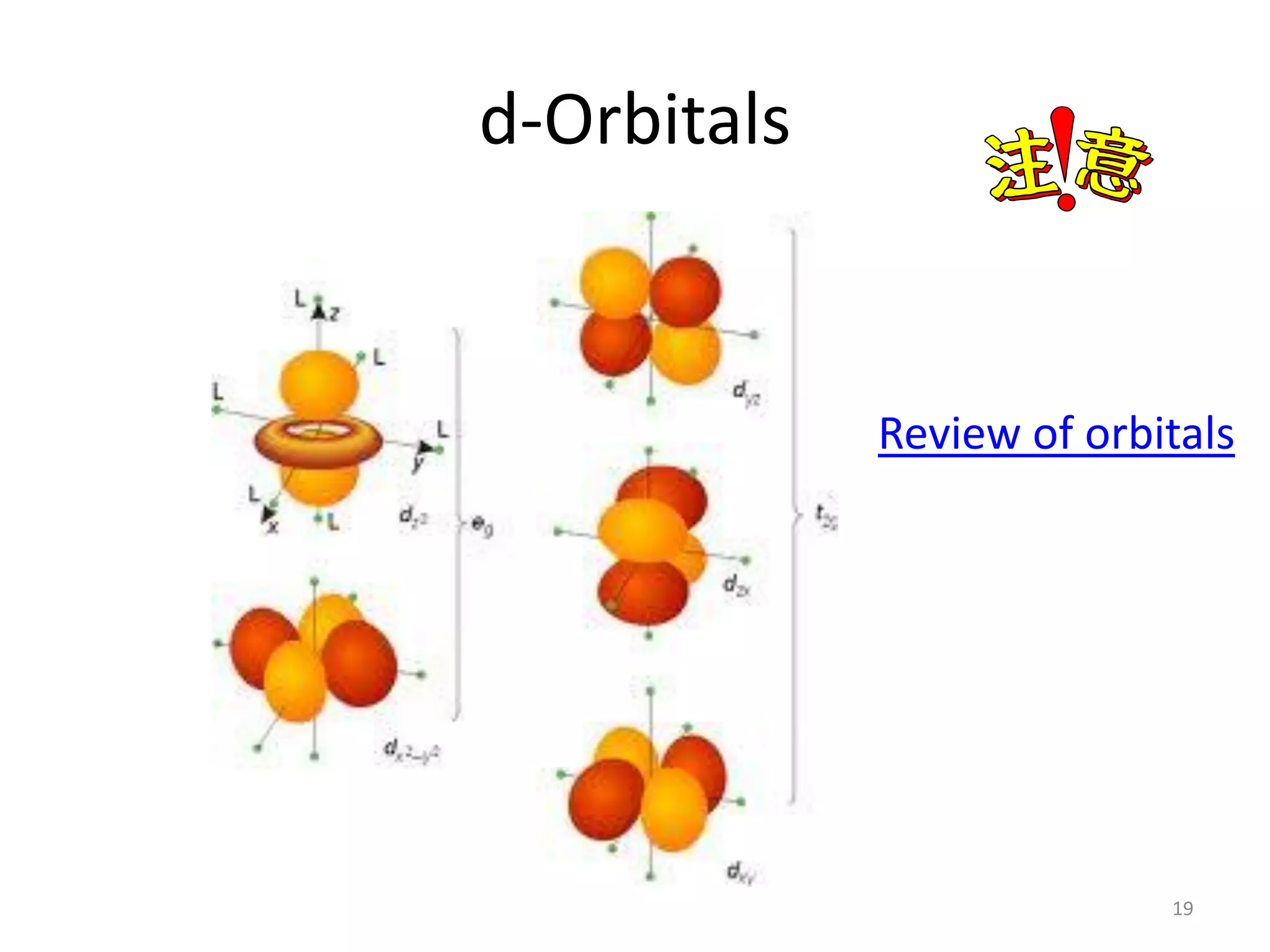
d-Orbitals
19
Review of orbitals
Energy Levels of d-Orbitals
“Crystal Field Splitting”
20
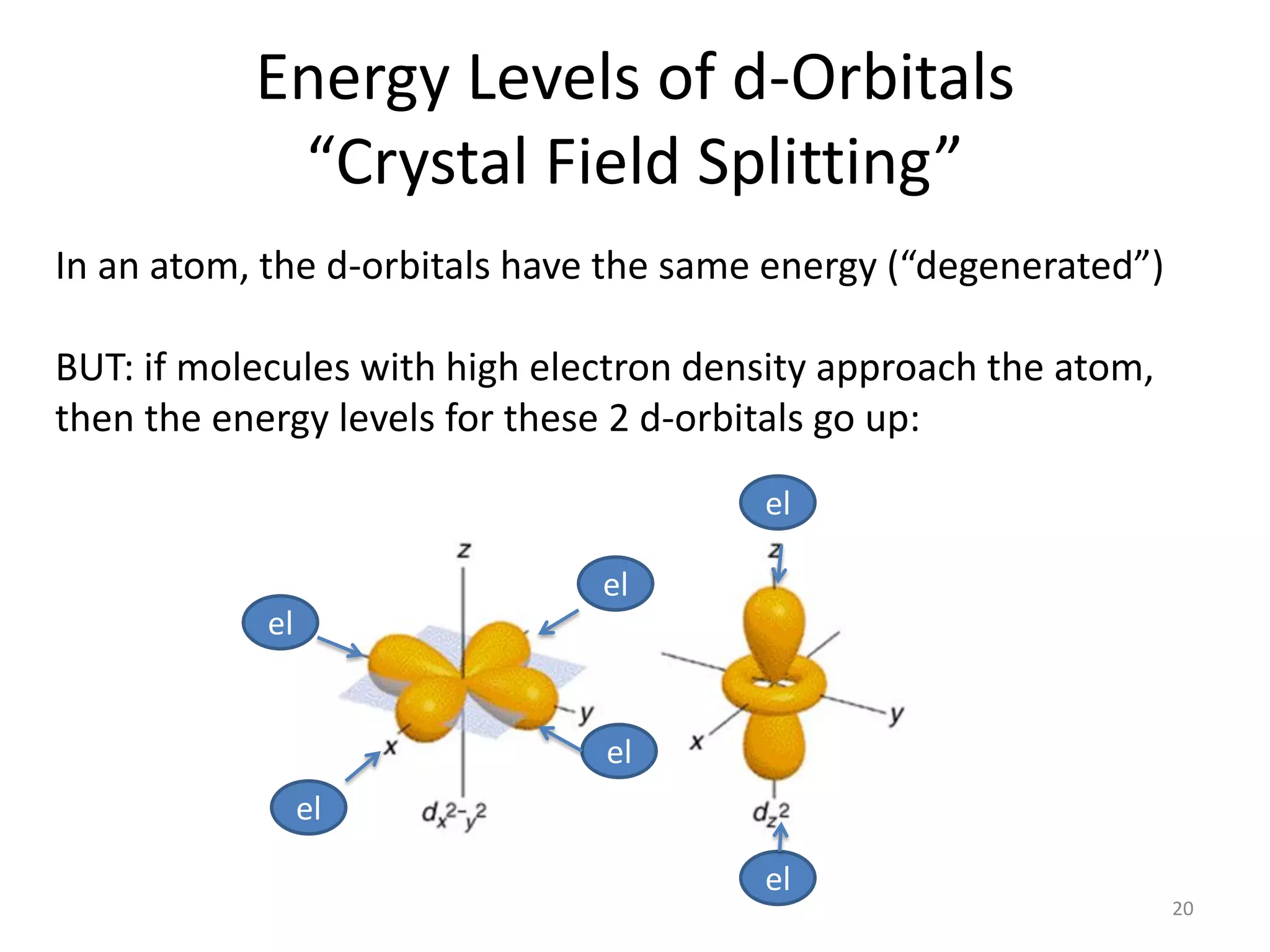
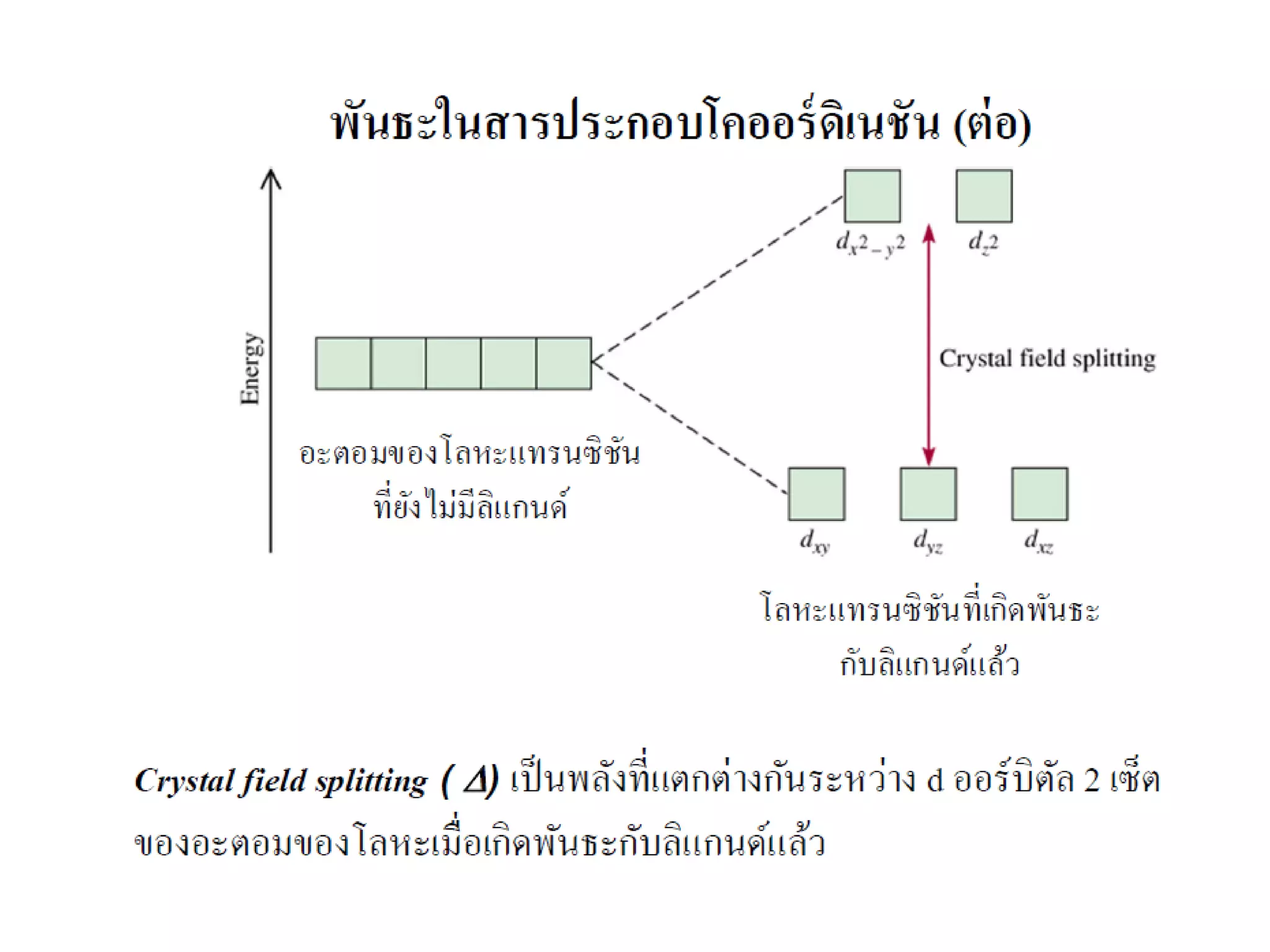
In an atom, the d-orbitals have the same energy (“degenerated”)
BUT: if molecules with high electron density approach the atom,
then the energy levels for these 2 d-orbitals go up:
el
el
el
el
el
el
21
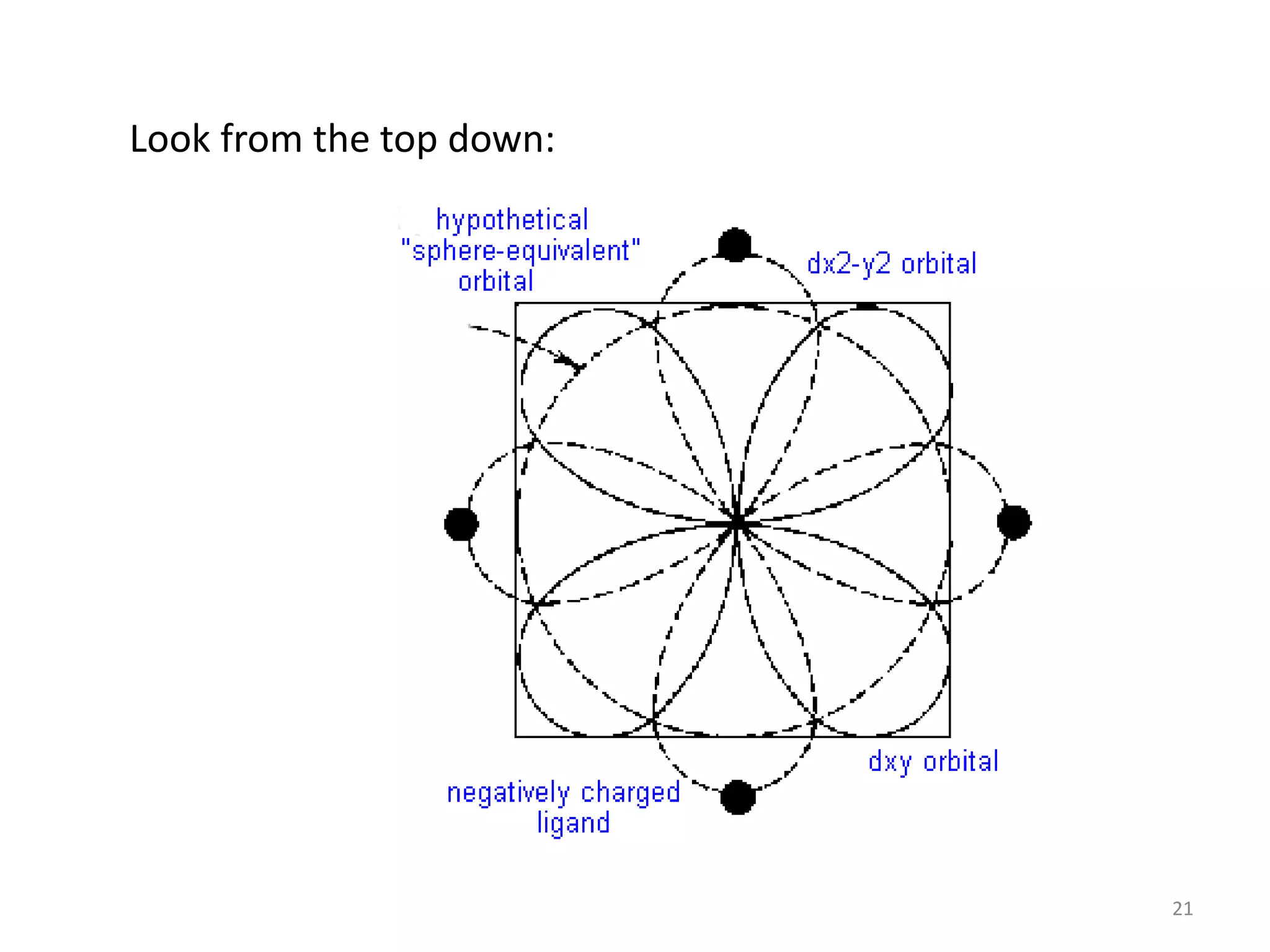
Look from the top down:
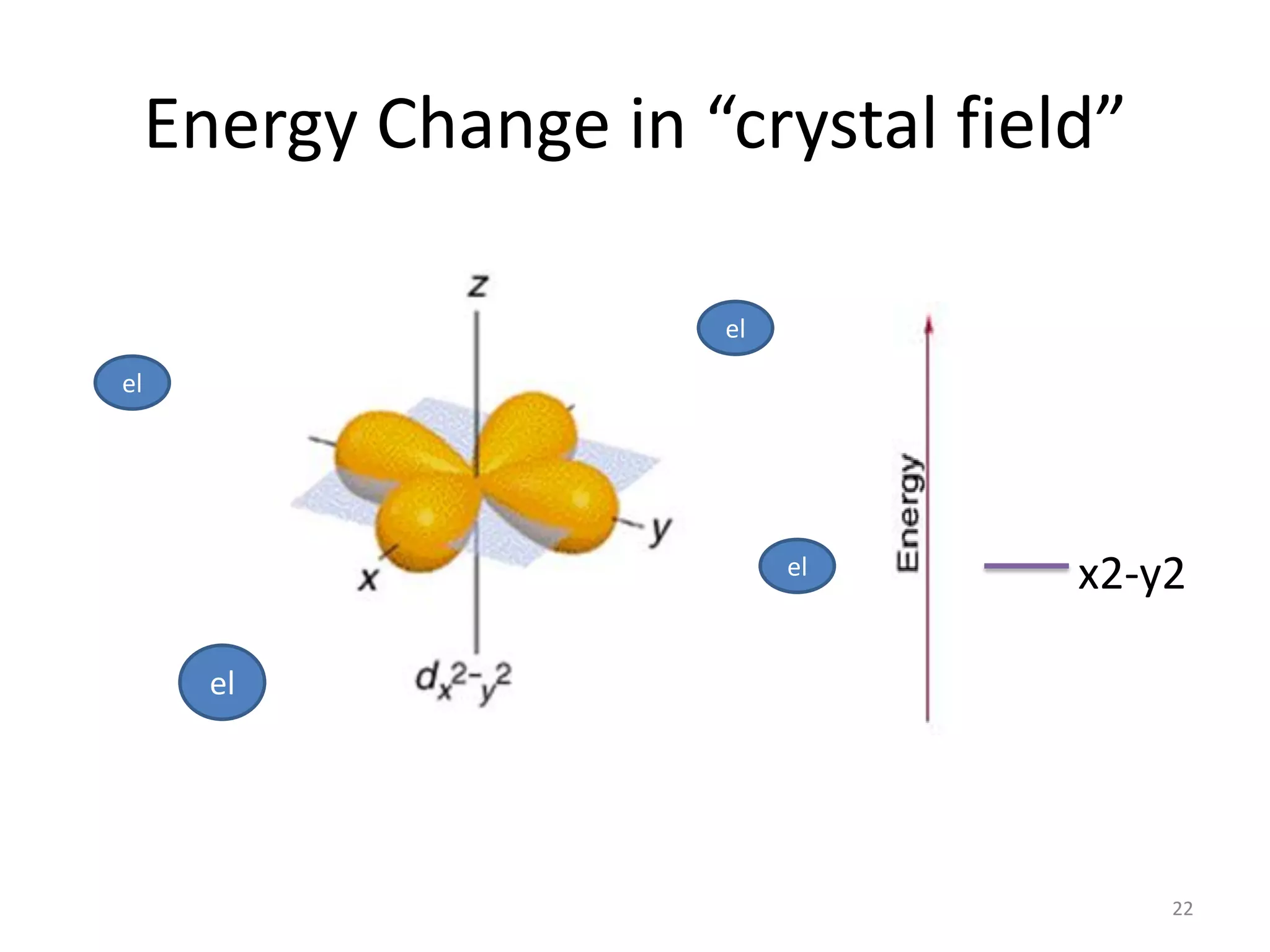
Energy Change in “crystal field”
22
el
el
el
el x2-y2
23
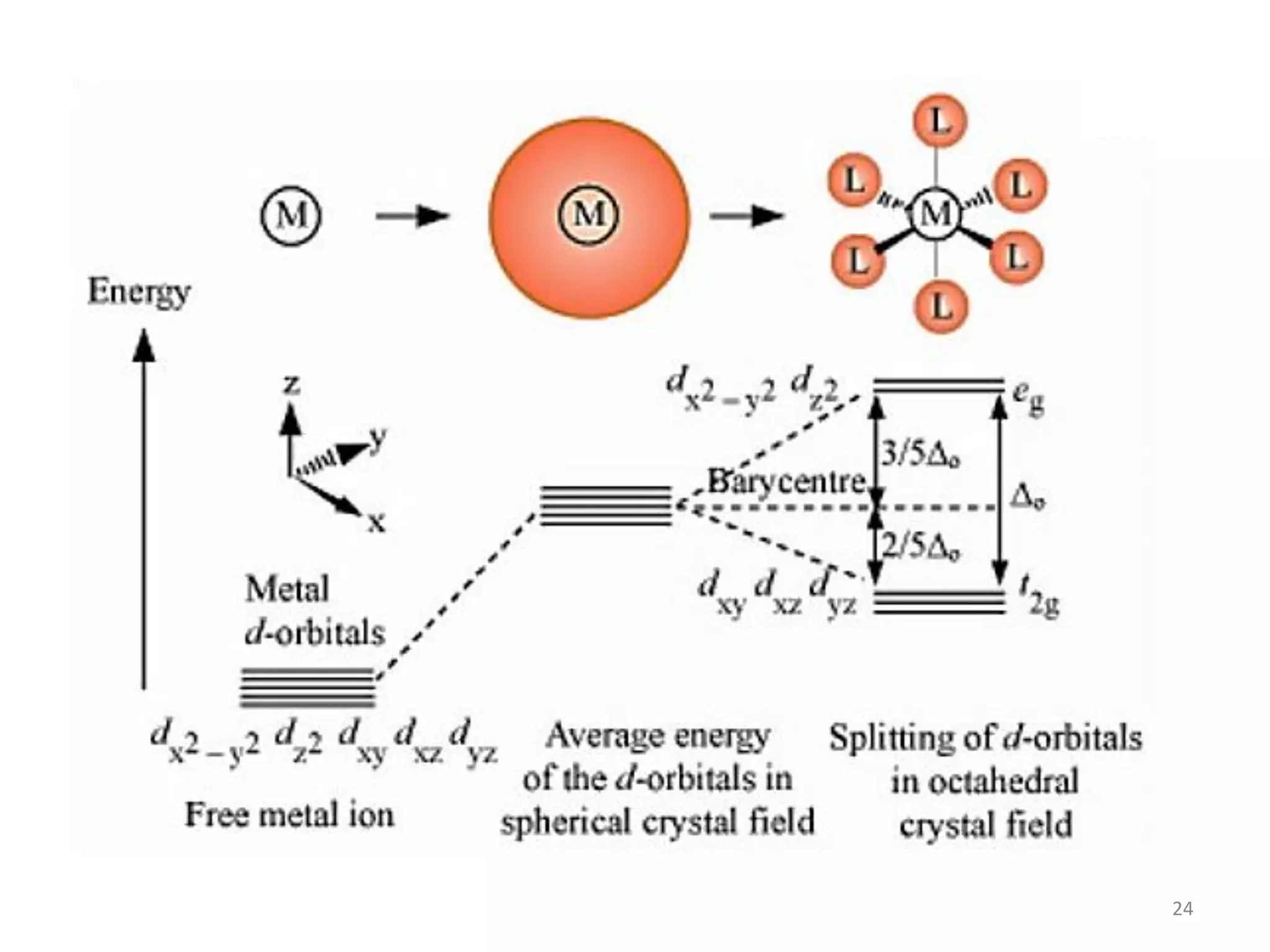
“Crystal Field Splitting Theory”
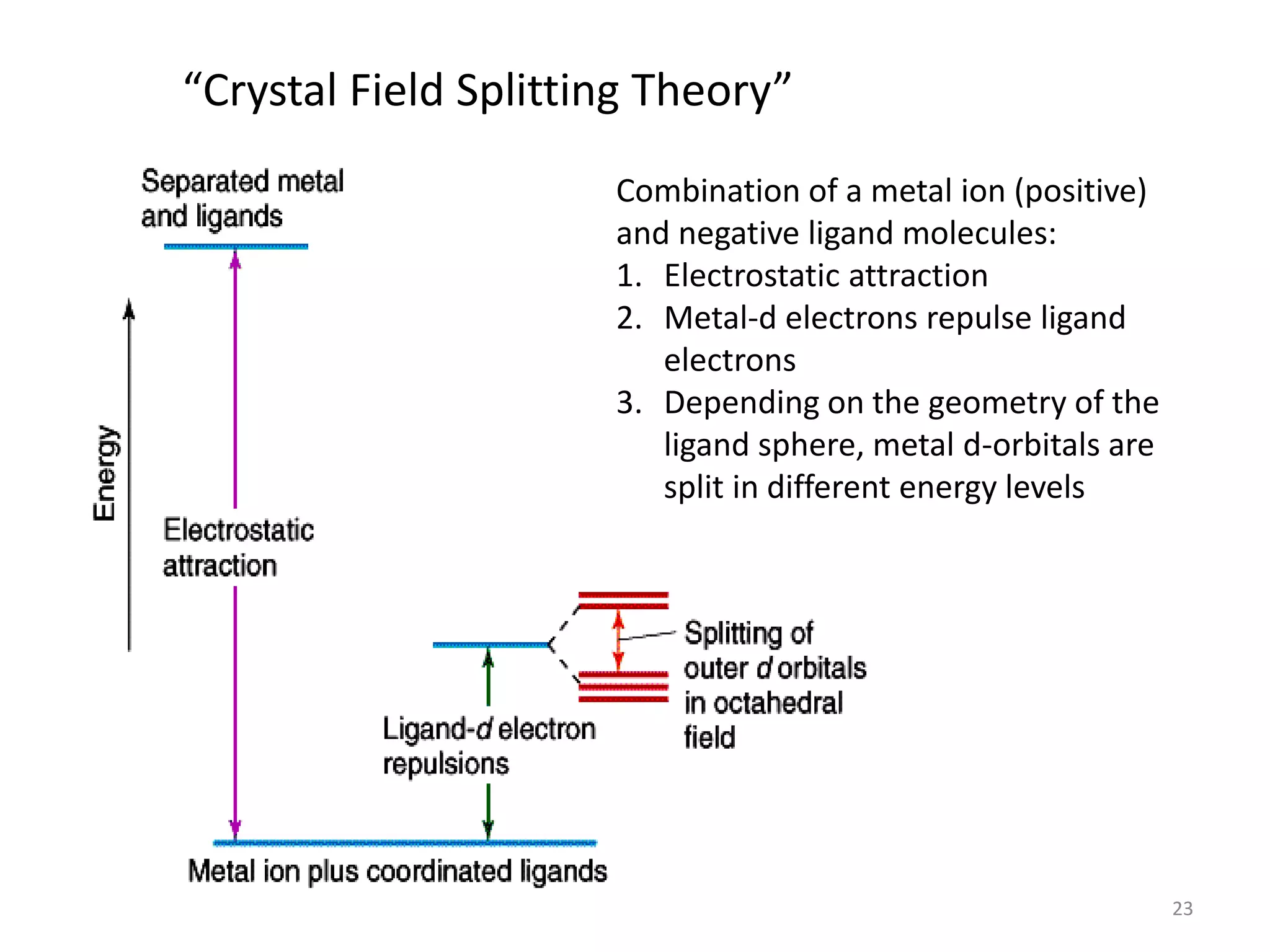
Combination of a metal ion (positive)
and negative ligand molecules:
1. Electrostatic attraction
2. Metal-d electrons repulse ligand
electrons
3. Depending on the geometry of the
ligand sphere, metal d-orbitals are
split in different energy levels
24
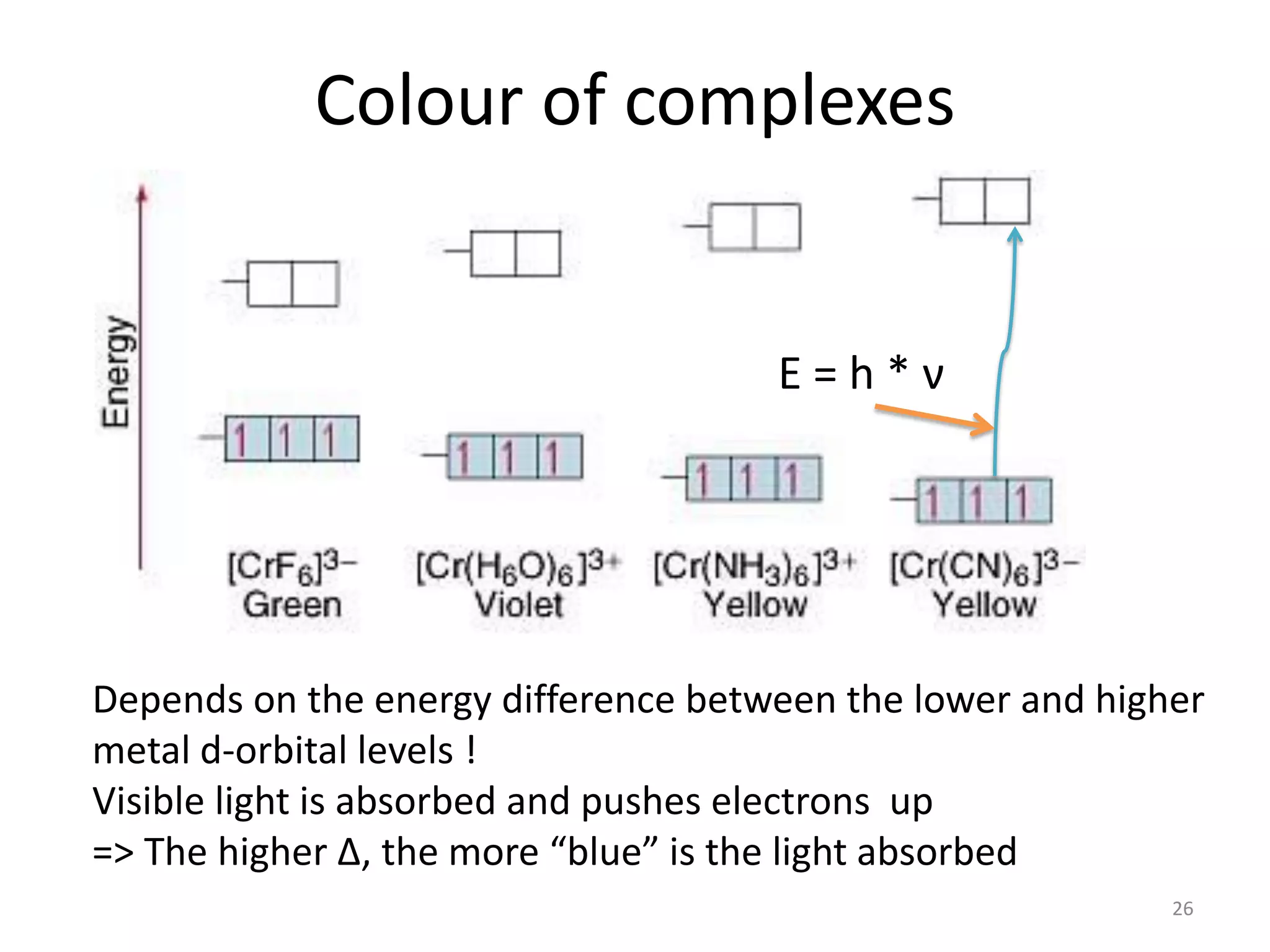
Colour of complexes
26
E = h * ν
Depends on the energy difference between the lower and higher
metal d-orbital levels !
Visible light is absorbed and pushes electrons up
=> The higher Δ, the more “blue” is the light absorbed
27
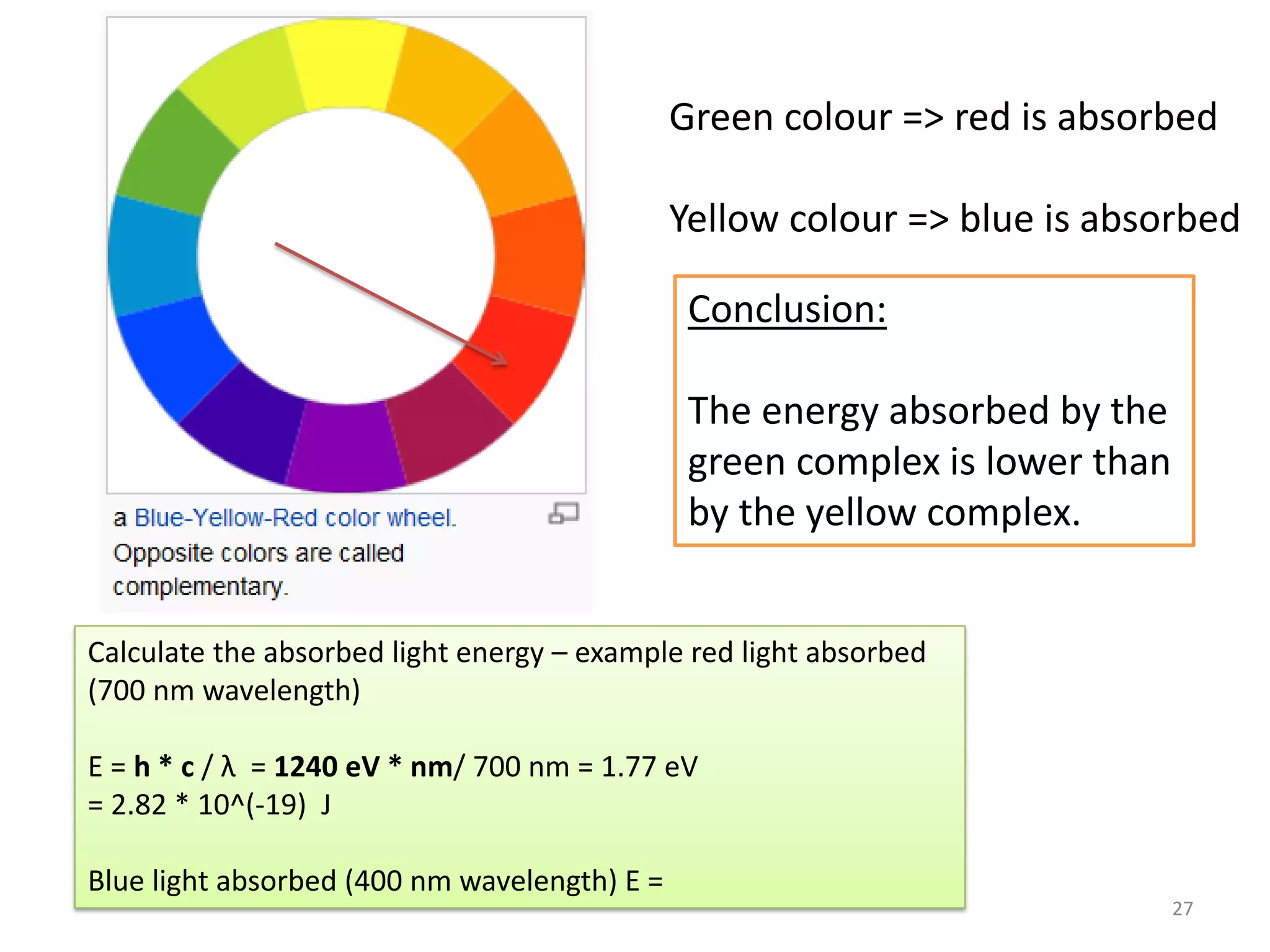
Green colour => red is absorbed
Yellow colour => blue is absorbed
Conclusion:
The energy absorbed by the
green complex is lower than
by the yellow complex.
Calculate the absorbed light energy – example red light absorbed
(700 nm wavelength)
E = h * c / λ = 1240 eV * nm/ 700 nm = 1.77 eV
= 2.82 * 10^(-19) J
Blue light absorbed (400 nm wavelength) E =
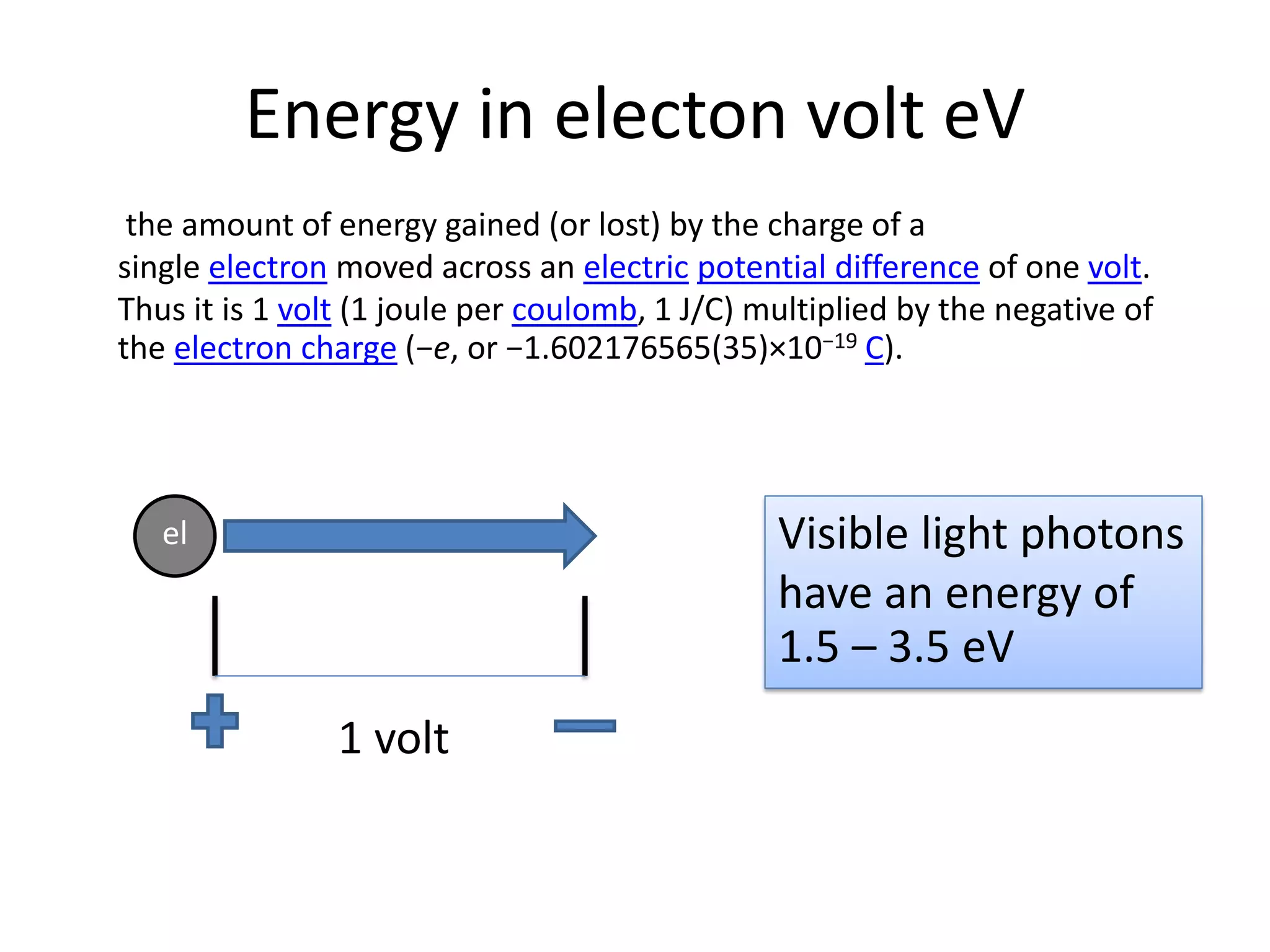
Energy in electon volt eV
the amount of energy gained (or lost) by the charge of a
single electron moved across an electric potential difference of one volt.
Thus it is 1 volt (1 joule per coulomb, 1 J/C) multiplied by the negative of
the electron charge (−e, or −1.602176565(35)×10−19 C).
el
1 volt
Visible light photons
have an energy of
1.5 – 3.5 eV
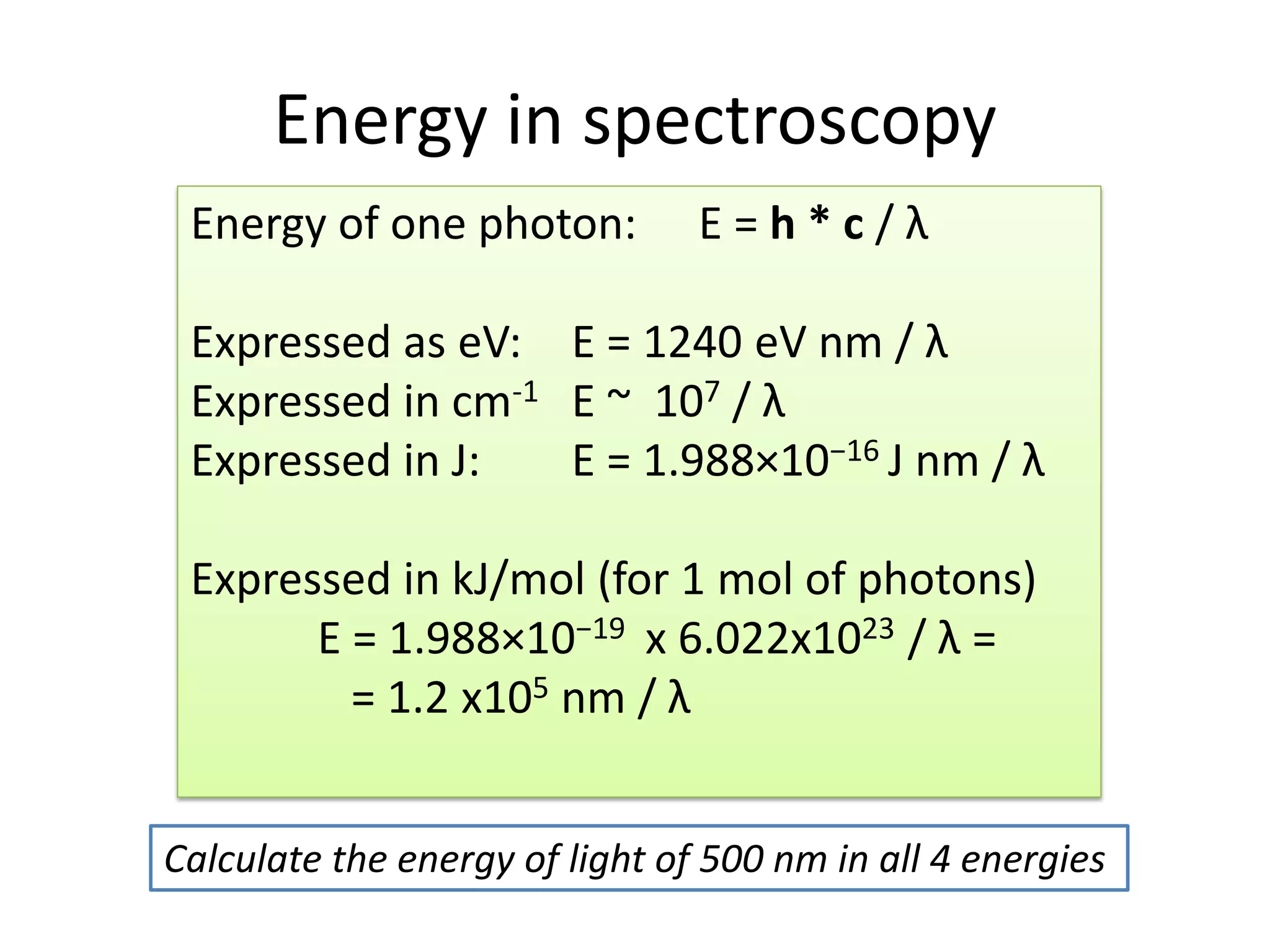
Energy in spectroscopy
Energy of one photon: E = h * c / λ
Expressed as eV: E = 1240 eV nm / λ
Expressed in cm-1 E ~ 107 / λ
Expressed in J: E = 1.988×10⁻¹⁶ J nm / λ
Expressed in kJ/mol (for 1 mol of photons)
E = 1.988×10−19 x 6.022x1023 / λ =
= 1.2 x10⁵ nm / λ
Calculate the energy of light of 500 nm in all 4 energies
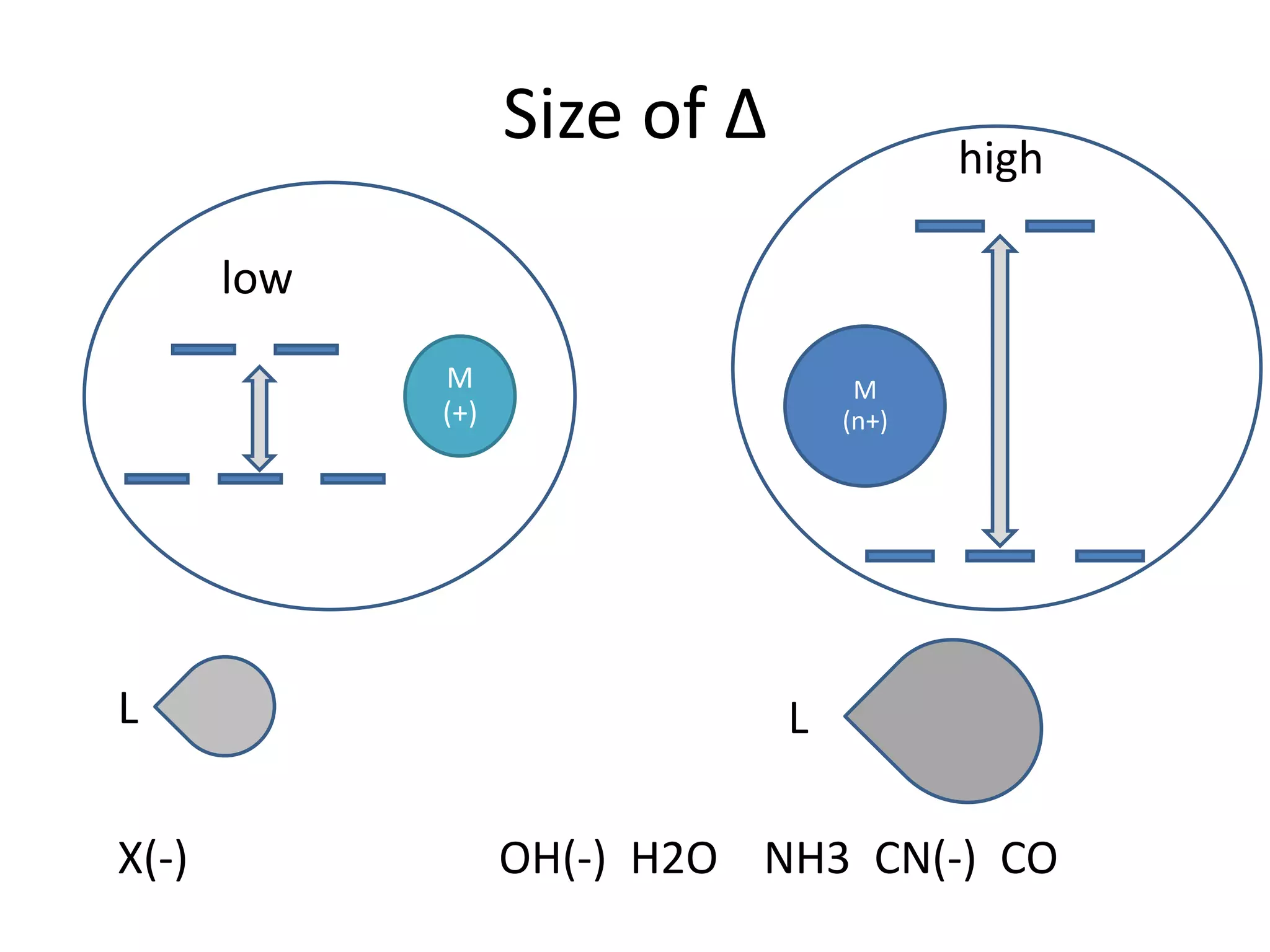
Size of ∆
M
(+)
M
(n+)
low
high
L L
X(-) OH(-) H2O NH3 CN(-) CO
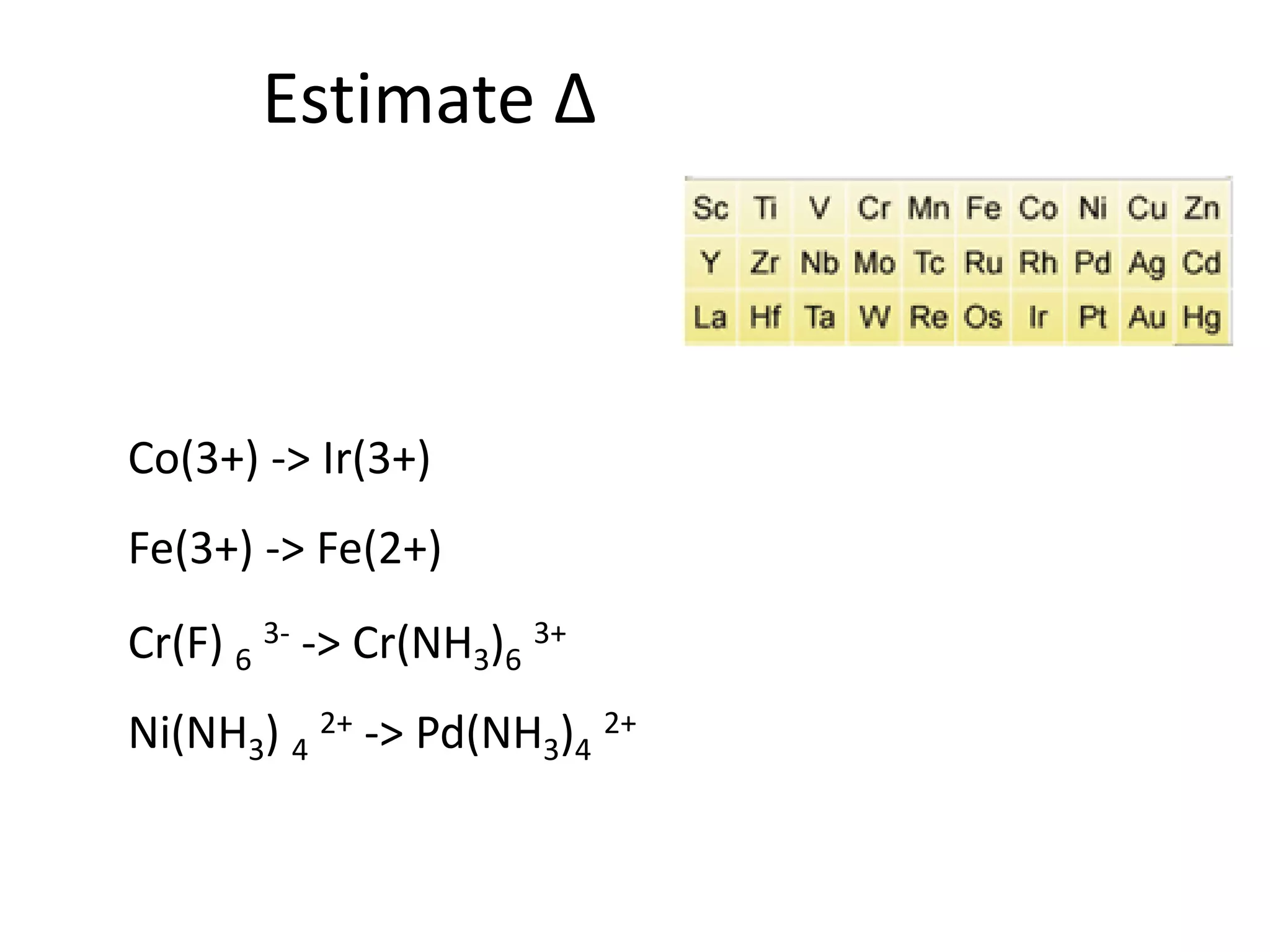
Estimate ∆
Co(3+) -> Ir(3+)
Fe(3+) -> Fe(2+)
Cr(F) 6
3- -> Cr(NH3)6
3+
Ni(NH3) 4
2+ -> Pd(NH3)4
2+
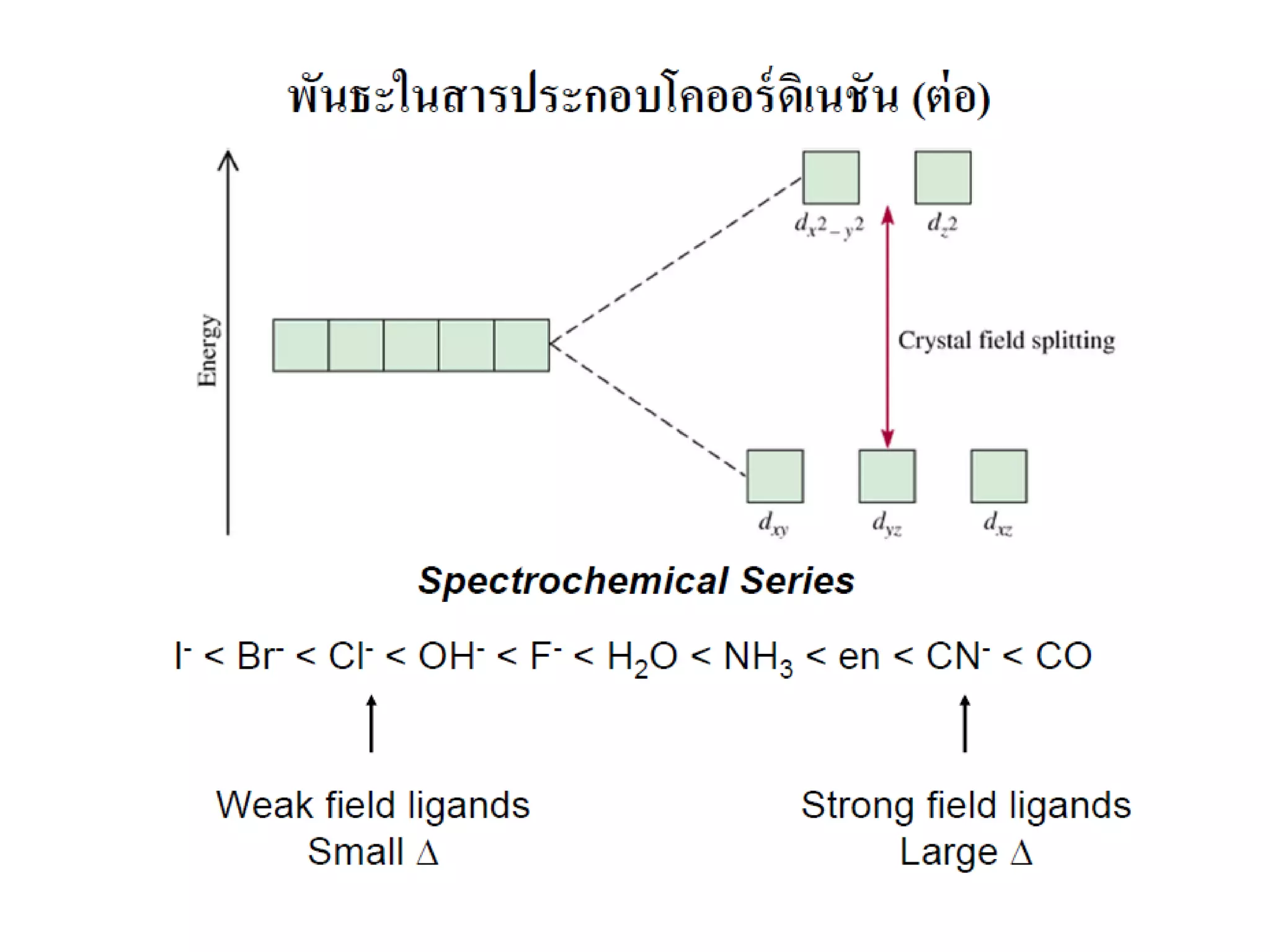
Spectrochemical Series
34
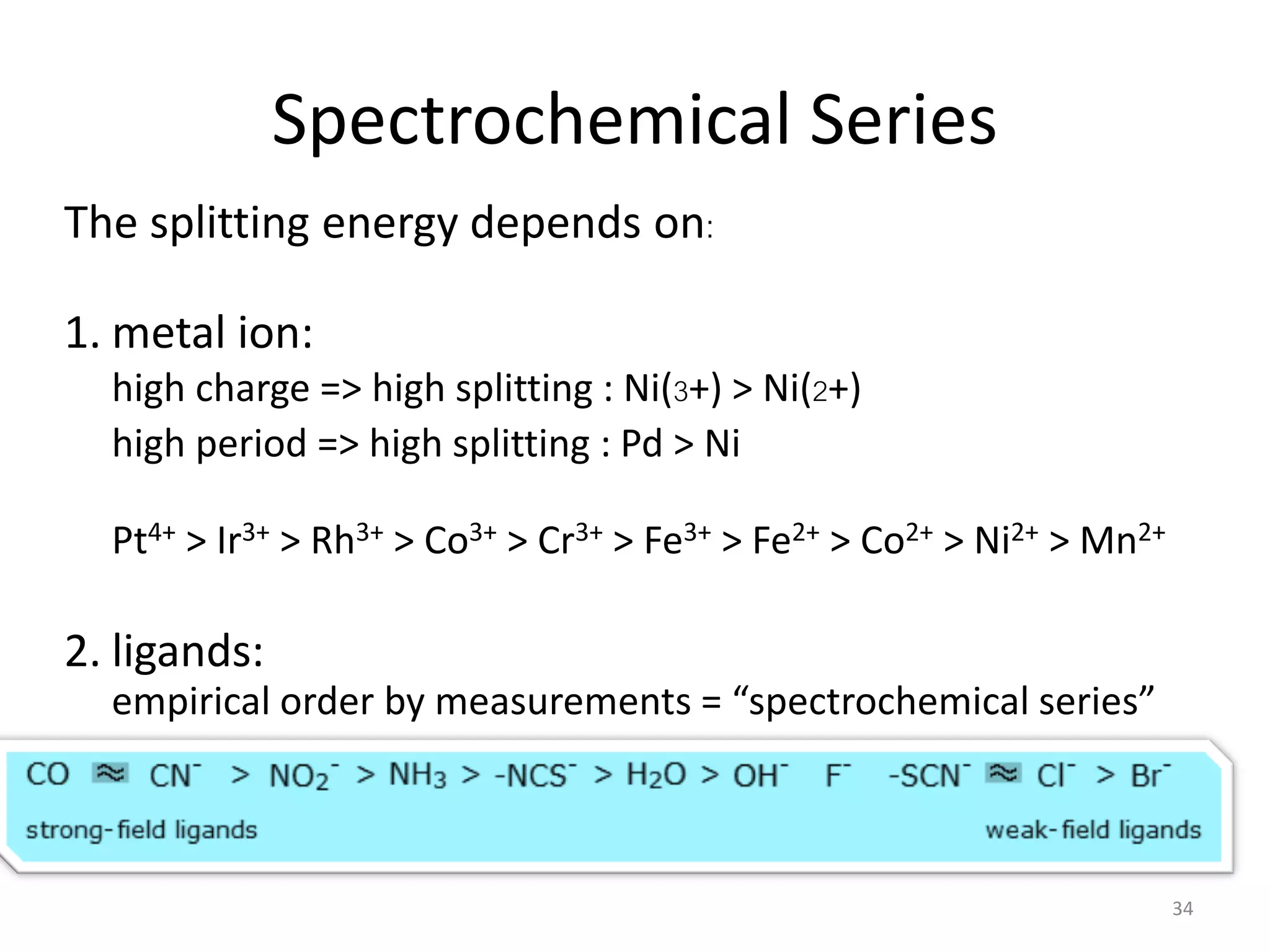
The splitting energy depends on:
1. metal ion:
high charge => high splitting : Ni(3+) > Ni(2+)
high period => high splitting : Pd > Ni
Pt4+ > Ir3+ > Rh3+ > Co3+ > Cr3+ > Fe3+ > Fe2+ > Co2+ > Ni2+ > Mn2+
2. ligands:
empirical order by measurements = “spectrochemical series”
Energy Calculations
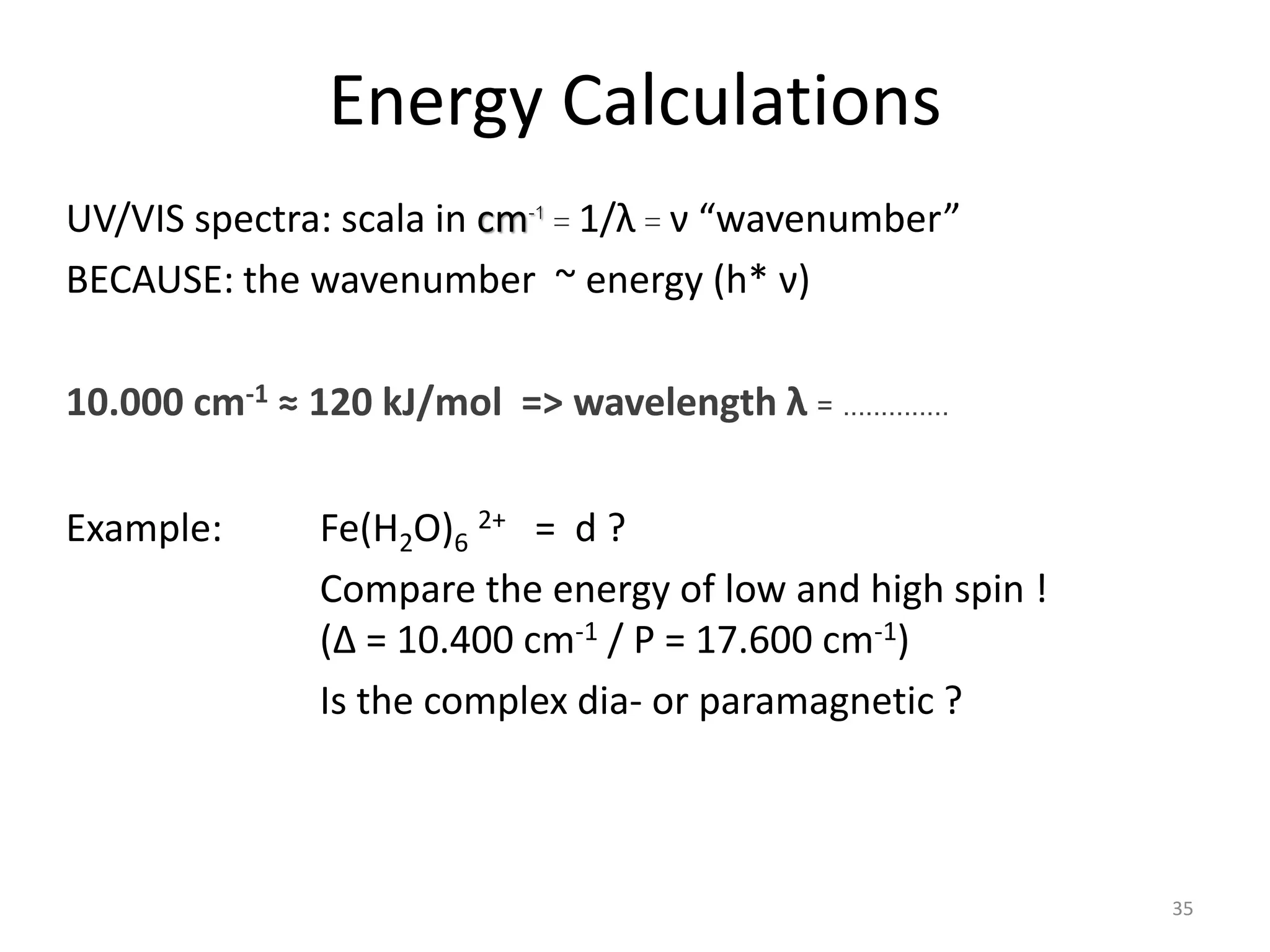
UV/VIS spectra: scala in cm-1 = 1/λ = ν “wavenumber”
BECAUSE: the wavenumber ~ energy (h* ν)
10.000 cm-1 ≈ 120 kJ/mol => wavelength λ = ..............
Example: Fe(H2O)6
2+ = d ?
Compare the energy of low and high spin !
(Δ = 10.400 cm-1 / P = 17.600 cm-1)
Is the complex dia- or paramagnetic ?
35
36
End of Part 1
Summary:
• Transition metal ions have d-electrons which can interact with electron
rich small molecules like ammonia, water, chloride ... (we call them
“ligands”)
• The electronic field of the ligands around the d-orbitals cause a splitting
in their energy -> for ML6 the d-orbitals split into 3 low- and 2 high-energy
orbitals
• The amount of splitting increases with higher charge on the metal and
with higher electron density on the ligands
• Electrons in the lower d-orbitals can jump to the high energy levels by
absorbing light energy => the complex has a colour !
THANKS FOR WATCHING … SEE YOU LATER !

Bonding in coordination complexes (Part 1)

  • 1.
    Bonding Models for Transition metalcompounds Part 1 1 Christoph Sontag PhD, Phayao University Aug. 2013 e-mail: c.sontag@web.de Office SCI 2201
  • 2.
    2  Review: electronicstructure and periodic table  VB Theory  Crystal Field Theory  Spectrochemical Series  UV/VIS spectroscopy  Ligand Field Theory
  • 3.
    3 Where are metalsand non-metals in the periodic table ? Where are the transition metals ? Which elements form cations and which anions ?
  • 4.
    How atoms formbonds ? Watch tutorial videos on my website http://myphayao.com  “Chemical Bonding” Atoms use their VALENCE ELECTRONS to exchange or share electrons to form bonds ! Examples: how many VE are in these elements ? Na Ca Cl Ar C N S P Which rule can we find for the main group elements ? 4
  • 5.
    Transition Metals have valenceelectrons in d-orbitals !! 5 How many groups of transition metals exist ? (compare to the 8 MAIN GROUP elements) And why ?
  • 6.
    Number of ValenceElectrons: The 2 s electrons in each row will stay in d-orbitals when we make a compound !!
  • 7.
    Valence Bond (VB)Theory Explain Metal-Ligand interaction: • Each ligand gives 2 electrons to an empty metal orbital and forms a covalent bond • The metal orbitals have to be hybridized in order to fit with the surrounding ligands • We have to find out the right combination of metal orbitals (all empty !) to combine with a number of ligands (2, 4, 5 or 6)
  • 8.
    Different idea frommain group chemistry ! Here we assume that the central atom contributes 1 electron and the ligands also 1 each but in coordination chemistry, the electrons come all from the ligands !
  • 11.
    “Strong” ligands asCN(-) cause single electrons in d-orbitals to combine together ! (forming “low-spin” compounds)
  • 12.
    Similar to theCarbon sp3 in CH4
  • 13.
  • 14.
    Exercises What kind ofcomplex will Ni(2+) form ? (a)With weak ligands like Cl(-) (b)With strong ligands like CN(-)
  • 15.
    Possible answers: (a) Consider[NiCl4]2+: Ni0 = 4s2 3d8  Ni2+ = 4s0 3d8 3d 4s 4p sp3
  • 16.
    (b) Consider [Ni(CN)4]2-: Ni0= 4s2 3d8  Ni2+ = 4s0 3d8 3d 4s 4p dsp2 4pz3d Strong ligands cause electron pairing
  • 17.
    Octahedral compounds We need6 empty hybrid orbitals on the metal -> for octahedral shape, we need: (a) d2sp3 (“inner shell”) or (b) sp3d2 (“outer shell”) Example: [CoF6]3- (weak ligands) How would [Co(NH3)6]3+ look like ?
  • 18.
    Transition metal complexes Oneinteresting property of TM compounds is their colour in solution: Show Cu(II) experiments on: http://www.youtube.com/watch?v=deNWxchzDRg
  • 19.
  • 20.
    Energy Levels ofd-Orbitals “Crystal Field Splitting” 20 In an atom, the d-orbitals have the same energy (“degenerated”) BUT: if molecules with high electron density approach the atom, then the energy levels for these 2 d-orbitals go up: el el el el el el
  • 21.
  • 22.
    Energy Change in“crystal field” 22 el el el el x2-y2
  • 23.
    23 “Crystal Field SplittingTheory” Combination of a metal ion (positive) and negative ligand molecules: 1. Electrostatic attraction 2. Metal-d electrons repulse ligand electrons 3. Depending on the geometry of the ligand sphere, metal d-orbitals are split in different energy levels
  • 24.
  • 26.
    Colour of complexes 26 E= h * ν Depends on the energy difference between the lower and higher metal d-orbital levels ! Visible light is absorbed and pushes electrons up => The higher Δ, the more “blue” is the light absorbed
  • 27.
    27 Green colour =>red is absorbed Yellow colour => blue is absorbed Conclusion: The energy absorbed by the green complex is lower than by the yellow complex. Calculate the absorbed light energy – example red light absorbed (700 nm wavelength) E = h * c / λ = 1240 eV * nm/ 700 nm = 1.77 eV = 2.82 * 10^(-19) J Blue light absorbed (400 nm wavelength) E =
  • 28.
    Energy in electonvolt eV the amount of energy gained (or lost) by the charge of a single electron moved across an electric potential difference of one volt. Thus it is 1 volt (1 joule per coulomb, 1 J/C) multiplied by the negative of the electron charge (−e, or −1.602176565(35)×10−19 C). el 1 volt Visible light photons have an energy of 1.5 – 3.5 eV
  • 29.
    Energy in spectroscopy Energyof one photon: E = h * c / λ Expressed as eV: E = 1240 eV nm / λ Expressed in cm-1 E ~ 107 / λ Expressed in J: E = 1.988×10⁻¹⁶ J nm / λ Expressed in kJ/mol (for 1 mol of photons) E = 1.988×10−19 x 6.022x1023 / λ = = 1.2 x10⁵ nm / λ Calculate the energy of light of 500 nm in all 4 energies
  • 30.
    Size of ∆ M (+) M (n+) low high LL X(-) OH(-) H2O NH3 CN(-) CO
  • 33.
    Estimate ∆ Co(3+) ->Ir(3+) Fe(3+) -> Fe(2+) Cr(F) 6 3- -> Cr(NH3)6 3+ Ni(NH3) 4 2+ -> Pd(NH3)4 2+
  • 34.
    Spectrochemical Series 34 The splittingenergy depends on: 1. metal ion: high charge => high splitting : Ni(3+) > Ni(2+) high period => high splitting : Pd > Ni Pt4+ > Ir3+ > Rh3+ > Co3+ > Cr3+ > Fe3+ > Fe2+ > Co2+ > Ni2+ > Mn2+ 2. ligands: empirical order by measurements = “spectrochemical series”
  • 35.
    Energy Calculations UV/VIS spectra:scala in cm-1 = 1/λ = ν “wavenumber” BECAUSE: the wavenumber ~ energy (h* ν) 10.000 cm-1 ≈ 120 kJ/mol => wavelength λ = .............. Example: Fe(H2O)6 2+ = d ? Compare the energy of low and high spin ! (Δ = 10.400 cm-1 / P = 17.600 cm-1) Is the complex dia- or paramagnetic ? 35
  • 36.
    36 End of Part1 Summary: • Transition metal ions have d-electrons which can interact with electron rich small molecules like ammonia, water, chloride ... (we call them “ligands”) • The electronic field of the ligands around the d-orbitals cause a splitting in their energy -> for ML6 the d-orbitals split into 3 low- and 2 high-energy orbitals • The amount of splitting increases with higher charge on the metal and with higher electron density on the ligands • Electrons in the lower d-orbitals can jump to the high energy levels by absorbing light energy => the complex has a colour ! THANKS FOR WATCHING … SEE YOU LATER !