NMR Spectroscopy
Dr. G. Krishnaswamy Page 1
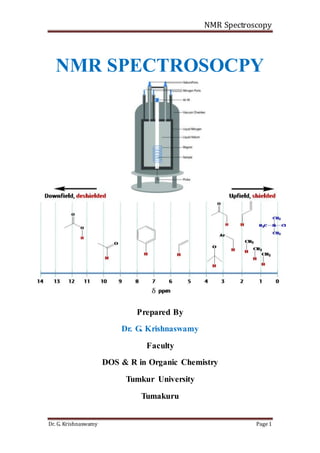
NMR SPECTROSOCPY
Prepared By
Dr. G. Krishnaswamy
Faculty
DOS & R in Organic Chemistry
Tumkur University
Tumakuru
NMR Spectroscopy
Dr. G. Krishnaswamy Page 2
Spectroscopy is the study of the interaction of electromagnetic radiation with matter.
Nuclear magnetic resonance (NMR) is a spectroscopy technique which is based on the
interaction of the sample being examined with electromagnetic radiation in the range
of radio frequencies (1- 1000 MHz). To absorb a photon of electromagnetic radiation,
the transition energy ΔE sample due to the interaction of a nuclear spin in the sample
with a magnetic field must match that of the absorbed radiation at a frequency.
ΔE sample = E photon = ħω = hν = hc/λ
The NMR experiments will provide a broad range of information on a sample; in
particular how the NMR frequency can be used to determine structural and dynamical
data.
Classically, a rotating particle possesses angular momentum. The nucleus of an atom
can be visualized as “rotating” and has a spin angular momentum I. The magnitude of
the spin angular momentum is given in quantum mechanics by:
ħ [I(I +1)]½ I = 0, 1/2, 1, 3/2,
where ħ is Planck’s constant h divided by 2π and I is the spin angular momentum
quantum number or the “spin” of the nucleus. I has a quantized z-component:
Iz = ħm m = −I, …, 0, …, I
where m is the magnetic quantum number with 2I +1 values.
Nuclei of all elements are composed of protons (p) and neutrons (n), both of which
have spin I = 1/2. Thus the total nuclear spin is the sum of the spins of all the nucleons.
The quantum treatment indicates that protons and neutrons pair up separately and that
even numbers of either have zero spin angular momentum.
Spin Nucleon Description Examples
I = 0
even numbers of both p and n 12C: 6p, 6n
16O: 8p, 8n
I = n (integer)
odd numbers of both p and n 2H: 1p, 1n, I = 1
10B: 5p, 5n, I = 3
I = n/2 (half integer)
even p (n) and odd n (p) 13C: 6p, 7n, I = 1/2
23Na: 11p, 12n, I = 3/2
NMR Spectroscopy
Dr. G. Krishnaswamy Page 3
Classically, if a rotating particle is charged, it generates a magnetic dipole which
creates a magnetic field. The dipole has a magnetic moment. Associated with nuclear
spin angular momentum is the nuclear magnetic moment μ which can interact with a
magnetic field:
μ = γ I
where γ is the magnetogyric ratio, a constant characteristic of each nuclide.
Nuclear Spin in an External Magnetic Field (Zeeman Effect)
There is no preferred orientation for a magnetic moment in the absence of external
fields. In the absence of B0, the magnetic moments of individual nuclei are randomly
oriented and all have essentially the same energy. Application of an external magnetic
field removes the randomness, forcing the nuclei to align with or against the direction
of B0. This change from a random state to an ordered state is known as polarization.
Such polarization means there is a difference in the population of the various spin
states. NMR spectroscopy induces transitions between adjacent nuclear spin energy
states (the selection rule is Δm = ±1).
Classically, in the presence of an external magnetic field B0 the energy of a magnetic
moment
μ depends on its orientation relative to the field:
E = μ B0
which is a minimum when the magnetic moment is aligned parallel to the magnetic
field and a maximum when it is anti-parallel. From the quantum mechanical
prospective, when a nucleus is introduced into a magnetic field its magnetic moment
will align itself in 2I +1 orientations (number of values of the m quantum number)
about the z direction of B0 where the energy is given by:
NMR Spectroscopy
Dr. G. Krishnaswamy Page 4
Em = μz B0 = γħmB0
For an I = 1/2 nucleus, there are only two orientations for the magnetic moment μ: 1)
a lower energy orientation parallel to B0 with a magnetic quantum number m = 1/2
often referred to as the α spin state and 2) a higher energy anti-parallel orientation
with m = −1/2 referred to as the β spin state. For an I = 1 nucleus there are three
possible orientations for the magnetic moment, these states are illustrated below
Directional quantization of the angular momentum P in the magnetic fieldfor nuclei with I=½ and
1
Energy level schemes for a nucleus spin quantum number ½
Transition Frequencies
When the magnetic field is applied the nucleus begins to precess about its own axis of
spin with angular frequency (ω) with units of radians/second called Larmor frequency.
The frequency at which proton precesses is directly proportional to the strength of
applied magnetic field. Stronger the magnetic field the higher the rate of precession.
The angular frequency of an NMR transition is more commonly written as: which is
the Larmor equation.
NMR Spectroscopy
Dr. G. Krishnaswamy Page 5
ω0 = γB0
Gyromagnetic ratio = 2πμ/hI
ν = γB0/2π
2πν = γB0
ω ≡ 2πν
(a) A top precessing in the earth’s gravitational field; (b) the precession of a spinning nucleus
resulting from the influence of an applied magnetic field.
Boltzmann Statistics
In the presence of an external magnetic field, different nuclear spin states (with
different values of m) have different energies. The energy difference is proportional to
B0. At thermal equilibrium, these states will also have different populations, their ratio
given by the Boltzmann equation:
Nhigh and Nlow the respective populations of the upper and lower spin states,
ΔE =Ehigh − Elow the energy difference between the two states,
k the Boltzmann constant, and T the absolute temperature.
In the applied magnetic fields, the difference between nuclear spin energy levels ΔE is
much smaller than kT, implying that Nlow is only very slightly in excess of Nhigh.
For 1H in a 9.4 Tesla field (400 MHz) and 300 K one obtains a population ratio
N(α)/N(β) of 1.000064, i.e., for one million spins in the upper β state there are one
million and sixty-four in the lower energy α state! It is the excess 64 spins that
respond to the NMR experiment and create the net magnetization M0. To summarize,
NMR Spectroscopy
Dr. G. Krishnaswamy Page 6
the larger B0 is the greater the energy difference ΔE between the levels and the larger
the ΔE the more excess population exists in the lower energy state.
The excess nuclei are the one that allow us to observe resonance. When the 60MHz
radiation is applied it not only induces transition upward but also stimulates transition
downward. If populations of the upper and lower states become exactly equal we
observe no net signal. This situation is called saturation. One must be careful to
avoid saturation when performing an NMR experiment.
Nuclear Spin Relaxation
Relaxation process involves non-radiative transition by which a nucleus in an
upper transition state returns to the lower spin state.
OR
The process that brings the spin back to thermal equilibrium is called relaxation.
It decays due to three distinct effects:
1. Spin-Lattice (or Longitudinal) Relaxation, T1
Mechanism involves a net transfer of energy from spin system to surroundings, to
reestablish Boltzmann distribution. The term refers to the frame work of molecule
containing the precessing nuclei. All these molecules undergo translational, rotational
and vibrational motion and posses magnetic properties giving rise to small magnetic
field in the lattice. When small magnetic field applied induces transition in particular
precessing nuclei from upper to lower state. The energy from this transition is
transferred to the component of the lattice as additional translational and vibrational
energy. This maintains the excess of nuclei in the lower energy state.
Spin-Lattice relation can be denoted by T1 and it is a measure of average lifetime of
the nuclei in the higher energy state. The time T1 is dependent on the gyromagnetic
ratio of absorbing nuclei.
2. Spin-Spin (or Transverse) Relaxation, T2
In which mutual exchange of spins by two precessing nuclei in close proximity to one
another. With each precessing nucleus, there is an associated magnetic field rotating
perpendicular to the main field. If this small magnetic field is same as is required to
induce transition in the neighbouring proton, then mutual exchange of spin take place.
NMR Spectroscopy
Dr. G. Krishnaswamy Page 7
This shortens the life time o fan individual nucleus in the higher state. In other wards
it involves the transfer of energy from one nucleus to the other. This loss of transverse
magnetization is characterized by a time constant denoted by T2, called the spin-spin
or transverse relaxation time.
3. The magnetic field is not perfectly uniform. Nuclei in different parts of the
sample precess at slightly different frequencies and get out of phase with one another,
thereby gradually decreasing the net magnetization of the sample.
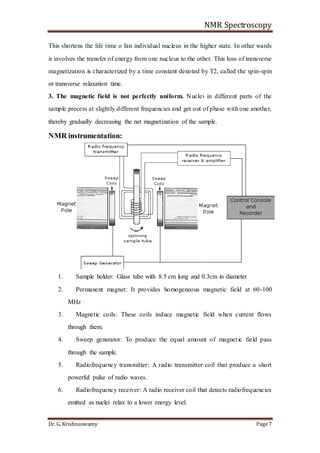
NMR instrumentation:
1. Sample holder: Glass tube with 8.5 cm long and 0.3cm in diameter
2. Permanent magnet: It provides homogeneous magnetic field at 60-100
MHz
3. Magnetic coils: These coils induce magnetic field when current flows
through them.
4. Sweep generator: To produce the equal amount of magnetic field pass
through the sample.
5. Radiofrequency transmitter: A radio transmitter coil that produce a short
powerful pulse of radio waves.
6. Radiofrequency receiver: A radio receiver coil that detects radiofrequencies
emitted as nuclei relax to a lower energy level.
NMR Spectroscopy
Dr. G. Krishnaswamy Page 8
7. Read out system: A computer that analyses and record the data.
FOURIER TRANSFORMS
A Fourier transform is an operation which converts functions from time to frequency
domains. An inverse Fourier transform (IFT ) converts from the frequency domain to
the time domain.
NMR Chemical Shift
• The chemical shift is the position on the δ scale (in ppm) where the peak occurs.
Chemical shift = δ = distance of peak from TMS, in Hz
spectrometer frequency in MHz ppm
• There are two major factors that influence chemical shifts:
1. Deshielding due to reduced electron density (due electronegative atoms)
2. Anisotropy due to magnetic fields generated by π bonds
Table of chemical shifts
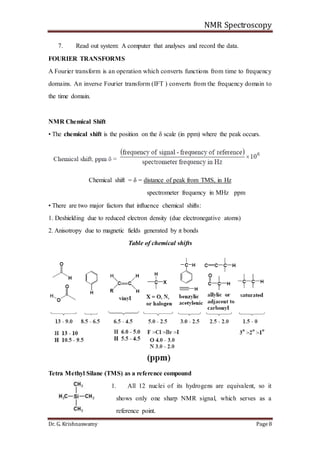
Tetra Methyl Silane (TMS) as a reference compound
1. All 12 nuclei of its hydrogens are equivalent, so it
shows only one sharp NMR signal, which serves as a
reference point.
NMR Spectroscopy
Dr. G. Krishnaswamy Page 9
2. Its hydrogen signals appear at higher field than do most 1H signals in other organic
compounds, thus making it easy to identify the TMS peak.
3. TMS is inert, so it does not react with most organic compounds, and it is low
boiling and can be removed easily at the end of a measurement.
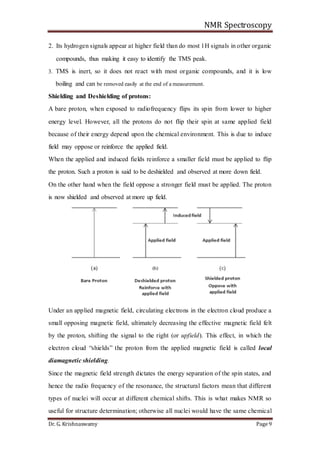
Shielding and Deshielding of protons:
A bare proton, when exposed to radiofrequency flips its spin from lower to higher
energy level. However, all the protons do not flip their spin at same applied field
because of their energy depend upon the chemical environment. This is due to induce
field may oppose or reinforce the applied field.
When the applied and induced fields reinforce a smaller field must be applied to flip
the proton. Such a proton is said to be deshielded and observed at more down field.
On the other hand when the field oppose a stronger field must be applied. The proton
is now shielded and observed at more up field.
Under an applied magnetic field, circulating electrons in the electron cloud produce a
small opposing magnetic field, ultimately decreasing the effective magnetic field felt
by the proton, shifting the signal to the right (or upfield). This effect, in which the
electron cloud “shields” the proton from the applied magnetic field is called local
diamagnetic shielding.
Since the magnetic field strength dictates the energy separation of the spin states, and
hence the radio frequency of the resonance, the structural factors mean that different
types of nuclei will occur at different chemical shifts. This is what makes NMR so
useful for structure determination; otherwise all nuclei would have the same chemical
NMR Spectroscopy
Dr. G. Krishnaswamy Page 10
shift. Some important factors include:
• inductive effects by electronegative groups
• magnetic anisotropy
Factors affecting chemical shift:
Electronegativity:
H’s that are attached to more electronegative atoms experience higher chemical shifts.
Electronegative atoms also remove electrons from the electron cloud, which decreases
their density and results in less shielding; hence electronegative atoms are said to
deshield the proton and cause it to have a higher chemical shift, moving it to the left
(or downfield).
CH3F CH3Cl CH3Br CH3I CH3CH3 CH4 SiMe4 CH3Li
4.26 3.05 2.69 2.19 0.96 0.2 0.0 -0.4
The magnitude of the Deshielding effect, however, rapidly decreases as the distance
between the proton and electronegative atom increases.
CH3Br CH3CH2Br CH3CH2CH2Br CH3CH2CH2CH2Br
2.69 ppm 1.66 ppm 1.06 ppm 0.93 ppm
Magnetic Anisotropy
Magnetic anisotropy means that there is a non-uniform magnetic field. Electrons in π
systems (e.g. aromatics, alkenes, alkynes, carbonyls, etc.) interact with the applied
field which induces a magnetic field that causes the anisotropy. As a result, the nearby
nuclei will experience three fields: the applied field, the shielding field of the valence
NMR Spectroscopy
Dr. G. Krishnaswamy Page 11
electrons, and the field due to the π system. Depending on the position of the nucleus
in this third field, it can be either shielded (smaller δ) or deshielded (larger δ), which
implies that the energy required for, and the frequency of the absorption will change.
Acidic and Exchangeable protons
Acidic hydrogens: Some of the least shielded protons are those attached to carboxylic
acid at 10 to 12 ppm.
R O
H
O
R O+
H
O-
Both resonance and electro negativity effect of oxygen withdraw electrons from the
proton.
NMR Spectroscopy
Dr. G. Krishnaswamy Page 12
Hydrogen bonding and exchangeable protons:
Protons that can exhibit hydrogen bonding (-OH & -NH) have extremely variable
absorption positions over a wide range. The more hydrogen bonding take place the
more deshielded a proton becomes. The amount of H-bonding is depends on
concentration and temperature. The more concentrate the solution more molecule
come into contact and hydrogen bond. At higher dilution, no hydrogen bonding
occurs.
δ value at dilute solution of –OH occurs at 0.5-1.0 ppm
δ value at higher concentration occurs at 4.0-5.0 ppm.
R
O
H
R
O+
H
O+
H
H
R
O+
H
R
Free (dilute) H-Bond (Concentrated)
Protons attached to electronegative atom with lone pair such as oxygen/nitrogen can
undergo rapid chemical exchange. That is, they can be transferred rapidly from one
molecule to another and are called exchangeable protons.
 Rapid exchange causes spin decoupling
R
O
Ha R'
O
Hb R
O
Hb R
O
Ha
++
 Spin decoupling is found in HNMR of alcohols, amines and carboxylic acids.
The signals of OH & NH protons are normally unsplit and broad.
 Recognizing Exchangeable Protons. Protons that undergo rapid chemical
exchange can be easily detected by replacing the compound by D2O. The
protons are rapidly replaced by deuterium and the proton signals disappear
from the spectrum.
Other types of exchange: TAUTOMERISM
Molecules whose structures differ markedly in the arrangement of atoms, but exist in
equilibrium with one another are called tautomers. The most common type of
NMR Spectroscopy
Dr. G. Krishnaswamy Page 13
tautomerism is Keto-enol tautomerism in which the species differ mainly by the
position of a hydrogen atom.
1, 3-dicarbonyl compounds are capable of exhibiting keto-enol tautomerism and the
equilibrium favours the enol form due to formation of intramolecular hydrogen bond.
Example for 1, 3-dicarbonyl is acetyl acetone.
The proton spectrum of acetyl acetone shows O-H peak at very far down field at δ =
15.5 ppm as well as the vinylic C-H proton at δ = 5.5 ppm. Also the strong CH3 peaks
from enol forms and compare it with the much weaker CH3 peak from the keto form.
Also note that the CH2 peak at 3.6 ppm is weak. It concludes that the enol form
predominates in this equilibrium.
NMR Spectroscopy
Dr. G. Krishnaswamy Page 14
Valence tautomerism:
Valence tautomerism is intramolecular nature in which tautomers rapidly interconvert
with one another, but the tauomeric forms differ principally by the position of
covalent bonds rather than by the positions of protons.
Example for valence tautomerism is Bullvalene.
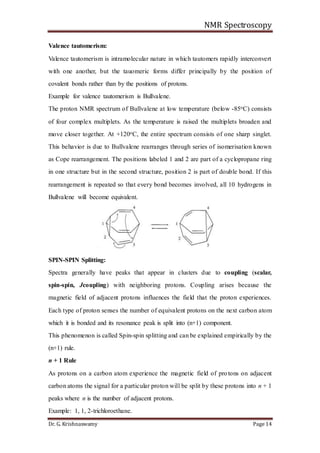
The proton NMR spectrum of Bullvalene at low temperature (below -85oC) consists
of four complex multiplets. As the temperature is raised the multiplets broaden and
move closer together. At +120oC, the entire spectrum consists of one sharp singlet.
This behavior is due to Bullvalene rearranges through series of isomerisation known
as Cope rearrangement. The positions labeled 1 and 2 are part of a cyclopropane ring
in one structure but in the second structure, position 2 is part of double bond. If this
rearrangement is repeated so that every bond becomes involved, all 10 hydrogens in
Bullvalene will become equivalent.
SPIN-SPIN Splitting:
Spectra generally have peaks that appear in clusters due to coupling (scalar,
spin-spin, Jcoupling) with neighboring protons. Coupling arises because the
magnetic field of adjacent protons influences the field that the proton experiences.
Each type of proton senses the number of equivalent protons on the next carbon atom
which it is bonded and its resonance peak is split into (n+1) component.
This phenomenon is called Spin-spin splitting and can be explained empirically by the
(n+1) rule.
n + 1 Rule
As protons on a carbon atom experience the magnetic field of protons on adjacent
carbon atoms the signal for a particular proton will be split by these protons into n + 1
peaks where n is the number of adjacent protons.
Example: 1, 1, 2-trichloroethane.
NMR Spectroscopy
Dr. G. Krishnaswamy Page 15
To understand the implications of this first consider the effect the −CH group has on
the adjacent −CH3. The methine –CH can adopt two alignments with respect to the
applied field. As a result, the signal for the adjacent methyl −CH3 is split into a
doublet, two lines of equal intensity ratio 1:1. Now consider the effect the −CH3
group has on the adjacent −CH. The methyl -CH3 protons have 8 possible
combinations with respect to the applied field, only four of which are magnetically
distinct. The resulting signal for the adjacent methane −CH is split into a quartet, 4
lines of intensity ratio 1:3:3:1.
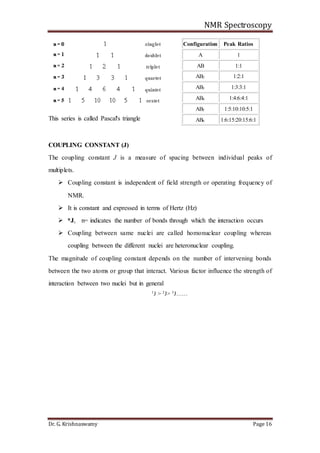
Pascal’s Triangle
The relative intensities of the lines in a coupling pattern is given by a binomial
expansion of the equation
(x+1)n
where n is the number of B nuclei
or more conveniently by Pascal's triangle. Individual resonances are split due to
coupling with n adjacent protons. The number of lines in a coupling pattern is given,
in general, by 2nI + 1 for coupling with n spin I nuclei.
NMR Spectroscopy
Dr. G. Krishnaswamy Page 16
This series is called Pascal's triangle
COUPLING CONSTANT (J)
The coupling constant J is a measure of spacing between individual peaks of
multiplets.
 Coupling constant is independent of field strength or operating frequency of
NMR.
 It is constant and expressed in terms of Hertz (Hz)
 nJ, n= indicates the number of bonds through which the interaction occurs
 Coupling between same nuclei are called homonuclear coupling whereas
coupling between the different nuclei are heteronuclear coupling.
The magnitude of coupling constant depends on the number of intervening bonds
between the two atoms or group that interact. Various factor influence the strength of
interaction between two nuclei but in general
1
J > 2
J> 3
J……
Configuration Peak Ratios
A 1
AB 1:1
AB2 1:2:1
AB3 1:3:3:1
AB4 1:4:6:4:1
AB5 1:5:10:10:5:1
AB6 1:6:15:20:15:6:1
NMR Spectroscopy
Dr. G. Krishnaswamy Page 17
Coupling through different bonds are given
Spin-spin coupling over one bond 1J
Geminal spin-spin coupling 2J
Vicinal spin-spin coupling 3J
Long-range spin-spin coupling nJ, n ≥ 4
Factors affecting spin-spin coupling
Spin-spin coupling constants are not easy to predict theoretically, and depend on a
number of factors:
i) hybridization of the atoms involved in the coupling;
ii) bond angles;
iii) dihedral angles;
iv) C - C bond length;
v) substituent effects
NMR Spectroscopy
Dr. G. Krishnaswamy Page 18
H
H
H
HH
H
Chart of coupling constant
1J -Spin-spin coupling: (one bond)
A one bond coupling occurs when a single bond links two spin active nuclei.
2J- Geminal spin-spin coupling: (Two bond)
Geminal coupling between protons attached to same central atom.
 Geminal coupling invokes nuclear-electronic spin coupling as a means of
transmitting spin information from one nucleus to the other.
 The amount of two bond coupling depends mainly on the H–C–H bond
angle, the influence of α and β substituents and the hybridization of the
carbon.
 Geminal coupling increases as the angle bond angle decreases.
α = 109o α = 118o α = 120o
2JHH= 12-18 Hz 2JHH= 5 Hz 2JHH= 0-3 Hz
3J -Vicinal spin-spin -coupling:
NMR Spectroscopy
Dr. G. Krishnaswamy Page 19
The spin of a hydrogen nucleus in one C-H bond is coupled to the spins of adjacent
C-H bonds.
In this coupling nuclear spin information is transferred via the small amount of
parallel orbital overlap that exists between adjacent C-H bond orbitals.
The magnitude of the coupling constant between two adjacent C-H bonds depends
directly on the dihedral angle α between the two bonds. The magnitude of the
splitting between two hydrogen is greatest when α = 0o or 180o and is small when
α = 90o.
The dihedral angle (α) dependence, the Karplus equation:
3JHH= A + B cos α + C cos 2 α
NMR Spectroscopy
Dr. G. Krishnaswamy Page 20
where α is the dihedral angle between the two C–H vectors, and A, B and C are
constants with empirical values for hydrocarbons found to be A = 7 Hz, B = -1 Hz and
C = 5 Hz.
The karplus relationship makes perfect sense according to the Dirac model. When the
two adjacent C-H bonds are orthogonal there should be minimal orbital overlap with
little or no spin interaction between the electrons in these orbitals. As a result nuclear
spin information is not transmitted and 3JHH=0. When the two bonds are parallel or
antiparallel the coupling constant should have greatest magnitude 3JHH = max.
Factors influencing the magnitude of 3JHH
 Dihedral angle
 Bond length (RCC)
 the valence angle θ1and θ2
 Electronegativity of any substituent attached to the carbon atoms.
NMR Spectroscopy
Dr. G. Krishnaswamy Page 21
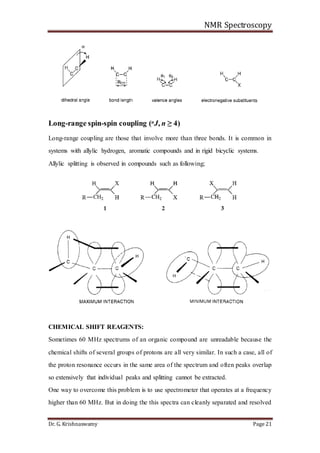
Long-range spin-spin coupling (nJ, n ≥ 4)
Long-range coupling are those that involve more than three bonds. It is common in
systems with allylic hydrogen, aromatic compounds and in rigid bicyclic systems.
Allylic splitting is observed in compounds such as following;
CHEMICAL SHIFT REAGENTS:
Sometimes 60 MHz spectrums of an organic compound are unreadable because the
chemical shifts of several groups of protons are all very similar. In such a case, all of
the proton resonance occurs in the same area of the spectrum and often peaks overlap
so extensively that individual peaks and splitting cannot be extracted.
One way to overcome this problem is to use spectrometer that operates at a frequency
higher than 60 MHz. But in doing the this spectra can cleanly separated and resolved
NMR Spectroscopy
Dr. G. Krishnaswamy Page 22
but the second order effect disappears at higher field and that many spectra are
simplified to first order spectra at 300 MHz.
Another way is to use chemical shift reagents allows a rapid and relatively
inexpensive means of resolving partially overlapping multiplets.
The Chemical shift reagents are organic complexes of paramagnetic rare earth metals
from the lanthanide series. When such metal complexes are added to the compound
whose spectrum is determined, there will be profound shift in the resonance positions
of various groups of protons. The direction of shift (up field or down field) depends
on which metal is being used.
 Complexes of europium, erbium, thulium and ytterbium shift resonance to
lower field.
 Complexes of cerium, praseodymium, neodymium, samarium, terbium and
holmium shift resonance to higher field.
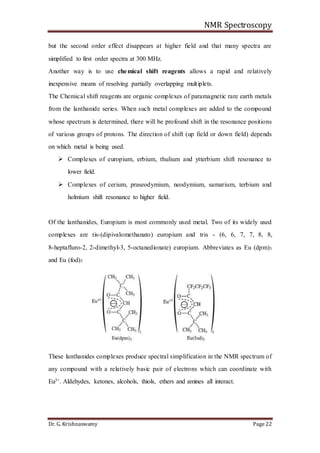
Of the lanthanides, Europium is most commonly used metal. Two of its widely used
complexes are tis-(dipivalomethanato) europium and tris - (6, 6, 7, 7, 8, 8,
8-heptafluro-2, 2-dimethyl-3, 5-octanedionate) europium. Abbreviates as Eu (dpm)3
and Eu (fod)3
These lanthanides complexes produce spectral simplification in the NMR spectrum of
any compound with a relatively basic pair of electrons which can coordinate with
Eu3+. Aldehydes, ketones, alcohols, thiols, ethers and amines all interact.
NMR Spectroscopy
Dr. G. Krishnaswamy Page 23
The amount of shift a given group of protons experiences depends on
1. The distance separating the metal and that group of protons
2. The concentration of the shift reagent in the solution.
First-order and Second-orderSpectra:
First order spectra. Second order spectra.
Spectra that can be interpreted by using
n+1 rule or a simple graphical analysis
are said to be First order spectra.
Spectra which cannot explain the splitting
patterns, intensities and number of peaks
observed neither graphical analysis nor n+1
rule and requires mathematical analysis
usually by computer are said to be Second
order spectra.
In first order spectra there is large
chemical shift difference between two
sets of nuclei.
In second order spectra the difference in
chemical shift between two nuclei have
nearly equivalent chemical shift but are not
exactly identical.
The ratio of ∆υ/J is large (>10) and
weakly coupled in first order spectra.
The ratio of ∆υ/J is small and strongly
coupled in first order spectra.
NMR Spectroscopy
Dr. G. Krishnaswamy Page 24
PROTON-DECOUPLED 13C SPECTRA
Proton decoupling is accomplished in the process of determining a 13CNMR spectrum
by simultaneously irradiating all of the protons in the molecule with a broad range of
frequencies in the proper range. For this a second tunable radiofrequency generator
the decoupler is used. Irradiation causes the protons to become saturates and they
undergo rapid upward and downward transitions among all the possible spin states.
These rapid transitions decouple any spin-spin interaction between the hydrogen and
the 13C nuclei being observed. The carbon nucleus senses only one average spin state
for the attached hydrogens rather than two or more distinct spin states.
OFF-RESONANCE DECOUPLING
The decoupling technique that is used to obtain typical proton decoupled spectra has
the advantage that all peaks become singlets. Unfortunately much useful information
number of hydrogens that are attached to a particular carbon is lost when carbon
spectra are decoupled. A compromising technique called off-resonance decoupling
can often provide multiplet information while keeping the spectrum relatively simple
in appearance.
The off-resonance decoupled spectrum retains the coupling between the carbon atom
NMR Spectroscopy
Dr. G. Krishnaswamy Page 25
and directly attached protons but effectively removes the coupling between the carbon
and more remote protons. The n+1 rule can be used to determine whether a given
carbon atom has three, two, one or no hydrogens attached.
In this technique, the frequency of second radiofrequency transmitter (decoupler) is
set either up field or down field. Further more in off-resonance decoupling the power
of the decoupling oscillator is held low to avoid complete decoupling.
Consider the off-resonance decoupled spectra of 1-propanol (CH3CH2CH2OH). The
–CH2 protons split into triplets as n+1 rule since in carbon is directly attached to two
protons and there is no coupling between other atoms.
In CH3 group split into quartet peak due to three protons directly attached to carbon.
NMR Spectroscopy
Dr. G. Krishnaswamy Page 26
NUCLEAR OVERHAUSER ENHANCEMENT (NOE)
When a proton decoupled spectra were recorded the intensities of many of the carbon
resonances increases significantly above those observed in a proton coupled
experiment. Carbon atoms with hydrogen atoms directly attached are enhanced the
most and the enhancement increases as more hydrogen is attached. This effect is
known as nuclear overhauser effect and the degree of increase in the signal is called
the nuclear overhauser enhancement (NOE).
The NOE effect is heteronuclear operating between two dissimilar atoms. Both atoms
exhibit spins and are NMR active. When one of two different types of atoms is
irradiated, while the NMR spectrum of the other type is determined and if the
intensities of observed i.e. nonirradiated atom change indicate enhancement has
occurred. The effect can be either positive or negative. The maximum enhancement
that can be observed is given by the relationship
Where γirr is the magnetogyric ratio of the nucleus being irradiated and γobs is the
magnetogyric ratio of the nucleus observed
Signal enhancement due to NOE is an example of cross polarization in which a
polarization of the spin state in one type of nucleus causes a polarization of the spin
state in another nucleus. Here when the hydrogens in the molecule are irradiated, they
became saturated and attain a distribution of spins very different from their
equilibrium state. There are more spins than normal in the excited state. Due to this
interaction of spin dipoles the spins of the carbon nuclei sense the spin imbalance of
the hydrogen nuclei and begin to adjust themselves to a new equilibrium state that has
more spins in the lower state. This increase of population in the lower spin state of
carbon increases the intensity of the NMR signal.
In a proton decouples 13C spectrum the total NOE for a given carbon increases as the
number of nearby hydrogen increases. The intensity of the signal assumes the order.

NMR spectroscopy

  • 1.
    NMR Spectroscopy Dr. G.Krishnaswamy Page 1 NMR SPECTROSOCPY Prepared By Dr. G. Krishnaswamy Faculty DOS & R in Organic Chemistry Tumkur University Tumakuru
  • 2.
    NMR Spectroscopy Dr. G.Krishnaswamy Page 2 Spectroscopy is the study of the interaction of electromagnetic radiation with matter. Nuclear magnetic resonance (NMR) is a spectroscopy technique which is based on the interaction of the sample being examined with electromagnetic radiation in the range of radio frequencies (1- 1000 MHz). To absorb a photon of electromagnetic radiation, the transition energy ΔE sample due to the interaction of a nuclear spin in the sample with a magnetic field must match that of the absorbed radiation at a frequency. ΔE sample = E photon = ħω = hν = hc/λ The NMR experiments will provide a broad range of information on a sample; in particular how the NMR frequency can be used to determine structural and dynamical data. Classically, a rotating particle possesses angular momentum. The nucleus of an atom can be visualized as “rotating” and has a spin angular momentum I. The magnitude of the spin angular momentum is given in quantum mechanics by: ħ [I(I +1)]½ I = 0, 1/2, 1, 3/2, where ħ is Planck’s constant h divided by 2π and I is the spin angular momentum quantum number or the “spin” of the nucleus. I has a quantized z-component: Iz = ħm m = −I, …, 0, …, I where m is the magnetic quantum number with 2I +1 values. Nuclei of all elements are composed of protons (p) and neutrons (n), both of which have spin I = 1/2. Thus the total nuclear spin is the sum of the spins of all the nucleons. The quantum treatment indicates that protons and neutrons pair up separately and that even numbers of either have zero spin angular momentum. Spin Nucleon Description Examples I = 0 even numbers of both p and n 12C: 6p, 6n 16O: 8p, 8n I = n (integer) odd numbers of both p and n 2H: 1p, 1n, I = 1 10B: 5p, 5n, I = 3 I = n/2 (half integer) even p (n) and odd n (p) 13C: 6p, 7n, I = 1/2 23Na: 11p, 12n, I = 3/2
  • 3.
    NMR Spectroscopy Dr. G.Krishnaswamy Page 3 Classically, if a rotating particle is charged, it generates a magnetic dipole which creates a magnetic field. The dipole has a magnetic moment. Associated with nuclear spin angular momentum is the nuclear magnetic moment μ which can interact with a magnetic field: μ = γ I where γ is the magnetogyric ratio, a constant characteristic of each nuclide. Nuclear Spin in an External Magnetic Field (Zeeman Effect) There is no preferred orientation for a magnetic moment in the absence of external fields. In the absence of B0, the magnetic moments of individual nuclei are randomly oriented and all have essentially the same energy. Application of an external magnetic field removes the randomness, forcing the nuclei to align with or against the direction of B0. This change from a random state to an ordered state is known as polarization. Such polarization means there is a difference in the population of the various spin states. NMR spectroscopy induces transitions between adjacent nuclear spin energy states (the selection rule is Δm = ±1). Classically, in the presence of an external magnetic field B0 the energy of a magnetic moment μ depends on its orientation relative to the field: E = μ B0 which is a minimum when the magnetic moment is aligned parallel to the magnetic field and a maximum when it is anti-parallel. From the quantum mechanical prospective, when a nucleus is introduced into a magnetic field its magnetic moment will align itself in 2I +1 orientations (number of values of the m quantum number) about the z direction of B0 where the energy is given by:
  • 4.
    NMR Spectroscopy Dr. G.Krishnaswamy Page 4 Em = μz B0 = γħmB0 For an I = 1/2 nucleus, there are only two orientations for the magnetic moment μ: 1) a lower energy orientation parallel to B0 with a magnetic quantum number m = 1/2 often referred to as the α spin state and 2) a higher energy anti-parallel orientation with m = −1/2 referred to as the β spin state. For an I = 1 nucleus there are three possible orientations for the magnetic moment, these states are illustrated below Directional quantization of the angular momentum P in the magnetic fieldfor nuclei with I=½ and 1 Energy level schemes for a nucleus spin quantum number ½ Transition Frequencies When the magnetic field is applied the nucleus begins to precess about its own axis of spin with angular frequency (ω) with units of radians/second called Larmor frequency. The frequency at which proton precesses is directly proportional to the strength of applied magnetic field. Stronger the magnetic field the higher the rate of precession. The angular frequency of an NMR transition is more commonly written as: which is the Larmor equation.
  • 5.
    NMR Spectroscopy Dr. G.Krishnaswamy Page 5 ω0 = γB0 Gyromagnetic ratio = 2πμ/hI ν = γB0/2π 2πν = γB0 ω ≡ 2πν (a) A top precessing in the earth’s gravitational field; (b) the precession of a spinning nucleus resulting from the influence of an applied magnetic field. Boltzmann Statistics In the presence of an external magnetic field, different nuclear spin states (with different values of m) have different energies. The energy difference is proportional to B0. At thermal equilibrium, these states will also have different populations, their ratio given by the Boltzmann equation: Nhigh and Nlow the respective populations of the upper and lower spin states, ΔE =Ehigh − Elow the energy difference between the two states, k the Boltzmann constant, and T the absolute temperature. In the applied magnetic fields, the difference between nuclear spin energy levels ΔE is much smaller than kT, implying that Nlow is only very slightly in excess of Nhigh. For 1H in a 9.4 Tesla field (400 MHz) and 300 K one obtains a population ratio N(α)/N(β) of 1.000064, i.e., for one million spins in the upper β state there are one million and sixty-four in the lower energy α state! It is the excess 64 spins that respond to the NMR experiment and create the net magnetization M0. To summarize,
  • 6.
    NMR Spectroscopy Dr. G.Krishnaswamy Page 6 the larger B0 is the greater the energy difference ΔE between the levels and the larger the ΔE the more excess population exists in the lower energy state. The excess nuclei are the one that allow us to observe resonance. When the 60MHz radiation is applied it not only induces transition upward but also stimulates transition downward. If populations of the upper and lower states become exactly equal we observe no net signal. This situation is called saturation. One must be careful to avoid saturation when performing an NMR experiment. Nuclear Spin Relaxation Relaxation process involves non-radiative transition by which a nucleus in an upper transition state returns to the lower spin state. OR The process that brings the spin back to thermal equilibrium is called relaxation. It decays due to three distinct effects: 1. Spin-Lattice (or Longitudinal) Relaxation, T1 Mechanism involves a net transfer of energy from spin system to surroundings, to reestablish Boltzmann distribution. The term refers to the frame work of molecule containing the precessing nuclei. All these molecules undergo translational, rotational and vibrational motion and posses magnetic properties giving rise to small magnetic field in the lattice. When small magnetic field applied induces transition in particular precessing nuclei from upper to lower state. The energy from this transition is transferred to the component of the lattice as additional translational and vibrational energy. This maintains the excess of nuclei in the lower energy state. Spin-Lattice relation can be denoted by T1 and it is a measure of average lifetime of the nuclei in the higher energy state. The time T1 is dependent on the gyromagnetic ratio of absorbing nuclei. 2. Spin-Spin (or Transverse) Relaxation, T2 In which mutual exchange of spins by two precessing nuclei in close proximity to one another. With each precessing nucleus, there is an associated magnetic field rotating perpendicular to the main field. If this small magnetic field is same as is required to induce transition in the neighbouring proton, then mutual exchange of spin take place.
  • 7.
    NMR Spectroscopy Dr. G.Krishnaswamy Page 7 This shortens the life time o fan individual nucleus in the higher state. In other wards it involves the transfer of energy from one nucleus to the other. This loss of transverse magnetization is characterized by a time constant denoted by T2, called the spin-spin or transverse relaxation time. 3. The magnetic field is not perfectly uniform. Nuclei in different parts of the sample precess at slightly different frequencies and get out of phase with one another, thereby gradually decreasing the net magnetization of the sample. NMR instrumentation: 1. Sample holder: Glass tube with 8.5 cm long and 0.3cm in diameter 2. Permanent magnet: It provides homogeneous magnetic field at 60-100 MHz 3. Magnetic coils: These coils induce magnetic field when current flows through them. 4. Sweep generator: To produce the equal amount of magnetic field pass through the sample. 5. Radiofrequency transmitter: A radio transmitter coil that produce a short powerful pulse of radio waves. 6. Radiofrequency receiver: A radio receiver coil that detects radiofrequencies emitted as nuclei relax to a lower energy level.
  • 8.
    NMR Spectroscopy Dr. G.Krishnaswamy Page 8 7. Read out system: A computer that analyses and record the data. FOURIER TRANSFORMS A Fourier transform is an operation which converts functions from time to frequency domains. An inverse Fourier transform (IFT ) converts from the frequency domain to the time domain. NMR Chemical Shift • The chemical shift is the position on the δ scale (in ppm) where the peak occurs. Chemical shift = δ = distance of peak from TMS, in Hz spectrometer frequency in MHz ppm • There are two major factors that influence chemical shifts: 1. Deshielding due to reduced electron density (due electronegative atoms) 2. Anisotropy due to magnetic fields generated by π bonds Table of chemical shifts Tetra Methyl Silane (TMS) as a reference compound 1. All 12 nuclei of its hydrogens are equivalent, so it shows only one sharp NMR signal, which serves as a reference point.
  • 9.
    NMR Spectroscopy Dr. G.Krishnaswamy Page 9 2. Its hydrogen signals appear at higher field than do most 1H signals in other organic compounds, thus making it easy to identify the TMS peak. 3. TMS is inert, so it does not react with most organic compounds, and it is low boiling and can be removed easily at the end of a measurement. Shielding and Deshielding of protons: A bare proton, when exposed to radiofrequency flips its spin from lower to higher energy level. However, all the protons do not flip their spin at same applied field because of their energy depend upon the chemical environment. This is due to induce field may oppose or reinforce the applied field. When the applied and induced fields reinforce a smaller field must be applied to flip the proton. Such a proton is said to be deshielded and observed at more down field. On the other hand when the field oppose a stronger field must be applied. The proton is now shielded and observed at more up field. Under an applied magnetic field, circulating electrons in the electron cloud produce a small opposing magnetic field, ultimately decreasing the effective magnetic field felt by the proton, shifting the signal to the right (or upfield). This effect, in which the electron cloud “shields” the proton from the applied magnetic field is called local diamagnetic shielding. Since the magnetic field strength dictates the energy separation of the spin states, and hence the radio frequency of the resonance, the structural factors mean that different types of nuclei will occur at different chemical shifts. This is what makes NMR so useful for structure determination; otherwise all nuclei would have the same chemical
  • 10.
    NMR Spectroscopy Dr. G.Krishnaswamy Page 10 shift. Some important factors include: • inductive effects by electronegative groups • magnetic anisotropy Factors affecting chemical shift: Electronegativity: H’s that are attached to more electronegative atoms experience higher chemical shifts. Electronegative atoms also remove electrons from the electron cloud, which decreases their density and results in less shielding; hence electronegative atoms are said to deshield the proton and cause it to have a higher chemical shift, moving it to the left (or downfield). CH3F CH3Cl CH3Br CH3I CH3CH3 CH4 SiMe4 CH3Li 4.26 3.05 2.69 2.19 0.96 0.2 0.0 -0.4 The magnitude of the Deshielding effect, however, rapidly decreases as the distance between the proton and electronegative atom increases. CH3Br CH3CH2Br CH3CH2CH2Br CH3CH2CH2CH2Br 2.69 ppm 1.66 ppm 1.06 ppm 0.93 ppm Magnetic Anisotropy Magnetic anisotropy means that there is a non-uniform magnetic field. Electrons in π systems (e.g. aromatics, alkenes, alkynes, carbonyls, etc.) interact with the applied field which induces a magnetic field that causes the anisotropy. As a result, the nearby nuclei will experience three fields: the applied field, the shielding field of the valence
  • 11.
    NMR Spectroscopy Dr. G.Krishnaswamy Page 11 electrons, and the field due to the π system. Depending on the position of the nucleus in this third field, it can be either shielded (smaller δ) or deshielded (larger δ), which implies that the energy required for, and the frequency of the absorption will change. Acidic and Exchangeable protons Acidic hydrogens: Some of the least shielded protons are those attached to carboxylic acid at 10 to 12 ppm. R O H O R O+ H O- Both resonance and electro negativity effect of oxygen withdraw electrons from the proton.
  • 12.
    NMR Spectroscopy Dr. G.Krishnaswamy Page 12 Hydrogen bonding and exchangeable protons: Protons that can exhibit hydrogen bonding (-OH & -NH) have extremely variable absorption positions over a wide range. The more hydrogen bonding take place the more deshielded a proton becomes. The amount of H-bonding is depends on concentration and temperature. The more concentrate the solution more molecule come into contact and hydrogen bond. At higher dilution, no hydrogen bonding occurs. δ value at dilute solution of –OH occurs at 0.5-1.0 ppm δ value at higher concentration occurs at 4.0-5.0 ppm. R O H R O+ H O+ H H R O+ H R Free (dilute) H-Bond (Concentrated) Protons attached to electronegative atom with lone pair such as oxygen/nitrogen can undergo rapid chemical exchange. That is, they can be transferred rapidly from one molecule to another and are called exchangeable protons.  Rapid exchange causes spin decoupling R O Ha R' O Hb R O Hb R O Ha ++  Spin decoupling is found in HNMR of alcohols, amines and carboxylic acids. The signals of OH & NH protons are normally unsplit and broad.  Recognizing Exchangeable Protons. Protons that undergo rapid chemical exchange can be easily detected by replacing the compound by D2O. The protons are rapidly replaced by deuterium and the proton signals disappear from the spectrum. Other types of exchange: TAUTOMERISM Molecules whose structures differ markedly in the arrangement of atoms, but exist in equilibrium with one another are called tautomers. The most common type of
  • 13.
    NMR Spectroscopy Dr. G.Krishnaswamy Page 13 tautomerism is Keto-enol tautomerism in which the species differ mainly by the position of a hydrogen atom. 1, 3-dicarbonyl compounds are capable of exhibiting keto-enol tautomerism and the equilibrium favours the enol form due to formation of intramolecular hydrogen bond. Example for 1, 3-dicarbonyl is acetyl acetone. The proton spectrum of acetyl acetone shows O-H peak at very far down field at δ = 15.5 ppm as well as the vinylic C-H proton at δ = 5.5 ppm. Also the strong CH3 peaks from enol forms and compare it with the much weaker CH3 peak from the keto form. Also note that the CH2 peak at 3.6 ppm is weak. It concludes that the enol form predominates in this equilibrium.
  • 14.
    NMR Spectroscopy Dr. G.Krishnaswamy Page 14 Valence tautomerism: Valence tautomerism is intramolecular nature in which tautomers rapidly interconvert with one another, but the tauomeric forms differ principally by the position of covalent bonds rather than by the positions of protons. Example for valence tautomerism is Bullvalene. The proton NMR spectrum of Bullvalene at low temperature (below -85oC) consists of four complex multiplets. As the temperature is raised the multiplets broaden and move closer together. At +120oC, the entire spectrum consists of one sharp singlet. This behavior is due to Bullvalene rearranges through series of isomerisation known as Cope rearrangement. The positions labeled 1 and 2 are part of a cyclopropane ring in one structure but in the second structure, position 2 is part of double bond. If this rearrangement is repeated so that every bond becomes involved, all 10 hydrogens in Bullvalene will become equivalent. SPIN-SPIN Splitting: Spectra generally have peaks that appear in clusters due to coupling (scalar, spin-spin, Jcoupling) with neighboring protons. Coupling arises because the magnetic field of adjacent protons influences the field that the proton experiences. Each type of proton senses the number of equivalent protons on the next carbon atom which it is bonded and its resonance peak is split into (n+1) component. This phenomenon is called Spin-spin splitting and can be explained empirically by the (n+1) rule. n + 1 Rule As protons on a carbon atom experience the magnetic field of protons on adjacent carbon atoms the signal for a particular proton will be split by these protons into n + 1 peaks where n is the number of adjacent protons. Example: 1, 1, 2-trichloroethane.
  • 15.
    NMR Spectroscopy Dr. G.Krishnaswamy Page 15 To understand the implications of this first consider the effect the −CH group has on the adjacent −CH3. The methine –CH can adopt two alignments with respect to the applied field. As a result, the signal for the adjacent methyl −CH3 is split into a doublet, two lines of equal intensity ratio 1:1. Now consider the effect the −CH3 group has on the adjacent −CH. The methyl -CH3 protons have 8 possible combinations with respect to the applied field, only four of which are magnetically distinct. The resulting signal for the adjacent methane −CH is split into a quartet, 4 lines of intensity ratio 1:3:3:1. Pascal’s Triangle The relative intensities of the lines in a coupling pattern is given by a binomial expansion of the equation (x+1)n where n is the number of B nuclei or more conveniently by Pascal's triangle. Individual resonances are split due to coupling with n adjacent protons. The number of lines in a coupling pattern is given, in general, by 2nI + 1 for coupling with n spin I nuclei.
  • 16.
    NMR Spectroscopy Dr. G.Krishnaswamy Page 16 This series is called Pascal's triangle COUPLING CONSTANT (J) The coupling constant J is a measure of spacing between individual peaks of multiplets.  Coupling constant is independent of field strength or operating frequency of NMR.  It is constant and expressed in terms of Hertz (Hz)  nJ, n= indicates the number of bonds through which the interaction occurs  Coupling between same nuclei are called homonuclear coupling whereas coupling between the different nuclei are heteronuclear coupling. The magnitude of coupling constant depends on the number of intervening bonds between the two atoms or group that interact. Various factor influence the strength of interaction between two nuclei but in general 1 J > 2 J> 3 J…… Configuration Peak Ratios A 1 AB 1:1 AB2 1:2:1 AB3 1:3:3:1 AB4 1:4:6:4:1 AB5 1:5:10:10:5:1 AB6 1:6:15:20:15:6:1
  • 17.
    NMR Spectroscopy Dr. G.Krishnaswamy Page 17 Coupling through different bonds are given Spin-spin coupling over one bond 1J Geminal spin-spin coupling 2J Vicinal spin-spin coupling 3J Long-range spin-spin coupling nJ, n ≥ 4 Factors affecting spin-spin coupling Spin-spin coupling constants are not easy to predict theoretically, and depend on a number of factors: i) hybridization of the atoms involved in the coupling; ii) bond angles; iii) dihedral angles; iv) C - C bond length; v) substituent effects
  • 18.
    NMR Spectroscopy Dr. G.Krishnaswamy Page 18 H H H HH H Chart of coupling constant 1J -Spin-spin coupling: (one bond) A one bond coupling occurs when a single bond links two spin active nuclei. 2J- Geminal spin-spin coupling: (Two bond) Geminal coupling between protons attached to same central atom.  Geminal coupling invokes nuclear-electronic spin coupling as a means of transmitting spin information from one nucleus to the other.  The amount of two bond coupling depends mainly on the H–C–H bond angle, the influence of α and β substituents and the hybridization of the carbon.  Geminal coupling increases as the angle bond angle decreases. α = 109o α = 118o α = 120o 2JHH= 12-18 Hz 2JHH= 5 Hz 2JHH= 0-3 Hz 3J -Vicinal spin-spin -coupling:
  • 19.
    NMR Spectroscopy Dr. G.Krishnaswamy Page 19 The spin of a hydrogen nucleus in one C-H bond is coupled to the spins of adjacent C-H bonds. In this coupling nuclear spin information is transferred via the small amount of parallel orbital overlap that exists between adjacent C-H bond orbitals. The magnitude of the coupling constant between two adjacent C-H bonds depends directly on the dihedral angle α between the two bonds. The magnitude of the splitting between two hydrogen is greatest when α = 0o or 180o and is small when α = 90o. The dihedral angle (α) dependence, the Karplus equation: 3JHH= A + B cos α + C cos 2 α
  • 20.
    NMR Spectroscopy Dr. G.Krishnaswamy Page 20 where α is the dihedral angle between the two C–H vectors, and A, B and C are constants with empirical values for hydrocarbons found to be A = 7 Hz, B = -1 Hz and C = 5 Hz. The karplus relationship makes perfect sense according to the Dirac model. When the two adjacent C-H bonds are orthogonal there should be minimal orbital overlap with little or no spin interaction between the electrons in these orbitals. As a result nuclear spin information is not transmitted and 3JHH=0. When the two bonds are parallel or antiparallel the coupling constant should have greatest magnitude 3JHH = max. Factors influencing the magnitude of 3JHH  Dihedral angle  Bond length (RCC)  the valence angle θ1and θ2  Electronegativity of any substituent attached to the carbon atoms.
  • 21.
    NMR Spectroscopy Dr. G.Krishnaswamy Page 21 Long-range spin-spin coupling (nJ, n ≥ 4) Long-range coupling are those that involve more than three bonds. It is common in systems with allylic hydrogen, aromatic compounds and in rigid bicyclic systems. Allylic splitting is observed in compounds such as following; CHEMICAL SHIFT REAGENTS: Sometimes 60 MHz spectrums of an organic compound are unreadable because the chemical shifts of several groups of protons are all very similar. In such a case, all of the proton resonance occurs in the same area of the spectrum and often peaks overlap so extensively that individual peaks and splitting cannot be extracted. One way to overcome this problem is to use spectrometer that operates at a frequency higher than 60 MHz. But in doing the this spectra can cleanly separated and resolved
  • 22.
    NMR Spectroscopy Dr. G.Krishnaswamy Page 22 but the second order effect disappears at higher field and that many spectra are simplified to first order spectra at 300 MHz. Another way is to use chemical shift reagents allows a rapid and relatively inexpensive means of resolving partially overlapping multiplets. The Chemical shift reagents are organic complexes of paramagnetic rare earth metals from the lanthanide series. When such metal complexes are added to the compound whose spectrum is determined, there will be profound shift in the resonance positions of various groups of protons. The direction of shift (up field or down field) depends on which metal is being used.  Complexes of europium, erbium, thulium and ytterbium shift resonance to lower field.  Complexes of cerium, praseodymium, neodymium, samarium, terbium and holmium shift resonance to higher field. Of the lanthanides, Europium is most commonly used metal. Two of its widely used complexes are tis-(dipivalomethanato) europium and tris - (6, 6, 7, 7, 8, 8, 8-heptafluro-2, 2-dimethyl-3, 5-octanedionate) europium. Abbreviates as Eu (dpm)3 and Eu (fod)3 These lanthanides complexes produce spectral simplification in the NMR spectrum of any compound with a relatively basic pair of electrons which can coordinate with Eu3+. Aldehydes, ketones, alcohols, thiols, ethers and amines all interact.
  • 23.
    NMR Spectroscopy Dr. G.Krishnaswamy Page 23 The amount of shift a given group of protons experiences depends on 1. The distance separating the metal and that group of protons 2. The concentration of the shift reagent in the solution. First-order and Second-orderSpectra: First order spectra. Second order spectra. Spectra that can be interpreted by using n+1 rule or a simple graphical analysis are said to be First order spectra. Spectra which cannot explain the splitting patterns, intensities and number of peaks observed neither graphical analysis nor n+1 rule and requires mathematical analysis usually by computer are said to be Second order spectra. In first order spectra there is large chemical shift difference between two sets of nuclei. In second order spectra the difference in chemical shift between two nuclei have nearly equivalent chemical shift but are not exactly identical. The ratio of ∆υ/J is large (>10) and weakly coupled in first order spectra. The ratio of ∆υ/J is small and strongly coupled in first order spectra.
  • 24.
    NMR Spectroscopy Dr. G.Krishnaswamy Page 24 PROTON-DECOUPLED 13C SPECTRA Proton decoupling is accomplished in the process of determining a 13CNMR spectrum by simultaneously irradiating all of the protons in the molecule with a broad range of frequencies in the proper range. For this a second tunable radiofrequency generator the decoupler is used. Irradiation causes the protons to become saturates and they undergo rapid upward and downward transitions among all the possible spin states. These rapid transitions decouple any spin-spin interaction between the hydrogen and the 13C nuclei being observed. The carbon nucleus senses only one average spin state for the attached hydrogens rather than two or more distinct spin states. OFF-RESONANCE DECOUPLING The decoupling technique that is used to obtain typical proton decoupled spectra has the advantage that all peaks become singlets. Unfortunately much useful information number of hydrogens that are attached to a particular carbon is lost when carbon spectra are decoupled. A compromising technique called off-resonance decoupling can often provide multiplet information while keeping the spectrum relatively simple in appearance. The off-resonance decoupled spectrum retains the coupling between the carbon atom
  • 25.
    NMR Spectroscopy Dr. G.Krishnaswamy Page 25 and directly attached protons but effectively removes the coupling between the carbon and more remote protons. The n+1 rule can be used to determine whether a given carbon atom has three, two, one or no hydrogens attached. In this technique, the frequency of second radiofrequency transmitter (decoupler) is set either up field or down field. Further more in off-resonance decoupling the power of the decoupling oscillator is held low to avoid complete decoupling. Consider the off-resonance decoupled spectra of 1-propanol (CH3CH2CH2OH). The –CH2 protons split into triplets as n+1 rule since in carbon is directly attached to two protons and there is no coupling between other atoms. In CH3 group split into quartet peak due to three protons directly attached to carbon.
  • 26.
    NMR Spectroscopy Dr. G.Krishnaswamy Page 26 NUCLEAR OVERHAUSER ENHANCEMENT (NOE) When a proton decoupled spectra were recorded the intensities of many of the carbon resonances increases significantly above those observed in a proton coupled experiment. Carbon atoms with hydrogen atoms directly attached are enhanced the most and the enhancement increases as more hydrogen is attached. This effect is known as nuclear overhauser effect and the degree of increase in the signal is called the nuclear overhauser enhancement (NOE). The NOE effect is heteronuclear operating between two dissimilar atoms. Both atoms exhibit spins and are NMR active. When one of two different types of atoms is irradiated, while the NMR spectrum of the other type is determined and if the intensities of observed i.e. nonirradiated atom change indicate enhancement has occurred. The effect can be either positive or negative. The maximum enhancement that can be observed is given by the relationship Where γirr is the magnetogyric ratio of the nucleus being irradiated and γobs is the magnetogyric ratio of the nucleus observed Signal enhancement due to NOE is an example of cross polarization in which a polarization of the spin state in one type of nucleus causes a polarization of the spin state in another nucleus. Here when the hydrogens in the molecule are irradiated, they became saturated and attain a distribution of spins very different from their equilibrium state. There are more spins than normal in the excited state. Due to this interaction of spin dipoles the spins of the carbon nuclei sense the spin imbalance of the hydrogen nuclei and begin to adjust themselves to a new equilibrium state that has more spins in the lower state. This increase of population in the lower spin state of carbon increases the intensity of the NMR signal. In a proton decouples 13C spectrum the total NOE for a given carbon increases as the number of nearby hydrogen increases. The intensity of the signal assumes the order.