Dr. Geeta Tewari
Department of Chemistry
D. S. B. Campus
Kumaun University, Nainital
Email: geeta_k@rediffmail.com
Metal π Complexes, Part 8,
Metal Dinitrogen Complexes
Introduction
 N2 is isoelectronic with NO+ ion and CO ligands.
 Dinitrogen metal complexes are not very stable.
 Lack of polarity of N2 and less tendency to behave as
a π -acceptor.
 [Ru(NH3)5N2]2+ first dinitrogen complex of transition
metal
 [Co(PPh3)3H(N2)] first dinitrogen complex of
transition metal prepared from N2.
 [Mo(PPh2CH2CH2PPh2)2(N2)2] first dinitrogen
complex of molybdenum
Preparation
 The first dinitrogen complex (Pentaamine dinitogen ruthenium
(II) cation) [Ru(NH3)5(N2)]2+ was prepared by the reduction of
commercial ruthenium trichloride by hydrazine in aqueous
solution (1965).
RuCl3 + 4N2H4 → [Ru(NH3)5N2]2+ + ...
 Direct reaction of N2
[Co(N2)H(PPh3)3], [RuH2(N2) (PPh3)3] and [FeH2(N2)(PR3)3] (R3
= EtPh2, n-Bu) react direct with nitrogen to form dinitrogen
complex.
[MH2(PR3)3] + N2 → [MHn-2(N2)(PR3)3 + H2
 N2 ligand can be easily displaced by water and formation of
dinuclear dinitrogen complex can be formed.
[Ru(NH3)5N2]2+ + [Ru(NH3)5H2O]2+  [Ru(NH3)5N2(NH3)5Ru]4+
+ H2O
 From nitrous oxide
[Ru(NH3)5Cl]Cl2 + Zn/Hg  [Ru(NH3)5H2O]2+
[Ru(NH3)5H2O]2+ + N2O  [Ru(NH3)5NNO]2+
[Ru(NH3)5NNO]2+ + Zn/Hg  [Ru(NH3)5N2]2+
Preparation
Mode of Bonding
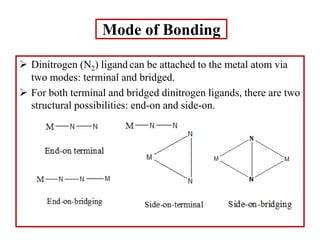
 Dinitrogen (N2) ligand can be attached to the metal atom via
two modes: terminal and bridged.
 For both terminal and bridged dinitrogen ligands, there are two
structural possibilities: end-on and side-on.
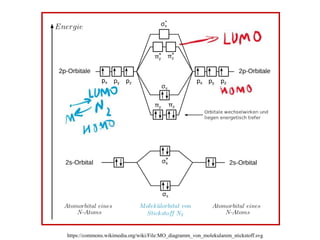
https://commons.wikimedia.org/wiki/File:MO_diagramm_von_molekularem_stickstoff.svg
HOMO and LUMO in N2
 In nitrogen, the highest filled HOMO is of a very low
energy (-156 eV)
 The vacant LUMO is relatively of high energy (-7
eV)
 Reduction and oxidation of dinitrogen is not easy,
because removal of electrons from HOMO is difficult
and addition of electrons in LUMO is also very
difficult
N2 Vs CO ligand
 N2 is isoelectronic with CO.
 CO has a lone pair electron on carbon atom which
can form a σ bond with the metal center (L→M).
 The empty π antibonding MO for back bonding is
also present on carbon (M →L).
 N2 also has a lone pair of electron in sigma BMO, but
the energy of this BMO is lower energy than the
corresponding orbital in CO (may be due to more
electronegativity of N than C).
 Therefore, N2 is weaker σ donor as compared to CO.
• Like CO, N2 also has empty π∗ orbitals. These orbitals
are of lower energy as compared to the empty π∗
orbitals of CO. So, the empty π∗ orbitals of N2 are
more approachable than the CO π∗ orbitals.
• In case of N2, the empty π∗ orbitals are equally
distributed over N1 and N2 and therefore, the
overlapping M→N π∗ is smaller than for M→CO π∗
(In CO, the π∗ orbitals are predominantly located on
carbon.
• As a result, the binding of N2 with the metal center is
less efficient than CO.
N2 Vs CO ligand
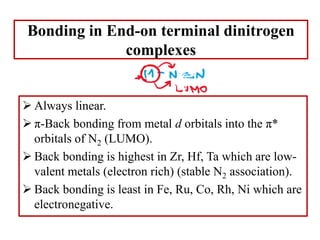
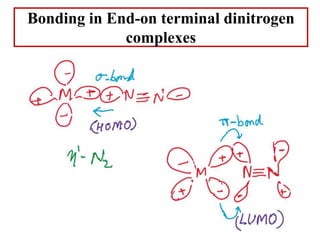
 Always linear.
 π-Back bonding from metal d orbitals into the π*
orbitals of N2 (LUMO).
 Back bonding is highest in Zr, Hf, Ta which are low-
valent metals (electron rich) (stable N2 association).
 Back bonding is least in Fe, Ru, Co, Rh, Ni which are
electronegative.
Bonding in End-on terminal dinitrogen
complexes
Bonding in End-on terminal dinitrogen
complexes
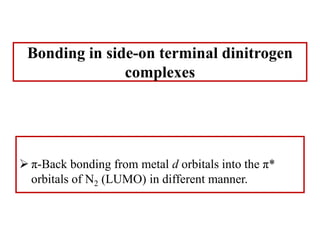
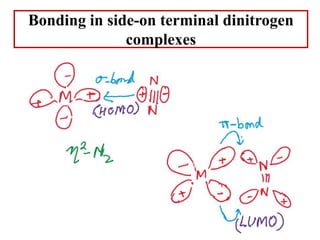
 π-Back bonding from metal d orbitals into the π*
orbitals of N2 (LUMO) in different manner.
Bonding in side-on terminal dinitrogen
complexes
Bonding in side-on terminal dinitrogen
complexes
Terminal end-on
 Terminal end-on (one end-on N2 ligand)
 N2 is sigma-donor and pi-accepter.
[Ru(NH3)5N2]2+
[IrCl(N2)(PPh3)2]
 Terminal end-on (more than one end-on N2 ligand)
mer-[Mo(N2)3(PPrn
2Ph)3]
[Mo(N2)2(Ph2PCH2CH2PPh2)2]
Terminal side-on
 one side N2 ligand
 High energy compounds
 Less stable
 N2 is pi donor
[Os(NH3)5(η2-N2)]2+ (metastable)
Bridging end-on
 Multinuclear dinitrogen complexes
{[Ru(NH3)5]2(μ-N2)}4+
 Iron dinitrogen complexes
Fe-N-N-Fe
Both terminal and bridging nitrogen
 [(η1-N2)(η5-C5Me5)2Zr]2(μ2, η2-N2)
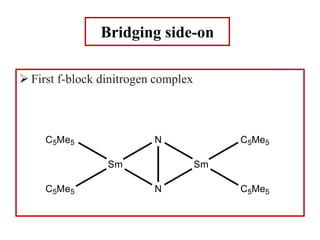
Bridging side-on
 First f-block dinitrogen complex
Sm
N
N
Sm
C5Me5
C5Me5
C5Me5
C5Me5
Bonding and vibrational spectra of
dinitrogen complexes
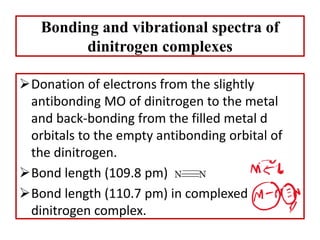
Donation of electrons from the slightly
antibonding MO of dinitrogen to the metal
and back-bonding from the filled metal d
orbitals to the empty antibonding orbital of
the dinitrogen.
Bond length (109.8 pm)
Bond length (110.7 pm) in complexed
dinitrogen complex.
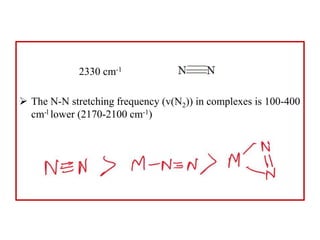
2330 cm-1
 The N-N stretching frequency (v(N2)) in complexes is 100-400
cm-l lower (2170-2100 cm-1)
Uses of dinitrogen complexes
 Dinitrogen complexes may be used in agriculture and
industries and are of great interest, especially as possible
intermediates to study the reactions that may simulate natural
processes of nitrogen fixation.
 The discovery of dinitrogen complexes is helpful in
investigating the possibility of nitrogen fixation via such
complexes.
Mo(N2)2(dpe)2 + 6H+ → 2NH3 + N2 + Mo (VI) products
where dpe = Ph2PCH2CH2PPh2[1,2- bis(diphenyl phosphine
ethane]
Thank You

Dinitrogen complexes

  • 1.
    Dr. Geeta Tewari Departmentof Chemistry D. S. B. Campus Kumaun University, Nainital Email: geeta_k@rediffmail.com Metal π Complexes, Part 8, Metal Dinitrogen Complexes
  • 2.
    Introduction  N2 isisoelectronic with NO+ ion and CO ligands.  Dinitrogen metal complexes are not very stable.  Lack of polarity of N2 and less tendency to behave as a π -acceptor.  [Ru(NH3)5N2]2+ first dinitrogen complex of transition metal  [Co(PPh3)3H(N2)] first dinitrogen complex of transition metal prepared from N2.  [Mo(PPh2CH2CH2PPh2)2(N2)2] first dinitrogen complex of molybdenum
  • 3.
    Preparation  The firstdinitrogen complex (Pentaamine dinitogen ruthenium (II) cation) [Ru(NH3)5(N2)]2+ was prepared by the reduction of commercial ruthenium trichloride by hydrazine in aqueous solution (1965). RuCl3 + 4N2H4 → [Ru(NH3)5N2]2+ + ...  Direct reaction of N2 [Co(N2)H(PPh3)3], [RuH2(N2) (PPh3)3] and [FeH2(N2)(PR3)3] (R3 = EtPh2, n-Bu) react direct with nitrogen to form dinitrogen complex. [MH2(PR3)3] + N2 → [MHn-2(N2)(PR3)3 + H2
  • 4.
     N2 ligandcan be easily displaced by water and formation of dinuclear dinitrogen complex can be formed. [Ru(NH3)5N2]2+ + [Ru(NH3)5H2O]2+  [Ru(NH3)5N2(NH3)5Ru]4+ + H2O  From nitrous oxide [Ru(NH3)5Cl]Cl2 + Zn/Hg  [Ru(NH3)5H2O]2+ [Ru(NH3)5H2O]2+ + N2O  [Ru(NH3)5NNO]2+ [Ru(NH3)5NNO]2+ + Zn/Hg  [Ru(NH3)5N2]2+ Preparation
  • 5.
    Mode of Bonding Dinitrogen (N2) ligand can be attached to the metal atom via two modes: terminal and bridged.  For both terminal and bridged dinitrogen ligands, there are two structural possibilities: end-on and side-on.
  • 6.
  • 7.
    HOMO and LUMOin N2  In nitrogen, the highest filled HOMO is of a very low energy (-156 eV)  The vacant LUMO is relatively of high energy (-7 eV)  Reduction and oxidation of dinitrogen is not easy, because removal of electrons from HOMO is difficult and addition of electrons in LUMO is also very difficult
  • 8.
    N2 Vs COligand  N2 is isoelectronic with CO.  CO has a lone pair electron on carbon atom which can form a σ bond with the metal center (L→M).  The empty π antibonding MO for back bonding is also present on carbon (M →L).  N2 also has a lone pair of electron in sigma BMO, but the energy of this BMO is lower energy than the corresponding orbital in CO (may be due to more electronegativity of N than C).  Therefore, N2 is weaker σ donor as compared to CO.
  • 9.
    • Like CO,N2 also has empty π∗ orbitals. These orbitals are of lower energy as compared to the empty π∗ orbitals of CO. So, the empty π∗ orbitals of N2 are more approachable than the CO π∗ orbitals. • In case of N2, the empty π∗ orbitals are equally distributed over N1 and N2 and therefore, the overlapping M→N π∗ is smaller than for M→CO π∗ (In CO, the π∗ orbitals are predominantly located on carbon. • As a result, the binding of N2 with the metal center is less efficient than CO. N2 Vs CO ligand
  • 10.
     Always linear. π-Back bonding from metal d orbitals into the π* orbitals of N2 (LUMO).  Back bonding is highest in Zr, Hf, Ta which are low- valent metals (electron rich) (stable N2 association).  Back bonding is least in Fe, Ru, Co, Rh, Ni which are electronegative. Bonding in End-on terminal dinitrogen complexes
  • 11.
    Bonding in End-onterminal dinitrogen complexes
  • 12.
     π-Back bondingfrom metal d orbitals into the π* orbitals of N2 (LUMO) in different manner. Bonding in side-on terminal dinitrogen complexes
  • 13.
    Bonding in side-onterminal dinitrogen complexes
  • 14.
    Terminal end-on  Terminalend-on (one end-on N2 ligand)  N2 is sigma-donor and pi-accepter. [Ru(NH3)5N2]2+ [IrCl(N2)(PPh3)2]  Terminal end-on (more than one end-on N2 ligand) mer-[Mo(N2)3(PPrn 2Ph)3] [Mo(N2)2(Ph2PCH2CH2PPh2)2]
  • 15.
    Terminal side-on  oneside N2 ligand  High energy compounds  Less stable  N2 is pi donor [Os(NH3)5(η2-N2)]2+ (metastable)
  • 16.
    Bridging end-on  Multinucleardinitrogen complexes {[Ru(NH3)5]2(μ-N2)}4+  Iron dinitrogen complexes Fe-N-N-Fe
  • 17.
    Both terminal andbridging nitrogen  [(η1-N2)(η5-C5Me5)2Zr]2(μ2, η2-N2)
  • 18.
    Bridging side-on  Firstf-block dinitrogen complex Sm N N Sm C5Me5 C5Me5 C5Me5 C5Me5
  • 19.
    Bonding and vibrationalspectra of dinitrogen complexes Donation of electrons from the slightly antibonding MO of dinitrogen to the metal and back-bonding from the filled metal d orbitals to the empty antibonding orbital of the dinitrogen. Bond length (109.8 pm) Bond length (110.7 pm) in complexed dinitrogen complex.
  • 20.
    2330 cm-1  TheN-N stretching frequency (v(N2)) in complexes is 100-400 cm-l lower (2170-2100 cm-1)
  • 21.
    Uses of dinitrogencomplexes  Dinitrogen complexes may be used in agriculture and industries and are of great interest, especially as possible intermediates to study the reactions that may simulate natural processes of nitrogen fixation.  The discovery of dinitrogen complexes is helpful in investigating the possibility of nitrogen fixation via such complexes. Mo(N2)2(dpe)2 + 6H+ → 2NH3 + N2 + Mo (VI) products where dpe = Ph2PCH2CH2PPh2[1,2- bis(diphenyl phosphine ethane]
  • 22.