Contents…..(6 hours)
Inorganic complexes- structure, bonding and applications
Organometallics – introduction, stability, structure and
applications of metal carbonyls and ferrocene
Metals in biology: haemoglobin and chlorophyll- structure and
property
2
3.
Inorganic Complexes
• Inorganic/coordinationcomplex is a molecule containing one or multiple metal
centers that is bound to ligands (atoms, ions, or molecules that donate electrons to
the metal).
• These complexes can be neutral or charged. The examples are:
3
Neutral Complexes: [CoCl3(NH3)3], K4[Fe(CN)6], etc.
Cationic Complex : [CO(NH3)6]3+
and Anionic Complex : [CoCl4(NH3)2]−
[Co(NH3)5Cl]Cl2 --- Chloropentaamminecobalt(III) chloride
[Cr(H2O)4Cl2]Cl --- Dichlorotetraaquochromium(III) chloride
K[PtCl3(NH3)] --- Potassiumtrichloroammineplatinate(II)
[PtCl2(NH3)2] --- Dichlorodiammineplatinum(II)
[Co(en)3Cl3] --- tris(ethylenediamine)cobalt(III)chloride
[Ni(PF3)4] --- tetrakis(phosphorus(III)fluoride)nickel(0)
Selected examples of metal complexes with names:
4.
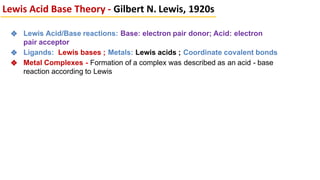
❖ Lewis Acid/Basereactions: Base: electron pair donor; Acid: electron
pair acceptor
❖ Ligands: Lewis bases ; Metals: Lewis acids ; Coordinate covalent bonds
❖ Metal Complexes - Formation of a complex was described as an acid - base
reaction according to Lewis
Lewis Acid Base Theory - Gilbert N. Lewis, 1920s
5.
Double Salts VsCoordination Compounds
❖ Double Salt:
Ferric alum
(NH4)2SO4.Fe2(SO4)3.24H2O
In water: NH4
+
, SO4
2-
, Fe3+
Potash alum
K2SO4.Al2(SO4)3.24H2O
3Cl–
(counter ion)
(coordination
sphere)
ligan
d
❖ Co-ordination Compounds
Fe(CN)2 + 4KCN Fe(CN)2.4KCN
4K+
+ [Fe(CN)6]4-
M
N forms a coordinate covalent
bond to the metal
Structure and Bonding
6.
Limitations:
1. Bonding withincoordination sphere.
2. Square planar (or) Tetrahedral
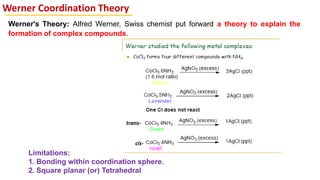
Werner's Theory: Alfred Werner, Swiss chemist put forward a theory to explain the
formation of complex compounds.
Werner Coordination Theory
trans-
cis-
7.
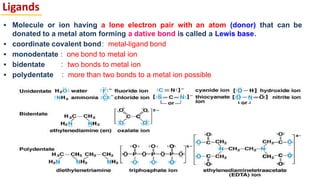
Ligands
▪ Molecule orion having a lone electron pair with an atom (donor) that can be
donated to a metal atom forming a dative bond is called a Lewis base.
▪ coordinate covalent bond: metal-ligand bond
▪ monodentate : one bond to metal ion
▪ bidentate : two bonds to metal ion
▪ polydentate : more than two bonds to a metal ion possible
7
8.
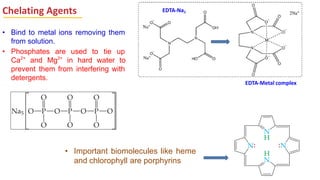
Chelating Agents
• Bindto metal ions removing them
from solution.
• Phosphates are used to tie up
Ca2+
and Mg2+
in hard water to
prevent them from interfering with
detergents.
• Important biomolecules like heme
and chlorophyll are porphyrins
EDTA-Na2
EDTA-Metal complex
9.
9
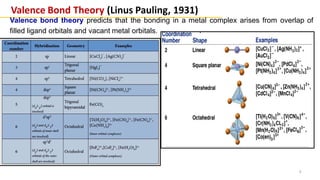
Valence Bond Theory(Linus Pauling, 1931)
Valence bond theory predicts that the bonding in a metal complex arises from overlap of
filled ligand orbitals and vacant metal orbitals.
10.
Tetrahedral Geometry
Cu ground
state3d9
4s2
• Tetrahedral copper complex
3
d
4
p
4s
Cu2+
4 e–
pairs by Cl–
ions
• One unpaired electron - paramagnetic and attracted by
magnets—High spin complexes
[CuCl4]2-
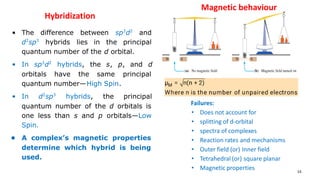
• The differencebetween sp3
d2
and
d2
sp3
hybrids lies in the principal
quantum number of the d orbital.
• In sp3
d2
hybrids, the s, p, and d
orbitals have the same principal
quantum number—High Spin.
• In d2
sp3
hybrids, the principal
quantum number of the d orbitals is
one less than s and p orbitals—Low
Spin.
• A complex’s magnetic properties
determine which hybrid is being
used.
14
Hybridization
Magnetic behaviour
Failures:
• Does not account for
• splitting of d-orbital
• spectra of complexes
• Reaction rates and mechanisms
• Outer field (or) Inner field
• Tetrahedral (or) square planar
• Magnetic properties
15.
15
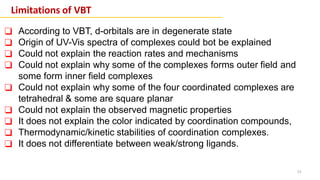
Limitations of VBT
❑According to VBT, d-orbitals are in degenerate state
❑ Origin of UV-Vis spectra of complexes could bot be explained
❑ Could not explain the reaction rates and mechanisms
❑ Could not explain why some of the complexes forms outer field and
some form inner field complexes
❑ Could not explain why some of the four coordinated complexes are
tetrahedral & some are square planar
❑ Could not explain the observed magnetic properties
❑ It does not explain the color indicated by coordination compounds,
❑ Thermodynamic/kinetic stabilities of coordination complexes.
❑ It does not differentiate between weak/strong ligands.
16.
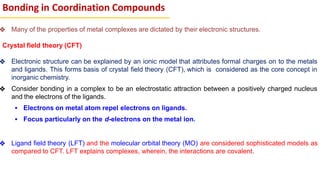
❖ Many ofthe properties of metal complexes are dictated by their electronic structures.
Crystal field theory (CFT)
❖ Electronic structure can be explained by an ionic model that attributes formal charges on to the metals
and ligands. This forms basis of crystal field theory (CFT), which is considered as the core concept in
inorganic chemistry.
❖ Consider bonding in a complex to be an electrostatic attraction between a positively charged nucleus
and the electrons of the ligands.
▪ Electrons on metal atom repel electrons on ligands.
▪ Focus particularly on the d-electrons on the metal ion.
❖ Ligand field theory (LFT) and the molecular orbital theory (MO) are considered sophisticated models as
compared to CFT. LFT explains complexes, wherein, the interactions are covalent.
Bonding in Coordination Compounds
17.
17
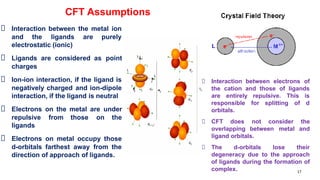
Interaction between electronsof
the cation and those of ligands
are entirely repulsive. This is
responsible for splitting of d
orbitals.
CFT does not consider the
overlapping between metal and
ligand orbitals.
The d-orbitals lose their
degeneracy due to the approach
of ligands during the formation of
complex.
CFT Assumptions
Interaction between the metal ion
and the ligands are purely
electrostatic (ionic)
Ligands are considered as point
charges
Ion-ion interaction, if the ligand is
negatively charged and ion-dipole
interaction, if the ligand is neutral
Electrons on the metal are under
repulsive from those on the
ligands
Electrons on metal occupy those
d-orbitals farthest away from the
direction of approach of ligands.
18.
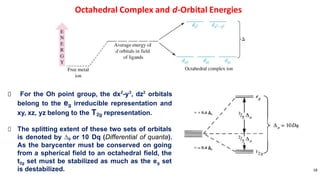
Octahedral Complex andd-Orbital Energies
18
For the Oh point group, the dx2
-y2
, dz2
orbitals
belong to the eg irreducible representation and
xy, xz, yz belong to the T2g representation.
The splitting extent of these two sets of orbitals
is denoted by ∆0 or 10 Dq (Differential of quanta).
As the barycenter must be conserved on going
from a spherical field to an octahedral field, the
t2g set must be stabilized as much as the eg set
is destabilized.
19.
19
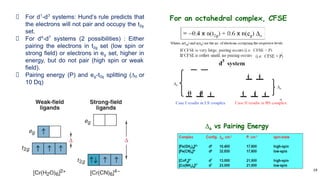
For d1
-d3
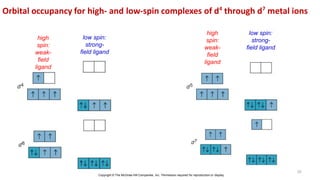
systems: Hund’srule predicts that
the electrons will not pair and occupy the t2g
set.
For d4
-d7
systems (2 possibilities) : Either
pairing the electrons in t2g set (low spin or
strong field) or electrons in eg set, higher in
energy, but do not pair (high spin or weak
field).
Pairing energy (P) and eg-t2g splitting (∆0 or
10 Dq)
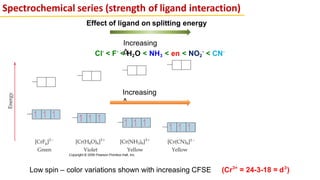
Thus, the LigandField Strength is related to the Color of the Complexes
[Cu(H2O)4]2+
: light blue ; [Cu(NH3)4]2+
: deep blue ; [CuCl4]2-
: yellow ; [Cu(en)2]2+
:
violetcolorless
In all the above complexes, Cu is in +2 oxidation state, but the ligand field strength
differ. Hence they have different colors.
d-d transitions take place by the absorption of visible radiation by transition metal
ions and transmitted light is colored with the complementary color of the color of
the light absorbed. e.g., when red-light is removed from the white light, the eye
sees its complementary color – blue-green.
Color of various Ni(II) complexes in aqueous solutions
From left to right, hexaamminenickel(II) -
[Ni(NH3)6]2+
; tris(ethylenediamine)nickel(II) -
[Ni(en)3]2+
; tetrachloronickelate(II) - [NiCl4]2-
; hexaaquanickel(II) - [Ni(H2O)6]2+
.
Reactions starting from NiCl2·6H2O can be
used to form a variety of nickel
coordination complexes because the H2O
ligands are rapidly displaced.
Chemistry of Colors
24
25.
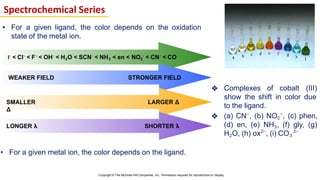
[Co(NH3)6]3+
[Co(en)3]3+
[Co(NO2)6]3-
are orange yellowwhile [CoF6]3-
[Co(H2O)6]3+
are blue
• Co3+
= 27-3-18 = d6
• NH3, en and NO2 are strong field ligands (more splitting – (t2g)6
(eg)0
- Large Δo)
• To favour d-d transition, the energy required is high. Hence absorbs violet color or blue color
and will appear yellow or orange.
• F-
and H2O are weak field ligands (less splitting - (t2g)4
(eg)2
- small Δo)
• Because of small Δo, lower energy radiations are required for d-d transition. The complex
absorbs yellow or orange (lower energy) and appear as blue.
25
26.
26
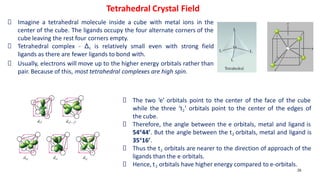
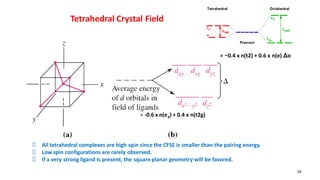
Imagine a tetrahedralmolecule inside a cube with metal ions in the
center of the cube. The ligands occupy the four alternate corners of the
cube leaving the rest four corners empty.
Tetrahedral complex - Δt is relatively small even with strong field
ligands as there are fewer ligands to bond with.
Usually, electrons will move up to the higher energy orbitals rather than
pair. Because of this, most tetrahedral complexes are high spin.
Tetrahedral Crystal Field
The two ‘e’ orbitals point to the center of the face of the cube
while the three ‘t2’ orbitals point to the center of the edges of
the cube.
Therefore, the angle between the e orbitals, metal and ligand is
54o
44’. But the angle between the t2 orbitals, metal and ligand is
35o
16’.
Thus the t2 orbitals are nearer to the direction of approach of the
ligands than the e orbitals.
Hence, t2 orbitals have higher energy compared to e-orbitals.
27.
27
Position of fourligands with respect to the d orbitals of the central metal ion.
• The d orbitals having their lobes oriented in between the axes (t2 orbitals) are nearer
to four ligands. Hence interact with the ligand orbitals to a greater extent and hence
higher energy.
• whereas the two d orbitals having their lobes oriented along the axes (e) are away
from the ligands. Interact only to a lesser extent with the ligand orbitals.
Splitting of d orbitals just the reverse of splitting observed in oh complexes.
Difference in energy -tetrahedral crystal field splitting energy [Δt = (4/9) Δ0]
Reason:
Only 4 ligands. Hence 1/3rd
decrease in the number of ligands decreases the Δt
High energy t2 orbitals although nearer to the ligands, do not point directly to the
ligands. Hence the extent of interaction is less. But in oh complex, the eg orbitals point
directly at the ligands.
Tetrahedral Crystal Field
28.
28
Tetrahedral Crystal Field
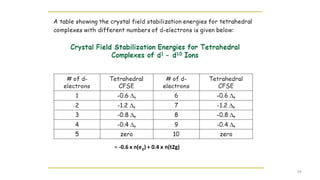
=−0.4 x n(t2) + 0.6 x n(e) Δo
= -0.6 x n(eg) + 0.4 x n(t2g)
All tetrahedral complexes are high spin since the CFSE is smaller than the pairing energy.
Low spin configurations are rarely observed.
If a very strong ligand is present, the square planar geometry will be favored.
30
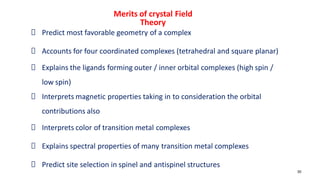
Predict most favorablegeometry of a complex
Accounts for four coordinated complexes (tetrahedral and square planar)
Explains the ligands forming outer / inner orbital complexes (high spin /
low spin)
Interprets magnetic properties taking in to consideration the orbital
contributions also
Interprets color of transition metal complexes
Explains spectral properties of many transition metal complexes
Predict site selection in spinel and antispinel structures
Merits of crystal Field
Theory
31.
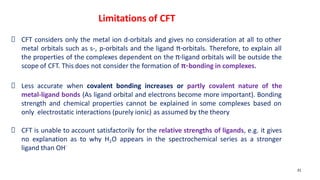
CFT considers onlythe metal ion d-orbitals and gives no consideration at all to other
metal orbitals such as s-, p-orbitals and the ligand π-orbitals. Therefore, to explain all
the properties of the complexes dependent on the π-ligand orbitals will be outside the
scope of CFT. This does not consider the formation of π-bonding in complexes.
Less accurate when covalent bonding increases or partly covalent nature of the
metal-ligand bonds (As ligand orbital and electrons become more important). Bonding
strength and chemical properties cannot be explained in some complexes based on
only electrostatic interactions (purely ionic) as assumed by the theory
CFT is unable to account satisfactorily for the relative strengths of ligands, e.g. it gives
no explanation as to why H2O appears in the spectrochemical series as a stronger
ligand than OH-
31
Limitations of CFT
32.
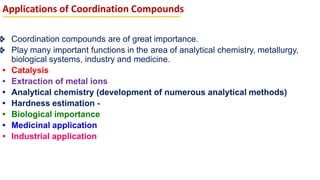
Applications of CoordinationCompounds
❖ Coordination compounds are of great importance.
❖ Play many important functions in the area of analytical chemistry, metallurgy,
biological systems, industry and medicine.
• Catalysis
• Extraction of metal ions
• Analytical chemistry (development of numerous analytical methods)
• Hardness estimation -
• Biological importance
• Medicinal application
• Industrial application
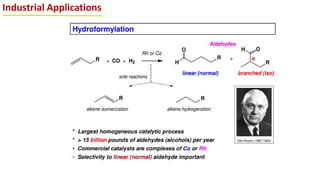
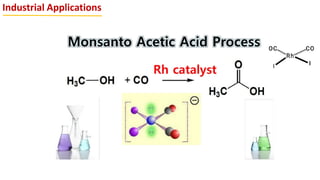
Industrial Applications
• Coordinationcompounds are used as catalysts for many
industrial processes. Examples rhodium complex,
[(Ph3P)3RhCl], a Wilkinson catalyst – Catalytic hydrogenation of
alkenes.
• Articles can be electroplated with silver and gold much more
smoothly and evenly from solutions of the complexes, [Ag(CN)2]–
and [Au(CN)2]–
than from a solution of simple metal ions.
• In black and white photography, the developed film is fixed by
washing with hypo solution which dissolves the non decomposed
AgBr to form a complex ion, [Ag(S2O3)2]3–
.
• Prussian blue – Mixture of hexacyanoFe(II) and Fe(III) -
Fe4[Fe(CN)6]3 inks, blueprinting, cosmetics, paints (commercial
coloring agents)
Alken
e
Alkane
Wilkinson catalyst
36.
Extraction
❖ processes ofmetals, like those of silver and gold, make use of complex formation.
❖ These noble metals are extracted from their ore by the formation of cyanide complexes -
dicyanoargentite(I) - [Ag(CN)2]–
and dicyanoaurate (I) - [Au(CN)2]–
in the presence of oxygen
and water, from which the metallic forms can be separated by the addition of zinc.
▪ Ag2S + 4NaCN 2 Na[Ag(CN)2] + Na2S
▪ 2 Na[Ag(CN)2] + Zn Na2[Zn(CN)4] + 2Ag↓
❖ Purification of metals can be achieved through formation and subsequent decomposition of
their coordination compounds. For example, impure nickel is converted to [Ni(CO)4], which is
decomposed to yield pure nickel (the Mond process).
Extraction / Purification of Metals
37.
Detection of ComplexFormation
❖ Formation of Precipitate
Ni2+
+ 2 HDMG [Ni(DMG)2] + 2H+
❖ Ni2+
and Pd2+
form insoluble colored precipitates with dimethyglyoxime
❖ In the qualitative methods of analysis, complex formation is
of immense importance in the identification by color
change and separation of most inorganic ions.
38.
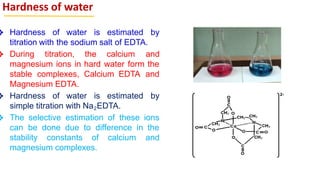
Hardness of water
❖Hardness of water is estimated by
titration with the sodium salt of EDTA.
❖ During titration, the calcium and
magnesium ions in hard water form the
stable complexes, Calcium EDTA and
Magnesium EDTA.
❖ Hardness of water is estimated by
simple titration with Na2EDTA.
❖ The selective estimation of these ions
can be done due to difference in the
stability constants of calcium and
magnesium complexes.
39.
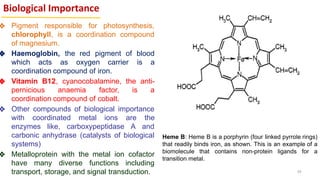
Biological Importance
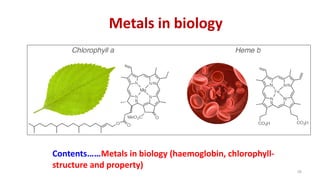
❖ Pigmentresponsible for photosynthesis,
chlorophyll, is a coordination compound
of magnesium.
❖ Haemoglobin, the red pigment of blood
which acts as oxygen carrier is a
coordination compound of iron.
❖ Vitamin B12, cyanocobalamine, the anti-
pernicious anaemia factor, is a
coordination compound of cobalt.
❖ Other compounds of biological importance
with coordinated metal ions are the
enzymes like, carboxypeptidase A and
carbonic anhydrase (catalysts of biological
systems)
❖ Metalloprotein with the metal ion cofactor
have many diverse functions including
transport, storage, and signal transduction.
Heme B: Heme B is a porphyrin (four linked pyrrole rings)
that readily binds iron, as shown. This is an example of a
biomolecule that contains non-protein ligands for a
transition metal.
39
40.
Medicinal Application
❖ Totreat problems caused by the presence of
metals in toxic proportions in plant/animal systems,
chelate therapy is used.
• Excess of copper and iron are removed by the
chelating ligands D–penicillamine and
desferrioxime B via the formation of coordination
compounds.
❖ EDTA is used in the treatment of lead poisoning.
❖ Coordination compound of platinum effectively
inhibit the growth of tumours. cisplatin - cis
[PtCl2(NH3)2], and related compounds.
40
41.
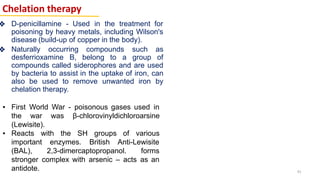
Chelation therapy
❖ D-penicillamine- Used in the treatment for
poisoning by heavy metals, including Wilson's
disease (build-up of copper in the body).
❖ Naturally occurring compounds such as
desferrioxamine B, belong to a group of
compounds called siderophores and are used
by bacteria to assist in the uptake of iron, can
also be used to remove unwanted iron by
chelation therapy.
▪ First World War - poisonous gases used in
the war was β-chlorovinyldichloroarsine
(Lewisite).
▪ Reacts with the SH groups of various
important enzymes. British Anti-Lewisite
(BAL), 2,3-dimercaptopropanol. forms
stronger complex with arsenic – acts as an
antidote. 41
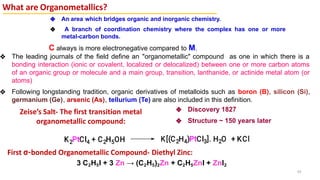
What are Organometallics?
Calways is more electronegative compared to M.
❖ The leading journals of the field define an "organometallic" compound as one in which there is a
bonding interaction (ionic or covalent, localized or delocalized) between one or more carbon atoms
of an organic group or molecule and a main group, transition, lanthanide, or actinide metal atom (or
atoms)
❖ Following longstanding tradition, organic derivatives of metalloids such as boron (B), silicon (Si),
germanium (Ge), arsenic (As), tellurium (Te) are also included in this definition.
43
❖ An area which bridges organic and inorganic chemistry.
❖ A branch of coordination chemistry where the complex has one or more
metal-carbon bonds.
Zeise’s Salt- The first transition metal
organometallic compound:
❖ Discovery 1827
❖ Structure ~ 150 years later
First σ-bonded Organometallic Compound- Diethyl Zinc:
3 C2H5I + 3 Zn → (C2H5)2Zn + C2H5ZnI + ZnI2
44.
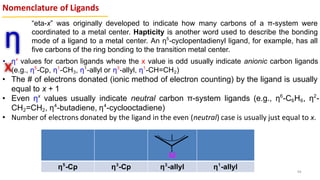
Nomenclature of Ligands
η
x
“eta-x”was originally developed to indicate how many carbons of a π-system were
coordinated to a metal center. Hapticity is another word used to describe the bonding
mode of a ligand to a metal center. An η5
-cyclopentadienyl ligand, for example, has all
five carbons of the ring bonding to the transition metal center.
• ηx
values for carbon ligands where the x value is odd usually indicate anionic carbon ligands
(e.g., η5
-Cp, η1
-CH3, η1
-allyl or η3
-allyl, η1
-CH=CH2)
• The # of electrons donated (ionic method of electron counting) by the ligand is usually
equal to x + 1
• Even ηx
values usually indicate neutral carbon π-system ligands (e.g., η6
-C6H6, η2
-
CH2=CH2, η4
-butadiene, η4
-cyclooctadiene)
• Number of electrons donated by the ligand in the even (neutral) case is usually just equal to x.
η5
-Cp η3
-Cp η3
-allyl η1
-allyl 44
45.
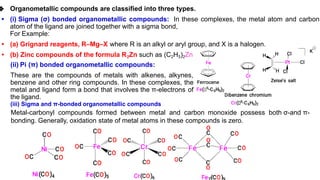
❖ Organometallic compoundsare classified into three types.
• (i) Sigma (σ) bonded organometallic compounds: In these complexes, the metal atom and carbon
atom of the ligand are joined together with a sigma bond,
For Example:
• (a) Grignard reagents, R–Mg–X where R is an alkyl or aryl group, and X is a halogen.
• (b) Zinc compounds of the formula R2Zn such as (C2H5)2Zn
(ii) Pi (π) bonded organometallic compounds:
These are the compounds of metals with alkenes, alkynes,
benzene and other ring compounds. In these complexes, the
metal and ligand form a bond that involves the π-electrons of
the ligand.
(iii) Sigma and π-bonded organometallic compounds
Metal-carbonyl compounds formed between metal and carbon monoxide possess both σ-and π-
bonding. Generally, oxidation state of metal atoms in these compounds is zero.
46.
Stability of OrganometallicCompounds
❖ In general terms, the stability of an organometallic compound may refer to either its
thermal stability, or resistance to chemical attack (by air and moisture). Obviously,
these different types of stabilities would depend both on thermodynamic as well as
kinetic factors.
46
The organometallic compounds are generally hydrolysed via nucleophilic
attack by water, which is facilitated by:
(1) the presence of empty low-lying orbitals on the metal
(2) the polarity of metal-carbon bonds. Rate of hydrolysis is dependent on M-
C bond polarity – greater the polarity, faster will be the rate
47.
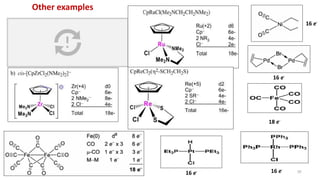
The 18-electron Ruleor Effective atomic number (EAN)
❖ The 18e rule is a way to help us decide whether a given d-block transition metal organometallic
complex is likely to be stable. Not all the organic formulas we can write down correspond to stable
species. Recall: Second row elements (B, C, N, O, F) have 4 valence orbitals (2s + 3p) so they can
accommodate up to 8 valence electrons--the octet rule.
▪ For example, CH5 requires a 5-valent carbon and is therefore not stable. Stable compounds, such as
CH4, have the noble gas octet, and so carbon can be thought of as following an 8e rule.
▪ The 18e rule, which applies to many low-valent transition metal complexes, follows a similar line of
reasoning. The metal now has one s, and three p orbitals, as before, but now also five d orbitals. We
need 18e to fill all nine orbitals; some come from the metal, the rest from the ligands. Therefore, we
can expect that the low-lying MOs can accommodate up to 18 valence electrons--The 18-Electron
Rule.
❖ The rule states that “thermodynamically stable transition metal organometallic
compounds are formed when the sum of the metal d electrons and the
electrons conventionally considered as being supplied by the surrounding
ligands equals 18”
47
48.
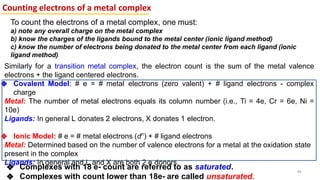
Similarly for atransition metal complex, the electron count is the sum of the metal valence
electrons + the ligand centered electrons.
❖ Covalent Model: # e = # metal electrons (zero valent) + # ligand electrons - complex
charge
Metal: The number of metal electrons equals its column number (i.e., Ti = 4e, Cr = 6e, Ni =
10e)
Ligands: In general L donates 2 electrons, X donates 1 electron.
❖ Ionic Model: # e = # metal electrons (dn
) + # ligand electrons
Metal: Determined based on the number of valence electrons for a metal at the oxidation state
present in the complex
Ligands: In general and L and X are both 2 e donors.
Counting electrons of a metal complex
48
To count the electrons of a metal complex, one must:
a) note any overall charge on the metal complex
b) know the charges of the ligands bound to the metal center (ionic ligand method)
c) know the number of electrons being donated to the metal center from each ligand (ionic
ligand method)
❖ Complexes with 18 e- count are referred to as saturated.
❖ Complexes with count lower than 18e- are called unsaturated.
49.
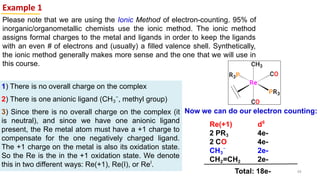
Please note thatwe are using the Ionic Method of electron-counting. 95% of
inorganic/organometallic chemists use the ionic method. The ionic method
assigns formal charges to the metal and ligands in order to keep the ligands
with an even # of electrons and (usually) a filled valence shell. Synthetically,
the ionic method generally makes more sense and the one that we will use in
this course.
Example 1
1) There is no overall charge on the complex
2) There is one anionic ligand (CH3
−
, methyl group)
3) Since there is no overall charge on the complex (it
is neutral), and since we have one anionic ligand
present, the Re metal atom must have a +1 charge to
compensate for the one negatively charged ligand.
The +1 charge on the metal is also its oxidation state.
So the Re is the in the +1 oxidation state. We denote
this in two different ways: Re(+1), Re(I), or ReI
.
Now we can do our electron counting:
Re(+1) d6
2 PR3 4e-
2 CO 4e-
CH3
−
2e-
CH2=CH2 2e-
Total: 18e- 49
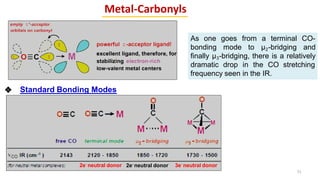
Metal-Carbonyls
❖ Standard BondingModes
As one goes from a terminal CO-
bonding mode to μ2-bridging and
finally μ3-bridging, there is a relatively
dramatic drop in the CO stretching
frequency seen in the IR.
2e-
neutral donor 3e-
neutral donor
2e-
neutral donor
51
52.
Types of CO-Metalbonding interactions
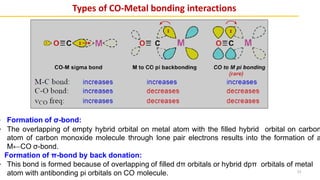
❖ Formation of σ-bond:
▪ The overlapping of empty hybrid orbital on metal atom with the filled hybrid orbital on carbon
atom of carbon monoxide molecule through lone pair electrons results into the formation of a
M←CO σ-bond.
Formation of π-bond by back donation:
▪ This bond is formed because of overlapping of filled dπ orbitals or hybrid dpπ orbitals of metal
atom with antibonding pi orbitals on CO molecule. 52
Applications
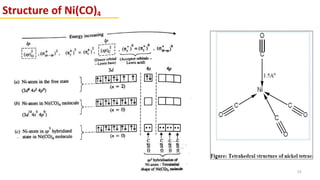
1. Metal carbonylsare used in several industrial processes. Perhaps the earliest
application was the extraction and purification of nickel via nickel tetracarbonyl by the
Mond process.
2. Fe(CO)5 is used for the preparation of inductors, pigments, as dietary supplements in
the production of radar-absorbing materials in the stealth technology, and in thermal
spraying.
3. Metal carbonyls are used in a number of industrially important carbonylation reactions.
In the oxo process, an alkene, hydrogen gas, and carbon monoxide react together with a
catalyst (such as HCo(CO)4) to give aldehydes (hydroformylation).
H2 + CO + CH3CH=CH2 → CH3CH2CH2CHO
4. Several other Metal-Carbonyl complexes have been employed in the hydrocarboxylation
and hydrogenation reactions. Dicobalt octacarbonyl [Co2(CO)8] can be used for
hydrosilylation of olefins also.
5. Many organometallic complexes are the sources for the pure metal particles/ metal
coatings using Chemical Vapour Deposition (CVD) process. 54
55.
Structure and Bondingin Ferrocene
• Mössbauer spectroscopy indicates that the iron center
in ferrocene should be assigned the +2 oxidation state.
Each cyclopentadienyl (Cp) ring should then be
allocated a single negative charge. Thus ferrocene
could be described as iron(II) bis(cyclopentadienide)
Fe2+
[C5H5
-
]2.
• The number of π-electrons on each ring is then six,
which makes it aromatic according to Hückel's rule.
These twelve π-electrons are then shared with the
metal via covalent bonding. Since Fe2+
has six d-
electrons, the complex attains an 18-electron
configuration, which accounts for its stability. In modern
notation, this sandwich structural model of the
ferrocene molecule is denoted as Fe(η5
-C5H5)2.
• Crystallography reveals that the cyclopentadienide
rings are in staggered conformation.
• Hybridization: d2
sp3
• Magnetic Nature: Diamagnetic
55
56.
Applications of Ferrocene
1.Fuel additives: Ferrocene and its derivatives could be used as antiknock agents in the fuel
for petrol engines. They are safer than previously TEL.
2. Pharmaceutical: Ferrocene derivatives have been investigated as drugs e.g. one drug has
entered clinic trials, Ferroquine (7-chloro-N-(2-((dimethylamino)methyl)ferrocenyl)quinolin-4-
amine), an antimalarial. Ferrocene-containing polymer-based drug delivery systems have
been investigated.
3. Solid rocket propellant: Ferrocene and related derivatives are used as powerful burn rate
catalysts in ammonium perchlorate composite propellant.
4. As a ligand scaffold: Chiral ferrocenyl phosphines are employed as ligands for transition-
metal catalyzed reactions. Some of them have found industrial applications in the synthesis of
pharmaceuticals and agrochemicals.
56
57.
Ferox Gas &Diesel Fuel Additive
is a catalyst that is an eco-friendly
fuel additive and horsepower
booster. It allegedly increases
mileage from between 10 and 20%
while also significantly reducing
harmful emissions.
Applications of Ferrocene as a Fuel additive, a smoke suppressant and
a chiral catalyst precursor
Ferrocene powder Ferrocene crystals
57
Chlorophyll- Structure andProperty
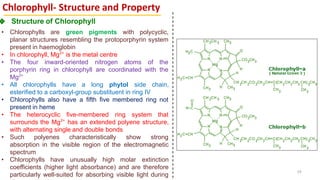
❖ Structure of Chlorophyll
• Chlorophylls are green pigments with polycyclic,
planar structures resembling the protoporphyrin system
present in haemoglobin
• In chlorophyll, Mg2+
is the metal centre
• The four inward-oriented nitrogen atoms of the
porphyrin ring in chlorophyll are coordinated with the
Mg2+
• All chlorophylls have a long phytol side chain,
esterified to a carboxyl-group substituent in ring IV
• Chlorophylls also have a fifth five membered ring not
present in heme
• The heterocyclic five-membered ring system that
surrounds the Mg2+
has an extended polyene structure,
with alternating single and double bonds
• Such polyenes characteristically show strong
absorption in the visible region of the electromagnetic
spectrum
• Chlorophylls have unusually high molar extinction
coefficients (higher light absorbance) and are therefore
particularly well-suited for absorbing visible light during
59
60.
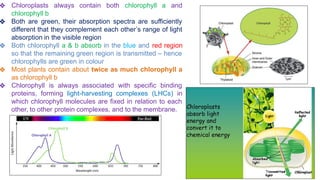
❖ Chloroplasts alwayscontain both chlorophyll a and
chlorophyll b
❖ Both are green, their absorption spectra are sufficiently
different that they complement each other’s range of light
absorption in the visible region
❖ Both chlorophyll a & b absorb in the blue and red region
so that the remaining green region is transmitted – hence
chlorophylls are green in colour
❖ Most plants contain about twice as much chlorophyll a
as chlorophyll b
❖ Chlorophyll is always associated with specific binding
proteins, forming light-harvesting complexes (LHCs) in
which chlorophyll molecules are fixed in relation to each
other, to other protein complexes, and to the membrane.
60
61.
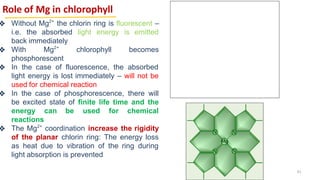
Role of Mgin chlorophyll
❖ Without Mg2+
the chlorin ring is fluorescent –
i.e. the absorbed light energy is emitted
back immediately
❖ With Mg2+
chlorophyll becomes
phosphorescent
❖ In the case of fluorescence, the absorbed
light energy is lost immediately – will not be
used for chemical reaction
❖ In the case of phosphorescence, there will
be excited state of finite life time and the
energy can be used for chemical
reactions
❖ The Mg2+
coordination increase the rigidity
of the planar chlorin ring: The energy loss
as heat due to vibration of the ring during
light absorption is prevented
61
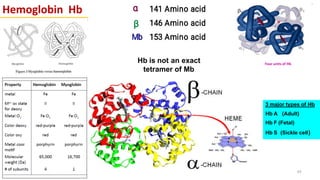
Hemoglobin Hb
Four unitsof Hb
3 major types of Hb
Hb A (Adult)
Hb F (Fetal)
Hb S (Sickle cell)
Hb is not an exact
tetramer of Mb
64
65.
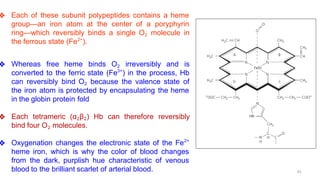
❖ Whereas freeheme binds O2 irreversibly and is
converted to the ferric state (Fe3+
) in the process, Hb
can reversibly bind O2 because the valence state of
the iron atom is protected by encapsulating the heme
in the globin protein fold
❖ Each tetrameric (α2β2) Hb can therefore reversibly
bind four O2 molecules.
❖ Oxygenation changes the electronic state of the Fe2+
heme iron, which is why the color of blood changes
from the dark, purplish hue characteristic of venous
blood to the brilliant scarlet of arterial blood.
❖ Each of these subunit polypeptides contains a heme
group—an iron atom at the center of a poryphyrin
ring—which reversibly binds a single O2 molecule in
the ferrous state (Fe2+
).
65
66.
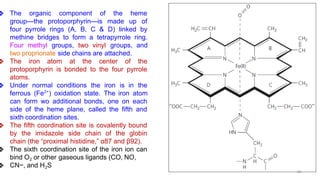
❖ The organiccomponent of the heme
group—the protoporphyrin—is made up of
four pyrrole rings (A, B, C & D) linked by
methine bridges to form a tetrapyrrole ring.
Four methyl groups, two vinyl groups, and
two proprionate side chains are attached.
❖ The iron atom at the center of the
protoporphyrin is bonded to the four pyrrole
atoms.
❖ Under normal conditions the iron is in the
ferrous (Fe2+
) oxidation state. The iron atom
can form wo additional bonds, one on each
side of the heme plane, called the fifth and
sixth coordination sites.
❖ The fifth coordination site is covalently bound
by the imidazole side chain of the globin
chain (the “proximal histidine,” α87 and β92).
❖ The sixth coordination site of the iron ion can
bind O2 or other gaseous ligands (CO, NO,
❖ CN−, and H2S
66
67.
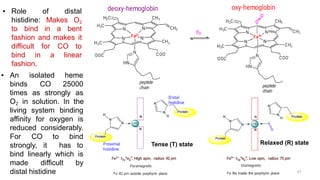
▪ An isolatedheme
binds CO 25000
times as strongly as
O2 in solution. In the
living system binding
affinity for oxygen is
reduced considerably.
For CO to bind
strongly, it has to
bind linearly which is
made difficult by
distal histidine
▪ Role of distal
histidine: Makes O2
to bind in a bent
fashion and makes it
difficult for CO to
bind in a linear
fashion.
Tense (T) state Relaxed (R) state
67
![Inorganic Complexes
• Inorganic/coordination complex is a molecule containing one or multiple metal
centers that is bound to ligands (atoms, ions, or molecules that donate electrons to
the metal).
• These complexes can be neutral or charged. The examples are:
3
Neutral Complexes: [CoCl3(NH3)3], K4[Fe(CN)6], etc.
Cationic Complex : [CO(NH3)6]3+
and Anionic Complex : [CoCl4(NH3)2]−
[Co(NH3)5Cl]Cl2 --- Chloropentaamminecobalt(III) chloride
[Cr(H2O)4Cl2]Cl --- Dichlorotetraaquochromium(III) chloride
K[PtCl3(NH3)] --- Potassiumtrichloroammineplatinate(II)
[PtCl2(NH3)2] --- Dichlorodiammineplatinum(II)
[Co(en)3Cl3] --- tris(ethylenediamine)cobalt(III)chloride
[Ni(PF3)4] --- tetrakis(phosphorus(III)fluoride)nickel(0)
Selected examples of metal complexes with names:](https://image.slidesharecdn.com/metalcomplex-module02-250428053946-cd6a558b/85/Eneering-Chemistry-MetalComplex-Module02-pdf-3-320.jpg)
![Double Salts Vs Coordination Compounds
❖ Double Salt:
Ferric alum
(NH4)2SO4.Fe2(SO4)3.24H2O
In water: NH4
+
, SO4
2-
, Fe3+
Potash alum
K2SO4.Al2(SO4)3.24H2O
3Cl–
(counter ion)
(coordination
sphere)
ligan
d
❖ Co-ordination Compounds
Fe(CN)2 + 4KCN Fe(CN)2.4KCN
4K+
+ [Fe(CN)6]4-
M
N forms a coordinate covalent
bond to the metal
Structure and Bonding](https://image.slidesharecdn.com/metalcomplex-module02-250428053946-cd6a558b/85/Eneering-Chemistry-MetalComplex-Module02-pdf-5-320.jpg)
![Tetrahedral Geometry
Cu ground
state 3d9
4s2
• Tetrahedral copper complex
3
d
4
p
4s
Cu2+
4 e–
pairs by Cl–
ions
• One unpaired electron - paramagnetic and attracted by
magnets—High spin complexes
[CuCl4]2-](https://image.slidesharecdn.com/metalcomplex-module02-250428053946-cd6a558b/85/Eneering-Chemistry-MetalComplex-Module02-pdf-10-320.jpg)
![Square Planar Geometry
Ni
(3d8
4s2
)
3
d
4
p
4s
Ni2+
dsp2
• All paired electrons – diamagnetic - weakly repelled by magnets
–Low spin compelxes
[Ni(CN)4]2-
• Square planar nickel complex
[Ni(CN)4]2-](https://image.slidesharecdn.com/metalcomplex-module02-250428053946-cd6a558b/85/Eneering-Chemistry-MetalComplex-Module02-pdf-11-320.jpg)
![Octahedral sp3
d2
Geometry
Gives [CoF6]3–
four unpaired electrons, which makes it paramagnetic and is called a high-spin
complex.
Ground state Co= (3d7
4s2
)](https://image.slidesharecdn.com/metalcomplex-module02-250428053946-cd6a558b/85/Eneering-Chemistry-MetalComplex-Module02-pdf-12-320.jpg)
![Octahedral d2
sp3
Geometry
Fe+3
3d 4p
4s
d2
sp3
CN–
Strong ligand
Fe: (3d6
4s2
)
[Fe(CN)6]3-
[Fe(CN)6]3-](https://image.slidesharecdn.com/metalcomplex-module02-250428053946-cd6a558b/85/Eneering-Chemistry-MetalComplex-Module02-pdf-13-320.jpg)
![[Co(NH3)6]3+
> [Co(NH3)6]2+
[Co(NH3)6]3+
= 23,000 cm-1
(3d)
[Rh(NH3)6]3+
= 34,000 cm-1
(4d)
[Ir(NH3)6]3+
= 41,000 cm-1
(5d)](https://image.slidesharecdn.com/metalcomplex-module02-250428053946-cd6a558b/85/Eneering-Chemistry-MetalComplex-Module02-pdf-21-320.jpg)
![Thus, the Ligand Field Strength is related to the Color of the Complexes
[Cu(H2O)4]2+
: light blue ; [Cu(NH3)4]2+
: deep blue ; [CuCl4]2-
: yellow ; [Cu(en)2]2+
:
violetcolorless
In all the above complexes, Cu is in +2 oxidation state, but the ligand field strength
differ. Hence they have different colors.
d-d transitions take place by the absorption of visible radiation by transition metal
ions and transmitted light is colored with the complementary color of the color of
the light absorbed. e.g., when red-light is removed from the white light, the eye
sees its complementary color – blue-green.
Color of various Ni(II) complexes in aqueous solutions
From left to right, hexaamminenickel(II) -
[Ni(NH3)6]2+
; tris(ethylenediamine)nickel(II) -
[Ni(en)3]2+
; tetrachloronickelate(II) - [NiCl4]2-
; hexaaquanickel(II) - [Ni(H2O)6]2+
.
Reactions starting from NiCl2·6H2O can be
used to form a variety of nickel
coordination complexes because the H2O
ligands are rapidly displaced.
Chemistry of Colors
24](https://image.slidesharecdn.com/metalcomplex-module02-250428053946-cd6a558b/85/Eneering-Chemistry-MetalComplex-Module02-pdf-24-320.jpg)
![[Co(NH3)6]3+
[Co(en)3]3+
[Co(NO2)6]3-
are orange yellow while [CoF6]3-
[Co(H2O)6]3+
are blue
• Co3+
= 27-3-18 = d6
• NH3, en and NO2 are strong field ligands (more splitting – (t2g)6
(eg)0
- Large Δo)
• To favour d-d transition, the energy required is high. Hence absorbs violet color or blue color
and will appear yellow or orange.
• F-
and H2O are weak field ligands (less splitting - (t2g)4
(eg)2
- small Δo)
• Because of small Δo, lower energy radiations are required for d-d transition. The complex
absorbs yellow or orange (lower energy) and appear as blue.
25](https://image.slidesharecdn.com/metalcomplex-module02-250428053946-cd6a558b/85/Eneering-Chemistry-MetalComplex-Module02-pdf-25-320.jpg)
![27
Position of four ligands with respect to the d orbitals of the central metal ion.
• The d orbitals having their lobes oriented in between the axes (t2 orbitals) are nearer
to four ligands. Hence interact with the ligand orbitals to a greater extent and hence
higher energy.
• whereas the two d orbitals having their lobes oriented along the axes (e) are away
from the ligands. Interact only to a lesser extent with the ligand orbitals.
Splitting of d orbitals just the reverse of splitting observed in oh complexes.
Difference in energy -tetrahedral crystal field splitting energy [Δt = (4/9) Δ0]
Reason:
Only 4 ligands. Hence 1/3rd
decrease in the number of ligands decreases the Δt
High energy t2 orbitals although nearer to the ligands, do not point directly to the
ligands. Hence the extent of interaction is less. But in oh complex, the eg orbitals point
directly at the ligands.
Tetrahedral Crystal Field](https://image.slidesharecdn.com/metalcomplex-module02-250428053946-cd6a558b/85/Eneering-Chemistry-MetalComplex-Module02-pdf-27-320.jpg)
![Industrial Applications
• Coordination compounds are used as catalysts for many
industrial processes. Examples rhodium complex,
[(Ph3P)3RhCl], a Wilkinson catalyst – Catalytic hydrogenation of
alkenes.
• Articles can be electroplated with silver and gold much more
smoothly and evenly from solutions of the complexes, [Ag(CN)2]–
and [Au(CN)2]–
than from a solution of simple metal ions.
• In black and white photography, the developed film is fixed by
washing with hypo solution which dissolves the non decomposed
AgBr to form a complex ion, [Ag(S2O3)2]3–
.
• Prussian blue – Mixture of hexacyanoFe(II) and Fe(III) -
Fe4[Fe(CN)6]3 inks, blueprinting, cosmetics, paints (commercial
coloring agents)
Alken
e
Alkane
Wilkinson catalyst](https://image.slidesharecdn.com/metalcomplex-module02-250428053946-cd6a558b/85/Eneering-Chemistry-MetalComplex-Module02-pdf-35-320.jpg)
![Extraction
❖ processes of metals, like those of silver and gold, make use of complex formation.
❖ These noble metals are extracted from their ore by the formation of cyanide complexes -
dicyanoargentite(I) - [Ag(CN)2]–
and dicyanoaurate (I) - [Au(CN)2]–
in the presence of oxygen
and water, from which the metallic forms can be separated by the addition of zinc.
▪ Ag2S + 4NaCN 2 Na[Ag(CN)2] + Na2S
▪ 2 Na[Ag(CN)2] + Zn Na2[Zn(CN)4] + 2Ag↓
❖ Purification of metals can be achieved through formation and subsequent decomposition of
their coordination compounds. For example, impure nickel is converted to [Ni(CO)4], which is
decomposed to yield pure nickel (the Mond process).
Extraction / Purification of Metals](https://image.slidesharecdn.com/metalcomplex-module02-250428053946-cd6a558b/85/Eneering-Chemistry-MetalComplex-Module02-pdf-36-320.jpg)
![Detection of Complex Formation
❖ Formation of Precipitate
Ni2+
+ 2 HDMG [Ni(DMG)2] + 2H+
❖ Ni2+
and Pd2+
form insoluble colored precipitates with dimethyglyoxime
❖ In the qualitative methods of analysis, complex formation is
of immense importance in the identification by color
change and separation of most inorganic ions.](https://image.slidesharecdn.com/metalcomplex-module02-250428053946-cd6a558b/85/Eneering-Chemistry-MetalComplex-Module02-pdf-37-320.jpg)
![Medicinal Application
❖ To treat problems caused by the presence of
metals in toxic proportions in plant/animal systems,
chelate therapy is used.
• Excess of copper and iron are removed by the
chelating ligands D–penicillamine and
desferrioxime B via the formation of coordination
compounds.
❖ EDTA is used in the treatment of lead poisoning.
❖ Coordination compound of platinum effectively
inhibit the growth of tumours. cisplatin - cis
[PtCl2(NH3)2], and related compounds.
40](https://image.slidesharecdn.com/metalcomplex-module02-250428053946-cd6a558b/85/Eneering-Chemistry-MetalComplex-Module02-pdf-40-320.jpg)
![Applications
1. Metal carbonyls are used in several industrial processes. Perhaps the earliest
application was the extraction and purification of nickel via nickel tetracarbonyl by the
Mond process.
2. Fe(CO)5 is used for the preparation of inductors, pigments, as dietary supplements in
the production of radar-absorbing materials in the stealth technology, and in thermal
spraying.
3. Metal carbonyls are used in a number of industrially important carbonylation reactions.
In the oxo process, an alkene, hydrogen gas, and carbon monoxide react together with a
catalyst (such as HCo(CO)4) to give aldehydes (hydroformylation).
H2 + CO + CH3CH=CH2 → CH3CH2CH2CHO
4. Several other Metal-Carbonyl complexes have been employed in the hydrocarboxylation
and hydrogenation reactions. Dicobalt octacarbonyl [Co2(CO)8] can be used for
hydrosilylation of olefins also.
5. Many organometallic complexes are the sources for the pure metal particles/ metal
coatings using Chemical Vapour Deposition (CVD) process. 54](https://image.slidesharecdn.com/metalcomplex-module02-250428053946-cd6a558b/85/Eneering-Chemistry-MetalComplex-Module02-pdf-54-320.jpg)
![Structure and Bonding in Ferrocene
• Mössbauer spectroscopy indicates that the iron center
in ferrocene should be assigned the +2 oxidation state.
Each cyclopentadienyl (Cp) ring should then be
allocated a single negative charge. Thus ferrocene
could be described as iron(II) bis(cyclopentadienide)
Fe2+
[C5H5
-
]2.
• The number of π-electrons on each ring is then six,
which makes it aromatic according to Hückel's rule.
These twelve π-electrons are then shared with the
metal via covalent bonding. Since Fe2+
has six d-
electrons, the complex attains an 18-electron
configuration, which accounts for its stability. In modern
notation, this sandwich structural model of the
ferrocene molecule is denoted as Fe(η5
-C5H5)2.
• Crystallography reveals that the cyclopentadienide
rings are in staggered conformation.
• Hybridization: d2
sp3
• Magnetic Nature: Diamagnetic
55](https://image.slidesharecdn.com/metalcomplex-module02-250428053946-cd6a558b/85/Eneering-Chemistry-MetalComplex-Module02-pdf-55-320.jpg)