Organometallic Catalysts
Dr. S.H. Burungale
M.Sc. 2016
Contents :
 The basis for catalysis
 Catalytic Cycle
 History
 Mechanistic Concept
 Homogeneous Catalysis
 Wilkinson’s Catalyst
 Asymmetric hydrogenation
 Hydroformylation
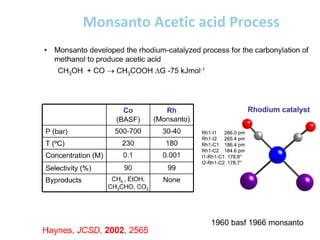
 Monsanto Acetic acid Process
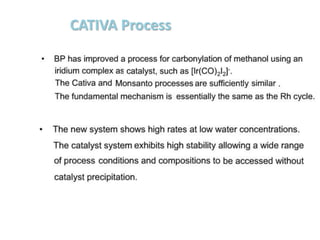
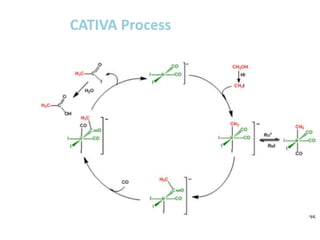
 CATIVA Process
 Wacker Process
 Heterogeneous Catalysis
 Ziegler-Natta Catalyst
Ligands
• Organometallic complexes have a wide range of ligand
• types from simple M-R to the -cyclopentadienyl rings
• of ferrocene.
• Hapticity of a ligand
• The hapticity of a ligand indicates the atoms that are
• directly bonded to the metal.
• The Greek letter η (eta) is used,
• ( 5-C5H5) M indicates that all five carbons are bonded to M.
• Metal-organo compounds can be conveniently
divided into those containing
• (a) Main group metals s-block (Na, Mg..) & p-
block (Al, Sn, Bi .. & Zn)
• (b) Transition metals Ti-Cu
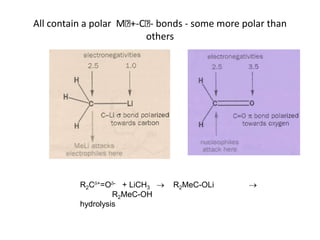
• All contain a polar Mᵟ+ -Cᵟ- bonds - some more
polar than others ......
All contain a polar M +-C - bonds - some more polar than
others
R2C+=O- + LiCH3  R2MeC-OLi 
R2MeC-OH
hydrolysis
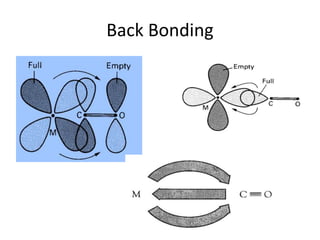
Metal carbonyls
• The CO transfers electrons to the metal
through the sigma-bond, but the metal
transfers electrons to the CO through the pi-
bond. This two-way flow of electrons is known
as back-bonding or synergic bonding. It is self
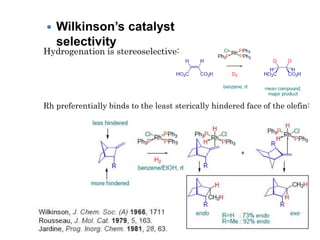
re-inforcing, so makes for strong bonds (M-CO
bond strength is greater than a single bond).
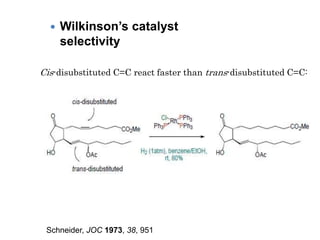
Back Bonding
Effects of -bonding ligands
• CO and related ligands are called -acceptor ligands
•
• 1. Effect on the metals
•
• Removal of electron density can stabilise metals in low oxidation
levels (zero or below).
• Fe(CO)5 contains Fe(0) zerovalent compound
• Na2Fe(CO)4 contains Fe(-2)
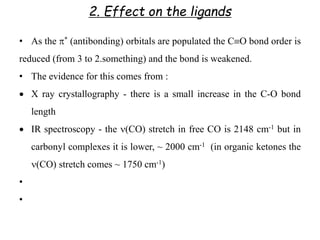
2. Effect on the ligands
• As the * (antibonding) orbitals are populated the CO bond order is
reduced (from 3 to 2.something) and the bond is weakened.
• The evidence for this comes from :
 X ray crystallography - there is a small increase in the C-O bond
length
 IR spectroscopy - the (CO) stretch in free CO is 2148 cm-1 but in
carbonyl complexes it is lower, ~ 2000 cm-1 (in organic ketones the
(CO) stretch comes ~ 1750 cm-1)
•
•
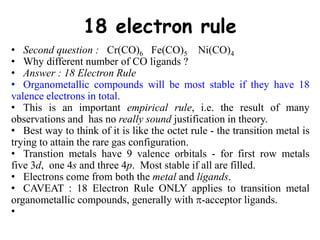
18 electron rule
• Second question : Cr(CO)6 Fe(CO)5 Ni(CO)4
• Why different number of CO ligands ?
• Answer : 18 Electron Rule
• Organometallic compounds will be most stable if they have 18
valence electrons in total.
• This is an important empirical rule, i.e. the result of many
observations and has no really sound justification in theory.
• Best way to think of it is like the octet rule - the transition metal is
trying to attain the rare gas configuration.
• Transtion metals have 9 valence orbitals - for first row metals
five 3d, one 4s and three 4p. Most stable if all are filled.
• Electrons come from both the metal and ligands.
• CAVEAT : 18 Electron Rule ONLY applies to transition metal
organometallic compounds, generally with -acceptor ligands.
•
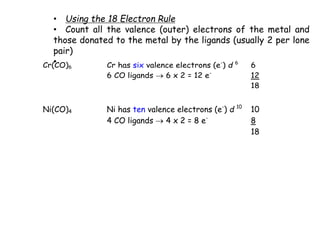
• Using the 18 Electron Rule
• Count all the valence (outer) electrons of the metal and
those donated to the metal by the ligands (usually 2 per lone
pair)
•
Cr(CO)6 Cr has six valence electrons (e-
) d 6
6
6 CO ligands  6 x 2 = 12 e-
12
18
Ni(CO)4 Ni has ten valence electrons (e-
) d 10
10
4 CO ligands  4 x 2 = 8 e-
8
18
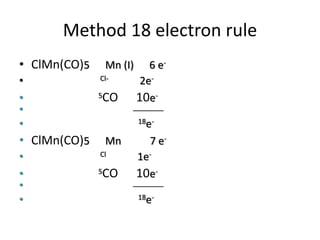
Method 18 electron rule
• ClMn(CO)5 Mn (I) 6 e-
• Cl- 2e-
• 5CO 10e-
• ________
• 18e-
• ClMn(CO)5 Mn 7 e-
• Cl 1e-
• 5CO 10e-
• ________
• 18e-
Mn(CO)6 would have 19 electrons - so it is not stable and does
not exist (but it can lose an electron to give the stable
[Mn(CO)6]+
which now has 18 e)
18-electron rule is very useful as it gives us a clue as to which
molecular structures will be stable. There are almost NO
stable organometallic compounds where the metal has more
than 18 electrons.
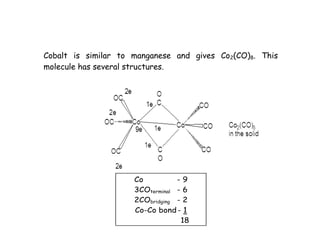
Cobalt is similar to manganese and gives Co2(CO)8. This
molecule has several structures.
Co - 9
3COterminal - 6
2CObridging - 2
Co-Co bond- 1
18
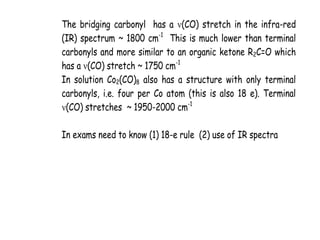
The bridging carbonyl has a (CO) stretch in the infra-red
(IR) spectrum ~ 1800 cm-1
This is much lower than terminal
carbonyls and more similar to an organic ketone R2C=O which
has a (CO) stretch ~ 1750 cm-1
In solution Co2(CO)8 also has a structure with only terminal
carbonyls, i.e. four per Co atom (this is also 18 e). Terminal
(CO) stretches ~ 1950-2000 cm-1
In exams need to know (1) 18-e rule (2) use of IR spectra
All the simple carbonyls of the 1st row transition metals
Ni(CO)4 Co2(CO)8 Fe(CO)5 Mn2(CO)10 Cr(CO)6
have formulae which can be understood in terms of the 18-
electron rule.
But V(CO)6 is a stable 17-electron compound - doesn't
dimerise. Why?
Answer is steric reasons : Cannot get 6 carbonyl ligands
around the V atom AND also get a V-V bond with another
V(CO)6 molecule - not enough space. So......
V(CO)6 is paramagnetic (i.e. has unpaired electron) and is very
reactive. Will easily gain an electron by chemical reduction to
give the anion [V(CO)6]-
. This now satisfies the 18-e rule and is
much more stable.
V - 5
6CO -12
-charge - 1
18
But CAN get a small ligand like H (hydride) - HV(CO)6
This has a direct V-H bond
Other -acceptor ligands
There are a multitude of other organic (and unsaturated)
molecules which can bond to transition metals in a similar way
to CO
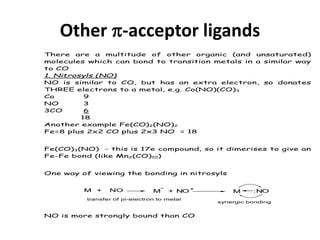
1. Nitrosyls (NO)
NO is similar to CO, but has an extra electron, so donates
THREE electrons to a metal, e.g. Co(NO)(CO)3
Co 9
NO 3
3CO 6
18
Another example Fe(CO)2(NO)2
Fe=8 plus 2x2 CO plus 2x3 NO = 18
Fe(CO)3(NO) - this is 17e compound, so it dimerises to give an
Fe-Fe bond (like Mn2(CO)10)
One way of viewing the bonding in nitrosyls
M + NO M
-
+ NO+
M :NO
transfer of pi-electron to metal
synergic bonding
NO is more strongly bound than CO
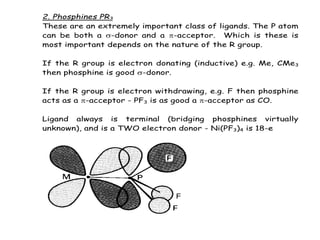
2. Phosphines PR3
These are an extremely important class of ligands. The P atom
can be both a -donor and a -acceptor. Which is these is
most important depends on the nature of the R group.
If the R group is electron donating (inductive) e.g. Me, CMe3
then phosphine is good -donor.
If the R group is electron withdrawing, e.g. F then phosphine
acts as a -acceptor - PF3 is as good a -acceptor as CO.
Ligand always is terminal (bridging phosphines virtually
unknown), and is a TWO electron donor - Ni(PF3)4 is 18-e
3. Alkenes
First organometallic compound made - Zeise's salt - 1827.
Made by reaction of reaction of KCl, PtCl2 in ethanol.
Original formulation - a double salt KCl.PtCl2.EtOH
Pt
Cl
Cl Cl
H H
H H
-
K+
Actually shown (1955) to be potassium salt of an anionic
ethene-complex K+
[PtCl3(C2H4)]-
.H2O (same empirical formula)
X-ray structure shows a square-planar platinum(II)
The bonding in this compound has similarities with previous
examples of -acceptor ligands. The experimental evidence
shows :
 The C=C bond is weakened when complexed with transition
metal. In free ethene the C=C bond length is 1.34Å, in
Zeise's salt it is 1.35Å
 IR stretching frequency of C=C bond drops also (but not as
easily seen as in CO)
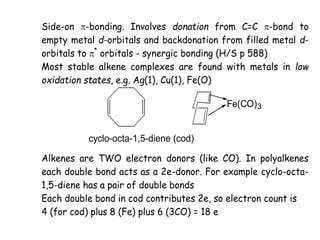
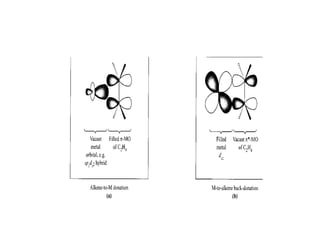
Side-on -bonding. Involves donation from C=C -bond to
empty metal d-orbitals and backdonation from filled metal d-
orbitals to *
orbitals - synergic bonding (H/S p 588)
Most stable alkene complexes are found with metals in low
oxidation states, e.g. Ag(1), Cu(1), Fe(O)
cyclo-octa-1,5-diene (cod)
Fe(CO)3
Alkenes are TWO electron donors (like CO). In polyalkenes
each double bond acts as a 2e-donor. For example cyclo-octa-
1,5-diene has a pair of double bonds
Each double bond in cod contributes 2e, so electron count is
4 (for cod) plus 8 (Fe) plus 6 (3CO) = 18 e
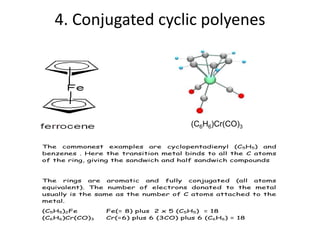
4. Conjugated cyclic polyenes
(C6H6)Cr(CO)3
The commonest examples are cyclopentadienyl (C5H5) and
benzenes . Here the transition metal binds to all the C atoms
of the ring, giving the sandwich and half sandwich compounds
The rings are aromatic and fully conjugated (all atoms
equivalent). The number of electrons donated to the metal
usually is the same as the number of C atoms attached to the
metal.
(C5H5)2Fe Fe(= 8) plus 2 x 5 (C5H5) = 18
(C6H6)Cr(CO)3 Cr(=6) plus 6 (3CO) plus 6 (C6H6) = 18
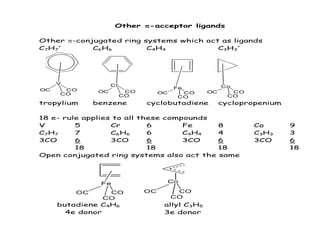
Other -acceptor ligands
Other -conjugated ring systems which act as ligands
C7H7
+
C6H6 C4H4 C3H3
+
V
OC CO
CO
Cr
OC CO
CO
Fe
OC CO
CO
Co
OC CO
CO
tropylium benzene cyclobutadiene cyclopropenium
18 e- rule applies to all these compounds
V 5 Cr 6 Fe 8 Co 9
C7H7 7 C6H6 6 C4H4 4 C3H3 3
3CO 6 3CO 6 3CO 6 3CO 6
18 18 18 18
Open conjugated ring systems also act the same
Fe
OC CO
CO
Co
OC CO
CO
butadiene C4H6 allyl C3H5
4e donor 3e donor
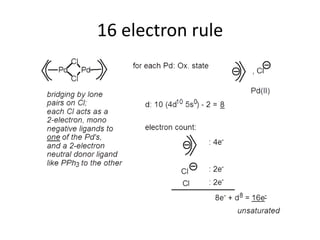
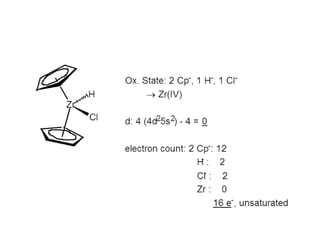
16 electron rule
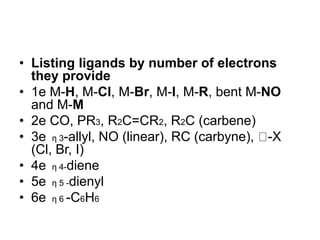
• Listing ligands by number of electrons
they provide
• 1e M-H, M-Cl, M-Br, M-I, M-R, bent M-NO
and M-M
• 2e CO, PR3, R2C=CR2, R2C (carbene)
• 3e η 3-allyl, NO (linear), RC (carbyne), -X
(Cl, Br, I)
• 4e η 4-diene
• 5e η 5 -dienyl
• 6e η 6 -C6H6
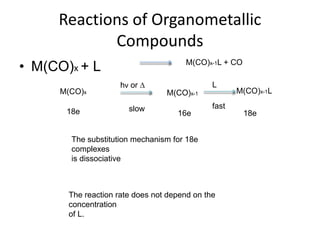
Reactions of Organometallic
Compounds
• M(CO)x + L M(CO)x-1L + CO
M(CO)x
hν or ∆
M(CO)x-1 M(CO)x-1L
L
18e 16e 18e
slow fast
The substitution mechanism for 18e
complexes
is dissociative
The reaction rate does not depend on the
concentration
of L.
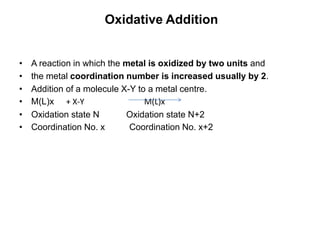
Oxidative Addition
• A reaction in which the metal is oxidized by two units and
• the metal coordination number is increased usually by 2.
• Addition of a molecule X-Y to a metal centre.
• M(L)x + X-Y M(L)x
• Oxidation state N Oxidation state N+2
• Coordination No. x Coordination No. x+2
• The best know examples are provide by the complexes of
• Rh(I) Ir(I) Pd(0) Pd(II) Pt(0) and Pt(II).
• The metal must have 2 stable oxidation states
• separated by 2 units.
• e.g. Rh(I) and Rh(III) or Pd(0) and Pd(II)
• Perhaps the best known is Vaska’s complex
[Ir(PPh3)2(CO)Cl]
• This complex reacts with a very large number of X-Y
molecules
• [Ir(PPh3)2(CO)Cl] + MeI = [Ir(Me)(PPh3)2(CO)(I)Cl]
• 16e Ir(I) 18e Ir(III)
• 4 coord. 6 coord.
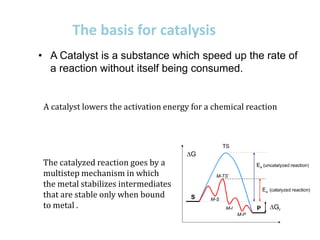
The basis for catalysis
• A Catalyst is a substance which speed up the rate of
a reaction without itself being consumed.
A catalyst lowers the activation energy for a chemical reaction
The catalyzed reaction goes by a
multistep mechanism in which
the metal stabilizes intermediates
that are stable only when bound
to metal .
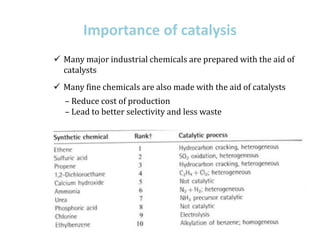
Importance of catalysis
 Many major industrial chemicals are prepared with the aid of
catalysts
 Many fine chemicals are also made with the aid of catalysts
– Reduce cost of production
– Lead to better selectivity and less waste
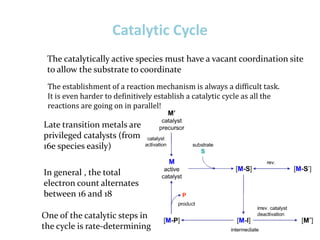
Catalytic Cycle
The catalytically active species must have a vacant coordination site
to allow the substrate to coordinate
Late transition metals are
privileged catalysts (from
16e species easily)
In general , the total
electron count alternates
between 16 and 18
One of the catalytic steps in
the cycle is rate-determining
The establishment of a reaction mechanism is always a difficult task.
It is even harder to definitively establish a catalytic cycle as all the
reactions are going on in parallel!
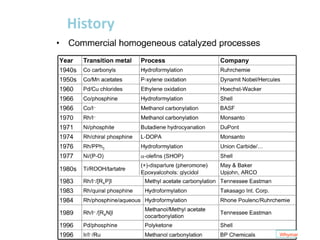
History
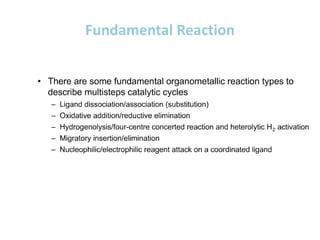
Fundamental Reaction
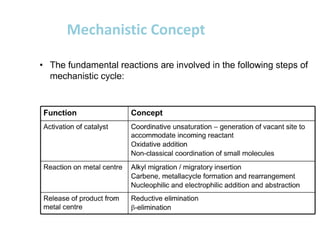
Mechanistic Concept
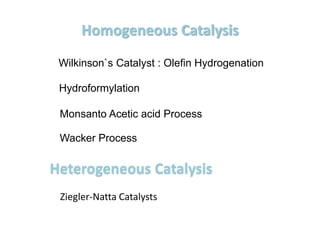
Homogeneous Catalysis
Wilkinson`s Catalyst : Olefin Hydrogenation
Hydroformylation
Monsanto Acetic acid Process
Wacker Process
Heterogeneous Catalysis
Ziegler-Natta Catalysts
Homogeneous Catalysis
Homogenous catalysts are used when selectivity is
critical and product-catalyst separation problems can
be solved.
• Advantages :
 Relatively high specificity
 Relatively low reaction temperatures
 far more easily studied from chemical & mechanistic aspects
 far more active
 Generally far more selective for a single product
 Disadvantages
:
o far more difficult for achieving product/catalyst
separations
• Catalytic steps in homogeneous reactions
 Most catalytic process can be built up from a small
number of different types of step
– Association / dissociation of a ligand
» requires labile complexes
– Insertion and elimination reactions
– Nucleophilic attack on a coordinated ligand
– Oxidation and reduction of a metal center
– Oxidative addition / reductive elimination
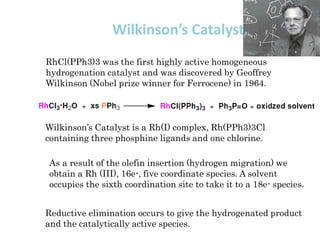
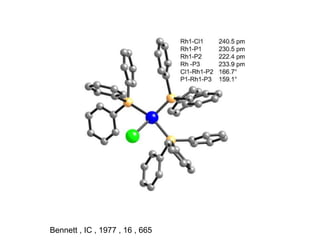
Wilkinson’s Catalyst:
RhCl(PPh3)3 was the first highly active homogeneous
hydrogenation catalyst and was discovered by Geoffrey
Wilkinson (Nobel prize winner for Ferrocene) in 1964.
Wilkinson’s Catalyst is a Rh(I) complex, Rh(PPh3)3Cl
containing three phosphine ligands and one chlorine.
As a result of the olefin insertion (hydrogen migration) we
obtain a Rh (III), 16e-, five coordinate species. A solvent
occupies the sixth coordination site to take it to a 18e- species.
Reductive elimination occurs to give the hydrogenated product
and the catalytically active species.
Bennett , IC , 1977 , 16 , 665
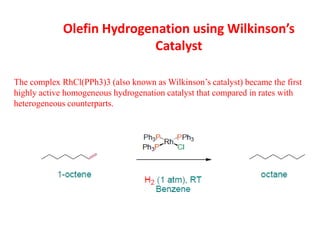
Olefin Hydrogenation using Wilkinson’s
Catalyst
The complex RhCl(PPh3)3 (also known as Wilkinson’s catalyst) became the first
highly active homogeneous hydrogenation catalyst that compared in rates with
heterogeneous counterparts.
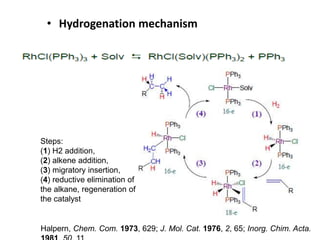
• Hydrogenation mechanism
Steps:
(1) H2 addition,
(2) alkene addition,
(3) migratory insertion,
(4) reductive elimination of
the alkane, regeneration of
the catalyst
Halpern, Chem. Com. 1973, 629; J. Mol. Cat. 1976, 2, 65; Inorg. Chim. Acta.
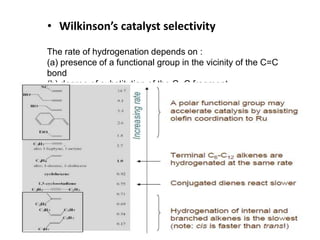
• Wilkinson’s catalyst selectivity
The rate of hydrogenation depends on :
(a) presence of a functional group in the vicinity of the C=C
bond
(b) degree of substitution of the C=C fragment
Hydrogenation is stereoselective:
 Wilkinson’s catalyst
selectivity
Rh preferentially binds to the least sterically hindered face of the olefin:
Cis-disubstituted C=C react faster than trans-disubstituted C=C:
 Wilkinson’s catalyst
selectivity
Schneider, JOC 1973, 38, 951
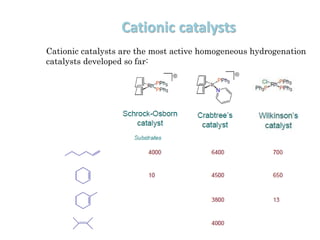
Cationic catalysts
Cationic catalysts are the most active homogeneous hydrogenation
catalysts developed so far:
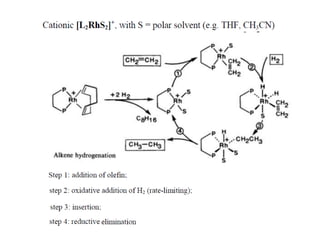
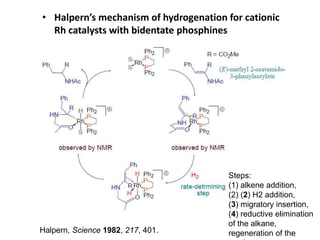
• Halpern’s mechanism of hydrogenation for cationic
Rh catalysts with bidentate phosphines
Steps:
(1) alkene addition,
(2) (2) H2 addition,
(3) migratory insertion,
(4) reductive elimination
of the alkane,
regeneration of the
Halpern, Science 1982, 217, 401.
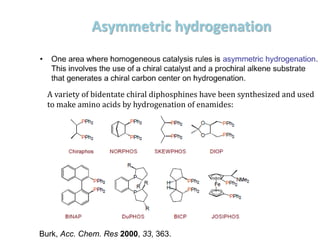
Asymmetric hydrogenation
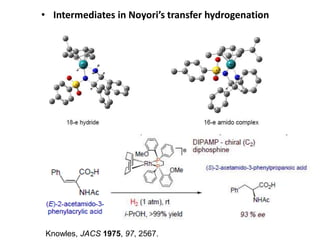
A variety of bidentate chiral diphosphines have been synthesized and used
to make amino acids by hydrogenation of enamides:
Burk, Acc. Chem. Res 2000, 33, 363.
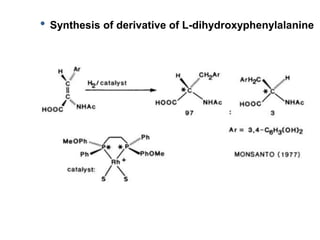
• Synthesis of derivative of L-dihydroxyphenylalanine
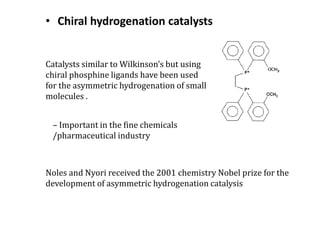
Catalysts similar to Wilkinson’s but using
chiral phosphine ligands have been used
for the asymmetric hydrogenation of small
molecules .
– Important in the fine chemicals
/pharmaceutical industry
Noles and Nyori received the 2001 chemistry Nobel prize for the
development of asymmetric hydrogenation catalysis
• Chiral hydrogenation catalysts
Knowles, JACS 1975, 97, 2567.
• Intermediates in Noyori’s transfer hydrogenation
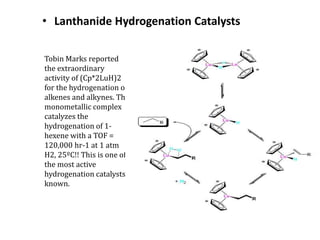
• Lanthanide Hydrogenation Catalysts
Tobin Marks reported
the extraordinary
activity of (Cp*2LuH)2
for the hydrogenation of
alkenes and alkynes. The
monometallic complex
catalyzes the
hydrogenation of 1-
hexene with a TOF =
120,000 hr-1 at 1 atm
H2, 25ºC!! This is one of
the most active
hydrogenation catalysts
known.
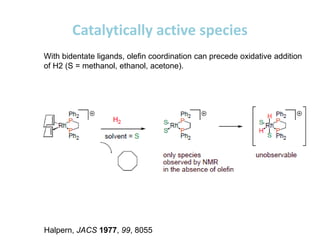
Catalytically active species
With bidentate ligands, olefin coordination can precede oxidative addition
of H2 (S = methanol, ethanol, acetone).
Halpern, JACS 1977, 99, 8055
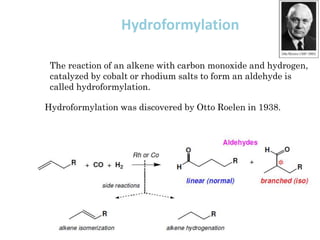
Hydroformylation
Hydroformylation was discovered by Otto Roelen in 1938.
The reaction of an alkene with carbon monoxide and hydrogen,
catalyzed by cobalt or rhodium salts to form an aldehyde is
called hydroformylation.
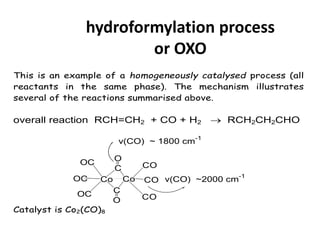
hydroformylation process
or OXO
This is an example of a homogeneously catalysed process (all
reactants in the same phase). The mechanism illustrates
several of the reactions summarised above.
overall reaction RCH=CH2 + CO + H2  RCH2CH2CHO
Co Co
C
C
CO
CO
OC
OC
OC
O
O
v(CO) ~ 1800 cm-1
v(CO) ~2000 cm-1
CO
Catalyst is Co2(CO)8
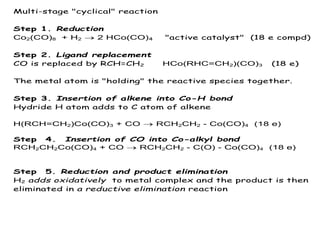
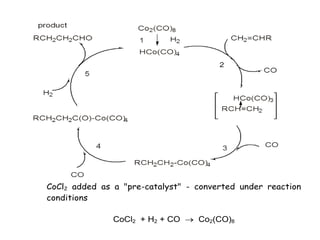
Multi-stage "cyclical" reaction
Step 1. Reduction
Co2(CO)8 + H2  2 HCo(CO)4 "active catalyst" (18 e compd)
Step 2. Ligand replacement
CO is replaced by RCH=CH2 HCo(RHC=CH2)(CO)3 (18 e)
The metal atom is "holding" the reactive species together.
Step 3. Insertion of alkene into Co-H bond
Hydride H atom adds to C atom of alkene
H(RCH=CH2)Co(CO)3 + CO  RCH2CH2 - Co(CO)4 (18 e)
Step 4. Insertion of CO into Co-alkyl bond
RCH2CH2Co(CO)4 + CO  RCH2CH2 - C(O) - Co(CO)4 (18 e)
Step 5. Reduction and product elimination
H2 adds oxidatively to metal complex and the product is then
eliminated in a reductive elimination reaction
CoCl2 added as a "pre-catalyst" - converted under reaction
conditions
CoCl2 + H2 + CO  Co2(CO)8
Disadvantages
• Catalyst is in same phase as products -
how to separate the two ??
• HCo(CO)4 + NaHCO3  Na+ [Co(CO)4]-
(water soluble)
• + H2O + CO2
• Catalyst can then be regenerated
• Na[Co(CO)4] + H2SO4  HCo(CO)4
•
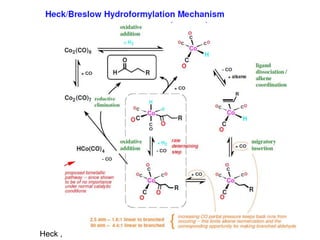
Heck ,
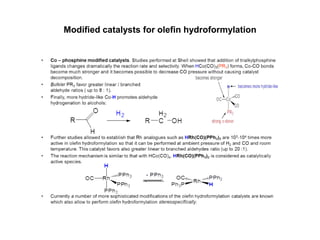
Modified catalysts for olefin hydroformylation
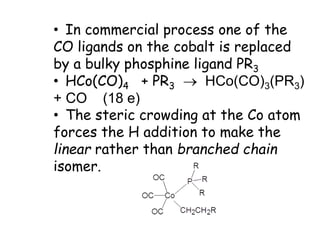
• In commercial process one of the
CO ligands on the cobalt is replaced
by a bulky phosphine ligand PR3
• HCo(CO)4 + PR3  HCo(CO)3(PR3)
+ CO (18 e)
• The steric crowding at the Co atom
forces the H addition to make the
linear rather than branched chain
isomer.
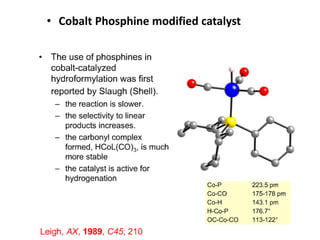
• Cobalt Phosphine modified catalyst
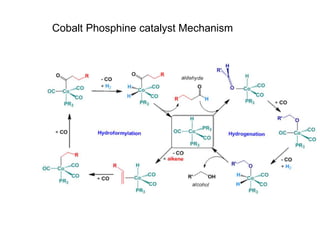
Cobalt Phosphine catalyst Mechanism
Monsanto Acetic acid Process
1960 basf 1966 monsanto
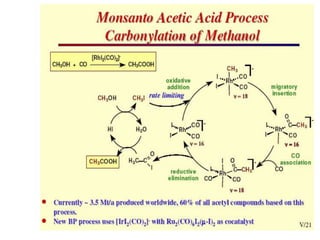
• This is another carbonylation reaction introduced in early 70-s by Monsanto. This
reaction involves dual catalysis with HI and with salts of [RhI2(CO)2]- anionic complex.
• Hydrogen iodide is responsible for conversion of MeOH into MeI. Rhodium catalyst is
responsible for carbonylation of MeI into MeCO-I. Finally, HI is regenerated in the end of
Rh-catalytic cycle as a result of hydrolysis of acetyliodide.
CATIVA Process
CATIVA Process
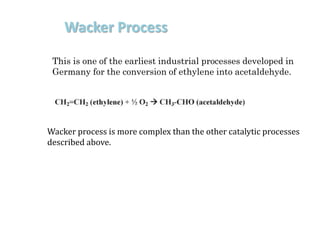
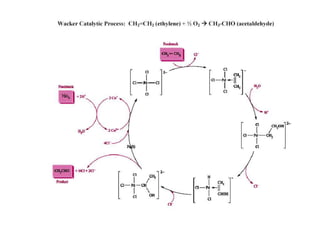
Wacker Process
This is one of the earliest industrial processes developed in
Germany for the conversion of ethylene into acetaldehyde.
Wacker process is more complex than the other catalytic processes
described above.
Heterogeneous Catalysis
Heterogeneous catalysts dominate chemical and
petrochemical industry: ~ 95% of all chemical processes
use heterogenous catalysts.
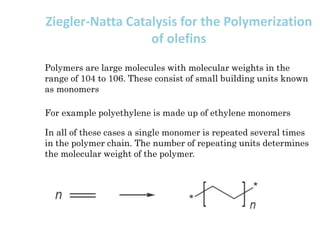
Ziegler-Natta Catalysis for the Polymerization
of olefins
Polymers are large molecules with molecular weights in the
range of 104 to 106. These consist of small building units known
as monomers
For example polyethylene is made up of ethylene monomers
In all of these cases a single monomer is repeated several times
in the polymer chain. The number of repeating units determines
the molecular weight of the polymer.
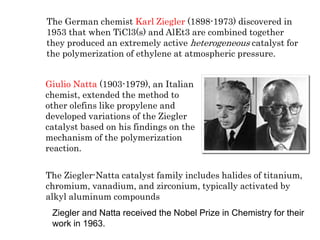
Giulio Natta (1903-1979), an Italian
chemist, extended the method to
other olefins like propylene and
developed variations of the Ziegler
catalyst based on his findings on the
mechanism of the polymerization
reaction.
The German chemist Karl Ziegler (1898-1973) discovered in
1953 that when TiCl3(s) and AlEt3 are combined together
they produced an extremely active heterogeneous catalyst for
the polymerization of ethylene at atmospheric pressure.
The Ziegler-Natta catalyst family includes halides of titanium,
chromium, vanadium, and zirconium, typically activated by
alkyl aluminum compounds
Ziegler and Natta received the Nobel Prize in Chemistry for their
work in 1963.
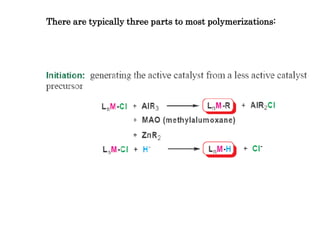
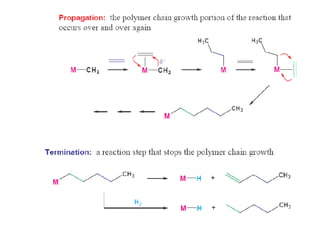
There are typically three parts to most polymerizations:
Thanks for your attention

Organometallic catalysts

  • 1.
  • 2.
    Contents :  Thebasis for catalysis  Catalytic Cycle  History  Mechanistic Concept  Homogeneous Catalysis  Wilkinson’s Catalyst  Asymmetric hydrogenation  Hydroformylation  Monsanto Acetic acid Process  CATIVA Process  Wacker Process  Heterogeneous Catalysis  Ziegler-Natta Catalyst
  • 3.
    Ligands • Organometallic complexeshave a wide range of ligand • types from simple M-R to the -cyclopentadienyl rings • of ferrocene. • Hapticity of a ligand • The hapticity of a ligand indicates the atoms that are • directly bonded to the metal. • The Greek letter η (eta) is used, • ( 5-C5H5) M indicates that all five carbons are bonded to M.
  • 4.
    • Metal-organo compoundscan be conveniently divided into those containing • (a) Main group metals s-block (Na, Mg..) & p- block (Al, Sn, Bi .. & Zn) • (b) Transition metals Ti-Cu • All contain a polar Mᵟ+ -Cᵟ- bonds - some more polar than others ......
  • 5.
    All contain apolar M +-C - bonds - some more polar than others R2C+=O- + LiCH3  R2MeC-OLi  R2MeC-OH hydrolysis
  • 6.
    Metal carbonyls • TheCO transfers electrons to the metal through the sigma-bond, but the metal transfers electrons to the CO through the pi- bond. This two-way flow of electrons is known as back-bonding or synergic bonding. It is self re-inforcing, so makes for strong bonds (M-CO bond strength is greater than a single bond).
  • 7.
  • 8.
    Effects of -bondingligands • CO and related ligands are called -acceptor ligands • • 1. Effect on the metals • • Removal of electron density can stabilise metals in low oxidation levels (zero or below). • Fe(CO)5 contains Fe(0) zerovalent compound • Na2Fe(CO)4 contains Fe(-2)
  • 9.
    2. Effect onthe ligands • As the * (antibonding) orbitals are populated the CO bond order is reduced (from 3 to 2.something) and the bond is weakened. • The evidence for this comes from :  X ray crystallography - there is a small increase in the C-O bond length  IR spectroscopy - the (CO) stretch in free CO is 2148 cm-1 but in carbonyl complexes it is lower, ~ 2000 cm-1 (in organic ketones the (CO) stretch comes ~ 1750 cm-1) • •
  • 10.
    18 electron rule •Second question : Cr(CO)6 Fe(CO)5 Ni(CO)4 • Why different number of CO ligands ? • Answer : 18 Electron Rule • Organometallic compounds will be most stable if they have 18 valence electrons in total. • This is an important empirical rule, i.e. the result of many observations and has no really sound justification in theory. • Best way to think of it is like the octet rule - the transition metal is trying to attain the rare gas configuration. • Transtion metals have 9 valence orbitals - for first row metals five 3d, one 4s and three 4p. Most stable if all are filled. • Electrons come from both the metal and ligands. • CAVEAT : 18 Electron Rule ONLY applies to transition metal organometallic compounds, generally with -acceptor ligands. •
  • 11.
    • Using the18 Electron Rule • Count all the valence (outer) electrons of the metal and those donated to the metal by the ligands (usually 2 per lone pair) • Cr(CO)6 Cr has six valence electrons (e- ) d 6 6 6 CO ligands  6 x 2 = 12 e- 12 18 Ni(CO)4 Ni has ten valence electrons (e- ) d 10 10 4 CO ligands  4 x 2 = 8 e- 8 18
  • 12.
    Method 18 electronrule • ClMn(CO)5 Mn (I) 6 e- • Cl- 2e- • 5CO 10e- • ________ • 18e- • ClMn(CO)5 Mn 7 e- • Cl 1e- • 5CO 10e- • ________ • 18e-
  • 13.
    Mn(CO)6 would have19 electrons - so it is not stable and does not exist (but it can lose an electron to give the stable [Mn(CO)6]+ which now has 18 e) 18-electron rule is very useful as it gives us a clue as to which molecular structures will be stable. There are almost NO stable organometallic compounds where the metal has more than 18 electrons.
  • 14.
    Cobalt is similarto manganese and gives Co2(CO)8. This molecule has several structures. Co - 9 3COterminal - 6 2CObridging - 2 Co-Co bond- 1 18
  • 15.
    The bridging carbonylhas a (CO) stretch in the infra-red (IR) spectrum ~ 1800 cm-1 This is much lower than terminal carbonyls and more similar to an organic ketone R2C=O which has a (CO) stretch ~ 1750 cm-1 In solution Co2(CO)8 also has a structure with only terminal carbonyls, i.e. four per Co atom (this is also 18 e). Terminal (CO) stretches ~ 1950-2000 cm-1 In exams need to know (1) 18-e rule (2) use of IR spectra
  • 16.
    All the simplecarbonyls of the 1st row transition metals Ni(CO)4 Co2(CO)8 Fe(CO)5 Mn2(CO)10 Cr(CO)6 have formulae which can be understood in terms of the 18- electron rule. But V(CO)6 is a stable 17-electron compound - doesn't dimerise. Why? Answer is steric reasons : Cannot get 6 carbonyl ligands around the V atom AND also get a V-V bond with another V(CO)6 molecule - not enough space. So...... V(CO)6 is paramagnetic (i.e. has unpaired electron) and is very reactive. Will easily gain an electron by chemical reduction to give the anion [V(CO)6]- . This now satisfies the 18-e rule and is much more stable. V - 5 6CO -12 -charge - 1 18 But CAN get a small ligand like H (hydride) - HV(CO)6 This has a direct V-H bond
  • 17.
    Other -acceptor ligands Thereare a multitude of other organic (and unsaturated) molecules which can bond to transition metals in a similar way to CO 1. Nitrosyls (NO) NO is similar to CO, but has an extra electron, so donates THREE electrons to a metal, e.g. Co(NO)(CO)3 Co 9 NO 3 3CO 6 18 Another example Fe(CO)2(NO)2 Fe=8 plus 2x2 CO plus 2x3 NO = 18 Fe(CO)3(NO) - this is 17e compound, so it dimerises to give an Fe-Fe bond (like Mn2(CO)10) One way of viewing the bonding in nitrosyls M + NO M - + NO+ M :NO transfer of pi-electron to metal synergic bonding NO is more strongly bound than CO
  • 18.
    2. Phosphines PR3 Theseare an extremely important class of ligands. The P atom can be both a -donor and a -acceptor. Which is these is most important depends on the nature of the R group. If the R group is electron donating (inductive) e.g. Me, CMe3 then phosphine is good -donor. If the R group is electron withdrawing, e.g. F then phosphine acts as a -acceptor - PF3 is as good a -acceptor as CO. Ligand always is terminal (bridging phosphines virtually unknown), and is a TWO electron donor - Ni(PF3)4 is 18-e
  • 19.
    3. Alkenes First organometalliccompound made - Zeise's salt - 1827. Made by reaction of reaction of KCl, PtCl2 in ethanol. Original formulation - a double salt KCl.PtCl2.EtOH Pt Cl Cl Cl H H H H - K+ Actually shown (1955) to be potassium salt of an anionic ethene-complex K+ [PtCl3(C2H4)]- .H2O (same empirical formula) X-ray structure shows a square-planar platinum(II) The bonding in this compound has similarities with previous examples of -acceptor ligands. The experimental evidence shows :  The C=C bond is weakened when complexed with transition metal. In free ethene the C=C bond length is 1.34Å, in Zeise's salt it is 1.35Å  IR stretching frequency of C=C bond drops also (but not as easily seen as in CO)
  • 20.
    Side-on -bonding. Involvesdonation from C=C -bond to empty metal d-orbitals and backdonation from filled metal d- orbitals to * orbitals - synergic bonding (H/S p 588) Most stable alkene complexes are found with metals in low oxidation states, e.g. Ag(1), Cu(1), Fe(O) cyclo-octa-1,5-diene (cod) Fe(CO)3 Alkenes are TWO electron donors (like CO). In polyalkenes each double bond acts as a 2e-donor. For example cyclo-octa- 1,5-diene has a pair of double bonds Each double bond in cod contributes 2e, so electron count is 4 (for cod) plus 8 (Fe) plus 6 (3CO) = 18 e
  • 22.
    4. Conjugated cyclicpolyenes (C6H6)Cr(CO)3 The commonest examples are cyclopentadienyl (C5H5) and benzenes . Here the transition metal binds to all the C atoms of the ring, giving the sandwich and half sandwich compounds The rings are aromatic and fully conjugated (all atoms equivalent). The number of electrons donated to the metal usually is the same as the number of C atoms attached to the metal. (C5H5)2Fe Fe(= 8) plus 2 x 5 (C5H5) = 18 (C6H6)Cr(CO)3 Cr(=6) plus 6 (3CO) plus 6 (C6H6) = 18
  • 23.
    Other -acceptor ligands Other-conjugated ring systems which act as ligands C7H7 + C6H6 C4H4 C3H3 + V OC CO CO Cr OC CO CO Fe OC CO CO Co OC CO CO tropylium benzene cyclobutadiene cyclopropenium 18 e- rule applies to all these compounds V 5 Cr 6 Fe 8 Co 9 C7H7 7 C6H6 6 C4H4 4 C3H3 3 3CO 6 3CO 6 3CO 6 3CO 6 18 18 18 18 Open conjugated ring systems also act the same Fe OC CO CO Co OC CO CO butadiene C4H6 allyl C3H5 4e donor 3e donor
  • 24.
  • 26.
    • Listing ligandsby number of electrons they provide • 1e M-H, M-Cl, M-Br, M-I, M-R, bent M-NO and M-M • 2e CO, PR3, R2C=CR2, R2C (carbene) • 3e η 3-allyl, NO (linear), RC (carbyne), -X (Cl, Br, I) • 4e η 4-diene • 5e η 5 -dienyl • 6e η 6 -C6H6
  • 27.
    Reactions of Organometallic Compounds •M(CO)x + L M(CO)x-1L + CO M(CO)x hν or ∆ M(CO)x-1 M(CO)x-1L L 18e 16e 18e slow fast The substitution mechanism for 18e complexes is dissociative The reaction rate does not depend on the concentration of L.
  • 28.
    Oxidative Addition • Areaction in which the metal is oxidized by two units and • the metal coordination number is increased usually by 2. • Addition of a molecule X-Y to a metal centre. • M(L)x + X-Y M(L)x • Oxidation state N Oxidation state N+2 • Coordination No. x Coordination No. x+2
  • 29.
    • The bestknow examples are provide by the complexes of • Rh(I) Ir(I) Pd(0) Pd(II) Pt(0) and Pt(II). • The metal must have 2 stable oxidation states • separated by 2 units. • e.g. Rh(I) and Rh(III) or Pd(0) and Pd(II) • Perhaps the best known is Vaska’s complex [Ir(PPh3)2(CO)Cl] • This complex reacts with a very large number of X-Y molecules • [Ir(PPh3)2(CO)Cl] + MeI = [Ir(Me)(PPh3)2(CO)(I)Cl] • 16e Ir(I) 18e Ir(III) • 4 coord. 6 coord.
  • 30.
    The basis forcatalysis • A Catalyst is a substance which speed up the rate of a reaction without itself being consumed. A catalyst lowers the activation energy for a chemical reaction The catalyzed reaction goes by a multistep mechanism in which the metal stabilizes intermediates that are stable only when bound to metal .
  • 31.
    Importance of catalysis Many major industrial chemicals are prepared with the aid of catalysts  Many fine chemicals are also made with the aid of catalysts – Reduce cost of production – Lead to better selectivity and less waste
  • 32.
    Catalytic Cycle The catalyticallyactive species must have a vacant coordination site to allow the substrate to coordinate Late transition metals are privileged catalysts (from 16e species easily) In general , the total electron count alternates between 16 and 18 One of the catalytic steps in the cycle is rate-determining The establishment of a reaction mechanism is always a difficult task. It is even harder to definitively establish a catalytic cycle as all the reactions are going on in parallel!
  • 33.
  • 34.
  • 35.
  • 36.
    Homogeneous Catalysis Wilkinson`s Catalyst: Olefin Hydrogenation Hydroformylation Monsanto Acetic acid Process Wacker Process Heterogeneous Catalysis Ziegler-Natta Catalysts
  • 37.
    Homogeneous Catalysis Homogenous catalystsare used when selectivity is critical and product-catalyst separation problems can be solved.
  • 38.
    • Advantages : Relatively high specificity  Relatively low reaction temperatures  far more easily studied from chemical & mechanistic aspects  far more active  Generally far more selective for a single product  Disadvantages : o far more difficult for achieving product/catalyst separations
  • 39.
    • Catalytic stepsin homogeneous reactions  Most catalytic process can be built up from a small number of different types of step – Association / dissociation of a ligand » requires labile complexes – Insertion and elimination reactions – Nucleophilic attack on a coordinated ligand – Oxidation and reduction of a metal center – Oxidative addition / reductive elimination
  • 40.
    Wilkinson’s Catalyst: RhCl(PPh3)3 wasthe first highly active homogeneous hydrogenation catalyst and was discovered by Geoffrey Wilkinson (Nobel prize winner for Ferrocene) in 1964. Wilkinson’s Catalyst is a Rh(I) complex, Rh(PPh3)3Cl containing three phosphine ligands and one chlorine. As a result of the olefin insertion (hydrogen migration) we obtain a Rh (III), 16e-, five coordinate species. A solvent occupies the sixth coordination site to take it to a 18e- species. Reductive elimination occurs to give the hydrogenated product and the catalytically active species.
  • 41.
    Bennett , IC, 1977 , 16 , 665
  • 42.
    Olefin Hydrogenation usingWilkinson’s Catalyst The complex RhCl(PPh3)3 (also known as Wilkinson’s catalyst) became the first highly active homogeneous hydrogenation catalyst that compared in rates with heterogeneous counterparts.
  • 43.
    • Hydrogenation mechanism Steps: (1)H2 addition, (2) alkene addition, (3) migratory insertion, (4) reductive elimination of the alkane, regeneration of the catalyst Halpern, Chem. Com. 1973, 629; J. Mol. Cat. 1976, 2, 65; Inorg. Chim. Acta.
  • 44.
    • Wilkinson’s catalystselectivity The rate of hydrogenation depends on : (a) presence of a functional group in the vicinity of the C=C bond (b) degree of substitution of the C=C fragment
  • 45.
    Hydrogenation is stereoselective: Wilkinson’s catalyst selectivity Rh preferentially binds to the least sterically hindered face of the olefin:
  • 46.
    Cis-disubstituted C=C reactfaster than trans-disubstituted C=C:  Wilkinson’s catalyst selectivity Schneider, JOC 1973, 38, 951
  • 47.
    Cationic catalysts Cationic catalystsare the most active homogeneous hydrogenation catalysts developed so far:
  • 49.
    • Halpern’s mechanismof hydrogenation for cationic Rh catalysts with bidentate phosphines Steps: (1) alkene addition, (2) (2) H2 addition, (3) migratory insertion, (4) reductive elimination of the alkane, regeneration of the Halpern, Science 1982, 217, 401.
  • 50.
    Asymmetric hydrogenation A varietyof bidentate chiral diphosphines have been synthesized and used to make amino acids by hydrogenation of enamides: Burk, Acc. Chem. Res 2000, 33, 363.
  • 51.
    • Synthesis ofderivative of L-dihydroxyphenylalanine
  • 52.
    Catalysts similar toWilkinson’s but using chiral phosphine ligands have been used for the asymmetric hydrogenation of small molecules . – Important in the fine chemicals /pharmaceutical industry Noles and Nyori received the 2001 chemistry Nobel prize for the development of asymmetric hydrogenation catalysis • Chiral hydrogenation catalysts
  • 53.
    Knowles, JACS 1975,97, 2567. • Intermediates in Noyori’s transfer hydrogenation
  • 54.
    • Lanthanide HydrogenationCatalysts Tobin Marks reported the extraordinary activity of (Cp*2LuH)2 for the hydrogenation of alkenes and alkynes. The monometallic complex catalyzes the hydrogenation of 1- hexene with a TOF = 120,000 hr-1 at 1 atm H2, 25ºC!! This is one of the most active hydrogenation catalysts known.
  • 55.
    Catalytically active species Withbidentate ligands, olefin coordination can precede oxidative addition of H2 (S = methanol, ethanol, acetone). Halpern, JACS 1977, 99, 8055
  • 56.
    Hydroformylation Hydroformylation was discoveredby Otto Roelen in 1938. The reaction of an alkene with carbon monoxide and hydrogen, catalyzed by cobalt or rhodium salts to form an aldehyde is called hydroformylation.
  • 57.
    hydroformylation process or OXO Thisis an example of a homogeneously catalysed process (all reactants in the same phase). The mechanism illustrates several of the reactions summarised above. overall reaction RCH=CH2 + CO + H2  RCH2CH2CHO Co Co C C CO CO OC OC OC O O v(CO) ~ 1800 cm-1 v(CO) ~2000 cm-1 CO Catalyst is Co2(CO)8
  • 58.
    Multi-stage "cyclical" reaction Step1. Reduction Co2(CO)8 + H2  2 HCo(CO)4 "active catalyst" (18 e compd) Step 2. Ligand replacement CO is replaced by RCH=CH2 HCo(RHC=CH2)(CO)3 (18 e) The metal atom is "holding" the reactive species together. Step 3. Insertion of alkene into Co-H bond Hydride H atom adds to C atom of alkene H(RCH=CH2)Co(CO)3 + CO  RCH2CH2 - Co(CO)4 (18 e) Step 4. Insertion of CO into Co-alkyl bond RCH2CH2Co(CO)4 + CO  RCH2CH2 - C(O) - Co(CO)4 (18 e) Step 5. Reduction and product elimination H2 adds oxidatively to metal complex and the product is then eliminated in a reductive elimination reaction
  • 59.
    CoCl2 added asa "pre-catalyst" - converted under reaction conditions CoCl2 + H2 + CO  Co2(CO)8
  • 60.
    Disadvantages • Catalyst isin same phase as products - how to separate the two ?? • HCo(CO)4 + NaHCO3  Na+ [Co(CO)4]- (water soluble) • + H2O + CO2 • Catalyst can then be regenerated • Na[Co(CO)4] + H2SO4  HCo(CO)4 •
  • 61.
  • 62.
    Modified catalysts forolefin hydroformylation
  • 63.
    • In commercialprocess one of the CO ligands on the cobalt is replaced by a bulky phosphine ligand PR3 • HCo(CO)4 + PR3  HCo(CO)3(PR3) + CO (18 e) • The steric crowding at the Co atom forces the H addition to make the linear rather than branched chain isomer.
  • 64.
    • Cobalt Phosphinemodified catalyst
  • 65.
  • 66.
    Monsanto Acetic acidProcess 1960 basf 1966 monsanto
  • 68.
    • This isanother carbonylation reaction introduced in early 70-s by Monsanto. This reaction involves dual catalysis with HI and with salts of [RhI2(CO)2]- anionic complex. • Hydrogen iodide is responsible for conversion of MeOH into MeI. Rhodium catalyst is responsible for carbonylation of MeI into MeCO-I. Finally, HI is regenerated in the end of Rh-catalytic cycle as a result of hydrolysis of acetyliodide.
  • 69.
  • 70.
  • 71.
    Wacker Process This isone of the earliest industrial processes developed in Germany for the conversion of ethylene into acetaldehyde. Wacker process is more complex than the other catalytic processes described above.
  • 73.
    Heterogeneous Catalysis Heterogeneous catalystsdominate chemical and petrochemical industry: ~ 95% of all chemical processes use heterogenous catalysts.
  • 74.
    Ziegler-Natta Catalysis forthe Polymerization of olefins Polymers are large molecules with molecular weights in the range of 104 to 106. These consist of small building units known as monomers For example polyethylene is made up of ethylene monomers In all of these cases a single monomer is repeated several times in the polymer chain. The number of repeating units determines the molecular weight of the polymer.
  • 75.
    Giulio Natta (1903-1979),an Italian chemist, extended the method to other olefins like propylene and developed variations of the Ziegler catalyst based on his findings on the mechanism of the polymerization reaction. The German chemist Karl Ziegler (1898-1973) discovered in 1953 that when TiCl3(s) and AlEt3 are combined together they produced an extremely active heterogeneous catalyst for the polymerization of ethylene at atmospheric pressure. The Ziegler-Natta catalyst family includes halides of titanium, chromium, vanadium, and zirconium, typically activated by alkyl aluminum compounds Ziegler and Natta received the Nobel Prize in Chemistry for their work in 1963.
  • 76.
    There are typicallythree parts to most polymerizations:
  • 78.
    Thanks for yourattention