Spectroscopy Problem Solving
Dr. Chris, UP Feb 2016
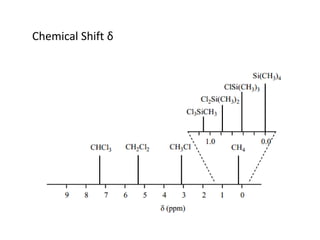
Chemical Shift δ
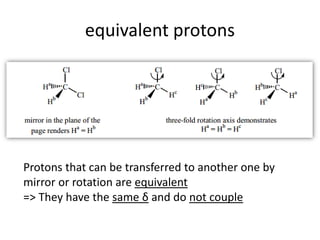
equivalent protons
Protons that can be transferred to another one by
mirror or rotation are equivalent
=> They have the same δ and do not couple
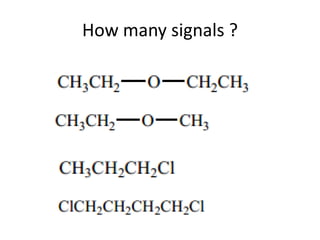
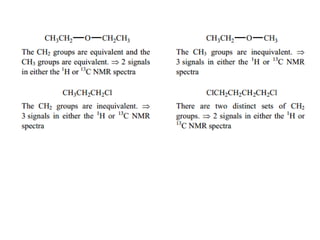
How many signals ?
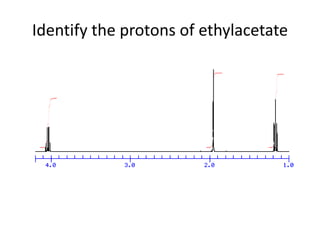
Identify the protons of ethylacetate
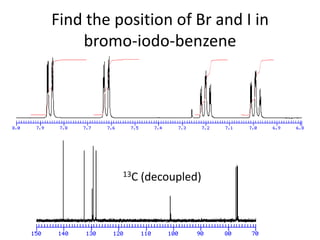
Find the position of Br and I in
bromo-iodo-benzene
13C (decoupled)
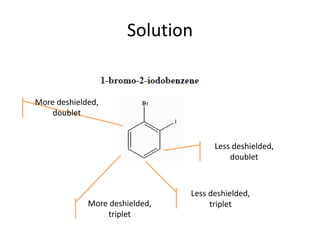
Solution
Less deshielded,
doublet
Less deshielded,
triplet
More deshielded,
doublet
More deshielded,
triplet
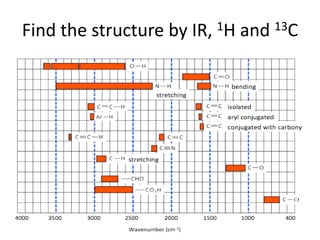
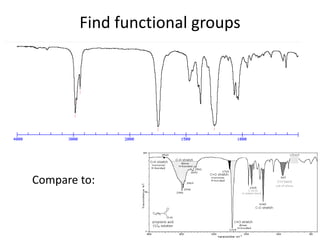
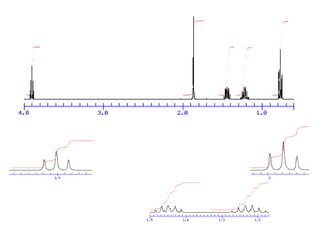
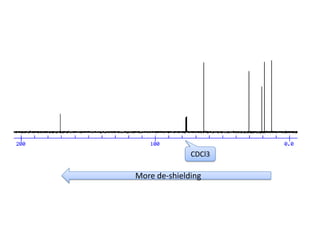
Find the structure by IR, 1H and 13C
Find functional groups
Compare to:
More de-shielding
CDCl3
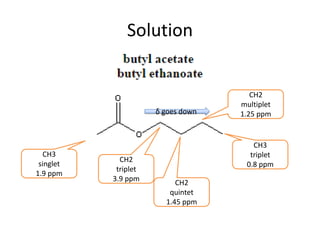
Solution
CH3
singlet
1.9 ppm
CH2
triplet
3.9 ppm CH2
quintet
1.45 ppm
CH2
multiplet
1.25 ppm
CH3
triplet
0.8 ppm
δ goes down
13C NMR
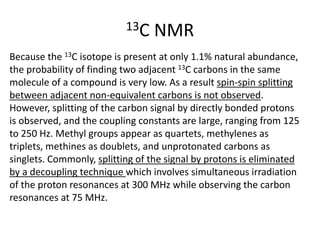
Because the 13C isotope is present at only 1.1% natural abundance,
the probability of finding two adjacent 13C carbons in the same
molecule of a compound is very low. As a result spin-spin splitting
between adjacent non-equivalent carbons is not observed.
However, splitting of the carbon signal by directly bonded protons
is observed, and the coupling constants are large, ranging from 125
to 250 Hz. Methyl groups appear as quartets, methylenes as
triplets, methines as doublets, and unprotonated carbons as
singlets. Commonly, splitting of the signal by protons is eliminated
by a decoupling technique which involves simultaneous irradiation
of the proton resonances at 300 MHz while observing the carbon
resonances at 75 MHz.
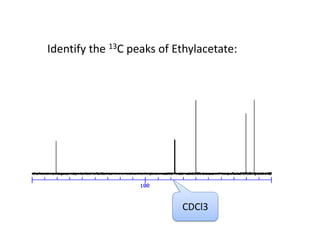
Identify the 13C peaks of Ethylacetate:
CDCl3
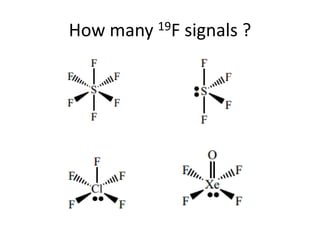
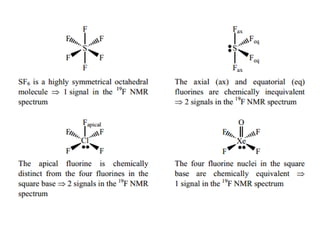
How many 19F signals ?
Problem solving with Spectroscopy

Problem solving with Spectroscopy