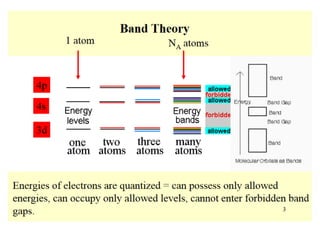
Inorganic Materials
UP, Dr. Chris 2019
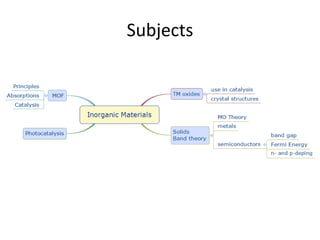
Subjects
SOLID STATE OF METALS
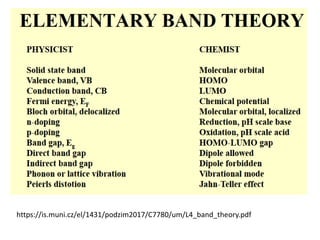
https://is.muni.cz/el/1431/podzim2017/C7780/um/L4_band_theory.pdf
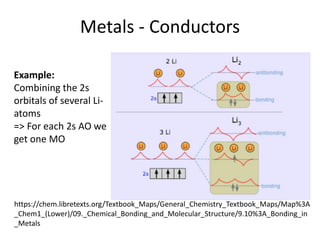
Metals - Conductors
Example:
Combining the 2s
orbitals of several Li-
atoms
=> For each 2s AO we
get one MO
https://chem.libretexts.org/Textbook_Maps/General_Chemistry_Textbook_Maps/Map%3A
_Chem1_(Lower)/09._Chemical_Bonding_and_Molecular_Structure/9.10%3A_Bonding_in
_Metals
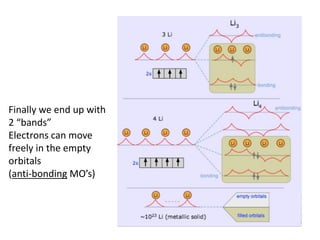
Finally we end up with
2 “bands”
Electrons can move
freely in the empty
orbitals
(anti-bonding MO’s)
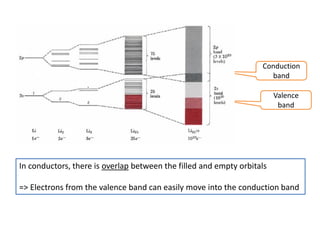
In conductors, there is overlap between the filled and empty orbitals
=> Electrons from the valence band can easily move into the conduction band
Conduction
band
Valence
band
SOLID STATE: SEMICONDUCTORS
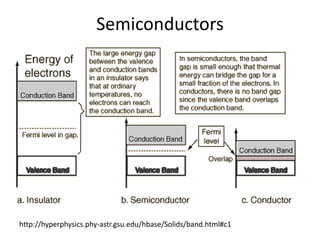
Semiconductors
http://hyperphysics.phy-astr.gsu.edu/hbase/Solids/band.html#c1
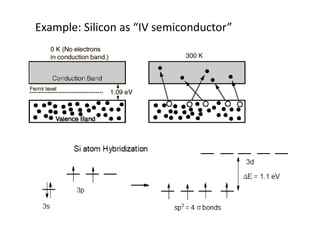
Example: Silicon as “IV semiconductor”
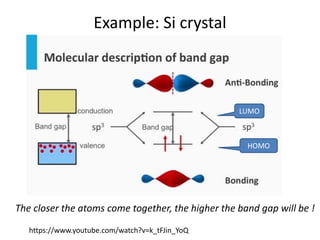
Example: Si crystal
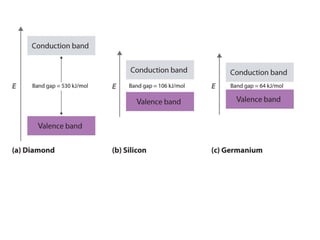
The closer the atoms come together, the higher the band gap will be !
LUMO
HOMO
https://www.youtube.com/watch?v=k_tFJin_YoQ
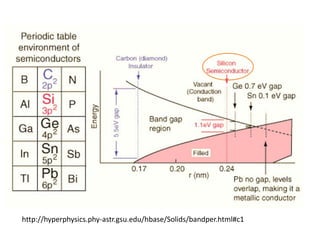
http://hyperphysics.phy-astr.gsu.edu/hbase/Solids/bandper.html#c1
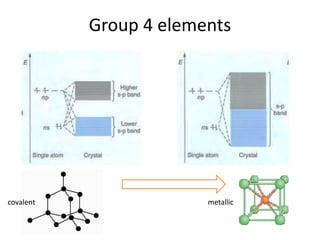
Group 4 elements
covalent metallic
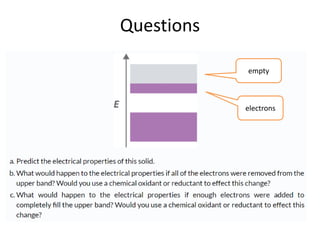
Questions
empty
electrons
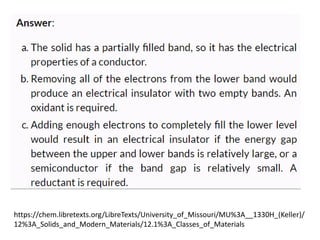
https://chem.libretexts.org/LibreTexts/University_of_Missouri/MU%3A__1330H_(Keller)/
12%3A_Solids_and_Modern_Materials/12.1%3A_Classes_of_Materials
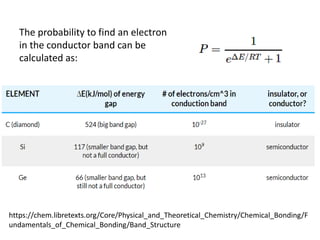
The probability to find an electron
in the conductor band can be
calculated as:
https://chem.libretexts.org/Core/Physical_and_Theoretical_Chemistry/Chemical_Bonding/F
undamentals_of_Chemical_Bonding/Band_Structure
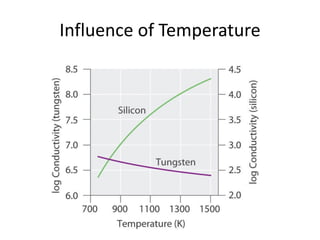
Influence of Temperature
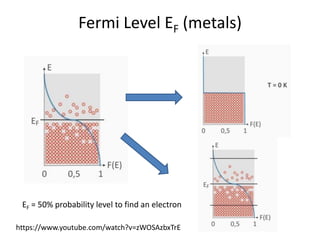
Fermi Level EF (metals)
EF = 50% probability level to find an electron
https://www.youtube.com/watch?v=zWOSAzbxTrE
For semiconductors, EF is in the middle of the band gap
The higher T, the more electrons
will come up to the conductive
band –
at 0 K, all electrons are in the
valence band
T up
Charge
carriers are
electrons
and holes
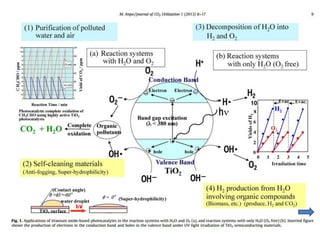
Example of practical applications
for TiO2
(J. of CO2 utilization 1 (2013),8-17)
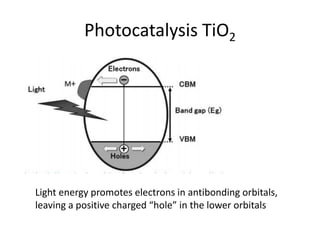
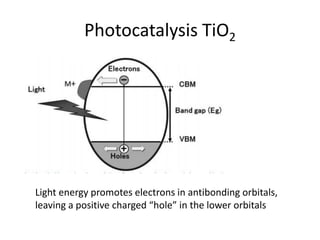
Photocatalysis TiO2
Light energy promotes electrons in antibonding orbitals,
leaving a positive charged “hole” in the lower orbitals
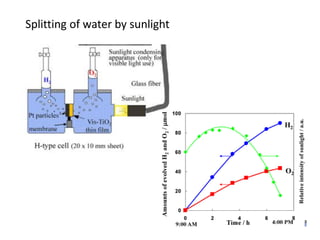
Splitting of water by sunlight
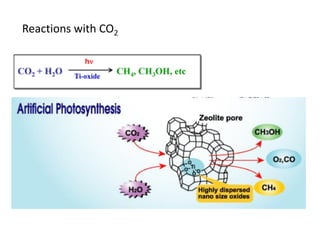
Reactions with CO2
https://www.azonano.com/article.aspx?ArticleID=4226
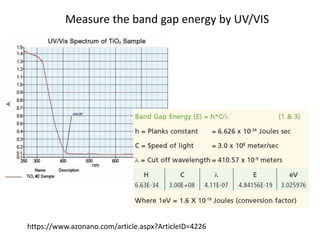
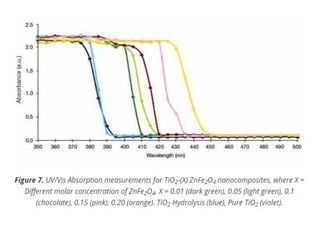
Measure the band gap energy by UV/VIS
RELATION MO DIAGRAM - BANDS
Extend MO theory
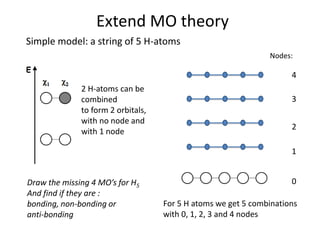
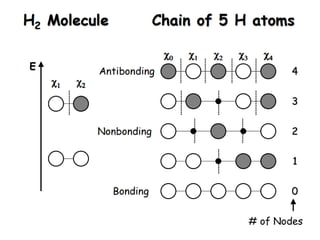
Simple model: a string of 5 H-atoms
2 H-atoms can be
combined
to form 2 orbitals,
with no node and
with 1 node
For 5 H atoms we get 5 combinations
with 0, 1, 2, 3 and 4 nodes
Nodes:
0
1
2
3
4
Draw the missing 4 MO’s for H5
And find if they are :
bonding, non-bonding or
anti-bonding
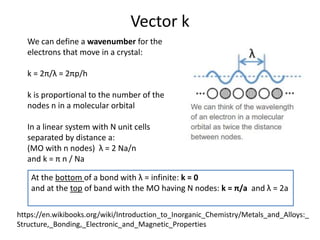
Vector k
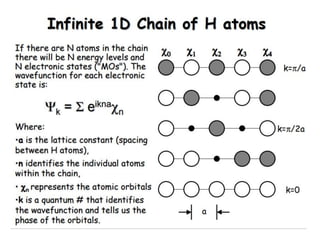
We can define a wavenumber for the
electrons that move in a crystal:
k = 2π/λ = 2πp/h
k is proportional to the number of the
nodes n in a molecular orbital
In a linear system with N unit cells
separated by distance a:
(MO with n nodes) λ = 2 Na/n
and k = π n / Na
At the bottom of a bond with λ = infinite: k = 0
and at the top of band with the MO having N nodes: k = π/a and λ = 2a
https://en.wikibooks.org/wiki/Introduction_to_Inorganic_Chemistry/Metals_and_Alloys:_
Structure,_Bonding,_Electronic_and_Magnetic_Properties
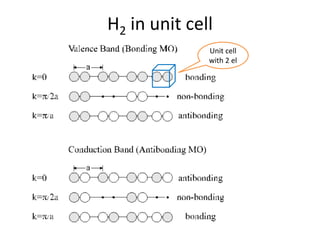
H2 in unit cell
Unit cell
with 2 el
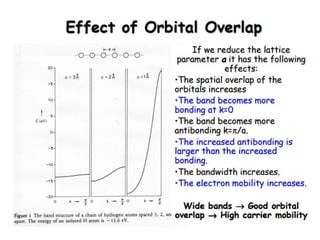
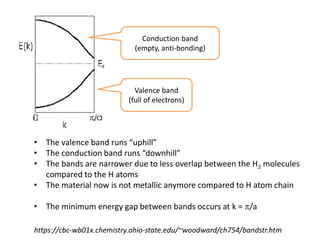
• The valence band runs “uphill”
• The conduction band runs “downhill”
• The bands are narrower due to less overlap between the H2 molecules
compared to the H atoms
• The material now is not metallic anymore compared to H atom chain
• The minimum energy gap between bands occurs at k = /a
Valence band
(full of electrons)
Conduction band
(empty, anti-bonding)
https://cbc-wb01x.chemistry.ohio-state.edu/~woodward/ch754/bandstr.htm
DOS – Density 0f States
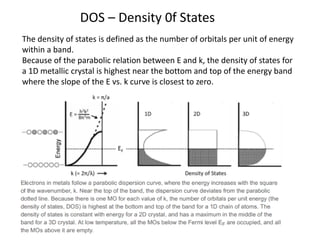
The density of states is defined as the number of orbitals per unit of energy
within a band.
Because of the parabolic relation between E and k, the density of states for
a 1D metallic crystal is highest near the bottom and top of the energy band
where the slope of the E vs. k curve is closest to zero.
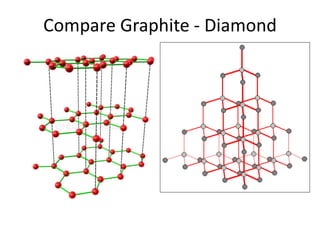
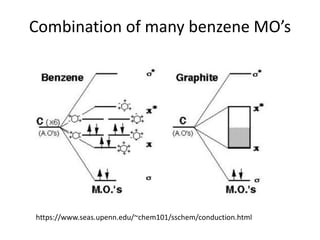
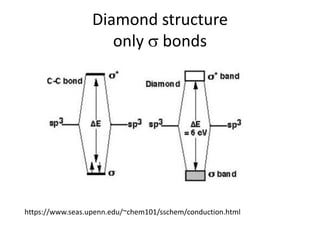
Compare Graphite - Diamond
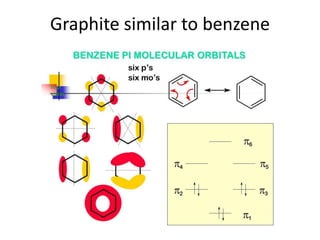
Graphite similar to benzene
Combination of many benzene MO’s
https://www.seas.upenn.edu/~chem101/sschem/conduction.html
Diamond structure
only  bonds
https://www.seas.upenn.edu/~chem101/sschem/conduction.html
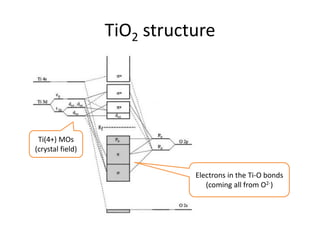
TiO2 structure
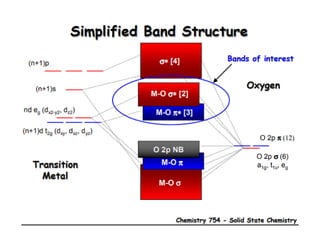
Ti(4+) MOs
(crystal field)
Electrons in the Ti-O bonds
(coming all from O2-)
Photocatalysis TiO2
Light energy promotes electrons in antibonding orbitals,
leaving a positive charged “hole” in the lower orbitals
TM OXIDES
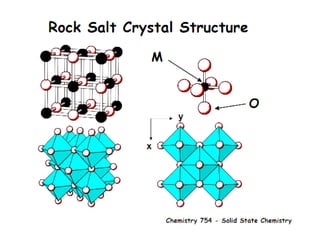
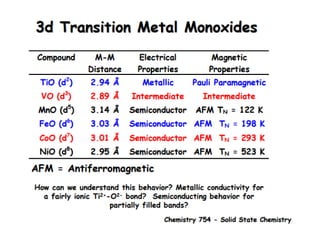
(1) Rocksalt Structure
Metal monoxides MO
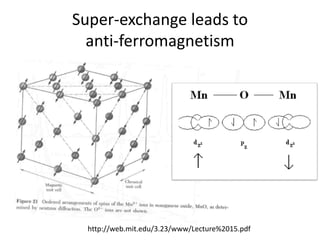
Super-exchange leads to
anti-ferromagnetism
http://web.mit.edu/3.23/www/Lecture%2015.pdf
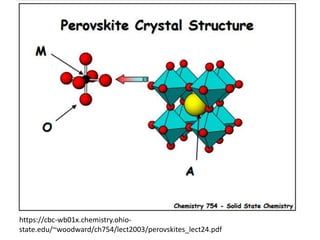
(2) Perovskite Structure ABO3
https://cbc-wb01x.chemistry.ohio-
state.edu/~woodward/ch754/lect2003/perovskites_lect24.pdf
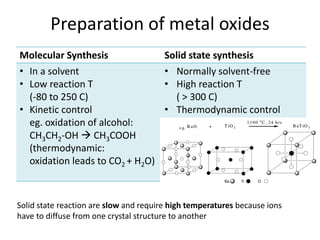
Preparation of metal oxides
Molecular Synthesis Solid state synthesis
• In a solvent
• Low reaction T
(-80 to 250 C)
• Kinetic control
eg. oxidation of alcohol:
CH3CH2-OH  CH3COOH
(thermodynamic:
oxidation leads to CO2 + H2O)
• Normally solvent-free
• High reaction T
( > 300 C)
• Thermodynamic control
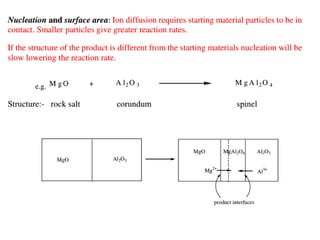
Solid state reaction are slow and require high temperatures because ions
have to diffuse from one crystal structure to another
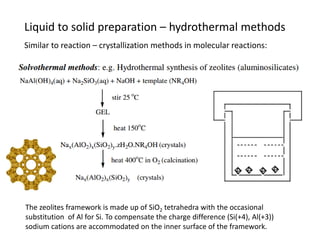
Liquid to solid preparation – hydrothermal methods
Similar to reaction – crystallization methods in molecular reactions:
The zeolites framework is made up of SiO2 tetrahedra with the occasional
substitution of Al for Si. To compensate the charge difference (Si(+4), Al(+3))
sodium cations are accommodated on the inner surface of the framework.
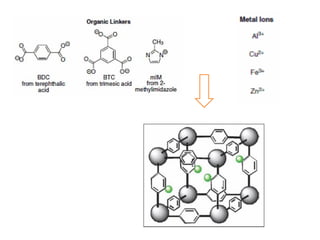
METAL ORGANIC FRAMEWORKS
(MOF)
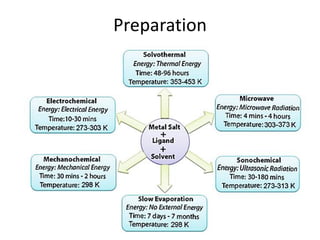
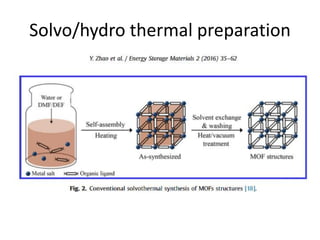
Solvo/hydro thermal preparation
Zeolite-like MOFs = ZIF
http://www.chemtube3d.com/solidstate/MOF-ZIF8.htm
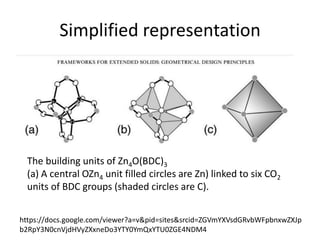
Simplified representation
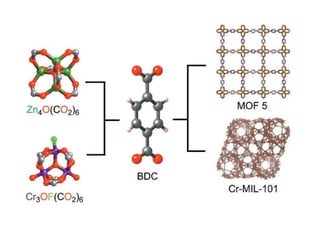
The building units of Zn4O(BDC)3
(a) A central OZn4 unit filled circles are Zn) linked to six CO2
units of BDC groups (shaded circles are C).
https://docs.google.com/viewer?a=v&pid=sites&srcid=ZGVmYXVsdGRvbWFpbnxwZXJp
b2RpY3N0cnVjdHVyZXxneDo3YTY0YmQxYTU0ZGE4NDM4
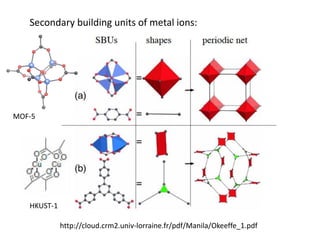
Secondary building units of metal ions:
http://cloud.crm2.univ-lorraine.fr/pdf/Manila/Okeeffe_1.pdf
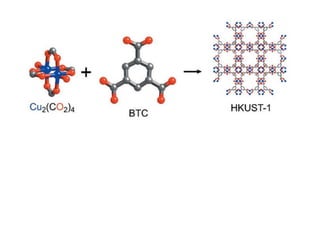
HKUST-1
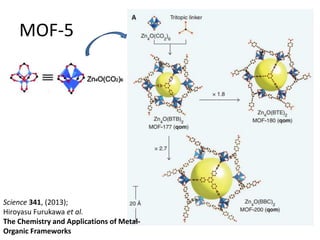
MOF-5
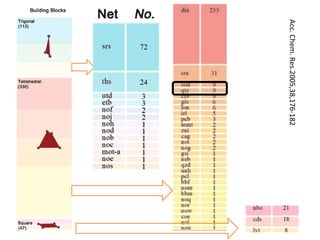
Acc.Chem.Res.2005,38,176-182
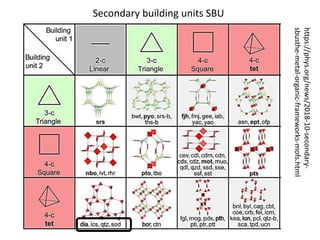
Secondary building units SBU
https://phys.org/news/2018-10-secondary-
sbusthe-metal-organic-frameworks-mofs.html
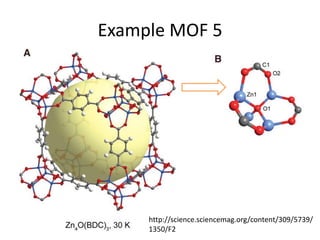
Example MOF 5
http://science.sciencemag.org/content/309/5739/
1350/F2
MOF-5
Science 341, (2013);
Hiroyasu Furukawa et al.
The Chemistry and Applications of Metal-
Organic Frameworks
MOF-5 (Zn4O(1,4-benzenedicarboxylate)3, 0.13-0.20 g/cm3)
consists of tetrahedral [Zn4O]6+ units that are linked together
with 1,4-benzene-dicarboxylate units. The opening in the
structure is 9.3-13.8 Å depending on the orientation of the
ring.
MOF-5 can store a significant amount of hydrogen at low
temperature (77 K: 7.1 wt % (40 bar), 10 wt % (100 bar)).
While the hydrogen storage capacity in decent at 77 K (66
g/L), its ability to store hydrogen at room temperature is
significantly lower (9.1 g/L), which limits its use as
hydrogen storage medium
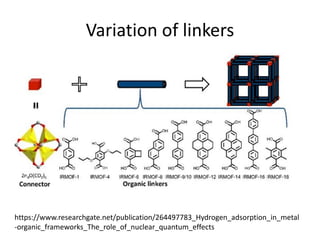
Variation of linkers
https://www.researchgate.net/publication/264497783_Hydrogen_adsorption_in_metal
-organic_frameworks_The_role_of_nuclear_quantum_effects
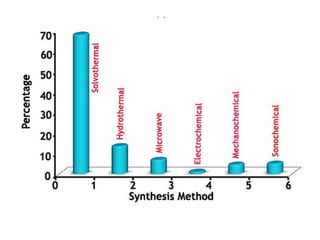
Preparation
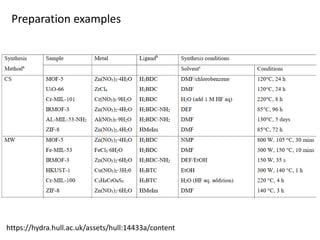
Preparation examples
https://hydra.hull.ac.uk/assets/hull:14433a/content
Zeolite-like MOF’s with Zn(2+) and Imidazole
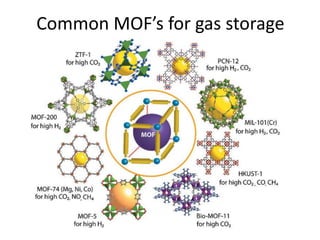
Common MOF’s for gas storage
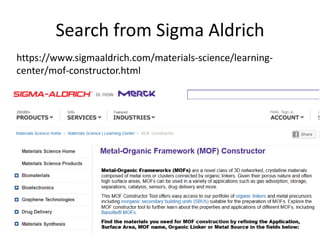
Search from Sigma Aldrich
https://www.sigmaaldrich.com/materials-science/learning-
center/mof-constructor.html
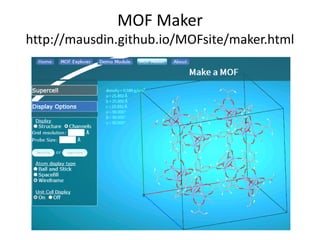
MOF Maker
http://mausdin.github.io/MOFsite/maker.html
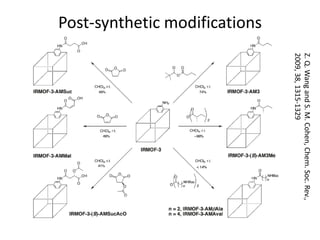
Post-synthetic modifications
Z.Q.WangandS.M.Cohen,Chem.Soc.Rev.,
2009,38,1315-1329
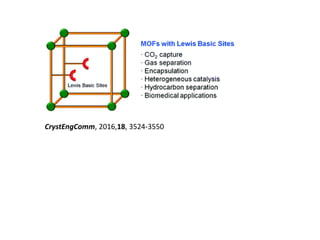
CrystEngComm, 2016,18, 3524-3550
APPENDICES
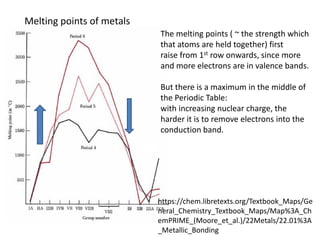
The melting points ( ~ the strength which
that atoms are held together) first
raise from 1st row onwards, since more
and more electrons are in valence bands.
But there is a maximum in the middle of
the Periodic Table:
with increasing nuclear charge, the
harder it is to remove electrons into the
conduction band.
https://chem.libretexts.org/Textbook_Maps/Ge
neral_Chemistry_Textbook_Maps/Map%3A_Ch
emPRIME_(Moore_et_al.)/22Metals/22.01%3A
_Metallic_Bonding
Melting points of metals
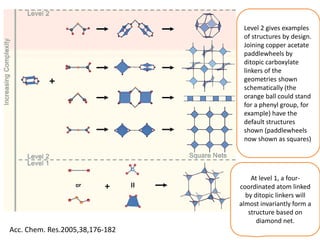
Acc. Chem. Res.2005,38,176-182
At level 1, a four-
coordinated atom linked
by ditopic linkers will
almost invariantly form a
structure based on
diamond net.
Level 2 gives examples
of structures by design.
Joining copper acetate
paddlewheels by
ditopic carboxylate
linkers of the
geometries shown
schematically (the
orange ball could stand
for a phenyl group, for
example) have the
default structures
shown (paddlewheels
now shown as squares)

Inorganic materials 2019