Dr. Susovan Bhowmik
Asst. Professor
Department of Chemistry
Bankura Sammilani College
LANTHANIDE AND ACTINIDE CHEMISTRY
Discovery:
Ytterby is a village in Sweden. In 1787 it was visited by an Army
officer C. A. Arhenious, who discovered unusual black
mineral (Earth). He sent it to Prof. John Gadolin for analysis.
Gadolin discovered Y, Tb, Er and Yb.
INNER TRANSITION ELEMENTS
The elements in which the additional electrons enters
(n-2)f orbitals are called inner transition elements. The valence
shell electronic configuration of these elements can be represented
as (n – 2)f1-14(n – 1)d0/1ns2.
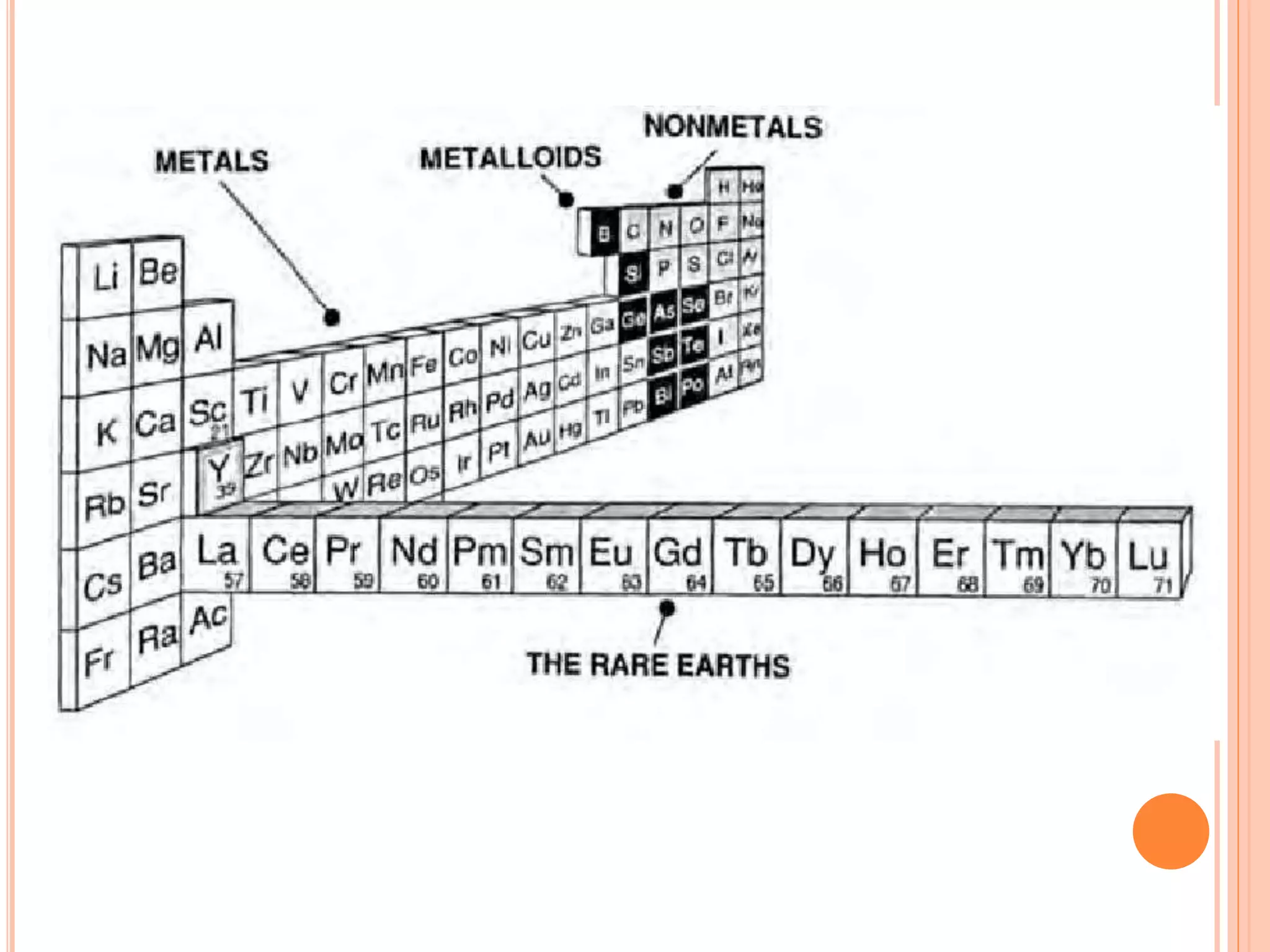
4f inner transition metals are known as lanthanides because they
come immediately after lanthanum and 5f inner transition metals
are known as actinoids because they come immediately after
actinium.
6s5d4f
Outermost
OrbitalAntepenultimate
Orbital Penultimate
Orbital
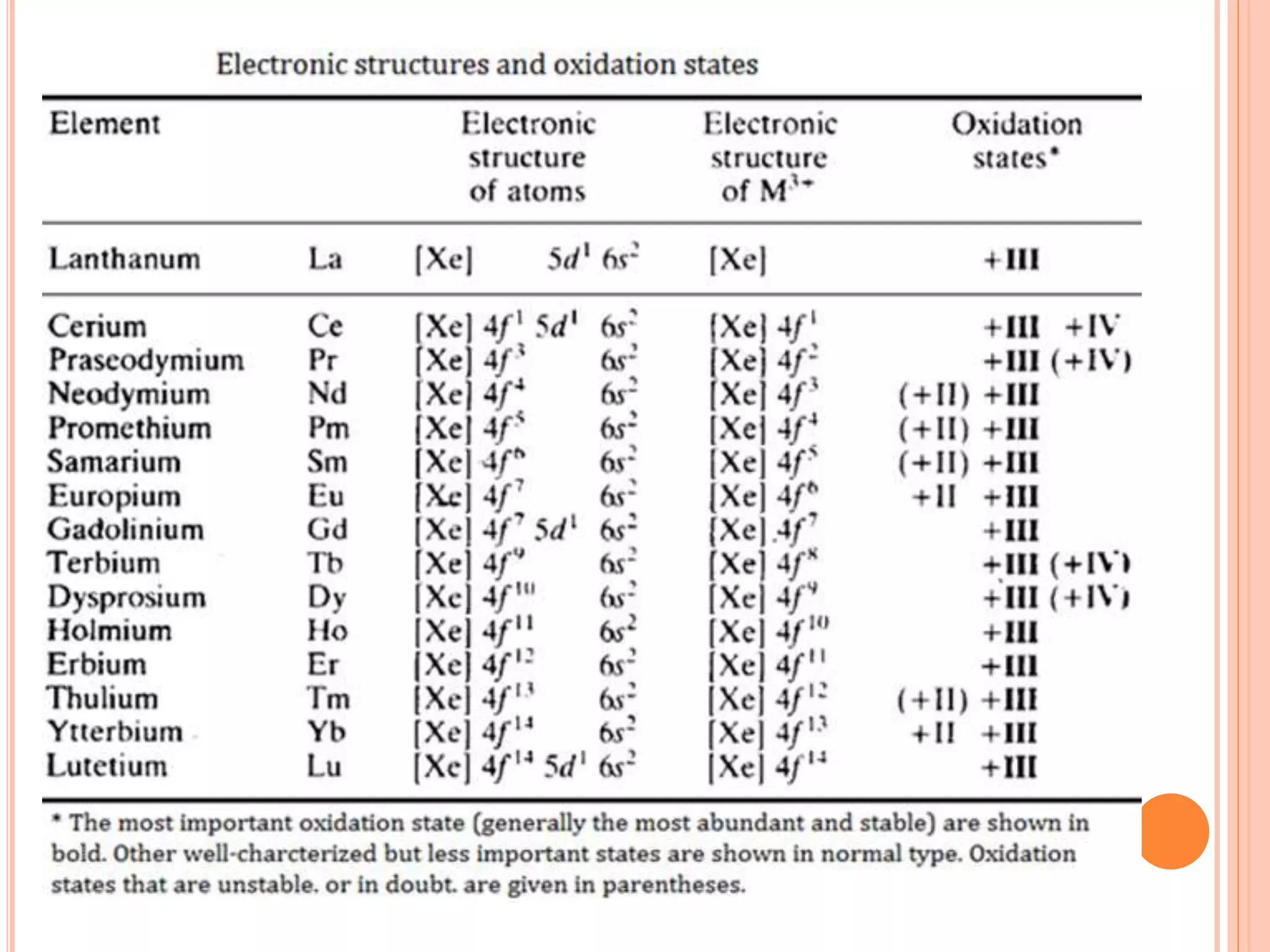
Ionisation Potential
I3(3rd I.P) for Eu and Yb is high, So
these prefer to have +2 Oxidation
State.
I4 (4th I.P) for Ce and Tb are low.
This explain stability for their +4
O.S
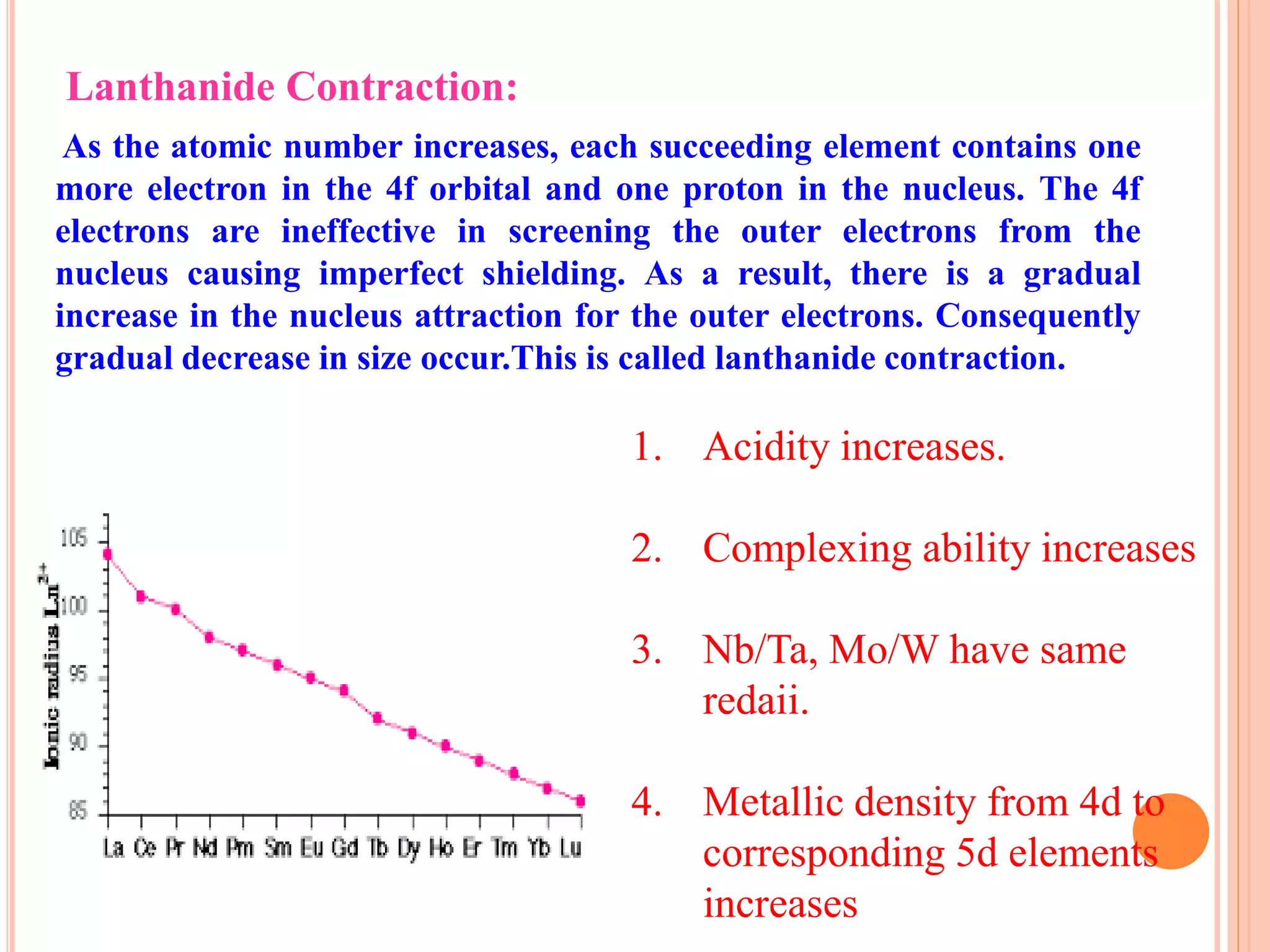
Lanthanide Contraction:
1. Acidity increases.
2. Complexing ability increases
3. Nb/Ta, Mo/W have same
redaii.
4. Metallic density from 4d to
corresponding 5d elements
increases
As the atomic number increases, each succeeding element contains one
more electron in the 4f orbital and one proton in the nucleus. The 4f
electrons are ineffective in screening the outer electrons from the
nucleus causing imperfect shielding. As a result, there is a gradual
increase in the nucleus attraction for the outer electrons. Consequently
gradual decrease in size occur.This is called lanthanide contraction.
Seperation Procedures:
Monazite is the ore: (Ln,Th)PO4
Seperation of the lanthanides is very
hard, given to their similar chemical and
physical property.
2) Complex Formation
4) Valency Change
3) Solvent Extraction
Tri-n butyl Phosphate
1) Fractional Crystallization
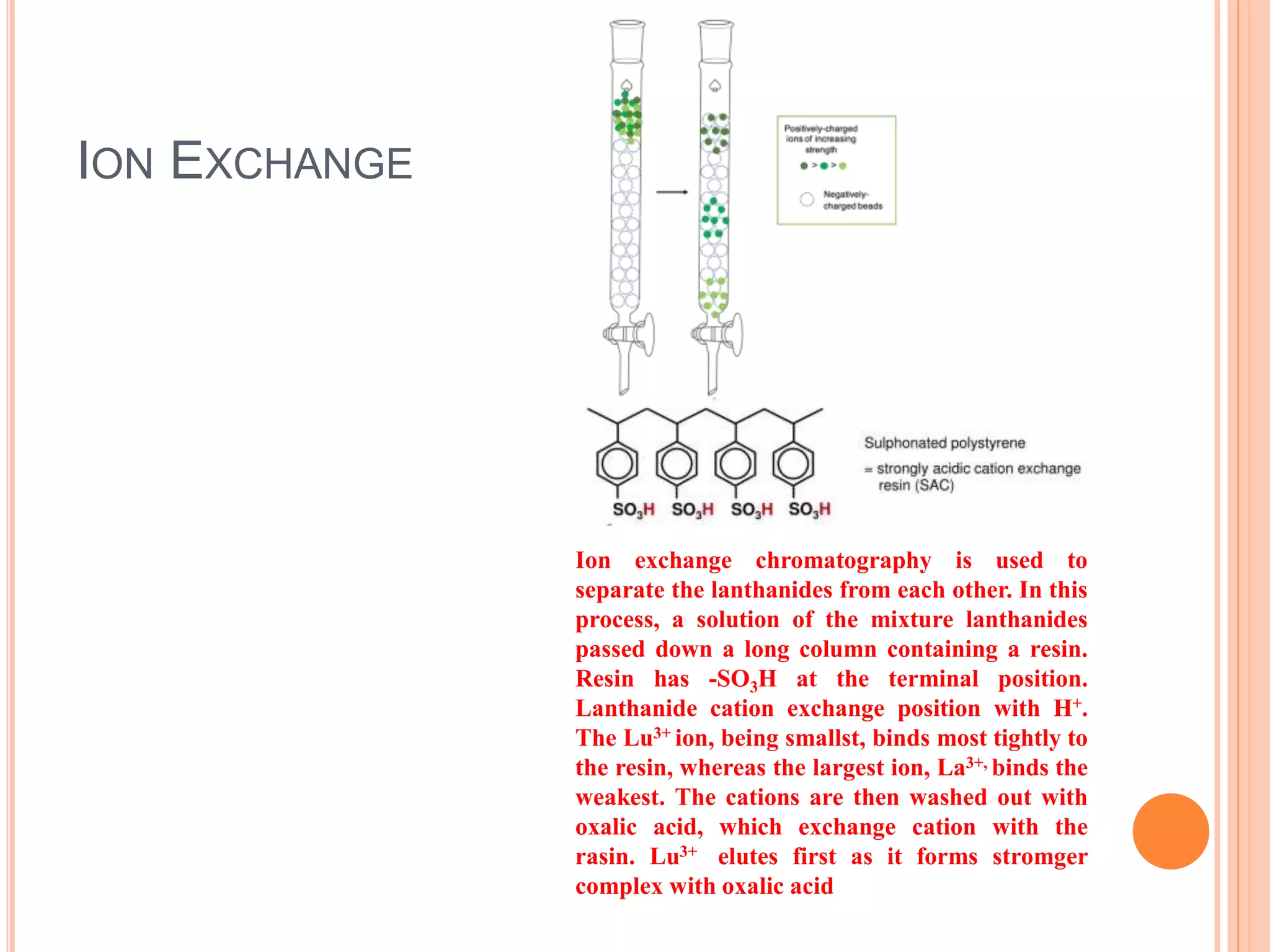
ION EXCHANGE
Ion exchange chromatography is used to
separate the lanthanides from each other. In this
process, a solution of the mixture lanthanides
passed down a long column containing a resin.
Resin has -SO3H at the terminal position.
Lanthanide cation exchange position with H+.
The Lu3+ ion, being smallst, binds most tightly to
the resin, whereas the largest ion, La3+, binds the
weakest. The cations are then washed out with
oxalic acid, which exchange cation with the
rasin. Lu3+ elutes first as it forms stromger
complex with oxalic acid
UV-Vis Spectrum
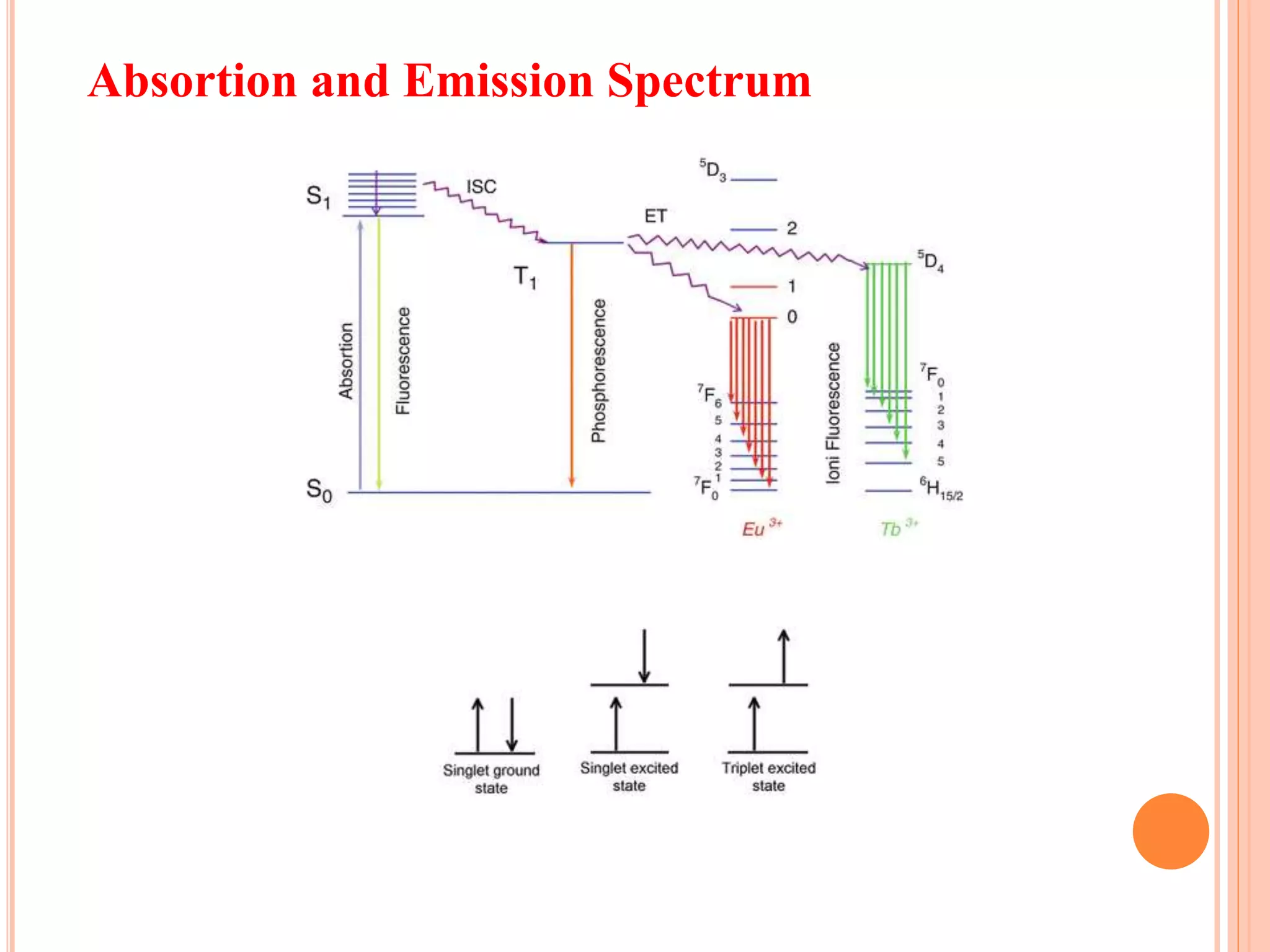
LUMINESCENCE OF LANTHANOID COMPLEXES
Irradiation of some Lanthanide(III) complexes with UV
light causes them to fluoresce
The origin of fluorescence is 4f-4f transitions.
–the excited state produced decays to the ground state
with emission of energy.
Some examples are Eu3+ (red) and Tb3+ (green)
They can be used as phosphors in television sets
and fluorescent lighting.
These applications are specific to lanthanoid ions
because of the sharp transitions observed.
Absortion and Emission Spectrum
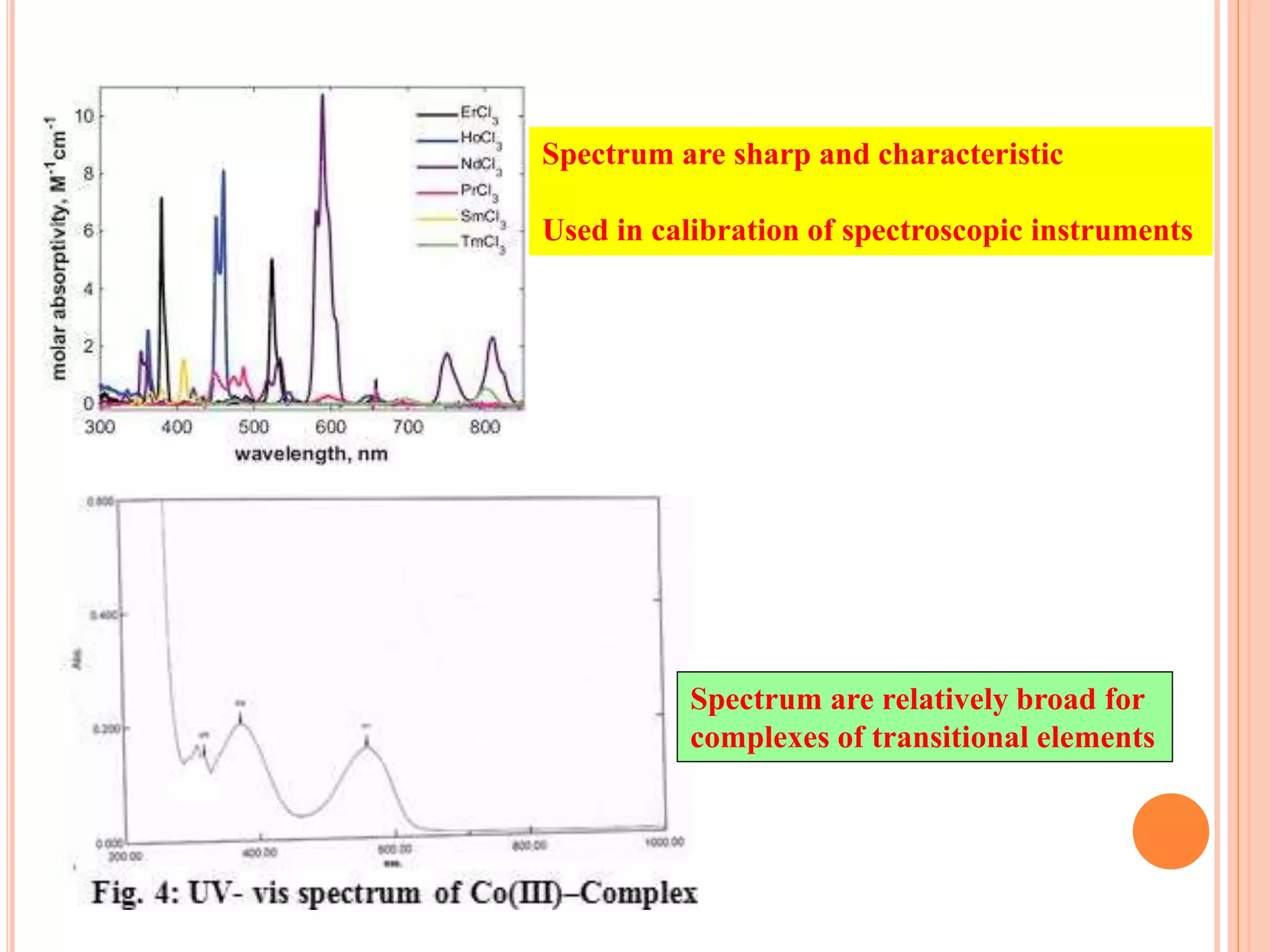
Spectrum are sharp and characteristic
Used in calibration of spectroscopic instruments
Spectrum are relatively broad for
complexes of transitional elements
MAGNETIC PROPERTIES
Lanthanides have very high magnetic susceptibilities due
to their large numbers of unpaired f-electrons.
The lanthanoid ions other then the f 0 type (La3+ and Ce3+) and
the f14 type (Yb2+ and Lu3+) are all paramagnetic. The
paramagnetism rises to the maximum in neodymium.
The strongest known magnets contain lanthanides
(eg. Nd-Fe-B, Sm-Fe-N, and Sm-Co).
Lanthanide complexes are used in MRI
(magnetic resonance imaging), eg. [Gd(III)(dtpa)]2-
Magnetism
For Spin only value:
applicable for symmetrically filled
f –electron system: La3+, Gd3+,Lu3+
𝜇𝐽 = 𝑔 √𝐽(𝐽 + 1) B.M
𝑔 = 1 + 𝑆(𝑆 + 1) + 𝐽(𝐽 + 1) − 𝐿(𝐿 + 1)
2𝐽(𝐽 + 1)
Applicable for
other lanthanides
g: Lande factor
J: Spin-orbit Coupling constant
S: Resultant spin moment
L: Resultant orbital moment
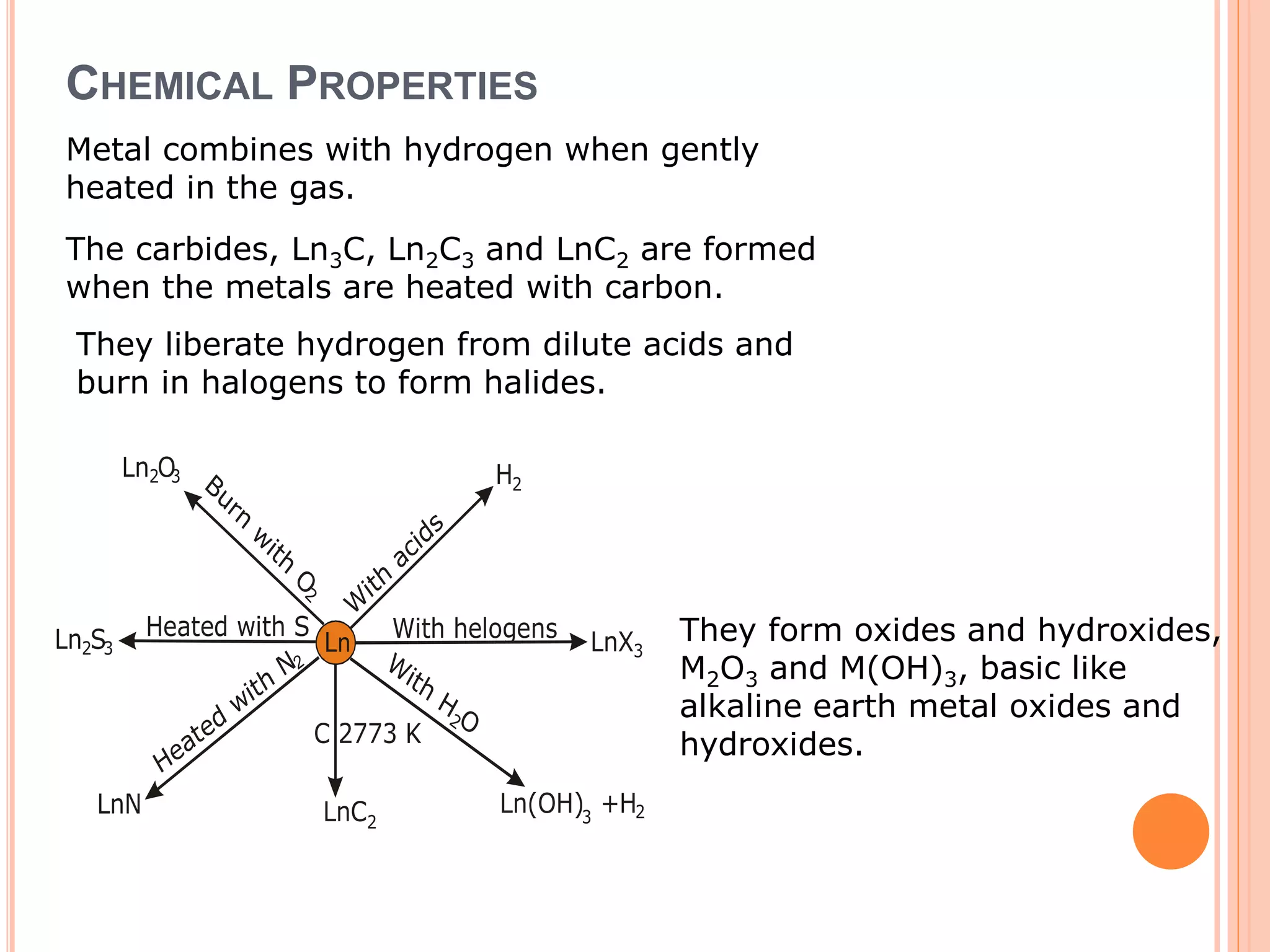
CHEMICAL PROPERTIES
Ln
W
ith
acids
With helogensHeated with S
Heated
with
N2
Burn
w
ith
O
2
2
C 2773 K
W
ith
H
O
Ln S2 3
2
32
2LnN LnC Ln(OH) +H
3LnX
HLn O2 3
Metal combines with hydrogen when gently
heated in the gas.
The carbides, Ln3C, Ln2C3 and LnC2 are formed
when the metals are heated with carbon.
They liberate hydrogen from dilute acids and
burn in halogens to form halides.
They form oxides and hydroxides,
M2O3 and M(OH)3, basic like
alkaline earth metal oxides and
hydroxides.
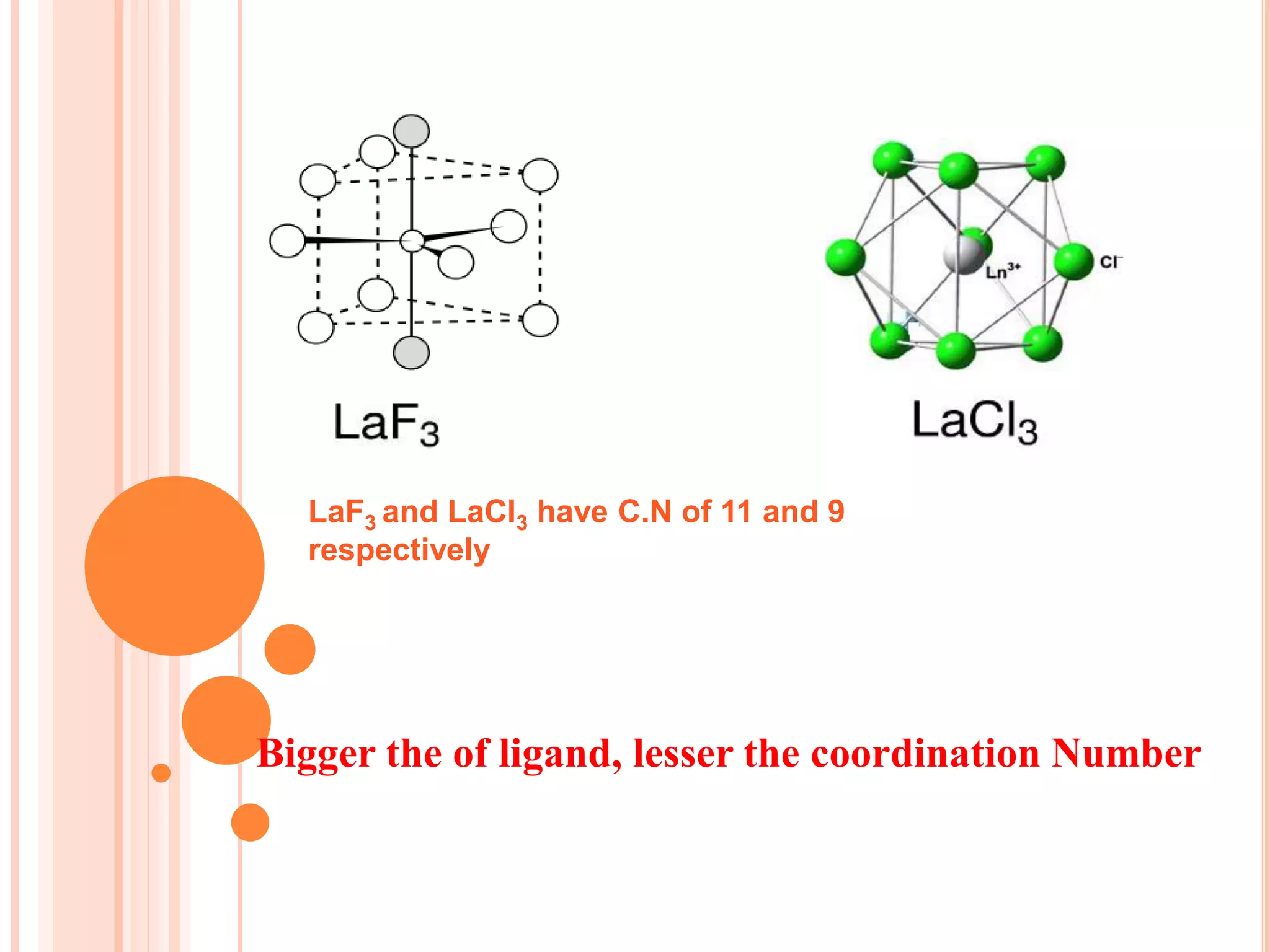
LaF3 and LaCl3 have C.N of 11 and 9
respectively
Bigger the of ligand, lesser the coordination Number
CN = 7
CN = 8
Ln3+/ pm
99 pm
116pm
Bigger the cation, higher the coordination number
C8H8
2- binds to Ce(IV) Ln in +3 O.S
Organometallic complexes of lanthanides
COMPARISON OF LANTHANIDES AND ACTINIDES
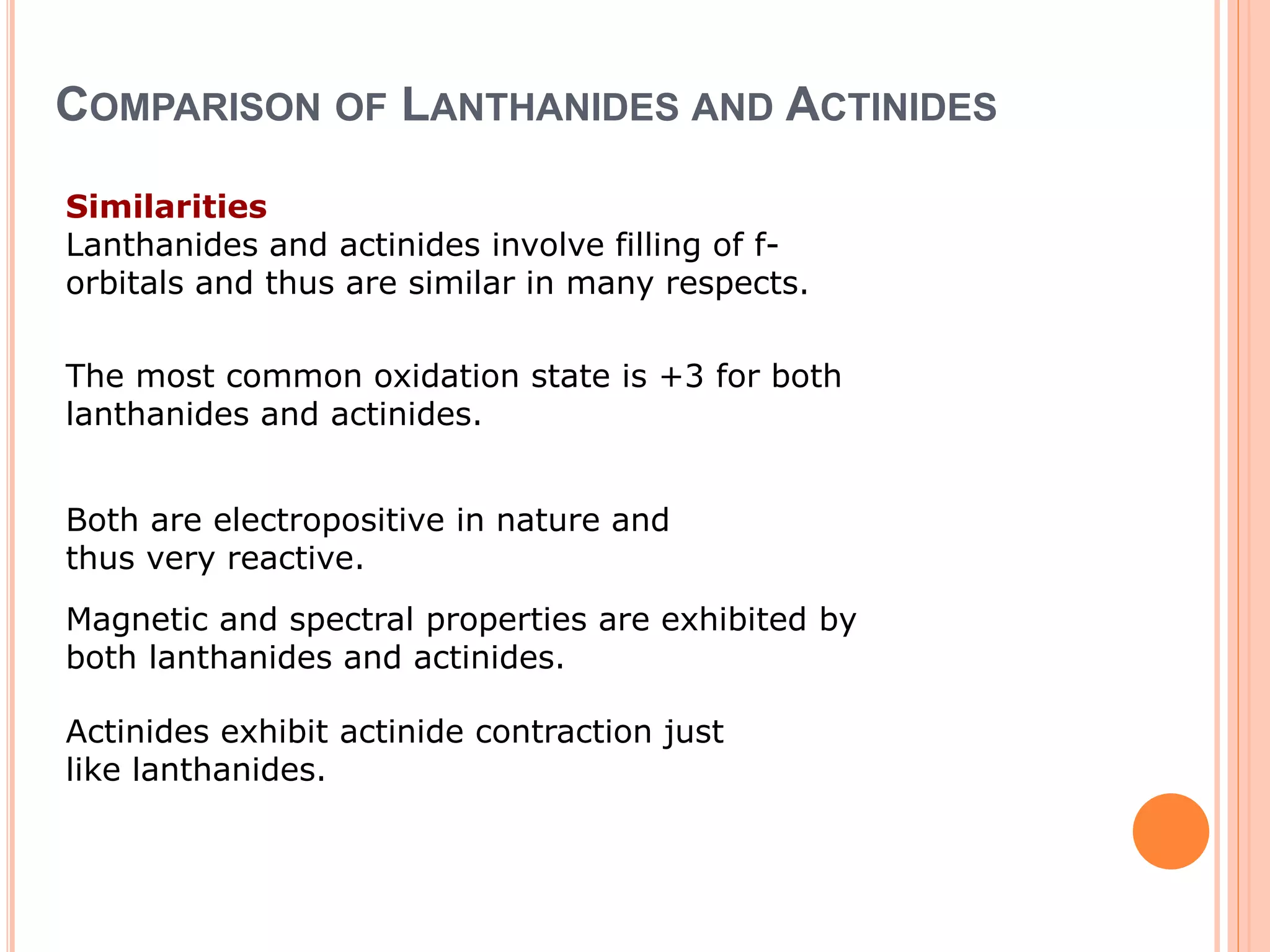
Similarities
Lanthanides and actinides involve filling of f-
orbitals and thus are similar in many respects.
The most common oxidation state is +3 for both
lanthanides and actinides.
Both are electropositive in nature and
thus very reactive.
Magnetic and spectral properties are exhibited by
both lanthanides and actinides.
Actinides exhibit actinide contraction just
like lanthanides.
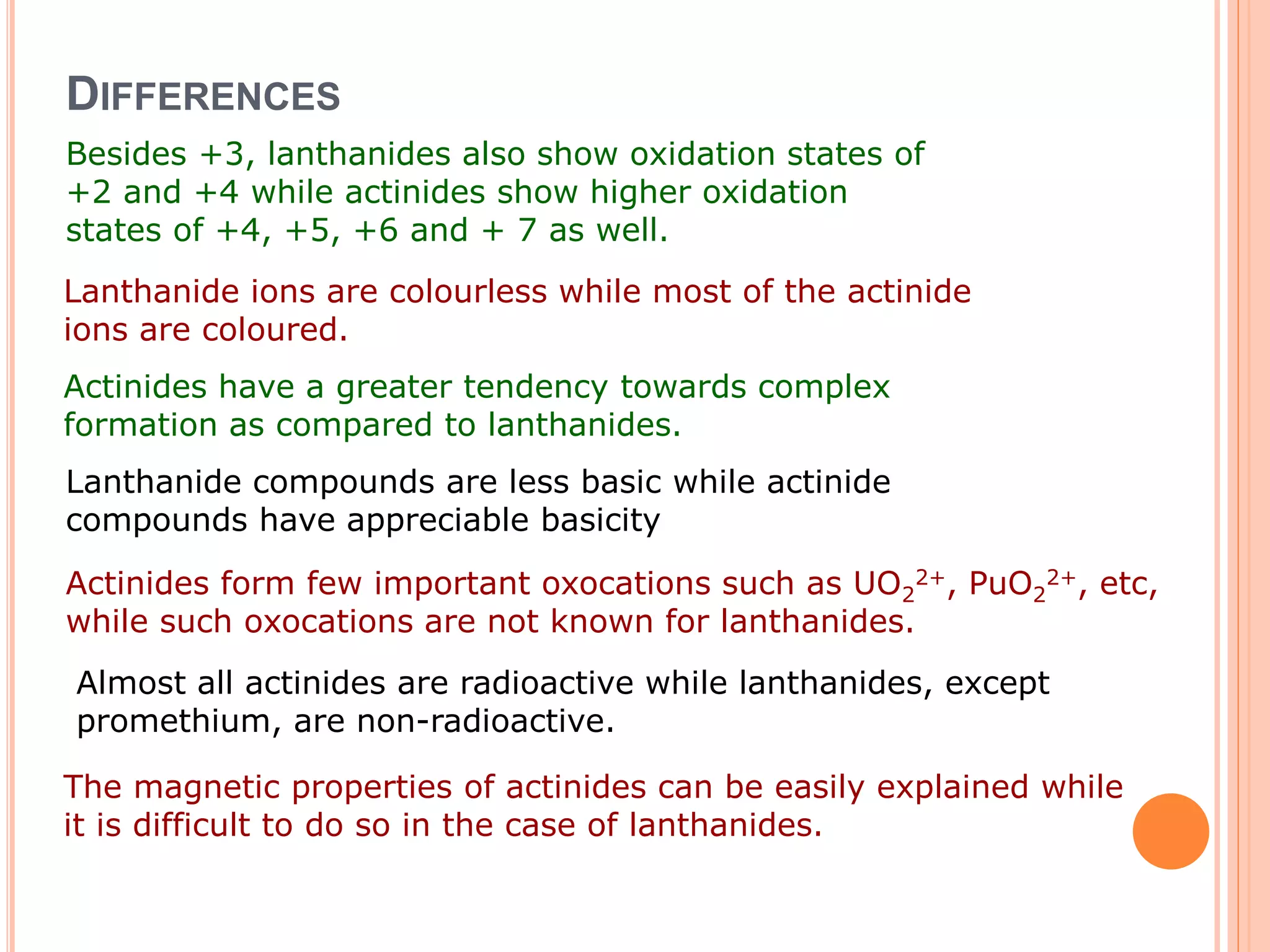
DIFFERENCES
Besides +3, lanthanides also show oxidation states of
+2 and +4 while actinides show higher oxidation
states of +4, +5, +6 and + 7 as well.
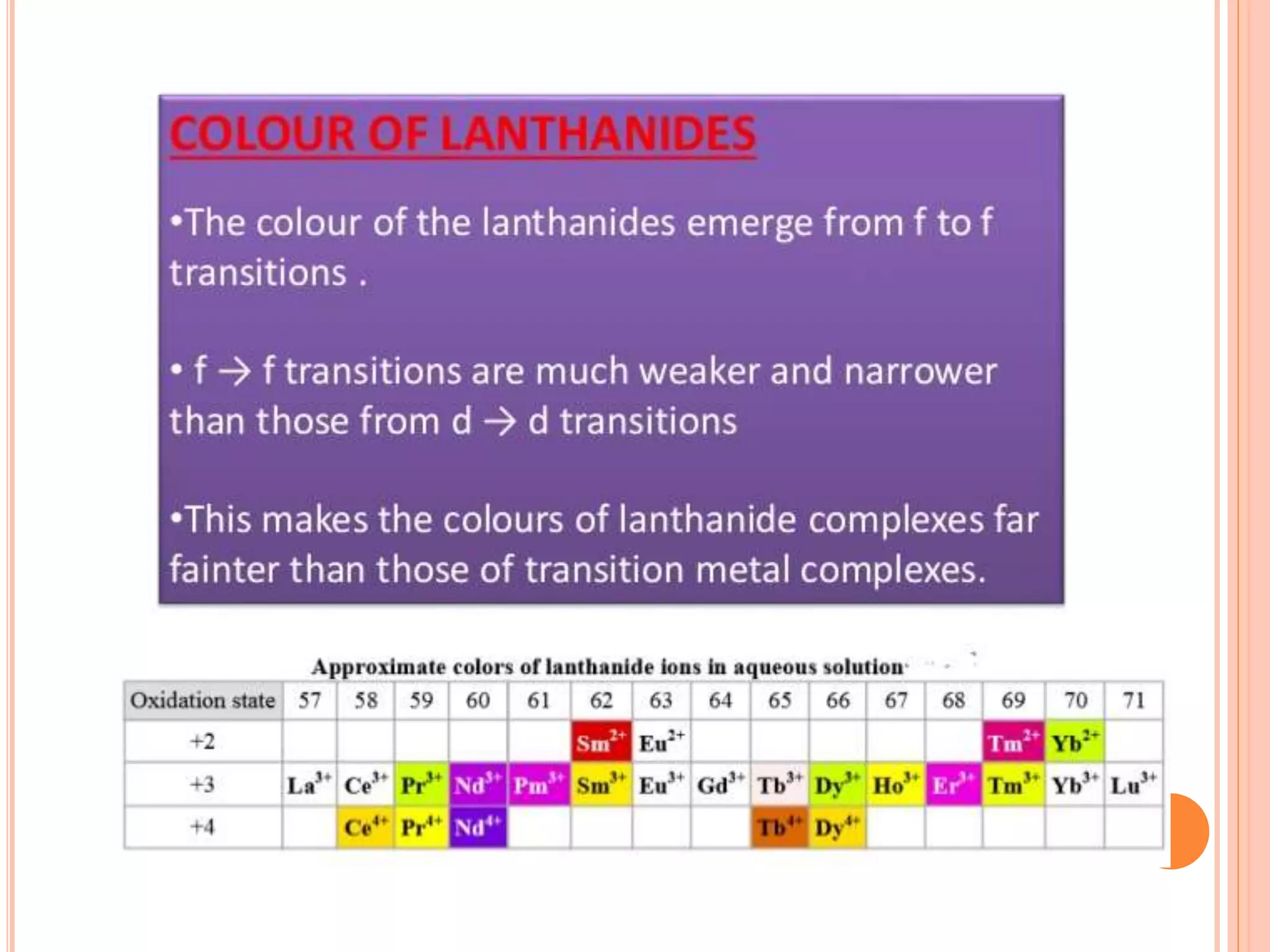
Lanthanide ions are colourless while most of the actinide
ions are coloured.
Actinides have a greater tendency towards complex
formation as compared to lanthanides.
Lanthanide compounds are less basic while actinide
compounds have appreciable basicity
Actinides form few important oxocations such as UO2
2+, PuO2
2+, etc,
while such oxocations are not known for lanthanides.
Almost all actinides are radioactive while lanthanides, except
promethium, are non-radioactive.
The magnetic properties of actinides can be easily explained while
it is difficult to do so in the case of lanthanides.
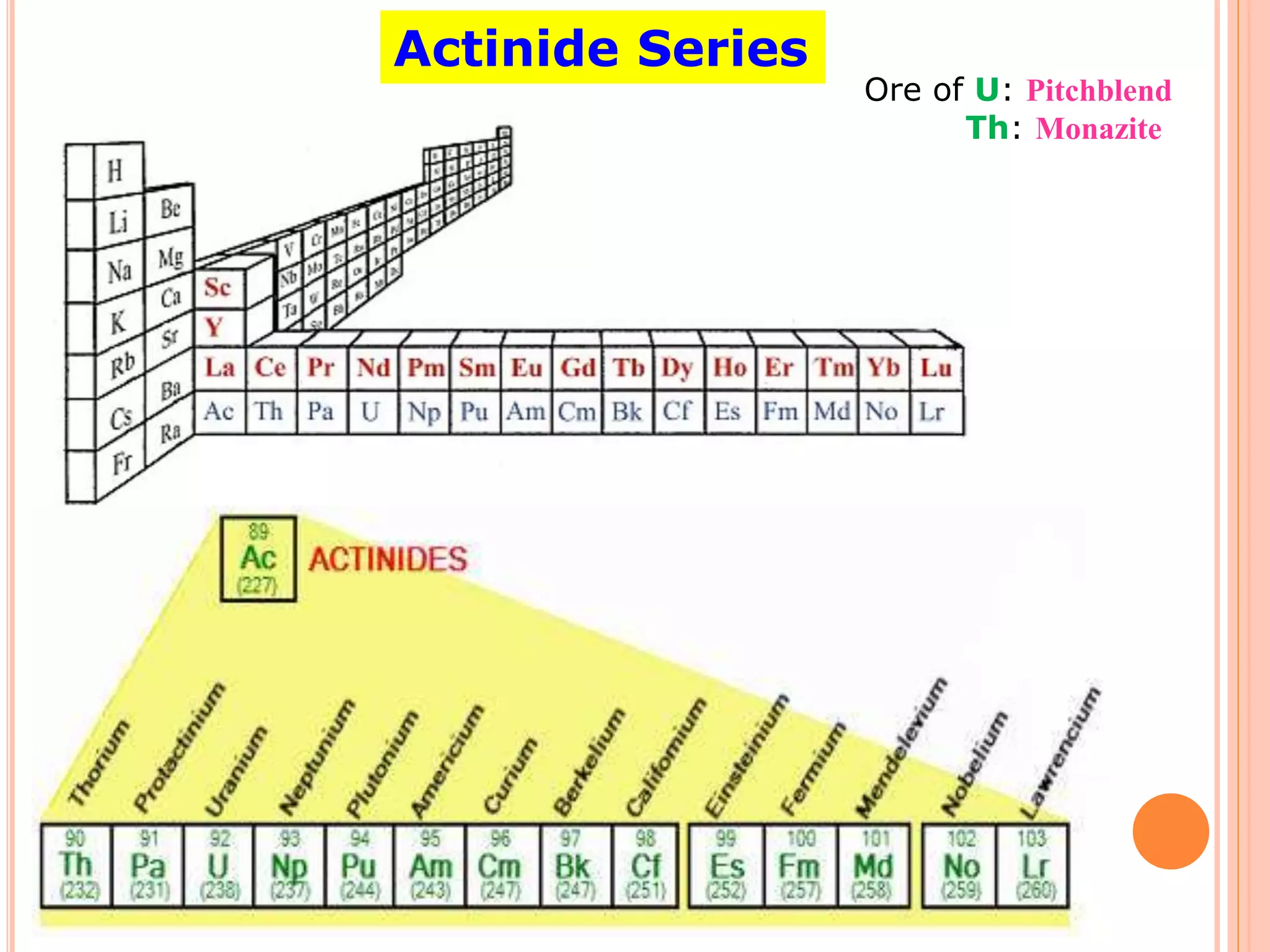
THE ACTINIDES
Result from the filling of the 5f orbitals.
The others must be made by nuclear processes.
Only Th and U occur naturally-both are more
abundant in the earth’s crust than tin.
All isotopes are radioactive, with only 232Th,
235U, 238U and 244Pu having long half-lives.
SOME CHARACTERISTIC
PROPERTIES OF ACTINIDES
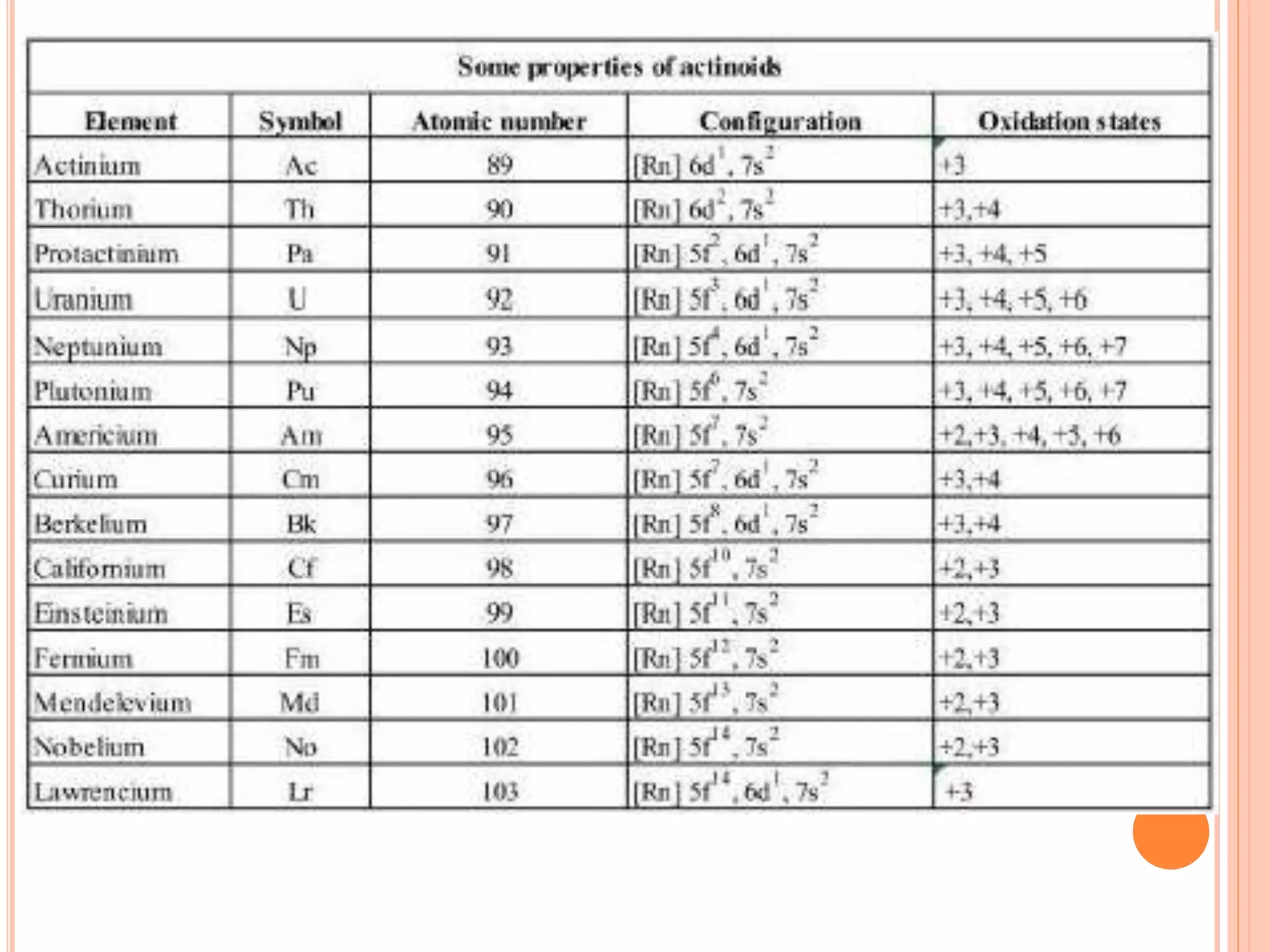
The dominant oxidation state of actinides is +3. Actinides also
exhibit an oxidation state of +4. Some actinides such as uranium,
neptunium and plutonium also exhibit an oxidation state of +6.
The actinides show actinide contraction (like lanthanide contraction)
due to poor shielding of the nuclear charge by 5f electrons.
All the actinides are radioactive. Actinides are radioactive in nature.
So the study of their chemistry is difficult in the laboratory. Their
chemistry is studied using tracer techniques.
Actinide Series
Ore of U: Pitchblend
Th: Monazite
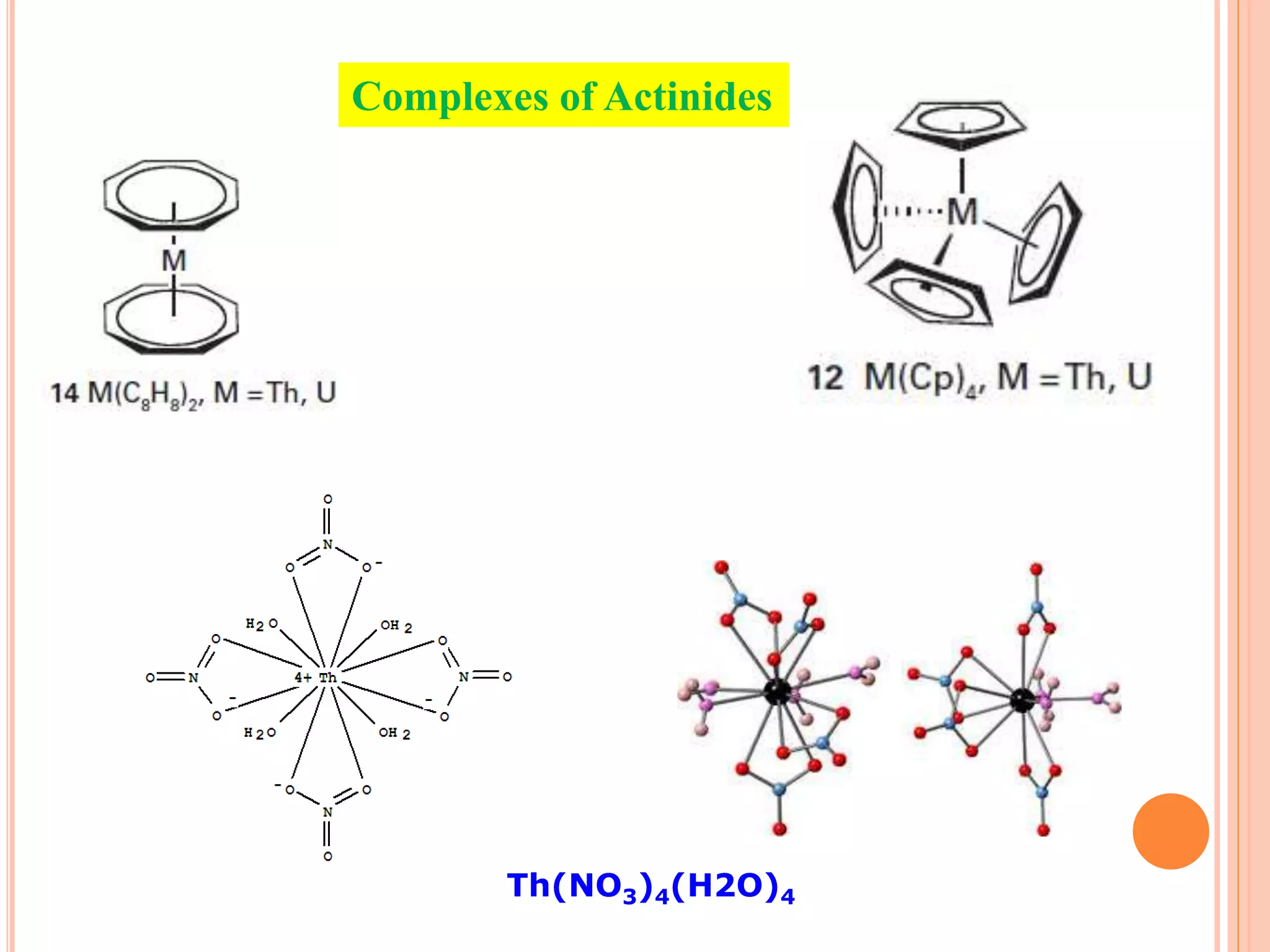
Th(NO3)4(H2O)4
Complexes of Actinides
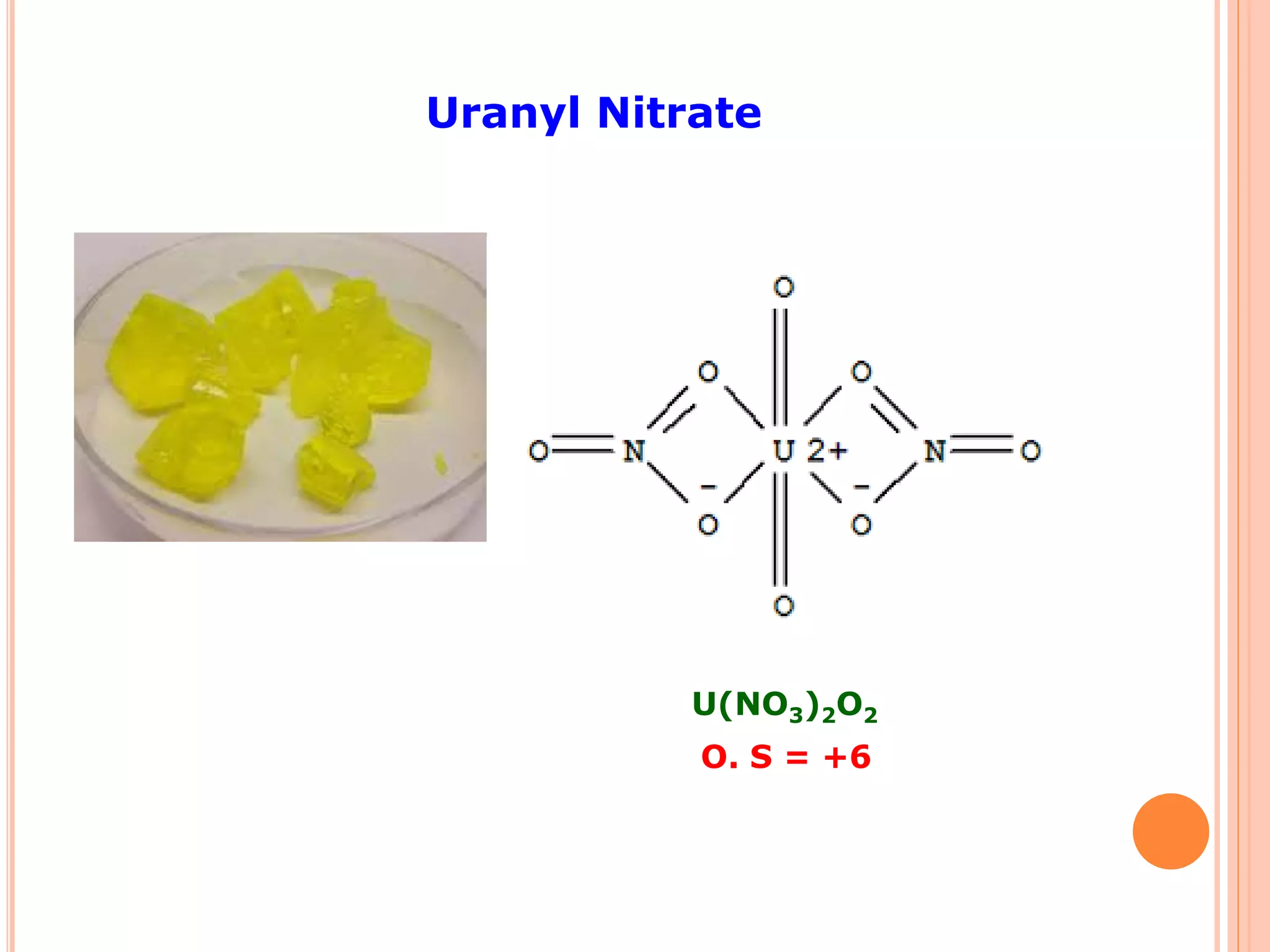
Uranyl Nitrate
U(NO3)2O2
O. S = +6
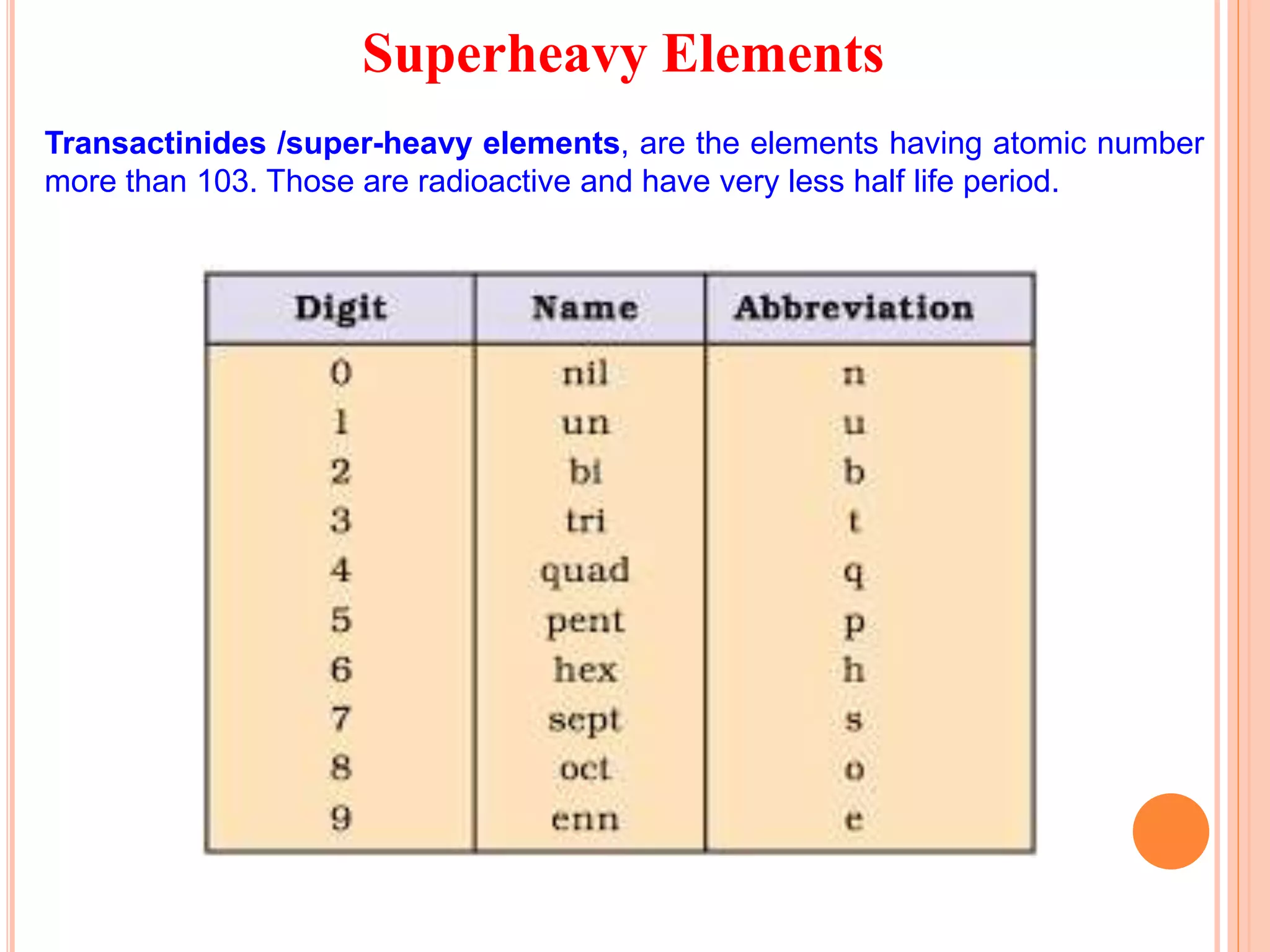
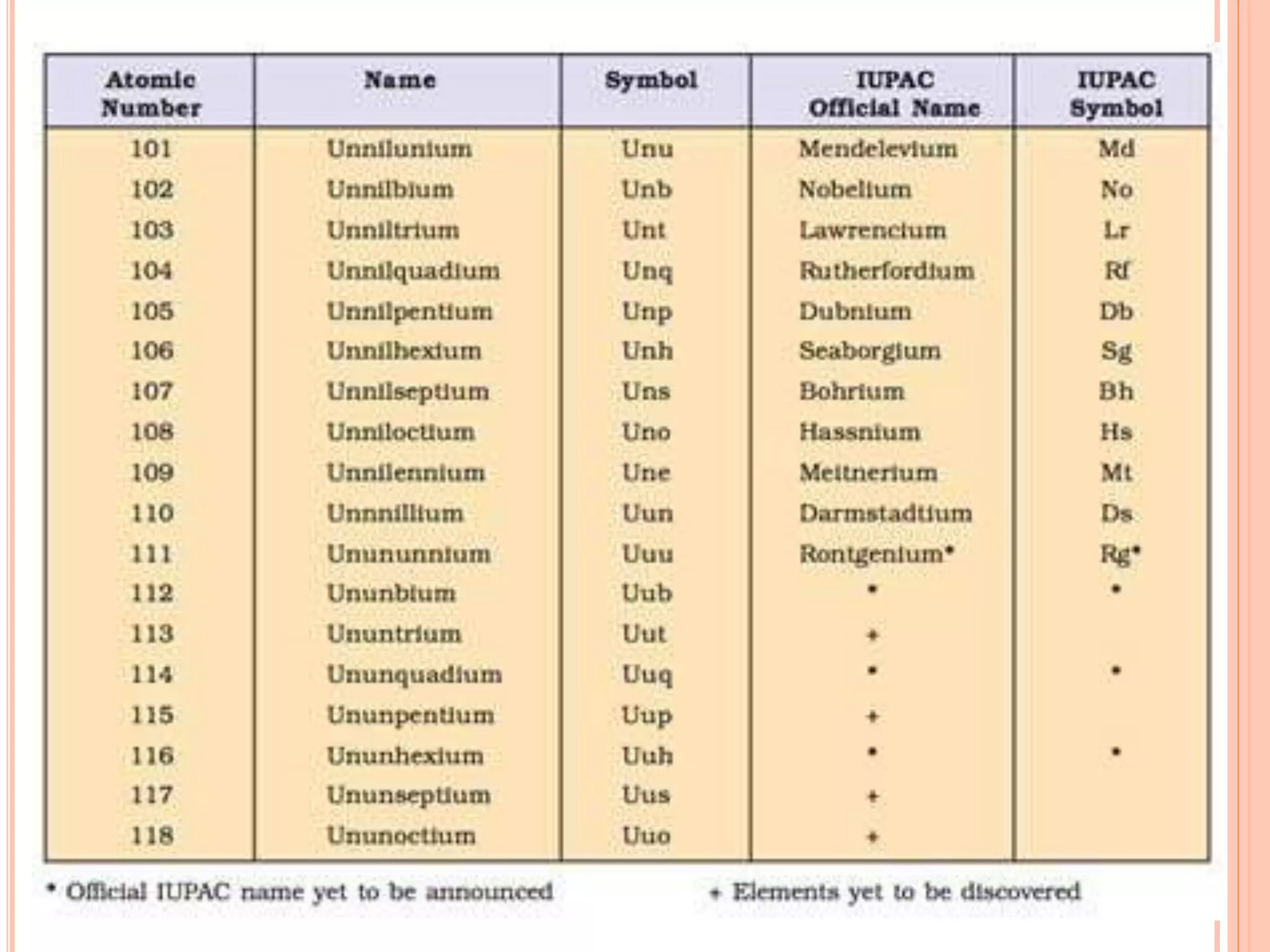
Superheavy Elements
Transactinides /super-heavy elements, are the elements having atomic number
more than 103. Those are radioactive and have very less half life period.
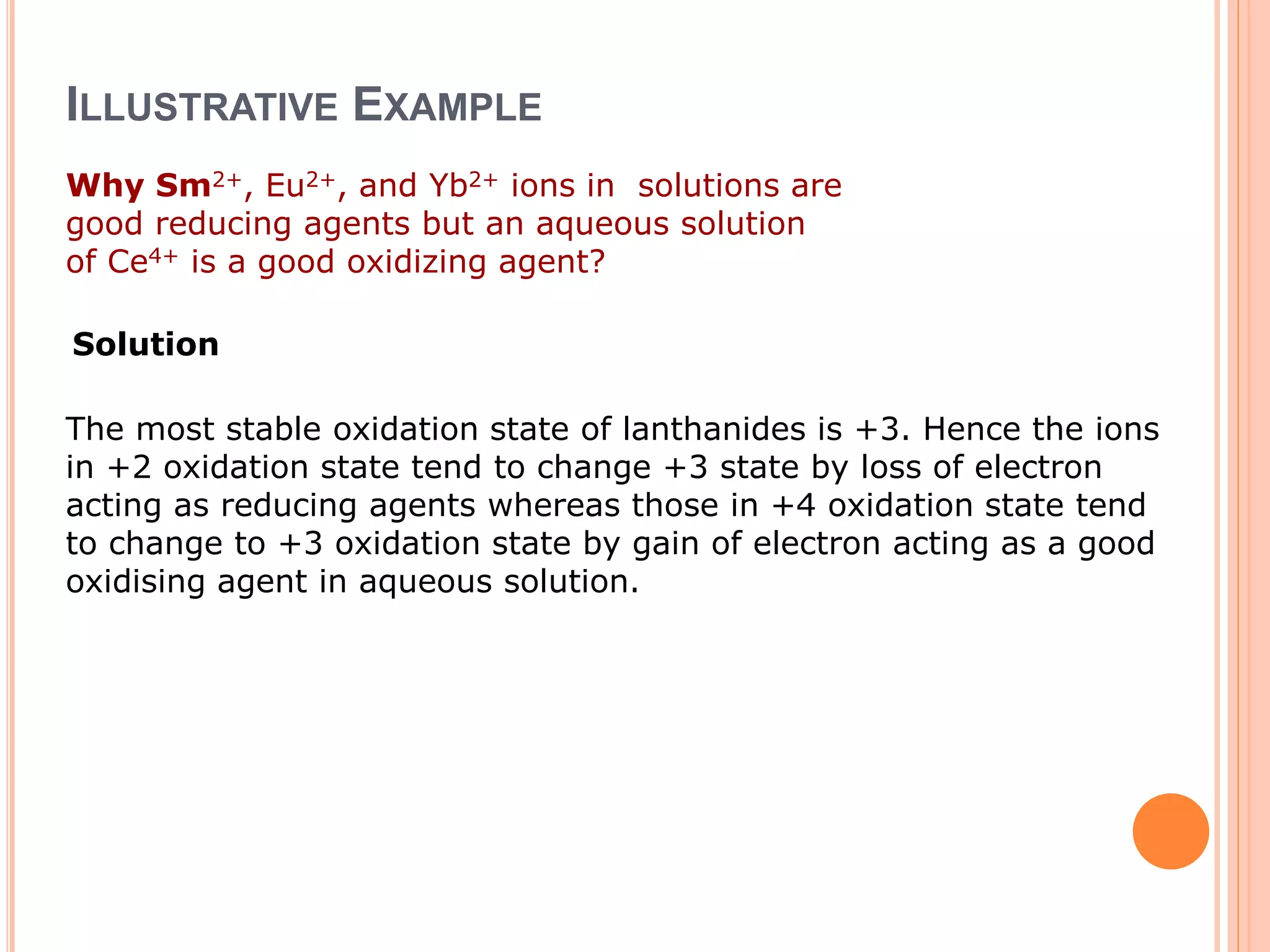
ILLUSTRATIVE EXAMPLE
Why Sm2+, Eu2+, and Yb2+ ions in solutions are
good reducing agents but an aqueous solution
of Ce4+ is a good oxidizing agent?
Solution
The most stable oxidation state of lanthanides is +3. Hence the ions
in +2 oxidation state tend to change +3 state by loss of electron
acting as reducing agents whereas those in +4 oxidation state tend
to change to +3 oxidation state by gain of electron acting as a good
oxidising agent in aqueous solution.

Lanthanide and actinide chemistry

  • 1.
    Dr. Susovan Bhowmik Asst.Professor Department of Chemistry Bankura Sammilani College LANTHANIDE AND ACTINIDE CHEMISTRY
  • 2.
    Discovery: Ytterby is avillage in Sweden. In 1787 it was visited by an Army officer C. A. Arhenious, who discovered unusual black mineral (Earth). He sent it to Prof. John Gadolin for analysis. Gadolin discovered Y, Tb, Er and Yb.
  • 4.
    INNER TRANSITION ELEMENTS Theelements in which the additional electrons enters (n-2)f orbitals are called inner transition elements. The valence shell electronic configuration of these elements can be represented as (n – 2)f1-14(n – 1)d0/1ns2. 4f inner transition metals are known as lanthanides because they come immediately after lanthanum and 5f inner transition metals are known as actinoids because they come immediately after actinium. 6s5d4f Outermost OrbitalAntepenultimate Orbital Penultimate Orbital
  • 6.
    Ionisation Potential I3(3rd I.P)for Eu and Yb is high, So these prefer to have +2 Oxidation State. I4 (4th I.P) for Ce and Tb are low. This explain stability for their +4 O.S
  • 7.
    Lanthanide Contraction: 1. Acidityincreases. 2. Complexing ability increases 3. Nb/Ta, Mo/W have same redaii. 4. Metallic density from 4d to corresponding 5d elements increases As the atomic number increases, each succeeding element contains one more electron in the 4f orbital and one proton in the nucleus. The 4f electrons are ineffective in screening the outer electrons from the nucleus causing imperfect shielding. As a result, there is a gradual increase in the nucleus attraction for the outer electrons. Consequently gradual decrease in size occur.This is called lanthanide contraction.
  • 8.
    Seperation Procedures: Monazite isthe ore: (Ln,Th)PO4 Seperation of the lanthanides is very hard, given to their similar chemical and physical property. 2) Complex Formation 4) Valency Change 3) Solvent Extraction Tri-n butyl Phosphate 1) Fractional Crystallization
  • 9.
    ION EXCHANGE Ion exchangechromatography is used to separate the lanthanides from each other. In this process, a solution of the mixture lanthanides passed down a long column containing a resin. Resin has -SO3H at the terminal position. Lanthanide cation exchange position with H+. The Lu3+ ion, being smallst, binds most tightly to the resin, whereas the largest ion, La3+, binds the weakest. The cations are then washed out with oxalic acid, which exchange cation with the rasin. Lu3+ elutes first as it forms stromger complex with oxalic acid
  • 12.
  • 13.
    LUMINESCENCE OF LANTHANOIDCOMPLEXES Irradiation of some Lanthanide(III) complexes with UV light causes them to fluoresce The origin of fluorescence is 4f-4f transitions. –the excited state produced decays to the ground state with emission of energy. Some examples are Eu3+ (red) and Tb3+ (green) They can be used as phosphors in television sets and fluorescent lighting. These applications are specific to lanthanoid ions because of the sharp transitions observed.
  • 14.
  • 15.
    Spectrum are sharpand characteristic Used in calibration of spectroscopic instruments Spectrum are relatively broad for complexes of transitional elements
  • 16.
    MAGNETIC PROPERTIES Lanthanides havevery high magnetic susceptibilities due to their large numbers of unpaired f-electrons. The lanthanoid ions other then the f 0 type (La3+ and Ce3+) and the f14 type (Yb2+ and Lu3+) are all paramagnetic. The paramagnetism rises to the maximum in neodymium. The strongest known magnets contain lanthanides (eg. Nd-Fe-B, Sm-Fe-N, and Sm-Co). Lanthanide complexes are used in MRI (magnetic resonance imaging), eg. [Gd(III)(dtpa)]2-
  • 17.
  • 18.
    For Spin onlyvalue: applicable for symmetrically filled f –electron system: La3+, Gd3+,Lu3+ 𝜇𝐽 = 𝑔 √𝐽(𝐽 + 1) B.M 𝑔 = 1 + 𝑆(𝑆 + 1) + 𝐽(𝐽 + 1) − 𝐿(𝐿 + 1) 2𝐽(𝐽 + 1) Applicable for other lanthanides g: Lande factor J: Spin-orbit Coupling constant S: Resultant spin moment L: Resultant orbital moment
  • 21.
    CHEMICAL PROPERTIES Ln W ith acids With helogensHeatedwith S Heated with N2 Burn w ith O 2 2 C 2773 K W ith H O Ln S2 3 2 32 2LnN LnC Ln(OH) +H 3LnX HLn O2 3 Metal combines with hydrogen when gently heated in the gas. The carbides, Ln3C, Ln2C3 and LnC2 are formed when the metals are heated with carbon. They liberate hydrogen from dilute acids and burn in halogens to form halides. They form oxides and hydroxides, M2O3 and M(OH)3, basic like alkaline earth metal oxides and hydroxides.
  • 22.
    LaF3 and LaCl3have C.N of 11 and 9 respectively Bigger the of ligand, lesser the coordination Number
  • 23.
    CN = 7 CN= 8 Ln3+/ pm 99 pm 116pm Bigger the cation, higher the coordination number
  • 24.
    C8H8 2- binds toCe(IV) Ln in +3 O.S Organometallic complexes of lanthanides
  • 25.
    COMPARISON OF LANTHANIDESAND ACTINIDES Similarities Lanthanides and actinides involve filling of f- orbitals and thus are similar in many respects. The most common oxidation state is +3 for both lanthanides and actinides. Both are electropositive in nature and thus very reactive. Magnetic and spectral properties are exhibited by both lanthanides and actinides. Actinides exhibit actinide contraction just like lanthanides.
  • 26.
    DIFFERENCES Besides +3, lanthanidesalso show oxidation states of +2 and +4 while actinides show higher oxidation states of +4, +5, +6 and + 7 as well. Lanthanide ions are colourless while most of the actinide ions are coloured. Actinides have a greater tendency towards complex formation as compared to lanthanides. Lanthanide compounds are less basic while actinide compounds have appreciable basicity Actinides form few important oxocations such as UO2 2+, PuO2 2+, etc, while such oxocations are not known for lanthanides. Almost all actinides are radioactive while lanthanides, except promethium, are non-radioactive. The magnetic properties of actinides can be easily explained while it is difficult to do so in the case of lanthanides.
  • 27.
    THE ACTINIDES Result fromthe filling of the 5f orbitals. The others must be made by nuclear processes. Only Th and U occur naturally-both are more abundant in the earth’s crust than tin. All isotopes are radioactive, with only 232Th, 235U, 238U and 244Pu having long half-lives.
  • 28.
    SOME CHARACTERISTIC PROPERTIES OFACTINIDES The dominant oxidation state of actinides is +3. Actinides also exhibit an oxidation state of +4. Some actinides such as uranium, neptunium and plutonium also exhibit an oxidation state of +6. The actinides show actinide contraction (like lanthanide contraction) due to poor shielding of the nuclear charge by 5f electrons. All the actinides are radioactive. Actinides are radioactive in nature. So the study of their chemistry is difficult in the laboratory. Their chemistry is studied using tracer techniques.
  • 29.
    Actinide Series Ore ofU: Pitchblend Th: Monazite
  • 33.
  • 34.
  • 35.
    Superheavy Elements Transactinides /super-heavyelements, are the elements having atomic number more than 103. Those are radioactive and have very less half life period.
  • 37.
    ILLUSTRATIVE EXAMPLE Why Sm2+,Eu2+, and Yb2+ ions in solutions are good reducing agents but an aqueous solution of Ce4+ is a good oxidizing agent? Solution The most stable oxidation state of lanthanides is +3. Hence the ions in +2 oxidation state tend to change +3 state by loss of electron acting as reducing agents whereas those in +4 oxidation state tend to change to +3 oxidation state by gain of electron acting as a good oxidising agent in aqueous solution.