Spectroscopic Methods in
Inorganic Chemistry
Part 3: NMR
Dr. Chris, August 2019
Rotating Charge produces a
magnetic moment μ
For ELECTRONS that means
that molecules become dia- or
paramagnetic.
For the NUCLEUS it means that
it gets a magnetic moment
that can be adjusted to an
outer magnetic field.
The spin I of particles is QUANTIZISED, means it can
only have certain values
For the nucleus of elements, the spin depends on the
number of protons and neutrons:
Most important for NMR are elements with I = ½
For bigger I there is a quadrupole moment which affects
the broadness of the peaks
NMR active elements
http://www.fhi-
berlin.mpg.de/acnew/department/pages/teaching/pages/teaching__wintersemester__2007_2
008/pelzer_nmr_301107.pdf
Printed with FinePrint trial version - purchase at www.fineprint.com
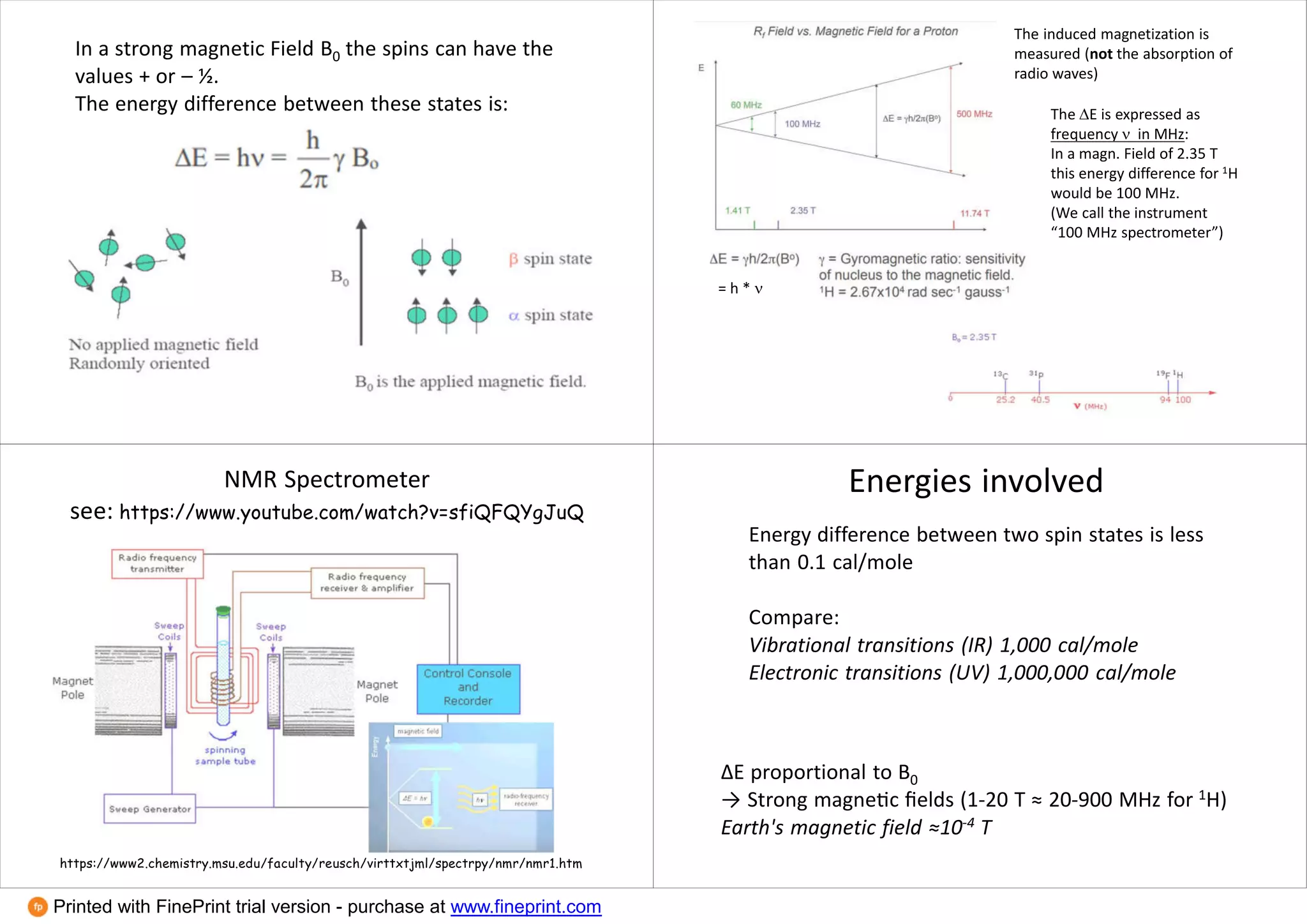
In a strong magnetic Field B0 the spins can have the
values + or – ½.
The energy difference between these states is: The E is expressed as
frequency  in MHz:
In a magn. Field of 2.35 T
this energy difference for 1H
would be 100 MHz.
(We call the instrument
“100 MHz spectrometer”)
The induced magnetization is
measured (not the absorption of
radio waves)
= h * 
NMR Spectrometer
see: https://www.youtube.com/watch?v=sfiQFQYgJuQ
https://www2.chemistry.msu.edu/faculty/reusch/virttxtjml/spectrpy/nmr/nmr1.htm
Energies involved
Energy difference between two spin states is less
than 0.1 cal/mole
Compare:
Vibrational transitions (IR) 1,000 cal/mole
Electronic transitions (UV) 1,000,000 cal/mole
∆E proportional to B0
→ Strong magne c fields (1-20 T ≈ 20-900 MHz for 1H)
Earth's magnetic field ≈10-4 T
Printed with FinePrint trial version - purchase at www.fineprint.com
RF Pulse Experiment
The sum of all
magn.moments is a vector
that rotates around B0
B1 as magn.field
perpendicular to B0
causes the
magn.moments to move
towards the y-axis
Fourier Transformation
All possible resonance frequencies are sent together
instead of going from slowly from low to high -
e.g. in the case of 4 different proton signals:
https://www2.chemaistry.msu.edu/faculty/reu
sch/virttxtjml/spectrpy/nmr/nmr2.htm#pulse
Printed with FinePrint trial version - purchase at www.fineprint.com
Chemical Shift δ
The magn.Field B0 also
affects the electrons moving
around the nucleus.
They will align with the B0
field, creating a local field
opposing B0 for the nucleus.
The nucleus is shielded by
the electrons.
Spin – Spin coupling
Spin Coupling
http://orgchem.colorado.edu/Spectroscopy/nmrthe
ory/splitting.html
Example
Printed with FinePrint trial version - purchase at www.fineprint.com
Calculate J (in Hz)
The coupling constant J must be independent of the
instrument (the used magnetic field):
Convert δ to Hz
Δδ = 0.07 ppm
The measuring frequency was 200 MHz
J = 0.07 1/106 x 200 MHz = 14 Hz
13C NMR
13C has I = ½; its natural abundance is 1.1%
• 13C sensitivity is only 1/5700 that of 1H
• 13C experiments require higher
concentrations and more scans/time
• S/N increases with square root of # of scans
1H coupled and de-coupled
How would the 13C NMR spectrum of:
CH3 – CH2 – CH - CH3
|
Br
look like with and without 1H-13C coupling ?
Step 1: identify how many different C atoms ?
Step 2: estimate chemical shift
Step 3: estimate coupling to adjacent protons.
Printed with FinePrint trial version - purchase at www.fineprint.com
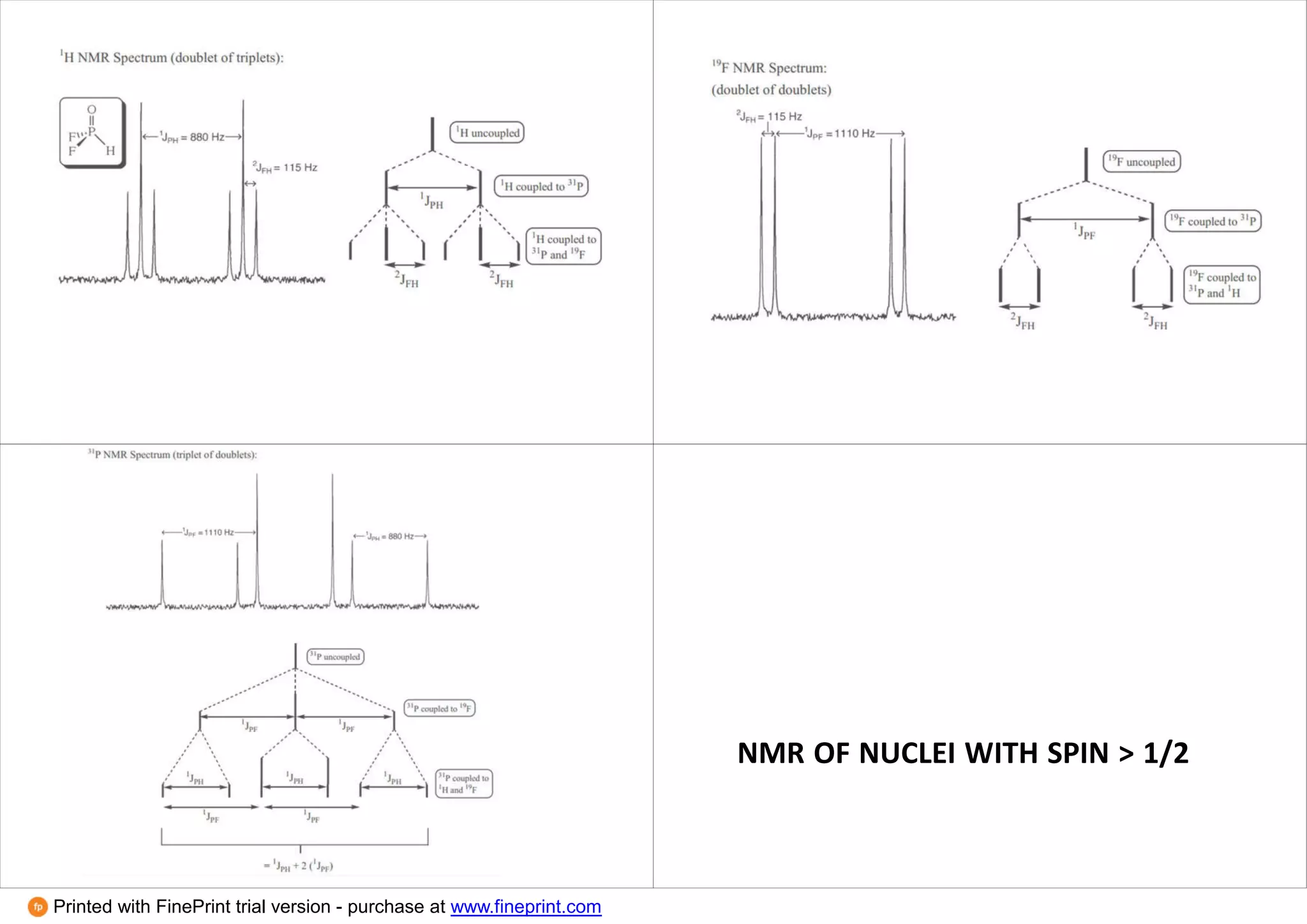
Exercise
How would the spectrum look like for
1H NMR
19F NMR
31P NMR
(all have I = ½)
Printed with FinePrint trial version - purchase at www.fineprint.com
NMR OF NUCLEI WITH SPIN > 1/2
Printed with FinePrint trial version - purchase at www.fineprint.com
Example 1: Compare CH4 and BH4
-
How would the 1H NMR spectra look like ?
 Consider that C has an NMR-active isotope 13C
 11B has a nuclear spin of 3/2
https://www.youtube.com/watch?v=x6lRDdR4Dj4
1H NMR of pure 13CH4
The protons are
equivalent but they
couple with the 13C
-> doublet
CH4 contains 1.1% of 13C -> coupling between the H
would result in a doublet
13C – 1H coupling
And a main peak in the middle from 1H alone
1H NMR of CH4
1.1% of the molecules have 13C -> doublet,
But 99% have no coupling
Printed with FinePrint trial version - purchase at www.fineprint.com
B has I = 3/2 => possible ml are 3/2, ½, -½ and -3/2
E
B0
l
4 possible spin orientations
 3 possible transitions
(in a 11B NMR spectrum !)
 Δml = +/- 1
-3/2
+3/2
+1/2
-1/2
The 4 protons can interact with 4
different B spin states => quadruple
signal (4 peaks in 1H NMR)
https://www.youtube.com/watch?v=ApCTiSjKg5s
1H NMR of BH4
-
1H NMR of BH4
-
The 4 protons are equivalent – they couple with the 11B
Because 11B has 4 different energy states, we get a quartet
How about 11B NMR of BH4
- ?
The interactions of the B-spin with the 4 H-spins
The 4 protons can have 5 different total spins:
½ ½ ½ ½ Spin 2 -> 1 way
½ ½ ½ -½ Spin 1 -> 4 ways
½ ½ -½ -½ Spin 0 -> 6 ways
½ -½ -½ -½ Spin -1 -> 4 ways
-½ -½ -½ -½ Spin -2 -> 1 way
Splitting pattern by spin ½ nuclei
1
1 1
1 2 1
1 3 3 1
1 4 6 4 1
Number of peaks: 2 x I x n + 1
( = 2 x ½ x 4 +1 = 5 )
“Pascal triangle”
Printed with FinePrint trial version - purchase at www.fineprint.com
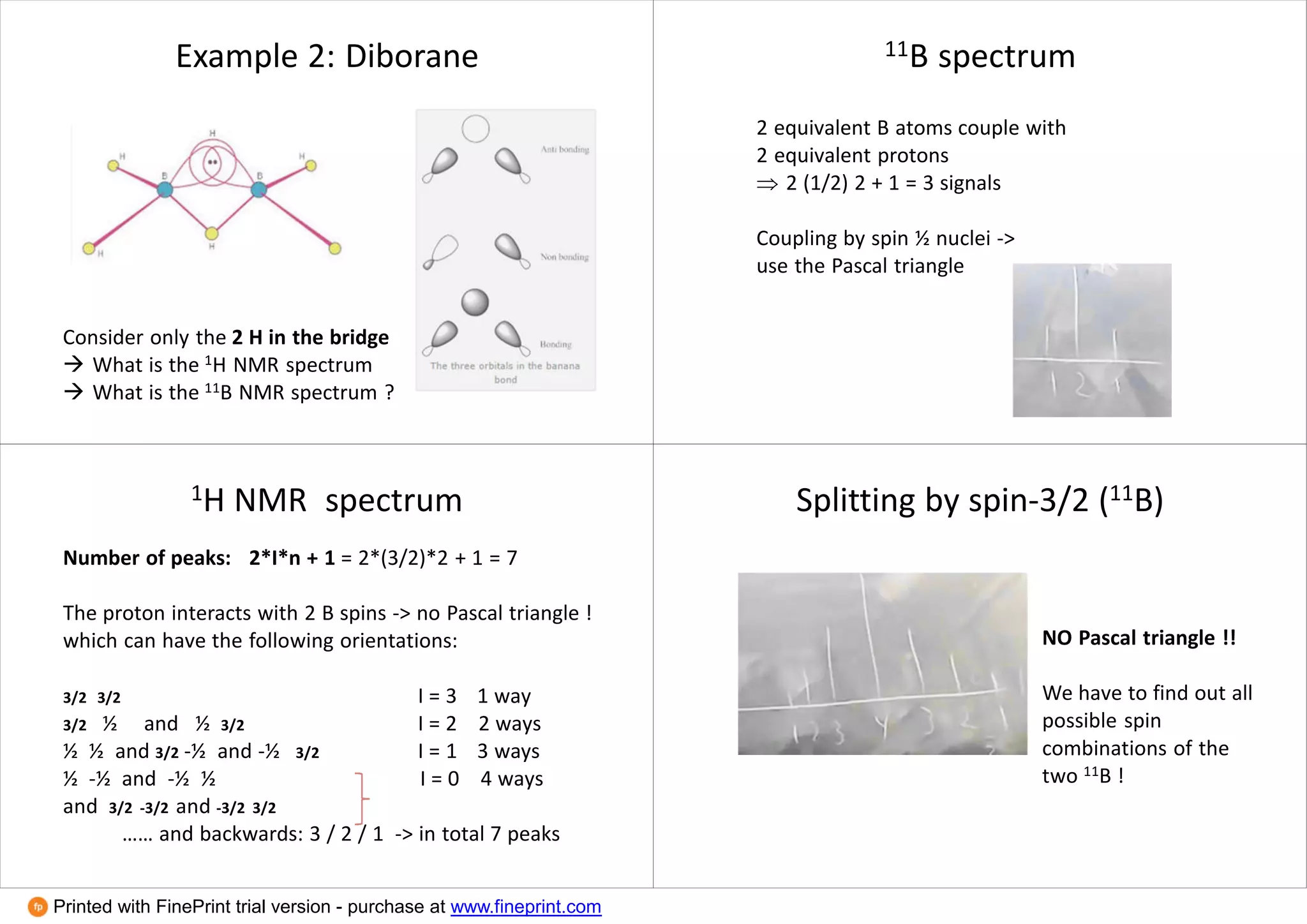
Example 2: Diborane
Consider only the 2 H in the bridge
 What is the 1H NMR spectrum
 What is the 11B NMR spectrum ?
11B spectrum
2 equivalent B atoms couple with
2 equivalent protons
 2 (1/2) 2 + 1 = 3 signals
Coupling by spin ½ nuclei ->
use the Pascal triangle
1H NMR spectrum
Number of peaks: 2*I*n + 1 = 2*(3/2)*2 + 1 = 7
The proton interacts with 2 B spins -> no Pascal triangle !
which can have the following orientations:
3/2 3/2 I = 3 1 way
3/2 ½ and ½ 3/2 I = 2 2 ways
½ ½ and 3/2 -½ and -½ 3/2 I = 1 3 ways
½ -½ and -½ ½ I = 0 4 ways
and 3/2 -3/2 and -3/2 3/2
…… and backwards: 3 / 2 / 1 -> in total 7 peaks
Splitting by spin-3/2 (11B)
NO Pascal triangle !!
We have to find out all
possible spin
combinations of the
two 11B !
Printed with FinePrint trial version - purchase at www.fineprint.com
How would the spectra change if
we had 3 bridging Hydrogens ?
19F NMR example (spin ½)
To calculate the coupling
constant J, we have to
convert the difference in
δ to Hz
Δδ = 0.07
The measuring
frequency was 282 MHz
J = 0.07 1/106 x 282 MHz
= 20 Hz
Printed with FinePrint trial version - purchase at www.fineprint.com
We refer this simply to
be a multiplet
Read the spectrum from left to right
Solid State NMR (SSNMR)
http://www.fhi-
berlin.mpg.de/acnew/department/pages/teaching/pages/teaching__wintersemester__2007_2
008/pelzer_nmr_301107.pdf
DYNAMIC NMR
Printed with FinePrint trial version - purchase at www.fineprint.com
Principle
How would the spectrum look like if the groups
A and B and “frozen” and if they can quickly
interchange ?
Example: Methanol
Printed with FinePrint trial version - purchase at www.fineprint.com
Example: Re Complex
Fast change in coordination of the
bidentate ligand at high T
-> only 2 groups of 1H atoms
At low T (< 0 deg) the exchange is
slow and 4 groups of 1H atoms can
be detected.
Printed with FinePrint trial version - purchase at www.fineprint.com

Nmr inorganic chemistry 2019 compact

  • 1.
    Spectroscopic Methods in InorganicChemistry Part 3: NMR Dr. Chris, August 2019 Rotating Charge produces a magnetic moment μ For ELECTRONS that means that molecules become dia- or paramagnetic. For the NUCLEUS it means that it gets a magnetic moment that can be adjusted to an outer magnetic field. The spin I of particles is QUANTIZISED, means it can only have certain values For the nucleus of elements, the spin depends on the number of protons and neutrons: Most important for NMR are elements with I = ½ For bigger I there is a quadrupole moment which affects the broadness of the peaks NMR active elements http://www.fhi- berlin.mpg.de/acnew/department/pages/teaching/pages/teaching__wintersemester__2007_2 008/pelzer_nmr_301107.pdf Printed with FinePrint trial version - purchase at www.fineprint.com
  • 2.
    In a strongmagnetic Field B0 the spins can have the values + or – ½. The energy difference between these states is: The E is expressed as frequency  in MHz: In a magn. Field of 2.35 T this energy difference for 1H would be 100 MHz. (We call the instrument “100 MHz spectrometer”) The induced magnetization is measured (not the absorption of radio waves) = h *  NMR Spectrometer see: https://www.youtube.com/watch?v=sfiQFQYgJuQ https://www2.chemistry.msu.edu/faculty/reusch/virttxtjml/spectrpy/nmr/nmr1.htm Energies involved Energy difference between two spin states is less than 0.1 cal/mole Compare: Vibrational transitions (IR) 1,000 cal/mole Electronic transitions (UV) 1,000,000 cal/mole ∆E proportional to B0 → Strong magne c fields (1-20 T ≈ 20-900 MHz for 1H) Earth's magnetic field ≈10-4 T Printed with FinePrint trial version - purchase at www.fineprint.com
  • 3.
    RF Pulse Experiment Thesum of all magn.moments is a vector that rotates around B0 B1 as magn.field perpendicular to B0 causes the magn.moments to move towards the y-axis Fourier Transformation All possible resonance frequencies are sent together instead of going from slowly from low to high - e.g. in the case of 4 different proton signals: https://www2.chemaistry.msu.edu/faculty/reu sch/virttxtjml/spectrpy/nmr/nmr2.htm#pulse Printed with FinePrint trial version - purchase at www.fineprint.com
  • 4.
    Chemical Shift δ Themagn.Field B0 also affects the electrons moving around the nucleus. They will align with the B0 field, creating a local field opposing B0 for the nucleus. The nucleus is shielded by the electrons. Spin – Spin coupling Spin Coupling http://orgchem.colorado.edu/Spectroscopy/nmrthe ory/splitting.html Example Printed with FinePrint trial version - purchase at www.fineprint.com
  • 5.
    Calculate J (inHz) The coupling constant J must be independent of the instrument (the used magnetic field): Convert δ to Hz Δδ = 0.07 ppm The measuring frequency was 200 MHz J = 0.07 1/106 x 200 MHz = 14 Hz 13C NMR 13C has I = ½; its natural abundance is 1.1% • 13C sensitivity is only 1/5700 that of 1H • 13C experiments require higher concentrations and more scans/time • S/N increases with square root of # of scans 1H coupled and de-coupled How would the 13C NMR spectrum of: CH3 – CH2 – CH - CH3 | Br look like with and without 1H-13C coupling ? Step 1: identify how many different C atoms ? Step 2: estimate chemical shift Step 3: estimate coupling to adjacent protons. Printed with FinePrint trial version - purchase at www.fineprint.com
  • 6.
    Exercise How would thespectrum look like for 1H NMR 19F NMR 31P NMR (all have I = ½) Printed with FinePrint trial version - purchase at www.fineprint.com
  • 7.
    NMR OF NUCLEIWITH SPIN > 1/2 Printed with FinePrint trial version - purchase at www.fineprint.com
  • 8.
    Example 1: CompareCH4 and BH4 - How would the 1H NMR spectra look like ?  Consider that C has an NMR-active isotope 13C  11B has a nuclear spin of 3/2 https://www.youtube.com/watch?v=x6lRDdR4Dj4 1H NMR of pure 13CH4 The protons are equivalent but they couple with the 13C -> doublet CH4 contains 1.1% of 13C -> coupling between the H would result in a doublet 13C – 1H coupling And a main peak in the middle from 1H alone 1H NMR of CH4 1.1% of the molecules have 13C -> doublet, But 99% have no coupling Printed with FinePrint trial version - purchase at www.fineprint.com
  • 9.
    B has I= 3/2 => possible ml are 3/2, ½, -½ and -3/2 E B0 l 4 possible spin orientations  3 possible transitions (in a 11B NMR spectrum !)  Δml = +/- 1 -3/2 +3/2 +1/2 -1/2 The 4 protons can interact with 4 different B spin states => quadruple signal (4 peaks in 1H NMR) https://www.youtube.com/watch?v=ApCTiSjKg5s 1H NMR of BH4 - 1H NMR of BH4 - The 4 protons are equivalent – they couple with the 11B Because 11B has 4 different energy states, we get a quartet How about 11B NMR of BH4 - ? The interactions of the B-spin with the 4 H-spins The 4 protons can have 5 different total spins: ½ ½ ½ ½ Spin 2 -> 1 way ½ ½ ½ -½ Spin 1 -> 4 ways ½ ½ -½ -½ Spin 0 -> 6 ways ½ -½ -½ -½ Spin -1 -> 4 ways -½ -½ -½ -½ Spin -2 -> 1 way Splitting pattern by spin ½ nuclei 1 1 1 1 2 1 1 3 3 1 1 4 6 4 1 Number of peaks: 2 x I x n + 1 ( = 2 x ½ x 4 +1 = 5 ) “Pascal triangle” Printed with FinePrint trial version - purchase at www.fineprint.com
  • 10.
    Example 2: Diborane Consideronly the 2 H in the bridge  What is the 1H NMR spectrum  What is the 11B NMR spectrum ? 11B spectrum 2 equivalent B atoms couple with 2 equivalent protons  2 (1/2) 2 + 1 = 3 signals Coupling by spin ½ nuclei -> use the Pascal triangle 1H NMR spectrum Number of peaks: 2*I*n + 1 = 2*(3/2)*2 + 1 = 7 The proton interacts with 2 B spins -> no Pascal triangle ! which can have the following orientations: 3/2 3/2 I = 3 1 way 3/2 ½ and ½ 3/2 I = 2 2 ways ½ ½ and 3/2 -½ and -½ 3/2 I = 1 3 ways ½ -½ and -½ ½ I = 0 4 ways and 3/2 -3/2 and -3/2 3/2 …… and backwards: 3 / 2 / 1 -> in total 7 peaks Splitting by spin-3/2 (11B) NO Pascal triangle !! We have to find out all possible spin combinations of the two 11B ! Printed with FinePrint trial version - purchase at www.fineprint.com
  • 11.
    How would thespectra change if we had 3 bridging Hydrogens ? 19F NMR example (spin ½) To calculate the coupling constant J, we have to convert the difference in δ to Hz Δδ = 0.07 The measuring frequency was 282 MHz J = 0.07 1/106 x 282 MHz = 20 Hz Printed with FinePrint trial version - purchase at www.fineprint.com
  • 12.
    We refer thissimply to be a multiplet Read the spectrum from left to right Solid State NMR (SSNMR) http://www.fhi- berlin.mpg.de/acnew/department/pages/teaching/pages/teaching__wintersemester__2007_2 008/pelzer_nmr_301107.pdf DYNAMIC NMR Printed with FinePrint trial version - purchase at www.fineprint.com
  • 13.
    Principle How would thespectrum look like if the groups A and B and “frozen” and if they can quickly interchange ? Example: Methanol Printed with FinePrint trial version - purchase at www.fineprint.com
  • 14.
    Example: Re Complex Fastchange in coordination of the bidentate ligand at high T -> only 2 groups of 1H atoms At low T (< 0 deg) the exchange is slow and 4 groups of 1H atoms can be detected. Printed with FinePrint trial version - purchase at www.fineprint.com