Presented By-
Swapnali Borah
M.Sc 4th Semester
Roll No. 17
1. Concerted, or three‐center, oxidative addition mechanism
2. SN2 mechanism
3. Radical mechanisms
4. Ionic Mechanisms
Introduction
Conditions for oxidative addition
Characteristics of oxidative addition
Examples
Mechanisms-
Applications
Conclusion
References
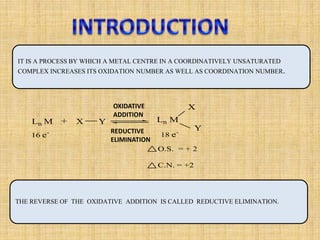
IT IS A PROCESS BY WHICH A METAL CENTRE IN A COORDINATIVELY UNSATURATED
COMPLEX INCREASES ITS OXIDATION NUMBER AS WELL AS COORDINATION NUMBER.
Ln M + X Y Ln M
X
Y
16 e- 18 e-
O.S. = + 2
C.N. = +2
THE REVERSE OF THE OXIDATIVE ADDITION IS CALLED REDUCTIVE ELIMINATION.
OXIDATIVE
ADDITION
REDUCTIVE
ELIMINATION
• Metal must possess non-bonding electron pair.
• The complex must be co-ordinatively
unsaturated.
• Suitable orbitals should be available.
• The higher oxidation state of the metal should
be energetically accessible and stable.
• Two new anionic ligands are added.
• Coordination number increases by two units.
• Oxidation number increases by two units.
• The oxidation state of the metal is low.
• The more electron rich the metal, the more
the addition becomes easier.
• The substrate behaves both as a Lewis acid
and a Lewis base.
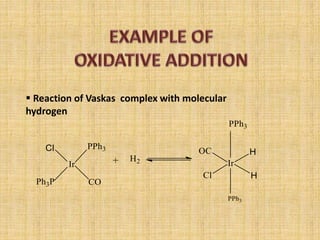
 Reaction of Vaskas complex with molecular
hydrogen
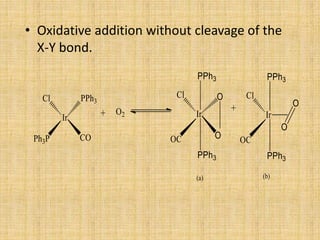
• Oxidative addition without cleavage of the
X-Y bond.
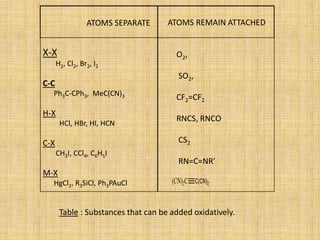
X-X
H2, Cl2, Br2, I2
C-C
Ph3C-CPh3, MeC(CN)3
H-X
HCl, HBr, HI, HCN
C-X
CH3I, CCl4, C6H5I
M-X
HgCl2, R3SiCl, Ph3PAuCl
ATOMS SEPARATE ATOMS REMAIN ATTACHED
O2,
SO2,
CF2=CF2
RNCS, RNCO
CS2
RN=C=NR’
Table : Substances that can be added oxidatively.
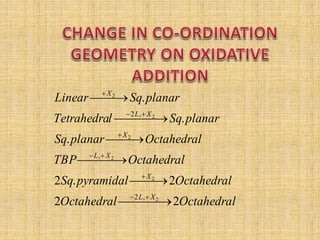
OctahedralOctahedral
OctahedralpyramidalSq
OctahedralTBP
OctahedralplanarSq
planarSqlTetrahedra
planarSqLinear
XL
X
XL
X
XL
X
22
2.2
.
.
.
2
2
2
2
2
2
,2
,
,2
 

 

 







MECHANISM OF OXIDATIVE ADDITION
 There are four mechanisms :
o Concerted or three-centered
o SN2
o Radical
o Ionic
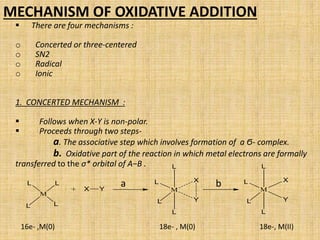
1. CONCERTED MECHANISM :
 Follows when X-Y is non-polar.
 Proceeds through two steps-
a. The associative step which involves formation of a Ϭ- complex.
b. Oxidative part of the reaction in which metal electrons are formally
transferred to the σ* orbital of A−B .
16e- ,M(0) 18e- , M(0) 18e-, M(II)
a b
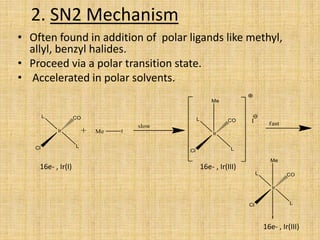
2. SN2 Mechanism
• Often found in addition of polar ligands like methyl,
allyl, benzyl halides.
• Proceed via a polar transition state.
• Accelerated in polar solvents.
16e- , Ir(I) 16e- , Ir(III)
16e- , Ir(III)
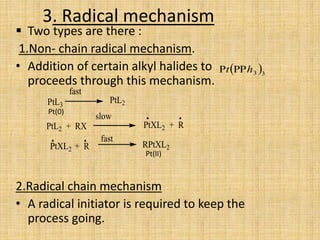
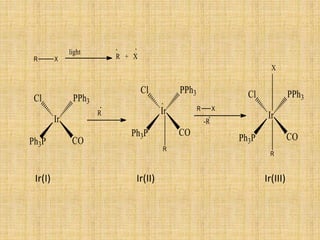
3. Radical mechanism
 Two types are there :
1.Non- chain radical mechanism.
• Addition of certain alkyl halides to
proceeds through this mechanism.
2.Radical chain mechanism
• A radical initiator is required to keep the
process going.
PtL3
fast
PtL2
PtL2 + RX
slow
PtXL2 + R
PtXL2 + R
fast
RPtXL2
 33ht 
.
..
Pt(II)
Pt(0)
.
Ir(I) Ir(II) Ir(III)
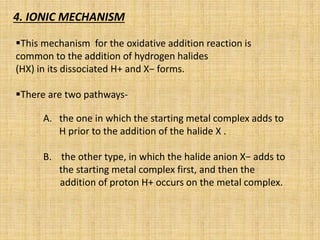
A. the one in which the starting metal complex adds to
H prior to the addition of the halide X .
B. the other type, in which the halide anion X− adds to
the starting metal complex first, and then the
addition of proton H+ occurs on the metal complex.
4. IONIC MECHANISM
This mechanism for the oxidative addition reaction is
common to the addition of hydrogen halides
(HX) in its dissociated H+ and X− forms.
There are two pathways-
   233343 )()()( 33
PRHPtClPRHPtClHPRPt PRPR
   
     
  222 )()()( ClLcodHIr
fast
LcodIrClClHLcodIr slow
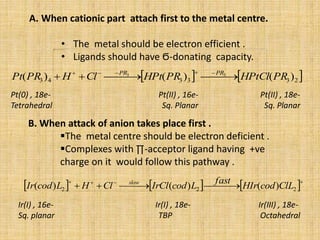
A. When cationic part attach first to the metal centre.
• The metal should be electron efficient .
• Ligands should have Ϭ-donating capacity.
Pt(0) , 18e- Pt(II) , 16e- Pt(II) , 18e-
Tetrahedral Sq. Planar Sq. Planar
B. When attack of anion takes place first .
The metal centre should be electron deficient .
Complexes with ∏-acceptor ligand having +ve
charge on it would follow this pathway .
Ir(I) , 16e- Ir(I) , 18e- Ir(III) , 18e-
Sq. planar TBP Octahedral
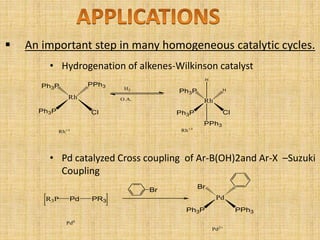
 An important step in many homogeneous catalytic cycles.
• Hydrogenation of alkenes-Wilkinson catalyst
• Pd catalyzed Cross coupling of Ar-B(OH)2and Ar-X –Suzuki
Coupling
R3P Pd PR3
Br
Pd
Br
Ph3P PPh3
Pd0
Pd2+
 Thus, both O. A. and R. E. are important processes in
organometallics and catalytic chemistry of transition metal
complexes.
 O. A. is more prominent in case of metal complexes with
low oxidation state. Reverse case applies in R.E.
 O.A. is accompanied by increase in oxidation number and
coordination number
 Oxidation number, coordination number of the metal
increases in O.A. ,vice versa in R.E.
 In both the processes, stereochemical aspects also holds
importance.
 Advanced Inorganic Chemistry,13th Edition, Vol ||, Gurdeep Raj, 837-844, 2012,
KRISHNA Prakashan Media Pvt. Ltd.
 Inorganic Chemistry, 3rd Edition,Gary L. Miessler, Donald A. Tarr, 534-536, 2015,
Pearson India Education Services Pvt. Ltd.
 Inorganic Chemistry, 4th Edition, James E. Huheey, Ellen A. Keiter, Richard L.
Keiter, Okhil K. Medhi, 637-642, 2013, Dorling Kindersley ( India ) Pvt. Ltd.
 Advanced Inorganic Chemistry, 3rd Edition, F. A. Cotton, G. Wilkinson, 772-774,
1972, John Wiley & Sons, Inc.
 Michael S. Driver, John F. Hartwig, Organometallics, vol. 17, Issue 6, 1134-1143,
1998.
 Colin Eaborn, Kalipada Kundu, Alan Pidcock, Journal of Chemical Society, 5, 1223-
1232, 1981.
 https://doi.org/10.1021%2Facs.organomet.5b00565
Oxidative addition

Oxidative addition

  • 1.
    Presented By- Swapnali Borah M.Sc4th Semester Roll No. 17
  • 2.
    1. Concerted, orthree‐center, oxidative addition mechanism 2. SN2 mechanism 3. Radical mechanisms 4. Ionic Mechanisms Introduction Conditions for oxidative addition Characteristics of oxidative addition Examples Mechanisms- Applications Conclusion References
  • 3.
    IT IS APROCESS BY WHICH A METAL CENTRE IN A COORDINATIVELY UNSATURATED COMPLEX INCREASES ITS OXIDATION NUMBER AS WELL AS COORDINATION NUMBER. Ln M + X Y Ln M X Y 16 e- 18 e- O.S. = + 2 C.N. = +2 THE REVERSE OF THE OXIDATIVE ADDITION IS CALLED REDUCTIVE ELIMINATION. OXIDATIVE ADDITION REDUCTIVE ELIMINATION
  • 4.
    • Metal mustpossess non-bonding electron pair. • The complex must be co-ordinatively unsaturated. • Suitable orbitals should be available. • The higher oxidation state of the metal should be energetically accessible and stable.
  • 5.
    • Two newanionic ligands are added. • Coordination number increases by two units. • Oxidation number increases by two units. • The oxidation state of the metal is low. • The more electron rich the metal, the more the addition becomes easier. • The substrate behaves both as a Lewis acid and a Lewis base.
  • 6.
     Reaction ofVaskas complex with molecular hydrogen
  • 7.
    • Oxidative additionwithout cleavage of the X-Y bond.
  • 8.
    X-X H2, Cl2, Br2,I2 C-C Ph3C-CPh3, MeC(CN)3 H-X HCl, HBr, HI, HCN C-X CH3I, CCl4, C6H5I M-X HgCl2, R3SiCl, Ph3PAuCl ATOMS SEPARATE ATOMS REMAIN ATTACHED O2, SO2, CF2=CF2 RNCS, RNCO CS2 RN=C=NR’ Table : Substances that can be added oxidatively.
  • 9.
  • 10.
    MECHANISM OF OXIDATIVEADDITION  There are four mechanisms : o Concerted or three-centered o SN2 o Radical o Ionic 1. CONCERTED MECHANISM :  Follows when X-Y is non-polar.  Proceeds through two steps- a. The associative step which involves formation of a Ϭ- complex. b. Oxidative part of the reaction in which metal electrons are formally transferred to the σ* orbital of A−B . 16e- ,M(0) 18e- , M(0) 18e-, M(II) a b
  • 11.
    2. SN2 Mechanism •Often found in addition of polar ligands like methyl, allyl, benzyl halides. • Proceed via a polar transition state. • Accelerated in polar solvents. 16e- , Ir(I) 16e- , Ir(III) 16e- , Ir(III)
  • 12.
    3. Radical mechanism Two types are there : 1.Non- chain radical mechanism. • Addition of certain alkyl halides to proceeds through this mechanism. 2.Radical chain mechanism • A radical initiator is required to keep the process going. PtL3 fast PtL2 PtL2 + RX slow PtXL2 + R PtXL2 + R fast RPtXL2  33ht  . .. Pt(II) Pt(0) .
  • 13.
  • 14.
    A. the onein which the starting metal complex adds to H prior to the addition of the halide X . B. the other type, in which the halide anion X− adds to the starting metal complex first, and then the addition of proton H+ occurs on the metal complex. 4. IONIC MECHANISM This mechanism for the oxidative addition reaction is common to the addition of hydrogen halides (HX) in its dissociated H+ and X− forms. There are two pathways-
  • 15.
      233343 )()()( 33 PRHPtClPRHPtClHPRPt PRPR             222 )()()( ClLcodHIr fast LcodIrClClHLcodIr slow A. When cationic part attach first to the metal centre. • The metal should be electron efficient . • Ligands should have Ϭ-donating capacity. Pt(0) , 18e- Pt(II) , 16e- Pt(II) , 18e- Tetrahedral Sq. Planar Sq. Planar B. When attack of anion takes place first . The metal centre should be electron deficient . Complexes with ∏-acceptor ligand having +ve charge on it would follow this pathway . Ir(I) , 16e- Ir(I) , 18e- Ir(III) , 18e- Sq. planar TBP Octahedral
  • 16.
     An importantstep in many homogeneous catalytic cycles. • Hydrogenation of alkenes-Wilkinson catalyst • Pd catalyzed Cross coupling of Ar-B(OH)2and Ar-X –Suzuki Coupling R3P Pd PR3 Br Pd Br Ph3P PPh3 Pd0 Pd2+
  • 17.
     Thus, bothO. A. and R. E. are important processes in organometallics and catalytic chemistry of transition metal complexes.  O. A. is more prominent in case of metal complexes with low oxidation state. Reverse case applies in R.E.  O.A. is accompanied by increase in oxidation number and coordination number  Oxidation number, coordination number of the metal increases in O.A. ,vice versa in R.E.  In both the processes, stereochemical aspects also holds importance.
  • 18.
     Advanced InorganicChemistry,13th Edition, Vol ||, Gurdeep Raj, 837-844, 2012, KRISHNA Prakashan Media Pvt. Ltd.  Inorganic Chemistry, 3rd Edition,Gary L. Miessler, Donald A. Tarr, 534-536, 2015, Pearson India Education Services Pvt. Ltd.  Inorganic Chemistry, 4th Edition, James E. Huheey, Ellen A. Keiter, Richard L. Keiter, Okhil K. Medhi, 637-642, 2013, Dorling Kindersley ( India ) Pvt. Ltd.  Advanced Inorganic Chemistry, 3rd Edition, F. A. Cotton, G. Wilkinson, 772-774, 1972, John Wiley & Sons, Inc.  Michael S. Driver, John F. Hartwig, Organometallics, vol. 17, Issue 6, 1134-1143, 1998.  Colin Eaborn, Kalipada Kundu, Alan Pidcock, Journal of Chemical Society, 5, 1223- 1232, 1981.  https://doi.org/10.1021%2Facs.organomet.5b00565